Recognition: unknown
Real-Time Cellist Postural Evaluation With On-Device Computer Vision
Pith reviewed 2026-05-10 05:34 UTC · model grok-4.3
The pith
The Cello Evaluator app gives cellists real-time posture feedback using computer vision that runs on any current Android phone.
A machine-rendered reading of the paper's core claim, the machinery that carries it, and where it could break.
Core claim
We present Cello Evaluator, a real-time postural feedback system for practicing cellists. Through this optimization for on-device computer vision inference, we provide access to cellist postural evaluation to anyone with a current generation Android phone and thus reduces the postural feedback voids within individual practice.
What carries the argument
On-device computer vision models optimized for real-time Android inference that detect and score cellist-specific posture issues.
Load-bearing premise
The computer vision models running on ordinary Android phones can detect and rate cellist posture problems accurately enough to give useful real-time guidance.
What would settle it
A side-by-side test in which the app's posture ratings are compared with ratings from professional cellists watching the same video recordings of practice sessions.
Figures




read the original abstract
Posture is a critical factor for beginning instrumental learners. Most students receive instruction only once a week, and during the intervals between lessons they have little or no feedback on their physical posture. As a result, posture often deteriorates, increasing the risk of musculoskeletal injury and inefficient technique. Recent advances in computer vision and machine learning make it possible to evaluate posture without the constant presence of a human expert. However, current solutions have been extremely limited in availability and convenience due to their reliance on computationally expensive hardware or multi-sensor setups. We present Cello Evaluator, a real-time postural feedback system for practicing cellists. Through this optimization for on-device computer vision inference, we provide access to cellist postural evaluation to anyone with a current generation Android phone and thus reduces the postural feedback voids within individual practice. To validate our mobile application, we conduct a heuristic evaluation consisting of cellist and UX experts. Overall feedback from the evaluation found the app to be user friendly and helpful.
Editorial analysis
A structured set of objections, weighed in public.
Referee Report
Summary. The paper presents Cello Evaluator, a mobile Android application that performs real-time cellist postural evaluation using on-device computer vision. It argues that this addresses gaps in feedback during individual practice sessions, reducing injury risk and improving technique. Validation consists of a heuristic evaluation with cellist and UX experts, who rated the app as user-friendly and helpful overall.
Significance. If the underlying posture detection were shown to be accurate and low-latency, the work would offer a practical, accessible tool for musicians that leverages commodity hardware. The on-device focus is a positive engineering choice that could broaden access compared to cloud or multi-sensor systems. However, the absence of any technical performance data means the significance of the postural evaluation component cannot yet be assessed.
major comments (3)
- [Evaluation] Evaluation section (and abstract): The heuristic evaluation reports only qualitative expert opinions on usability and helpfulness. No quantitative metrics are supplied for the core claim of accurate postural evaluation, such as precision/recall for posture keypoints, agreement with expert-labeled ground truth on cello-specific issues (e.g., shoulder position, wrist angle), or false-positive rates for feedback triggers.
- [Implementation] Implementation / Methods: No description is given of the computer vision model (e.g., MediaPipe, OpenPose, or custom), any fine-tuning or dataset used for cellist postures, on-device optimization steps (quantization, model size), or inference pipeline. Without these, the feasibility of real-time on-device operation on standard Android hardware cannot be evaluated.
- [Results] Results / Claims: The abstract and introduction assert real-time performance and reduction of 'postural feedback voids,' yet no latency measurements (ms per frame), hardware specifications tested, or accuracy benchmarks appear. This leaves the central engineering claim unsupported.
minor comments (2)
- [Introduction] The abstract and introduction would benefit from a brief comparison table or citations to prior posture-detection systems in music education or general HCI to clarify novelty.
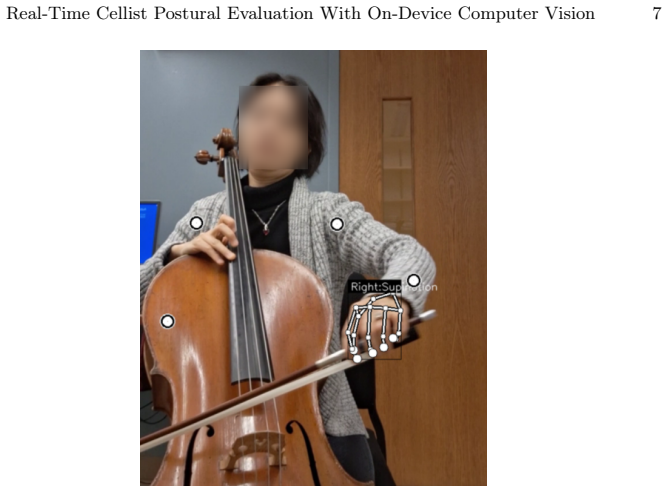
- [Figures] If figures of the UI or detected keypoints exist, ensure they include example outputs with overlaid feedback to illustrate the system's behavior.
Simulated Author's Rebuttal
We thank the referee for their constructive and detailed comments, which highlight important areas for strengthening the technical aspects of the manuscript. We address each major comment below and outline the revisions we will make.
read point-by-point responses
-
Referee: [Evaluation] Evaluation section (and abstract): The heuristic evaluation reports only qualitative expert opinions on usability and helpfulness. No quantitative metrics are supplied for the core claim of accurate postural evaluation, such as precision/recall for posture keypoints, agreement with expert-labeled ground truth on cello-specific issues (e.g., shoulder position, wrist angle), or false-positive rates for feedback triggers.
Authors: We agree that quantitative accuracy metrics for the posture detection would strengthen the claims regarding effective postural evaluation. As this is an HCI-focused paper presenting an integrated mobile application rather than a novel computer vision algorithm, the evaluation centered on a heuristic assessment of usability and helpfulness with cellist and UX experts, following standard practices for prototype systems. The detection relies on off-the-shelf on-device models without cello-specific fine-tuning or ground-truth labeling in this work. In revision, we will expand the Evaluation and Discussion sections to explicitly note this limitation, qualify the claims about postural evaluation accuracy, and suggest directions for future quantitative validation studies. revision: partial
-
Referee: [Implementation] Implementation / Methods: No description is given of the computer vision model (e.g., MediaPipe, OpenPose, or custom), any fine-tuning or dataset used for cellist postures, on-device optimization steps (quantization, model size), or inference pipeline. Without these, the feasibility of real-time on-device operation on standard Android hardware cannot be evaluated.
Authors: We acknowledge the omission of implementation details and will revise the Methods section to include a complete description of the computer vision pipeline. This will cover the specific model used, any adaptations for cellist postures (including whether fine-tuning or a dedicated dataset was applied), on-device optimizations such as quantization and model size, and the end-to-end inference pipeline to allow assessment of real-time feasibility on standard Android hardware. revision: yes
-
Referee: [Results] Results / Claims: The abstract and introduction assert real-time performance and reduction of 'postural feedback voids,' yet no latency measurements (ms per frame), hardware specifications tested, or accuracy benchmarks appear. This leaves the central engineering claim unsupported.
Authors: We agree that explicit performance benchmarks are needed to support the real-time and accessibility claims. While the system was implemented and tested to run in real time on current Android devices, specific quantitative results were not reported in the initial submission. In the revision, we will add a Results subsection with latency measurements (e.g., ms per frame), the hardware specifications of devices tested, and any available accuracy-related observations to substantiate the engineering claims. revision: yes
Circularity Check
No derivations, predictions, or self-referential steps; straightforward engineering with external heuristic validation
full rationale
The paper presents an on-device CV mobile app for cellist posture feedback and validates it via a heuristic evaluation by cellist and UX experts. No equations, fitted parameters, predictions, or derivation chains appear. The validation is an independent external assessment rather than a self-referential fit or self-citation. This matches the default expectation of no significant circularity for applied engineering work.
Axiom & Free-Parameter Ledger
Reference graph
Works this paper leans on
-
[1]
Amershi, S., Weld, D., Vorvoreanu, M., Fourney, A., Nushi, B., Collisson, P., Suh, J., Iqbal, S., Bennett, P.N., Inkpen, K., Teevan, J., Kikin-Gil, R., Horvitz, E.: Guidelinesforhuman-aiinteraction.In:Proceedingsofthe2019CHIConferenceon Human Factors in Computing Systems. p. 1–13. CHI ’19, Association for Comput- ing Machinery, New York, NY, USA (2019).ht...
-
[2]
Bradski, G.: The opencv library. Dr. Dobb’s Journal of Software Tools (2000)
2000
- [3]
-
[4]
SAM 3: Segment Anything with Concepts
Carion, N., Gustafson, L., Hu, Y.T., Debnath, S., Hu, R., Suris, D., Ryali, C., Alwala, K.V., Khedr, H., Huang, A., Lei, J., Ma, T., Guo, B., Kalla, A., Marks, M., Greer, J., Wang, M., Sun, P., Rädle, R., Afouras, T., Mavroudi, E., Xu, K., Wu, T.H., Zhou, Y., Momeni, L., Hazra, R., Ding, S., Vaze, S., Porcher, F., Li, F., Li, S., Kamath, A., Cheng, H.K., ...
work page internal anchor Pith review Pith/arXiv arXiv 2025
-
[5]
Journal of Sport and Health Research4, 23–34 (10 2011)
Figueres, J., Perez-Soriano, P., Belloch, S., Figueres, E.: Injuries prevention in string players. Journal of Sport and Health Research4, 23–34 (10 2011)
2011
-
[6]
Heinan, M.: A review of the unique injuries sustained by musicians. JAAPA: official journal of the American Academy of Physician Assistants21(4) (2008).https: //doi.org/10.1097/01720610-200804000-00015
-
[7]
Howard, A.G., Zhu, M., Chen, B., Kalenichenko, D., Wang, W., Weyand, T., An- dreetto, M., Adam, H.: Mobilenets: Efficient convolutional neural networks for mobile vision applications (2017),https://arxiv.org/abs/1704.04861
work page internal anchor Pith review arXiv 2017
-
[8]
Computer Music Journal43(1), 59–78 (2020).https://doi
Johnson, D., Damian, D., Tzanetakis, G.: Detecting hand posture in piano playing using depth data. Computer Music Journal43(1), 59–78 (2020).https://doi. org/10.1162/comj_a_00500
-
[9]
Khanam, R., Hussain, M.: Yolov11: An overview of the key architectural enhance- ments (2024),https://arxiv.org/abs/2410.17725 20 Wang et al
work page internal anchor Pith review arXiv 2024
-
[10]
Lugaresi, C., Tang, J., Nash, H., McClanahan, C., Uboweja, E., Hays, M., Zhang, F., Chang, C.L., Yong, M.G., Lee, J., Chang, W.T., Hua, W., Georg, M., Grund- mann, M.: Mediapipe: A framework for building perception pipelines (2019), https://arxiv.org/abs/1906.08172
work page internal anchor Pith review arXiv 2019
-
[11]
com/articles/ten-usability-heuristics/(1994), accessed: 2026-01-20
Nielsen, J.: 10 usability heuristics for user interface design.https://www.nngroup. com/articles/ten-usability-heuristics/(1994), accessed: 2026-01-20
1994
-
[12]
Nielsen, J., Molich, R.: Heuristic evaluation of user interfaces. In: Proceedings of theSIGCHIConferenceonHumanFactorsinComputingSystems.p.249–256.CHI ’90, Association for Computing Machinery, New York, NY, USA (1990).https: //doi.org/10.1145/97243.97281,https://doi.org/10.1145/97243.97281
- [14]
-
[15]
Scientific Reports10, 13882 (08 2020)
Rozé, J., Aramaki, M., Kronland-Martinet, R., Ystad, S.: Cellists’ sound quality is shaped by their primary postural behavior. Scientific Reports10, 13882 (08 2020). https://doi.org/10.1038/s41598-020-70705-8
- [16]
-
[17]
Tian, Y., Ye, Q., Doermann, D.: Yolov12: Attention-centric real-time object detec- tors (2025),https://arxiv.org/abs/2502.12524
work page internal anchor Pith review arXiv 2025
-
[18]
Empowering edge intelligence: A comprehensive survey on on-device ai models,
Wang, X., Tang, Z., Guo, J., Meng, T., Wang, C., Wang, T., Jia, W.: Empowering edgeintelligence:Acomprehensivesurveyonon-deviceaimodels.ACMComputing Surveys57(9), 1–39 (Apr 2025).https://doi.org/10.1145/3724420,http://dx. doi.org/10.1145/3724420
-
[19]
Wu, Y., Kirillov, A., Massa, F., Lo, W.Y., Girshick, R.: Detectron2.https:// github.com/facebookresearch/detectron2(2019), computer software
2019
-
[20]
Molecular & Cellular Biome- chanics22, 762 (01 2025).https://doi.org/10.62617/mcb762
Yang, P.: Integrating intelligent algorithms in music education to analyze and im- prove posture and motion in instrumental training. Molecular & Cellular Biome- chanics22, 762 (01 2025).https://doi.org/10.62617/mcb762
- [21]
- [22]
- [23]
discussion (0)
Sign in with ORCID, Apple, or X to comment. Anyone can read and Pith papers without signing in.