Recognition: unknown
Photocurrent at oblique illumination and reconstruction of wavefront direction with 2d photodetectors
Pith reviewed 2026-05-10 05:19 UTC · model grok-4.3
The pith
Symmetric metal-2DES junctions generate zero-bias photocurrent under oblique illumination and enable reconstruction of the light incidence direction.
A machine-rendered reading of the paper's core claim, the machinery that carries it, and where it could break.
Core claim
In metal-contacted 2D electron systems, spatial variations in the phase of obliquely incident light lead to strong variations in local field amplitude at opposite junctions. This results in dissimilar absorbances and a finite zero-bias photocurrent whose direction indicates the quadrant of incidence. Under conditions of 2D plasmon resonance accessed by varying carrier density, the amplitude of asymmetrically excited plasmon modes carries unique information about the precise angle of incidence.
What carries the argument
Phase-to-amplitude conversion at metal-2DES junctions, which produces asymmetric local absorption independent of the rectification mechanism.
Load-bearing premise
Spatial variations of the incident field phase translate into strong variations of local field amplitude at the two opposite metal-2DES junctions, producing dissimilar local absorbances independent of the microscopic rectification mechanism.
What would settle it
A measurement showing zero net photocurrent or symmetric responses from opposite junctions under oblique illumination would falsify the directional reconstruction capability.
Figures


read the original abstract
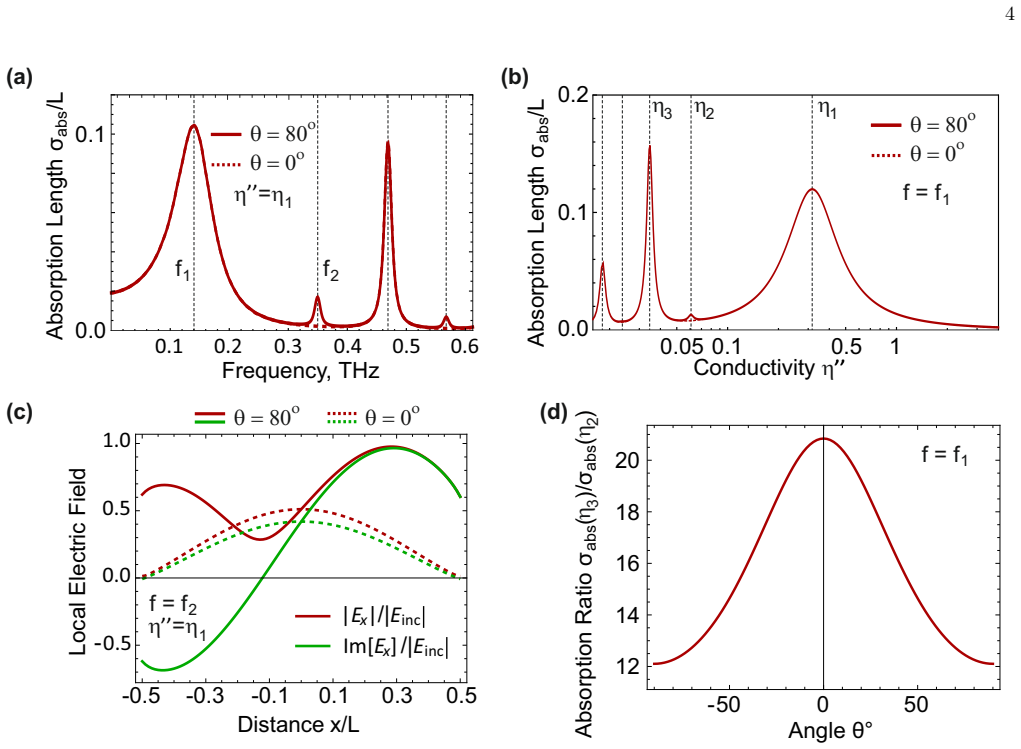
Many contemporary photodetectors operate beyond the readout of light intensity and enable the reconstruction of spectrum and polarization at the single-pixel level. However, the determination of light incidence direction with reconstructive detectors has not been realized so far. We show that photodetectors based on symmetric junctions of metals and 2d electron systems (2DES) enable (1) zero-bias photocurrent at oblique light incidence (2) reconstruction of incidence direction based on photocurrent measurements at variable carrier density. The former effect is based on peculiar electrodynamics of metal-contacted 2DES, where spatial variations of incident field phase translate into strong variations of local field amplitude. The local absorbances at two opposite metal-2DES junctions at oblique incidence are dissimilar, which results in finite photocurrent independent of microscopic rectification mechanism at these junctions. The direction of photocurrent uniquely determines the quadrant of light incidence. Quantitative determination of incidence angle becomes possible under conditions of 2d plasmon resonance at variable carrier density. In such a case, obliquely incident radiation excites the asymmetric plasmon modes, which amplitude carries unique information about angle of incidence.
Editorial analysis
A structured set of objections, weighed in public.
Referee Report
Summary. The manuscript claims that symmetric metal-2DES junctions enable zero-bias photocurrent under oblique illumination because a phase gradient across the device produces unequal local field amplitudes (and thus absorbances) at the two opposite junctions; the resulting net current direction encodes the incidence quadrant. It further claims that photocurrent measurements while tuning carrier density through the 2D plasmon resonance allow quantitative reconstruction of the incidence angle via the amplitude of excited asymmetric plasmon modes.
Significance. If experimentally validated, the approach would provide a compact, single-pixel method for wavefront-direction sensing that does not rely on additional optics or multiple detectors, extending the functionality of 2DES-based photodetectors beyond intensity, spectrum, and polarization. The use of carrier-density tuning to access angle information via plasmon resonance is a potentially powerful and tunable feature.
major comments (2)
- [Abstract] Abstract and main text: the central claim that spatial phase variations produce 'strong variations of local field amplitude' at the two junctions (independent of rectification mechanism) is presented only qualitatively; no electrodynamic model, boundary-condition treatment, or explicit calculation of the local |E| asymmetry is supplied, leaving the load-bearing step unverified.
- [Abstract] The reconstruction protocol: the statement that 'obliquely incident radiation excites the asymmetric plasmon modes, which amplitude carries unique information about angle of incidence' is asserted without equations relating plasmon amplitude to incidence angle, without simulated or measured photocurrent-vs-density curves, and without error analysis, so the quantitative claim cannot be assessed.
minor comments (2)
- [Abstract] The phrase 'peculiar electrodynamics' is imprecise; replace with a concise reference to the relevant boundary conditions or prior literature on metal-2DES interfaces.
- [Abstract] No device schematic, illumination geometry, or contact configuration is described; a figure or brief paragraph would clarify how the two opposite junctions are defined.
Simulated Author's Rebuttal
We thank the referee for the careful reading and constructive comments. We agree that the manuscript would benefit from more explicit quantitative support for the central claims and will revise accordingly.
read point-by-point responses
-
Referee: [Abstract] Abstract and main text: the central claim that spatial phase variations produce 'strong variations of local field amplitude' at the two junctions (independent of rectification mechanism) is presented only qualitatively; no electrodynamic model, boundary-condition treatment, or explicit calculation of the local |E| asymmetry is supplied, leaving the load-bearing step unverified.
Authors: We agree that the presentation in the submitted manuscript is qualitative. In the revision we will add an electrodynamic model section deriving the local field amplitudes from the incident phase gradient. This will include boundary conditions at the metal-2DES interfaces, explicit calculation of the |E| asymmetry using the 2DES conductivity tensor, and numerical field profiles confirming the effect is independent of the microscopic rectification mechanism. revision: yes
-
Referee: [Abstract] The reconstruction protocol: the statement that 'obliquely incident radiation excites the asymmetric plasmon modes, which amplitude carries unique information about angle of incidence' is asserted without equations relating plasmon amplitude to incidence angle, without simulated or measured photocurrent-vs-density curves, and without error analysis, so the quantitative claim cannot be assessed.
Authors: We acknowledge the need for quantitative detail. The revised manuscript will include the governing equations for asymmetric plasmon excitation under oblique incidence (phase difference δ = (2π/λ) d sinθ), simulated photocurrent-versus-density curves for multiple angles derived from the plasmon dispersion relation, and an error analysis based on realistic measurement noise and tuning precision to demonstrate uniqueness of the angle reconstruction. revision: yes
Circularity Check
No significant circularity
full rationale
The paper's derivation rests on the electrodynamics of oblique incidence creating a phase gradient across symmetric metal-2DES junctions, which produces unequal local field amplitudes and thus dissimilar absorbances. This yields net zero-bias photocurrent whose sign maps to incidence quadrant, independent of the microscopic rectification process. Quantitative angle extraction is enabled by tuning through 2D plasmon resonance via carrier density, which supplies an independent experimental knob rather than a fitted parameter. No equations, self-citations, or ansatzes are exhibited that reduce the claimed photocurrent or reconstruction to a quantity defined by the same data or prior author work. The logic is self-contained against external physical benchmarks and does not collapse by construction.
Axiom & Free-Parameter Ledger
Reference graph
Works this paper leans on
-
[1]
Harwit and J
A. Harwit and J. S. Harris, Observation of Stark shifts in quantum well intersubband transitions, Applied Physics Letters50, 685 (1987)
1987
-
[2]
K. W. B¨ oer, H. J. H¨ ansch, and K¨ ummel, Anwendung elektro-optischer Effekte zur Analyse des elektrischen Leitungsvorganges in CdS-Einkristallen, Zeitschrift f¨ ur Physik155, 170 (1959)
1959
-
[3]
S. J. Allen, D. C. Tsui, and R. A. Logan, Observation of the two-dimensional plasmon in silicon inversion layers, Physical Review Letters38, 980 (1977)
1977
-
[4]
Y. Zhang, E. Yang, H. H. Yoon, Q. Cheng, Z. Sun, T. Hasan, and W. Cai, Reconstructive spectrometers: hardware miniaturization and computational reconstruc- tion, eLight5, 10.1186/s43593-025-00101-0 (2025)
-
[5]
Q. Xue, Y. Yang, W. Ma, H. Zhang, D. Zhang, X. Lan, L. Gao, J. Zhang, and J. Tang, Advances in Minia- turized Computational Spectrometers, Advanced Science 11, 10.1002/advs.202404448 (2024)
-
[6]
S. Yuan, C. Ma, E. Fetaya, T. Mueller, D. Naveh, F. Zhang, and F. Xia, Geometric deep optical sensing, Science379, 1103 (2023)
2023
-
[7]
S. Yuan, D. Naveh, K. Watanabe, T. Taniguchi, and F. Xia, A wavelength-scale black phosphorus spectrome- ter, Nature Photonics15, 601–607 (2021)
2021
-
[8]
H. H. Yoon, H. A. Fernandez, F. Nigmatulin, W. Cai, Z. Yang, H. Cui, F. Ahmed, X. Cui, M. G. Uddin, E. D. Minot, H. Lipsanen, K. Kim, P. Hakonen, T. Hasan, and Z. Sun, Miniaturized spectrometers with a tunable van der waals junction, Science378, 296–299 (2022)
2022
-
[9]
X. He, Y. Li, H. Yu, G. Zhou, L. Ke, H.-L. Yip, and N. Zhao, A microsized optical spectrometer based on an organic photodetector with an electrically tunable spec- tral response, Nature Electronics7, 694 (2024)
2024
-
[10]
H. Yu, M. H. Memon, M. Yao, Z. Gao, Y. Luo, Y. Kang, Q. Zhan, W. Chen, Y. Chen, S. Liu, Z. Yang, T. Hasan, and H. Sun, A miniaturized cascaded-diode- array spectral imager, Nature Photonics 10.1038/s41566- 025-01754-6 (2025)
-
[11]
C. Ma, S. Yuan, P. Cheung, K. Watanabe, T. Taniguchi, F. Zhang, and F. Xia, Intelligent infrared sensing enabled by tunable moir´ e quantum geometry, Nature604, 266 (2022)
2022
- [12]
-
[13]
L. Li, J. Wang, L. Kang, W. Liu, L. Yu, B. Zheng, M. L. Brongersma, D. H. Werner, S. Lan, Y. Shi, Y. Xu, and X. Wang, Monolithic Full-Stokes Near-Infrared Po- larimetry with Chiral Plasmonic Metasurface Integrated Graphene-Silicon Photodetector, ACS Nano14, 16634 (2020)
2020
-
[14]
F. Lu, J. Lee, A. Jiang, S. Jung, and M. A. Belkin, Ther- mopile detector of light ellipticity, Nature Communica- tions7, 1 (2016)
2016
-
[15]
J. Deng, M. Shi, X. Liu, J. Zhou, X. Qin, R. Wang, Y. Zhen, X. Dai, Y. Chen, J. Wei, Z. Ni, W. Gao, C. W. Qiu, and X. Chen, An on-chip full-Stokes polarimeter based on optoelectronic polarization eigenvectors, Nature Electronics7, 1004 (2024)
2024
-
[16]
S. N. Danilov, B. Wittmann, P. Olbrich, W. Eder, W. Prettl, L. E. Golub, E. V. Beregulin, Z. D. Kvon, N. N. Mikhailov, S. A. Dvoretsky, V. A. Shalygin, N. Q. Vinh, A. F. G. van der Meer, B. Murdin, and S. D. Ganichev, Fast detector of the ellipticity of in- frared and terahertz radiation based on HgTe quan- tum well structures, Journal of Applied Physics1...
-
[17]
Boominathan, J
V. Boominathan, J. T. Robinson, L. Waller, and A. Veer- araghavan, Recent advances in lensless imaging, Optica 9, 1 (2022)
2022
-
[18]
Huang and L
Z. Huang and L. Cao, Quantitative phase imaging based on holography: trends and new perspectives, Light: Sci- ence & Applications13, 145 (2024)
2024
-
[19]
A. F. Gibson, M. F. Kimmitt, and A. C. Walker, Pho- ton drag in germanium, Applied Physics Letters17, 75 (1970)
1970
-
[20]
Ganichev, S
S. Ganichev, S. Emel’yanov, and I. Yaroshetskii, Drag of carriers by photons in semiconductors in the far infrared and submillimeter spectral ranges, Semiconductors17, 436 (1983)
1983
-
[21]
Kesselring, A
R. Kesselring, A. W. K¨ alin, H. Sigg, and F. K. Kneub¨ uhl, Picosecond response of photon-drag detectors for the 10- µm wavelength range, Review of Scientific Instruments 63, 3317 (1992)
1992
-
[22]
Matyushkin, S
Y. Matyushkin, S. Danilov, M. Moskotin, V. Belosevich, N. Kaurova, M. Rybin, E. D. Obraztsova, G. Fedorov, I. Gorbenko, V. Kachorovskii, and S. Ganichev, Helicity- Sensitive Plasmonic Terahertz Interferometer, Nano Let- ters20, 7296 (2020)
2020
-
[23]
Amani, E
M. Amani, E. Regan, J. Bullock, G. H. Ahn, and A. Javey, Mid-Wave Infrared Photoconductors Based on Black Phosphorus-Arsenic Alloys, ACS Nano11, 11724 (2017)
2017
-
[24]
Vasiliadou, G
E. Vasiliadou, G. M¨ uller, D. Heitmann, D. Weiss, K. V. 8 Klitzing, H. Nickel, W. Schlapp, and R. L¨ osch, Collective response in the microwave photoconductivity of Hall bar structures, Physical Review B48, 17145 (1993)
1993
-
[25]
To track the conceptual idea, we consider metal contacts as semi-infinite, the width of the 2d channel is considered infinite as well
-
[26]
T. J. Echtermeyer, P. S. Nene, M. Trushin, R. V. Gor- bachev, A. L. Eiden, S. Milana, Z. Sun, J. Schlie- mann, E. Lidorikis, K. S. Novoselov, and A. C. Ferrari, Photothermoelectric and Photoelectric Contributions to Light Detection in Metal–Graphene–Metal Photodetec- tors, Nano Letters14, 3733 (2014)
2014
-
[27]
K. J. Tielrooij, M. Massicotte, L. Piatkowski, A. Woess- ner, Q. Ma, P. Jarillo-Herrero, N. F. van Hulst, and F. H. L. Koppens, Hot-carrier photocurrent effects at graphene–metal interfaces, Journal of Physics: Con- densed Matter27, 164207 (2015)
2015
-
[28]
V. M. Muravev and I. V. Kukushkin, Plasmonic detec- tor/spectrometer of subterahertz radiation based on two- dimensional electron system with embedded defect, Ap- plied Physics Letters100, 082102 (2012)
2012
-
[29]
Ryzhii and M
V. Ryzhii and M. S. Shur, Resonant terahertz detector utilizing plasma oscillations in two-dimensional electron system with lateral Schottky junction, Japanese Journal of Applied Physics, Part 2: Letters45, 8 (2006)
2006
-
[30]
X. Cai, A. B. Sushkov, R. J. Suess, M. M. Jadidi, G. S. Jenkins, L. O. Nyakiti, R. L. Myers-Ward, S. Li, J. Yan, D. K. Gaskill, T. E. Murphy, H. D. Drew, and M. S. Fuhrer, Sensitive room-temperature terahertz detection via the photothermoelectric effect in graphene, Nature Nanotechnology9, 814 (2014)
2014
-
[31]
V. A. Semkin, A. V. Shabanov, D. A. Mylnikov, M. A. Kashchenko, I. K. Domaratskiy, S. S. Zhukov, and D. A. Svintsov, Zero-bias photodetection in 2d materials via ge- ometric design of contacts, Nano Letters23, 5250 (2023)
2023
-
[32]
D. V. Fateev, V. V. Popov, and M. S. Shur, Transforma- tion of the plasmon spectrum in a grating-gate transistor structure with spatially modulated two-dimensional elec- tron channel, Semiconductors44, 1406 (2010)
2010
-
[33]
Popov, V
M. Popov, V. V. Tsymbalov, G.S. Shur, W. Knap, V. V. Popov, G. M. Tsymbalov, M. S. Shur, and W. Knap, The Resonant Terahertz Response of a Slot Diode with a Two-Dimensional Electron Channel, Semiconductors39, 142 (2005)
2005
-
[34]
S. A. Mikhailov, Plasma instability and amplification of electromagnetic waves in low-dimensional electron sys- tems, Physical Review B58, 1517 (1998)
1998
-
[35]
(5) as a convolution of electric fields at other po- sitionsE(x ′) with the weight functiong(x−x ′)
We have intentionally presented the currentJ(x) in Eq. (5) as a convolution of electric fields at other po- sitionsE(x ′) with the weight functiong(x−x ′). Such representation is convenient for objects enclosed in per- fect conductors, the latter expelling the electric fields completely [33]. As a result of perfect screening in the contacts, the integrati...
-
[36]
For very low-frequency fieldω→0, retention of a single Legendre polynomialP 0 = 1 is asymptotically exact, as one-dimensional current cannot be accumulated or lost in the dc limit,J(x) = const
-
[37]
M. M. Jadidi, A. B. Sushkov, R. L. Myers-Ward, A. K. Boyd, K. M. Daniels, D. K. Gaskill, M. S. Fuhrer, H. D. Drew, and T. E. Murphy, Tunable Terahertz Hy- brid Metal-Graphene Plasmons, Nano Letters15, 7099 (2015)
2015
-
[38]
Karch, P
J. Karch, P. Olbrich, M. Schmalzbauer, C. Zoth, C. Brin- steiner, M. Fehrenbacher, U. Wurstbauer, M. M. Glazov, S. A. Tarasenko, E. L. Ivchenko, D. Weiss, J. Eroms, R. Yakimova, S. Lara-Avila, S. Kubatkin, and S. D. Ganichev, Dynamic Hall Effect Driven by Circularly Po- larized Light in a Graphene Layer, Physical Review Let- ters105, 227402 (2010)
2010
-
[39]
W. Knap, Y. Deng, S. Rumyantsev, J.-Q. L¨ u, M. S. Shur, C. A. Saylor, and L. C. Brunel, Resonant detection of subterahertz radiation by plasma waves in a submicron field-effect transistor, Applied Physics Letters80, 3433 (2002)
2002
-
[40]
D. A. Bandurin, D. Svintsov, I. Gayduchenko, S. G. Xu, A. Principi, M. Moskotin, I. Tretyakov, D. Yagodkin, S. Zhukov, T. Taniguchi, K. Watanabe, I. V. Grigorieva, M. Polini, G. N. Goltsman, A. K. Geim, and G. Fedorov, Resonant terahertz detection using graphene plasmons, Nature Communications9, 5392 (2018)
2018
-
[41]
Dyakonov and M
M. Dyakonov and M. Shur, Detection, mixing, and fre- quency multiplication of terahertz radiation by two- dimensional electronic fluid, IEEE Transactions on Elec- tron Devices43, 380 (1996)
1996
-
[42]
Gorbenko, S
I. Gorbenko, S. Potashin, and V. Y. Kachorovskii, Dc photoresponse of the plasmonic crystal: excitation of the dark modes and transition to super-resonant regime, in Proceedings of the XXXth symposium ’Nanophysics and Nanoelectronics’ (in Russian)(2026)
2026
-
[43]
Pae, S.-j
J.-s. Pae, S.-j. Im, K.-s. Song, C.-s. Ri, K.-s. Ho, and Y.-h. Han, Deep subwavelength flow-resonant modes in a waveguide-coupled plasmonic nanocavity, Physical Re- view B101, 245420 (2020)
2020
discussion (0)
Sign in with ORCID, Apple, or X to comment. Anyone can read and Pith papers without signing in.