Recognition: unknown
QuickScope: Certifying Hard Questions in Dynamic LLM Benchmarks
Pith reviewed 2026-05-10 04:23 UTC · model grok-4.3
The pith
QuickScope adapts Bayesian optimization to identify the hardest questions in dynamic LLM benchmarks that can generate unlimited variants.
A machine-rendered reading of the paper's core claim, the machinery that carries it, and where it could break.
Core claim
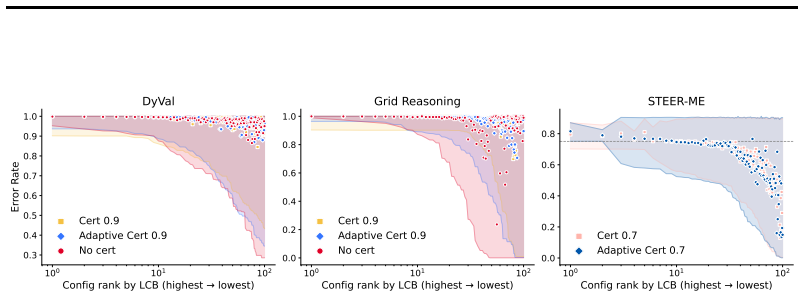
By introducing several substantive modifications to the COUP Bayesian optimization algorithm and wrapping it in a flexible tool that accepts different datasets and user-chosen utility functions, QuickScope discovers truly difficult questions in dynamic benchmarks more sample-efficiently than standard baselines while reducing false positives from noisy outcomes.
What carries the argument
QuickScope, a modified version of the COUP Bayesian optimization algorithm adapted for LLM pipelines, which uses user-specified utility functions to guide efficient search for hard questions in template-based benchmarks.
If this is right
- Evaluation of LLM weaknesses becomes feasible even when the space of possible questions is effectively unlimited.
- Users gain direct control over the definition of hardness through flexible utility functions instead of relying on aggregate scores.
- Fewer samples are needed to certify model vulnerabilities, lowering the overall cost of thorough benchmarking.
- Reduced false positives from noise improve the reliability of identified weak spots for model improvement.
- The approach applies across a range of existing dynamic benchmarks without requiring fixed test sets.
Where Pith is reading between the lines
- If adopted, this method could shift LLM evaluation practice from broad average scores toward targeted debugging of specific failure modes.
- It may generalize to other generative AI systems where evaluation spaces are large or infinite, such as in code generation or creative tasks.
- Better alignment between utility functions and real user priorities could make benchmark results more actionable for deployment decisions.
- The efficiency gains might encourage creation of larger or more varied dynamic benchmarks that were previously too expensive to certify thoroughly.
Load-bearing premise
The modifications to COUP make the algorithm suitable for practical LLM pipelines and the chosen utility functions correctly identify the kinds of hard questions users care about.
What would settle it
An experiment in which QuickScope requires at least as many evaluations as random or standard baselines to reach the same precision in identifying hard questions, or yields a higher rate of false positives on repeated noisy runs.
Figures



read the original abstract
LLM benchmarks are increasingly dynamic: instead of containing a fixed set of questions, they define templates and parameters that can generate an effectively unlimited number of question variants. This flexibility is valuable, but it makes evaluation expensive -- especially when the goal is not just determining an average score, but reliably identifying a model's weak spots. This paper introduces a new methodology for identifying hard questions in dynamic benchmarks. It leverages COUP, a recent Bayesian optimization algorithm (Graham, Velez & Leyton-Brown, 2026), after introducing several substantive modifications to make the algorithm suitable for practical LLM pipelines. We also wrap it in a tool that supports flexible choices of datasets and utility functions, enabling users to target the kinds of questions they care about (e.g., low-accuracy questions; questions that are unusually hard relative to their measured complexity). In experiments across a range of benchmarks, we show that our method, dubbed $\texttt{QuickScope}$, discovers truly difficult questions more sample efficiently than standard baselines, while also reducing false positives from noisy outcomes.
Editorial analysis
A structured set of objections, weighed in public.
Referee Report
Summary. The paper introduces QuickScope, a methodology that adapts the COUP Bayesian optimization algorithm with substantive modifications for practical LLM evaluation pipelines. It provides a tool supporting flexible dataset choices and utility functions to target specific notions of question difficulty (e.g., low accuracy or complexity-adjusted hardness). Experiments across multiple dynamic benchmarks are reported to show that QuickScope identifies truly difficult questions with greater sample efficiency than standard baselines while also reducing false positives arising from noisy LLM outcomes.
Significance. If the reported efficiency gains and false-positive reductions hold under scrutiny, the work would be significant for LLM benchmarking practice. Dynamic benchmarks generate effectively unlimited variants, making exhaustive evaluation costly; a reliable method to focus sampling on hard cases could lower evaluation budgets while improving identification of model weaknesses. The emphasis on customizable utilities is a practical strength that aligns with user needs in the field.
major comments (1)
- [Abstract] Abstract: the central empirical claim of superior sample efficiency and fewer false positives is stated without any quantitative results, baseline definitions, statistical tests, or details on the modifications made to COUP. This information is load-bearing for assessing whether the modifications actually deliver the claimed advantages.
minor comments (2)
- The citation to COUP (Graham, Velez & Leyton-Brown, 2026) should include a precise reference entry and a brief summary of the original algorithm's assumptions to clarify what was changed.
- Notation for utility functions and the modified acquisition function should be introduced with explicit equations rather than descriptive text alone.
Simulated Author's Rebuttal
We thank the referee for their positive assessment of the work's significance for LLM benchmarking practice and for the constructive feedback. We address the single major comment below and will make the requested changes to strengthen the manuscript.
read point-by-point responses
-
Referee: [Abstract] Abstract: the central empirical claim of superior sample efficiency and fewer false positives is stated without any quantitative results, baseline definitions, statistical tests, or details on the modifications made to COUP. This information is load-bearing for assessing whether the modifications actually deliver the claimed advantages.
Authors: We agree that the abstract would be strengthened by including quantitative support for the central claims, along with brief references to baselines and the nature of the COUP modifications. In the revised manuscript we will expand the abstract to report key empirical results (e.g., measured gains in sample efficiency and false-positive reduction relative to the baselines used in our experiments), note the statistical tests performed, and summarize the principal modifications to COUP. These additions will be drawn directly from the detailed experimental sections while remaining within standard abstract length limits. We believe this change will make the load-bearing claims more transparent to readers. revision: yes
Circularity Check
No significant circularity identified
full rationale
The paper's central contribution is an empirical methodology: it modifies the externally cited COUP Bayesian optimization algorithm (Graham et al. 2026) with substantive changes for LLM use, wraps it in a tool supporting flexible utilities, and evaluates QuickScope via experiments showing improved sample efficiency and fewer false positives over baselines across benchmarks. No derivation chain, equations, or predictions reduce by construction to inputs; the efficiency claims rest on independent experimental comparisons rather than self-definitional fits, renamed patterns, or load-bearing self-citations. The overlapping-author citation provides the base algorithm but does not justify the target results, which are externally falsifiable through the reported benchmark tests.
Axiom & Free-Parameter Ledger
Reference graph
Works this paper leans on
-
[1]
Devon Graham and Eros Rojas Velez and Kevin Leyton-Brown , year=. 2510.14683 , archivePrefix=
-
[2]
Devon Graham and Kevin Leyton-Brown , year=. 2405.18246 , archivePrefix=
-
[3]
Liang, Percy and Bommasani, Rishi and Lee, Tony and Tsipras, Dimitris and Soylu, Dilara and Yasunaga, Michihiro and Zhang, Yian and Narayanan, Deepak and Wu, Yuhuai and Kumar, Ananya and Newman, Benjamin and Yan, Binhang and Zhang, Ce and Cosgrove, Christian and Manning, Christopher D. and R. 2022 , eprint =
2022
-
[4]
Dynabench: Rethinking Benchmarking in
Kiela, Douwe and Bartolo, Max and Nie, Yixin and Kaushik, Divyansh and Geiger, Atticus and Wu, Zheng and Vidgen, Bertie and Prasad, Grusha and Singh, Amanpreet and Ringshia, Pratik and Ma, Zhiyi and Thakker, Udit and Gupta, Kushal and Liu, Percy and Patil, Devang and Hitaj, Briland and Riedel, Sebastian and. Dynabench: Rethinking Benchmarking in. 2021 , eprint =
2021
-
[5]
Beyond the Imitation Game: Quantifying and extrapolating the capabilities of language models
Srivastava, Aarohi and others , year =. 2206.04615 , archivePrefix =
work page internal anchor Pith review arXiv
-
[6]
2021 , eprint =
Dodge, Jesse and Sap, Maarten and Marasovi. 2021 , eprint =
2021
-
[7]
Hu, Xiaomeng and Warmington, Matthew and Price, Gregory and Li, Wei , year =. 2409.07476 , archivePrefix =
-
[8]
2023 , howpublished =
Evals: A framework for evaluating. 2023 , howpublished =
2023
-
[9]
, year =
Lord, Frederic M. , year =
-
[10]
, Xie X: A survey on evaluation of large language models
Chang, Yupeng and Wang, Xu and Wang, Jindong and Wu, Yuan and Yang, Linyi and Zhu, Kaijie and Chen, Hao and Yi, Xiaoyuan and Wang, Cunxiang and Wang, Yidong and Ye, Wei and Zhang, Yue and Chang, Yi and Yu, Philip S. and Yang, Qiang and Xie, Xing , title=. ACM Trans. Intell. Syst. Technol. , month = mar, articleno =. 2024 , issue_date =. doi:10.1145/364128...
-
[11]
Concrete Problems in AI Safety
Dario Amodei and Chris Olah and Jacob Steinhardt and Paul Christiano and John Schulman and Dan Mané , year=. 1606.06565 , archivePrefix=
work page internal anchor Pith review arXiv
-
[12]
On the Opportunities and Risks of Foundation Models
Rishi Bommasani and Drew A. Hudson and Ehsan Adeli and Russ Altman and Simran Arora and Sydney von Arx and Michael S. Bernstein and Jeannette Bohg and Antoine Bosselut and Emma Brunskill and Erik Brynjolfsson and Shyamal Buch and Dallas Card and Rodrigo Castellon and Niladri Chatterji and Annie Chen and Kathleen Creel and Jared Quincy Davis and Dora Demsz...
work page internal anchor Pith review arXiv
-
[13]
Deduplicating training data makes language models better
Lee, Katherine and Ippolito, Daphne and Nystrom, Andrew and Zhang, Chiyuan and Eck, Douglas and Callison-Burch, Chris and Carlini, Nicholas. Deduplicating Training Data Makes Language Models Better. Proceedings of the 60th Annual Meeting of the Association for Computational Linguistics (Volume 1: Long Papers). 2022. doi:10.18653/v1/2022.acl-long.577
-
[14]
Aaditya K. Singh and Muhammed Yusuf Kocyigit and Andrew Poulton and David Esiobu and Maria Lomeli and Gergely Szilvasy and Dieuwke Hupkes , year=. 2411.03923 , archivePrefix=
-
[15]
Yixiong Fang and Tianran Sun and Yuling Shi and Min Wang and Xiaodong Gu , year=. 2506.21614 , archivePrefix=
-
[16]
2021 , isbn =
Nicholas Carlini and Florian Tram. 2021 , isbn =
2021
-
[17]
Quantifying Memorization Across Neural Language Models
Nicholas Carlini and Daphne Ippolito and Matthew Jagielski and Katherine Lee and Florian Tramer and Chiyuan Zhang , year=. 2202.07646 , archivePrefix=
work page internal anchor Pith review arXiv
-
[18]
The hitchhiker’s guide to test- ing statistical significance in natural language processing
Dror, Rotem and Baumer, Gili and Shlomov, Segev and Reichart, Roi. The Hitchhiker ' s Guide to Testing Statistical Significance in Natural Language Processing. Proceedings of the 56th Annual Meeting of the Association for Computational Linguistics (Volume 1: Long Papers). 2018. doi:10.18653/v1/P18-1128
-
[19]
Xavier Bouthillier and Pierre Delaunay and Mirko Bronzi and Assya Trofimov and Brennan Nichyporuk and Justin Szeto and Naz Sepah and Edward Raff and Kanika Madan and Vikram Voleti and Samira Ebrahimi Kahou and Vincent Michalski and Dmitriy Serdyuk and Tal Arbel and Chris Pal and Gaël Varoquaux and Pascal Vincent , year=. 2103.03098 , archivePrefix=
-
[20]
arXiv:2104.14337 (2021), https://arxiv.org/abs/2104.14337
Douwe Kiela and Max Bartolo and Yixin Nie and Divyansh Kaushik and Atticus Geiger and Zhengxuan Wu and Bertie Vidgen and Grusha Prasad and Amanpreet Singh and Pratik Ringshia and Zhiyi Ma and Tristan Thrush and Sebastian Riedel and Zeerak Waseem and Pontus Stenetorp and Robin Jia and Mohit Bansal and Christopher Potts and Adina Williams , year=. 2104.1433...
-
[21]
Beyond the Imitation Game: Quantifying and extrapolating the capabilities of language models
Aarohi Srivastava and Abhinav Rastogi and Abhishek Rao and Abu Awal Md Shoeb and Abubakar Abid and Adam Fisch and Adam R. Brown and Adam Santoro and Aditya Gupta and Adri. CoRR , timestamp =. doi:10.48550/ARXIV.2206.04615 , eprint =
work page internal anchor Pith review doi:10.48550/arxiv.2206.04615
-
[22]
Vahid Majdinasab and Amin Nikanjam and Foutse Khomh , year=. 2504.05500 , archivePrefix=
-
[23]
Benchmark Self-Evolving: A Multi-Agent Framework for Dynamic LLM Evaluation
Wang, Siyuan and Long, Zhuohan and Fan, Zhihao and Huang, Xuanjing and Wei, Zhongyu. Benchmark Self-Evolving: A Multi-Agent Framework for Dynamic LLM Evaluation. Proceedings of the 31st International Conference on Computational Linguistics. 2025
2025
-
[24]
GSM-Symbolic: Understanding the Limitations of Mathematical Reasoning in Large Language Models
Iman Mirzadeh and Keivan Alizadeh and Hooman Shahrokhi and Oncel Tuzel and Samy Bengio and Mehrdad Farajtabar , year=. 2410.05229 , archivePrefix=
-
[25]
arXiv preprint arXiv:2309.17167 , year=
Kaijie Zhu and Jiaao Chen and Jindong Wang and Neil Zhenqiang Gong and Diyi Yang and Xing Xie , year=. 2309.17167 , archivePrefix=
-
[26]
Narun Raman and Taylor Lundy and Thiago Amin and Jesse Perla and Kevin Leyton-Brown , year=. 2502.13119 , archivePrefix=
-
[27]
Discovering Language Model Behaviors with Model-Written Evaluations
Ethan Perez and Sam Ringer and Kamilė Lukošiūtė and Karina Nguyen and Edwin Chen and Scott Heiner and Craig Pettit and Catherine Olsson and Sandipan Kundu and Saurav Kadavath and Andy Jones and Anna Chen and Ben Mann and Brian Israel and Bryan Seethor and Cameron McKinnon and Christopher Olah and Da Yan and Daniela Amodei and Dario Amodei and Dawn Drain a...
work page internal anchor Pith review arXiv
-
[28]
Defending Against Indirect Prompt Injection Attacks With Spotlighting
Keegan Hines and Gary Lopez and Matthew Hall and Federico Zarfati and Yonatan Zunger and Emre Kiciman , year=. 2403.14720 , archivePrefix=
work page internal anchor Pith review arXiv
-
[29]
Belaire, Roman and Sinha, Arunesh and Varakantham, Pradeep , journal=
-
[30]
Universal and Transferable Adversarial Attacks on Aligned Language Models
Andy Zou and Zifan Wang and Nicholas Carlini and Milad Nasr and J. Zico Kolter and Matt Fredrikson , year=. 2307.15043 , archivePrefix=
work page internal anchor Pith review Pith/arXiv arXiv
-
[31]
2025 , url =
Wang, Ren , title=. 2025 , url =
2025
-
[32]
Narun Raman and Taylor Lundy and Kevin Leyton-Brown , year=. 2507.15337 , archivePrefix=
-
[33]
Reasoninggym: Reasoningenvironmentsforreinforcementlearningwithverifiable rewards, 2025
Zafir Stojanovski and Oliver Stanley and Joe Sharratt and Richard Jones and Abdulhakeem Adefioye and Jean Kaddour and Andreas Köpf , year=. 2505.24760 , archivePrefix=
-
[34]
Marius Lindauer and Katharina Eggensperger and Matthias Feurer and André Biedenkapp and Difan Deng and Carolin Benjamins and Tim Ruhopf and René Sass and Frank Hutter , year=. 2109.09831 , archivePrefix=
-
[35]
and Leyton-Brown, Kevin , booktitle=
Hutter, Frank and Hoos, Holger H. and Leyton-Brown, Kevin , booktitle=
-
[36]
Marius Lindauer and Matthias Feurer and Katharina Eggensperger and André Biedenkapp and Frank Hutter , year=. 1908.06674 , archivePrefix=
-
[37]
Hyperband: A Novel Bandit-Based Approach to Hyperparameter Optimization
Lisha Li and Kevin Jamieson and Giulia DeSalvo and Afshin Rostamizadeh and Ameet Talwalkar , year=. 1603.06560 , archivePrefix=
-
[38]
Massively parallel hyperparameter tuning
Liam Li and Kevin Jamieson and Afshin Rostamizadeh and Ekaterina Gonina and Moritz Hardt and Benjamin Recht and Ameet Talwalkar , year=. 1810.05934 , archivePrefix=
-
[39]
BOHB: Robust and Efficient Hyperparameter Optimization at Scale
Stefan Falkner and Aaron Klein and Frank Hutter , year=. 1807.01774 , archivePrefix=
-
[40]
Jasmin Brandt and Elias Schede and Viktor Bengs and Björn Haddenhorst and Eyke Hüllermeier and Kevin Tierney , year=. 2212.00333 , archivePrefix=
-
[41]
2012 , isbn =
Kalyanakrishnan, Shivaram and Tewari, Ambuj and Auer, Peter and Stone, Peter , title=. 2012 , isbn =
2012
discussion (0)
Sign in with ORCID, Apple, or X to comment. Anyone can read and Pith papers without signing in.