Recognition: unknown
Superfluid ³He aerogel experiments as a laboratory neutron star analogue
Pith reviewed 2026-05-10 04:29 UTC · model grok-4.3
The pith
Superfluid 3He in aerogels exhibits two vortex pinning regimes that can model neutron star interiors.
A machine-rendered reading of the paper's core claim, the machinery that carries it, and where it could break.
Core claim
Vortex experiments in superfluids contained in aerogels show two different regimes of pinned vortex dynamics. In a crust-like aerogel, vortices get depinned once the ambient superflow is fast enough, while in a core-like aerogel pinned vortices are never released and rotational velocity changes are accommodated by the avalanche-like production of new vortices. These findings support a microscopic picture of very strong vortex pinning and are argued to apply in neutron stars as well.
What carries the argument
Point-vortex simulation applied to aerogel structures that mimic neutron star crust and core conditions, extracting pinning and depinning behaviors.
If this is right
- In crust-like conditions, pinned vortices depin at sufficient superflow velocities, leading to sudden rotational adjustments.
- In core-like conditions, strong pinning forces new vortex creation in avalanches rather than depinning.
- The two regimes provide distinct mechanisms for accommodating rotational changes in superfluids.
- These dynamics can be used to interpret neutron star glitch phenomena and spin-down rates.
Where Pith is reading between the lines
- The aerogel analogue might allow testing how temperature or impurity levels affect pinning strength in ways relevant to neutron star cooling.
- If applicable, models of neutron star interiors could be calibrated against lab-measured avalanche statistics to predict glitch sizes.
- This approach could extend to other quantum fluids or condensed matter systems with pinned defects.
Load-bearing premise
The assumption that the vortex pinning and depinning extracted from aerogel experiments map quantitatively to the conditions inside a neutron star despite huge differences in scale, density, and temperature.
What would settle it
If simulations of neutron star glitches using the extracted pinning thresholds from aerogel data fail to reproduce observed glitch distributions or spin-down behaviors in real pulsars.
Figures

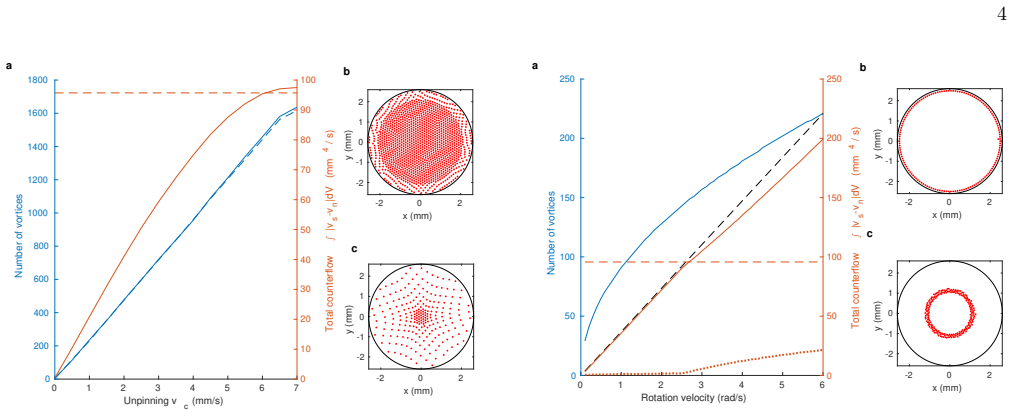

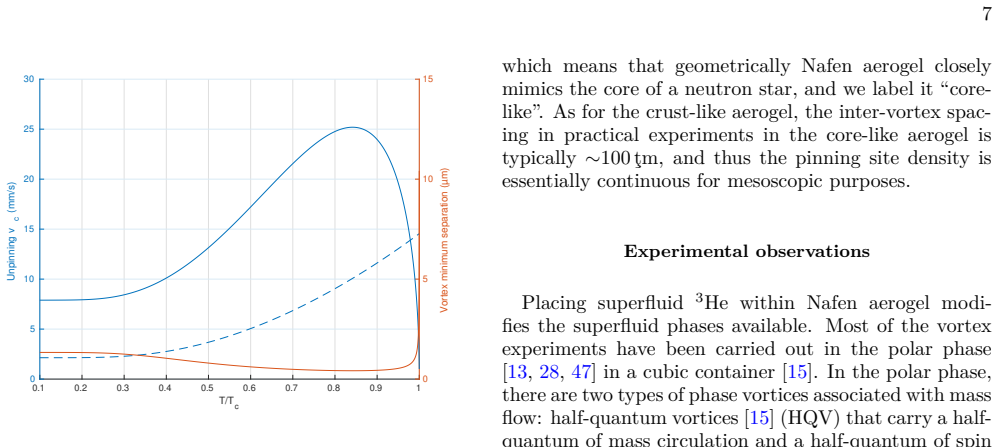


read the original abstract
Neutron stars make a unique astrophysical test bench for our understanding of quantum physics at kilometre scales. The rotation of a neutron star features glitches, sudden spin-ups that interrupt the otherwise regular stellar spin-down, which are often attributed to the dynamics of pinned quantised vortices in one or several of the superfluid phases inside the star. Laboratory experiments probing superfluid vortices have inspired neutron star theory and simulations from the beginning. Here we argue that vortex experiments in superfluids contained in aerogels show phenomenology that offers a highly appealing but vastly unexplored analogue for neutron star physics. We build a point-vortex simulation that allows analysing experiments in a crust-like and a core-like aerogel, extracting two different regimes of pinned vortex (non-)dynamics and validating a microscopic picture of very strong vortex pinning. In the crust-like aerogel, vortices get depinned once the ambient superflow is fast enough, while in the core-like aerogel pinned vortices are never released and rotational velocity changes are accommodated by the avalanche-like production of new vortices instead. Finally, we show that these concepts should apply also in neutron stars and may thus revolutionise the analysis of neutron star observations.
Editorial analysis
A structured set of objections, weighed in public.
Referee Report
Summary. The paper proposes superfluid 3He confined in aerogels as a laboratory analogue for neutron-star superfluid vortex dynamics, especially pinning/depinning relevant to glitches. A point-vortex simulation is used to analyze experiments in two aerogel types (crust-like and core-like), yielding two regimes: depinning above a critical superflow velocity in the crust-like case, and permanent pinning with avalanche production of new vortices to accommodate rotation changes in the core-like case. The authors extract a microscopic picture of very strong pinning and conclude that these concepts should apply to neutron stars, potentially revolutionizing observational analysis.
Significance. If the analogy can be placed on a quantitative footing, the work would supply a controllable laboratory system for testing vortex pinning and avalanche dynamics at scales inaccessible to direct neutron-star simulation. The point-vortex model provides a concrete microscopic interpretation of the aerogel data and demonstrates clear regime separation between the two aerogel types; these are genuine strengths. However, the significance for neutron-star physics remains conditional on an explicit mapping of dimensionless parameters that the manuscript does not yet supply.
major comments (2)
- [Discussion / neutron-star application paragraph] The final section asserting applicability to neutron stars contains no derivation or table comparing the governing dimensionless quantities (pinning energy relative to superflow kinetic energy per vortex, vortex areal density, mean free path versus intervortex spacing, pinning-site separation versus coherence length) between the laboratory 3He-aerogel parameters and the neutron-superfluid conditions at nuclear density and ~10^8 K. Without this regime-matching argument the claim that the two extracted regimes 'should apply' rests only on qualitative similarity and is therefore load-bearing for the central conclusion.
- [Simulation and results sections] The point-vortex simulation is presented as validating the microscopic strong-pinning picture, yet the manuscript reports neither quantitative validation metrics (e.g., RMS deviation between simulated and measured vortex positions or velocities) nor an error analysis on the extracted critical superflow or avalanche thresholds. This absence weakens the evidential basis for transferring the regimes to neutron-star models.
minor comments (2)
- [Abstract] The abstract states that the simulation 'validates' the pinning picture; this language should be softened to 'supports' or 'is consistent with' until quantitative metrics are added.
- [Introduction / Methods] Notation for the two aerogel regimes ('crust-like' and 'core-like') is introduced without an explicit table mapping laboratory length scales or pinning strengths to the corresponding neutron-star regions; a short comparison table would improve clarity.
Simulated Author's Rebuttal
We thank the referee for their careful reading and constructive comments, which have helped us improve the manuscript. We address each major comment below and indicate the revisions made.
read point-by-point responses
-
Referee: [Discussion / neutron-star application paragraph] The final section asserting applicability to neutron stars contains no derivation or table comparing the governing dimensionless quantities (pinning energy relative to superflow kinetic energy per vortex, vortex areal density, mean free path versus intervortex spacing, pinning-site separation versus coherence length) between the laboratory 3He-aerogel parameters and the neutron-superfluid conditions at nuclear density and ~10^8 K. Without this regime-matching argument the claim that the two extracted regimes 'should apply' rests only on qualitative similarity and is therefore load-bearing for the central conclusion.
Authors: We agree that an explicit quantitative comparison of dimensionless parameters is required to substantiate the applicability to neutron stars. In the revised manuscript we have added a new subsection and table in the discussion that derives and tabulates the relevant quantities, including the pinning strength (pinning energy relative to superflow kinetic energy per vortex), vortex areal density, mean free path versus intervortex spacing, and pinning-site separation versus coherence length, for both the aerogel experiments and typical neutron-star conditions at nuclear density. These comparisons confirm that both systems operate in the strong-pinning regime with analogous avalanche dynamics. revision: yes
-
Referee: [Simulation and results sections] The point-vortex simulation is presented as validating the microscopic strong-pinning picture, yet the manuscript reports neither quantitative validation metrics (e.g., RMS deviation between simulated and measured vortex positions or velocities) nor an error analysis on the extracted critical superflow or avalanche thresholds. This absence weakens the evidential basis for transferring the regimes to neutron-star models.
Authors: The point-vortex model provides a minimal microscopic description that reproduces the two distinct experimental regimes without free parameters beyond those fixed by the aerogel properties. To strengthen the validation, the revised manuscript now includes RMS deviation metrics between simulated and observed vortex configurations (where experimental position data are available) together with an uncertainty analysis on the critical superflow velocities and avalanche thresholds obtained from ensembles of simulations with varied initial conditions. revision: yes
Circularity Check
No circularity: simulation interprets data and analogy to neutron stars remains conceptual
full rationale
The paper constructs a point-vortex simulation to analyze existing aerogel experiments, extracts two pinning regimes (depinning in crust-like aerogel; avalanche production in core-like aerogel), and then offers a qualitative argument that the same concepts may apply to neutron-star glitches. No load-bearing step reduces a claimed prediction or first-principles result to its own fitted inputs by construction; the simulation is presented as a new interpretive tool rather than a self-validating fit, and the neutron-star transfer is framed as an unexplored analogue without quantitative regime-matching equations that would force equivalence. The derivation chain is therefore self-contained against external benchmarks.
Axiom & Free-Parameter Ledger
Reference graph
Works this paper leans on
-
[1]
is composed of 98% empty space with disordered, interconnected spherical silica particles ( d ≈ 5 nm) form- 3 FIG. 1. Superfluid 3He as a laboratory neutron star simulator: ( a) A neutron star is composed of ( b) an s-wave neutron superfluid with an underlying solid lattice in the crust and a p-wave neutron superfluid with an underlying array of flux tubes ho...
-
[2]
core- like
is of cylindrical shape with radius R = 2. 6 mm. Experimental observations The superfluid 3He placed within the crust-like silica aerogel is in the B phase [ 7], which for the purposes of vortex mechanics is as close to an s-wave system as one can get in superfluid 3He; the B phase gap spectrum is (nearly) isotropic. Thus, the pinning force and the Mag- nus...
2000
-
[3]
and qualitatively supported by the phenomenology of vortex avalanches observed in superconducting films [ 63]. That is, the observed bursts of vortices enter as disor- dered branches, spreading inwards from the points where the superflow first reaches the critical value vc ≈ 2 mm/s at the container side wall centres. The microscopic pro- cess creating these ...
-
[4]
Nonequilibrium phenomena in superfluid systems: atomic nuclei, liquid helium, ultracold gases, and neu- tron stars
by, say, only updating the positions and flow con- tributions of those vortices that are outside a threshold radius for vortex motion (see Fig. 2). Phenomenologi- cal simulations of vortex nucleation avalanches in a neu- tron star (and the core-like aerogel) will require devel- oping new simulation techniques, but the immobility of the vortices once create...
-
[6]
G. Baym, C. Pethick, and D. Pines, Superfluidity in Neu- tron Stars, Nature 224, 673 (1969)
1969
-
[7]
T. S. Wood and V. Graber, Superconducting Phases in Neutron Star Cores, Universe 8, 228 (2022)
2022
-
[8]
A. Basu, B. Shaw, D. Antonopoulou, M. J. Keith, A. G. Lyne, M. B. Mickaliger, B. W. Stappers, P. Weltevrede, and C. A. Jordan, The Jodrell bank glitch catalogue: 106 new rotational glitches in 70 pulsars, Monthly Notices of the Royal Astronomical Society 510, 4049 (2022)
2022
-
[9]
Antonopoulou, B
D. Antonopoulou, B. Haskell, and C. M. Espinoza, Pulsar glitches: observations and physical interpretation, Re- ports on Progress in Physics (2022)
2022
-
[10]
Dmitriev, A
V. Dmitriev, A. Soldatov, and A. Yudin, Superfluid 3He in a nematic aerogel, Journal of Experimental and The- oretical Physics 131, 2 (2020)
2020
-
[11]
Alles, J
H. Alles, J. Kaplinsky, P. Wootton, J. Reppy, J. Naish, and J. Hook, Evidence for superfluid B phase of 3He in aerogel, Physical review letters 83, 1367 (1999)
1999
-
[12]
W. P. Halperin, Superfluid 3He in aerogel, Annual Re- view of Condensed Matter Physics 10, 155 (2019)
2019
-
[13]
Pollanen, J
J. Pollanen, J. Li, C. Collett, W. Gannon, W. Halperin, and J. Sauls, New chiral phases of superfluid 3He stabi- lized by anisotropic silica aerogel, Nature Physics 8, 317 (2012)
2012
-
[14]
V. V. Dmitriev, M. Kutuzov, A. A. Soldatov, and A. N. Yudin, Superfluid 3He in squeezed nematic aerogel, JETP Letters 110, 734 (2019)
2019
-
[15]
Scott, M
J. Scott, M. Nguyen, D. Park, and W. Halperin, Pla- nar aerogel and superfluid 3He, structure and transitions, Journal of Low Temperature Physics 215, 407 (2024)
2024
-
[16]
Dmitriev, M
V. Dmitriev, M. Kutuzov, A. Mikheev, V. Morozov, A. Soldatov, and A. Yudin, Superfluid 3He in planar aero- gel, Physical Review B 102, 144507 (2020)
2020
-
[17]
V. V. Dmitriev, A. A. Senin, A. A. Soldatov, and A. N. Yudin, Polar phase of superfluid 3He in anisotropic aero- gel, Phys. Rev. Lett. 115, 165304 (2015)
2015
-
[18]
M. M. Salomaa and G. E. Volovik, Quantized vortices in superfluid 3He, Rev. Mod. Phys. 59, 533 (1987)
1987
-
[19]
Autti, V
S. Autti, V. V. Dmitriev, J. T. Mäkinen, A. A. Soldatov, G. E. Volovik, A. N. Yudin, V. V. Zavjalov, and V. B. Eltsov, Observation of half-quantum vortices in topolog- ical superfluid 3He, Phys. Rev. Lett. 117, 255301 (2016)
2016
-
[20]
V. M. H. Ruutu, J. Kopu, M. Krusius, U. Parts, B. Plaçais, E. V. Thuneberg, and W. Xu, Critical ve- locity of vortex nucleation in rotating superfluid 3He-A, Phys. Rev. Lett. 79, 5058 (1997)
1997
-
[21]
Parts, J
U. Parts, J. M. Karimäki, J. H. Koivuniemi, M. Krusius, V. M. H. Ruutu, E. V. Thuneberg, and G. E. Volovik, 14 Phase diagram of vortices in superfluid 3He-A, Phys. Rev. Lett. 75, 3320 (1995)
1995
-
[22]
Rantanen and V
R. Rantanen and V. Eltsov, Competition of vortex core structures in superfluid 3He−B, Phys. Rev. Res. 6, 043112 (2024)
2024
-
[23]
J. P. Pekola, J. T. Simola, P. J. Hakonen, M. Krusius, O. V. Lounasmaa, K. K. Nummila, G. Mamniashvili, R. E. Packard, and G. E. Volovik, Phase diagram of the first-order vortex-core transition in superfluid 3He- B, Phys. Rev. Lett. 53, 584 (1984)
1984
-
[24]
M. A. Alpar, D. Pines, P. W. Anderson, and J. Shaham, Vortex creep and the internal temperature of neutron stars. I - General theory, Astrophys. J. 276, 325 (1984)
1984
-
[25]
Rainer and M
D. Rainer and M. Vuorio, Small objects in superfluid 3He, Journal of Physics C: Solid State Physics 10, 3093 (1977)
1977
-
[26]
Mäkinen, V
J. Mäkinen, V. Dmitriev, J. Nissinen, J. Rysti, G. Volovik, A. Yudin, K. Zhang, and V. Eltsov, Half- quantum vortices and walls bounded by strings in the polar-distorted phases of topological superfluid 3He, Na- ture Communications 10 (2019)
2019
-
[27]
J. Li, J. Pollanen, A. Zimmerman, C. Collett, W. Gan- non, and W. Halperin, The superfluid glass phase of 3He- A, Nature Physics 9, 775 (2013)
2013
-
[28]
Volovik, On larkin-imry-ma state of 3He-A in aerogel, Journal of Low Temperature Physics 150, 453 (2008)
G. Volovik, On larkin-imry-ma state of 3He-A in aerogel, Journal of Low Temperature Physics 150, 453 (2008)
2008
-
[29]
Bevan, A
T. Bevan, A. Manninen, J. Cook, H. Alles, J. Hook, and H. Hall, Vortex mutual friction in superfluid 3 he, Journal of low temperature physics 109, 423 (1997)
1997
-
[30]
P. W. Anderson and N. Itoh, Pulsar glitches and restless- ness as a hard superfluidity phenomenon, Nature (Lon- don) 256, 25 (1975)
1975
-
[31]
Ahmad, S
S. Ahmad, S. Ahmad, and J. N. Sheikh, Silica centered aerogels as advanced functional material and their ap- plications: A review, Journal of Non-Crystalline Solids 611, 122322 (2023)
2023
-
[32]
Zhelev, M
N. Zhelev, M. Reichl, T. S. Abhilash, E. N. Smith, K. Nguyen, E. Mueller, and J. M. Parpia, Observation of a new superfluid phase for 3He embedded in nemat- ically ordered aerogel, Nature communications 7, 12975 (2016)
2016
-
[33]
Ruutu, Ü
V. Ruutu, Ü. Parts, J. Koivuniemi, N. Kopnin, and M. Krusius, Intrinsic and extrinsic mechanisms of vortex formation in superfluid 3He-B, Journal of low tempera- ture physics 107, 93 (1997)
1997
-
[34]
G. E. Volovik, The Universe in a Helium Droplet (Oxford University Press, 2003)
2003
-
[35]
Yamashita, A
M. Yamashita, A. Matsubara, R. Ishiguro, Y. Sasaki, Y. Kataoka, M. Kubota, O. Ishikawa, Y. M. Bunkov, T. Ohmi, T. Takagi, et al. , Pinning of texture and vor- tices of the rotating B-like phase of superfluid He-3 con- fined in a 98% aerogel, Physical review letters 94, 075301 (2005)
2005
-
[36]
Pines, J
D. Pines, J. Shaham, M. A. Alpar, and P. W. Anderson, Pinned vorticity in rotating superfluids, with application to neutron stars., Progress of Theoretical Physics Sup- plement 69, 376 (1980)
1980
-
[37]
Haskell, D
B. Haskell, D. Antonopoulou, and C. Barenghi, Turbu- lent, pinned superfluids in neutron stars and pulsar glitch recoveries, Monthly Notices of the Royal Astronomical Society 499, 161 (2020)
2020
-
[38]
N. Chamel and P. Haensel, Physics of Neutron Star Crusts, Living Reviews in Relativity 11, 10 (2008) , arXiv:0812.3955 [astro-ph]
- [39]
-
[40]
Y. M. Bunkov, A. Chen, D. Cousins, and H. Godfrin, Semisuperfluidity of 3He in aerogel?, Physical Review Letters 85, 3456 (2000)
2000
-
[41]
V. B. Eltsov, A. I. Golov, R. de Graaf, R. Hänninen, M. Krusius, V. S. L’vov, and R. E. Solntsev, Quantum turbulence in a propagating superfluid vortex front, Phys. Rev. Lett. 99, 265301 (2007)
2007
-
[42]
Eltsov, J
V. Eltsov, J. Hosio, and M. Krusius, Kelvin–Helmholtz instability in 3He superfluids in zero-temperature limit, Journal of Low Temperature Physics 217, 292 (2024)
2024
-
[43]
Skrbek, R
L. Skrbek, R. Blaauwgeers, V. Eltsov, A. Finne, N. Kop- nin, and M. Krusius, Vortex flow in rotating superfluid 3He-B, Physica B: Condensed Matter 329, 106 (2003)
2003
-
[44]
Eltsov, A
V. Eltsov, A. Gordeev, and M. Krusius, Kelvin- Helmholtz instability of ab interface in superfluid 3He, Physical Review B 99, 054104 (2019)
2019
-
[45]
Autti, J
S. Autti, J. T. Mäkinen, J. Rysti, G. E. Volovik, V. V. Zavjalov, and V. B. Eltsov, Exceeding the Landau speed limit with topological Bogoliubov Fermi surfaces, Phys. Rev. Res. 2, 033013 (2020)
2020
-
[46]
Seveso, P
S. Seveso, P. M. Pizzochero, F. Grill, and B. Haskell, Mesoscopic pinning forces in neutron star crusts, Monthly Notices of the Royal Astronomical Society 455, 3952 (2016)
2016
-
[47]
Sauls, Superfluidity in the interiors of neutron stars, in Timing Neutron Stars , NATO Advanced Study Insti- tute (ASI) Series C, Vol
J. Sauls, Superfluidity in the interiors of neutron stars, in Timing Neutron Stars , NATO Advanced Study Insti- tute (ASI) Series C, Vol. 262, edited by H. Ögelman and E. P. J. van den Heuvel (1989) p. 457
1989
- [48]
-
[49]
N. Chamel, Superfluidity and Superconductivity in Neu- tron Stars, Journal of Astrophysics and Astronomy 38, 43 (2017) , arXiv:1709.07288 [astro-ph.HE]
-
[50]
nematically ordered
V. E. Asadchikov, R. S. Askhadullin, V. V. Volkov, V. V. Dmitriev, N. K. Kitaeva, P. N. Martynov, A. A. Osipov, A. A. Senin, A. A. Soldatov, D. I. Chekrygina, and A. N. Yudin, Structure and properties of “nematically ordered” aerogels, JETP Lett. 101, 556 (2015)
2015
-
[51]
V. P. Mineev, Nmr properties of the polar phase of su- perfluid 3he in anisotropic aerogel under rotation, J Low Temp. Phys. 184, 1007 (2016)
2016
-
[52]
Rysti, J
J. Rysti, J. T. Mäkinen, S. Autti, T. Kamppinen, G. E. Volovik, and V. B. Eltsov, Suppressing the Kibble-Zurek mechanism by a symmetry-violating bias, Phys. Rev. Lett. 127, 115702 (2021)
2021
-
[53]
Autti, V
S. Autti, V. V. Dmitriev, J. T. Mäkinen, J. Rysti, A. A. Soldatov, G. E. Volovik, A. N. Yudin, and V. B. Eltsov, Bose-einstein condensation of magnons and spin superflu- idity in the polar phase of 3He, Physical Review Letters 121, 025303 (2018)
2018
-
[54]
Autti, P
S. Autti, P. Heikkinen, S. Laine, J. Mäkinen, E. Thuneberg, V. Zavjalov, and V. Eltsov, Vortex- mediated relaxation of magnon BEC into light Higgs quasiparticles, Physical Review Research 3, L032002 (2021)
2021
-
[55]
V. M. H. Ruutu, V. B. Eltsov, A. J. Gill, W. B. Kibble, M. Krusius, Y. G. Makhlin, B. Placais, G. E. Volovik, and W. Xu, Vortex formation in neutron-irradiated su- perfluid 3He as an analogue of cosmological defect for- 15 mation, Nature 382, 334 (1996)
1996
-
[56]
Bauerle, Y
C. Bauerle, Y. M. Bunkov, S. N. Fisher, H. Godfrin, and G. R. Pickett, Laboratory simulation of cosmic string for- mation in the early universe using superfluid 3He, Nature 382, 332 (1996)
1996
-
[57]
Y. M. Bunkov, A. I. Golov, V. S. L’vov, A. Pomyalov, and I. Procaccia, Evolution of a neutron-initiated micro big bang in superfluid 3He − B, Phys. Rev. B 90, 024508 (2014)
2014
-
[58]
V. B. Eltsov, M. Krusius, and G. E. Volovik, Progr. in Low Temp. Phys. , Vol. XV, p. 1-137 (Elsevier, 2005)
2005
-
[59]
Blaauwgeers, V
R. Blaauwgeers, V. Eltsov, M. Krusius, J. Ruohio, R. Schanen, and G. Volovik, Double-quantum vortex in superfluid 3He-a, Nature 404, 471 (2000)
2000
-
[60]
Rantanen, E
R. Rantanen, E. Thuneberg, and V. Eltsov, Structure of a single-quantum vortex in 3he-a, Journal of Low Tem- perature Physics 220, 88 (2025)
2025
-
[61]
Vollhardt and P
D. Vollhardt and P. Wölfle, The Superfluid Phases of Helium 3 (Dover Publications, 2013)
2013
-
[62]
Volovik, Glass state of superfluid 3He-A in an aerogel, Journal of Experimental and Theoretical Physics Letters 63, 301 (1996)
G. Volovik, Glass state of superfluid 3He-A in an aerogel, Journal of Experimental and Theoretical Physics Letters 63, 301 (1996)
1996
-
[63]
V. V. Dmitriev, D. Krasnikhin, N. Mulders, A. Senin, G. E. Volovik, and A. Yudin, Orbital glass and spin glass states of 3He-A in aerogel, JETP letters 91, 599 (2010)
2010
-
[64]
Kopnin and M
N. Kopnin and M. Salomaa, Mutual friction in superfluid he 3: Effects of bound states in the vortex core, Physical Review B 44, 9667 (1991)
1991
-
[65]
V. P. Mineev, Half-quantum vortices in polar phase of superfluid 3He, J. Low Temp. Phys. 177, 48 (2014)
2014
-
[66]
G. E. Volovik and V. P. Mineev, Line and point singlu- larities in superfluid 3He, JETP Lett. 24, 561 (1976)
1976
-
[67]
Altshuler and T
E. Altshuler and T. Johansen, Colloquium: Experiments in vortex avalanches, Reviews of Modern Physics 76, 471 (2004)
2004
-
[68]
Graber, A
V. Graber, A. Cumming, and N. Andersson, Glitch rises as a test for rapid superfluid coupling in neutron stars, The Astrophysical Journal 865, 23 (2018)
2018
-
[69]
Howitt, A
G. Howitt, A. Melatos, and B. Haskell, Simulating pulsar glitches: an n-body solver for superfluid vortex motion in two dimensions, Monthly Notices of the Royal Astro- nomical Society 498, 320 (2020)
2020
-
[70]
superfluid 3He aerogel experiments as a lab- oratory neutron star analogue
S. Autti, V. Graber, and B. Haskell, Dataset for the manuscript "superfluid 3He aerogel experiments as a lab- oratory neutron star analogue" (2026). 16 TABLE I. Characteristics of superfluid 3He in terrestrial experiments vs neutron star (NS) superfluidity. We distinguish crust-like and core-like aerogels and provide relevant parameters for the NS crust and ...
2026
discussion (0)
Sign in with ORCID, Apple, or X to comment. Anyone can read and Pith papers without signing in.