Recognition: unknown
SignDPO: Multi-level Direct Preference Optimisation for Skeleton-based Gloss-free Sign Language Translation
Pith reviewed 2026-05-10 04:13 UTC · model grok-4.3
The pith
SignDPO shifts skeleton-based sign language translation from imitation learning to multi-level preference alignment across spatial, temporal, and linguistic dimensions.
A machine-rendered reading of the paper's core claim, the machinery that carries it, and where it could break.
Core claim
The paper establishes that a multi-level DPO framework, built from hierarchical spatial-temporal perturbations, decoder cross-attention guidance for salient region selection, and an automated language-level preference generator, allows skeleton-based models to optimize for semantic alignment rather than sequence mimicry and thereby reduce semantic drift in gloss-free sign language translation.
What carries the argument
The multi-level direct preference optimisation framework that constructs non-preferred samples through hierarchical perturbations and self-guiding attention to enforce distinctions between correct and semantically drifted outputs.
If this is right
- Models learn to reject structural distortions in skeletal trajectories that would otherwise produce incorrect word sequences.
- Preference pairs can be generated without human annotation at any of the three levels.
- The resulting systems surpass existing gloss-free methods on CSL-Daily, How2Sign, and OpenASL.
- Performance approaches that of established gloss-based pipelines on the same data.
Where Pith is reading between the lines
- The attention-guided perturbation step may identify which body parts carry the heaviest semantic load for particular signs.
- The same hierarchical preference construction could be applied to other high-entropy sequence tasks such as motion capture to text.
- Combining the language-level preference model with larger pretrained text generators might further reduce output-level failures.
Load-bearing premise
The perturbations at spatial, temporal, and language levels generate non-preferred samples that reflect genuine semantic drift rather than mere superficial changes.
What would settle it
Retraining the same base model on one of the three benchmarks using only the new preference pairs and observing no gain or a drop in standard translation metrics such as BLEU or ROUGE relative to the original MLE baseline.
Figures



read the original abstract
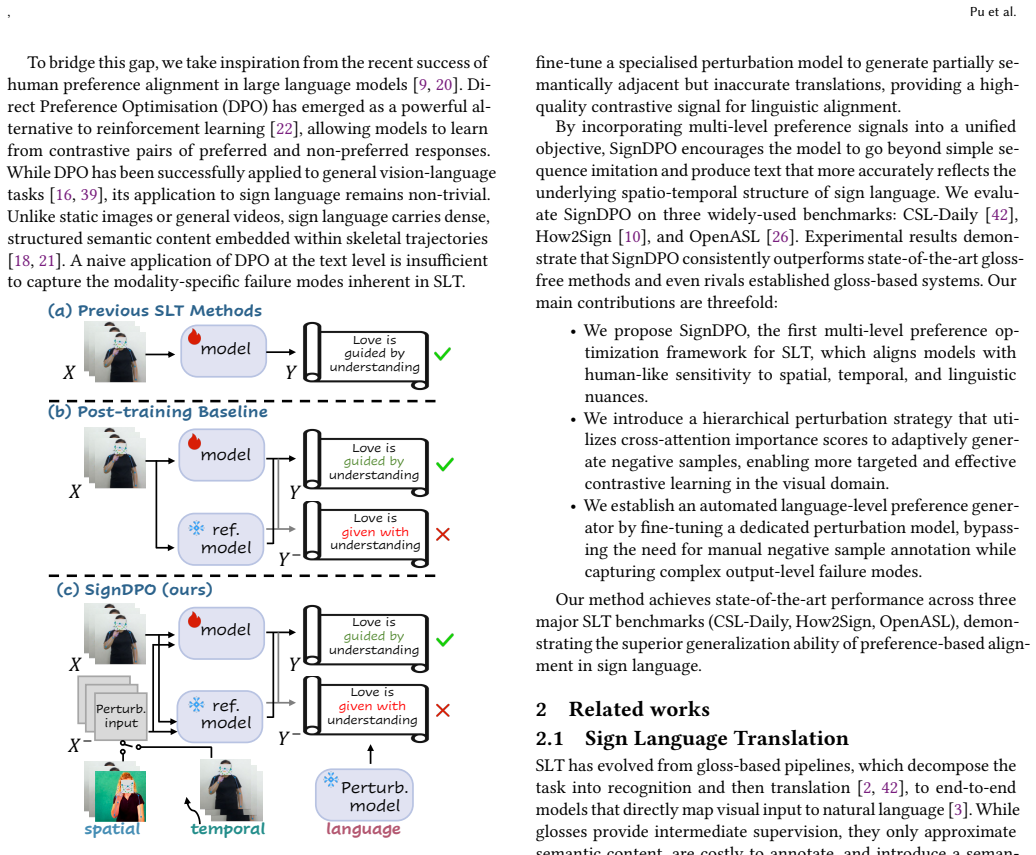
We present SignDPO, a novel multi-level Direct Preference Optimisation (DPO) framework designed to enhance the alignment of skeleton-based Sign Language Translation. While current skeleton-based models have made significant progress using Maximum Likelihood Estimation, they are primarily constrained by an imitation-based paradigm that lacks discriminative sensitivity to the fine-grained spatio-temporal nuances of sign language, often leading to semantic drift. To address this, SignDPO shifts the optimisation goal from simple sequence mimicry to structured preference alignment across spatial, temporal, and linguistic dimensions. Our framework involves three key designs. First, we introduce a hierarchical perturbation strategy to construct spatial and temporal non-preferred samples at both global and local granularities automatically. Second, we propose a self-guiding mechanism that leverages decoder cross-attention scores to identify and perturb semantically salient skeletal regions, forcing the model to distinguish genuine sign signals from structural distortions. Third, we establish an automated language-level preference generator by fine-tuning a dedicated perturbation model, capturing complex output-level failure modes without manual annotation. Extensive experiments on three widely adopted benchmarks, CSL-Daily, How2Sign, and OpenASL, demonstrate that SignDPO consistently outperforms state-of-the-art gloss-free methods and even rivals established gloss-based ones. Our results suggest that multi-level preference alignment is a powerful paradigm for bridging the gap between high-entropy skeletal trajectories and discrete linguistic semantics.
Editorial analysis
A structured set of objections, weighed in public.
Referee Report
Summary. The manuscript presents SignDPO, a multi-level Direct Preference Optimization framework for skeleton-based gloss-free sign language translation. It replaces standard MLE training with structured preference alignment by automatically constructing non-preferred samples via hierarchical spatial/temporal perturbations at global and local levels, a self-guiding mechanism that uses decoder cross-attention scores to target semantically salient skeletal regions, and a fine-tuned language-level perturbation model to generate output-level failure modes. Experiments on CSL-Daily, How2Sign, and OpenASL are reported to show consistent gains over gloss-free baselines and competitiveness with gloss-based methods.
Significance. If the preference pairs are shown to encode genuine semantic differences, the work offers a practical route to move sign language translation beyond imitation-based objectives toward discriminative alignment across spatial, temporal, and linguistic levels. The fully automated construction of preference data without manual annotation is a clear engineering strength and could transfer to other continuous-to-discrete sequence tasks.
major comments (2)
- [§3.2] §3.2 (hierarchical perturbation and self-guiding mechanism): The central claim that these perturbations produce non-preferred samples reflecting semantic drift rather than superficial kinematic noise is load-bearing for the entire DPO objective. The manuscript supplies no human semantic ratings, no correlation between perturbation severity and downstream BLEU/ROUGE degradation, and no ablation comparing attention-guided perturbations against random or uniform ones on semantic metrics. Without such validation, the multi-level alignment may reduce to regularized MLE on trajectory statistics.
- [§4.1–4.3] §4.1–4.3 (experimental tables): The reported outperformance is presented without error bars, without the number of random seeds, and without an ablation isolating the contribution of each perturbation level (spatial vs. temporal vs. language-level). This makes it impossible to assess whether the gains are robust or driven by a single component.
minor comments (2)
- [§3.3] §3.3: The fine-tuning procedure for the language-level perturbation model (base architecture, training corpus, and hyper-parameters) is described at too high a level for reproducibility.
- [Figure 2 and §3.1] Figure 2 and §3.1: The notation for global vs. local perturbation operators is introduced without an explicit equation or pseudocode, making the hierarchical construction difficult to follow precisely.
Simulated Author's Rebuttal
We thank the referee for the positive assessment of SignDPO and for the detailed comments, which help clarify how to strengthen the validation of our preference construction pipeline. We respond to each major comment below and will incorporate the suggested analyses in the revised manuscript.
read point-by-point responses
-
Referee: [§3.2] §3.2 (hierarchical perturbation and self-guiding mechanism): The central claim that these perturbations produce non-preferred samples reflecting semantic drift rather than superficial kinematic noise is load-bearing for the entire DPO objective. The manuscript supplies no human semantic ratings, no correlation between perturbation severity and downstream BLEU/ROUGE degradation, and no ablation comparing attention-guided perturbations against random or uniform ones on semantic metrics. Without such validation, the multi-level alignment may reduce to regularized MLE on trajectory statistics.
Authors: We agree that direct evidence linking perturbations to semantic rather than purely kinematic changes is important. The self-guiding mechanism is explicitly motivated by the observation that decoder cross-attention concentrates on linguistically meaningful skeletal joints and frames; perturbing those regions is intended to create preference pairs that penalize semantic drift. The consistent gains over strong gloss-free baselines across three datasets provide indirect support that the DPO objective is not merely regularized MLE. Nevertheless, we acknowledge the absence of the requested validations. In revision we will add (i) an ablation of attention-guided versus random/uniform perturbations evaluated on BLEU/ROUGE, (ii) plots correlating perturbation severity with metric degradation, and (iii) a limitations paragraph noting that large-scale human semantic ratings were outside the current resource scope. These additions will make the semantic grounding explicit without altering the core technical contribution. revision: partial
-
Referee: [§4.1–4.3] §4.1–4.3 (experimental tables): The reported outperformance is presented without error bars, without the number of random seeds, and without an ablation isolating the contribution of each perturbation level (spatial vs. temporal vs. language-level). This makes it impossible to assess whether the gains are robust or driven by a single component.
Authors: We concur that reporting variance, seed counts, and component-wise ablations is necessary for assessing robustness. The experiments were run with multiple random seeds, yet the variance and exact seed count were omitted from the tables. In the revised manuscript we will (i) add error bars computed over three independent seeds for all main results, (ii) state the seed count explicitly in §4, and (iii) include a new ablation table that isolates the contribution of the spatial, temporal, and language-level perturbation modules. This will demonstrate that the observed improvements arise from the combination of all three levels rather than any single component. revision: yes
Circularity Check
No circularity: SignDPO applies standard DPO to externally generated preference pairs
full rationale
The paper extends the existing DPO objective (from prior non-self literature) to skeleton-based sign language translation by constructing preference pairs via hierarchical spatial/temporal perturbations and attention-guided self-perturbation. No equations are presented that define a success metric or prediction in terms of the method's own fitted parameters; the claimed gains are measured on independent external benchmarks (CSL-Daily, How2Sign, OpenASL) rather than reducing to the perturbation process by construction. No self-citations are load-bearing for uniqueness theorems, ansatzes, or core derivations, and the framework does not rename known results or smuggle assumptions via author-overlapping citations. The derivation chain remains self-contained with external empirical validation.
Axiom & Free-Parameter Ledger
Reference graph
Works this paper leans on
-
[1]
G., Guo, Z
AzaR, M. G., Guo, Z. D., Piot, B., Munos, R., Rowland, M., ValKo, M., and CalandRiello, D. A general theoretical paradigm to understand learning from human preferences. InInternational Conference on Artificial Intelligence and Sta- tistics (2024), PMLR, pp. 4447–4455
2024
-
[2]
C., Hadfield, S., KolleR, O., Ney, H., and Bowden, R
Camgoz, N. C., Hadfield, S., KolleR, O., Ney, H., and Bowden, R. Neural sign language translation. InProceedings of the IEEE conference on computer vision and pattern recognition (2018), pp. 7784–7793
2018
-
[3]
C., KolleR, O., Hadfield, S., and Bowden, R
Camgoz, N. C., KolleR, O., Hadfield, S., and Bowden, R. Sign language trans- formers: Joint end-to-end sign language recognition and translation. InProceed- ings of the IEEE/CVF conference on computer vision and pattern recognition (2020), pp. 10023–10033
2020
-
[4]
A simple multi-modality transfer learning baseline for sign language translation
Chen, Y., Wei, F., Sun, X., Wu, Z., and Lin, S. A simple multi-modality transfer learning baseline for sign language translation. InProceedings of the IEEE/CVF conference on computer vision and pattern recognition (2022), pp. 5120–5130
2022
-
[5]
Two-stream network for sign language recognition and translation.Advances in Neural Information Processing Systems 35 (2022), 17043–17056
Chen, Y., Zuo, R., Wei, F., Wu, Y., Liu, S., and MaK, B. Two-stream network for sign language recognition and translation.Advances in Neural Information Processing Systems 35 (2022), 17043–17056
2022
-
[6]
Self-Play Fine-Tuning Converts Weak Language Models to Strong Language Models
Chen, Z., Deng, Y., Yuan, H., Ji, K., and Gu, Q. Self-play fine-tuning converts weak language models to strong language models.arXiv preprint arXiv:2401.01335 (2024)
work page internal anchor Pith review arXiv 2024
-
[7]
𝑐2𝑟𝑙 : Content and context representation learning for gloss-free sign language translation and retrieval.IEEE Transactions on Circuits and Systems for Video Technology (2025)
Chen, Z., Zhou, B., Huang, Y., Wan, J., Hu, Y., Shi, H., Liang, Y., Lei, Z., and Zhang, D. 𝑐2𝑟𝑙 : Content and context representation learning for gloss-free sign language translation and retrieval.IEEE Transactions on Circuits and Systems for Video Technology (2025)
2025
-
[8]
Fac- torized learning assisted with large language model for gloss-free sign language translation
Chen, Z., Zhou, B., Li, J., Wan, J., Lei, Z., Jiang, N., Lu, Q., and Zhao, G. Fac- torized learning assisted with large language model for gloss-free sign language translation. InProceedings of the 2024 Joint International Conference on Com- putational Linguistics, Language Resources and Evaluation (LREC-COLING 2024) (Torino, Italia, May 2024), ELRA and I...
2024
-
[9]
F., LeiKe, J., BRown, T., MaRtic, M., Legg, S., and Amodei, D
ChRistiano, P. F., LeiKe, J., BRown, T., MaRtic, M., Legg, S., and Amodei, D. Deep reinforcement learning from human preferences.Advances in neural infor- mation processing systems 30 (2017)
2017
-
[10]
How2sign: a large-scale multimodal dataset for continuous american sign language
DuaRte, A., PalasKaR, S., VentuRa, L., GhadiyaRam, D., DeHaan, K., Metze, F., ToRRes, J., and GiRo-i Nieto, X. How2sign: a large-scale multimodal dataset for continuous american sign language. InProceedings of the IEEE/CVF conference on computer vision and pattern recognition (2021), pp. 2735–2744
2021
-
[11]
A token-level con- trastive framework for sign language translation
Fu, B., Ye, P., Zhang, L., Yu, P., Hu, C., Shi, X., and Chen, Y. A token-level con- trastive framework for sign language translation. InICASSP 2023-2023 IEEE In- ternational Conference on Acoustics, Speech and Signal Processing (ICASSP) (2023), IEEE, pp. 1–5
2023
-
[12]
Contrastive learning for sign language recognition and translation
Gan, S., Yin, Y., Jiang, Z., Xia, K., Xie, L., and Lu, S. Contrastive learning for sign language recognition and translation. InIJCAI (2023), vol. 23, pp. 763–772
2023
-
[13]
Towards real-time sign language recognition and translation on edge devices
Gan, S., Yin, Y., Jiang, Z., Xie, L., and Lu, S. Towards real-time sign language recognition and translation on edge devices. InProceedings of the 31st ACM international conference on multimedia (2023), pp. 4502–4512
2023
-
[14]
G., He, Y., Rahmani, H., and Liu, J
Gong, J., Foo, L. G., He, Y., Rahmani, H., and Liu, J. Llms are good sign language translators. InProceedings of the IEEE/CVF Conference on Computer Vision and Pattern Recognition (2024), pp. 18362–18372
2024
-
[15]
Signbert+: Hand-model-aware self- supervised pre-training for sign language understanding.IEEE Transactions on Pattern Analysis and Machine Intelligence 45 , 9 (2023), 11221–11239
Hu, H., Zhao, W., Zhou, W., and Li, H. Signbert+: Hand-model-aware self- supervised pre-training for sign language understanding.IEEE Transactions on Pattern Analysis and Machine Intelligence 45 , 9 (2023), 11221–11239
2023
-
[16]
Huang, H., Chen, H., Wu, S., Luo, M., Fu, J., Du, X., Zhang, H., and Fei, H. Vistadpo: Video hierarchical spatial-temporal direct preference optimization for large video models.arXiv preprint arXiv:2504.13122 (2025)
-
[17]
Silkie: Preference distillation for large visual language models
Li, L., Xie, Z., Li, M., Chen, S., Wang, P., Chen, L., Yang, Y., Wang, B., and Kong, L. Silkie: Preference distillation for large visual language models.arXiv preprint arXiv:2312.10665 (2023)
-
[18]
Uni-sign: Toward unified sign language understanding at scale
Li, Z., Zhou, W., Zhao, W., Wu, K., Hu, H., and Li, H. Uni-sign: Toward unified sign language understanding at scale. InThe Thirteenth International Conference on Learning Representations (2025)
2025
-
[19]
Gloss-free end- to-end sign language translation
Lin, K., Wang, X., Zhu, L., Sun, K., Zhang, B., and Yang, Y. Gloss-free end- to-end sign language translation. InProceedings of the 61st Annual Meeting of the Association for Computational Linguistics (Volume 1: Long Papers) (Toronto, Canada, July 2023), Association for Computational Linguistics, pp. 12904–12916
2023
-
[20]
Training language mod- els to follow instructions with human feedback.Advances in neural information processing systems 35 (2022), 27730–27744
Ouyang, L., Wu, J., Jiang, X., Almeida, D., WainwRight, C., MishKin, P., Zhang, C., AgaRwal, S., Slama, K., Ray, A., et al. Training language mod- els to follow instructions with human feedback.Advances in neural information processing systems 35 (2022), 27730–27744
2022
-
[21]
Pu, M., Lim, M. K., Chong, C. Y., and Loy, C. C. Sigma: Semantically informa- tive pre-training for skeleton-based sign language understanding.arXiv preprint arXiv:2509.21223 (2025)
-
[22]
D., ERmon, S., and Finn, C
Rafailov, R., ShaRma, A., Mitchell, E., Manning, C. D., ERmon, S., and Finn, C. Direct preference optimization: Your language model is secretly a reward model.Advances in neural information processing systems 36(2023), 53728–53741
2023
-
[23]
Rvlf: A reinforcing vision-language framework for gloss-free sign language translation
Rao, Z., Zhou, Y., Zhou, B., Huang, Y., EscaleRa, S., and Wan, J. Rvlf: A reinforcing vision-language framework for gloss-free sign language translation. arXiv preprint arXiv:2512.07273 (2025)
-
[24]
Sign Language and Linguistic Universals
SandleR, W., and Lillo-MaRtin, D. Sign Language and Linguistic Universals . Cambridge University Press, 2006
2006
-
[25]
DeepSeekMath: Pushing the Limits of Mathematical Reasoning in Open Language Models
Shao, Z., Wang, P., Zhu, Q., Xu, R., Song, J., Bi, X., Zhang, H., Zhang, M., Li, Y., et al. Deepseekmath: Pushing the limits of mathematical reasoning in open language models.arXiv preprint arXiv:2402.03300 (2024)
work page internal anchor Pith review Pith/arXiv arXiv 2024
-
[26]
Open-domain sign language translation learned from online video
Shi, B., BRentaRi, D., ShaKhnaRovich, G., and Livescu, K. Open-domain sign language translation learned from online video. InProceedings of the 2022 Con- ference on Empirical Methods in Natural Language Processing (Abu Dhabi, United Arab Emirates, Dec. 2022), Y. Goldberg, Z. Kozareva, and Y. Zhang, Eds., Associ- ation for Computational Linguistics, pp. 6365–6379
2022
-
[27]
Stiennon, N., Ouyang, L., Wu, J., ZiegleR, D., Lowe, R., Voss, C., RadfoRd, A., Amodei, D., and ChRistiano, P. F. Learning to summarize with human feedback. Advances in neural information processing systems 33 (2020), 3008–3021
2020
-
[28]
Llama 2: Open foundation and fine- tuned chat models
TouvRon, H., MaRtin, L., Stone, K., et al. Llama 2: Open foundation and fine- tuned chat models. InarXiv preprint (2023)
2023
-
[29]
Youtube-asl: A large-scale, open-domain american sign language-english parallel corpus.Advances in Neural Information Processing Systems 36 (2023), 29029–29047
Uthus, D., TanzeR, G., and GeoRg, M. Youtube-asl: A large-scale, open-domain american sign language-english parallel corpus.Advances in Neural Information Processing Systems 36 (2023), 29029–29047
2023
-
[30]
C., CamgÖz, N
Wong, R. C., CamgÖz, N. C., and Bowden, R. Sign2gpt: leveraging large lan- guage models for gloss-free sign language translation. InICLR 2024: The Twelfth International Conference on Learning Representations (2024)
2024
-
[31]
WoRld FedeRation of the Deaf. Wfd. world federation of the deaf. https: //wfdeaf.org/our-work/, 2025. Accessed: 2025-9-1
2025
-
[32]
Deafness and hearing loss.https://www.who
WoRld Health ORganization. Deafness and hearing loss.https://www.who. int/news-room/fact-sheets/detail/deafness-and-hearing-loss, 2025. Accessed: 2025-9-1
2025
-
[33]
mT5: A massively multilingual pre-trained text-to- text transformer
Xue, L., Constant, N., RobeRts, A., Kale, M., Al-Rfou, R., Siddhant, A., BaRua, A., and Raffel, C. mT5: A massively multilingual pre-trained text-to- text transformer. InProceedings of the 2021 Conference of the North American Chapter of the Association for Computational Linguistics: Human Language Tech- nologies (Online, June 2021), Association for Compu...
2021
-
[34]
Spatial temporal graph convolutional networks for skeleton-based action recognition
Yan, S., Xiong, Y., and Lin, D. Spatial temporal graph convolutional networks for skeleton-based action recognition. InProceedings of the AAAI conference on artificial intelligence (2018), vol. 32
2018
-
[35]
Improving gloss-free sign language translation by reducing representation density.Advances in Neural Information Processing Systems 37 (2024), 107379–107402
Ye, J., Wang, X., Jiao, W., Liang, J., and Xiong, H. Improving gloss-free sign language translation by reducing representation density.Advances in Neural Information Processing Systems 37 (2024), 107379–107402
2024
-
[36]
Gloss attention for gloss-free sign language translation
Yin, A., Zhong, T., Tang, L., Jin, W., Jin, T., and Zhao, Z. Gloss attention for gloss-free sign language translation. InProceedings of the IEEE/CVF conference on computer vision and pattern recognition (2023), pp. 2551–2562
2023
-
[37]
SLTUNET: A simple unified model for sign language translation
Zhang, B., MÜlleR, M., and SennRich, R. SLTUNET: A simple unified model for sign language translation. InThe Eleventh International Conference on Learning Representations (2023)
2023
-
[38]
Focused-dpo: Enhancing code gen- eration through focused preference optimization on error-prone points
Zhang, K., Li, G., Li, J., Dong, Y., and Jin, Z. Focused-dpo: Enhancing code gen- eration through focused preference optimization on error-prone points. InFind- ings of the Association for Computational Linguistics: ACL 2025 (2025), pp. 9578– 9591
2025
-
[39]
G., BisK, Y., et al
Zhang, R., Gui, L., Sun, Z., Feng, Y., Xu, K., Zhang, Y., Fu, D., Li, C., Haupt- mann, A. G., BisK, Y., et al. Direct preference optimization of video large multi- modal models from language model reward. InProceedings of the 2025 Conference of the Nations of the Americas Chapter of the Association for Computational Lin- guistics: Human Language Technolog...
2025
-
[40]
Conditional varia- tional autoencoder for sign language translation with cross-modal alignment
Zhao, R., Zhang, L., Fu, B., Hu, C., Su, J., and Chen, Y. Conditional varia- tional autoencoder for sign language translation with cross-modal alignment. In Proceedings of the AAAI Conference on Artificial Intelligence (2024), vol. 38, pp. 19643–19651
2024
-
[41]
Gloss-free sign language translation: Improving from visual- language pretraining
Zhou, B., Chen, Z., ClapÉs, A., Wan, J., Liang, Y., EscaleRa, S., Lei, Z., and Zhang, D. Gloss-free sign language translation: Improving from visual- language pretraining. InProceedings of the IEEE/CVF International Conference on Computer Vision (2023), pp. 20871–20881
2023
-
[42]
Improving sign language trans- lation with monolingual data by sign back-translation
Zhou, H., Zhou, W., Qi, W., Pu, J., and Li, H. Improving sign language trans- lation with monolingual data by sign back-translation. InProceedings of the IEEE/CVF conference on computer vision and pattern recognition (2021), pp. 1316– 1325
2021
-
[43]
Scaling up multimodal pre- training for sign language understanding.CoRR (2024)
Zhou, W., Zhao, W., Hu, H., Li, Z., and Li, H. Scaling up multimodal pre- training for sign language understanding.CoRR (2024)
2024
-
[44]
Aligning modalities in vision large language models via preference fine-tuning
Zhou, Y., Cui, C., Rafailov, R., Finn, C., and Yao, H. Aligning modalities in vision large language models via preference fine-tuning. InICLR 2024 Workshop on Reliable and Responsible Foundation Models (2024)
2024
discussion (0)
Sign in with ORCID, Apple, or X to comment. Anyone can read and Pith papers without signing in.