Recognition: unknown
JWST Exoplanetary Worlds and Elemental Survey (JEWELS) II: Condensation Temperature Trends and Galactic Chemical Evolution in JWST Planet-Hosting Stars
Pith reviewed 2026-05-10 03:40 UTC · model grok-4.3
The pith
Condensation temperature trends in 25 planet-hosting stars show no dependence on stellar or planetary properties after galactic chemical evolution correction.
A machine-rendered reading of the paper's core claim, the machinery that carries it, and where it could break.
Core claim
The Tcond slopes show no dependence on stellar or planetary properties, indicating that they reflect a mixture of multiple mechanisms, with planet-related signatures entangled in GCE and stellar evolution effects. Thus, Tcond trends require careful interpretation.
What carries the argument
Condensation temperature (Tcond) trends examined before and after correction by empirical Galactic chemical evolution relations derived from isochrone ages.
Load-bearing premise
The strictly differential line-by-line analysis and isochrone ages yield abundances and ages accurate enough to detect or rule out dependencies on planetary properties in a sample of 25 stars.
What would settle it
Detection of a statistically significant correlation between Tcond slopes and planetary properties such as planet mass or multiplicity in a larger sample with independently verified ages would falsify the no-dependence claim.
Figures



read the original abstract
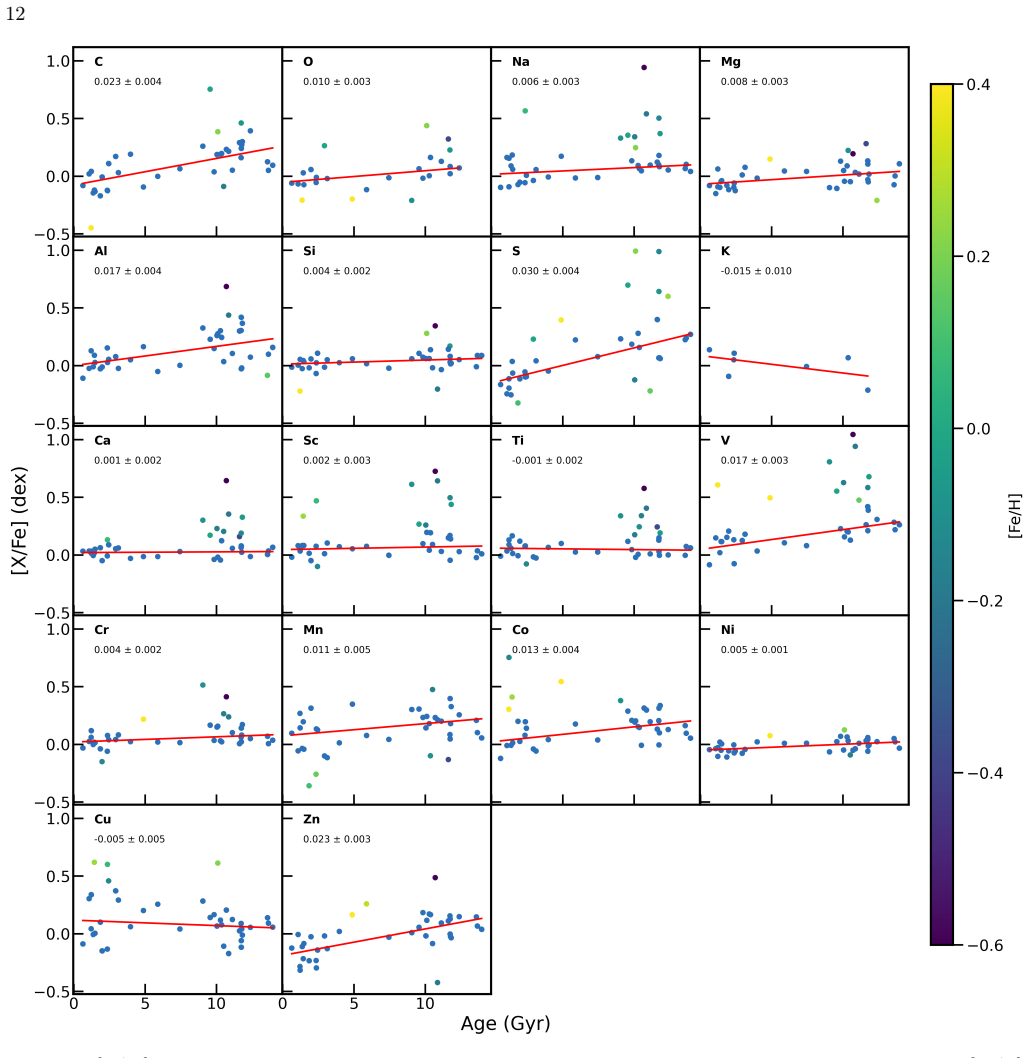
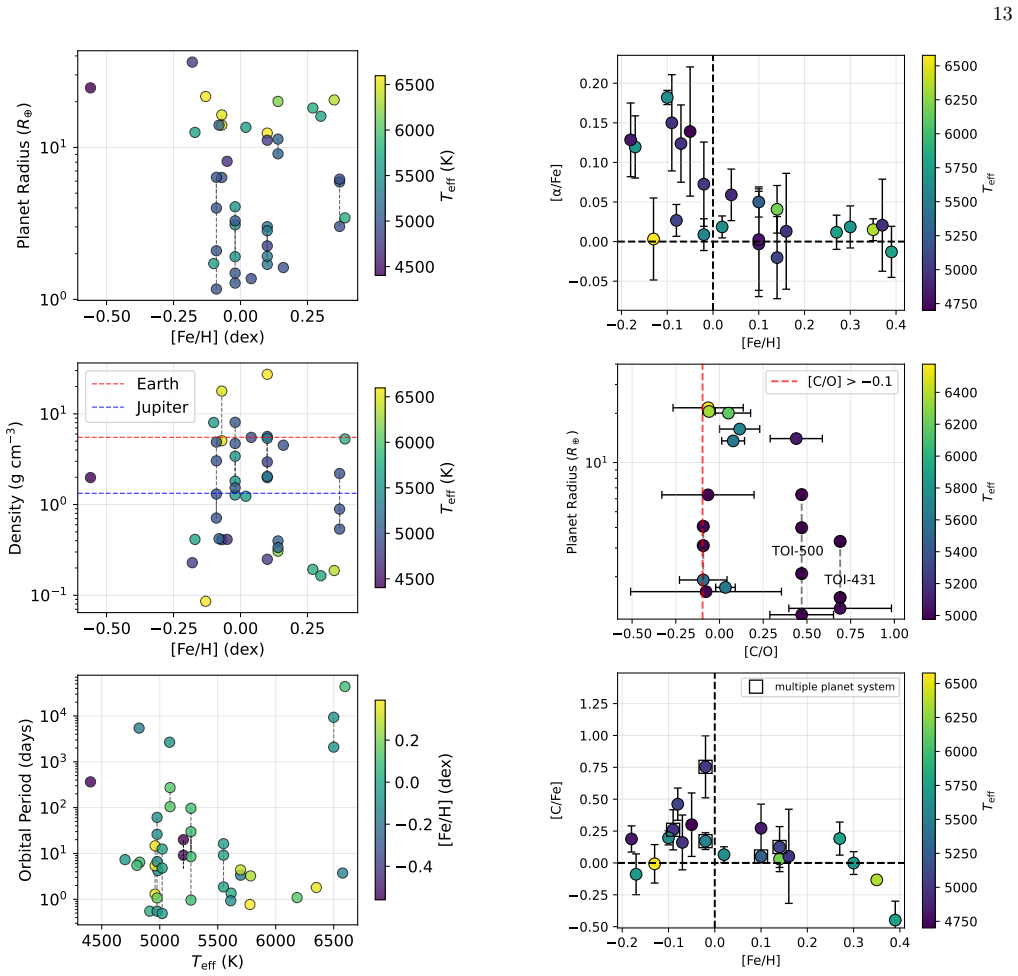
We present high-precision chemical abundances for 25 FGK-type stars hosting exoplanets observed in JWST Cycle 3 programs and all GTO and DDT programs from Cycles 1-3, based on high-resolution, high signal-to-noise ratio optical spectra from ground-based telescopes. Using a strictly differential, line-by-line analysis relative to the Sun, we derive homogeneous stellar parameters and abundances for 19 elements with atomic number Z <= 30. The sample spans a wide range of stellar properties, with [Fe/H] = -0.6 to +0.4 dex and effective temperatures between 4700 and 6600 K, and includes hosts of terrestrial and giant planets as well as multi-planet systems. We refine carbon and sulfur abundances in cool dwarfs using spectral synthesis, mitigating systematics from line blending. Several chemically interesting systems are identified, including mildly $\alpha$-enhanced metal-poor stars and multi-planet hosts with elevated [C/O]. Using isochrone ages, we derive empirical Galactic chemical evolution (GCE) relations and examine condensation temperature (Tcond) trends before and after GCE correction. The $T_{cond}$ slopes show no dependence on stellar or planetary properties, indicating that they reflect a mixture of multiple mechanisms, with planet-related signatures entangled in GCE and stellar evolution effects. Thus, Tcond trends require careful interpretation. Several systems with significantly positive or negative Tcond slopes are identified. Together with forthcoming JWST atmospheric measurements, this homogeneous stellar abundance catalog provides a basis for probing star-planet chemical connections and planet formation pathways.
Editorial analysis
A structured set of objections, weighed in public.
Referee Report
Summary. The manuscript presents a homogeneous set of high-precision chemical abundances for 19 elements (Z ≤ 30) in 25 FGK exoplanet-host stars, derived from ground-based high-resolution spectra using a strictly differential line-by-line analysis relative to the Sun. Isochrone ages are used to construct empirical Galactic chemical evolution (GCE) relations, which are then applied to analyze condensation temperature (Tcond) trends in the sample. The central result is that Tcond slopes exhibit no dependence on stellar parameters or planetary properties (e.g., presence of terrestrial vs. giant planets), leading to the conclusion that such trends reflect a mixture of GCE, stellar evolution, and entangled planet-formation effects. The work also highlights specific systems with anomalous abundances and provides the abundance catalog as a foundation for combining with JWST atmospheric data.
Significance. This study contributes a valuable, homogeneous abundance dataset for JWST planet-host stars, which will be useful for interpreting upcoming transmission and emission spectra. The finding that Tcond trends require careful interpretation after GCE correction is important for the broader debate on refractory element depletion in planet hosts. Strengths include the differential analysis mitigating systematics and the identification of chemically peculiar systems. However, the significance is tempered by the modest sample size for drawing firm conclusions on the absence of dependencies.
major comments (2)
- Section 5 (Tcond analysis and GCE correction): The headline claim that 'the Tcond slopes show no dependence on stellar or planetary properties' is load-bearing for the interpretation but is presented without sufficient statistical detail. With N=25 spanning a broad [Fe/H] range (-0.6 to +0.4) and Teff (4700-6600 K), and given abundance precisions typically 0.03-0.08 dex, it is unclear if the analysis has the power to exclude correlations at the amplitude expected from planet-related effects. Explicit reporting of Spearman or Pearson coefficients, associated p-values, or a power analysis for the null result is needed to support the conclusion.
- Section 4.1 (Empirical GCE relations): The GCE relations are fitted using isochrone ages from the same sample. This creates a potential circularity where any planet-induced abundance variations could be partially absorbed into the GCE trends, artificially flattening the post-correction Tcond slopes. A test showing the sensitivity of the null result to the GCE fit (e.g., by excluding multi-planet hosts or using literature ages) would strengthen the analysis.
minor comments (3)
- Abstract: The phrase 'refine carbon and sulfur abundances in cool dwarfs using spectral synthesis, mitigating systematics from line blending' would benefit from a brief mention of the specific lines or the achieved precision improvement.
- Section 2 (Observations and sample): Clarify the exact selection criteria for including the 25 stars from the JWST Cycle 3, GTO, and DDT programs, and whether the sample is representative or biased toward certain planet architectures.
- Figure captions: Ensure all figures showing Tcond slopes include error bars on the slopes and the number of points used in each correlation.
Simulated Author's Rebuttal
We thank the referee for the constructive comments and positive assessment of the homogeneous abundance dataset and its relevance to JWST observations. We address each major comment below and have revised the manuscript to incorporate additional statistical details and sensitivity tests.
read point-by-point responses
-
Referee: Section 5 (Tcond analysis and GCE correction): The headline claim that 'the Tcond slopes show no dependence on stellar or planetary properties' is load-bearing for the interpretation but is presented without sufficient statistical detail. With N=25 spanning a broad [Fe/H] range (-0.6 to +0.4) and Teff (4700-6600 K), and given abundance precisions typically 0.03-0.08 dex, it is unclear if the analysis has the power to exclude correlations at the amplitude expected from planet-related effects. Explicit reporting of Spearman or Pearson coefficients, associated p-values, or a power analysis for the null result is needed to support the conclusion.
Authors: We agree that explicit statistical measures will strengthen support for the null result. In the revised manuscript, we report Spearman rank correlation coefficients and p-values between the Tcond slopes and stellar parameters (Teff, [Fe/H], age) as well as planetary properties (planet mass, radius, multiplicity, terrestrial vs. giant). We also include a brief power analysis based on the sample size, abundance uncertainties, and expected effect amplitudes from planet-formation models. These additions confirm the lack of significant correlations while transparently indicating the statistical power of the dataset. revision: yes
-
Referee: Section 4.1 (Empirical GCE relations): The GCE relations are fitted using isochrone ages from the same sample. This creates a potential circularity where any planet-induced abundance variations could be partially absorbed into the GCE trends, artificially flattening the post-correction Tcond slopes. A test showing the sensitivity of the null result to the GCE fit (e.g., by excluding multi-planet hosts or using literature ages) would strengthen the analysis.
Authors: We acknowledge the potential for circularity when fitting GCE relations to isochrone ages from the same stars. In the revised manuscript, we add sensitivity tests that (1) refit the GCE relations after excluding multi-planet hosts and (2) substitute literature ages for isochrone ages where available. In both cases the post-correction Tcond slopes remain independent of stellar and planetary properties, with no material change to the conclusions. These tests are now described in Section 4.1 with updated figures. revision: yes
Circularity Check
No significant circularity in derivation chain
full rationale
The paper derives empirical GCE relations from isochrone ages within the 25-star sample and applies them to examine Tcond trends before/after correction, but the headline result (no Tcond slope dependence on stellar/planetary properties) is a statistical outcome from independent per-star slope measurements and does not reduce by construction to the GCE fit itself. No self-definitional loops, fitted inputs renamed as predictions, or load-bearing self-citations appear in the described chain; the analysis remains grounded in new differential spectroscopy and external isochrone models.
Axiom & Free-Parameter Ledger
axioms (2)
- domain assumption Strictly differential line-by-line analysis relative to the Sun removes systematic errors in stellar abundances for the 19 elements.
- domain assumption Isochrone ages provide sufficiently accurate stellar ages to derive empirical GCE relations that can be subtracted from Tcond trends.
Reference graph
Works this paper leans on
-
[1]
Abate , C., Pols , O. R., Izzard , R. G., & Karakas , A. I. 2015, , 581, A22, 10.1051/0004-6361/201525876
-
[2]
Adibekyan , V., Santos , N. C., Figueira , P., et al. 2015, , 581, L2, 10.1051/0004-6361/201527059
-
[3]
Ahrer , E.-M., Stevenson , K. B., Mansfield , M., et al. 2023, , 614, 653, 10.1038/s41586-022-05590-4
-
[4]
2025b, Monthly Notices of the Royal Astronomical Society, 540, 2535, doi: 10.1093/mnras/staf819
Ahrer , E.-M., Gandhi , S., Alderson , L., et al. 2025, , 540, 2535, 10.1093/mnras/staf819
-
[5]
Ali-Dib , M., Mousis , O., Petit , J.-M., & Lunine , J. I. 2014, , 785, 125, 10.1088/0004-637X/785/2/125
-
[6]
R., Hellier , C., Gillon , M., et al
Anderson , D. R., Hellier , C., Gillon , M., et al. 2010, , 709, 159, 10.1088/0004-637X/709/1/159
-
[7]
2020, , 640, A123, 10.1051/0004-6361/202038511
Baratella , M., D'Orazi , V., Biazzo , K., et al. 2020, , 640, A123, 10.1051/0004-6361/202038511
-
[8]
Barros , S. C. C., Demangeon , O. D. S., Armstrong , D. J., et al. 2023, , 673, A4, 10.1051/0004-6361/202245741
-
[9]
Bedell , M., Bean , J. L., Mel \'e ndez , J., et al. 2018, , 865, 68, 10.3847/1538-4357/aad908
-
[10]
2009, MNRAS, 398, 2122, doi: 10.1111/j.1365-2966.2009.15261.x
Bergemann , M., Pickering , J. C., & Gehren , T. 2010, , 401, 1334, 10.1111/j.1365-2966.2009.15736.x
-
[11]
Bergemann , M., Gallagher , A. J., Eitner , P., et al. 2019, , 631, A80, 10.1051/0004-6361/201935811
-
[12]
2022, , 664, A161, 10.1051/0004-6361/202243467
Biazzo , K., D'Orazi , V., Desidera , S., et al. 2022, , 664, A161, 10.1051/0004-6361/202243467
-
[13]
S., Desidera, S., Benatti, S., et al
Bonomo , A. S., Desidera , S., Benatti , S., et al. 2017, , 602, A107, 10.1051/0004-6361/201629882
-
[14]
Brewer , J. M., & Fischer , D. A. 2016, , 831, 20, 10.3847/0004-637X/831/1/20
-
[15]
Cugno , G., & Grant , S. L. 2025, , 991, L46, 10.3847/2041-8213/ae0290
-
[16]
2024, , 688, A193, 10.1051/0004-6361/202450604
da Silva , R., Danielski , C., Delgado Mena , E., et al. 2024, , 688, A193, 10.1051/0004-6361/202450604
-
[17]
doi:10.1146/annurev-astro-081817-051853 , eprint =
Dawson , R. I., & Johnson , J. A. 2018, , 56, 175, 10.1146/annurev-astro-081817-051853
work page Pith review doi:10.1146/annurev-astro-081817-051853 2018
-
[18]
Deeg , H. J., Georgieva , I. Y., Nowak , G., et al. 2023, , 677, A12, 10.1051/0004-6361/202346370
-
[19]
Delgado Mena , E., Adibekyan , V., Santos , N. C., et al. 2021, , 655, A99, 10.1051/0004-6361/202141588
-
[20]
Denissenkov , P. A., & Pinsonneault , M. 2008, , 679, 1541, 10.1086/587681
-
[21]
2017, , 608, A92, 10.1051/0004-6361/201731491
Dr a \.z kowska , J., & Alibert , Y. 2017, , 608, A92, 10.1051/0004-6361/201731491
-
[22]
2024, Nature, 625, 51, doi: 10.1038/s41586-023-06849-0
Dyrek , A., Min , M., Decin , L., et al. 2024, , 625, 51, 10.1038/s41586-023-06849-0
-
[23]
1993, , 275, 101
Edvardsson , B., Andersen , J., Gustafsson , B., et al. 1993, , 275, 101
1993
-
[24]
Edwards , B., Changeat , Q., Tsiaras , A., et al. 2023, , 269, 31, 10.3847/1538-4365/ac9f1a
-
[25]
2019, , 490, 5002, 10.1093/mnras/stz2912
Feng , F., Anglada-Escud \'e , G., Tuomi , M., et al. 2019, , 490, 5002, 10.1093/mnras/stz2912
-
[26]
Filomeno , S., Biazzo , K., Baratella , M., et al. 2024, , 690, A370, 10.1051/0004-6361/202450611
-
[27]
Fischer , D. A., & Valenti , J. 2005, , 622, 1102, 10.1086/428383
-
[28]
Gaia Collaboration , Vallenari , A., Brown , A. G. A., et al. 2023, , 674, A1, 10.1051/0004-6361/202243940
-
[29]
Gardner , J. P., Mather , J. C., Abbott , R., et al. 2023, , 135, 068001, 10.1088/1538-3873/acd1b5
-
[30]
2024, , 689, A185, 10.1051/0004-6361/202449951
Godoy , N., Choquet , E., Serabyn , E., et al. 2024, , 689, A185, 10.1051/0004-6361/202449951
-
[31]
2008, A&A, 486, 951, doi: 10.1051/0004-6361:200809724
Gustafsson , B., Edvardsson , B., Eriksson , K., et al. 2008, , 486, 951, 10.1051/0004-6361:200809724
-
[32]
Hartman , J. D., Bakos , G. \'A ., Kipping , D. M., et al. 2011 a , , 728, 138, 10.1088/0004-637X/728/2/138
-
[33]
Hartman , J. D., Bakos , G. \'A ., Sato , B., et al. 2011 b , , 726, 52, 10.1088/0004-637X/726/1/52
-
[34]
D., Jord \'a n , A., Bayliss , D., et al
Hartman , J. D., Jord \'a n , A., Bayliss , D., et al. 2020, , 159, 173, 10.3847/1538-3881/ab7821
-
[35]
Hayden , M. R., Bovy , J., Holtzman , J. A., et al. 2015, , 808, 132, 10.1088/0004-637X/808/2/132
-
[36]
2009, , 693, 1920, 10.1088/0004-637X/693/2/1920
Hebb , L., Collier-Cameron , A., Loeillet , B., et al. 2009, , 693, 1920, 10.1088/0004-637X/693/2/1920
-
[37]
2012, MNRAS, 427, 127, doi: 10.1111/j.1365-2966.2012.21948.x
Hellier , C., Anderson , D. R., Collier Cameron , A., et al. 2012, , 426, 739, 10.1111/j.1365-2966.2012.21780.x
-
[38]
Hinkley , S., Lacour , S., Marleau , G. D., et al. 2023, , 671, L5, 10.1051/0004-6361/202244727
-
[39]
J., Trifonov , T., Henning , T., et al
Hobson , M. J., Trifonov , T., Henning , T., et al. 2023, , 166, 201, 10.3847/1538-3881/acfc1d
-
[40]
W., Sinukoff , E., Blunt , S., et al
Howard , A. W., Sinukoff , E., Blunt , S., et al. 2025, , 278, 52, 10.3847/1538-4365/adc5e4
-
[41]
Jiang , H., Wang , Y., Ormel , C. W., Krijt , S., & Dong , R. 2023, , 678, A33, 10.1051/0004-6361/202346637
-
[42]
Johnson , B. C., Walsh , K. J., Minton , D. A., Krot , A. N., & Levison , H. F. 2016, Science Advances, 2, e1601658, 10.1126/sciadv.1601658
-
[43]
Johnson , J. A., Aller , K. M., Howard , A. W., & Crepp , J. R. 2010, , 122, 905, 10.1086/655775
-
[44]
JWST Transiting Exoplanet Community Early Release Science Team , Ahrer , E.-M., Alderson , L., et al. 2023, , 614, 649, 10.1038/s41586-022-05269-w
-
[45]
2017, in Astronomical Society of the Pacific Conference Series, Vol
Korotin , S., Andrievsky , S., Caffau , E., & Bonifacio , P. 2017, in Astronomical Society of the Pacific Conference Series, Vol. 510, Stars: From Collapse to Collapse, ed. Y. Y. Balega , D. O. Kudryavtsev , I. I. Romanyuk , & I. A. Yakunin , 141
2017
-
[46]
T., Lavvas , P., Huang , C., et al
Koskinen , T. T., Lavvas , P., Huang , C., et al. 2022, , 929, 52, 10.3847/1538-4357/ac4f45
-
[47]
Kunimoto , M., Vanderburg , A., Huang , C. X., et al. 2023, , 166, 7, 10.3847/1538-3881/acd537
-
[48]
Lind , K., Asplund , M., Barklem , P. S., & Belyaev , A. K. 2011, , 528, A103, 10.1051/0004-6361/201016095
-
[49]
2024, , 627, 501, 10.1038/s41586-024-07091-y
Liu , F., Ting , Y.-S., Yong , D., et al. 2024, , 627, 501, 10.1038/s41586-024-07091-y
-
[50]
Llop-Sayson , J., Wang , J. J., Ruffio , J.-B., et al. 2021, , 162, 181, 10.3847/1538-3881/ac134a
-
[51]
MacDougall , M. G., Petigura , E. A., Gilbert , G. J., et al. 2023, , 166, 33, 10.3847/1538-3881/acd557
-
[52]
2012, ApJ, 758, 36, doi: 10.1088/0004-637X/758/1/36
Madhusudhan , N. 2012, , 758, 36, 10.1088/0004-637X/758/1/36
-
[53]
2022, , 663, A161, 10.1051/0004-6361/202243405
Magrini , L., Danielski , C., Bossini , D., et al. 2022, , 663, A161, 10.1051/0004-6361/202243405
-
[54]
Maxted , P. F. L., Anderson , D. R., Collier Cameron , A., et al. 2013, , 125, 48, 10.1086/669231
-
[55]
D., L \'o pez-Morales , M., Brahm , R., & Jord \'a n , A
McGruder , C. D., L \'o pez-Morales , M., Brahm , R., & Jord \'a n , A. 2023, , 944, L56, 10.3847/2041-8213/acb154
-
[56]
2009, , 704, L66, 10.1088/0004-637X/704/1/L66
Mel \'e ndez , J., Asplund , M., Gustafsson , B., & Yong , D. 2009, , 704, L66, 10.1088/0004-637X/704/1/L66
-
[57]
Mesa , D., Baudino , J. L., Charnay , B., et al. 2018, , 612, A92, 10.1051/0004-6361/201731649
-
[58]
Miles , B. E., Biller , B. A., Patapis , P., et al. 2023, , 946, L6, 10.3847/2041-8213/acb04a
-
[59]
Murgas , F., Nowak , G., Masseron , T., et al. 2022, , 668, A158, 10.1051/0004-6361/202244459
-
[60]
2022, , 664, A163, 10.1051/0004-6361/202243743
Nardiello , D., Malavolta , L., Desidera , S., et al. 2022, , 664, A163, 10.1051/0004-6361/202243743
-
[61]
2026 a , Planetary Systems Table, NExScI–Caltech/IPAC, 10.26133/NEA12
NASA Exoplanet Archive . 2026 a , Planetary Systems Table, NExScI–Caltech/IPAC, 10.26133/NEA12
-
[62]
---. 2026 b , Planetary Systems Composite Table, NExScI–Caltech/IPAC, 10.26133/NEA13
-
[63]
Newton , E. R., Mann , A. W., Kraus , A. L., et al. 2021, , 161, 65, 10.3847/1538-3881/abccc6
-
[64]
Osborn , A., Armstrong , D. J., Cale , B., et al. 2021, , 507, 2782, 10.1093/mnras/stab2313
-
[65]
2024, , 976, 202, 10.3847/1538-4357/ad6f03
Peng , B., & Valencia , D. 2024, , 976, 202, 10.3847/1538-4357/ad6f03
-
[66]
, year = 1996, month = nov, volume =
Pollack , J. B., Hubickyj , O., Bodenheimer , P., et al. 1996, , 124, 62, 10.1006/icar.1996.0190
-
[67]
Ram \' rez , I., Allende Prieto , C., & Lambert , D. L. 2007, , 465, 271, 10.1051/0004-6361:20066619
-
[69]
2014 b , , 572, A48, 10.1051/0004-6361/201424244
---. 2014 b , , 572, A48, 10.1051/0004-6361/201424244
-
[70]
2022, in Society of Photo-Optical Instrumentation Engineers (SPIE) Conference Series, Vol
Romaniello , M. 2022, in Society of Photo-Optical Instrumentation Engineers (SPIE) Conference Series, Vol. 12186, Observatory Operations: Strategies, Processes, and Systems IX, ed. D. S. Adler , R. L. Seaman , & C. R. Benn , 121860D, 10.1117/12.2628253
-
[71]
Santos , N. C., Israelian , G., & Mayor , M. 2004, , 415, 1153, 10.1051/0004-6361:20034469
-
[73]
2008 b , , 491, 311, 10.1051/0004-6361:20078840
---. 2008 b , , 491, 311, 10.1051/0004-6361:20078840
-
[74]
Serrano , L. M., Gandolfi , D., Mustill , A. J., et al. 2022, Nature Astronomy, 6, 736, 10.1038/s41550-022-01641-y
-
[75]
Stassun , K. G., Collins , K. A., & Gaudi , B. S. 2017, , 153, 136, 10.3847/1538-3881/aa5df3
-
[76]
2026, , 282, 37, 10.3847/1538-4365/ae2a29
Sun , Q. 2026, , 282, 37, 10.3847/1538-4365/ae2a29
-
[77]
Sun , Q., Ji , C., Wang , S. X., et al. 2025 a , , 701, A107, 10.1051/0004-6361/202556272
-
[78]
X., Welbanks , L., Teske , J., & Buchner , J
Sun , Q., Wang , S. X., Welbanks , L., Teske , J., & Buchner , J. 2024, , 167, 167, 10.3847/1538-3881/ad298d
-
[79]
Sun , Q., Wang , S. X., Gan , T., et al. 2025 b , , 980, 179, 10.3847/1538-4357/ad9924
-
[80]
Swastik , C., Banyal , R. K., Narang , M., et al. 2021, , 161, 114, 10.3847/1538-3881/abd802
-
[81]
Tran , H. D., Holt , J., Goodrich , R. W., et al. 2014, in Society of Photo-Optical Instrumentation Engineers (SPIE) Conference Series, Vol. 9152, Software and Cyberinfrastructure for Astronomy III, ed. G. Chiozzi & N. M. Radziwill , 91522I, 10.1117/12.2054830
-
[82]
2025, , 697, A102, 10.1051/0004-6361/202453059
Tsantaki , M., Magrini , L., Danielski , C., et al. 2025, , 697, A102, 10.1051/0004-6361/202453059
discussion (0)
Sign in with ORCID, Apple, or X to comment. Anyone can read and Pith papers without signing in.