Recognition: unknown
Galaxy Populations in the IllustrisTNG Caustic Skeleton
Pith reviewed 2026-05-10 03:47 UTC · model grok-4.3
The pith
Galaxy properties form a continuous sequence across scales in the cosmic web, reflecting the formation times of its structural elements.
A machine-rendered reading of the paper's core claim, the machinery that carries it, and where it could break.
Core claim
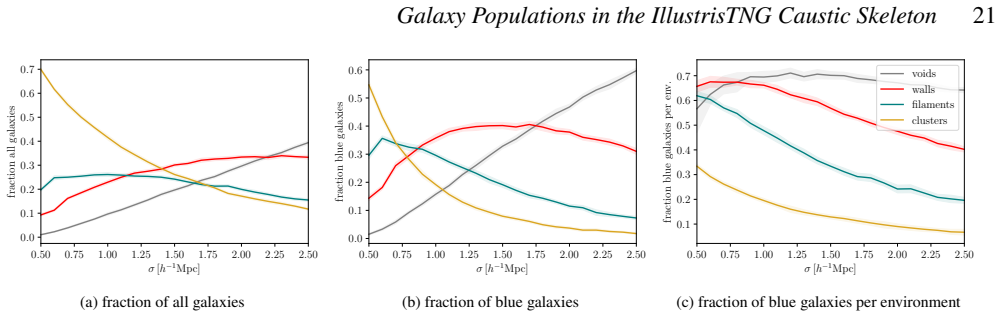
By building the multiscale caustic skeleton of the dark matter distribution in IllustrisTNG, galaxies are classified by the voids, walls, filaments, and nodes they occupy at different scales. Their colors and star formation rates form a continuum in this scale-space web, tied to the hierarchical build-up of structure and the formation epochs of each web component.
What carries the argument
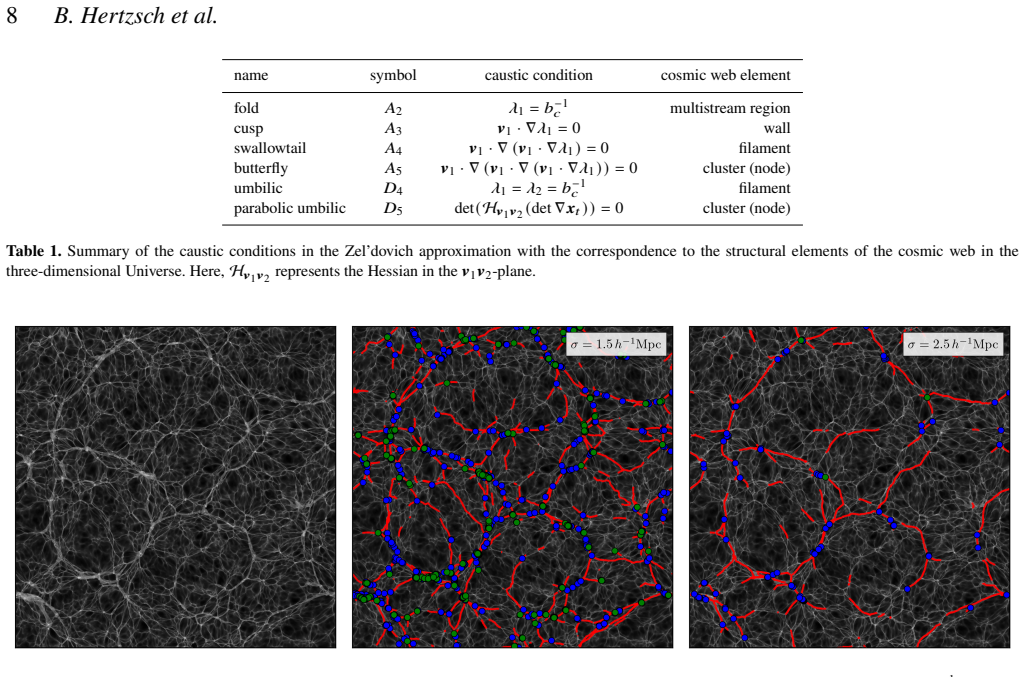
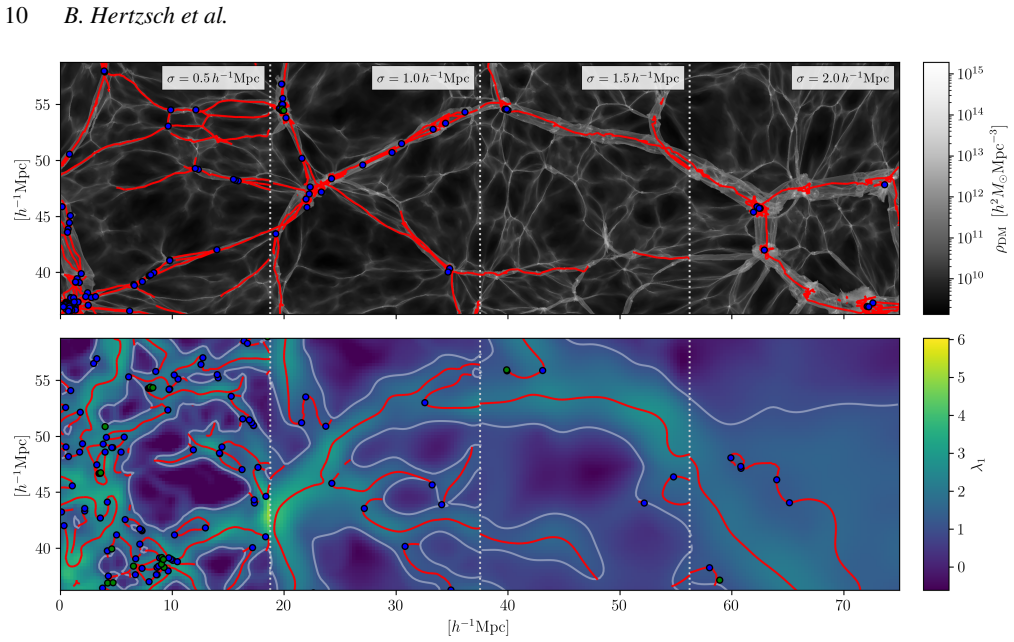
The multiscale caustic skeleton: a parameter-free formalism that traces the hierarchical formation of the cosmic web from singularities in the dark matter flow, used here to classify galaxy environments across scales.
If this is right
- Galaxy colors and star formation rates depend on the formation epoch of the enclosing web element at each scale.
- The color-density relation arises because denser structures form earlier and host more evolved galaxies.
- Multiscale caustic analysis gives a systematic way to quantify how web formation time shapes galaxy properties.
- Baryonic gas near the caustics reflects the multistreaming character of the web at each scale.
Where Pith is reading between the lines
- Large observational surveys could reconstruct caustic skeletons from galaxy positions and test whether the same continuum appears in real data.
- Galaxy formation models may need to track scale-dependent assembly times more explicitly to reproduce these trends.
- The method could be extended to other observables such as galaxy morphology or metallicity to map additional scale-dependent effects.
Load-bearing premise
Galaxies can be unambiguously associated with specific caustic features at multiple scales without major misclassification from simulation resolution or baryonic physics.
What would settle it
Re-running the classification with an independent environmental finder or higher-resolution run and finding no smooth continuum in galaxy colors or star formation with web scale.
Figures







read the original abstract
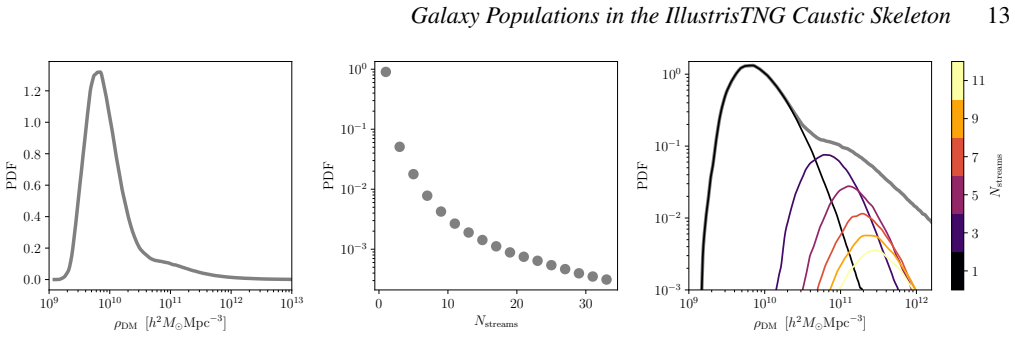
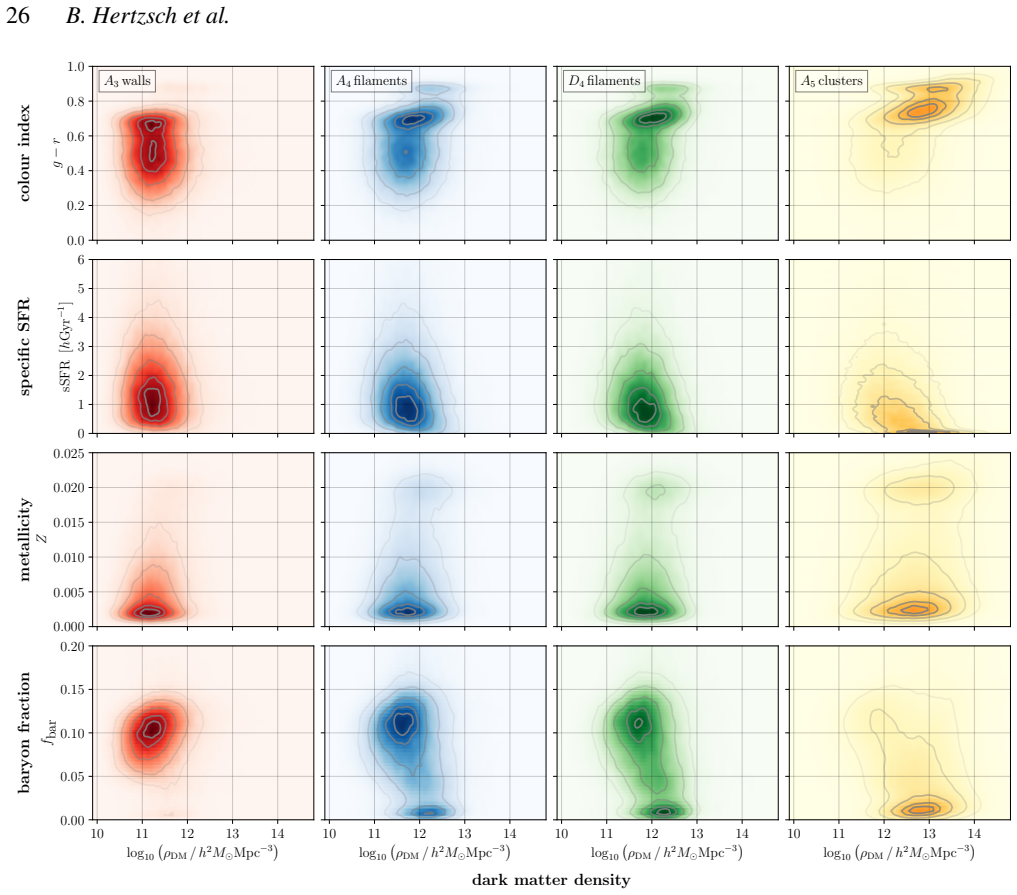
The caustic skeleton is a parameter-free and mathematically rigorous formalism for tracing the hierarchical formation history of the multiscale cosmic web from the singularities in the underlying dark matter flow. In the present study, we explicitly use the multistreaming nature of the cosmic mass distribution to address the influence of the weblike embedding on the galaxy populations and discern their properties in different web environments. To this end, we construct the multiscale caustic skeleton of the dark mass distribution in the state-of-the-art suite of the large-scale IllustrisTNG simulations. In addition to the multistreaming dark matter density field, we assess the characteristic properties of the intergalactic baryonic gas in the vicinity of the caustics. Next, we associate the galaxies with the voids, walls, filaments and cluster nodes, and investigate their colours and star formation activities. A unique feature of the analysis is that it explicitly addresses the multiscale aspects with respect to the galaxy population, assessing issues such as the fraction of (blue) galaxies as a function of the scale of the cosmic web pattern and its caustic features. We find that the galaxy properties form a continuum in the scale-space cosmic web. Intimately coupled to the hierarchical build-up of the cosmic structure, it also allows us to systematically assess the impact of the formation time of the various structural components of the cosmic web on the galaxy properties. This furthers insight into the establishment of the observed colour-density relation of galaxies.
Editorial analysis
A structured set of objections, weighed in public.
Referee Report
Summary. The paper applies the parameter-free caustic skeleton formalism, derived from the multistreaming dark matter flow, to the IllustrisTNG simulations. It constructs the multiscale cosmic web, associates galaxies (via baryonic subhalos) with voids, walls, filaments, and nodes across scales, and analyzes their colors, star formation rates, and formation times. The central claim is that galaxy properties form a continuum in scale-space, directly coupled to the hierarchical assembly of cosmic structure and offering insight into the color-density relation.
Significance. If the galaxy-caustic associations prove robust, the work supplies a mathematically rigorous, simulation-based framework for tracing environmental effects on galaxies across the full hierarchy of the cosmic web. The explicit multiscale treatment and use of public TNG data are strengths that could enable reproducible tests of how structure formation time imprints on observed galaxy populations.
major comments (2)
- [§3.3] §3.3 (Galaxy association procedure): The mapping of TNG galaxies to multiscale caustic features is described via proximity in the DM multistreaming field, but no quantitative robustness tests (e.g., resolution degradation runs or DM-only vs. full-physics comparisons) are reported. At small scales where caustic spacing approaches the DM particle resolution (~10^6 M⊙), baryonic displacement could produce misclassifications that contribute to the reported continuum in blue fraction and SFR versus scale.
- [§5.1] §5.1 (Results on scale-dependent properties): The claim that galaxy properties form a 'continuum' across web scales relies on the hierarchical classification; however, the trends lack explicit statistical controls for classification uncertainty or covariance induced by the nested caustic structure, weakening the link to hierarchical build-up.
minor comments (2)
- [Figure 4] Figure 4 and associated text: Axis labels and legends should explicitly state the smoothing scales used for each caustic skeleton level to improve readability of the multiscale trends.
- [Results] The abstract states that formation times of structural components are assessed, yet the results section provides only qualitative discussion; a quantitative table or plot of median formation redshift per web element would clarify this point.
Simulated Author's Rebuttal
We thank the referee for the constructive and detailed comments on our manuscript. We address each major point below, agreeing that additional robustness tests and statistical controls will strengthen the presentation. We will incorporate these revisions in the updated version.
read point-by-point responses
-
Referee: [§3.3] §3.3 (Galaxy association procedure): The mapping of TNG galaxies to multiscale caustic features is described via proximity in the DM multistreaming field, but no quantitative robustness tests (e.g., resolution degradation runs or DM-only vs. full-physics comparisons) are reported. At small scales where caustic spacing approaches the DM particle resolution (~10^6 M⊙), baryonic displacement could produce misclassifications that contribute to the reported continuum in blue fraction and SFR versus scale.
Authors: We agree that quantitative robustness tests for the association procedure were not reported and represent a gap in the current manuscript. The classification is performed using the dark-matter multistreaming field, which is computed directly from the DM particles and is therefore largely insensitive to baryonic physics. To address the referee's concern about possible misclassifications at small scales, we will add a dedicated subsection presenting (i) direct comparisons of galaxy-caustic associations between the full-physics TNG runs and the corresponding DM-only simulations, and (ii) resolution-degradation tests in which the particle number is reduced before recomputing the caustic skeleton. These tests will quantify any residual impact of baryonic displacement on the reported trends in blue fraction and SFR, thereby confirming that the continuum is not driven by classification artifacts. revision: yes
-
Referee: [§5.1] §5.1 (Results on scale-dependent properties): The claim that galaxy properties form a 'continuum' across web scales relies on the hierarchical classification; however, the trends lack explicit statistical controls for classification uncertainty or covariance induced by the nested caustic structure, weakening the link to hierarchical build-up.
Authors: We concur that explicit statistical controls would make the connection to hierarchical assembly more rigorous. In the revised manuscript we will introduce bootstrap resampling of the galaxy sample to propagate classification uncertainties (arising from the proximity criterion) into the reported trends. In addition, we will perform conditional analyses that hold the classification fixed at larger scales while varying the scale of interest; this isolates the incremental effect of each nested level and quantifies the covariance induced by the hierarchical structure. These controls will be presented alongside the existing figures, providing a clearer statistical foundation for the continuum interpretation. revision: yes
Circularity Check
No circularity: empirical mapping in simulations with no self-referential derivations
full rationale
The paper applies the pre-existing caustic skeleton formalism (described as parameter-free and based on multistreaming singularities in the DM flow) to the IllustrisTNG suite. Galaxy associations to voids/walls/filaments/nodes and the reported continuum of properties (colors, SFR, formation times) across scales are obtained by direct classification and measurement in the simulation outputs. No equations reduce a claimed prediction to a fitted input by construction, no ansatz is smuggled via self-citation, and the central results do not rely on uniqueness theorems or self-citations that are themselves unverified within the paper. The analysis is self-contained as an observational study of simulation data.
Axiom & Free-Parameter Ledger
axioms (1)
- domain assumption The caustic skeleton formalism traces the hierarchical formation history of the cosmic web from singularities in the underlying dark matter flow.
Reference graph
Works this paper leans on
-
[1]
The Messenger , keywords =. doi:10.18727/0722-6691/5117 , archiveprefix =. 1903.02464 , primaryclass =
-
[2]
Abel, Tom and Hahn, Oliver and Kaehler, Ralf , title =. Monthly Notices of the Royal Astronomical Society , volume =. 2012 , month =. doi:10.1111/j.1365-2966.2012.21754.x , url =
-
[3]
2026 , note =
, author =. 2026 , note =
2026
-
[4]
doi:10.1093/mnrasl/slu019 , archiveprefix =
, keywords =. doi:10.1093/mnrasl/slu019 , archiveprefix =. 1401.7331 , primaryclass =
-
[5]
LRCA8(1), 1 (2022) https://doi.org/10.1007/s41115-021-00013-z arXiv:2112.05165 [astro- ph.CO]
Angulo, Raul E. and Hahn, Oliver , year =. Large-scale dark matter simulations , volume =. Living Reviews in Computational Astrophysics , publisher =. doi:10.1007/s41115-021-00013-z , number =
-
[6]
Astrophysical Journal723(1), 364–382 (2010) https://doi
, keywords =. doi:10.1088/0004-637X/723/1/364 , archiveprefix =. 0809.5104 , primaryclass =
-
[7]
A&A , year = 2007, volume = 474, number = 1, pages =
The multiscale morphology filter: identifying and extracting spatial patterns in the galaxy distribution , doi =. A&A , year = 2007, volume = 474, number = 1, pages =
2007
-
[8]
doi:10.1086/511633 , archiveprefix =
, keywords =. doi:10.1086/511633 , archiveprefix =. astro-ph/0610249 , primaryclass =
-
[9]
2010, MNRAS, 407, 1403, doi: 10.1111/j.1365-2966.2010.16985.x
Aragón-Calvo, Miguel A. and van de Weygaert, Rien and Jones, Bernard J. T. , title =. Monthly Notices of the Royal Astronomical Society , volume =. 2010 , month =. doi:10.1111/j.1365-2966.2010.17263.x , url =
-
[10]
doi:10.1093/mnras/stv2301 , archiveprefix =
, keywords =. doi:10.1093/mnras/stv2301 , archiveprefix =. 1210.7871 , primaryclass =
-
[11]
doi:10.21105/astro.1697.07881 , archiveprefix =
The Open Journal of Astrophysics , keywords =. doi:10.21105/astro.1697.07881 , archiveprefix =. 1607.07881 , primaryclass =
-
[12]
The Zeldovich Universe: Genesis and Growth of the Cosmic Web , year = 2016, editor =
The origin of the galaxy color bimodality. The Zeldovich Universe: Genesis and Growth of the Cosmic Web , year = 2016, editor =. doi:10.1017/S174392131601022X , adsurl =
-
[13]
Functional Analysis and Its Applications , year =
Normal forms for functions near degenerate critical points, the Weyl groups of Ak, Dk, Ek and Lagrangian singularities , author =. Functional Analysis and Its Applications , year =
-
[14]
1986 , month = feb, journal =
Evolution of Singularities of Potential Flows in Collision-Free Media and the Metamorphosis of Caustics in Three-Dimensional Space , author =. 1986 , month = feb, journal =
1986
-
[15]
Arnol'd, V. I , year =. Catastrophe. doi:10.1007/978-3-642-58124-3 , urldate =
-
[16]
and Gusein-Zade, S
Arnold, V. and Gusein-Zade, S. and Varchenko, A. , year =. Singularities of Differentiable Maps, Volume 1 , publisher =
-
[17]
Arnol'd, V. I. and Shandarin, S. F. and Zel'dovich,. The Large Scale Structure of the Universe. 1982 , month = apr, journal =. doi:10.1080/03091928208209001 , urldate =
-
[18]
K., Glazebrook K., Brinkmann J., Ivezi \'c Z ., Lupton R
The Astrophysical Journal , keywords =. doi:10.1086/380092 , archiveprefix =. astro-ph/0309710 , primaryclass =
-
[19]
doi:10.1086/426079 , archiveprefix =
The Astrophysical Journal , keywords =. doi:10.1086/426079 , archiveprefix =. astro-ph/0406266 , primaryclass =
-
[20]
Bamford, Steven P. and Nichol, Robert C. and Baldry, Ivan K. and Land, Kate and Lintott, Chris J. and Schawinski, Kevin and Slosar, Anže and Szalay, Alexander S. and Thomas, Daniel and Torki, Mehri and Andreescu, Dan and Edmondson, Edward M. and Miller, Christopher J. and Murray, Phil and Raddick, M. Jordan and Vandenberg, Jan , title =. Monthly Notices o...
-
[21]
Monthly Notices of the Royal Astronomical Society , volume =
Bernardeau, Francis and van de Weygaert, Rien , title =. Monthly Notices of the Royal Astronomical Society , volume =. 1996 , month =. doi:10.1093/mnras/279.2.693 , url =
-
[22]
The Astrophysical Journal , author =
, keywords =. doi:10.1086/185066 , adsurl =
-
[23]
, keywords =. doi:10.1086/191028 , adsurl =
-
[24]
doi:10.1093/mnras/stw280 , archiveprefix =
, keywords =. doi:10.1093/mnras/stw280 , archiveprefix =. 1601.08228 , primaryclass =
-
[25]
doi:10.1093/mnras/stw2362 , archiveprefix =
, keywords =. doi:10.1093/mnras/stw2362 , archiveprefix =. 1609.04920 , primaryclass =
-
[26]
Blanton, Michael R. and Eisenstein, Daniel and Hogg, David W. and Schlegel, David J. and Brinkmann, J. , title =. 2005 , month =. doi:10.1086/422897 , url =
-
[27]
Richard and Kofman, Lev and Pogosyan, Dmitri
Nature , keywords =. doi:10.1038/380603a0 , archiveprefix =. astro-ph/9512141 , primaryclass =
-
[28]
doi:10.1051/0004-6361/201731699 , archiveprefix =
, keywords =. doi:10.1051/0004-6361/201731699 , archiveprefix =. 1710.08699 , primaryclass =
-
[29]
Bouchet, F. R. and Colombi, S. and Hivon, E. and Juszkiewicz, R. , year =. Perturbative. Astronomy and Astrophysics , volume =. doi:10.48550/arXiv.astro-ph/9406013 , urldate =
-
[30]
doi:10.1093/mnras/stae667 , archiveprefix =
Monthly Notices of the Royal Astronomical Society , keywords =. doi:10.1093/mnras/stae667 , archiveprefix =. 2309.03282 , primaryclass =
-
[31]
doi:10.1093/mnras/stab2650 , archiveprefix =
, keywords =. doi:10.1093/mnras/stab2650 , archiveprefix =. 2107.03407 , primaryclass =
-
[32]
Lagrangian Dynamics in Non-Flat Universes and Non-Linear Gravitational Evolution , author =. 1995 , month = sep, journal =. doi:10.1093/mnras/276.1.115 , urldate =
-
[34]
doi:10.1093/mnras/sts416 , archiveprefix =
, keywords =. doi:10.1093/mnras/sts416 , archiveprefix =. 1209.2043 , primaryclass =
-
[35]
Cautun, Marius and van de Weygaert, Rien and Jones, Bernard J. T. and Frenk, Carlos S. , title =. Monthly Notices of the Royal Astronomical Society , volume =. 2014 , month =. doi:10.1093/mnras/stu768 , url =
-
[36]
doi:10.1086/304207 , archiveprefix =
, keywords =. doi:10.1086/304207 , archiveprefix =. astro-ph/9702079 , primaryclass =
-
[37]
arXiv e-prints , keywords =. doi:10.48550/arXiv.2604.07445 , archiveprefix =. 2604.07445 , primaryclass =
work page internal anchor Pith review Pith/arXiv arXiv doi:10.48550/arxiv.2604.07445
-
[38]
, keywords =. doi:10.1111/j.1365-2966.2012.21636.x , archiveprefix =. 1201.5794 , primaryclass =
-
[39]
doi:10.1093/mnras/stv1570 , archiveprefix =
, keywords =. doi:10.1093/mnras/stv1570 , archiveprefix =. 1504.06073 , primaryclass =
-
[40]
Monthly Notices of the Royal Astronomical Society , volume =
Codis, Sandrine and Pogosyan, Dmitri and Pichon, Christophe , title =. Monthly Notices of the Royal Astronomical Society , volume =. 2018 , month =. doi:10.1093/mnras/sty1643 , url =
-
[41]
32nd General Assembly International Union (IAUGA 2024) , year = 2024, month = aug, eid =
2024
-
[42]
2003 , eprint =
The 2dF Galaxy Redshift Survey: Final Data Release , author =. 2003 , eprint =
2003
-
[43]
2025, Nature Astronomy, 9, 1226, doi: 10.1038/s41550-025-02566-y
Nature Astronomy , keywords =. doi:10.1038/s41550-025-02566-y , archiveprefix =. 2409.16952 , primaryclass =
-
[44]
doi:10.1051/0004-6361/202449414 , archiveprefix =
, keywords =. doi:10.1051/0004-6361/202449414 , archiveprefix =. 2404.10823 , primaryclass =
-
[45]
Conselice, Christopher J. , title =. Monthly Notices of the Royal Astronomical Society , volume =. 2006 , month =. doi:10.1111/j.1365-2966.2006.11114.x , url =
-
[46]
Cooper, Michael C. and Newman, Jeffrey A. and Coil, Alison L. and Croton, Darren J. and Gerke, Brian F. and Yan, Renbin and Davis, Marc and Faber, S. M. and Guhathakurta, Puragra and Koo, David C. and Weiner, Benjamin J. and Willmer, Christopher N. A. , title =. Monthly Notices of the Royal Astronomical Society , volume =. 2007 , month =. doi:10.1111/j.13...
-
[47]
Crain, Robert A. and van de Voort, Freeke , year =. Hydrodynamical Simulations of the Galaxy Population: Enduring Successes and Outstanding Challenges , volume =. Annual Review of Astronomy and Astrophysics , publisher =. doi:10.1146/annurev-astro-041923-043618 , number =
-
[48]
doi:10.1093/mnras/sty2111 , archiveprefix =
, keywords =. doi:10.1093/mnras/sty2111 , archiveprefix =. 1809.04622 , primaryclass =
-
[49]
doi:10.1086/591512 , archiveprefix =
, keywords =. doi:10.1086/591512 , archiveprefix =. 0803.3453 , primaryclass =
-
[50]
doi:10.3847/1538-4357/837/1/16 , archiveprefix =
The Astrophysical Journal , keywords =. doi:10.3847/1538-4357/837/1/16 , archiveprefix =. 1611.05451 , primaryclass =
-
[51]
doi:10.1051/0004-6361/201935159 , archiveprefix =
, keywords =. doi:10.1051/0004-6361/201935159 , archiveprefix =. 1709.10378 , primaryclass =
-
[52]
, keywords =. doi:10.1111/j.1365-2966.2006.10145.x , archiveprefix =. astro-ph/0412300 , primaryclass =
-
[53]
Abdul Karim, et al., DESI DR2 results
, keywords =. doi:10.1103/2wwn-xjm5 , archiveprefix =. 2503.14739 , primaryclass =
-
[54]
, keywords =. doi:10.1103/tr6y-kpc6 , archiveprefix =. 2503.14738 , primaryclass =
-
[55]
2011, MNRAS, 415, 2101, doi: 10.1111/j.1365-2966.2011.18820.x
, keywords =. doi:10.1111/j.1365-2966.2011.19995.x , archiveprefix =. 1103.4607 , primaryclass =
-
[56]
, keywords =. doi:10.1111/j.1365-2966.2006.10511.x , archiveprefix =. astro-ph/0511357 , primaryclass =
-
[57]
doi:10.1038/s41586-023-06109-1 , archiveprefix =
, keywords =. doi:10.1038/s41586-023-06109-1 , archiveprefix =. 2306.16818 , primaryclass =
-
[58]
doi:10.1007/BF01001625 , adsurl =
Astrophysica , keywords =. doi:10.1007/BF01001625 , adsurl =
-
[59]
doi:10.1093/mnras/184.3.643 , adsurl =
Monthly Notices of the Royal Astronomical Society , keywords =. doi:10.1093/mnras/184.3.643 , adsurl =
-
[60]
doi:10.1086/304890 , archiveprefix =
, keywords =. doi:10.1086/304890 , archiveprefix =. astro-ph/9707232 , primaryclass =
-
[61]
The Astrophysical Journal , keywords =. doi:10.1086/157753 , adsurl =
-
[62]
Comments on Astrophysics , keywords =
-
[63]
Einasto, J. and Hütsi, G. and Kuutma, T. and Einasto, M. , year =. Correlation function: biasing and fractal properties of the cosmic web , volume =. doi:10.1051/0004-6361/202037683 , journal =
-
[64]
Fractal and Fractional , volume =
Einasto, Jaan , title =. Fractal and Fractional , volume =. 2025 , number =
2025
-
[65]
H., Harmon L., Lex A., Meyer M
IEEE Transactions on Vehicular Communications , keywords =. doi:10.1109/TVCG.2020.3030407 , adsurl =
-
[66]
doi:10.48550/arXiv.2204.01256 , archiveprefix =
arXiv e-prints , keywords =. doi:10.48550/arXiv.2204.01256 , archiveprefix =. 2204.01256 , primaryclass =
-
[67]
doi:10.1088/0004-637X/754/2/126 , archiveprefix =
, keywords =. doi:10.1088/0004-637X/754/2/126 , archiveprefix =. 1201.2353 , primaryclass =
-
[68]
Feldbrugge, Job and. Caustic. 2018 , journal =
2018
-
[69]
doi:10.1093/mnras/stae2627 , journal =
Feldbrugge, Job , title =. doi:10.1093/mnras/stae2627 , journal =. 2402.16234 , archiveprefix =
-
[70]
Feldbrugge, Job and Hertzsch, Benjamin , title =. 2025 , month =. doi:10.5281/zenodo.16637561 , url =
-
[71]
Cosmic Web & Caustic Skeleton: Non-Linear Constrained Realizations ---
Feldbrugge, Job and. Cosmic Web & Caustic Skeleton: Non-Linear Constrained Realizations ---. 2023 , journal =. doi:10.1088/1475-7516/2023/02/058 , keywords =
-
[72]
Monthly Notices of the Royal Astronomical Society , volume =
Feldbrugge, Job and van de Weygaert, Rien , title =. Monthly Notices of the Royal Astronomical Society , volume =. 2025 , month =. doi:10.1093/mnras/staf536 , url =
-
[73]
Monthly Notices of the Royal Astronomical Society , volume =
Feldbrugge, Job and Yan, Yihan and van de Weygaert, Rien , title =. Monthly Notices of the Royal Astronomical Society , volume =. 2023 , month =. doi:10.1093/mnras/stad2777 , url =
-
[74]
Ferreira, Leonardo and Adams, Nathan and Conselice, Christopher J. and Sazonova, Elizaveta and Austin, Duncan and Caruana, Joseph and Ferrari, Fabricio and Verma, Aprajita and Trussler, James and Broadhurst, Tom and Diego, Jose and Frye, Brenda L. and Pascale, Massimo and Wilkins, Stephen M. and Windhorst, Rogier A. and Zitrin, Adi , title =. 2022 , month...
-
[75]
Forero–Romero, J. E. and Hoffman, Y. and Gottlöber, S. and Klypin, A. and Yepes, G. , title =. Monthly Notices of the Royal Astronomical Society , volume =. 2009 , month =. doi:10.1111/j.1365-2966.2009.14885.x , url =
-
[76]
doi:10.1051/0004-6361/202039781 , archiveprefix =
, keywords =. doi:10.1051/0004-6361/202039781 , archiveprefix =. 2010.15139 , primaryclass =
-
[77]
doi:10.1051/0004-6361/202141974 , archiveprefix =
, keywords =. doi:10.1051/0004-6361/202141974 , archiveprefix =. 2109.06198 , primaryclass =
-
[78]
Monthly Notices of the Royal Astronomical Society , volume =
Ganeshaiah Veena, Punyakoti and Cautun, Marius and van de Weygaert, Rien and Tempel, Elmo and Jones, Bernard J T and Rieder, Steven and Frenk, Carlos S , title =. Monthly Notices of the Royal Astronomical Society , volume =. 2018 , month =. doi:10.1093/mnras/sty2270 , url =
-
[79]
doi:10.1093/mnras/stz1343 , archiveprefix =
, keywords =. doi:10.1093/mnras/stz1343 , archiveprefix =. 1903.06716 , primaryclass =
-
[80]
doi:10.1093/mnras/stab411 , archiveprefix =
, keywords =. doi:10.1093/mnras/stab411 , archiveprefix =. 2007.10365 , primaryclass =
-
[81]
2005, MNRAS, 361, L25, doi: 10.1111/j.1745-3933.2005.00057.x
, keywords =. doi:10.1111/j.1745-3933.2005.00084.x , archiveprefix =. astro-ph/0506510 , primaryclass =
discussion (0)
Sign in with ORCID, Apple, or X to comment. Anyone can read and Pith papers without signing in.