Recognition: 2 theorem links
· Lean TheoremWeak-lensing Analysis of Intracluster Filaments in Abell 2744: Matched-filter Scans and Stepwise 2D Tracing
Pith reviewed 2026-05-10 18:02 UTC · model grok-4.3
The pith
Stepwise tracing of local filament orientations resolves inconsistent weak-lensing constraints for the eastern structure in Abell 2744.
A machine-rendered reading of the paper's core claim, the machinery that carries it, and where it could break.
Core claim
Re-characterizing the eastern filament using the locally preferred elongation directions recovered by stepwise 2D tracing resolves the tensions between inner and outer weak-lensing constraints, improves overall fit quality, and produces consistent parameter estimates across radii where global reference-point scans failed.
What carries the argument
The stepwise 2D tracing method, which reconstructs locally varying filament orientations by scanning and connecting elongation directions in successive 2D steps rather than assuming a single global reference point.
If this is right
- The northwest filament yields stable constraints with either method, confirming that global scans suffice for straight structures.
- Detected filaments coincide with diffuse X-ray emission and previously known merger axes.
- Stepwise tracing becomes necessary once filaments curve or interact with complex substructure.
- Consistent inner-outer parameters allow reliable mass estimates for filamentary structures out to 3.4 Mpc.
Where Pith is reading between the lines
- The approach could map curved filaments in other merging clusters where global scans produce discrepant results.
- Ignoring local orientation changes may systematically bias filament mass and density estimates in large-scale structure studies.
- Application to upcoming wide-field weak-lensing surveys could tighten constraints on how clusters accrete mass along filaments.
Load-bearing premise
The weak-lensing signal in the eastern region is produced by one coherent filament whose local orientations can be recovered without major contamination from cluster substructure, projection effects, or shape noise.
What would settle it
Deeper imaging or spectroscopic data showing multiple overlapping filaments with unrelated orientations in the eastern region would eliminate the improved agreement obtained by using the stepwise local directions.
Figures





read the original abstract
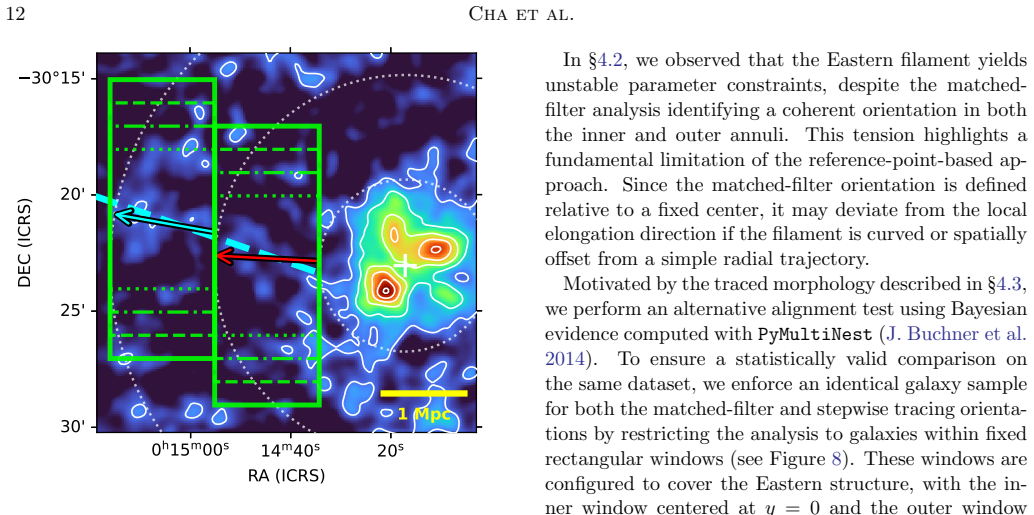
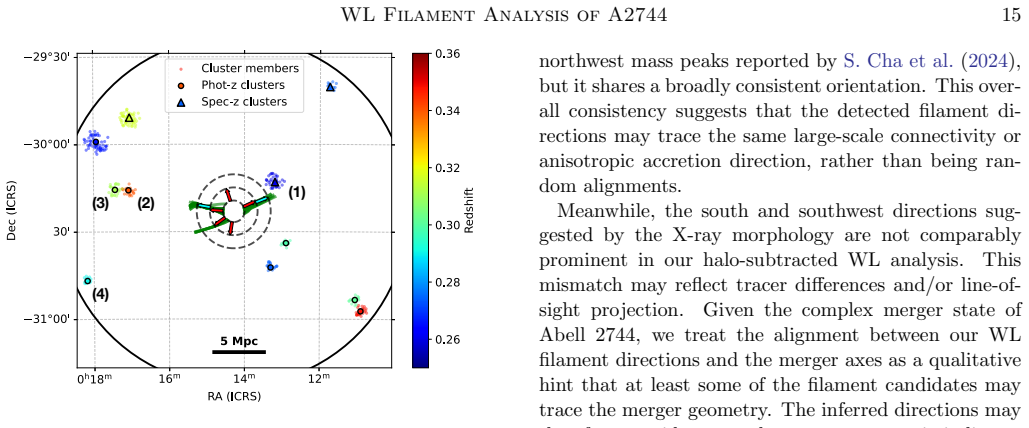
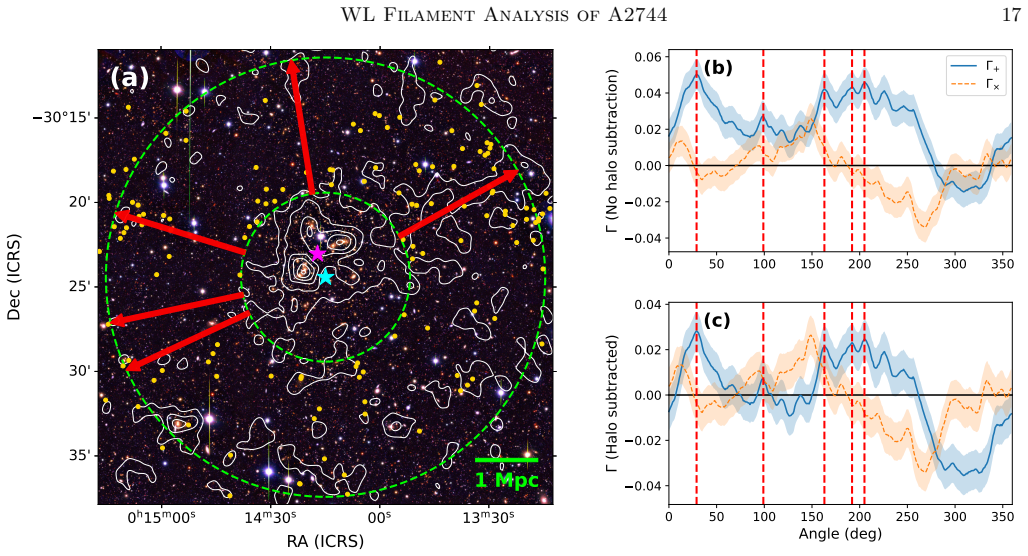
We present a weak-lensing (WL) analysis of filamentary structures in the merging galaxy cluster Abell 2744 using wide-field Magellan/MegaCam imaging data. We employ two complementary techniques: standard matched-filter scans to identify global orientations, and a new stepwise 2D tracing method to reconstruct locally varying filament orientations. The matched-filter analysis detects coherent filamentary features in the northwest and east directions across both inner (1.0-2.2 Mpc) and outer (2.2-3.4 Mpc) annuli. However, while the northwest filament yields consistent constraints across both regions, parameter inference for the eastern structure remains unstable and radially inconsistent when restricted to global reference-point scans. We demonstrate that re-characterizing the eastern structure using the locally preferred elongation directions from our stepwise tracer significantly resolves these tensions, improving fit quality and bringing inner and outer constraints into agreement. Furthermore, the detected filaments align well with diffuse X-ray structures and previously identified merger axes, supporting their physical connection to the cluster's mass assembly. These results highlight that stepwise 2D tracing is essential for characterizing curved or complex filaments where global reference-point scans are insufficient.
Editorial analysis
A structured set of objections, weighed in public.
Referee Report
Summary. The paper presents a weak-lensing analysis of filamentary structures in the merging cluster Abell 2744 using wide-field Magellan/MegaCam imaging. It applies standard matched-filter scans to detect global filament orientations in northwest and east directions across inner (1.0-2.2 Mpc) and outer (2.2-3.4 Mpc) annuli, and introduces a new stepwise 2D tracing method to recover locally varying elongation directions. The central result is that re-characterizing the eastern filament with the stepwise tracer's local orientations resolves radial inconsistencies in parameter inference, improves fit quality, and brings inner and outer constraints into agreement, while the northwest filament remains consistent; the detected features align with diffuse X-ray emission and known merger axes.
Significance. If the stepwise method is shown to recover physically meaningful filament geometries rather than noise-driven orientations, the work provides a practical technique for handling curved or complex intracluster filaments where global matched-filter scans are insufficient. It strengthens the case for filamentary mass assembly in Abell 2744 by linking weak-lensing signals to independent X-ray and dynamical tracers, and could inform future analyses of filamentary structures in other clusters.
major comments (1)
- [Stepwise 2D tracing description and eastern filament results] The central claim that the stepwise tracer resolves tensions in the eastern filament (abstract and § on results) rests on the assumption that locally preferred elongation directions are data-driven rather than selected by shape noise or residual substructure in the low-S/N regime. The method, by construction, allows independent angle choices at each step; without quantitative validation (e.g., application to noise-only mocks, comparison of Δχ² to the number of added degrees of freedom, or robustness tests against varying step sizes), the reported improvement in fit quality and radial consistency could arise from extra flexibility rather than true filament geometry. This is load-bearing for the conclusion that tensions are resolved rather than absorbed.
minor comments (2)
- [Methods] Clarify the precise definition of the inner/outer annuli boundaries and the choice of global reference points for the matched-filter scans, including any sensitivity tests.
- [Discussion] The alignment with X-ray structures is stated qualitatively; a quantitative overlap metric or figure overlay would strengthen the supporting evidence.
Simulated Author's Rebuttal
We thank the referee for their thoughtful and constructive review of our manuscript. We appreciate the recognition of the stepwise 2D tracing method's potential utility for complex filament geometries and the emphasis on rigorous validation. We address the major comment below and will incorporate the requested quantitative tests in a revised version.
read point-by-point responses
-
Referee: [Stepwise 2D tracing description and eastern filament results] The central claim that the stepwise tracer resolves tensions in the eastern filament (abstract and § on results) rests on the assumption that locally preferred elongation directions are data-driven rather than selected by shape noise or residual substructure in the low-S/N regime. The method, by construction, allows independent angle choices at each step; without quantitative validation (e.g., application to noise-only mocks, comparison of Δχ² to the number of added degrees of freedom, or robustness tests against varying step sizes), the reported improvement in fit quality and radial consistency could arise from extra flexibility rather than true filament geometry. This is load-bearing for the conclusion that tensions are resolved rather than absorbed.
Authors: We agree that explicit validation is essential to establish that the local orientations recovered by the stepwise tracer are driven by the data rather than noise or extra degrees of freedom. In the submitted manuscript we already performed robustness tests by repeating the tracing with step sizes ranging from 0.2 Mpc to 0.5 Mpc; the recovered eastern-filament directions, the improvement in χ², and the convergence of inner/outer parameter constraints remained stable across this range. We also note that the final filament geometry aligns with independent X-ray and dynamical tracers, providing external support for a physical origin. However, we did not include noise-only Monte Carlo mocks or a formal Δχ² accounting for the additional angular degrees of freedom. We will add both in the revised manuscript: (i) 1000 realizations with randomized galaxy ellipticities to quantify the probability that the observed local angles arise from shape noise alone, and (ii) a penalized-likelihood comparison that explicitly tracks the increase in model parameters. These additions will directly address whether the reported improvement reflects genuine filament curvature or merely flexibility. revision: partial
Circularity Check
No significant circularity in the observational analysis pipeline
full rationale
The paper applies two complementary techniques—matched-filter scans and a new stepwise 2D tracing method—to the same weak-lensing imaging dataset of Abell 2744. The central claim is an empirical demonstration that local orientations recovered by the stepwise tracer improve consistency between inner and outer radial constraints for the eastern filament. This is a data-driven comparison of analysis pipelines rather than a derivation in which any result reduces by the paper's equations to a quantity defined in terms of its own inputs. No self-citations, self-definitional steps, or fitted parameters renamed as independent predictions are present in the provided text.
Axiom & Free-Parameter Ledger
Lean theorems connected to this paper
-
IndisputableMonolith/Foundation/RealityFromDistinction.leanreality_from_one_distinction unclear?
unclearRelation between the paper passage and the cited Recognition theorem.
We employ two complementary techniques: standard matched-filter scans to identify global orientations, and a new stepwise 2D tracing method to reconstruct locally varying filament orientations... re-characterizing the eastern structure using the locally preferred elongation directions from our stepwise tracer
-
IndisputableMonolith/Cost/FunctionalEquation.leanwashburn_uniqueness_aczel unclear?
unclearRelation between the paper passage and the cited Recognition theorem.
κ(h) = κ0 / (1 + (h/hc)^2) ... Γ(θ) = 1/W(θ) Σ γi Ψi(θ)
What do these tags mean?
- matches
- The paper's claim is directly supported by a theorem in the formal canon.
- supports
- The theorem supports part of the paper's argument, but the paper may add assumptions or extra steps.
- extends
- The paper goes beyond the formal theorem; the theorem is a base layer rather than the whole result.
- uses
- The paper appears to rely on the theorem as machinery.
- contradicts
- The paper's claim conflicts with a theorem or certificate in the canon.
- unclear
- Pith found a possible connection, but the passage is too broad, indirect, or ambiguous to say the theorem truly supports the claim.
Forward citations
Cited by 1 Pith paper
-
Galaxy Populations in the IllustrisTNG Caustic Skeleton
Galaxy properties in IllustrisTNG form a continuum across the multiscale caustic skeleton, with formation time of web components influencing colors and star formation activity.
Reference graph
Works this paper leans on
-
[1]
2024, A&A, 684, A193, doi: 10.1051/0004-6361/202347887
Abriola, D., Della Pergola, D., Lombardi, M., et al. 2024, A&A, 684, A193, doi: 10.1051/0004-6361/202347887
-
[2]
J., Lee, W., Joo, H., & ZuHone, J
Ahn, E., Jee, M. J., Lee, W., Joo, H., & ZuHone, J. 2024, ApJ, 973, 79, doi: 10.3847/1538-4357/ad65dc
-
[3]
Ahn, E., Cho, H., Jee, M. J., et al. 2025, ApJ, 984, 26, doi: 10.3847/1538-4357/adbc99
-
[4]
2017, A&A, 606, A1, doi: 10.1051/0004-6361/201730497 Astropy Collaboration, Robitaille, T
Akamatsu, H., Fujita, Y., Akahori, T., et al. 2017, A&A, 606, A1, doi: 10.1051/0004-6361/201730497 Astropy Collaboration, Robitaille, T. P., Tollerud, E. J., et al. 2013, A&A, 558, A33, doi: 10.1051/0004-6361/201322068 Astropy Collaboration, Price-Whelan, A. M., Sip˝ ocz, B. M., et al. 2018, AJ, 156, 123, doi: 10.3847/1538-3881/aabc4f Astropy Collaboratio...
-
[5]
Bartelmann, M., & Schneider, P. 2001, PhR, 340, 291, doi: 10.1016/S0370-1573(00)00082-X
-
[6]
2025, arXiv e-prints, arXiv:2507.05360, doi: 10.48550/arXiv.2507.05360
Benoist, C., Aguena, M., da Costa, L., et al. 2025, arXiv e-prints, arXiv:2507.05360, doi: 10.48550/arXiv.2507.05360
-
[7]
2023, ApJ, 952, 84, doi: 10.3847/1538-4357/acd643
Bergamini, P., Acebron, A., Grillo, C., et al. 2023, ApJ, 952, 84, doi: 10.3847/1538-4357/acd643
-
[8]
2006, in Astronomical Society of the Pacific Conference Series, Vol
Bertin, E. 2006, in Astronomical Society of the Pacific Conference Series, Vol. 351, Astronomical Data Analysis Software and Systems XV, ed. C. Gabriel, C. Arviset, D. Ponz, & S. Enrique, 112
2006
-
[9]
Bertin, E., & Arnouts, S. 1996, A&AS, 117, 393, doi: 10.1051/aas:1996164
-
[10]
2002, in Astronomical Society of the Pacific Conference Series, Vol
Bertin, E., Mellier, Y., Radovich, M., et al. 2002, in Astronomical Society of the Pacific Conference Series, Vol. 281, Astronomical Data Analysis Software and Systems XI, ed. D. A. Bohlender, D. Durand, & T. H. Handley, 228
2002
-
[11]
Richard and Kofman, Lev and Pogosyan, Dmitri
Bond, J. R., Kofman, L., & Pogosyan, D. 1996, Nature, 380, 603, doi: 10.1038/380603a0 18Cha et al. (a) step size 0.2 Mpc (b) step size 0.8 Mpc (c) aperture 0.4 Mpc 0.8 Mpc× (d) aperture 1.6 Mpc 3.2 Mpc× (e) search window 60∘ (f) search window 120∘ Figure 13.Robustness test of the stepwise tracing method. The fiducial configuration in Figure 7 uses an aper...
-
[12]
2020, A&A, 637, A18, doi: 10.1051/0004-6361/201936859
Bonnaire, T., Aghanim, N., Decelle, A., & Douspis, M. 2020, A&A, 637, A18, doi: 10.1051/0004-6361/201936859
-
[13]
G., Pierini, D., Biviano, A., & B¨ ohringer, H
Braglia, F. G., Pierini, D., Biviano, A., & B¨ ohringer, H. 2009, A&A, 500, 947, doi: 10.1051/0004-6361/200811589
-
[14]
Buchner, J., Georgakakis, A., Nandra, K., et al. 2014, A&A, 564, A125, doi: 10.1051/0004-6361/201322971
work page internal anchor Pith review doi:10.1051/0004-6361/201322971 2014
-
[15]
Cautun, M., van de Weygaert, R., Jones, B. J. T., & Frenk, C. S. 2014, MNRAS, 441, 2923, doi: 10.1093/mnras/stu768
-
[16]
Cha, S., Cho, B. Y., Joo, H., et al. 2025, ApJL, 987, L15, doi: 10.3847/2041-8213/add2f0
-
[17]
Cha, S., HyeongHan, K., Scofield, Z. P., Joo, H., & Jee, M. J. 2024, ApJ, 961, 186, doi: 10.3847/1538-4357/ad0cbf
-
[18]
Cha, S., & Jee, M. J. 2022, ApJ, 931, 127, doi: 10.3847/1538-4357/ac69df
-
[19]
Cha, S., & Jee, M. J. 2023, ApJ, 951, 140, doi: 10.3847/1538-4357/acd111
-
[20]
Cha, S., & Jee, M. J. 2026, ApJ, 997, 18, doi: 10.3847/1538-4357/ae2258
-
[21]
The Astrophysical Journal Supplement Series , author =
Chisari, N. E., Alonso, D., Krause, E., et al. 2019, ApJS, 242, 2, doi: 10.3847/1538-4365/ab1658
-
[22]
2016, MNRAS, 457, 2391, doi: 10.1093/mnras/stw142
Clampitt, J., Miyatake, H., Jain, B., & Takada, M. 2016, MNRAS, 457, 2391, doi: 10.1093/mnras/stw142
-
[23]
Colberg, J. M., Krughoff, K. S., & Connolly, A. J. 2005, MNRAS, 359, 272, doi: 10.1111/j.1365-2966.2005.08897.x
-
[24]
P., Werner, N., Clowe, D., et al
Dietrich, J. P., Werner, N., Clowe, D., et al. 2012, Nature, 487, 202, doi: 10.1038/nature11224
-
[25]
2016, A&A, 588, A69, doi: 10.1051/0004-6361/201527655
Durret, F., M´ arquez, I., Acebr´ on, A., et al. 2016, A&A, 588, A69, doi: 10.1051/0004-6361/201527655
-
[26]
2004, ApJL, 609, L49, doi: 10.1086/422750
Ebeling, H., Barrett, E., & Donovan, D. 2004, ApJL, 609, L49, doi: 10.1086/422750
-
[27]
2015, Nature, 528, 105, doi: 10.1038/nature16058
Eckert, D., Jauzac, M., Shan, H., et al. 2015, Nature, 528, 105, doi: 10.1038/nature16058
-
[28]
Epps, S. D., & Hudson, M. J. 2017, MNRAS, 468, 2605, doi: 10.1093/mnras/stx517
-
[29]
Finner, K., Jee, M. J., Cho, H., et al. 2025, ApJS, 277, 28, doi: 10.3847/1538-4365/adb0b6
-
[30]
Finner, K., Jee, M. J., Golovich, N., et al. 2017, ApJ, 851, 46, doi: 10.3847/1538-4357/aa998c
-
[31]
and Lang, Dustin and Goodman, Jonathan , title =
Foreman-Mackey, D., Hogg, D. W., Lang, D., & Goodman, J. 2013, PASP, 125, 306, doi: 10.1086/670067 Gal´ arraga-Espinosa, D., Langer, M., & Aghanim, N. 2022, A&A, 661, A115, doi: 10.1051/0004-6361/202141974
-
[32]
2024, A&A, 692, A200, doi: 10.1051/0004-6361/202451163
Gallo, S., Aghanim, N., Gouin, C., et al. 2024, A&A, 692, A200, doi: 10.1051/0004-6361/202451163
-
[33]
Geller, M. J., Hwang, H. S., Fabricant, D. G., et al. 2014, ApJS, 213, 35, doi: 10.1088/0067-0049/213/2/35
-
[34]
Harris, C. R., Millman, K. J., van der Walt, S. J., et al. 2020, Nature, 585, 357, doi: 10.1038/s41586-020-2649-2
-
[35]
D., Radiconi, F., Romero, C., et al
Hincks, A. D., Radiconi, F., Romero, C., et al. 2022, MNRAS, 510, 3335, doi: 10.1093/mnras/stab3391
-
[36]
A., Ramsay, G., Andronov, I., et al
Hobson, M. P., & Lasenby, A. N. 1998, MNRAS, 298, 905, doi: 10.1046/j.1365-8711.1998.01707.x
-
[37]
2013, SSRv, 177, 75, doi: 10.1007/s11214-013-9978-5
Hoekstra, H., Bartelmann, M., Dahle, H., et al. 2013, SSRv, 177, 75, doi: 10.1007/s11214-013-9978-5
-
[38]
Hunter, J. D. 2007, Computing in Science & Engineering, 9, 90, doi: 10.1109/MCSE.2007.55
-
[39]
HyeongHan, K., Jee, M. J., Cha, S., & Cho, H. 2024a, Nature Astronomy, 8, 377, doi: 10.1038/s41550-023-02164-w
-
[40]
HyeongHan, K., Cho, H., Jee, M. J., et al. 2024b, ApJ, 962, 100, doi: 10.3847/1538-4357/ad1bcc
-
[41]
Jauzac, M., Jullo, E., Kneib, J.-P., et al. 2012, MNRAS, 426, 3369, doi: 10.1111/j.1365-2966.2012.21966.x
-
[42]
Jee, M. J., Blakeslee, J. P., Sirianni, M., et al. 2007, PASP, 119, 1403, doi: 10.1086/524849
-
[43]
Jee, M. J., & Tyson, J. A. 2011, PASP, 123, 596, doi: 10.1086/660137
-
[44]
Jee, M. J., Tyson, J. A., Schneider, M. D., et al. 2013, ApJ, 765, 74, doi: 10.1088/0004-637X/765/1/74
-
[45]
J., Stroe, A., Dawson, W., et al
Jee, M. J., Stroe, A., Dawson, W., et al. 2015, ApJ, 802, 46, doi: 10.1088/0004-637X/802/1/46
-
[46]
F., Capozziello, S., & Dainotti, M
Jones, D. H., Read, M. A., Saunders, W., et al. 2009, MNRAS, 399, 683, doi: 10.1111/j.1365-2966.2009.15338.x
-
[47]
URLhttps://doi.org/ 10.1080/01621459.1995.10476572
Kass, R. E., & Raftery, A. E. 1995, Journal of the American Statistical Association, 90, 773, doi: 10.1080/01621459.1995.10476572
-
[48]
2011, A&A Rv, 19, 47, doi: 10.1007/s00159-011-0047-3
Kneib, J.-P., & Natarajan, P. 2011, A&A Rv, 19, 47, doi: 10.1007/s00159-011-0047-3
-
[49]
Nishizawa, A. J. 2020, MNRAS, 495, 3695, doi: 10.1093/mnras/staa1390
-
[50]
Kuchner, U., Arag´ on-Salamanca, A., Pearce, F. R., et al. 2020, MNRAS, 494, 5473, doi: 10.1093/mnras/staa1083
-
[51]
Systematic errors in shear estimation and the impact of real galaxy morphology
Mandelbaum, R., Rowe, B., Armstrong, R., et al. 2015, MNRAS, 450, 2963, doi: 10.1093/mnras/stv781
-
[52]
Markwardt, C. B. 2009, in Astronomical Society of the Pacific Conference Series, Vol. 411, Astronomical Data Analysis Software and Systems XVIII, ed. D. A
2009
-
[53]
Bohlender, D. Durand, & P. Dowler, 251, doi: 10.48550/arXiv.0902.2850
-
[54]
2005, A&A, 442, 851, doi: 10.1051/0004-6361:20042600
Moscardini, L. 2005, A&A, 442, 851, doi: 10.1051/0004-6361:20042600
-
[55]
2013, A&A, 559, A112, doi: 10.1051/0004-6361/201322007
Maturi, M., & Merten, J. 2013, A&A, 559, A112, doi: 10.1051/0004-6361/201322007
-
[56]
2015, PASP, 127, 366, doi: 10.1086/680687 20Cha et al
McLeod, B., Geary, J., Conroy, M., et al. 2015, PASP, 127, 366, doi: 10.1086/680687 20Cha et al
-
[57]
Mead, J. M. G., King, L. J., & McCarthy, I. G. 2010, MNRAS, 401, 2257, doi: 10.1111/j.1365-2966.2009.15840.x
-
[58]
2016, ApJ, 817, 24, doi: 10.3847/0004-637X/817/1/24
Medezinski, E., Umetsu, K., Okabe, N., et al. 2016, ApJ, 817, 24, doi: 10.3847/0004-637X/817/1/24
-
[59]
2022, ApJL, 938, L14, doi: 10.3847/2041-8213/ac8f93
Merlin, E., Bonchi, A., Paris, D., et al. 2022, ApJL, 938, L14, doi: 10.3847/2041-8213/ac8f93
-
[60]
, archivePrefix = "arXiv", eprint =
Merten, J., Coe, D., Dupke, R., et al. 2011, MNRAS, 417, 333, doi: 10.1111/j.1365-2966.2011.19266.x
-
[61]
2025, A&A, 698, A270, doi: 10.1051/0004-6361/202554944
Migkas, K., Pacaud, F., Tuominen, T., & Aghanim, N. 2025, A&A, 698, A270, doi: 10.1051/0004-6361/202554944
-
[62]
Mirakhor, M. S., Walker, S. A., & Runge, J. 2022, MNRAS, 509, 1109, doi: 10.1093/mnras/stab2979
-
[63]
Owers, M. S., Randall, S. W., Nulsen, P. E. J., et al. 2011, ApJ, 728, 27, doi: 10.1088/0004-637X/728/1/27
-
[64]
Pascale, M., Frye, B. L., Pierel, J. D. R., et al. 2025, ApJ, 979, 13, doi: 10.3847/1538-4357/ad9928
-
[65]
2019, in Advances in Neural Information Processing Systems, ed
Paszke, A., Gross, S., Massa, F., et al. 2019, in Advances in Neural Information Processing Systems, ed. H. Wallach, H. Larochelle, A. Beygelzimer, F. d'Alch´ e-Buc, E. Fox, & R. Garnett, Vol. 32 (Curran Associates, Inc.). https://proceedings.neurips.cc/paper files/paper/2019/ file/bdbca288fee7f92f2bfa9f7012727740-Paper.pdf
2019
-
[66]
Pearce, C. J. J., van Weeren, R. J., Andrade-Santos, F., et al. 2017, ApJ, 845, 81, doi: 10.3847/1538-4357/aa7e2f
-
[67]
Rajpurohit, K., Vazza, F., van Weeren, R. J., et al. 2021, A&A, 654, A41, doi: 10.1051/0004-6361/202141060
-
[68]
H., Basu, K., Ettori, S., et al
Reiprich, T. H., Basu, K., Ettori, S., et al. 2013, SSRv, 177, 195, doi: 10.1007/s11214-013-9983-8
-
[69]
2021, MNRAS, 502, 714, doi: 10.1093/mnras/staa3792
Rost, A., Kuchner, U., Welker, C., et al. 2021, MNRAS, 502, 714, doi: 10.1093/mnras/staa3792
-
[70]
Scofield, Z. P., Jee, M. J., Cha, S., & Park, H. 2025, ApJ, 993, 226, doi: 10.3847/1538-4357/ae07da
-
[71]
P., Finner, K., Joo, H., et al
Scofield, Z. P., Finner, K., Joo, H., et al. 2026, ApJL, 999, L1, doi: 10.3847/2041-8213/ae447a
-
[72]
2025, arXiv e-prints, arXiv:2510.26318, doi: 10.48550/arXiv.2510.26318
Shinde, R., & Dell’Antonio, I. 2025, arXiv e-prints, arXiv:2510.26318, doi: 10.48550/arXiv.2510.26318
-
[73]
Springel, V., Frenk, C. S., & White, S. D. M. 2006, Nature, 440, 1137, doi: 10.1038/nature04805
-
[74]
2008, ApJ, 684, 177, doi: 10.1086/589683
Umetsu, K., & Broadhurst, T. 2008, ApJ, 684, 177, doi: 10.1086/589683
-
[75]
2013, A&A, 551, A24, doi: 10.1051/0004-6361/201219872
Venturi, T., Giacintucci, S., Dallacasa, D., et al. 2013, A&A, 551, A24, doi: 10.1051/0004-6361/201219872
-
[76]
Virtanen, P., Gommers, R., Oliphant, T. E., et al. 2020, Nature Methods, 17, 261, doi: https://doi.org/10.1038/s41592-019-0686-2
-
[77]
2019, SSRv, 215, 7, doi: 10.1007/s11214-018-0572-8
Walker, S., Simionescu, A., Nagai, D., et al. 2019, SSRv, 215, 7, doi: 10.1007/s11214-018-0572-8
-
[78]
2025, arXiv e-prints, arXiv:2510.27291, doi: 10.48550/arXiv.2510.27291
Wang, Q., Li, M., Gao, L., et al. 2025, arXiv e-prints, arXiv:2510.27291, doi: 10.48550/arXiv.2510.27291
-
[79]
Weaver, J. R., Kauffmann, O. B., Ilbert, O., et al. 2022, ApJS, 258, 11, doi: 10.3847/1538-4365/ac3078
-
[80]
Werner, N., Finoguenov, A., Kaastra, J. S., et al. 2008, A&A, 482, L29, doi: 10.1051/0004-6361:200809599
discussion (0)
Sign in with ORCID, Apple, or X to comment. Anyone can read and Pith papers without signing in.