Recognition: unknown
TacticGen: Grounding Adaptable and Scalable Generation of Football Tactics
Pith reviewed 2026-05-10 04:08 UTC · model grok-4.3
The pith
TacticGen steers a multi-agent diffusion model at inference time to generate football tactics matching user-specified strategic goals.
A machine-rendered reading of the paper's core claim, the machinery that carries it, and where it could break.
Core claim
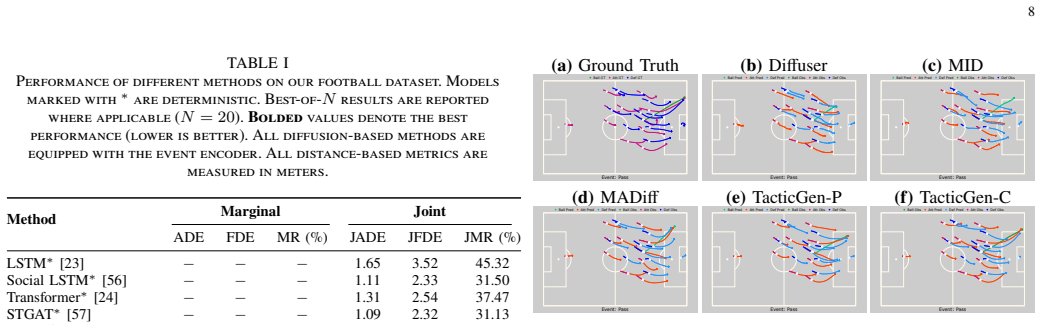
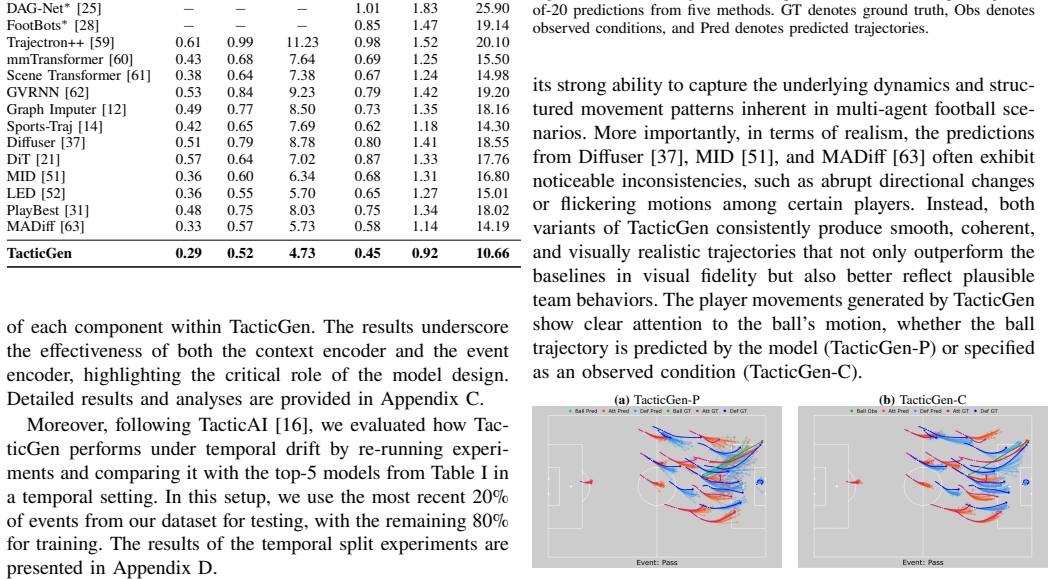
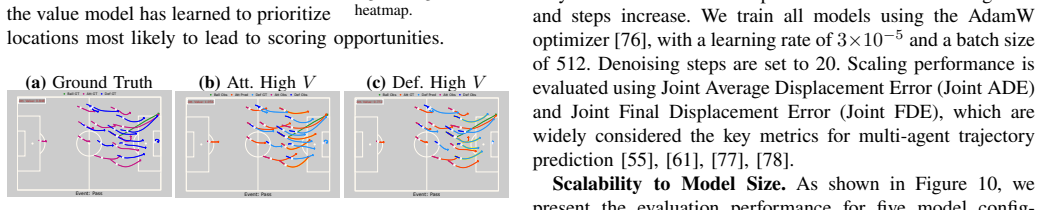
TacticGen formulates tactics as sequences of multi-agent movements and interactions conditioned on game context. It employs a multi-agent diffusion transformer with agent-wise self-attention and context-aware cross-attention to capture cooperative and competitive dynamics among players and the ball. Trained with over 3.3 million events and 100 million tracking frames from top-tier leagues, TacticGen achieves state-of-the-art precision in predicting player trajectories. Building on it, TacticGen enables adaptable tactic generation tailored to diverse inference-time objectives through classifier guidance mechanism, specified via rules, natural language, or neural models, with expert case study
What carries the argument
Multi-agent diffusion transformer that uses agent-wise self-attention to model interactions and context-aware cross-attention to condition on game state, allowing both accurate trajectory prediction and guided generation.
If this is right
- The same trained model can predict player trajectories more accurately than prior methods on large-scale league data.
- Tactics can be generated on demand by supplying objectives through simple rules, natural language prompts, or auxiliary neural classifiers.
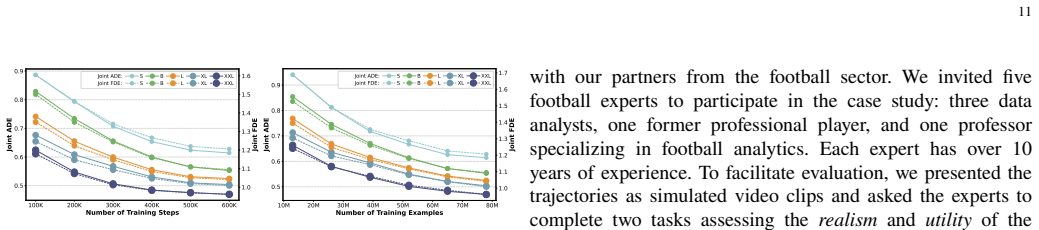
- The generative process scales with additional data or compute while preserving the same architecture.
- Expert reviewers judge the resulting tactics as both realistic and strategically useful for planning.
Where Pith is reading between the lines
- The guidance mechanism could be extended to other team sports that share similar multi-agent tracking data.
- Real-time match feeds might allow the model to suggest mid-game tactical adjustments.
- Explicit physics-based constraints could be added during sampling to reduce the chance of implausible paths.
Load-bearing premise
Classifier guidance applied at inference time will produce movement sequences that stay physically realistic and strategically coherent without creating invalid actions or artifacts.
What would settle it
A side-by-side comparison in which professional analysts or automated rule checkers flag generated trajectories for violations of physical limits such as maximum player speed or ball-interception rules at rates significantly higher than real match data.
Figures






read the original abstract
Success in association football relies on both individual skill and coordinated tactics. While recent advancements in spatio-temporal data and deep learning have enabled predictive analyses like trajectory forecasting, the development of tactical design remains limited. Bridging this gap is essential, as prediction reveals what is likely to occur, whereas tactic generation determines what should occur to achieve strategic objectives. In this work, we present TacticGen, a generative model for adaptable and scalable tactic generation. TacticGen formulates tactics as sequences of multi-agent movements and interactions conditioned on the game context. It employs a multi-agent diffusion transformer with agent-wise self-attention and context-aware cross-attention to capture cooperative and competitive dynamics among players and the ball. Trained with over 3.3 million events and 100 million tracking frames from top-tier leagues, TacticGen achieves state-of-the-art precision in predicting player trajectories. Building on it, TacticGen enables adaptable tactic generation tailored to diverse inference-time objectives through classifier guidance mechanism, specified via rules, natural language, or neural models. Its modeling performance is also inherently scalable. A case study with football experts confirms that TacticGen generates realistic, strategically valuable tactics, demonstrating its practical utility for tactical planning in professional football. The project page is available at: https://shengxu.net/TacticGen/.
Editorial analysis
A structured set of objections, weighed in public.
Referee Report
Summary. The paper presents TacticGen, a multi-agent diffusion transformer that models football tactics as sequences of player and ball movements conditioned on game context. It uses agent-wise self-attention and context-aware cross-attention, trains on 3.3M events and 100M tracking frames from top leagues, reports SOTA trajectory prediction accuracy, and introduces classifier guidance (via rules, language, or neural models) at inference time to enable adaptable tactic generation for diverse objectives. A case study with football experts is cited to confirm that generated tactics are realistic and strategically valuable.
Significance. If the classifier guidance mechanism can be shown to produce constraint-respecting, objective-achieving outputs without artifacts, the work would provide a scalable generative framework that bridges trajectory prediction and controllable tactical design in sports analytics, with potential applications in coaching tools and simulation.
major comments (3)
- [Abstract] Abstract: the claim of 'state-of-the-art precision in predicting player trajectories' is asserted without reference to specific baselines, error metrics (e.g., ADE/FDE, collision rates), ablation studies, or quantitative tables; this is load-bearing for the subsequent claim that the base model grounds the guided generation.
- [Abstract] Abstract, guidance paragraph: the adaptability claim rests on classifier guidance producing realistic, constraint-respecting tactics at inference time, yet the only supporting evidence cited is an expert case study; no quantitative results are provided for guided outputs (e.g., physical feasibility scores, success rate on user-specified objectives, violation rates vs. unguided sampling, or ablations isolating the guidance step).
- [Abstract] Abstract: the statement that 'its modeling performance is also inherently scalable' is not accompanied by scaling experiments, parameter counts, or inference-time measurements that would substantiate scalability beyond the training dataset size.
minor comments (1)
- [Abstract] The project page URL is given but no supplementary material (code, model weights, or additional quantitative results) is referenced in the abstract.
Simulated Author's Rebuttal
We thank the referee for the constructive and detailed feedback on the abstract. The comments correctly identify areas where the abstract could better reference the supporting evidence in the manuscript body. We will revise the abstract accordingly while preserving its concise nature. Point-by-point responses follow.
read point-by-point responses
-
Referee: [Abstract] Abstract: the claim of 'state-of-the-art precision in predicting player trajectories' is asserted without reference to specific baselines, error metrics (e.g., ADE/FDE, collision rates), ablation studies, or quantitative tables; this is load-bearing for the subsequent claim that the base model grounds the guided generation.
Authors: The full manuscript substantiates this claim in Section 4.1 and Table 1, which report ADE/FDE, collision rates, and comparisons against baselines including Constant Velocity, Social-LSTM, and Trajectron++. Ablations on attention mechanisms are in Section 4.3. We will revise the abstract to explicitly reference these results (e.g., 'achieves state-of-the-art precision in predicting player trajectories (Table 1)') to make the grounding clear. revision: yes
-
Referee: [Abstract] Abstract, guidance paragraph: the adaptability claim rests on classifier guidance producing realistic, constraint-respecting tactics at inference time, yet the only supporting evidence cited is an expert case study; no quantitative results are provided for guided outputs (e.g., physical feasibility scores, success rate on user-specified objectives, violation rates vs. unguided sampling, or ablations isolating the guidance step).
Authors: The manuscript presents quantitative results for the base trajectory model and qualitative validation of guided outputs via the expert case study in Section 5. We agree that quantitative metrics for guided generation (e.g., objective success rates and feasibility) would strengthen the adaptability claim. We will add a short quantitative analysis of guided vs. unguided outputs in the revised manuscript. revision: yes
-
Referee: [Abstract] Abstract: the statement that 'its modeling performance is also inherently scalable' is not accompanied by scaling experiments, parameter counts, or inference-time measurements that would substantiate scalability beyond the training dataset size.
Authors: The claim is grounded in the architecture's design for variable agent counts and its successful training on 100M frames, as described in Sections 3 and 4. We acknowledge the absence of dedicated scaling curves. We will revise the abstract to qualify the statement (e.g., 'demonstrates scalability via training on large-scale data') and include model size and inference-time details from our experiments. revision: partial
Circularity Check
No significant circularity; derivation grounded in external data and standard inference techniques
full rationale
The paper trains a multi-agent diffusion transformer on independent external datasets (3.3M events, 100M frames from top-tier leagues) to achieve SOTA trajectory prediction. Adaptable generation is performed via classifier guidance at inference time (specified by rules, language, or neural models), which is a standard conditioning method that does not reduce to the training inputs or fitted parameters by construction. The expert case study provides qualitative validation rather than a quantitative fit. No self-citations, self-definitional equations, or renamings of known results appear as load-bearing steps in the abstract or described chain; the central claims remain independently testable against held-out data and physical constraints.
Axiom & Free-Parameter Ledger
axioms (1)
- domain assumption Multi-agent self- and cross-attention can adequately model player interactions and game context for both prediction and guided generation.
Reference graph
Works this paper leans on
-
[1]
The most popular sports in the world,
A. Singh, “The most popular sports in the world,” 2025, accessed: 2025-07-14. [Online]. Available: https://www.worldatlas.com/articles/ what-are-the-most-popular-sports-in-the-world.html
2025
-
[2]
Match analysis in football: a systematic review,
H. Sarmento, R. Marcelino, M. T. Anguera, J. CampaniC ¸ o, N. Matos, and J. C. Leit ˜Ao, “Match analysis in football: a systematic review,” Journal of Sports Sciences, vol. 32, no. 20, pp. 1831–1843, 2014
2014
-
[3]
Towards a foundation large events model for soccer,
T. Mendes-Neves, L. Meireles, and J. Mendes-Moreira, “Towards a foundation large events model for soccer,”Machine Learning, vol. 113, no. 11, pp. 8687–8709, 2024
2024
-
[4]
Artificial intelligence for team sports: a survey,
R. Beal, T. J. Norman, and S. D. Ramchurn, “Artificial intelligence for team sports: a survey,”The Knowledge Engineering Review, vol. 34, p. e28, 2019
2019
-
[5]
A goal scoring probability model for shots based on synchronized positional and event data in football (soccer),
G. Anzer and P. Bauer, “A goal scoring probability model for shots based on synchronized positional and event data in football (soccer),” Frontiers in sports and active living, vol. 3, p. 624475, 2021
2021
-
[6]
Accuracy and explainability of statistical and machine learning xg models in football,
M. Cefis and M. Carpita, “Accuracy and explainability of statistical and machine learning xg models in football,”Statistics, vol. 59, no. 2, pp. 426–445, 2025
2025
-
[7]
Dynamic expected threat (dxt) model: Addressing the deficit of realism in football action evaluation,
K. Hassani, M. Ramdani, and M. Lotfi, “Dynamic expected threat (dxt) model: Addressing the deficit of realism in football action evaluation,” Applied Sciences, vol. 15, no. 8, p. 4151, 2025
2025
-
[8]
Action valuation of on-and off-ball soccer players based on multi-agent deep reinforcement learning,
H. Nakahara, K. Tsutsui, K. Takeda, and K. Fujii, “Action valuation of on-and off-ball soccer players based on multi-agent deep reinforcement learning,”IEEE Access, vol. 11, pp. 131 237–131 244, 2023
2023
-
[9]
Action valuation in sports: A survey,
A. Xarles, S. Escalera, T. B. Moeslund, and A. Clap ´es, “Action valuation in sports: A survey,” inProceedings of the Computer Vision and Pattern Recognition Conference, 2025, pp. 6132–6142
2025
-
[10]
Score: A convolutional approach for football event forecast- ing,
R. Alves, “Score: A convolutional approach for football event forecast- ing,”International Journal of Forecasting, 2025
2025
-
[11]
M. Hong, M. Lee, G. Jo, H. Jo, P. Bauer, and S.-K. Ko, “Modeling matches as language: A generative transformer approach for counter- factual player valuation in football,”arXiv preprint arXiv:2603.15212, 2026
-
[12]
Multiagent off-screen behavior prediction in football,
S. Omidshafiei, D. Hennes, M. Garnelo, Z. Wang, A. Recasens, E. Tarassov, Y. Yang, R. Elie, J. T. Connor, P. Mulleret al., “Multiagent off-screen behavior prediction in football,”Scientific reports, vol. 12, no. 1, p. 8638, 2022
2022
-
[13]
Agentformer: Agent-aware transformers for socio-temporal multi-agent forecasting,
Y. Yuan, X. Weng, Y. Ou, and K. M. Kitani, “Agentformer: Agent-aware transformers for socio-temporal multi-agent forecasting,” inProceedings of the IEEE/CVF international conference on computer vision, 2021, pp. 9813–9823
2021
-
[14]
Sports-traj: A unified trajectory generation model for multi-agent movement in sports,
Y. Xu and Y. Fu, “Sports-traj: A unified trajectory generation model for multi-agent movement in sports,” inThe Thirteenth International Conference on Learning Representations, 2025
2025
-
[15]
Smgdiff: Soccer motion generation using diffusion probabilistic models,
H. Yang, C. Li, Z. Wu, G. Li, J. Wang, J. Yu, Z. Su, and L. Xu, “Smgdiff: Soccer motion generation using diffusion probabilistic models,” in Proceedings of the IEEE/CVF International Conference on Computer Vision, 2025, pp. 11 807–11 817
2025
-
[16]
Tacticai: an ai assistant for football tactics,
Z. Wang, P. Veli ˇckovi´c, D. Hennes, N. Toma ˇsev, L. Prince, M. Kaisers, Y. Bachrach, R. Elie, L. K. Wenliang, F. Piccininiet al., “Tacticai: an ai assistant for football tactics,”Nature communications, vol. 15, no. 1, p. 1906, 2024
1906
-
[17]
Taceleven: generative tactic discovery for football open play,
S. Zhao, H. Ma, Z. Pu, J. Huang, Y. Pan, S. Wang, and Z. Ming, “Taceleven: generative tactic discovery for football open play,”arXiv preprint arXiv:2511.13326, 2025
-
[18]
GenTac: Generative Modeling and Forecasting of Soccer Tactics
J. Rao, T. Gui, H. Wu, Y. Wang, and W. Xie, “Gentac: Generative model- ing and forecasting of soccer tactics,”arXiv preprint arXiv:2604.11786, 2026
work page internal anchor Pith review Pith/arXiv arXiv 2026
-
[19]
On the Opportunities and Risks of Foundation Models
R. Bommasani, D. A. Hudson, E. Adeli, R. Altman, S. Arora, S. von Arx, M. S. Bernstein, J. Bohg, A. Bosselut, E. Brunskillet al., “On the opportunities and risks of foundation models,”arXiv preprint arXiv:2108.07258, 2021
work page internal anchor Pith review arXiv 2021
-
[20]
Explaining neural scaling laws,
Y. Bahri, E. Dyer, J. Kaplan, J. Lee, and U. Sharma, “Explaining neural scaling laws,”Proceedings of the National Academy of Sciences, vol. 121, no. 27, p. e2311878121, 2024
2024
-
[21]
Scalable diffusion models with transformers,
W. Peebles and S. Xie, “Scalable diffusion models with transformers,” inProceedings of the IEEE/CVF international conference on computer vision, 2023, pp. 4195–4205
2023
-
[22]
A survey of deep learning in sports applica- tions: Perception, comprehension, and decision,
Z. Zhao, W. Chai, S. Hao, W. Hu, G. Wang, S. Cao, M. Song, J.-N. Hwang, and G. Wang, “A survey of deep learning in sports applica- tions: Perception, comprehension, and decision,”IEEE Transactions on Visualization and Computer Graphics, vol. 31, no. 10, pp. 9368–9386, 2025
2025
-
[23]
Long short-term memory,
S. Hochreiter and J. Schmidhuber, “Long short-term memory,”Neural computation, vol. 9, no. 8, pp. 1735–1780, 1997
1997
-
[24]
Attention is all you need,
A. Vaswani, N. Shazeer, N. Parmar, J. Uszkoreit, L. Jones, A. N. Gomez, L. Kaiser, and I. Polosukhin, “Attention is all you need,”Advances in neural information processing systems, vol. 30, 2017
2017
-
[25]
Dag-net: Double attentive graph neural network for trajectory forecasting,
A. Monti, A. Bertugli, S. Calderara, and R. Cucchiara, “Dag-net: Double attentive graph neural network for trajectory forecasting,” in2020 25th international conference on pattern recognition (ICPR), 2021, pp. 2551– 2558
2021
-
[26]
Transportmer: A holistic approach to trajectory understanding in multi- agent sports,
G. Capellera, L. Ferraz, A. Rubio, A. Agudo, and F. Moreno-Noguer, “Transportmer: A holistic approach to trajectory understanding in multi- agent sports,” inProceedings of the asian conference on computer vision, 2024, pp. 1652–1670
2024
-
[27]
Football trajectory prediction and real-time feedback mechanism based on temporal convolutional network,
C. Zhang, X. Xi, X. Wang, and Z. Zhang, “Football trajectory prediction and real-time feedback mechanism based on temporal convolutional network,”Alexandria Engineering Journal, vol. 114, pp. 476–484, 2025
2025
-
[28]
Footbots: A transformer-based architecture for motion prediction in soccer,
G. Capellera, L. Ferraz, A. Rubio, A. Agudo, and F. Moreno-Noguer, “Footbots: A transformer-based architecture for motion prediction in soccer,” inIEEE International Conference on Image Processing, 2024, pp. 2313–2319
2024
-
[29]
C. Doersch, “Tutorial on variational autoencoders,”arXiv preprint arXiv:1606.05908, 2016
-
[30]
Denoising diffusion probabilistic models,
J. Ho, A. Jain, and P. Abbeel, “Denoising diffusion probabilistic models,” Advances in Neural Information Processing Systems, vol. 33, pp. 6840– 6851, 2020
2020
-
[31]
Playbest: Professional basketball player behavior synthesis via planning with diffusion,
X. Chen, W.-Y. Wang, Z. Hu, D. Reynoso, K. Jin, M. Liu, P. J. Brantingham, and W. Wang, “Playbest: Professional basketball player behavior synthesis via planning with diffusion,” inProceedings of the 33rd ACM International Conference on Information and Knowledge Management, 2024, pp. 4406–4413
2024
-
[32]
Unified uncertainty- aware diffusion for multi-agent trajectory modeling,
G. Capellera, A. Rubio, L. Ferraz, and A. Agudo, “Unified uncertainty- aware diffusion for multi-agent trajectory modeling,” inProceedings of the IEEE/CVF international conference on computer vision, 2025
2025
-
[33]
A survey on trajectory-prediction methods for autonomous driving,
Y. Huang, J. Du, Z. Yang, Z. Zhou, L. Zhang, and H. Chen, “A survey on trajectory-prediction methods for autonomous driving,”IEEE transactions on intelligent vehicles, vol. 7, no. 3, pp. 652–674, 2022
2022
-
[34]
Deep unsupervised learning using nonequilibrium thermodynamics,
J. Sohl-Dickstein, E. Weiss, N. Maheswaranathan, and S. Ganguli, “Deep unsupervised learning using nonequilibrium thermodynamics,” in International Conference on Machine Learning, 2015, pp. 2256–2265
2015
-
[35]
Diffusion models beat gans on image synthesis,
P. Dhariwal and A. Nichol, “Diffusion models beat gans on image synthesis,”Advances in neural information processing systems, vol. 34, pp. 8780–8794, 2021
2021
-
[36]
Diffusion-based planning for autonomous driving with flexible guidance,
Y. Zheng, R. Liang, K. Zheng, J. Zheng, L. Mao, J. Li, W. Gu, R. Ai, S. E. Li, and Zhan, “Diffusion-based planning for autonomous driving with flexible guidance,” inInternational Conference on Learning Representations, 2025
2025
-
[37]
Planning with diffusion for flexible behavior synthesis,
M. Janner, Y. Du, J. B. Tenenbaum, and S. Levine, “Planning with diffusion for flexible behavior synthesis,” inInternational Conference on Machine Learning, 2022
2022
-
[38]
Mlp-mixer: 14 An all-mlp architecture for vision,
I. O. Tolstikhin, N. Houlsby, A. Kolesnikov, L. Beyer, X. Zhai, T. Un- terthiner, J. Yung, A. Steiner, D. Keysers, J. Uszkoreitet al., “Mlp-mixer: 14 An all-mlp architecture for vision,”Advances in neural information processing systems, vol. 34, pp. 24 261–24 272, 2021
2021
-
[39]
Classifier-Free Diffusion Guidance
J. Ho and T. Salimans, “Classifier-free diffusion guidance,”arXiv preprint arXiv:2207.12598, 2022
work page internal anchor Pith review arXiv 2022
-
[40]
Contrastive energy prediction for exact energy-guided diffusion sampling in offline rein- forcement learning,
C. Lu, H. Chen, J. Chen, H. Su, C. Li, and J. Zhu, “Contrastive energy prediction for exact energy-guided diffusion sampling in offline rein- forcement learning,” inInternational Conference on Machine Learning, 2023, pp. 22 825–22 855
2023
-
[41]
Diffusion posterior sampling for general noisy inverse problems,
H. Chung, J. Kim, M. T. Mccann, M. L. Klasky, and J. C. Ye, “Diffusion posterior sampling for general noisy inverse problems,” inInternational Conference on Learning Representations, 2023
2023
-
[42]
Rethinking diffusion posterior sampling: From conditional score estimator to maximizing a posterior,
T. Xu, X. Cai, X. Zhang, X. Ge, D. He, M. Sun, J. Liu, Y.-Q. Zhang, J. Li, and Y. Wang, “Rethinking diffusion posterior sampling: From conditional score estimator to maximizing a posterior,” inInternational Conference on Learning Representations, 2025
2025
-
[43]
J. Achiam, S. Adler, S. Agarwal, L. Ahmad, I. Akkaya, F. L. Aleman, D. Almeida, J. Altenschmidt, S. Altman, S. Anadkatet al., “Gpt-4 technical report,”arXiv preprint arXiv:2303.08774, 2023
work page internal anchor Pith review Pith/arXiv arXiv 2023
-
[44]
A. Jaech, A. Kalai, A. Lerer, A. Richardson, A. El-Kishky, A. Low, A. Helyar, A. Madry, A. Beutel, A. Carneyet al., “Openai o1 system card,”arXiv preprint arXiv:2412.16720, 2024
work page internal anchor Pith review Pith/arXiv arXiv 2024
-
[45]
A. Singh, A. Fry, A. Perelman, A. Tart, A. Ganesh, A. El-Kishky, A. McLaughlin, A. Low, A. Ostrow, A. Ananthramet al., “Openai gpt-5 system card,”arXiv preprint arXiv:2601.03267, 2025
work page internal anchor Pith review Pith/arXiv arXiv 2025
-
[46]
R. S. Sutton, A. G. Bartoet al.,Reinforcement learning: An introduction. Cambridge, MA: MIT press Cambridge, 1998, vol. 1
1998
-
[47]
Diffusion models for reinforcement learning: A survey.arXiv preprint arXiv:2311.01223, 2023
Z. Zhu, H. Zhao, H. He, Y. Zhong, S. Zhang, H. Guo, T. Chen, and W. Zhang, “Diffusion models for reinforcement learning: A survey,” arXiv preprint arXiv:2311.01223, 2023
-
[48]
Deep reinforcement learning: A brief survey,
K. Arulkumaran, M. P. Deisenroth, M. Brundage, and A. A. Bharath, “Deep reinforcement learning: A brief survey,”IEEE signal processing magazine, vol. 34, no. 6, pp. 26–38, 2017
2017
-
[49]
Synchronise event and tracking data using dynamic programming,
M. Kwiatkowski, “Synchronise event and tracking data using dynamic programming,” https://github.com/huffyhenry/sync.soccer, 2020, gitHub repository
2020
-
[50]
Multi-modal trajectory prediction of nba players,
S. Hauri, N. Djuric, V. Radosavljevic, and S. Vucetic, “Multi-modal trajectory prediction of nba players,” inProceedings of the IEEE/CVF Winter Conference on Applications of Computer Vision, 2021, pp. 1640– 1649
2021
-
[51]
Stochastic tra- jectory prediction via motion indeterminacy diffusion,
T. Gu, G. Chen, J. Li, C. Lin, Y. Rao, J. Zhou, and J. Lu, “Stochastic tra- jectory prediction via motion indeterminacy diffusion,” inProceedings of the IEEE/CVF conference on computer vision and pattern recognition, 2022, pp. 17 113–17 122
2022
-
[52]
Leapfrog diffu- sion model for stochastic trajectory prediction,
W. Mao, C. Xu, Q. Zhu, S. Chen, and Y. Wang, “Leapfrog diffu- sion model for stochastic trajectory prediction,” inProceedings of the IEEE/CVF conference on computer vision and pattern recognition, 2023, pp. 5517–5526
2023
-
[53]
Learning group interactions and se- mantic intentions for multi-object trajectory prediction,
M. Qi, Y. Yang, and H. Ma, “Learning group interactions and se- mantic intentions for multi-object trajectory prediction,”arXiv preprint arXiv:2412.15673, 2024
-
[54]
Multi-agent trajectory prediction with scalable diffusion transformer,
S. Zhang, S. Kai, C. Chen, Y. Zhuang, Z. Zhu, M. Liu, and W. Zhang, “Multi-agent trajectory prediction with scalable diffusion transformer,” inProceedings of the International Conference on Distributed Artificial Intelligence, 2024
2024
-
[55]
Joint metrics matter: A better standard for trajectory forecasting,
E. Weng, H. Hoshino, D. Ramanan, and K. Kitani, “Joint metrics matter: A better standard for trajectory forecasting,” inProceedings of the IEEE/CVF International Conference on Computer Vision, 2023, pp. 20 315–20 326
2023
-
[56]
Social lstm: Human trajectory prediction in crowded spaces,
A. Alahi, K. Goel, V. Ramanathan, A. Robicquet, L. Fei-Fei, and S. Savarese, “Social lstm: Human trajectory prediction in crowded spaces,” inProceedings of the IEEE conference on computer vision and pattern recognition, 2016, pp. 961–971
2016
-
[57]
Stgat: Modeling spatial- temporal interactions for human trajectory prediction,
Y. Huang, H. Bi, Z. Li, T. Mao, and Z. Wang, “Stgat: Modeling spatial- temporal interactions for human trajectory prediction,” inProceedings of the IEEE/CVF international conference on computer vision, 2019, pp. 6272–6281
2019
-
[58]
Rating player actions in soccer,
U. Dick, M. Tavakol, and U. Brefeld, “Rating player actions in soccer,” Frontiers in Sports and Active Living, vol. 3, p. 682986, 2021
2021
-
[59]
Trajectron++: Dynamically-feasible trajectory forecasting with heterogeneous data,
T. Salzmann, B. Ivanovic, P. Chakravarty, and M. Pavone, “Trajectron++: Dynamically-feasible trajectory forecasting with heterogeneous data,” in European Conference on Computer Vision. Springer, 2020, pp. 683– 700
2020
-
[60]
Multimodal motion prediction with stacked transformers,
Y. Liu, J. Zhang, L. Fang, Q. Jiang, and B. Zhou, “Multimodal motion prediction with stacked transformers,” inProceedings of the IEEE/CVF conference on computer vision and pattern recognition, 2021, pp. 7577– 7586
2021
-
[61]
Scene transformer: A unified architecture for predicting multiple agent trajectories,
J. Ngiam, B. Caine, V. Vasudevan, Z. Zhang, H.-T. L. Chiang, J. Ling, R. Roelofs, A. Bewley, C. Liu, A. Venugopalet al., “Scene transformer: A unified architecture for predicting multiple agent trajectories,” inThe Thirteenth International Conference on Learning Representations, 2022
2022
-
[62]
Diverse gener- ation for multi-agent sports games,
R. A. Yeh, A. G. Schwing, J. Huang, and K. Murphy, “Diverse gener- ation for multi-agent sports games,” inProceedings of the IEEE/CVF Conference on Computer Vision and Pattern Recognition, 2019, pp. 4610–4619
2019
-
[63]
Madiff: Offline multi-agent learning with diffusion models,
Z. Zhu, M. Liu, L. Mao, B. Kang, M. Xu, Y. Yu, S. Ermon, and W. Zhang, “Madiff: Offline multi-agent learning with diffusion models,” Advances in Neural Information Processing Systems, vol. 37, pp. 4177– 4206, 2024
2024
-
[64]
Social gan: Socially acceptable trajectories with generative adversarial networks,
A. Gupta, J. Johnson, L. Fei-Fei, S. Savarese, and A. Alahi, “Social gan: Socially acceptable trajectories with generative adversarial networks,” inProceedings of the IEEE conference on computer vision and pattern recognition, 2018, pp. 2255–2264
2018
-
[65]
Social-stgcnn: A social spatio-temporal graph convolutional neural network for human trajectory prediction,
A. Mohamed, K. Qian, M. Elhoseiny, and C. Claudel, “Social-stgcnn: A social spatio-temporal graph convolutional neural network for human trajectory prediction,” inProceedings of the IEEE/CVF conference on computer vision and pattern recognition, 2020, pp. 14 424–14 432
2020
-
[66]
It is not the journey but the destination: Endpoint conditioned trajectory prediction,
K. Mangalam, H. Girase, S. Agarwal, K.-H. Lee, E. Adeli, J. Malik, and A. Gaidon, “It is not the journey but the destination: Endpoint conditioned trajectory prediction,” inEuropean Conference on Computer Vision, 2020, pp. 759–776
2020
-
[67]
Spatio-temporal graph transformer networks for pedestrian trajectory prediction,
C. Yu, X. Ma, J. Ren, H. Zhao, and S. Yi, “Spatio-temporal graph transformer networks for pedestrian trajectory prediction,” inEuropean Conference on Computer Vision, 2020, pp. 507–523
2020
-
[68]
Remember intentions: Retrospective-memory-based trajectory prediction,
C. Xu, W. Mao, W. Zhang, and S. Chen, “Remember intentions: Retrospective-memory-based trajectory prediction,” inProceedings of the IEEE/CVF Conference on Computer Vision and Pattern Recognition, 2022, pp. 6488–6497
2022
-
[69]
Non-probability sampling net- work for stochastic human trajectory prediction,
I. Bae, J.-H. Park, and H.-G. Jeon, “Non-probability sampling net- work for stochastic human trajectory prediction,” inProceedings of the IEEE/CVF Conference on Computer Vision and Pattern Recognition, 2022, pp. 6477–6487
2022
-
[70]
Groupnet: Multiscale hypergraph neural networks for trajectory prediction with relational reasoning,
C. Xu, M. Li, Z. Ni, Y. Zhang, and S. Chen, “Groupnet: Multiscale hypergraph neural networks for trajectory prediction with relational reasoning,” inProceedings of the IEEE/CVF Conference on Computer Vision and Pattern Recognition, 2022, pp. 6498–6507
2022
-
[71]
Physics-based modeling of pass probabilities in soccer,
W. Spearman, A. Basye, G. Dick, R. Hotovy, and P. Pop, “Physics-based modeling of pass probabilities in soccer,” inProceeding of the 11th MIT Sloan Sports Analytics Conference, vol. 1, 2017
2017
-
[72]
Beyond expected goals,
W. Spearman, “Beyond expected goals,” inProceedings of the 12th MIT sloan sports analytics conference, 2018, pp. 1–17
2018
-
[73]
Wide open spaces: A statistical technique for measuring space creation in professional soccer,
J. Fernandez and L. Bornn, “Wide open spaces: A statistical technique for measuring space creation in professional soccer,” inSloan sports analytics conference, 2018
2018
-
[74]
Space and control in soccer,
F. Martens, U. Dick, and U. Brefeld, “Space and control in soccer,” Frontiers in Sports and Active Living, vol. 3, p. 676179, 2021
2021
-
[75]
Measuring the pitch control of professional football players using spatiotemporal tracking data,
L. Higgins, T. Galla, B. Prestidge, and T. Wyatt, “Measuring the pitch control of professional football players using spatiotemporal tracking data,”Journal of Physics: Complexity, vol. 4, no. 2, 2023
2023
-
[76]
Decoupled Weight Decay Regularization
I. Loshchilov and F. Hutter, “Decoupled weight decay regularization,” arXiv preprint arXiv:1711.05101, 2017
work page internal anchor Pith review Pith/arXiv arXiv 2017
-
[77]
Gatraj: A graph-and attention-based multi-agent trajectory prediction model,
H. Cheng, M. Liu, L. Chen, H. Broszio, M. Sester, and M. Y. Yang, “Gatraj: A graph-and attention-based multi-agent trajectory prediction model,”ISPRS Journal of Photogrammetry and Remote Sensing, vol. 205, pp. 163–175, 2023
2023
-
[78]
M2i: From factored marginal trajectory prediction to interactive prediction,
Q. Sun, X. Huang, J. Gu, B. C. Williams, and H. Zhao, “M2i: From factored marginal trajectory prediction to interactive prediction,” in Proceedings of the IEEE/CVF Conference on Computer Vision and Pattern Recognition, 2022, pp. 6543–6552
2022
-
[79]
Improved denoising diffusion probabilis- tic models,
A. Q. Nichol and P. Dhariwal, “Improved denoising diffusion probabilis- tic models,” inInternational Conference on Machine Learning (ICML). PMLR, 2021, pp. 8162–8171
2021
-
[80]
Denoising Diffusion Implicit Models
J. Song, C. Meng, and S. Ermon, “Denoising diffusion implicit models,” arXiv preprint arXiv:2010.02502, 2020
work page internal anchor Pith review Pith/arXiv arXiv 2010
discussion (0)
Sign in with ORCID, Apple, or X to comment. Anyone can read and Pith papers without signing in.