Recognition: unknown
A Counterexample to EFX n ge 3 Agents, m ge n + 5 Items, Submodular Valuations via SAT-Solving
Pith reviewed 2026-05-10 03:22 UTC · model grok-4.3
The pith
EFX allocations do not always exist for three or more agents and at least eight indivisible goods under monotone valuations.
A machine-rendered reading of the paper's core claim, the machinery that carries it, and where it could break.
Core claim
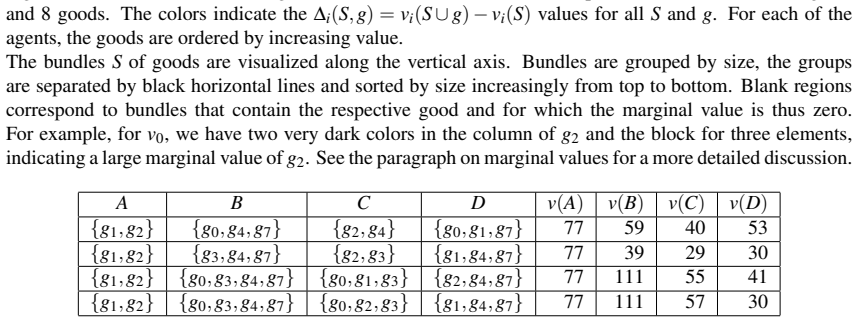
While EFX allocations exist for three agents and seven goods, there exist monotone valuation functions over three agents and eight goods for which no allocation satisfies the EFX condition, and this counterexample generalizes to n agents and m goods whenever n is at least three and m is at least n plus five.
What carries the argument
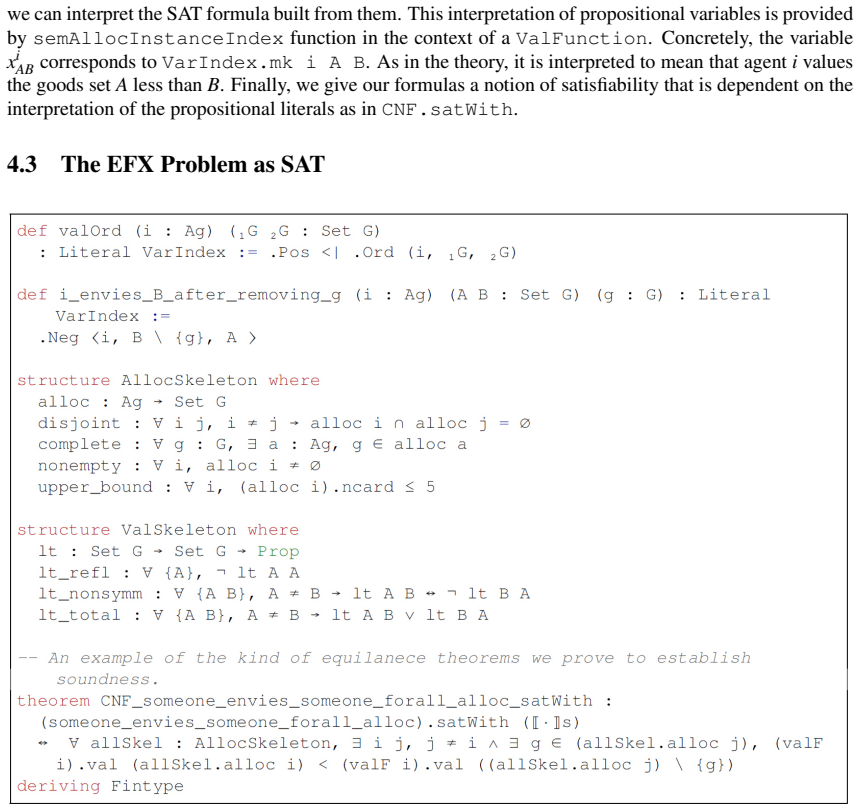
SAT encoding of the negation of EFX existence, whose satisfiability produces concrete counterexample valuations and whose unsatisfiability proves existence.
If this is right
- For every n at least 3 and every m at least n+5, there exist monotone valuations with no EFX allocation.
- The boundary for guaranteed EFX existence lies strictly between seven and eight goods when there are three agents.
- SAT-based methods can decide EFX existence for small fixed numbers of agents and goods.
- The negative result for large m holds without any further SAT computation once the three-agent eight-good instance is established.
Where Pith is reading between the lines
- The exact threshold separating guaranteed EFX existence from counterexamples may be m = n+4 for some n, which could be checked with the same encoding.
- Practical fair-division procedures may need to fall back to weaker notions such as EF1 when the number of items exceeds the number of agents by five or more.
- The Lean-verified encoding provides a reusable template for attacking other open existence questions in discrete fair division via SAT.
Load-bearing premise
The logical encoding of the negation of EFX existence into SAT is faithful to the original problem definition.
What would settle it
An explicit check showing that the three-agent eight-good valuation functions found by the solver do admit an EFX allocation would falsify the counterexample.
Figures




read the original abstract
The existence of EFX allocations is a central open problem in discrete fair division. An allocation is EFX (envy-free up to any good) if no agent envies another agent after the removal of any single good from the other agent's bundle. We resolve this longstanding question by providing the \textbf{first-ever counterexample} to the existence of EFX allocations for agents with monotone valuations, which in turn immediately implies a counterexample for submodular valuations. Specifically, we show that EFX allocations need not exist for instances with $n \ge 3$ agents and $m \ge n+5$ goods. In contrast, we prove that every instance with three agents and seven goods admits an EFX allocation. Both results are obtained via SAT solving. We encode the negation of EFX existence as a SAT instance: satisfiability yields a counterexample, while unsatisfiability establishes universal existence. The correctness of the encoding is formally verified in Lean. Finally, we establish positive guarantees for fair allocations with three agents and an arbitrary number of goods. Although EFX allocations may fail to exist, we prove that every instance with three agents and monotone valuations admits at least one of two natural relaxations of EFX: tEFX, or EF1 and EEFX.
Editorial analysis
A structured set of objections, weighed in public.
Referee Report
Summary. The paper claims that EFX allocations exist for three agents and seven goods under monotone valuations, established via unsatisfiability of a SAT encoding whose correctness is proven in Lean and verified by a DRAT-trim proof. It provides an explicit counterexample for three agents and eight goods, obtained from a satisfiable SAT instance and confirmed by exhaustive enumeration of all 3^8 allocations. This counterexample is extended directly to all n ≥ 3 agents and m ≥ n + 5 goods. The work resolves negatively the existence question for EFX in these regimes.
Significance. The result settles a central open question in discrete fair division by exhibiting the first counterexample to EFX existence for monotone valuations when the number of goods is at least five more than the number of agents. Credit is due for the machine-checked Lean proof of the SAT encoding, the DRAT-verified unsatisfiability certificate for the 3+7 case, and the exhaustive enumeration verification for the 3+8 satisfiable instance; these elements provide unusually high assurance for a computational negative result.
Simulated Author's Rebuttal
We thank the referee for their positive assessment of the manuscript, accurate summary of the results, and recommendation to accept. We appreciate the recognition given to the machine-checked Lean proof, the DRAT-trim verification, and the exhaustive enumeration check.
Circularity Check
No significant circularity; direct computational counterexample with external verification
full rationale
The paper derives its central negative result (non-existence of EFX for n=3 m=8 and the extension to n>=4 m>=n+5) via SAT encoding of the negation of EFX, whose faithfulness is proven in Lean, followed by satisfiability yielding explicit valuations that are exhaustively verified by enumeration of all 3^8 allocations. The m=7 case uses a DRAT-verified unsatisfiability proof. The extension is a direct construction inheriting monotonicity non-existence without further solving. No step reduces by definition or self-citation to its own inputs; the encoding and verification are independent of the target counterexample values, and the result is self-contained against external benchmarks.
Axiom & Free-Parameter Ledger
axioms (1)
- domain assumption The reduction from the negation of EFX existence to SAT satisfiability is correct and complete.
discussion (0)
Sign in with ORCID, Apple, or X to comment. Anyone can read and Pith papers without signing in.