Gamma-Based Expansion for the First-Passage Time Distribution of Stochastic Logistic Models with Harvesting
Pith reviewed 2026-05-10 03:21 UTC · model grok-4.3
The pith
A Laguerre-Gamma expansion yields closed-form first-passage time densities for stochastic logistic models with constant harvesting.
A machine-rendered reading of the paper's core claim, the machinery that carries it, and where it could break.
Core claim
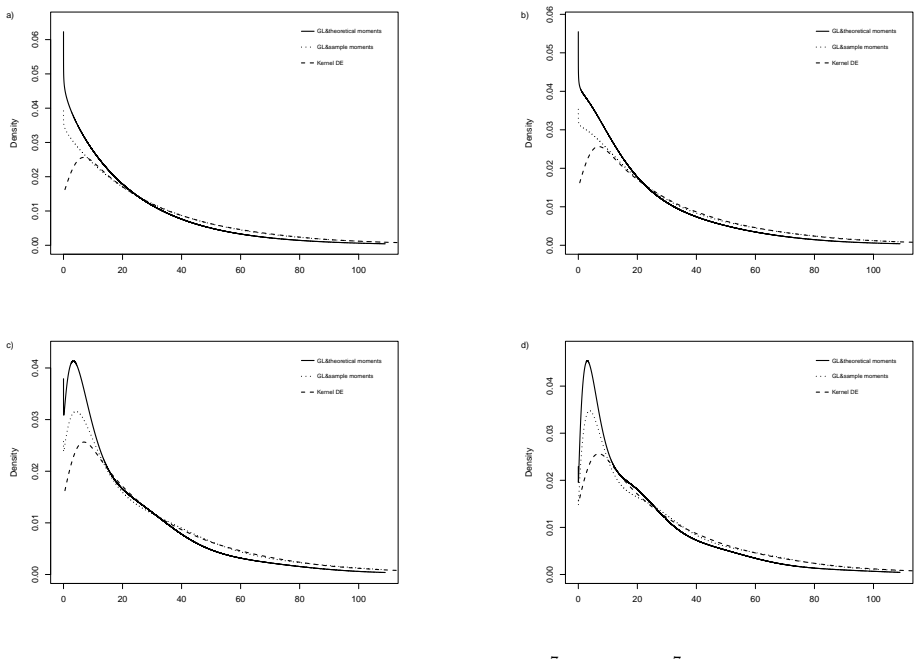
The authors obtain explicit expressions for the moments and cumulants of both upcrossing and downcrossing first-passage times through a power-series expansion of the Laplace transform, and recover a closed-form representation of the first-passage time density via an orthogonal Laguerre-Gamma expansion that can be truncated for numerical computation.
What carries the argument
The orthogonal Laguerre-Gamma expansion of the first-passage time density, constructed after extracting moments and cumulants from the power-series expansion of the Laplace transform.
If this is right
- Explicit moments and cumulants are available for upcrossing and downcrossing first-passage times at constant thresholds.
- The first-passage time density can be approximated numerically by truncating the Laguerre-Gamma series, with truncation order trading accuracy for stability.
- The approximation remains accurate for moderate dispersion and for large-scale populations in fisheries models.
- The approximated density supports estimation of model parameters.
Where Pith is reading between the lines
- The same power-series-plus-orthogonal-expansion route may apply to first-passage problems in other nonlinear stochastic population models with multiplicative noise.
- Threshold-crossing probabilities could be obtained directly from the truncated series without repeated simulation runs.
- The approach supplies an analytic alternative for computing recovery or extinction times that could be compared against purely numerical integrators in management settings.
Load-bearing premise
The power-series expansion of the Laplace transform and the subsequent Laguerre-Gamma series converge and remain numerically stable for the truncation orders used, particularly when higher-order moments do not grow rapidly.
What would settle it
Monte Carlo histograms of first-passage times would deviate substantially from the truncated Laguerre-Gamma density even in regimes of moderate dispersion.
Figures

read the original abstract
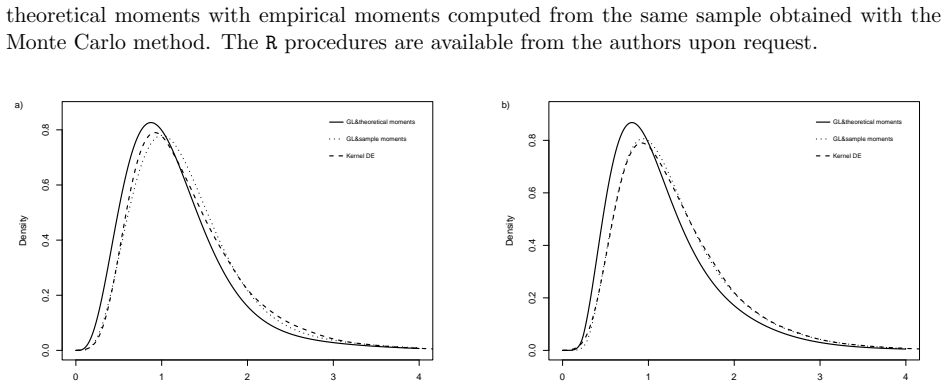
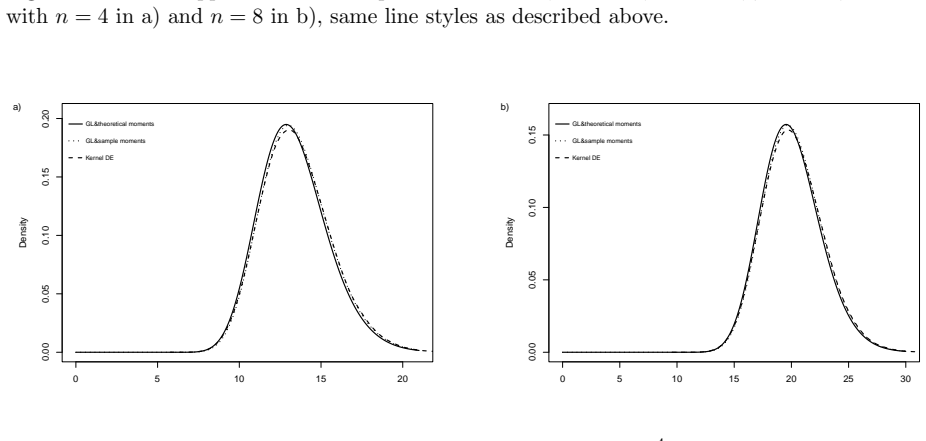
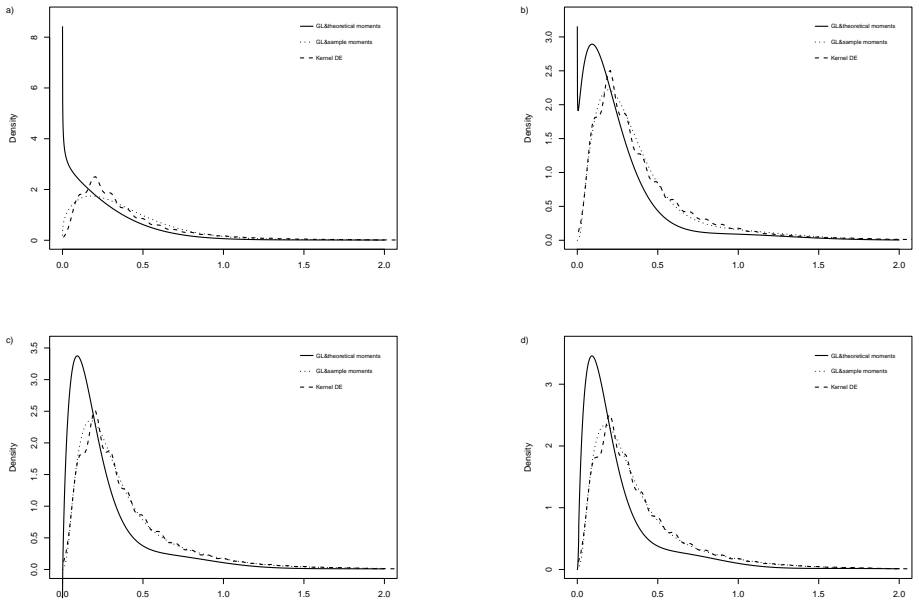
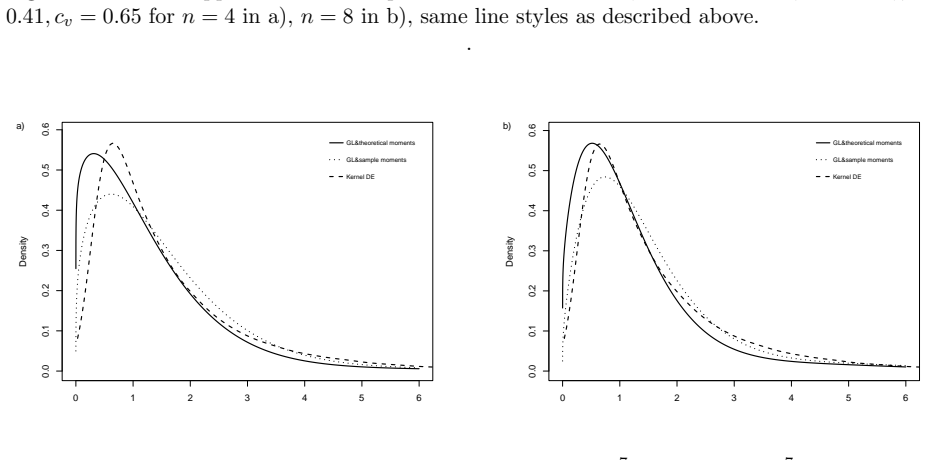
The first passage time problem is considered for stochastic logistic growth model with constant harvesting and multiplicative environmental noise. Explicit expressions for the moments and cumulants of both upcrossing and downcrossing FPTs in the presence of constant thresholds are obtained through a power-series expansion of the Laplace transform. Then a closed-form representation of the FPT density is recovered via an orthogonal Laguerre--Gamma expansion . This representation is used to numerically evaluate FPT densities, with the truncation order controlling the trade-off between accuracy and stability. Numerical experiments based on Monte Carlo simulations confirm the high accuracy of the method in regimes of moderate dispersion and highlight its limitations when higher-order moments grow rapidly. Application to fisheries management models shows that the method remains effective even for large-scale population. Finally, the approximated density is satisfactory used to estimate some parameters of the model.
Editorial analysis
A structured set of objections, weighed in public.
Referee Report
Summary. The manuscript develops a method for the first-passage time (FPT) problem in the stochastic logistic growth model with constant harvesting and multiplicative noise. It obtains explicit expressions for moments and cumulants of upcrossing and downcrossing FPTs via power-series expansion of the Laplace transform, recovers the FPT density through an orthogonal Laguerre-Gamma expansion, validates numerical accuracy via Monte Carlo simulations in moderate-dispersion regimes, notes limitations when higher moments grow rapidly, and demonstrates an application to parameter estimation in fisheries models.
Significance. If the series expansions converge reliably, the approach supplies explicit moment formulas and a controllable approximation for FPT densities that avoids pure simulation, which is useful for stochastic population models in ecology. The Monte Carlo confirmation in moderate regimes and the fisheries application are concrete strengths that support practical utility.
major comments (1)
- [Abstract and Laguerre-Gamma expansion section] Abstract and the section on the Laguerre-Gamma expansion: the central claim that the truncated Laguerre-Gamma series yields a high-accuracy density representation rests on the unstated assumption that the power series for the Laplace transform has a sufficient radius of convergence and that the orthogonal coefficients remain square-summable for the truncation orders employed. No explicit remainder bound or radius estimate is supplied, even though the abstract itself flags rapid growth of higher moments as a limiting regime; this directly affects the reliability of the numerical experiments and the subsequent parameter-estimation application.
minor comments (2)
- The description of the underlying SDE and the constant thresholds would be clearer if collected in a short preliminary section with explicit notation for the infinitesimal generator.
- [Numerical experiments] In the numerical experiments, the specific truncation orders used for each Monte Carlo comparison should be tabulated alongside the reported error metrics to make the accuracy-stability trade-off reproducible.
Simulated Author's Rebuttal
We thank the referee for the careful reading of our manuscript and the constructive comments. The positive assessment of the method's utility for stochastic population models is appreciated. We address the major comment on convergence properties below and will incorporate revisions to strengthen the presentation.
read point-by-point responses
-
Referee: [Abstract and Laguerre-Gamma expansion section] Abstract and the section on the Laguerre-Gamma expansion: the central claim that the truncated Laguerre-Gamma series yields a high-accuracy density representation rests on the unstated assumption that the power series for the Laplace transform has a sufficient radius of convergence and that the orthogonal coefficients remain square-summable for the truncation orders employed. No explicit remainder bound or radius estimate is supplied, even though the abstract itself flags rapid growth of higher moments as a limiting regime; this directly affects the reliability of the numerical experiments and the subsequent parameter-estimation application.
Authors: We agree that an explicit discussion of the convergence conditions would improve the manuscript. The power-series expansion of the Laplace transform arises from the recursive solution of the moment ODEs, so its radius is governed by the growth of the moment sequence; the abstract already identifies the rapid growth of higher moments as the limiting regime. Deriving a closed-form radius estimate or remainder bound valid for arbitrary parameter values is technically involved and would require additional restrictions on the drift and diffusion coefficients. In the revision we will add a dedicated paragraph to the Laguerre-Gamma expansion section that (i) states the sufficient condition for square-summability of the orthogonal coefficients in terms of moment growth, (ii) notes that the truncation error is controlled numerically by monitoring coefficient decay, and (iii) cross-references the Monte Carlo validation already performed in moderate-dispersion regimes. These additions will make the supporting assumptions transparent without altering the numerical or applied results. revision: partial
Circularity Check
No circularity: derivations proceed from SDE via standard Laplace and orthogonal expansions
full rationale
The paper begins from the stochastic logistic SDE with harvesting and multiplicative noise, derives the Kolmogorov backward equation for the Laplace transform of the first-passage time, expands that transform in a power series to obtain explicit moment and cumulant expressions, and recovers the density via a Laguerre-Gamma orthogonal series. These steps apply standard transform and series methods without defining any quantity in terms of itself, without fitting parameters to data and relabeling them as predictions, and without load-bearing self-citations that would render the central claims tautological. The abstract and described procedure contain no self-referential reductions or imported uniqueness theorems from the authors' prior work; numerical truncation and convergence are presented as practical controls rather than definitional assumptions. This is the normal case of a self-contained analytic derivation.
Axiom & Free-Parameter Ledger
free parameters (1)
- truncation order
axioms (2)
- standard math The Laplace transform of the first-passage time distribution exists and admits a power-series expansion yielding moments and cumulants.
- ad hoc to paper The Laguerre-Gamma orthogonal expansion converges to the true FPT density for suitable truncation orders.
Reference graph
Works this paper leans on
-
[1]
Allen, Linda J. S. , title =
-
[2]
Renshaw, Eric , title =
-
[3]
Mao, Xuerong , title =
- [4]
-
[5]
Optimal harvesting of fluctuating populations with a risk of extinction , journal =
Lande, Russell and Engen, Steinar and S. Optimal harvesting of fluctuating populations with a risk of extinction , journal =
- [6]
-
[7]
Tuckwell, H. C. , title =. Theoretical Population Biology , volume =
- [8]
- [9]
-
[10]
Gihman, I. I. and Skorohod, A. V. , title =
-
[11]
Notice sur la loi que la population suit dans son accroissement , journal =
Verhulst, Pierre-Fran. Notice sur la loi que la population suit dans son accroissement , journal =
-
[12]
Murray, J. D. , title =
-
[13]
Brites, Nuno M. and Braumann, Carlos A. , title =. Computational Statistics , year =
- [14]
- [15]
-
[16]
Applied Mathematics and Computation , volume =
Di Nardo, Elvira and D'Onofrio, Giuseppe and Martini, Tommaso , title =. Applied Mathematics and Computation , volume =. 2024 , doi =
work page 2024
-
[17]
Di Nardo, Elvira and D'Onofrio, Giuseppe , title =. Mathematics , volume =. 2021 , doi =
work page 2021
-
[18]
Advances in Applied Probability , volume =
Abate, Joseph and Whitt, Ward , title =. Advances in Applied Probability , volume =
- [19]
- [20]
-
[21]
Otunuga, O. M. , title =. Physica A: Statistical Mechanics and its Applications , volume =. 2021 , doi =
work page 2021
-
[22]
Otunuga, O. M. , title =. Scientific Reports , volume =. 2025 , doi =
work page 2025
-
[23]
Olver, Frank W. J. and Lozier, Daniel W. and Boisvert, Ronald F. and Clark, Charles W. , title =. 2010 , note =
work page 2010
- [24]
-
[25]
Communications in Nonlinear Science and Numerical Simulation , volume=
Approximating the first passage time density from data using generalized Laguerre polynomials , author=. Communications in Nonlinear Science and Numerical Simulation , volume=. 2023 , publisher=
work page 2023
- [26]
-
[27]
Approximation of Some Stochastic Differential Equations by the Splitting Up Method , journal =
Bensoussan, Alain and Glowinski, Roland and R. Approximation of Some Stochastic Differential Equations by the Splitting Up Method , journal =. 1992 , doi =
work page 1992
-
[28]
B\'elisle, C. J. P. , title =. Journal of Applied Probability , volume =
- [29]
discussion (0)
Sign in with ORCID, Apple, or X to comment. Anyone can read and Pith papers without signing in.