Recognition: unknown
Looking for Lights from the Darkness: Signals from MeV-scale Solar Axion-like Particles
Pith reviewed 2026-05-10 04:15 UTC · model grok-4.3
The pith
MeV-scale solar axion-like particles produce off-Sun photons via two-body decays, enabling new detection methods that surpass supernova limits on their photon coupling.
A machine-rendered reading of the paper's core claim, the machinery that carries it, and where it could break.
Core claim
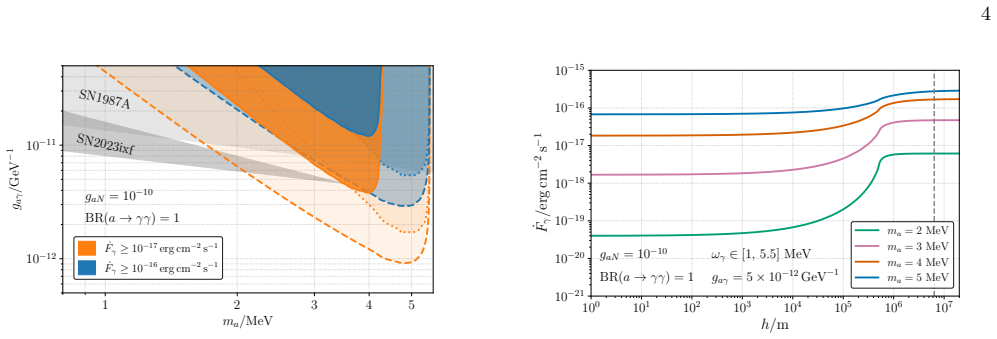
Axion-like particles a with masses up to 5.5 MeV are produced in the Sun by p + D → ³He + a and subsequently decay to two photons. Because the decay is two-body, the photons can be emitted at large angles relative to the Sun's direction, producing observable signals either from space or from terrestrial sites at the South Pole where a critical height determines whether photons reach the detector for given particle parameters. This geometry allows future experiments with MeV-photon sensitivities of 10^{-16} (10^{-17}) erg cm^{-2} s^{-1} to constrain the coupling g_{aγ} down to 3×10^{-12} (1×10^{-12}) GeV^{-1}, exceeding current supernova limits.
What carries the argument
The geometric effects arising from two-body decay kinematics of solar-produced ALPs, which shift photon arrival directions away from the Sun and create a critical height for terrestrial detection.
Load-bearing premise
The production rate of ALPs in the Sun via the p + D → ³He + a reaction is accurately known from nuclear physics, and the resulting photon signals have sufficiently distinct angular and spectral features to permit background-free detection at the quoted sensitivities.
What would settle it
A dedicated search with a MeV gamma-ray telescope that finds no excess events in the predicted off-axis directions at the sensitivity of 10^{-16} erg cm^{-2} s^{-1} would falsify the projected reach on g_aγ, assuming the solar production rate holds.
Figures



read the original abstract
The axion-like particles $a$ can be produced in the Sun via the process of $p + D \to {}^3{\rm He} +a$, with mass up to 5.5 MeV. The photons in the subsequent decay $a \to \gamma\gamma$ can deviate significantly from the Sun, or even from roughly the opposite direction of the Sun. The nontrivial angular and spectral distributions of such photons enable us new methods to detect the {\it lights from the darkness}. In this letter, we consider both the space detection and terrestrial experiments at the South Pole. As a result of the two-body decay and the geometric effects, there exists a critical height for the terrestrial experiments, below which there is no photon for some regions of the parameter space. With the sensitivities of $10^{-16}$ ($10^{-17}$) erg cm$^{-2}$ s$^{-1}$ for the MeV-scale photons in future space and terrestrial experiments, the coupling $g_{a\gamma}$ of $a$ to photons can be probed up to $3\times10^{-12}$ ($1\times10^{-12}$) GeV$^{-1}$, well surpassing the current supernova limits.
Editorial analysis
A structured set of objections, weighed in public.
Referee Report
Summary. The manuscript investigates signals from MeV-scale axion-like particles (ALPs) produced in the Sun through the reaction p + D → ³He + a, with subsequent decay a → γγ. It emphasizes the unique angular and spectral distributions arising from two-body decay kinematics and solar geometry, which allow photons to appear deviated from the Sun's direction or even from the opposite direction. The authors propose detection strategies using future space-based experiments and terrestrial setups at the South Pole, noting a critical height for the latter below which signals vanish in parts of parameter space. They project that sensitivities of 10^{-16} (10^{-17}) erg cm^{-2} s^{-1} in photon flux would allow probing the ALP-photon coupling g_{aγ} down to 3×10^{-12} (1×10^{-12}) GeV^{-1}, surpassing current supernova constraints.
Significance. If the underlying calculations hold and the coupling dependence is properly accounted for, this approach could provide a novel probe of MeV ALPs using directional photon searches, offering potential improvements over existing limits from astrophysics. The focus on geometric effects in two-body decays represents a creative angle for background rejection in solar ALP searches.
major comments (2)
- [Abstract] Abstract: The projected reach is quoted solely as limits on g_{aγ} (3×10^{-12} GeV^{-1} for space, 1×10^{-12} GeV^{-1} for terrestrial), but the production rate via p + D → ³He + a scales with g_{aN}^2 while the two-photon decay width scales with g_{aγ}^2 m_a^3. For generic ALPs these couplings are independent, so the observable photon flux depends on the product g_{aN}^2 g_{aγ}^2 (modulo lifetime and geometric factors from the two-body decay). The manuscript does not specify any model relation between g_{aN} and g_{aγ} or present results in terms of the product, rendering the numerical claims on g_{aγ} alone model-dependent in a way not acknowledged.
- [Abstract] Abstract: The sensitivity projections are stated without reference to the explicit derivations of the solar production rate, the decay kinematics leading to the angular/spectral distributions, the photon flux at Earth, background estimates, or error analysis. These steps are load-bearing for the central claim that the quoted sensitivities surpass supernova limits, and their absence prevents verification of the numerical results.
minor comments (1)
- [Abstract] The abstract refers to 'current supernova limits' without a specific citation; adding the relevant reference (e.g., to the bound on g_{aγ} for MeV-scale ALPs) would improve traceability.
Simulated Author's Rebuttal
We are grateful to the referee for their thorough review and insightful comments, which have helped us improve the clarity and precision of our manuscript. Below, we provide detailed responses to the major comments.
read point-by-point responses
-
Referee: [Abstract] Abstract: The projected reach is quoted solely as limits on g_{aγ} (3×10^{-12} GeV^{-1} for space, 1×10^{-12} GeV^{-1} for terrestrial), but the production rate via p + D → ³He + a scales with g_{aN}^2 while the two-photon decay width scales with g_{aγ}^2 m_a^3. For generic ALPs these couplings are independent, so the observable photon flux depends on the product g_{aN}^2 g_{aγ}^2 (modulo lifetime and geometric factors from the two-body decay). The manuscript does not specify any model relation between g_{aN} and g_{aγ} or present results in terms of the product, rendering the numerical claims on g_{aγ} alone model-dependent in a way not acknowledged.
Authors: We agree with the referee that this is an important point. The manuscript does not currently specify the relation between the ALP-nucleon coupling g_{aN} and the ALP-photon coupling g_{aγ}. We will revise the abstract and the relevant sections of the manuscript to explicitly state the assumption used in our projections (for example, by presenting results in terms of the product g_{aN} g_{aγ} or by adopting a specific model relation such as g_{aN} = g_{aγ}). This will make the model dependence transparent and allow readers to interpret the results correctly for different scenarios. revision: yes
-
Referee: [Abstract] Abstract: The sensitivity projections are stated without reference to the explicit derivations of the solar production rate, the decay kinematics leading to the angular/spectral distributions, the photon flux at Earth, background estimates, or error analysis. These steps are load-bearing for the central claim that the quoted sensitivities surpass supernova limits, and their absence prevents verification of the numerical results.
Authors: While the abstract is necessarily concise and does not contain the full derivations, the manuscript body includes detailed calculations: the solar production rate is derived in Section II, the decay kinematics and angular/spectral distributions in Section III, the photon flux at Earth in Section IV, and background estimates along with the sensitivity analysis in Section V. To address the referee's concern, we will modify the abstract to include pointers to these sections, such as 'following the derivations in Secs. II-V'. This will enable easier verification of the numerical results and the comparison to supernova limits. revision: yes
Circularity Check
No significant circularity; forward projections rely on external inputs
full rationale
The paper calculates ALP production via the nuclear process p + D → ³He + a (rate ∝ g_aN²) followed by two-body decay a → γγ (width ∝ g_aγ² m_a³) and derives projected photon fluxes at Earth for future detectors. These are then converted to sensitivity reaches on g_aγ under stated experimental flux thresholds. No step reduces by construction to a fitted parameter, self-defined quantity, or load-bearing self-citation; the numerical claims are explicit functions of the two independent couplings, geometric factors, and assumed detector performance, all drawn from standard external physics without internal redefinition or renaming of known results. The derivation chain is therefore self-contained against external benchmarks.
Axiom & Free-Parameter Ledger
free parameters (2)
- g_aγ
- m_a
axioms (1)
- domain assumption ALPs produced via p + D → ³He + a in the Sun and decay to two photons
Reference graph
Works this paper leans on
-
[1]
C. A. Baker et al.,An Improved experimental limit on the electric dipole moment of the neutron,Phys. Rev. Lett.97 (2006) 131801, [hep-ex/0602020]
work page Pith review arXiv 2006
- [2]
-
[3]
Abelet al., Measurement of the Permanent Electric Dipole Moment of the Neutron, Phys
C. Abel et al.,Measurement of the Permanent Electric Dipole Moment of the Neutron,Phys. Rev. Lett.124 (2020) 081803, [2001.11966]
-
[4]
R. D. Peccei and H. R. Quinn,CP Conservation in the Presence of Instantons,Phys. Rev. Lett.38(1977) 1440– 1443
1977
-
[5]
R. D. Peccei and H. R. Quinn,Constraints Imposed by CP Conservation in the Presence of Instantons,Phys. Rev. D16(1977) 1791–1797
1977
-
[6]
Weinberg,A New Light Boson?,Phys
S. Weinberg,A New Light Boson?,Phys. Rev. Lett.40 (1978) 223–226
1978
-
[7]
Wilczek,Problem of StrongPandTInvariance in the Presence of Instantons,Phys
F. Wilczek,Problem of StrongPandTInvariance in the Presence of Instantons,Phys. Rev. Lett.40(1978) 279–282
1978
-
[8]
J. E. Kim,Weak Interaction Singlet and Strong CP In- variance,Phys. Rev. Lett.43(1979) 103
1979
-
[9]
M. A. Shifman, A. I. Vainshtein and V. I. Zakharov,Can Confinement Ensure Natural CP Invariance of Strong In- teractions?,Nucl. Phys. B166(1980) 493–506
1980
-
[10]
A. R. Zhitnitsky,On Possible Suppression of the Axion Hadron Interactions. (In Russian),Sov. J. Nucl. Phys. 31(1980) 260
1980
-
[11]
M. Dine, W. Fischler and M. Srednicki,A Simple Solu- tion to the Strong CP Problem with a Harmless Axion, Phys. Lett. B104(1981) 199–202
1981
-
[12]
G. G. Raffelt,Astrophysical methods to constrain axions and other novel particle phenomena,Phys. Rept.198 (1990) 1–113
1990
- [13]
-
[14]
L. Di Luzio, M. Giannotti, E. Nardi and L. Visinelli,The landscape of QCD axion models,Phys. Rept.870(2020) 1–117, [2003.01100]
-
[15]
P. Carenza, M. Giannotti, J. Isern, A. Mirizzi and O. Straniero,Axion astrophysics,Phys. Rept.1117 (2025) 1–102, [2411.02492]
-
[16]
cajohare/axionlimits: Axionlimits
C. O’Hare, “cajohare/axionlimits: Axionlimits.” https://cajohare.github.io/AxionLimits/, July,
-
[17]
10.5281/zenodo.3932430
- [18]
-
[19]
S. Girmohanta, S. Nakagawa, Y. Nakai and J. Xu,How viable is a QCD axion near 10 MeV?,JHEP10(2024) 153, [2405.13425]
- [20]
- [21]
- [22]
-
[23]
I. G. Irastorza and J. Redondo,New experimental ap- proaches in the search for axion-like particles,Prog. Part. Nucl. Phys.102(2018) 89–159, [1801.08127]
work page Pith review arXiv 2018
-
[24]
A. Berlin and Y. Kahn,New Technologies for Axion and Dark Photon Searches,Ann. Rev. Nucl. Part. Sci.75 (2025) 83–108, [2412.08704]. [24]Particle Data Groupcollaboration, S. Navas et al., Review of particle physics,Phys. Rev. D110(2024) 030001
-
[25]
H. M. Georgi, L. J. Hall and M. B. Wise,Grand Uni- fied Models With an Automatic Peccei-Quinn Symmetry, Nucl. Phys. B192(1981) 409–416
1981
-
[26]
S. B. Giddings and A. Strominger,Loss of incoher- ence and determination of coupling constants in quantum gravity,Nucl. Phys. B307(1988) 854–866
1988
-
[27]
Planck-Scale Physics and the Peccei-Quinn Mechanism
M. Kamionkowski and J. March-Russell,Planck scale physics and the Peccei-Quinn mechanism,Phys. Lett. B 282(1992) 137–141, [hep-th/9202003]
work page Pith review arXiv 1992
-
[28]
S. M. Barr and D. Seckel,Planck scale corrections to axion models,Phys. Rev. D46(1992) 539–549
1992
-
[29]
Solutions to the strong CP problem in a world with gravity
R. Holman, S. D. H. Hsu, T. W. Kephart, E. W. Kolb, R. Watkins and L. M. Widrow,Solutions to the strong CP problem in a world with gravity,Phys. Lett. B282 (1992) 132–136, [hep-ph/9203206]
work page Pith review arXiv 1992
-
[30]
Primakoff,Photoproduction of neutral mesons in nu- clear electric fields and the mean life of the neutral meson, Phys
H. Primakoff,Photoproduction of neutral mesons in nu- clear electric fields and the mean life of the neutral meson, Phys. Rev.81(1951) 899
1951
-
[31]
D. A. Dicus, E. W. Kolb, V. L. Teplitz and R. V. Wag- oner,Astrophysical Bounds on the Masses of Axions and Higgs Particles,Phys. Rev. D18(1978) 1829
1978
-
[32]
T. W. Donnelly, S. J. Freedman, R. S. Lytel, R. D. Peccei and M. Schwartz,Do Axions Exist?,Phys. Rev. D18 (1978) 1607
1978
-
[33]
R. Massarczyk, P. H. Chu and S. R. Elliott,Axion emis- sion from nuclear magnetic dipole transitions,Phys. Rev. D105(2022) 015031, [2112.08285]
-
[34]
L. Di Luzio et al.,Probing the axion–nucleon coupling with the next generation of axion helioscopes,Eur. Phys. J. C82(2022) 120, [2111.06407]
-
[35]
Raffelt and L
G. Raffelt and L. Stodolsky,New Particles From Nuclear Reactions in the Sun,Phys. Lett. B119(1982) 323
1982
-
[36]
R. A. Gustafson, R. Plestid, I. M. Shoemaker and A. Zhou,Long-lived particles and the quiet Sun,Phys. Rev. D109(2024) 015020, [2307.01856]. [37]Borexinocollaboration, G. Bellini et al.,Search for Solar Axions Produced inp(d, 3He)AReaction with Borexino Detector,Phys. Rev. D85(2012) 092003, [1203.6258]
- [37]
- [38]
- [39]
- [40]
- [41]
-
[42]
S. Hoof and L. Schulz,Updated constraints on axion- 7 like particles from temporal information in supernova SN1987A gamma-ray data,JCAP03(2023) 054, [2212.09764]
-
[43]
E. M¨ uller, F. Calore, P. Carenza, C. Eckner and M. C. D. Marsh,Investigating the gamma-ray burst from decaying MeV-scale axion-like particles produced in supernova ex- plosions,JCAP07(2023) 056, [2304.01060]
-
[44]
E. M¨ uller, P. Carenza, C. Eckner and A. Goobar,Con- straining MeV-scale axionlike particles with Fermi-LAT observations of SN 2023ixf,Phys. Rev. D109(2024) 023018, [2306.16397]
-
[45]
J. Jaeckel, P. C. Malta and J. Redondo,Decay photons from the axionlike particles burst of type II supernovae, Phys. Rev. D98(2018) 055032, [1702.02964]
-
[46]
Low-Energy Supernovae Severely Constrain Radiative Particle Decays,
A. Caputo, H.-T. Janka, G. Raffelt and E. Vitagliano, Low-Energy Supernovae Severely Constrain Radiative Particle Decays,Phys. Rev. Lett.128(2022) 221103, [2201.09890]
-
[47]
M. Diamond, D. F. G. Fiorillo, G. Marques-Tavares and E. Vitagliano,Axion-sourced fireballs from supernovae, Phys. Rev. D107(2023) 103029, [2303.11395]. [Erra- tum: Phys.Rev.D 108, 049902 (2023)]
-
[48]
M. Diamond, D. F. G. Fiorillo, G. Marques- Tavares, I. Tamborra and E. Vitagliano,Multimes- senger Constraints on Radiatively Decaying Axions from GW170817,Phys. Rev. Lett.132(2024) 101004, [2305.10327]
- [49]
- [50]
- [51]
-
[52]
Oberauer, C
L. Oberauer, C. Hagner, G. Raffelt and E. Rieger,Su- pernova bounds on neutrino radiative decays,Astropart. Phys.1(1993) 377–386
1993
- [53]
-
[54]
L. Mastrototaro, A. Mirizzi, P. D. Serpico and A. Esmaili, Heavy sterile neutrino emission in core-collapse super- novae: Constraints and signatures,JCAP01(2020) 010, [1910.10249]
-
[55]
Muonic Boson Limits: Supernova Redux
A. Caputo, G. Raffelt and E. Vitagliano,Muonic bo- son limits: Supernova redux,Phys. Rev. D105(2022) 035022, [2109.03244]
work page internal anchor Pith review Pith/arXiv arXiv 2022
- [56]
- [57]
- [58]
- [59]
-
[60]
V. Syvolap and O. Ruchayskiy,High-energy neutrino signals from supernova explosions: A new window into dark photon parameter space,Phys. Rev. D110(2024) 115043, [2404.19191]
-
[61]
B. Telalovic, D. F. G. Fiorillo, P. Mart´ ınez-Mirav´ e, E. Vitagliano and M. Bustamante,The next galactic su- pernova can uncover mass and couplings of particles de- caying to neutrinos,JCAP11(2024) 011, [2406.15506]
- [62]
-
[63]
G. Chauhan, R. A. Gustafson and I. M. Shoemaker,Su- pernova gamma-ray constraints from heavy sterile neu- trino decays,JCAP07(2025) 012, [2503.13607]
-
[64]
Heavy dark photon handbook: Cosmological and astrophysical bounds,
A. Caputo, J. Park and S. Yun,The Heavy Dark Pho- ton Handbook: Cosmological and Astrophysical Bounds, 2511.15785
- [65]
- [66]
-
[67]
F. R. Candon, D. F. G. Fiorillo, G. Lucente, E. Vitagliano and J. K. Vogel,NuSTAR Bounds on Ra- diatively Decaying Particles from M82,Phys. Rev. Lett. 134(2025) 171004, [2412.03660]. [69]NuSTARcollaboration, F. A. Harrison et al.,The Nu- clear Spectroscopic Telescope Array (NuSTAR) High- Energy X-Ray Mission,Astrophys. J.770(2013) 103, [1301.7307]. [70]BO...
-
[68]
A. O. Benz,Flare Observations,Living Reviews in Solar Physics14(2017) 59
2017
-
[69]
D. Seckel, T. Stanev and T. K. Gaisser,Signatures of cosmic-ray interactions on the solar surface,Astrophys. J.382(1991) 652–666. [73]Fermi-LATcollaboration, A. A. Abdo et al.,Fermi-LAT Observations of Two Gamma-Ray Emission Components from the Quiescent Sun,Astrophys. J.734(2011) 116, [1104.2093]
- [70]
-
[71]
G. Hasinger, T. Miyaji and M. Schmidt,Luminosity- dependent evolution of soft x-ray selected AGN: New Chandra and XMM-Newton surveys,Astron. Astrophys. 441(2005) 417–434, [astro-ph/0506118]
-
[72]
The synthesis of the cosmic X-ray background in the Chandra and XMM-Newton era
R. Gilli, A. Comastri and G. Hasinger,The synthe- sis of the cosmic X-ray background in the Chandra and XMM-Newton era,Astron. Astrophys.463(2007) 79, [astro-ph/0610939]
work page Pith review arXiv 2007
-
[73]
M. Fornasa and M. A. S´ anchez-Conde,The nature of the Diffuse Gamma-Ray Background,Phys. Rept.598(2015) 8 1–58, [1502.02866]
-
[74]
T. K. Gaisser, R. Engel and E. Resconi,Cosmic Rays and Particle Physics: 2nd Edition. Cambridge University Press, 6, 2016
2016
-
[75]
Fuke,Recent highlights of scientific ballooning in japan,Journal of Astronomical Instrumentation6(2017) 1740001
H. Fuke,Recent highlights of scientific ballooning in japan,Journal of Astronomical Instrumentation6(2017) 1740001
2017
-
[76]
Colloquium: Annual modulation of dark matter,
K. Freese, M. Lisanti and C. Savage,Colloquium: Annual modulation of dark matter,Rev. Mod. Phys.85(2013) 1561–1581, [1209.3339]
- [77]
- [78]
-
[79]
J. Wei and B. Cordier,The Deep and Transient Universe in the SVOM Era: New Challenges and Opportunities - Scientific prospects of the SVOM mission, 10, 2016, 1610.06892. [84]e-ASTROGAMcollaboration, M. Tavani et al.,Science with e-ASTROGAM: A space mission for MeV–GeV gamma-ray astrophysics,JHEAp19(2018) 1–106, [1711.01265]
work page internal anchor Pith review Pith/arXiv arXiv 2016
-
[80]
A. M. Galper et al.,Precision Measurements of High-Energy Cosmic Gamma-Ray Emission with the GAMMA-400 Gamma-Ray Telescope,Phys. Atom. Nucl. 80(2017) 1141–1145. [86]VLASTcollaboration, F. Yi-zhong et al.,Very large area gamma-ray space telescope (vlast),Acta Astronom- ica Sinica63(2022) 27. [87]APTcollaboration, J. H. Buckley et al.,The Advanced Particle-...
2017
discussion (0)
Sign in with ORCID, Apple, or X to comment. Anyone can read and Pith papers without signing in.