Recognition: unknown
Random-State Generation and Preparation Complexity in Rydberg Atom Arrays
Pith reviewed 2026-05-10 05:27 UTC · model grok-4.3
The pith
In Rydberg atom arrays, optimal control prepares generic symmetric states to high accuracy, but accuracy falls as the state's entanglement entropy increases.
A machine-rendered reading of the paper's core claim, the machinery that carries it, and where it could break.
Core claim
Employing target states drawn from an ensemble with a broad entropy distribution, we observe high fidelities (infidelities between 10^{-5} and 3×10^{-2} for 9 spins). The fidelity, however, decreases with the entanglement entropy of the target state, demonstrating that highly entangled states are intrinsically harder to prepare under realistic constraints.
What carries the argument
Quantum optimal control applied to target states drawn from random global pulse ensembles, with the central observation that preparation fidelity decreases with the target's entanglement entropy.
If this is right
- In the strong-interaction blockade regime, level-spacing statistics of reduced density matrices follow random-matrix predictions while measurement probabilities deviate from Porter-Thomas statistics.
- Weaker interactions allow the dynamics to approach Haar-like statistics in entanglement entropy, entanglement spectrum, and measurement probabilities on experimentally relevant timescales.
- At intermediate interactions, Haar-like behavior emerges within fixed evolution times accessible in experiments.
- Preparation succeeds with low error for most targets but systematically worsens for those with higher entanglement entropy.
Where Pith is reading between the lines
- The fidelity-entropy trend suggests entanglement entropy could serve as a practical metric for estimating preparation cost in neutral-atom hardware.
- Scaling the optimal-control protocol to arrays larger than nine spins would test whether the difficulty with high-entropy states becomes prohibitive.
- The random-pulse generation method offers a way to benchmark control techniques on other quantum platforms that aim to produce generic states.
Load-bearing premise
That the ensembles generated by random global pulse sequences under hardware constraints are representative of generic symmetric states and that numerical comparisons accurately reflect the physical dynamics without significant artifacts.
What would settle it
An experiment or simulation finding that fidelity for high-entropy targets stays as high as for low-entropy ones across larger arrays or altered pulse constraints would disprove the claim of intrinsic preparation difficulty.
Figures




read the original abstract
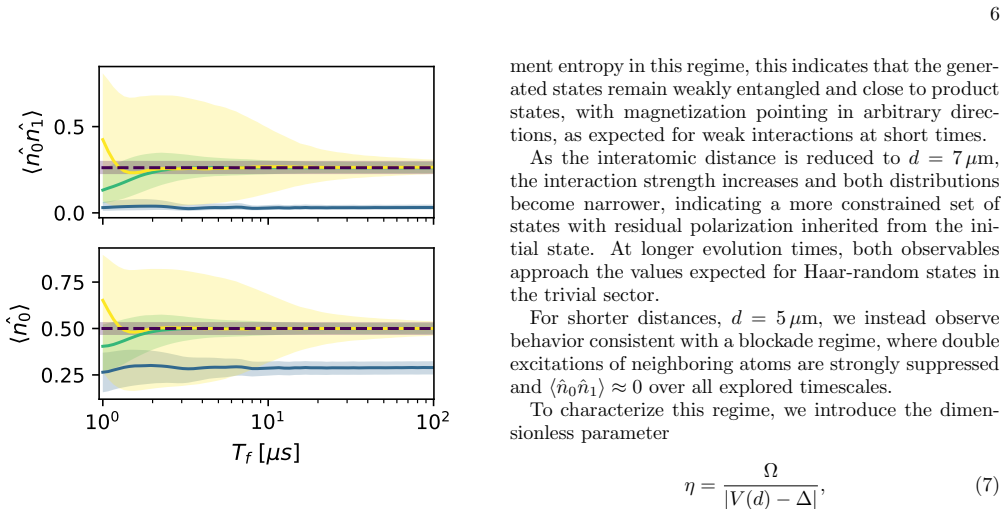
Rydberg atom arrays are powerful platforms for studying quantum many-body systems. We consider the Rydberg-Ising Hamiltonian on periodic chains and numerically study ensembles of states generated by random global pulse sequences subject to hardware constraints and fixed evolution times. We compare the statistical properties of such states with those of Haar-random states within the relevant lattice symmetry sector. In the strong-interaction regime (short interatomic distance), the dynamics is governed by an effective blockade that restricts Hilbert-space exploration and limits entanglement growth. In this regime, level-spacing statistics of reduced density matrices are close to random-matrix predictions, while the distribution of measurement probabilities deviates from Porter-Thomas behavior. For weaker interactions (larger interatomic distance), the system approaches Haar-like statistics at long times, as reflected in entanglement entropy, entanglement spectrum statistics, and the distribution of measurement probabilities. At intermediate interactions, this behavior is observed on experimentally relevant timescales. Motivated by this observation, we investigate whether generic symmetric quantum states can be efficiently prepared using quantum optimal control in this regime. Employing target states drawn from an ensemble with a broad entropy distribution, we observe high fidelities (infidelities between $10^{-5}$ and $3\times 10^{-2}$ for 9 spins). The fidelity, however, decreases with the entanglement entropy of the target state, demonstrating that highly entangled states are intrinsically harder to prepare under realistic constraints.
Editorial analysis
A structured set of objections, weighed in public.
Referee Report
Summary. The manuscript numerically investigates ensembles of states generated by random global pulse sequences on the Rydberg-Ising Hamiltonian for periodic chains, comparing their statistical properties (level-spacing, entanglement entropy, entanglement spectrum, and measurement probabilities) to Haar-random states in the symmetry sector. It identifies regime-dependent behavior: strong interactions induce blockade-limited dynamics with RMT-like level statistics but deviations from Porter-Thomas; weaker interactions approach Haar statistics at long times. The paper then applies quantum optimal control to prepare target states sampled from such an ensemble (with broad entropy distribution), reporting infidelities of 10^{-5} to 3×10^{-2} for 9 spins that increase with target entanglement entropy.
Significance. If the central claims hold, the work offers quantitative insight into state-preparation complexity under realistic Rydberg hardware constraints, showing an explicit correlation between entanglement entropy and preparation fidelity. The regime-dependent approach to Haar-like statistics and the use of optimal control on constrained ensembles could inform experimental design for generating entangled states in quantum simulators. The direct numerical comparisons to random-matrix predictions provide a useful benchmark for many-body dynamics in symmetry sectors.
major comments (2)
- [Abstract and optimal-control results] Abstract and optimal-control results: The headline claim that fidelity decreases with entanglement entropy, demonstrating that 'highly entangled states are intrinsically harder to prepare under realistic constraints,' rests on targets drawn from the same random global-pulse ensemble. The manuscript itself notes that strong interactions restrict exploration via blockade and that even intermediate regimes only approach Haar statistics at long times; because the optimal-control targets are sampled from this constrained ensemble, the observed trend may reflect the limited support of the pulse sequences rather than a fundamental limit. A direct comparison of optimal-control performance on Haar-random targets drawn from the same symmetry sector is needed to substantiate the intrinsic-hardness interpretation.
- [Numerical methods and data reporting] Numerical methods and data reporting: The abstract states infidelities between 10^{-5} and 3×10^{-2} for 9 spins and reports regime-dependent statistics, yet provides no details on the number of sampled sequences, the distribution of pulse amplitudes/durations, the precise optimal-control algorithm and convergence criteria, or statistical uncertainties/error bars on the fidelity-entropy correlation. These omissions are load-bearing for evaluating whether the reported trend is robust or affected by post-hoc selection or finite sampling.
minor comments (2)
- [Abstract] The abstract refers to 'periodic chains' and '9 spins' for the fidelity data but does not state the system sizes employed for the level-statistics and entanglement analyses, which is needed to assess finite-size effects.
- [Statistical analysis section] Clarify the precise definition of the 'reduced density matrices' whose level-spacing statistics are compared to random-matrix predictions (single-site, two-site, etc.) and the exact ensemble (GOE, GUE, or other) used for the benchmark.
Simulated Author's Rebuttal
We thank the referee for the careful reading and constructive comments on our manuscript. We address each major comment below and outline the revisions we will make to strengthen the work.
read point-by-point responses
-
Referee: [Abstract and optimal-control results] Abstract and optimal-control results: The headline claim that fidelity decreases with entanglement entropy, demonstrating that 'highly entangled states are intrinsically harder to prepare under realistic constraints,' rests on targets drawn from the same random global-pulse ensemble. The manuscript itself notes that strong interactions restrict exploration via blockade and that even intermediate regimes only approach Haar statistics at long times; because the optimal-control targets are sampled from this constrained ensemble, the observed trend may reflect the limited support of the pulse sequences rather than a fundamental limit. A direct comparison of optimal-control performance on Haar-random targets drawn from the same symmetry sector is needed to substantiate the intrinsic-hardness interpretation.
Authors: We agree that the target states are sampled from the random global-pulse ensemble rather than directly from the Haar measure, and that this ensemble only approaches Haar statistics in the weaker-interaction regime. Our phrasing 'intrinsically harder to prepare under realistic constraints' is intended to refer specifically to preparation via global controls on the Rydberg-Ising Hamiltonian (matching the hardware platform), not to a claim of fundamental hardness independent of all methods. The correlation we report is therefore meaningful within the physically accessible ensemble generated by the same class of controls. Nevertheless, to address the referee's concern and clarify the scope of the claim, we will add a direct comparison: we will sample a modest number of Haar-random states in the same symmetry sector for N=9 and report the optimal-control infidelities achieved with the same algorithm and resources. This will allow readers to see whether the fidelity-entropy trend persists or is modulated by the choice of ensemble. revision: yes
-
Referee: [Numerical methods and data reporting] Numerical methods and data reporting: The abstract states infidelities between 10^{-5} and 3×10^{-2} for 9 spins and reports regime-dependent statistics, yet provides no details on the number of sampled sequences, the distribution of pulse amplitudes/durations, the precise optimal-control algorithm and convergence criteria, or statistical uncertainties/error bars on the fidelity-entropy correlation. These omissions are load-bearing for evaluating whether the reported trend is robust or affected by post-hoc selection or finite sampling.
Authors: We acknowledge that the current manuscript lacks sufficient detail on the numerical protocols. In the revised version we will expand the Methods section (and add a short paragraph in the main text) to specify: (i) the total number of random pulse sequences generated per interaction regime (typically several hundred to a few thousand), (ii) the exact sampling distributions for pulse amplitudes and durations (uniform over hardware-allowed intervals), (iii) the optimal-control algorithm (gradient-based method with explicit iteration count and convergence threshold), and (iv) statistical uncertainties on the fidelity-entropy data, obtained via bootstrap resampling or standard deviation across independent runs. These additions will make the robustness of the reported trend transparent. revision: yes
Circularity Check
No significant circularity; results from direct numerical simulation.
full rationale
The paper's central results arise from explicit numerical integration of the Rydberg-Ising Hamiltonian under random global pulse sequences (subject to fixed-time and hardware constraints) to produce state ensembles, followed by direct comparison of their statistical properties (entanglement entropy, level-spacing, measurement probabilities) against Haar-random states and random-matrix theory as independent external benchmarks. Optimal-control preparation of targets drawn from the same ensemble then yields an empirical fidelity-entropy correlation. No step reduces by construction to a fitted parameter, self-definition, or load-bearing self-citation; the derivation chain is self-contained against the stated numerical protocols and benchmarks.
Axiom & Free-Parameter Ledger
axioms (1)
- domain assumption The Rydberg-Ising Hamiltonian on periodic chains accurately models the system dynamics under the stated pulse sequences.
Reference graph
Works this paper leans on
-
[1]
As shown in Fig
andβ= 2 corresponds to GUE. As shown in Fig. 2(a), the ratio distribution for random- pulse states approachesP W-D at long times. In addition to the evolution timeT f, the interatomic distancedcontrols the interaction strength and thus the degree of effective constraints in the dynamics. It is therefore natural to expect that it also influences the con- v...
2000
-
[2]
Saffman, T
M. Saffman, T. G. Walker, and K. Mølmer, Quantum information with Rydberg atoms, Reviews of Modern Physics82, 2313 (2010)
2010
-
[3]
Henriet, L
L. Henriet, L. Beguin, A. Signoles, T. Lahaye, A. Browaeys, G.-O. Reymond, and C. Jurczak, Quantum computing with neutral atoms, Quantum4, 327 (2020)
2020
-
[4]
Browaeys and T
A. Browaeys and T. Lahaye, Many-body physics with individually controlled Rydberg atoms, Nat. Phys.16, 132–142 (2020)
2020
-
[5]
Morgado and S
M. Morgado and S. Whitlock, Quantum simulation and computing with Rydberg-interacting qubits, AVS Quan- tum Sci.3, 023501 (2021)
2021
-
[6]
Labuhn, D
H. Labuhn, D. Barredo, S. Ravets, S. de L´ es´ eleuc, T. Macr` ı, T. Lahaye, and A. Browaeys, Tunable two- dimensional arrays of single Rydberg atoms for realizing quantum Ising models, Nature534, 667 (2016)
2016
-
[7]
Bernien, S
H. Bernien, S. Schwartz, A. Keesling, H. Levine, A. Om- ran, H. Pichler, S. Choi, A. S. Zibrov, M. Endres, M. Greiner, V. Vuleti´ c, and M. D. Lukin, Probing many- body dynamics on a 51-atom quantum simulator, Nature 551, 579 (2017)
2017
-
[8]
Guardado-Sanchez, P
E. Guardado-Sanchez, P. T. Brown, D. Mitra, T. De- vakul, D. A. Huse, P. Schauß, and W. S. Bakr, Probing the Quench Dynamics of Antiferromagnetic Correlations in a 2D Quantum Ising Spin System, Phys. Rev. X8, 021069 (2018)
2018
-
[9]
Bluvstein, A
D. Bluvstein, A. Omran, H. Levine, A. Keesling, G. Se- meghini, S. Ebadi, T. T. Wang, A. A. Michailidis, N. Maskara, W. W. Ho, S. Choi, M. Serbyn, M. Greiner, V. Vuleti´ c, and M. D. Lukin, Controlling quantum many- body dynamics in driven Rydberg atom arrays, Science 371, 1355–1359 (2021)
2021
-
[10]
Scholl, M
P. Scholl, M. Schuler, H. J. Williams, A. A. Eberharter, D. Barredo, K.-N. Schymik, V. Lienhard, L.-P. Henry, T. C. Lang, T. Lahaye, A. M. L¨ auchli, and A. Browaeys, Quantum simulation of 2d antiferromagnets with hun- dreds of Rydberg atoms, Nature595, 233–238 (2021)
2021
-
[11]
One-to-one quantum simulation of a frustrated magnet with 256 qubits
L. Leclerc, S. Juli` a-Farr´ e, G. S. Freitas, G. Villaret, B. Albrecht, L. B´ eguin, L. Bourachot, C. Briosne- Frejaville, D. Claveau, A. Cornillot, J. de Hond, D. Di- allo, C. Dupays, R. Dupont, T. Eritzpokhoff, E. Got- tlob, L. Henriet, M. Kaicher, L. Lassabli` ere, A. Lind- berg, Y. Machu, H. Mamann, T. Pansiot, J. Ripoll, 10 E. S. Choi, A. Signoles, ...
work page internal anchor Pith review Pith/arXiv arXiv 2026
-
[12]
Ebadi, T
S. Ebadi, T. T. Wang, H. Levine, A. Keesling, G. Se- meghini, A. Omran, D. Bluvstein, R. Samajdar, H. Pich- ler, W. W. Ho, S. Choi, S. Sachdev, M. Greiner, V. Vuleti´ c, and M. D. Lukin, Quantum phases of matter on a 256-atom programmable quantum simulator, Nature 595, 227 (2021)
2021
-
[13]
Keesling, A
A. Keesling, A. Omran, H. Levine, H. Bernien, H. Pich- ler, S. Choi, R. Samajdar, S. Schwartz, P. Silvi, S. Sachdev, P. Zoller, M. Endres, M. Greiner, V. Vuleti´ c, and M. D. Lukin, Quantum Kibble–Zurek mechanism and critical dynamics on a programmable Rydberg sim- ulator, Nature568, 207–211 (2019)
2019
-
[14]
J. Zhang, S. H. Cant´ u, F. Liu, A. Bylinskii, B. Braver- man, F. Huber, J. Amato-Grill, A. Lukin, N. Gemelke, A. Keesling, S.-T. Wang, Y. Meurice, and S.-W. Tsai, Probing quantum floating phases in Rydberg atom ar- rays, Nat. Commun.16, 10.1038/s41467-025-55947-2 (2025)
-
[15]
Manovitz, S
T. Manovitz, S. H. Li, S. Ebadi, R. Samajdar, A. A. Geim, S. J. Evered, D. Bluvstein, H. Zhou, N. U. Koylu- oglu, J. Feldmeier, P. E. Dolgirev, N. Maskara, M. Kali- nowski, S. Sachdev, D. A. Huse, M. Greiner, V. Vuleti´ c, and M. D. Lukin, Quantum coarsening and collective dy- namics on a programmable simulator, Nature638, 86–92 (2025)
2025
-
[16]
C. Chen, G. Bornet, M. Bintz, G. Emperauger, L. Leclerc, V. S. Liu, P. Scholl, D. Barredo, J. Hauschild, S. Chatterjee, M. Schuler, A. M. L¨ auchli, M. P. Zale- tel, T. Lahaye, N. Y. Yao, and A. Browaeys, Continuous symmetry breaking in a two-dimensional Rydberg array, Nature616, 691 (2023)
2023
-
[17]
S. K. Kanungo, J. D. Whalen, Y. Lu, M. Yuan, S. Dasgupta, F. B. Dunning, K. R. A. Hazzard, and T. C. Killian, Realizing topological edge states with Rydberg-atom synthetic dimensions, Nat. Commun.13, 10.1038/s41467-022-28550-y (2022)
-
[18]
Semeghini, H
G. Semeghini, H. Levine, A. Keesling, S. Ebadi, T. T. Wang, D. Bluvstein, R. Verresen, H. Pichler, M. Kali- nowski, R. Samajdar, A. Omran, S. Sachdev, A. Vish- wanath, M. Greiner, V. Vuleti´ c, and M. D. Lukin, Prob- ing topological spin liquids on a programmable quantum simulator, Science374, 1242–1247 (2021)
2021
-
[19]
de L´ es´ eleuc, V
S. de L´ es´ eleuc, V. Lienhard, P. Scholl, D. Barredo, S. We- ber, N. Lang, H. P. B¨ uchler, T. Lahaye, and A. Browaeys, Observation of a symmetry-protected topological phase of interacting bosons with Rydberg atoms, Science365, 775–780 (2019)
2019
-
[20]
Bornet, G
G. Bornet, G. Emperauger, C. Chen, B. Ye, M. Block, M. Bintz, J. A. Boyd, D. Barredo, T. Comparin, F. Mezzacapo, T. Roscilde, T. Lahaye, N. Y. Yao, and A. Browaeys, Scalable spin squeezing in a dipolar Ryd- berg atom array, Nature621, 728–733 (2023)
2023
-
[21]
Z. Qin and V. W. Scarola, Scaling of computational order parameters in Rydberg-atom graph states, Phys. Rev. A 111, 10.1103/physreva.111.042617 (2025)
-
[22]
Michel, L
A. Michel, L. Henriet, C. Domain, A. Browaeys, and T. Ayral, Hubbard physics with Rydberg atoms: Using a quantum spin simulator to simulate strong fermionic correlations, Phys. Rev. B109, 174409 (2024)
2024
-
[23]
S. Juli` a-Farr´ e, A. Michel, C. Domain, J. Mikael, J.- C. Lafoucriere, J. Vovrosh, A. Chahlaoui, D. Claveau, G. Villaret, J. de Hond, L. Henriet, A. Browaeys, T. Ayral, and A. Dauphin, Hybrid quantum-classical analog simulation of two-dimensional Fermi-Hubbard models with neutral atoms (2025), arXiv:2510.05897 [quant-ph]
-
[24]
G. M. Huang, T. J. Tarn, and J. W. Clark, On the controllability of quantum-mechanical systems, J. Math. Phys.24, 2608 (1983)
1983
-
[25]
D’Alessandro,Introduction to Quantum Control and Dynamics(Chapman and Hall/CRC, 2021)
D. D’Alessandro,Introduction to Quantum Control and Dynamics(Chapman and Hall/CRC, 2021)
2021
-
[26]
I. D. Smith, M. Cautr` es, D. T. Stephen, and H. Poulsen Nautrup, Optimally generatingsu(2 N) using Pauli strings, Phys. Rev. Lett.134, 200601 (2025)
2025
- [27]
-
[28]
D’Alessandro and Y
D. D’Alessandro and Y. Isik, Controllability of the peri- odic quantum Ising spin chain and the onsager algebra, J. Phys. A: Math. Theor.58, 115202 (2025)
2025
-
[29]
Cerezo, A
M. Cerezo, A. Arrasmith, R. Babbush, S. C. Benjamin, S. Endo, K. Fujii, J. R. McClean, K. Mitarai, X. Yuan, L. Cincio, and P. J. Coles, Variational quantum algo- rithms, Nat. Rev. Phys.3, 625–644 (2021)
2021
-
[30]
Z. Holmes, K. Sharma, M. Cerezo, and P. J. Coles, Connecting ansatz expressibility to gradient magnitudes and barren plateaus, PRX Quantum3, 10.1103/prxquan- tum.3.010313 (2022)
-
[31]
S. Sim, P. D. Johnson, and A. Aspuru-Guzik, Expressibil- ity and entangling capability of parameterized quantum circuits for hybrid quantum-classical algorithms, Adv. Quantum Technol.2, 10.1002/qute.201900070 (2019)
-
[32]
Nahum, S
A. Nahum, S. Vijay, and J. Haah, Operator Spreading in Random Unitary Circuits, Phys. Rev. X8, 021014 (2018)
2018
-
[33]
C. W. von Keyserlingk, T. Rakovszky, F. Pollmann, and S. L. Sondhi, Operator Hydrodynamics, OTOCs, and Entanglement Growth in Systems without Conservation Laws, Phys. Rev. X8, 021013 (2018)
2018
-
[34]
Arute, K
F. Arute, K. Arya, R. Babbush, D. Bacon, J. C. Bardin, R. Barends, R. Biswas, S. Boixo, F. G. S. L. Brandao, D. A. Buell, B. Burkett, Y. Chen, Z. Chen, B. Chiaro, R. Collins, W. Courtney, A. Dunsworth, E. Farhi, B. Foxen, A. Fowler, C. Gidney, M. Giustina, R. Graff, K. Guerin, S. Habegger, M. P. Harrigan, M. J. Hartmann, A. Ho, M. Hoffmann, T. Huang, T. S...
2019
-
[35]
Tangpanitanon, S
J. Tangpanitanon, S. Thanasilp, N. Dangniam, M.- A. Lemonde, and D. G. Angelakis, Expressibility and trainability of parametrized analog quantum systems for machine learning applications, Phys. Rev. Research2, 043364 (2020)
2020
-
[36]
Silv´ erio, S
H. Silv´ erio, S. Grijalva, C. Dalyac, L. Leclerc, P. J. Kar- alekas, N. Shammah, M. Beji, L.-P. Henry, and L. Hen- riet, Pulser: An open-source package for the design of pulse sequences in programmable neutral-atom arrays, Quantum6, 629 (2022)
2022
-
[37]
Pasqal, Pulser online documentation
- [38]
-
[39]
H. Erbin, P.-L. Burdeau, C. Bertrand, T. Ayral, and G. Misguich, Many-body Quantum Score: A scalable benchmark for digital and analog quantum processors and first test on a commercial neutral atom device (2026), arXiv:2601.03461 [quant-ph]
-
[40]
Hayden, D
P. Hayden, D. W. Leung, and A. Winter, Aspects of generic entanglement, Commun. Math. Phys.265, 95–117 (2006)
2006
-
[41]
D. N. Page, Average entropy of a subsystem, Phys. Rev. Lett.71, 1291 (1993)
1993
-
[42]
Nakata and M
Y. Nakata and M. Murao, Generic entanglement en- tropy for quantum states with symmetry, Entropy22, 684 (2020)
2020
-
[43]
B. Swingle, G. Bentsen, M. Schleier-Smith, and P. Hay- den, Measuring the scrambling of quantum information, Phys. Rev. A94, 10.1103/physreva.94.040302 (2016)
- [44]
-
[45]
Zyczkowski and H.-J
K. Zyczkowski and H.-J. Sommers, Induced measures in the space of mixed quantum states, J. Phys. A: Math. Theor.34, 7111–7125 (2001)
2001
-
[46]
P. J. Forrester,Log-Gases and Random Matrices (LMS- 34)(Princeton University Press, Princeton, NJ, 2010)
2010
-
[47]
True and A
S. True and A. Hamma, Transitions in entanglement complexity in random circuits, Quantum6, 818 (2022)
2022
-
[48]
Y. Y. Atas, E. Bogomolny, O. Giraud, and G. Roux, Distribution of the ratio of consecutive level spacings in random matrix ensembles, Phys. Rev. Lett.110, 10.1103/physrevlett.110.084101 (2013)
-
[49]
C. E. Porter and R. G. Thomas, Fluctuations of nuclear reaction widths, Phys. Rev.104, 483 (1956)
1956
-
[50]
Hangleiter, J
D. Hangleiter, J. Bermejo-Vega, M. Schwarz, and J. Eis- ert, Anticoncentration theorems for schemes showing a quantum speedup, Quantum2, 65 (2018)
2018
-
[51]
Boixo, S
S. Boixo, S. V. Isakov, V. N. Smelyanskiy, R. Babbush, N. Ding, Z. Jiang, M. J. Bremner, J. M. Martinis, and H. Neven, Characterizing quantum supremacy in near- term devices, Nat. Phys.14, 595 (2018)
2018
-
[52]
Hangleiter and J
D. Hangleiter and J. Eisert, Computational advantage of quantum random sampling, Rev. Mod. Phys.95, 035001 (2023)
2023
-
[53]
A. Sauliere, G. Lami, C. Boyer, J. D. Nardis, and A. D. Luca, Universality in the Anticoncentration of Noisy Quantum Circuits at Finite Depths, PRX Quan- tum 10.1103/xl16-cdy9 (2026)
-
[54]
Urban, T
E. Urban, T. A. Johnson, T. Henage, L. Isenhower, D. D. Yavuz, T. G. Walker, and M. Saffman, Observation of Rydberg blockade between two atoms, Nat. Phys.5, 110–114 (2009)
2009
-
[55]
Entanglement entropy and the fermi surface,
T. Amthor, C. Giese, C. S. Hofmann, and M. Wei- dem¨ uller, Evidence of antiblockade in an ultracold Rydberg gas, Phys. Rev. Lett.104, 10.1103/phys- revlett.104.013001 (2010)
-
[56]
C. Ates, T. Pohl, T. Pattard, and J. M. Rost, An- tiblockade in Rydberg excitation of an ultracold lattice gas, Phys. Rev. Lett.98, 10.1103/physrevlett.98.023002 (2007)
-
[57]
P. Rembold, N. Oshnik, M. M. M¨ uller, S. Montangero, T. Calarco, and E. Neu, Introduction to quantum optimal control for quantum sensing with nitrogen- vacancy centers in diamond, AVS Quantum Sci.2, 10.1116/5.0006785 (2020)
-
[58]
E. S. Carrera, H. Erbin, and G. Misguich, Preparing spin- squeezed states in Rydberg atom arrays via quantum optimal control, Phys. Rev. A112, 10.1103/wdqt-tpwz (2025)
-
[59]
R. A. Horn and C. R. Johnson,Matrix Analysis(Cam- bridge University Press, 2012)
2012
-
[60]
Y. Guo and L.-H. Lim, Eigen, singular, cosine-sine, and Autonne–Takagi vectors distributions of random matrix ensembles (2025), arXiv:2512.12766 [math.PR]. Appendix A: Entanglement spectrum ratio statistics In the main text, we characterized the statistical be- havior of the entanglement entropy and entanglement spectrum for a fixed bipartition of the qua...
discussion (0)
Sign in with ORCID, Apple, or X to comment. Anyone can read and Pith papers without signing in.