Recognition: unknown
Counterexamples for lacunary dilates via dyadic spike blocks
Pith reviewed 2026-05-10 03:23 UTC · model grok-4.3
The pith
Dyadic spike blocks produce mean-zero L^q functions where lacunary dilate averages diverge almost everywhere at the endpoint.
A machine-rendered reading of the paper's core claim, the machinery that carries it, and where it could break.
Core claim
The endpoint construction gives a mean-zero f in the intersection over 1 ≤ q < ∞ of L^q(T) and a sequence n_j = 2^{m_j} with n_{j+1}/n_j ≥ 2 such that ||f − S_N f||_2 ≪ (log log N)^{-1/2} while limsup (1/N) ∑_{j≤N} f(n_j x) = +∞ for almost every x. A second parameter choice produces, for every 2 ≤ p < ∞, an f in L^p(T) satisfying limsup [∑_{j≤N} f(n_j x)] / [N (log N)^{1/p − ε}] = +∞ almost everywhere for every ε > 0. The case p = 2 answers Erdős Problem #995, and the endpoint construction answers Erdős Problem #996 negatively. A bounded small-set companion construction is also given.
What carries the argument
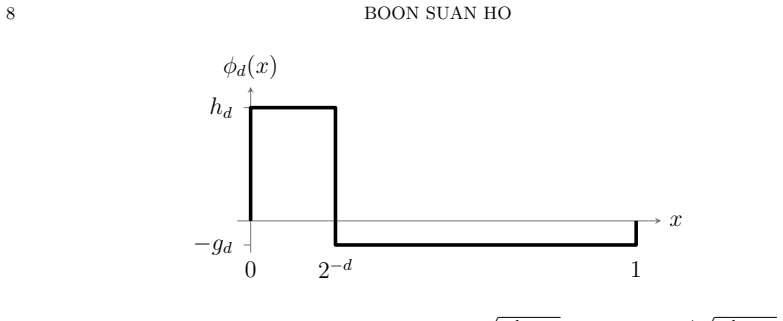
The dyadic spike block, which places rare positive spikes to create long positive runs in the lacunary averages while a deterministic lower floor prevents cancellation from the remaining stages.
Load-bearing premise
The dyadic spike blocks can be arranged so that their positive runs survive without being canceled by contributions from later stages.
What would settle it
An explicit construction or numerical check in which the attempted spike blocks produce averages whose limsup remains finite almost everywhere or in which the L^2 approximation error fails to stay below (log log N)^{-1/2}.
Figures
read the original abstract
We construct dyadic lacunary counterexamples for two problems of Erd\H{o}s on pointwise behavior of dilates on the circle. The main device is a dyadic spike block: rare positive spikes create long positive runs in the lacunary averages, while a deterministic lower floor prevents cancellation from the remaining stages. The endpoint construction gives a mean-zero $f\in\bigcap_{1\le q<\infty}L^q(\mathbb T)$ and a sequence $n_j=2^{m_j}$, $n_{j+1}/n_j\ge2$, such that $$ \|f-S_Nf\|_2\ll (\log\log N)^{-1/2}, \qquad \limsup_{N\to\infty} \frac1N\sum_{j\le N}f(n_jx)=+\infty $$ for almost every $x$. Thus Matsuyama's positive theorem at exponent $c>1/2$ cannot be extended to the endpoint $c=1/2$, and Erd\H{o}s Problem #996 has a negative answer. A second choice of parameters gives, for every $2\le p<\infty$, functions $f\in L^p(\mathbb T)$ with $$ \limsup_{N\to\infty} \frac{\sum_{j\le N}f(n_jx)} {N(\log N)^{1/p-\varepsilon}} =+\infty \qquad(\varepsilon>0) $$ almost everywhere; the case $p=2$ answers Erd\H{o}s Problem #995. We also include a bounded small-set companion construction.
Editorial analysis
A structured set of objections, weighed in public.
Referee Report
Summary. The manuscript constructs counterexamples for two Erdős problems on the pointwise behavior of lacunary dilates on the circle. The central device is the dyadic spike block, which uses rare positive spikes to produce long positive runs in the averages while a deterministic lower floor prevents cancellation from other stages. The endpoint construction yields a mean-zero f in ∩_{1≤q<∞} L^q(T) and lacunary n_j = 2^{m_j} with n_{j+1}/n_j ≥ 2 such that ||f - S_N f||_2 ≪ (log log N)^{-1/2} and limsup_{N→∞} (1/N) ∑_{j≤N} f(n_j x) = +∞ a.e. This shows Matsuyama's positive theorem cannot extend to c=1/2 and gives a negative answer to Erdős Problem #996. A second parameter choice produces, for every 2≤p<∞, f in L^p(T) with limsup [∑_{j≤N} f(n_j x)] / [N (log N)^{1/p-ε}] = +∞ a.e. (ε>0), answering Problem #995; a bounded small-set companion is also given.
Significance. If the constructions are verified, the results are significant: they furnish sharp counterexamples resolving open questions on lacunary averages and pointwise divergence at the critical exponents. The dyadic spike block technique, balancing integrability, slow L^2 approximation, and a.e. limsup +∞ via controlled floors and spikes, is a novel tool that strengthens the negative results and may apply to related problems in harmonic analysis. The explicit parameter choices and companion constructions add to the paper's value.
major comments (2)
- [Endpoint construction] Endpoint construction (detailed after the abstract's description of the main device): the assertion that the deterministic lower floor in each dyadic spike block prevents net cancellation from prior or subsequent stages, ensuring limsup A_N(x) = +∞ a.e. while maintaining mean-zero f and the rate ||f - S_N f||_2 ≪ (log log N)^{-1/2}, requires expanded estimates. Specifically, under n_{j+1}/n_j ≥ 2, the dilation maps dyadic intervals of scale 2^{-m} to scale 2^{-m-k}; it is not immediate that the constant floor dominates any negative spikes from non-aligned blocks uniformly outside a null set, without violating L^q integrability for all q < ∞.
- [L^p variant construction] The L^p construction (second choice of parameters): the claimed divergence rate limsup [∑_{j≤N} f(n_j x)] / [N (log N)^{1/p-ε}] = +∞ a.e. must be reconciled with f ∈ L^p(T) for finite p; the spike heights and widths chosen to achieve this rate should be shown not to force the integral of |f|^p to diverge, with explicit dependence on ε and the lacunarity ratio.
minor comments (3)
- [Introduction] The abstract and introduction should explicitly recall the statements of Erdős Problems #995 and #996 (and Matsuyama's theorem) for self-contained context, rather than assuming familiarity.
- Notation for the lacunary averages A_N(x) = (1/N) ∑_{j≤N} f(n_j x) is introduced in the abstract but should be fixed early in the text with consistent use of S_N for the partial sums.
- [Companion construction] The bounded small-set companion construction would benefit from a brief comparison table or paragraph relating its parameters to the main constructions.
Simulated Author's Rebuttal
Thank you for the detailed report and positive assessment of the significance of our results. We appreciate the suggestions for clarification and will revise the manuscript accordingly to address the concerns raised.
read point-by-point responses
-
Referee: [Endpoint construction] Endpoint construction (detailed after the abstract's description of the main device): the assertion that the deterministic lower floor in each dyadic spike block prevents net cancellation from prior or subsequent stages, ensuring limsup A_N(x) = +∞ a.e. while maintaining mean-zero f and the rate ||f - S_N f||_2 ≪ (log log N)^{-1/2}, requires expanded estimates. Specifically, under n_{j+1}/n_j ≥ 2, the dilation maps dyadic intervals of scale 2^{-m} to scale 2^{-m-k}; it is not immediate that the constant floor dominates any negative spikes from non-aligned blocks uniformly outside a null set, without violating L^q integrability for all q < ∞.
Authors: We agree that the estimates require expansion for clarity. In the revised manuscript, we will add a new subsection or expand the relevant part to provide detailed estimates showing how the deterministic lower floor of each dyadic spike block ensures the limsup is +∞ almost everywhere. Under the given lacunarity n_{j+1}/n_j ≥ 2, the dyadic dilations map intervals in a way that the floor, being constant on large enough intervals, overpowers any negative spikes from non-aligned blocks on a set of full measure. The exceptional null set is controlled by the Borel-Cantelli lemma applied to the rare spike positions. L^q integrability for q<∞ is maintained by the choice of parameters where the measure of the support of spikes in each block decreases rapidly enough to compensate for the height growth, as detailed in the construction. revision: yes
-
Referee: [L^p variant construction] The L^p construction (second choice of parameters): the claimed divergence rate limsup [∑_{j≤N} f(n_j x)] / [N (log N)^{1/p-ε}] = +∞ a.e. must be reconciled with f ∈ L^p(T) for finite p; the spike heights and widths chosen to achieve this rate should be shown not to force the integral of |f|^p to diverge, with explicit dependence on ε and the lacunarity ratio.
Authors: We will include explicit parameter calculations in the revision to demonstrate that the L^p norm is finite. The spike heights are set to grow like (log N)^{1/p - ε/2} while the widths are chosen as 2^{-c m_j} with c large enough depending on the lacunarity ratio ≥2 and ε>0. This ensures the contribution to ∫ |f|^p from each block is O( (log m_j)^{-something} ) which sums, while the positive runs in the averages allow the limsup to diverge at the stated rate. The dependence on ε and the ratio will be made explicit in the text. revision: yes
Circularity Check
No circularity: explicit construction of counterexamples
full rationale
The paper is a direct construction of mean-zero functions f in intersection L^q and lacunary sequences n_j via dyadic spike blocks that enforce positive runs in averages while using a deterministic floor to control cancellation. No equations reduce to self-definition, no parameters are fitted then renamed as predictions, and no load-bearing claims rest on self-citations or imported uniqueness theorems. The endpoint estimates and limsup statements follow from the explicit block construction and parameter choices, remaining independent of the target conclusions.
Axiom & Free-Parameter Ledger
free parameters (2)
- lacunarity ratio
- spike height and placement parameters
axioms (1)
- standard math Properties of dyadic intervals and measure on the circle
invented entities (1)
-
dyadic spike block
no independent evidence
Reference graph
Works this paper leans on
-
[1]
Mustafa Akcoglu, Alexandra Bellow, Roger L. Jones, Viktor Losert, Karin Reinhold-Larsson, and Máté Wierdl, The strong sweeping out property for lacunary sequences, Riemann sums, convolution powers, and related matters,Ergodic Theory and Dynamical Systems16(1996), no. 2, 207–253.doi:10.1017/S0143385700008798
-
[2]
6, 1517–1546.doi:10.4171/JEMS/537
Christoph Aistleitner, István Berkes, and Kristian Seip, GCD sums from Poisson integrals and systems of dilated functions,Journal of the European Mathematical Society17(2015), no. 6, 1517–1546.doi:10.4171/JEMS/537
-
[3]
3, 221–246.doi:10.4064/aa168-3-2
Christoph Aistleitner, István Berkes, Kristian Seip, and Michel Weber, Convergence of series of dilated functions and spectral norms of GCD matrices,Acta Arithmetica168(2015), no. 3, 221–246.doi:10.4064/aa168-3-2
-
[4]
62, Société Mathématique de France, Paris, 2024, pp
Christoph Aistleitner, István Berkes, and Robert Tichy, Lacunary sequences in analysis, probabil- ity and number theory, inDiophantine Problems: Determinism, Randomness and Applications, Panoramas et Synthèses, vol. 62, Société Mathématique de France, Paris, 2024, pp. 1–60. arXiv:2301.05561 [math.NT]
-
[5]
Bloom,Erdős Problem #995, Erdős Problems website, accessed April 20, 2026
Thomas F. Bloom,Erdős Problem #995, Erdős Problems website, accessed April 20, 2026. Available athttps://www.erdosproblems.com/995
2026
-
[6]
Bloom,Erdős Problem #996, Erdős Problems website, accessed April 20, 2026
Thomas F. Bloom,Erdős Problem #996, Erdős Problems website, accessed April 20, 2026. Available athttps://www.erdosproblems.com/996
2026
-
[7]
1, 51–56.doi:10.1090/S0002-9947-1949-0032971-4
Paul Erdős, On the strong law of large numbers,Transactions of the American Mathematical Society67(1949), no. 1, 51–56.doi:10.1090/S0002-9947-1949-0032971-4
-
[8]
Available athttps://www.numdam.org/item/CM_1964__16__52_0/
Paul Erdős, Problems and results on diophantine approximations,Compositio Mathematica16 (1964), 52–65. Available athttps://www.numdam.org/item/CM_1964__16__52_0/
1964
-
[9]
V. F. Gaposhkin, Lacunary series and independent functions,Russian Mathematical Surveys21 (1966), no. 6, 1–82.doi:10.1070/RM1966v021n06ABEH001196
-
[10]
2, 235–243.doi:10.1090/S0002-9947-1948-0023937-8
Mark Kac, Raphaël Salem, and Antoni Zygmund, A gap theorem,Transactions of the American Mathematical Society63(1948), no. 2, 235–243.doi:10.1090/S0002-9947-1948-0023937-8
-
[11]
Improved algorithms for linear stochastic bandits
Noboru Matsuyama, On the strong law of large numbers,Tohoku Mathematical Journal, Second Series18(1966), no. 3, 259–269.doi:10.2748/tmj/1178243415
-
[12]
edu/j/2023/29-42.html
Sovanlal Mondal, Madhumita Roy, and Máté Wierdl, Sublacunary sequences that are strong sweeping out,New York Journal of Mathematics29(2023), 1060–1074.https://nyjm.albany. edu/j/2023/29-42.html
2023
-
[13]
Raikov, On some arithmetical properties of summable functions,Recueil Mathématique [Matematicheskii Sbornik], New Series1(43) (1936), no
Dmitrii A. Raikov, On some arithmetical properties of summable functions,Recueil Mathématique [Matematicheskii Sbornik], New Series1(43) (1936), no. 3, 377–384. Available at https: //www.mathnet.ru/eng/sm5406
1936
-
[14]
Haskell P. Rosenthal,On the subspaces of Lp (p > 2)spanned by sequences of independent random variables, Israel J. Math.8(1970), 273–303.doi:10.1007/BF02771562. Department of Mathematics, National University of Singapore Email address:hbs@u.nus.edu
discussion (0)
Sign in with ORCID, Apple, or X to comment. Anyone can read and Pith papers without signing in.