Recognition: no theorem link
Enhancement of the Rate of Tidal Disruption Events in Active Galactic Nuclei due to the Sweeping Secular Resonance Mechanism
Pith reviewed 2026-05-13 21:25 UTC · model grok-4.3
The pith
A sweeping secular resonance from a depleting gaseous disk and intermediate-mass companion boosts tidal disruption rates in active galactic nuclei.
A machine-rendered reading of the paper's core claim, the machinery that carries it, and where it could break.
Core claim
As the gaseous disk mass declines, the secular resonance between the orbital precession of stars in the nuclear cluster and the precession induced by a co-orbiting intermediate-mass companion sweeps through the cluster, driving stellar eccentricities to near unity on orbital timescales much shorter than those of gravitational relaxation and thereby raising the tidal disruption event rate by the central supermassive black hole.
What carries the argument
The sweeping secular resonance (SSR) mechanism, in which declining disk mass causes the resonance condition between stellar and companion precession to sweep outward through the nuclear cluster and excite eccentricities.
If this is right
- The TDE rate reaches a peak of 10^{-3} to 10^{-2} per galaxy per year for a disk depletion timescale of about 10 Myr.
- The mechanism requires IMC-to-SMBH mass ratios q at least 10^{-3} and disk mass ratios p at least 10^{-3}.
- Significant enhancement occurs only for co-orbiting IMCs and is negligible for counter-orbiting ones.
- Lower-mass IMCs can still produce notable rate increases if the disk is compact and long-lived.
- A high observed TDE incidence can serve as a tracer for otherwise hidden parsec-scale intermediate-mass companions.
Where Pith is reading between the lines
- TDE monitoring could provide an indirect way to detect parsec-scale intermediate-mass companions that are hard to observe by other means.
- The sweeping resonance may couple to additional nuclear processes such as stellar migration or binary black hole dynamics.
- Similar resonance sweeping could occur in other astrophysical disks and influence eccentricity distributions in different environments.
- Correlations between TDE rates and AGN disk lifetimes or recent star-formation signatures offer direct observational tests.
Load-bearing premise
That a co-orbiting intermediate-mass companion with mass ratio at least 10^{-3} exists and that the gaseous disk depletes smoothly on a timescale of a few million years without other effects disrupting the resonance sweep.
What would settle it
N-body simulations that add stellar encounters or disk instabilities and find the resonance fails to sweep and excite eccentricities before the disk is gone, or observations that show no TDE excess in AGN with clear signatures of recent disk depletion.
Figures


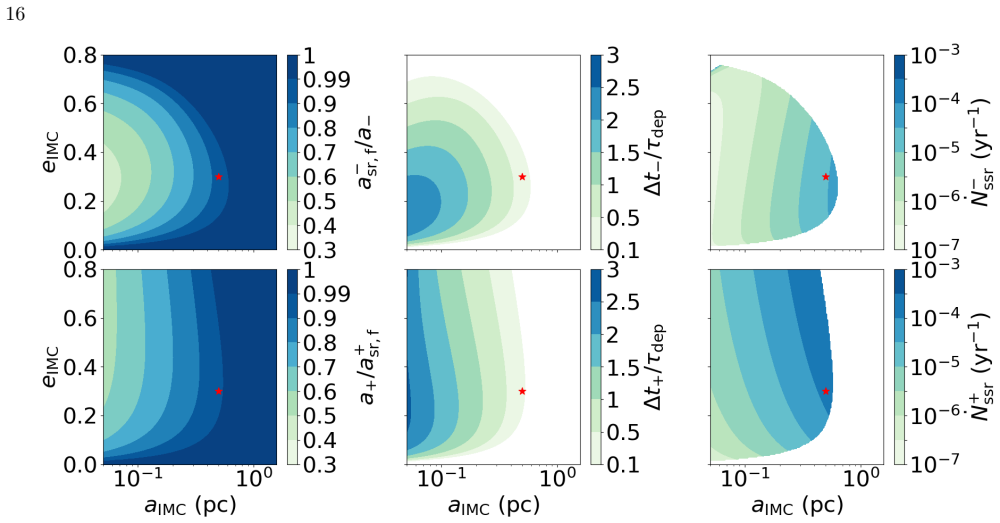

read the original abstract
Tidal disruption event (TDE) rates in active galactic nuclei (AGN) consistently exceed predictions from two-body relaxation, particularly in post-starburst and green valley galaxies. We explain this excess with a new mechanism: a sweeping secular resonance (SSR) driven by an intermediate-mass companion (IMC) and a depleting gaseous disk. As the disk mass declines, a resonance between stellar and IMC orbital precession sweeps through the nuclear cluster, exciting stellar eccentricities to near unity on orbital timescales far faster than gravitational relaxation. Our analytical framework, validated by N-body simulations (REBOUND), shows this mechanism requires IMC-to-SMBH mass ratios of $q \geq 10^{-3}$, disk mass ratio $p \geq 10^{-3}$, and few Myr-scale disk depletion. It is highly effective for co-orbiting IMCs but negligible for counter-orbiting ones. The TDE rate peaks at $10^{-3}-10^{-2}$ per galaxy per year for a depletion timescale $\tau_{\rm dep} \sim 10$ Myr. Even lower-mass IMCs can produce significant enhancements with compact, long-lived disks. Our model naturally explains elevated AGN TDE rates and implies that a high TDE incidence is a potential tracer of hidden parsec-scale IMCs, offering testable predictions for future AGN monitoring.
Editorial analysis
A structured set of objections, weighed in public.
Referee Report
Summary. The manuscript proposes a sweeping secular resonance (SSR) mechanism, driven by an intermediate-mass companion (IMC) and a depleting gaseous disk, to explain the observed excess of tidal disruption events (TDEs) in active galactic nuclei (AGN) beyond two-body relaxation predictions. As the disk mass declines over a few Myr, the resonance between stellar and IMC precession sweeps through the nuclear cluster, rapidly exciting stellar eccentricities to near unity. The analytical framework, validated by REBOUND N-body simulations, requires IMC-to-SMBH mass ratio q ≥ 10^{-3} and disk mass ratio p ≥ 10^{-3} for effectiveness (strong for co-orbiting IMCs, negligible for counter-orbiting), yielding peak TDE rates of 10^{-3}–10^{-2} per galaxy per year for τ_dep ∼ 10 Myr. The model implies high TDE incidence as a tracer of hidden parsec-scale IMCs.
Significance. If the central claim holds, the work provides a physically motivated explanation for elevated AGN TDE rates in post-starburst and green-valley galaxies and generates falsifiable predictions for future monitoring campaigns. The combination of secular-theory derivation with direct N-body validation (REBOUND) is a methodological strength, and the parameter-free aspects of the resonance condition under the stated mass-ratio thresholds add rigor. The result could influence interpretations of TDE demographics and searches for intermediate-mass black holes in galactic nuclei.
major comments (2)
- [§3] §3 (Analytical framework): The derivation of the resonance sweep rate and the resulting eccentricity excitation timescale should explicitly show how τ_dep enters the condition for the resonance to traverse the nuclear cluster before other processes (e.g., two-body relaxation) dominate; the stated thresholds q ≥ 10^{-3} and p ≥ 10^{-3} appear to follow from this, but the quantitative mapping to the quoted TDE rate of 10^{-3}–10^{-2} yr^{-1} galaxy^{-1} requires the full expression for the fraction of stars reaching e ≈ 1 within τ_dep.
- [§4] §4 (N-body validation): The REBOUND simulations are invoked to confirm the analytic predictions, yet the manuscript must report the number of particles, initial eccentricity/inclination distributions, integration duration relative to τ_dep, and the precise criterion used to count TDEs (e.g., pericenter < tidal radius). Without these, it is unclear whether the reported rate enhancement is quantitatively reproduced or only qualitatively consistent.
minor comments (2)
- [Abstract] Abstract and §1: The statement that the mechanism is “highly effective for co-orbiting IMCs but negligible for counter-orbiting ones” should be accompanied by a brief physical explanation (sign of the induced precession) already in the abstract for clarity.
- [Figures] Figure captions (throughout): Ensure all panels label the depletion timescale τ_dep used and indicate whether the plotted orbits are co- or counter-rotating with the IMC.
Simulated Author's Rebuttal
We thank the referee for the positive assessment of our work and for the constructive major comments. We have revised the manuscript to address both points by expanding the analytical derivations and adding the requested simulation details.
read point-by-point responses
-
Referee: [§3] §3 (Analytical framework): The derivation of the resonance sweep rate and the resulting eccentricity excitation timescale should explicitly show how τ_dep enters the condition for the resonance to traverse the nuclear cluster before other processes (e.g., two-body relaxation) dominate; the stated thresholds q ≥ 10^{-3} and p ≥ 10^{-3} appear to follow from this, but the quantitative mapping to the quoted TDE rate of 10^{-3}–10^{-2} yr^{-1} galaxy^{-1} requires the full expression for the fraction of stars reaching e ≈ 1 within τ_dep.
Authors: We agree that the dependence on τ_dep and the direct mapping to the TDE rate should be shown explicitly. In the revised §3 we now derive the resonance sweep rate as dω/dt ∝ p / τ_dep and demonstrate that the resonance traverses the cluster on a timescale shorter than the two-body relaxation time only when q ≥ 10^{-3} and p ≥ 10^{-3}. We have added the explicit expression for the excited fraction f(e≈1) = 1 − exp(−τ_dep / τ_sweep), which directly yields the quoted peak TDE rates of 10^{-3}–10^{-2} yr^{-1} galaxy^{-1} for τ_dep ∼ 10 Myr. revision: yes
-
Referee: [§4] §4 (N-body validation): The REBOUND simulations are invoked to confirm the analytic predictions, yet the manuscript must report the number of particles, initial eccentricity/inclination distributions, integration duration relative to τ_dep, and the precise criterion used to count TDEs (e.g., pericenter < tidal radius). Without these, it is unclear whether the reported rate enhancement is quantitatively reproduced or only qualitatively consistent.
Authors: We have added a new paragraph in §4 that reports the full simulation parameters. The runs use N = 10^4 particles initialized with a thermal eccentricity distribution and isotropic inclinations. Integrations are performed for 20 Myr (twice the fiducial τ_dep). A TDE is recorded whenever a star’s pericenter falls below the tidal radius r_t = R_* (M_SMBH / M_*)^{1/3}. With these specifications the N-body results quantitatively reproduce the analytic TDE rate enhancement to within a factor of ∼2. revision: yes
Circularity Check
No significant circularity identified
full rationale
The derivation starts from standard secular perturbation theory for orbital precession, introduces the sweeping resonance as the disk mass declines (parameterized by depletion timescale τ_dep), and computes the resulting eccentricity excitation and TDE rate enhancement explicitly as a function of q, p, and τ_dep. The central result is validated against independent N-body integrations (REBOUND) rather than being fitted to TDE observations or reduced to a self-definition. No load-bearing self-citation, ansatz smuggling, or renaming of a known result is present; the TDE rate is an output of the model, not an input renamed as a prediction. The framework remains self-contained under the explicit conditions q ≥ 10^{-3}, p ≥ 10^{-3}, and τ_dep ∼ 10 Myr.
Axiom & Free-Parameter Ledger
free parameters (3)
- IMC-to-SMBH mass ratio q
- disk mass ratio p
- depletion timescale τ_dep
axioms (2)
- standard math Secular precession rates of stellar orbits and IMC orbit can be calculated from standard Laplace-Lagrange theory in the presence of a disk potential
- domain assumption Gaseous disk mass declines monotonically on Myr timescales without external replenishment
invented entities (1)
-
Sweeping secular resonance (SSR)
no independent evidence
Reference graph
Works this paper leans on
-
[1]
D., van Velzen, S., Horesh, A., & Zauderer, B
Alexander, K. D., van Velzen, S., Horesh, A., & Zauderer, B. A. 2020, SSRv, 216, 81, doi: 10.1007/s11214-020-00702-w
-
[2]
D., Margutti, R., Gomez, S., et al
Alexander, K. D., Margutti, R., Gomez, S., et al. 2025, arXiv e-prints, arXiv:2506.12729, doi: 10.48550/arXiv.2506.12729
-
[3]
Angus, C. R., Baldassare, V. F., Mockler, B., et al. 2022, Nature Astronomy, 6, 1452, doi: 10.1038/s41550-022-01811-y
-
[4]
1993, ApJ, 419, 155, doi: 10.1086/173469
Artymowicz, P. 1993, ApJ, 419, 155, doi: 10.1086/173469
-
[5]
2017, ApJ, 838, 149, doi: 10.3847/1538-4357/aa633b
Auchettl, K., Guillochon, J., & Ramirez-Ruiz, E. 2017, ApJ, 838, 149, doi: 10.3847/1538-4357/aa633b
-
[6]
Becklin, E. E., & Neugebauer, G. 1968, Astrophysical Journal, 151, 145, doi: 10.1086/149425
-
[7]
2023, MNRAS, 521, 4180, doi: 10.1093/mnras/stad804
Bu, D.-F., Chen, L., Mou, G., Qiao, E., & Yang, X.-H. 2023, MNRAS, 521, 4180, doi: 10.1093/mnras/stad804
-
[8]
Cantiello, M., Jermyn, A. S., & Lin, D. N. C. 2021, Astrophys. J., 910, 94, doi: 10.3847/1538-4357/abdf4f
-
[9]
2020, ApJL, 888, L14, doi: 10.3847/2041-8213/ab5fe8
Cen, R. 2020, ApJL, 888, L14, doi: 10.3847/2041-8213/ab5fe8
-
[10]
Cendes, Y., Berger, E., Alexander, K. D., et al. 2024, ApJ, 971, 185, doi: 10.3847/1538-4357/ad5541
-
[11]
Chan, C.-H., Piran, T., & Krolik, J. H. 2020, ApJ, 903, 17, doi: 10.3847/1538-4357/abb776
-
[12]
Chan, C.-H., Piran, T., Krolik, J. H., & Saban, D. 2019, ApJ, 881, 113, doi: 10.3847/1538-4357/ab2b40
- [13]
-
[14]
Davies, M. B., & Lin, D. N. C. 2020, Mon. Not. R. Astron. Soc., 498, 3452, doi: 10.1093/mnras/staa2590
-
[15]
Ramirez-Ruiz, E., & Foley, R. J. 2021, ApJL, 907, L21, doi: 10.3847/2041-8213/abd852
-
[16]
A., Nukala, A., Connor, I., et al
Dodd, S. A., Nukala, A., Connor, I., et al. 2023, ApJL, 959, L19, doi: 10.3847/2041-8213/ad1112
-
[17]
2017, ApJ, 840, 31, doi: 10.3847/1538-4357/aa6b58
Dosopoulou, F., & Antonini, F. 2017, ApJ, 840, 31, doi: 10.3847/1538-4357/aa6b58
-
[18]
R., Generozov, A., & Madigan, A.-M
Foote, H. R., Generozov, A., & Madigan, A.-M. 2020, ApJ, 890, 175, doi: 10.3847/1538-4357/ab6c66
-
[19]
Zabludoff, A. I. 2020, SSRv, 216, 32, doi: 10.1007/s11214-020-00657-y
-
[20]
Genzel, R., Hollenbach, D., & Townes, C. H. 1994, Reports on Progress in Physics, 57, 417, doi: 10.1088/0034-4885/57/5/001
-
[21]
Genzel, R., & Townes, C. H. 1987, Annual Review of Astronomy and Astrophysics, 25, 377, doi: 10.1146/annurev.aa.25.090187.002113
-
[22]
2021a, ARA&A, 59, 21, doi: 10.1146/annurev-astro-111720-030029 —
Gezari, S. 2021a, ARA&A, 59, 21, doi: 10.1146/annurev-astro-111720-030029 —. 2021b, ARA&A, 59, 21, doi: 10.1146/annurev-astro-111720-030029
-
[23]
Goodman, J. 2003, Monthly Notice of the Royal Astronomical Society, 339, 937, doi: 10.1046/j.1365-8711.2003.06241.x
-
[24]
J., van Velzen, S., Miller-Jones, J
Goodwin, A. J., van Velzen, S., Miller-Jones, J. C. A., et al. 2022, MNRAS, 511, 5328, doi: 10.1093/mnras/stac333
-
[25]
Goodwin, A. J., Miller-Jones, J. C. A., van Velzen, S., et al. 2023, MNRAS, 518, 847, doi: 10.1093/mnras/stac3127
-
[26]
2014, ApJ, 783, 23, doi: 10.1088/0004-637X/783/1/23
Guillochon, J., Manukian, H., & Ramirez-Ruiz, E. 2014, ApJ, 783, 23, doi: 10.1088/0004-637X/783/1/23
-
[27]
2013, ApJ, 767, 25, doi: 10.1088/0004-637X/767/1/25 —
Guillochon, J., & Ramirez-Ruiz, E. 2013, ApJ, 767, 25, doi: 10.1088/0004-637X/767/1/25 —. 2015, ApJ, 809, 166, doi: 10.1088/0004-637X/809/2/166
-
[28]
2021, ApJL, 908, L20, doi: 10.3847/2041-8213/abdcb4
Hammerstein, E., Gezari, S., van Velzen, S., et al. 2021, ApJL, 908, L20, doi: 10.3847/2041-8213/abdcb4
-
[29]
2023a, ApJ, 942, 9, doi: 10.3847/1538-4357/aca283 —
Hammerstein, E., van Velzen, S., Gezari, S., et al. 2023a, ApJ, 942, 9, doi: 10.3847/1538-4357/aca283 —. 2023b, ApJ, 942, 9, doi: 10.3847/1538-4357/aca283 21
-
[30]
1985, in Protostars and Planets II, ed
Hayashi, C., Nakazawa, K., & Nakagawa, Y. 1985, in Protostars and Planets II, ed. D. C. Black & M. S. Matthews, 1100–1153
work page 1985
-
[31]
1990, ApJ, 356, 359, doi: 10.1086/168845
Hernquist, L. 1990, ApJ, 356, 359, doi: 10.1086/168845
-
[32]
2006, ApJ, 645, 1152, doi: 10.1086/504400
Hopman, C., & Alexander, T. 2006, ApJ, 645, 1152, doi: 10.1086/504400
-
[33]
2024, ApJL, 964, L22, doi: 10.3847/2041-8213/ad319f
Huang, S., Jiang, N., Zhu, J., et al. 2024, ApJL, 964, L22, doi: 10.3847/2041-8213/ad319f
-
[34]
G., Cannizzaro, G., Mata S´ anchez, D., & Saxton, R
Inkenhaag, A., Jonker, P. G., Cannizzaro, G., Mata S´ anchez, D., & Saxton, R. D. 2021, MNRAS, 507, 6196, doi: 10.1093/mnras/stab2541
-
[35]
Polnarev, A. G. 2015, A&A, 576, A29, doi: 10.1051/0004-6361/201424359
-
[36]
2023, ApJL, 953, L12, doi: 10.3847/2041-8213/acebe3
Jiang, N., Zhou, Z., Zhu, J., Wang, Y., & Wang, T. 2023, ApJL, 953, L12, doi: 10.3847/2041-8213/acebe3
-
[37]
2025, ApJ, 990, 149, doi: 10.3847/1538-4357/adf216
Karmen, M., Gezari, S., Lambrides, E., et al. 2025, ApJ, 990, 149, doi: 10.3847/1538-4357/adf216
-
[38]
Z., Blecha, L., & Hernquist, L
Kelley, L. Z., Blecha, L., & Hernquist, L. 2017, MNRAS, 464, 3131, doi: 10.1093/mnras/stw2452
-
[39]
Kidder, L. E. 1995, PhRvD, 52, 821, doi: 10.1103/PhysRevD.52.821
-
[40]
Kochanek, C. S. 1994, ApJ, 422, 508, doi: 10.1086/173745 —. 2016, MNRAS, 461, 371, doi: 10.1093/mnras/stw1290
-
[41]
2010, MNRAS, 407, 1403, doi: 10.1111/j.1365-2966.2010.16985.x
Kocsis, B., & Tremaine, S. 2011, MNRAS, 412, 187, doi: 10.1111/j.1365-2966.2010.17897.x —. 2015, Mon. Not. R. Astron. Soc., 448, 3265, doi: 10.1093/mnras/stv05710.48550/arXiv.1406.1178
-
[42]
2011, PhRvD, 84, 024032, doi: 10.1103/PhysRevD.84.024032
Kocsis, B., Yunes, N., & Loeb, A. 2011, PhRvD, 84, 024032, doi: 10.1103/PhysRevD.84.024032
-
[43]
Kolykhalov, P. I., & Syunyaev, R. A. 1980, Soviet Astronomy Letters, 6, 357
work page 1980
-
[44]
1995, Annual Review of Astronomy and Astrophysics, 33, 581, doi: 10.1146/annurev.aa.33.090195.003053
Kormendy, J., & Richstone, D. 1995, Annual Review of Astronomy and Astrophysics, 33, 581, doi: 10.1146/annurev.aa.33.090195.003053
-
[45]
2025, A&A, 704, A3, doi: 10.1051/0004-6361/202555038
Kunert-Bajraszewska, M., Kozie l-Wierzbowska, D., Stern, D., et al. 2025, A&A, 704, A3, doi: 10.1051/0004-6361/202555038
- [46]
-
[47]
2017a, ApJ, 841, 132, doi: 10.3847/1538-4357/aa6ffb
Ramirez-Ruiz, E. 2017a, ApJ, 841, 132, doi: 10.3847/1538-4357/aa6ffb
-
[48]
Law-Smith, J., Ramirez-Ruiz, E., Ellison, S. L., & Foley, R. J. 2017b, ApJ, 850, 22, doi: 10.3847/1538-4357/aa94c7
-
[49]
Lin, D. N. C., & Pringle, J. E. 1987, MNRAS, 225, 607, doi: 10.1093/mnras/225.3.607
-
[50]
Lin, D. N. C., Pringle, J. E., & Rees, M. J. 1988, ApJ, 328, 103, doi: 10.1086/166272
-
[51]
2022, ApJL, 939, L33, doi: 10.3847/2041-8213/ac9c63
Lin, Z., Jiang, N., Kong, X., et al. 2022, ApJL, 939, L33, doi: 10.3847/2041-8213/ac9c63
-
[52]
2024, Monthly Notice of the Royal Astronomical Society, 527, 4317, doi: 10.1093/mnras/stad3470
Linial, I., & Quataert, E. 2024, Monthly Notice of the Royal Astronomical Society, 527, 4317, doi: 10.1093/mnras/stad3470
-
[53]
Liodakis, I., Koljonen, K. I. I., Blinov, D., et al. 2023, Science, 380, 656, doi: 10.1126/science.abj9570
-
[54]
Liu, M., Wang, L., & Peng, P. 2025, arXiv e-prints, arXiv:2505.10524, doi: 10.48550/arXiv.2505.10524 Lixin Dai, J., Lodato, G., & Cheng, R. M. 2021, arXiv e-prints, arXiv:2101.05195. https://arxiv.org/abs/2101.05195
-
[55]
Lodato, G., King, A. R., & Pringle, J. E. 2009, MNRAS, 392, 332, doi: 10.1111/j.1365-2966.2008.14049.x
-
[56]
1969, Nature, 223, 690, doi: 10.1038/223690a0
Lynden-Bell, D. 1969, Nature, 223, 690, doi: 10.1038/223690a0
-
[57]
Lynden-Bell, D., & Rees, M. J. 1971, Monthly Notices of the Royal Astronomical Society, 152, 461, doi: 10.1093/mnras/152.4.461
-
[58]
2014, ApJ, 794, 9, doi: 10.1088/0004-637X/794/1/9
MacLeod, M., Goldstein, J., Ramirez-Ruiz, E., Guillochon, J., & Samsing, J. 2014, ApJ, 794, 9, doi: 10.1088/0004-637X/794/1/9
-
[59]
2012, ApJ, 757, 134, doi: 10.1088/0004-637X/757/2/134
MacLeod, M., Guillochon, J., & Ramirez-Ruiz, E. 2012, ApJ, 757, 134, doi: 10.1088/0004-637X/757/2/134
-
[60]
MacLeod, M., & Lin, D. N. C. 2020, ApJ, 889, 94, doi: 10.3847/1538-4357/ab64db
-
[61]
2013, ApJ, 777, 133, doi: 10.1088/0004-637X/777/2/133
MacLeod, M., Ramirez-Ruiz, E., Grady, S., & Guillochon, J. 2013, ApJ, 777, 133, doi: 10.1088/0004-637X/777/2/133
-
[62]
2018, ApJ, 853, 141, doi: 10.3847/1538-4357/aaa714
Madigan, A.-M., Halle, A., Moody, M., et al. 2018, ApJ, 853, 141, doi: 10.3847/1538-4357/aaa714
-
[63]
2011, ApJ, 738, 99, doi: 10.1088/0004-637X/738/1/99
Madigan, A.-M., Hopman, C., & Levin, Y. 2011, ApJ, 738, 99, doi: 10.1088/0004-637X/738/1/99
-
[64]
2009, ApJL, 697, L44, doi: 10.1088/0004-637X/697/1/L44
Madigan, A.-M., Levin, Y., & Hopman, C. 2009, ApJL, 697, L44, doi: 10.1088/0004-637X/697/1/L44
-
[65]
Magorrian, J., & Tremaine, S. 1999, MNRAS, 309, 447, doi: 10.1046/j.1365-8711.1999.02853.x
-
[66]
2024a, ApJ, 961, 211, doi: 10.3847/1538-4357/ad18bb —
Masterson, M., De, K., Panagiotou, C., et al. 2024a, ApJ, 961, 211, doi: 10.3847/1538-4357/ad18bb —. 2024b, ApJ, 961, 211, doi: 10.3847/1538-4357/ad18bb
-
[67]
McKernan, B., Ford, K. E. S., Lyra, W., & Perets, H. B. 2012, MNRAS, 425, 460, doi: 10.1111/j.1365-2966.2012.21486.x
-
[68]
2013, Dynamics and Evolution of Galactic Nuclei
Merritt, D. 2013, Dynamics and Evolution of Galactic Nuclei
work page 2013
-
[69]
Mezger, P. G., Duschl, W. J., & Zylka, R. 1996, The Astronomy and Astrophysics Review, 7, 289, doi: 10.1007/s001590050007
-
[70]
2019, ApJ, 872, 151, doi: 10.3847/1538-4357/ab010f
Mockler, B., Guillochon, J., & Ramirez-Ruiz, E. 2019, ApJ, 872, 151, doi: 10.3847/1538-4357/ab010f
-
[71]
2021, ApJ, 906, 101, doi: 10.3847/1538-4357/abc955 22
Mockler, B., & Ramirez-Ruiz, E. 2021, ApJ, 906, 101, doi: 10.3847/1538-4357/abc955 22
- [72]
-
[73]
Nagasawa, M., Lin, D. N. C., & Ida, S. 2003, ApJ, 586, 1374, doi: 10.1086/367884
-
[74]
Nagasawa, M., Lin, D. N. C., & Thommes, E. 2005, ApJ, 635, 578, doi: 10.1086/497386
-
[75]
2020, A&A Rv, 28, 4, doi: 10.1007/s00159-020-00125-0
Neumayer, N., Seth, A., & B¨ oker, T. 2020, A&A Rv, 28, 4, doi: 10.1007/s00159-020-00125-0
- [76]
-
[77]
Parkinson, E. J., Knigge, C., Matthews, J. H., et al. 2022, MNRAS, 510, 5426, doi: 10.1093/mnras/stac027
-
[78]
2020, ApJ, 900, 32, doi: 10.3847/1538-4357/abaaa7
Pechetti, R., Seth, A., Neumayer, N., et al. 2020, ApJ, 900, 32, doi: 10.3847/1538-4357/abaaa7
-
[79]
Pfister, H., Volonteri, M., Dai, J. L., & Colpi, M. 2020, MNRAS, 497, 2276, doi: 10.1093/mnras/staa1962
-
[80]
Rauch, K. P., & Tremaine, S. 1996, NewA, 1, 149, doi: 10.1016/S1384-1076(96)00012-7
discussion (0)
Sign in with ORCID, Apple, or X to comment. Anyone can read and Pith papers without signing in.