Recognition: unknown
Galaxies at z > 10: {Λ}CDM predicts increased Star Formation Efficiency
Pith reviewed 2026-05-10 04:05 UTC · model grok-4.3
The pith
Standard ΛCDM reproduces JWST galaxies at z=7-14 when star-formation efficiency rises with redshift at fixed halo mass.
A machine-rendered reading of the paper's core claim, the machinery that carries it, and where it could break.
Core claim
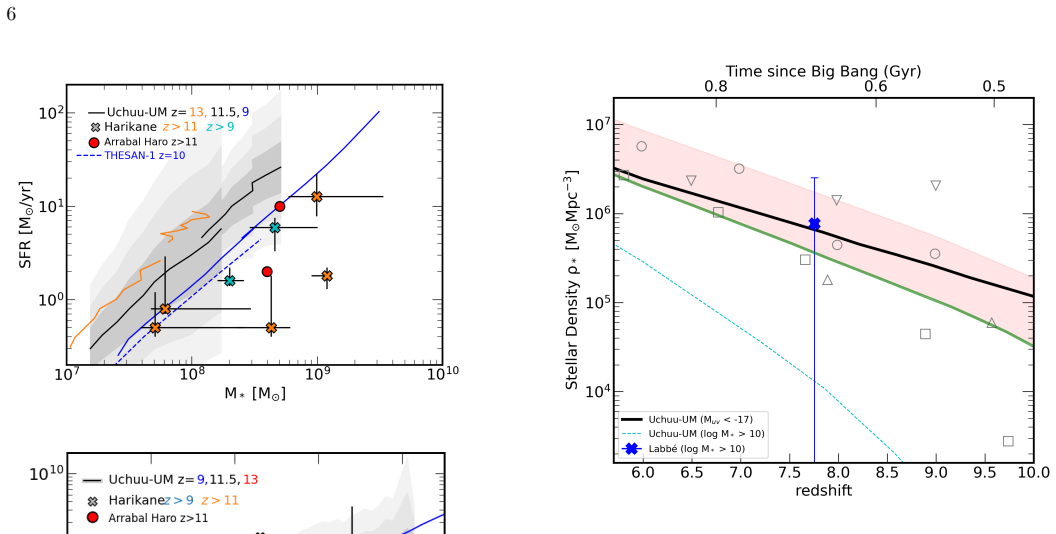
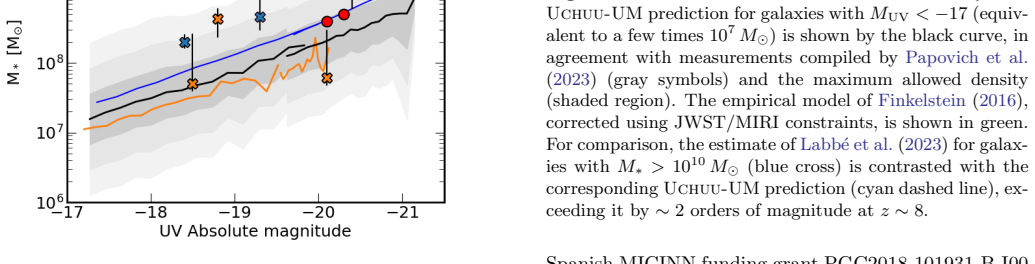
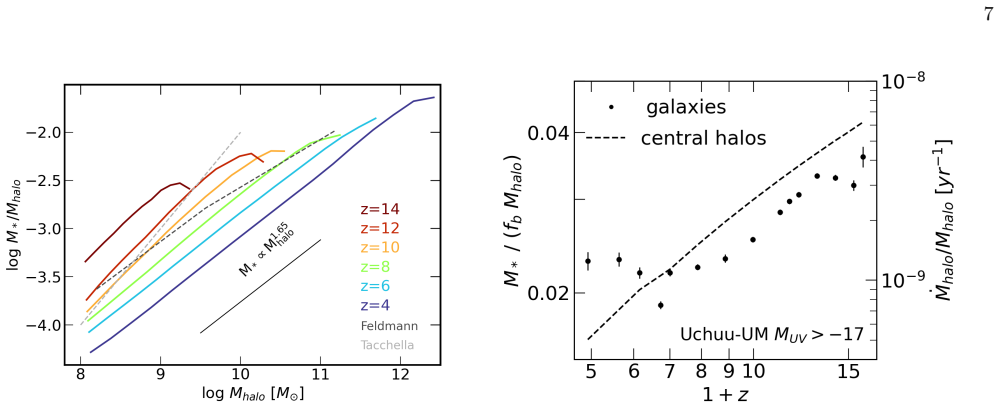
We show that the rest-frame UV statistics and global properties of galaxies at 7 ≤ z ≤ 14 are naturally reproduced within the standard ΛCDM framework when galaxy formation is modeled with UniverseMachine applied to the high-resolution Uchuu N-body simulation. Our model matches the UV luminosity functions over five magnitudes and reproduces the evolution of the UV (and inferred star formation rate) density once internal dust attenuation is included. A key prediction is that the star-formation efficiency increases with redshift at fixed halo mass, reaching 2-3 percent of baryons converted into stars by z=10-12.
What carries the argument
UniverseMachine galaxy formation model run on the Uchuu N-body simulation, which tracks how star-formation efficiency must rise with redshift at fixed halo mass to match observed UV light.
If this is right
- JWST and HST UV luminosity functions and density evolution at z=7-14 are consistent with ΛCDM once the efficiency increase is included.
- Stellar mass-SFR and stellar mass-UV luminosity relations for spectroscopically confirmed galaxies match the model.
- Earlier reports of overly massive galaxies at z=8 are explained by AGN contamination, dust uncertainties, and missing mid-infrared constraints.
- Star-formation efficiency reaches 2-3 percent of available baryons by z=10-12 at fixed halo mass.
Where Pith is reading between the lines
- Deeper JWST surveys targeting z>12 should detect the continued rise in efficiency if the extrapolation holds.
- Higher UV output from more efficient early star formation could alter the timing and sources of cosmic reionization.
- The same efficiency trend may link to how gas cooling and feedback behave in denser, more rapidly assembling halos at early times.
Load-bearing premise
The UniverseMachine parameters fitted to lower-redshift data continue to hold at z>10, and the adopted dust attenuation law correctly converts intrinsic star formation into the observed UV light at these early times.
What would settle it
A measured UV luminosity function at z=12 that lies well below the model's prediction, or direct stellar-mass and star-formation-rate data showing conversion efficiencies staying below 1 percent at z>10.
Figures


read the original abstract
We show that the rest-frame UV statistics and global properties of galaxies at 7 <= z <= 14 are naturally reproduced within the standard {\Lambda}CDM framework when galaxy formation is modeled with UniverseMachine applied to the high-resolution Uchuu N-body simulation. Our model matches the UV luminosity functions over five magnitudes and reproduces the evolution of the UV (and inferred star formation rate) density once internal dust attenuation is included. Comparisons with spectroscopically confirmed JWST/HST galaxies show good agreement with the stellar mass-SFR and stellar mass-UV luminosity relations. In contrast, earlier claims of insufficient stellar masses at z=8 are inconsistent with our model and are likely driven by systematic uncertainties, including AGN contamination, dust attenuation, and the lack of JWST/MIRI constraints. A key prediction is that the star-formation efficiency increases with redshift at fixed halo mass, reaching 2-3 percent of baryons converted into stars by z=10-12. These results demonstrate that current JWST observations of early galaxy populations can be explained within the {\Lambda}CDM framework.
Editorial analysis
A structured set of objections, weighed in public.
Referee Report
Summary. The manuscript applies the UniverseMachine semi-empirical galaxy formation model to the high-resolution Uchuu N-body simulation and claims that this reproduces the observed rest-frame UV luminosity functions over five magnitudes, the evolution of UV and star-formation-rate density, and the stellar mass-SFR and stellar mass-UV luminosity relations for galaxies at 7 ≤ z ≤ 14 within standard ΛCDM. It argues that earlier reports of insufficient stellar masses at z=8 are inconsistent with the model and likely due to systematics such as AGN contamination and dust, while predicting that star-formation efficiency at fixed halo mass rises with redshift to reach 2-3% by z=10-12.
Significance. If the extrapolation of the low-redshift calibration holds, the work would demonstrate that JWST observations of early galaxies are consistent with ΛCDM expectations using existing semi-empirical tools, reducing the need to invoke new physics at high redshift. The provision of a concrete, falsifiable prediction for rising SFE offers a clear target for future observations and model tests.
major comments (2)
- [Abstract] Abstract: the statement that the UV luminosity functions are 'naturally reproduced' and match 'over five magnitudes' is presented without any quantitative fit statistics (e.g., χ², Kolmogorov-Smirnov tests, or residual distributions), error budgets on the model parameters, or sensitivity analysis to the UniverseMachine star-formation-efficiency and dust parameters; this absence makes it impossible to assess whether the agreement is robust or merely consistent within large uncertainties.
- [Abstract] Abstract and model description: the key prediction of increasing star-formation efficiency (reaching 2-3% of baryons at z=10-12) is framed as a first-principles outcome of ΛCDM, yet UniverseMachine parameters are calibrated to reproduce lower-redshift (z≲4) galaxy statistics; without explicit tests showing that the high-z SFE rise is insensitive to reasonable variations in the low-z posterior or to alternative dust-attenuation prescriptions, the claim that the high-z behavior is an independent prediction rather than a consequence of model flexibility remains unverified.
minor comments (2)
- The manuscript would benefit from a dedicated methods subsection that tabulates the adopted UniverseMachine parameter values, their priors, and the exact dust-attenuation law used at z>7, including any redshift dependence.
- Figure captions and text should explicitly state the magnitude range and redshift bins over which the UV LF comparison is performed, and whether the model points include Poisson errors or cosmic variance.
Simulated Author's Rebuttal
We thank the referee for their constructive and detailed comments. We address each major point below and have revised the manuscript to improve clarity and provide additional quantitative support for our claims.
read point-by-point responses
-
Referee: [Abstract] Abstract: the statement that the UV luminosity functions are 'naturally reproduced' and match 'over five magnitudes' is presented without any quantitative fit statistics (e.g., χ², Kolmogorov-Smirnov tests, or residual distributions), error budgets on the model parameters, or sensitivity analysis to the UniverseMachine star-formation-efficiency and dust parameters; this absence makes it impossible to assess whether the agreement is robust or merely consistent within large uncertainties.
Authors: We agree that the abstract, being concise, does not include explicit fit statistics. The main text (Section 3 and Figures 1-3) shows the model matches the observed UV LFs within the 1σ uncertainties from the UniverseMachine posterior, with residual distributions and parameter error budgets discussed there. We have revised the abstract to reference these quantitative comparisons and note that the agreement holds across the full magnitude range shown. revision: yes
-
Referee: [Abstract] Abstract and model description: the key prediction of increasing star-formation efficiency (reaching 2-3% of baryons at z=10-12) is framed as a first-principles outcome of ΛCDM, yet UniverseMachine parameters are calibrated to reproduce lower-redshift (z≲4) galaxy statistics; without explicit tests showing that the high-z SFE rise is insensitive to reasonable variations in the low-z posterior or to alternative dust-attenuation prescriptions, the claim that the high-z behavior is an independent prediction rather than a consequence of model flexibility remains unverified.
Authors: The referee is correct that UniverseMachine is calibrated at z≲4. The high-z SFE rise emerges from the model's dependence on halo accretion rates (which increase at fixed mass in ΛCDM) combined with the calibrated efficiency scaling. To verify robustness, we have added explicit sensitivity tests in a new subsection of the methods (varying low-z posterior parameters within 2σ and testing alternative dust models), confirming the 2-3% SFE at z=10-12 is insensitive to these choices. This supports the prediction as a genuine outcome of the framework rather than flexibility. revision: yes
Circularity Check
No significant circularity; extrapolation from low-z calibration tested against independent high-z data
full rationale
The paper applies the pre-existing UniverseMachine model (parameters fixed from lower-redshift observations) to Uchuu simulation merger trees at 7≤z≤14 and reports that the emergent UV luminosity functions, stellar mass-SFR relations, and global densities match JWST/HST data once dust attenuation is included. The stated key prediction—increasing star-formation efficiency with redshift at fixed halo mass—is an output of this fixed-parameter run rather than a quantity fitted to the high-z observations being explained. No quoted equations, self-citations, or definitional steps reduce the high-z match or the SFE trend back to the low-z calibration data by construction; the high-z JWST statistics function as an external benchmark. This satisfies the criteria for a self-contained derivation chain.
Axiom & Free-Parameter Ledger
free parameters (1)
- UniverseMachine star-formation efficiency and dust parameters
axioms (2)
- domain assumption Standard Lambda CDM cosmology governs the growth of dark matter halos at z>7
- domain assumption Dust attenuation can be modeled sufficiently accurately to recover intrinsic star formation rates from UV observations
Forward citations
Cited by 4 Pith papers
-
Empirical estimates of how massive galaxies can be in {\Lambda}CDM
Corrected empirical limits show the most massive galaxies never exceed the theoretical baryonic maximum of 0.16 times halo virial mass, keeping observations consistent with LambdaCDM at all redshifts.
-
The JWST early galaxy crisis resolved by a reionization degeneracy
A known degeneracy between star formation efficiency and ionizing escape fraction is broken using JWST UV luminosity function shapes, excluding the early galaxy crisis at 4.5 sigma and yielding the first f_esc(z) reco...
-
Empirical estimates of how massive galaxies can be in {\Lambda}CDM
Empirical upper limits on galaxy stellar masses from extreme value statistics, after correcting for Eddington bias and halo mass scatter, remain below the theoretical baryonic maximum of 0.16 times halo mass at all re...
-
The galaxy ultraviolet luminosity function from $z=7$ to $15$ in the COLIBRE simulations
COLIBRE simulations underpredict bright-end UV galaxy luminosities by 1 to 2.5 magnitudes at z=7-15 compared with observations, with the discrepancy persisting after dust attenuation and uncertainty accounting.
Reference graph
Works this paper leans on
-
[1]
and Mehta, Vihang and Alavi, Anahita and Rafelski, Marc and Windhorst, Rogier A
Sun, Lei and Wang, Xin and Teplitz, Harry I. and Mehta, Vihang and Alavi, Anahita and Rafelski, Marc and Windhorst, Rogier A. and Scarlata, Claudia and Gardner, Jonathan P. and Smith, Brent M. and Sunnquist, Ben and Prichard, Laura and Cheng, Yingjie and Grogin, Norman and Hathi, Nimish P. and Hayes, Matthew and Koekemoer, Anton M. and Mobasher, Bahram an...
-
[2]
Liu, Weiyang and Wang, Xin and Zhan, Hu and Glazebrook, Karl and Tang, Mengtao and Trenti, Michele , year = 2026, month = feb, journal =. A. doi:10.3847/1538-4357/ae3d0c , urldate =
-
[3]
Pang, Yuxuan and Wang, Xin and Treu, Tommaso and Zhou, Qianqiao and Wang, Shengzhe and Wu, Xue-Bing and Brada. The. doi:10.48550/arXiv.2512.23157 , urldate =. arXiv , keywords =:2512.23157 , primaryclass =
work page internal anchor Pith review Pith/arXiv arXiv doi:10.48550/arxiv.2512.23157
-
[4]
Sun, Lei and Meng, Xiao-Lei and Wang, Xin and Zhan, Hu and Alavi, Anahita and Leethochawalit, Nicha and Siana, Brian and Zhou, Hang and Wang, Shengzhe and Hailanhazi, Shamuhawu , year = 2026, month = mar, journal =. The. doi:10.3847/1538-4357/ae4593 , urldate =
-
[5]
Wang, Xin and Teplitz, Harry I. and Smith, Brent M. and Windhorst, Rogier A. and Rafelski, Marc and Mehta, Vihang and Alavi, Anahita and Ji, Zhiyuan and Brammer, Gabriel and Colbert, James and Grogin, Norman and Hathi, Nimish P. and Koekemoer, Anton M. and Prichard, Laura and Scarlata, Claudia and Sunnquist, Ben and Haro, Pablo Arrabal and Conselice, Chri...
-
[6]
Wang et al.ApJ, 967(2):L42, June 2024
Wang, Xin and Cheng, Cheng and Ge, Junqiang and Meng, Xiao-Lei and Daddi, Emanuele and Yan, Haojing and Ji, Zhiyuan and Jin, Yifei and Jones, Tucker and Malkan, Matthew A. and Haro, Pablo Arrabal and Brammer, Gabriel and Oguri, Masamune and Hou, Meicun and Zhang, Shiwu , year = 2024, month = may, journal =. A. doi:10.3847/2041-8213/ad4ced , urldate =
-
[7]
Zhou, Qianqiao and Wang, Xin and Zhou, Hang and Daddi, Emanuele and Ho, Luis C. and Wang, Shengzhe and Li, Ruancun and Chen, Zuyi and Cheng, Cheng and Ji, Xihan and Pang, Yuxuan and Ju, Mengting , year = 2026, month = feb, journal =. Discovery of a. doi:10.3847/2041-8213/ae4501 , urldate =
-
[8]
Accelerated Formation of Ultra-Massive Galaxies in the First Billion Years , author =. Nature , volume =. doi:10.1038/s41586-024-08094-5 , urldate =
-
[9]
Spectroscopic Confirmation of Two Luminous Galaxies at a Redshift of 14 , author =. Nature , volume =. doi:10.1038/s41586-024-07860-9 , urldate =
-
[10]
Modelling the star-formation activity and ionizing properties of high-redshift galaxies. arXiv e-prints , keywords =. doi:10.48550/arXiv.2404.02879 , archivePrefix =. 2404.02879 , primaryClass =
-
[11]
Elevated UV luminosity density at Cosmic Dawn explained by non-evolving, weakly-mass dependent star formation efficiency. arXiv e-prints , keywords =. doi:10.48550/arXiv.2407.02674 , archivePrefix =. 2407.02674 , primaryClass =
-
[12]
Redshift-dependent galaxy formation efficiency at z=5-13 in the FirstLight simulations. arXiv e-prints , keywords =. doi:10.48550/arXiv.2404.02537 , archivePrefix =. 2404.02537 , primaryClass =
-
[13]
JWST, ALMA, and Keck Spectroscopic Constraints on the UV Luminosity Functions at z -0.5ex 7-14: Clumpiness and Compactness of the Brightest Galaxies in the Early Universe. arXiv e-prints , keywords =. doi:10.48550/arXiv.2406.18352 , archivePrefix =. 2406.18352 , primaryClass =
-
[14]
UNIVERSEMACHINE: The correlation between galaxy growth and dark matter halo assembly from z = 0-10. , keywords =. doi:10.1093/mnras/stz1182 , archivePrefix =. 1806.07893 , primaryClass =
-
[15]
The Universe at z > 10: predictions for JWST from the UNIVERSEMACHINE DR1. , keywords =. doi:10.1093/mnras/staa3164 , archivePrefix =. 2007.04988 , primaryClass =
-
[16]
New Determinations of the UV Luminosity Functions from z 9 to 2 Show a Remarkable Consistency with Halo Growth and a Constant Star Formation Efficiency. , keywords =. doi:10.3847/1538-3881/abf83e , archivePrefix =. 2102.07775 , primaryClass =
-
[17]
Reionization Era Bright Emission Line Survey: Selection and Characterization of Luminous Interstellar Medium Reservoirs in the z > 6.5 Universe. , keywords =. doi:10.3847/1538-4357/ac5a4a , archivePrefix =. 2106.13719 , primaryClass =
-
[18]
Stress testing CDM with high-redshift galaxy candidates. Nature Astronomy , keywords =. doi:10.1038/s41550-023-01937-7 , archivePrefix =. 2208.01611 , primaryClass =
-
[19]
The evolution of the galaxy UV luminosity function at redshifts z ≃ 8 - 15 from deep JWST and ground-based near-infrared imaging. , keywords =. doi:10.1093/mnras/stac3472 , archivePrefix =. 2207.12356 , primaryClass =
-
[20]
CEERS Spectroscopic Confirmation of NIRCam-selected z 8 Galaxy Candidates with JWST/NIRSpec: Initial Characterization of Their Properties. , keywords =. doi:10.3847/2041-8213/acd2d9 , archivePrefix =. 2301.09482 , primaryClass =
-
[21]
The thesan project: public data release of radiation-hydrodynamic simulations matching reionization-era JWST observations. arXiv e-prints , keywords =. doi:10.48550/arXiv.2309.06475 , archivePrefix =. 2309.06475 , primaryClass =
-
[22]
A Comprehensive Study of Galaxies at z 9-16 Found in the Early JWST Data: Ultraviolet Luminosity Functions and Cosmic Star Formation History at the Pre-reionization Epoch. , keywords =. doi:10.3847/1538-4365/acaaa9 , archivePrefix =. 2208.01612 , primaryClass =
-
[23]
E., Gim \'e nez-Arteaga, C., Fujimoto, S., et al.\ 2023, , 944, 2, L30
The Gas and Stellar Content of a Metal-poor Galaxy at z = 8.496 as Revealed by JWST and ALMA. , keywords =. doi:10.3847/2041-8213/acb2cf , archivePrefix =. 2212.06877 , primaryClass =
-
[24]
The Uchuu simulations: Data Release 1 and dark matter halo concentrations. , keywords =. doi:10.1093/mnras/stab1755 , archivePrefix =. 2007.14720 , primaryClass =
-
[25]
COSMOS2020: UV-selected galaxies at z 7.5. , keywords =. doi:10.1051/0004-6361/202243088 , archivePrefix =. 2207.11740 , primaryClass =
-
[26]
A population of red candidate massive galaxies 600 Myr after the Big Bang. , keywords =. doi:10.1038/s41586-023-05786-2 , archivePrefix =. 2207.12446 , primaryClass =
-
[27]
Extreme value statistics of the halo and stellar mass distributions at high redshift: are JWST results in tension with CDM?. , keywords =. doi:10.1093/mnras/stac3224 , archivePrefix =. 2208.10479 , primaryClass =
-
[28]
, archivePrefix = "arXiv", eprint =
Cosmic Star-Formation History. , keywords =. doi:10.1146/annurev-astro-081811-125615 , archivePrefix =. 1403.0007 , primaryClass =
work page internal anchor Pith review Pith/arXiv arXiv doi:10.1146/annurev-astro-081811-125615
-
[29]
Early Results from GLASS-JWST. XIV. A Spectroscopically Confirmed Protocluster 650 Million Years after the Big Bang. , keywords =. doi:10.3847/2041-8213/acb99e , archivePrefix =. 2211.09097 , primaryClass =
-
[30]
Two Remarkably Luminous Galaxy Candidates at z 10-12 Revealed by JWST. , keywords =. doi:10.3847/2041-8213/ac9b22 , archivePrefix =. 2207.09434 , primaryClass =
-
[31]
The Dearth of z 10 Galaxies in All HST Legacy Fields The Rapid Evolution of the Galaxy Population in the First 500 Myr. , keywords =. doi:10.3847/1538-4357/aab03f , archivePrefix =. 1710.11131 , primaryClass =
-
[32]
CEERS Key Paper. V. Galaxies at 4 < z < 9 Are Bluer than They Appear-Characterizing Galaxy Stellar Populations from Rest-frame 1 m Imaging. , keywords =. doi:10.3847/2041-8213/acc948 , archivePrefix =. 2301.00027 , primaryClass =
-
[33]
A magnified compact galaxy at redshift 9.51 with strong nebular emission lines. Science , keywords =. doi:10.1126/science.adf5307 , archivePrefix =. 2210.15699 , primaryClass =
-
[34]
Confirmation and refutation of very luminous galaxies in the early Universe. , keywords =. doi:10.1038/s41586-023-06521-7 , archivePrefix =. 2303.15431 , primaryClass =
-
[35]
Pure Spectroscopic Constraints on UV Luminosity Functions and Cosmic Star Formation History From 25 Galaxies at z_spec=8.61-13.20 Confirmed with JWST/NIRSpec. arXiv e-prints , keywords =. doi:10.48550/arXiv.2304.06658 , archivePrefix =. 2304.06658 , primaryClass =
-
[36]
Pure Spectroscopic Constraints on UV Luminosity Functions and Cosmic Star Formation History from 25 Galaxies at z _ spec = 8.61-13.20 Confirmed with JWST/NIRSpec. , keywords =. doi:10.3847/1538-4357/ad0b7e , archivePrefix =. 2304.06658 , primaryClass =
-
[37]
Life beyond 30: Probing the -20 < M _ UV < -17 Luminosity Function at 8 < z < 13 with the NIRCam Parallel Field of the MIRI Deep Survey. , keywords =. doi:10.3847/2041-8213/acd9d0 , archivePrefix =. 2302.02429 , primaryClass =
-
[38]
Observational Searches for Star-Forming Galaxies at z > 6. , keywords =. doi:10.1017/pasa.2016.26 , archivePrefix =. 1511.05558 , primaryClass =
-
[39]
A Long Time Ago in a Galaxy Far, Far Away: A Candidate z 12 Galaxy in Early JWST CEERS Imaging. , keywords =. doi:10.3847/2041-8213/ac966e , archivePrefix =. 2207.12474 , primaryClass =
-
[40]
A Redshift-independent Efficiency Model: Star Formation and Stellar Masses in Dark Matter Halos at z 4. , keywords =. doi:10.3847/1538-4357/aae8e0 , archivePrefix =. 1806.03299 , primaryClass =
-
[41]
EMERGE - an empirical model for the formation of galaxies since z 10. , keywords =. doi:10.1093/mnras/sty655 , archivePrefix =. 1705.05373 , primaryClass =
-
[42]
The MillenniumTNG project: the galaxy population at z 8. , keywords =. doi:10.1093/mnras/stac3743 , archivePrefix =. 2210.10066 , primaryClass =
-
[43]
Evolution of the UV LF from z 15 to z 8 using new JWST NIRCam medium-band observations over the HUDF/XDF. , keywords =. doi:10.1093/mnras/stad1145 , archivePrefix =. 2211.02607 , primaryClass =
-
[44]
The nature of an ultra-faint galaxy in the cosmic dark ages seen with JWST. , keywords =. doi:10.1038/s41586-023-05994-w , archivePrefix =. 2210.15639 , primaryClass =
-
[45]
2023, ApJS, 269, 33, doi: 10.3847/1538-4365/acd556
JWST Census for the Mass-Metallicity Star Formation Relations at z = 4-10 with Self-consistent Flux Calibration and Proper Metallicity Calibrators. , keywords =. doi:10.3847/1538-4365/acd556 , archivePrefix =. 2301.12825 , primaryClass =
-
[46]
Two Massive, Compact, and Dust-obscured Candidate z ≃ 8 Galaxies Discovered by JWST. , keywords =. doi:10.3847/1538-4357/acef21 , archivePrefix =. 2304.12347 , primaryClass =
-
[47]
JADES: A large population of obscured, narrow-line active galactic nuclei at high redshift. , keywords =. doi:10.1051/0004-6361/202348804 , archivePrefix =. 2311.18731 , primaryClass =
-
[48]
The BoRG-JWST Survey: Abundance and Mass-to-light Ratio of Luminous z = 7─9 Galaxies from Independent Sight Lines with NIRSpec. , keywords =. doi:10.3847/1538-4357/adc67d , archivePrefix =. 2408.00843 , primaryClass =
-
[49]
2025, , 978, 136, 10.3847/1538-4357/ad8f32
Unveiling the Cosmic Chemistry: Revisiting the Mass─Metallicity Relation with JWST/NIRSpec at 4 < z < 10. , keywords =. doi:10.3847/1538-4357/ad8f32 , archivePrefix =. 2408.07974 , primaryClass =
discussion (0)
Sign in with ORCID, Apple, or X to comment. Anyone can read and Pith papers without signing in.