Recognition: unknown
Characterizing AlphaEarth Embedding Geometry for Agentic Environmental Reasoning
Pith reviewed 2026-05-10 05:09 UTC · model grok-4.3
The pith
AlphaEarth embeddings occupy a twisting non-Euclidean manifold where local retrieval outperforms vector arithmetic for environmental reasoning.
A machine-rendered reading of the paper's core claim, the machinery that carries it, and where it could break.
Core claim
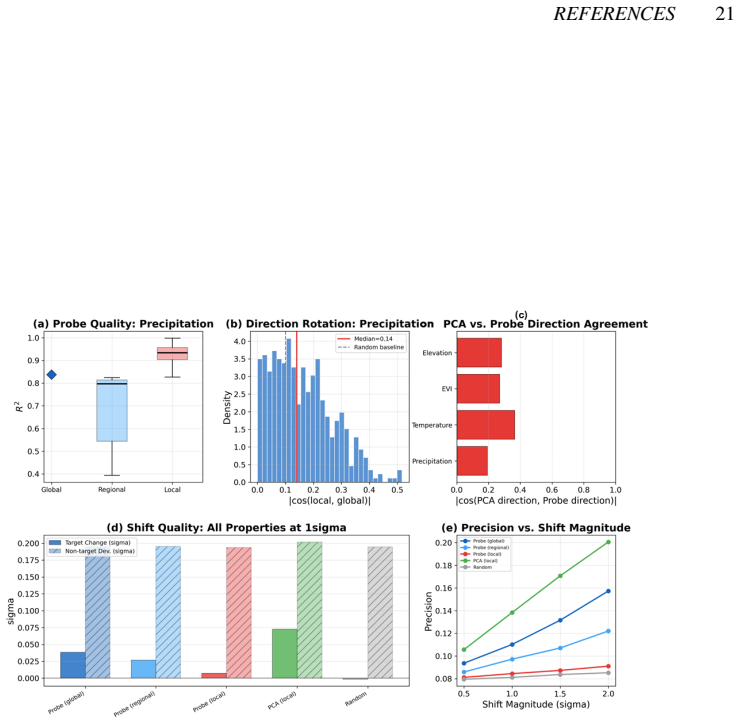
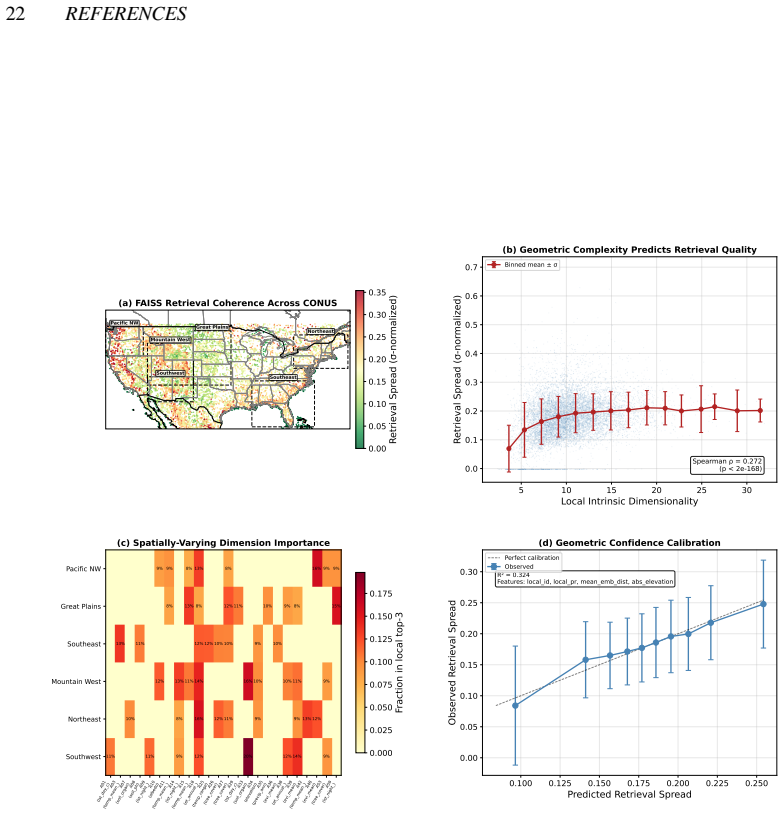
The embeddings form a non-Euclidean manifold whose effective dimensionality is 13.3 by participation ratio and whose local intrinsic dimensionality is approximately 10. Tangent spaces rotate more than 60 degrees at 84 percent of locations, local-global alignment reaches only 0.17, and concept directions shift across the manifold according to linear probes. Compositional vector arithmetic therefore yields poor precision while retrieval produces physically coherent results whose quality is predicted by local geometry with R-squared of 0.32. An agentic system equipped with nine specialized tools that operate over a FAISS-indexed embedding database therefore achieves higher-quality responses to
What carries the argument
The nine-tool agentic system that decomposes environmental queries into reasoning chains over a FAISS-indexed embedding database, guided by measurements of manifold dimensionality, tangent rotation, and retrieval coherence.
Load-bearing premise
The geometric properties measured on Continental US 2017-2023 data and the performance gains from the nine-tool agentic system will generalize to other regions, time periods, or foundation models without being confounded by tool design or query selection.
What would settle it
Re-running the five-condition ablation on embeddings from a different continent or different years and finding that the retrieval-augmented agent no longer outperforms the parametric baseline.
Figures




read the original abstract
Earth observation foundation models encode land surface information into dense embedding vectors, yet the geometric structure of these representations and its implications for downstream reasoning remain underexplored. We characterize the manifold geometry of Google AlphaEarth's 64-dimensional embeddings across 12.1 million Continental United States samples (2017--2023) and develop an agentic system that leverages this geometric understanding for environmental reasoning. The manifold is non-Euclidean: effective dimensionality is 13.3 (participation ratio) from 64 raw dimensions, with local intrinsic dimensionality of approximately 10. Tangent spaces rotate substantially, with 84\% of locations exceeding 60\textdegree{} and local-global alignment (mean$|\cos\theta| = 0.17$) approaching the random baseline of 0.125. Supervised linear probes indicate that concept directions rotate across the manifold, and compositional vector arithmetic using both PCA-derived and probe-derived directions yields poor precision. Retrieval instead produces physically coherent results, with local geometry predicting retrieval coherence ($R^2 = 0.32$). Building on this characterization, we introduce an agentic system with nine specialized tools that decomposes environmental queries into reasoning chains over a FAISS-indexed embedding database. A five-condition ablation (120 queries, three complexity tiers) shows that embedding retrieval dominates response quality ($\mu = 3.79 \pm 0.90$ vs.\ $3.03 \pm 0.77$ parametric-only; scale 1--5), with peak performance on multi-step comparisons ($\mu = 4.28 \pm 0.43$). A cross-model benchmark show that geometric tools reduce Sonnet 4.5's score by 0.12 points but improve Opus 4.6's by 0.07, with Opus achieving higher geometric grounding (3.38 vs.\ 2.64), suggesting that the value of geometric characterization scales with the reasoning capability of the consuming model.
Editorial analysis
A structured set of objections, weighed in public.
Referee Report
Summary. The manuscript characterizes the manifold geometry of Google AlphaEarth's 64-dimensional embeddings from 12.1 million Continental US samples (2017-2023). It reports an effective dimensionality of 13.3 via participation ratio, local intrinsic dimensionality of ~10, substantial tangent space rotations (84% >60°), and low local-global alignment (mean |cos θ| = 0.17). Vector arithmetic is shown to be imprecise, while retrieval coherence correlates with local geometry (R² = 0.32). The authors then present an agentic system with nine geometry-informed tools using FAISS retrieval, demonstrating via ablation on 120 queries that retrieval-augmented responses score higher (3.79 ± 0.90) than parametric-only (3.03 ± 0.77) on a 1-5 scale, with variations across models.
Significance. If the results hold, the work provides concrete empirical metrics on the non-Euclidean structure of Earth-observation foundation-model embeddings and illustrates how retrieval can outperform pure parametric reasoning in environmental query tasks. The cross-model benchmark and ablation design offer a useful template for evaluating geometry-aware agentic systems, though stronger isolation of the geometry contribution would increase impact.
major comments (3)
- [Ablation experiments] The five-condition ablation (abstract and associated results) compares the full nine-tool agentic system to a parametric-only baseline but lacks a control using plain FAISS kNN retrieval without the geometry-derived specializations such as coherence prediction or local tangent tools. This omission means the performance delta (μ = 3.79 vs. 3.03) cannot be confidently attributed to the geometric characterization rather than retrieval augmentation in general.
- [Geometric characterization results] The reported participation ratio of 13.3 and local intrinsic dimensionality of ~10 are central to the non-Euclidean manifold claim, yet the manuscript provides insufficient detail on the precise estimators, any post-hoc data filtering, or uncertainty quantification applied to the 12.1 million samples.
- [Retrieval coherence analysis] The R² = 0.32 correlation between local geometry and retrieval coherence is presented as evidence supporting tool design, but the paper does not test this relationship causally inside the agentic loop (e.g., via an ablation that disables geometry-informed components while retaining retrieval).
minor comments (2)
- [Abstract] Abstract: 'A cross-model benchmark show' should read 'shows'.
- [Discussion] The generalization discussion is brief; adding a short paragraph on expected behavior outside the Continental US 2017-2023 domain would improve clarity without altering the core claims.
Simulated Author's Rebuttal
We thank the referee for their constructive and detailed feedback, which highlights important opportunities to strengthen the attribution of results and the reproducibility of our geometric analyses. We address each major comment below and commit to revisions that directly respond to the concerns raised.
read point-by-point responses
-
Referee: The five-condition ablation (abstract and associated results) compares the full nine-tool agentic system to a parametric-only baseline but lacks a control using plain FAISS kNN retrieval without the geometry-derived specializations such as coherence prediction or local tangent tools. This omission means the performance delta (μ = 3.79 vs. 3.03) cannot be confidently attributed to the geometric characterization rather than retrieval augmentation in general.
Authors: We agree that the current ablation does not fully isolate the contribution of the geometry-informed tools from generic retrieval augmentation. The five conditions focus on variations in reasoning strategy and model choice but omit a plain FAISS kNN baseline. In the revised manuscript we will add this control condition to the ablation, enabling a clearer decomposition of performance gains attributable to the geometric specializations. revision: yes
-
Referee: The reported participation ratio of 13.3 and local intrinsic dimensionality of ~10 are central to the non-Euclidean manifold claim, yet the manuscript provides insufficient detail on the precise estimators, any post-hoc data filtering, or uncertainty quantification applied to the 12.1 million samples.
Authors: We acknowledge that additional methodological detail is required for full reproducibility. The revised methods section will explicitly describe the participation-ratio formula (trace of squared eigenvalues over sum of squared eigenvalues), the maximum-likelihood estimator and neighborhood size used for local intrinsic dimensionality, the absence of post-hoc filtering beyond the initial continental-US sampling, and uncertainty quantification via bootstrap resampling across spatial subsamples. revision: yes
-
Referee: The R² = 0.32 correlation between local geometry and retrieval coherence is presented as evidence supporting tool design, but the paper does not test this relationship causally inside the agentic loop (e.g., via an ablation that disables geometry-informed components while retaining retrieval).
Authors: The referee is correct that the reported correlation is observational and does not demonstrate causality within the agentic system. While the correlation guided tool selection, we did not ablate the geometry-derived components while keeping retrieval fixed. We will add this ablation in the revision, comparing the full nine-tool system against a retrieval-only variant with geometry tools disabled, to quantify the incremental benefit. revision: yes
Circularity Check
No significant circularity in geometric characterization or agentic ablation
full rationale
The paper measures manifold properties (participation ratio 13.3, local ID ~10, tangent rotations, alignment 0.17) via standard participation-ratio and local-PCA techniques on the 12.1M-sample dataset; these quantities are computed directly from the embeddings and do not presuppose the downstream agentic results. The reported R^2=0.32 link between local geometry and retrieval coherence is an empirical correlation obtained after the geometry is fixed, not a definitional reduction. The nine-tool agentic system is constructed after the geometry analysis, and the five-condition ablation (120 queries) reports a measured performance delta (3.79 vs 3.03) rather than a quantity forced by construction or by self-citation. No load-bearing step reduces to its own inputs, no uniqueness theorem is imported from the authors' prior work, and no ansatz is smuggled via citation. The derivation chain therefore remains self-contained against external benchmarks.
Axiom & Free-Parameter Ledger
axioms (1)
- domain assumption Embedding vectors lie on a differentiable manifold whose local geometry can be estimated via participation ratio and tangent space PCA
Reference graph
Works this paper leans on
-
[1]
Physically Interpretable
Rahman, Mashrekur , journal=. Physically Interpretable. 2026 , note=
2026
-
[2]
and others , journal=
Brown, Christopher F. and others , journal=
-
[3]
Nature , volume =
Tollefson, Jeff , title =. Nature , volume =. 2025 , doi =
2025
-
[4]
Xiao, Aoran and Xuan, Weihao and Wang, Junjue and Huang, Jiaxing and Tao, Dacheng and Lu, Shijian and Yokoya, Naoto , title =. arXiv preprint arXiv:2410.16602 , year =
-
[5]
arXiv preprint arXiv:2405.04285 , year=
On the Foundations of Earth and Climate Foundation Models , author=. arXiv preprint arXiv:2405.04285 , year=
-
[6]
and Lucic, Ana and Stanley, Megan and Allen, Anna and Brandstetter, Johannes and Garvan, Patrick and Riechert, Maik and Weyn, Jonathan A
Bodnar, Cristian and Bruinsma, Wessel P. and Lucic, Ana and Stanley, Megan and Allen, Anna and Brandstetter, Johannes and Garvan, Patrick and Riechert, Maik and Weyn, Jonathan A. and Dong, Haiyu and Gupta, Jayesh K. and Thambiratnam, Kit and Archibald, Alexander T. and Wu, Chun-Chieh and Heider, Elizabeth and Welling, Max and Turner, Richard E. and Perdik...
2025
-
[7]
On the opportunities and challenges of foundation models for geospatial artificial intelligence,
On the opportunities and challenges of foundation models for geospatial artificial intelligence , author=. arXiv preprint arXiv:2304.06798 , year=
-
[8]
, journal=
Murakami, K. , journal=. Within- and Cross-Regional Crop Classification for Cool Climate Upland Agriculture Using
-
[9]
arXiv preprint arXiv:2510.09894 , year=
Beyond AlphaEarth: toward human-centered spatial representation via POI-guided contrastive learning , author=. arXiv preprint arXiv:2510.09894 , year=
-
[10]
Advances in Neural Information Processing Systems , volume=
Maximum Likelihood Estimation of Intrinsic Dimension , author=. Advances in Neural Information Processing Systems , volume=
-
[11]
International Conference on Learning Representations (ICLR) Workshop , year=
Efficient Estimation of Word Representations in Vector Space , author=. International Conference on Learning Representations (ICLR) Workshop , year=
-
[12]
Proceedings of the 2013 Conference of the North American Chapter of the Association for Computational Linguistics: Human Language Technologies , pages=
Linguistic Regularities in Continuous Space Word Representations , author=. Proceedings of the 2013 Conference of the North American Chapter of the Association for Computational Linguistics: Human Language Technologies , pages=
2013
-
[13]
Retrieval-Augmented Generation for Knowledge-Intensive
Lewis, Patrick and Perez, Ethan and Piktus, Aleksandra and Petroni, Fabio and Karpukhin, Vladimir and Goyal, Naman and K. Retrieval-Augmented Generation for Knowledge-Intensive. Advances in Neural Information Processing Systems , volume=
-
[14]
Billion-Scale Similarity Search with
Johnson, Jeff and Douze, Matthijs and J. Billion-Scale Similarity Search with. IEEE Transactions on Big Data , volume=. 2019 , doi=
2019
-
[15]
and Stoica, Ion , booktitle=
Zheng, Lianmin and Chiang, Wei-Lin and Sheng, Ying and Zhuang, Siyuan and Wu, Zhanghao and Zhuang, Yonghao and Lin, Zi and Li, Zhuohan and Li, Dacheng and Xing, Eric and Zhang, Hao and Gonzalez, Joseph E. and Stoica, Ion , booktitle=. Judging
-
[16]
International Journal of Digital Earth , volume=
GPT, large language models (LLMs) and generative artificial intelligence (GAI) models in geospatial science: a systematic review , author=. International Journal of Digital Earth , volume=. 2024 , publisher=
2024
-
[17]
Zhang, Yifan and Wei, Cheng and Wu, Shangyou and He, Zhengting and Yu, Wenhao , journal=
-
[18]
and Ye, X
Xu, Yue and Kibria, Golam and Peeta, Srinivas and Wang, G. and Ye, X. and Yang, Y. and Ding, Y. , booktitle=. Agentic
-
[19]
Big Earth Data , pages=
An LLM-based multi-agent system for remote sensing analysis , author=. Big Earth Data , pages=. 2026 , publisher=
2026
-
[20]
Empowering LLM Agents with Geospatial Awareness: Toward Grounded Reasoning for Wildfire Response
Empowering LLM Agents with Geospatial Awareness: Toward Grounded Reasoning for Wildfire Response , author=. arXiv preprint arXiv:2510.12061 , year=
work page internal anchor Pith review Pith/arXiv arXiv
-
[21]
International Conference on Learning Representations (ICLR) , year=
Earth-Agent: Unlocking the Full Landscape of Earth Observation with Agents , author=. International Conference on Learning Representations (ICLR) , year=
-
[22]
Yao, Shunyu and Zhao, Jeffrey and Yu, Dian and Du, Nan and Shafran, Izhak and Narasimhan, Karthik and Cao, Yuan , booktitle=
-
[23]
Advances in Neural Information Processing Systems , volume=
Toolformer: Language Models Can Teach Themselves to Use Tools , author=. Advances in Neural Information Processing Systems , volume=
-
[24]
Nature Communications , volume=
Spatial Validation Reveals Poor Predictive Performance of Large-Scale Ecological Mapping Models , author=. Nature Communications , volume=
-
[25]
Ecography , volume=
Cross-Validation Strategies for Data with Temporal, Spatial, Hierarchical, or Phylogenetic Structure , author=. Ecography , volume=. 2017 , doi=
2017
-
[26]
arXiv preprint arXiv:2503.19786 , year=
work page internal anchor Pith review Pith/arXiv arXiv
-
[27]
2024 , url=
Dartmouth Chat: Institutional. 2024 , url=
2024
-
[28]
2017 , doi=
Gorelick, Noel and Hancher, Matt and Dixon, Mike and Ilyushchenko, Simon and Thau, David and Moore, Rebecca , journal=. 2017 , doi=
2017
-
[29]
How Contextual Are Contextualized Word Representations?
Ethayarajh, Kawin , booktitle=. How Contextual Are Contextualized Word Representations?
-
[30]
IEEE Transactions on Pattern Analysis and Machine Intelligence , volume=
Representation Learning: A Review and New Perspectives , author=. IEEE Transactions on Pattern Analysis and Machine Intelligence , volume=. 2013 , doi=
2013
- [31]
- [32]
-
[33]
2024 , url=
Clay Foundation Model , author=. 2024 , url=
2024
-
[34]
arXiv preprint arXiv:2601.13134 , year=
Earth Embeddings as Products: Taxonomy, Ecosystem, and Standardized Access , author=. arXiv preprint arXiv:2601.13134 , year=
-
[35]
International Conference on Learning Representations , year=
All-but-the-Top: Simple and Effective Postprocessing for Word Representations , author=. International Conference on Learning Representations , year=
-
[36]
bioRxiv , year=
A Theory of Multineuronal Dimensionality, Dynamics and Measurement , author=. bioRxiv , year=
-
[37]
Measuring the Intrinsic Dimension of
Rao, Arjun and Ru. Measuring the Intrinsic Dimension of. arXiv preprint arXiv:2511.02101 , year=
discussion (0)
Sign in with ORCID, Apple, or X to comment. Anyone can read and Pith papers without signing in.