Recognition: unknown
JASPER: Joint Bayesian Analysis of Spatial Expression via Regression
Pith reviewed 2026-05-10 03:13 UTC · model grok-4.3
The pith
JASPER uses joint Bayesian basis function regression to model spatial gene expression across multiple genes simultaneously, improving detection accuracy over independent methods.
A machine-rendered reading of the paper's core claim, the machinery that carries it, and where it could break.
Core claim
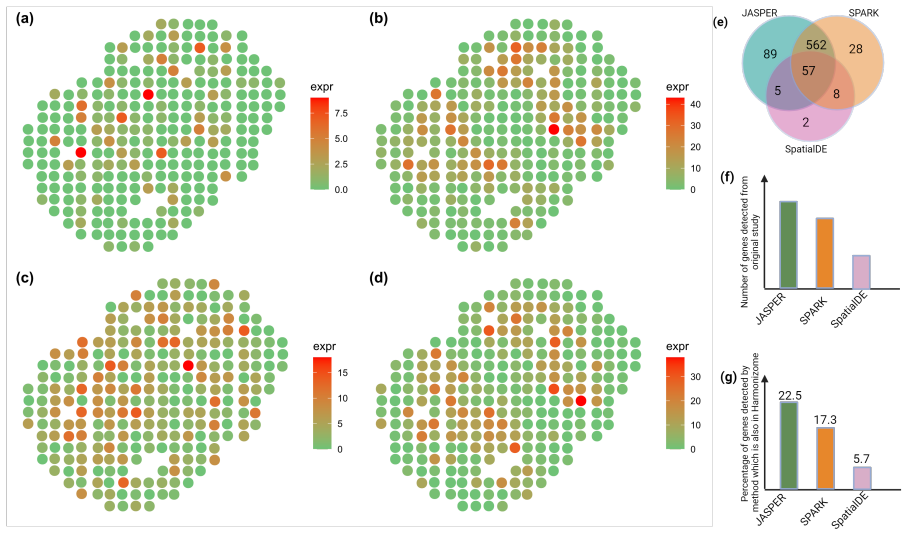
JASPER is a Bayesian framework that jointly models spatial expression patterns across multiple genes using a spatial basis function regression approach. It addresses limitations in existing methods by accounting for inter-gene correlations without relying on predefined spatial covariance kernels. Demonstrations on real-world spatial transcriptomic datasets, including a human breast cancer dataset, and simulation experiments show superior performance. The method identifies genes with stronger spatial correlation and greater biological relevance, as confirmed through overlap comparisons, enrichment analysis, and pathway analysis with independent biological databases.
What carries the argument
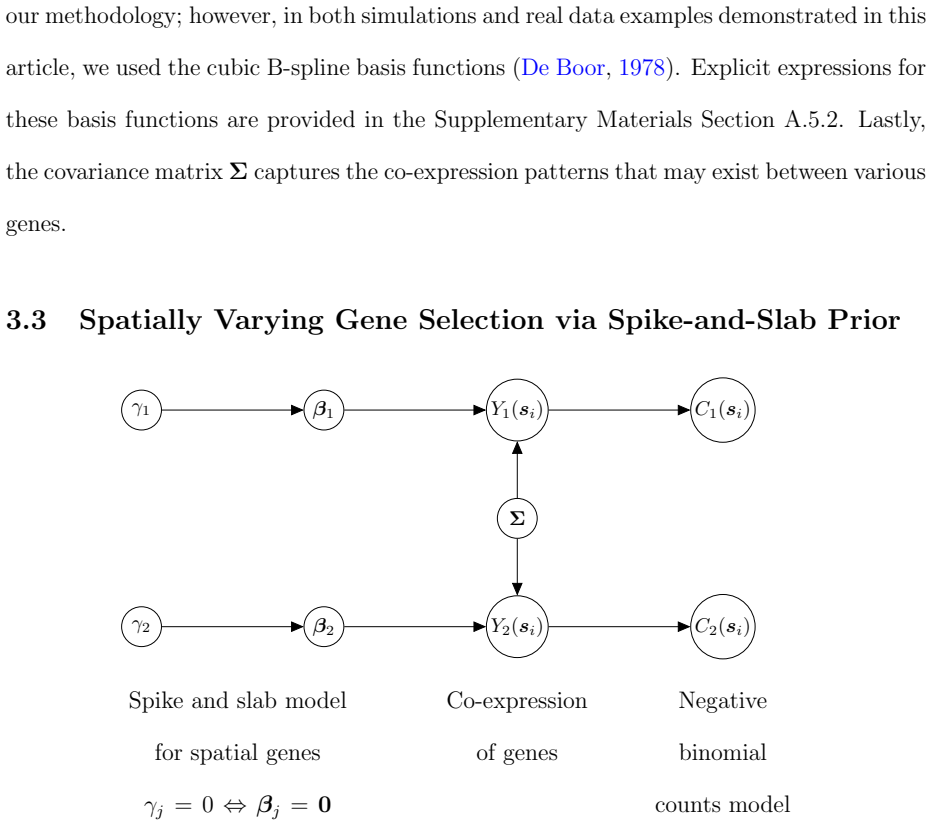
The joint Bayesian spatial basis function regression that couples multiple gene expressions through shared spatial basis expansions and hierarchical priors to capture both spatial variation and inter-gene correlations.
If this is right
- Identified genes exhibit higher spatial correlation strengths than those from competing methods.
- Greater overlap with independently validated spatially relevant genes.
- Improved enrichment in relevant biological pathways and processes.
- Lower false positive and false negative rates in both simulated and real data scenarios.
- Enhanced interpretability of spatial patterns in complex tissues.
Where Pith is reading between the lines
- Similar joint modeling could apply to other spatially resolved omics technologies beyond transcriptomics.
- The approach might integrate with non-spatial single-cell data for hybrid analyses.
- Adaptive selection of basis functions could further reduce sensitivity to model choices.
- Results suggest potential for better biomarker discovery in spatial contexts.
Load-bearing premise
That jointly modeling inter-gene correlations through spatial basis function regression will reduce false positives and negatives without adding biases from the specific basis functions or Bayesian prior choices.
What would settle it
Running JASPER and existing methods on a new independent spatial transcriptomics dataset and checking if JASPER's gene list has significantly lower overlap with known non-spatial genes or fails to show stronger pathway enrichments.
Figures



read the original abstract
Spatially resolved transcriptomics is a fast-developing set of technologies that enables the measurement of localized gene expression across spatial locations in a sample. Detecting spatially varying genes is critical for analyzing such data, yet existing methods often fail to account for inter-gene correlations, leading to inflated false positive and false negative rates. Additionally, most prominent methods rely on predefined spatial covariance kernels, making them sensitive to the complexity of spatial expression patterns. Motivated by a human breast cancer dataset, we address these limitations in existing literature through JASPER (Joint Bayesian Analysis of SPatial Expression via Regression), a Bayesian framework that jointly models spatial expression patterns across multiple genes using a spatial basis function regression approach. We demonstrate the superior performance of JASPER compared to existing methods in several real-world spatial transcriptomic datasets and supporting simulation experiments. JASPER identifies genes with stronger spatial correlation and greater biological relevance, as validated by overlap comparison, enrichment analysis, and pathway analysis using independent biological databases. Our results highlight the ability of JASPER to improve the statistical and biological interpretability of spatial transcriptomics data, making it a powerful tool for uncovering spatial gene expression patterns in complex biological systems.
Editorial analysis
A structured set of objections, weighed in public.
Referee Report
Summary. The manuscript introduces JASPER, a Bayesian framework for jointly modeling spatial gene expression patterns across multiple genes via spatial basis function regression. It claims this approach accounts for inter-gene correlations and avoids sensitivity to predefined covariance kernels, yielding superior performance over existing methods on real spatial transcriptomic datasets (including a motivating human breast cancer example) and supporting simulations, with validation via overlap comparisons, enrichment analysis, and pathway analysis against independent biological databases.
Significance. If the quantitative claims hold, JASPER would represent a meaningful advance in spatial transcriptomics analysis by reducing false positive and false negative rates through explicit joint modeling of correlations, while offering greater flexibility than kernel-based alternatives. This could improve the reliability of identifying biologically relevant spatially patterned genes in complex tissues.
major comments (3)
- Abstract: the central claim of 'superior performance' and 'stronger spatial correlation' is asserted without any quantitative metrics (e.g., precision-recall, AUC, or FDR values from simulations or real-data comparisons), making it impossible to evaluate the magnitude or statistical significance of the reported improvements.
- Methods (basis construction and prior specification): the paper must demonstrate, via sensitivity checks or explicit equations, that the chosen spatial basis functions and joint priors do not offset the intended reduction in FP/FN rates; without this, the weakest assumption flagged in the review remains untested and load-bearing for the main claim.
- Results (simulation and real-data sections): tables or figures reporting direct head-to-head error rates, overlap statistics, and enrichment p-values against the cited competing methods are required to substantiate the performance and biological-relevance assertions.
minor comments (1)
- Abstract: consider adding one sentence summarizing the number of datasets, simulation settings, and key performance deltas to give readers an immediate sense of scale.
Simulated Author's Rebuttal
We are grateful to the referee for their insightful comments, which have prompted us to clarify and strengthen several aspects of the manuscript. Below, we provide a point-by-point response to the major comments.
read point-by-point responses
-
Referee: Abstract: the central claim of 'superior performance' and 'stronger spatial correlation' is asserted without any quantitative metrics (e.g., precision-recall, AUC, or FDR values from simulations or real-data comparisons), making it impossible to evaluate the magnitude or statistical significance of the reported improvements.
Authors: We concur that the abstract would benefit from quantitative support for the claims of superior performance. Accordingly, in the revised manuscript, we will revise the abstract to include key quantitative metrics, such as the AUC from simulation experiments and the percentage overlap with known spatially varying genes in real data, along with comparisons to baseline methods. revision: yes
-
Referee: Methods (basis construction and prior specification): the paper must demonstrate, via sensitivity checks or explicit equations, that the chosen spatial basis functions and joint priors do not offset the intended reduction in FP/FN rates; without this, the weakest assumption flagged in the review remains untested and load-bearing for the main claim.
Authors: In the Methods section, we have detailed the construction of the spatial basis functions and the specification of the joint priors. To address the concern regarding their potential impact on false positive and false negative rates, we will conduct and report sensitivity analyses in the revised version. These will include varying the number of basis functions and the hyperparameters of the priors, with results demonstrating that the performance advantages persist across these choices. revision: yes
-
Referee: Results (simulation and real-data sections): tables or figures reporting direct head-to-head error rates, overlap statistics, and enrichment p-values against the cited competing methods are required to substantiate the performance and biological-relevance assertions.
Authors: The Results section presents validation through overlap comparisons, enrichment analysis, and pathway analysis. To provide more direct substantiation, we will include additional tables and figures in the revised manuscript that report head-to-head error rates (such as precision-recall and FDR) from the simulations and quantitative overlap statistics with associated p-values for enrichment analyses against the competing methods. revision: yes
Circularity Check
No significant circularity
full rationale
The paper introduces JASPER as a Bayesian spatial basis-function regression model that jointly accounts for inter-gene correlations, with performance evaluated on independent real datasets, simulations, and external biological databases for validation. No equations, basis definitions, or claims in the abstract reduce by construction to fitted inputs or self-citations; the central modeling choice and superiority claims rest on standard Bayesian priors and regression rather than tautological reparameterization. The derivation chain is self-contained against external benchmarks.
Axiom & Free-Parameter Ledger
Reference graph
Works this paper leans on
-
[1]
Journal of the American Statistical Association , volume=
Optimal sample size for multiple testing: the case of gene expression microarrays , author=. Journal of the American Statistical Association , volume=. 2004 , publisher=
2004
-
[2]
The Annals of Statistics , pages=
Bayes and empirical-Bayes multiplicity adjustment in the variable-selection problem , author=. The Annals of Statistics , pages=. 2010 , publisher=
2010
-
[3]
1978 , publisher=
A practical guide to splines , author=. 1978 , publisher=
1978
-
[4]
2012 , publisher=
Interpolation of spatial data: some theory for kriging , author=. 2012 , publisher=
2012
-
[5]
Biometrika , volume=
Reversible jump Markov chain Monte Carlo computation and Bayesian model determination , author=. Biometrika , volume=. 1995 , publisher=
1995
-
[6]
Journal of the American Statistical Association , volume=
Partially collapsed Gibbs samplers: Theory and methods , author=. Journal of the American Statistical Association , volume=. 2008 , publisher=
2008
-
[7]
Bayesian inference for logistic models using P
Polson, Nicholas G and Scott, James G and Windle, Jesse , journal=. Bayesian inference for logistic models using P. 2013 , publisher=
2013
-
[8]
International Statistical Review , volume=
Methods for scalar-on-function regression , author=. International Statistical Review , volume=. 2017 , publisher=
2017
-
[9]
Statistica Sinica , volume=
Variable selection and estimation in high-dimensional varying-coefficient models , author=. Statistica Sinica , volume=. 2011 , publisher=
2011
-
[10]
Bayesian Analysis , volume=
Bayesian Image-on-Scalar Regression with a Spatial Global-Local Spike-and-Slab Prior , author=. Bayesian Analysis , volume=. 2024 , publisher=
2024
-
[11]
Gonzalez and Erin L
Fan Li and Tingting Zhang and Quanli Wang and Marlen Z. Gonzalez and Erin L. Maresh and James A. Coan , title =. The Annals of Applied Statistics , number =. 2015 , doi =
2015
-
[12]
Journal of machine learning research , volume=
Distributed Bayesian varying coefficient modeling using a Gaussian process prior , author=. Journal of machine learning research , volume=
-
[13]
Journal of the American Statistical Association , volume=
Spatial modeling with spatially varying coefficient processes , author=. Journal of the American Statistical Association , volume=. 2003 , publisher=
2003
-
[14]
Ecological Modelling , volume=
Importance of spatial predictor variable selection in machine learning applications--Moving from data reproduction to spatial prediction , author=. Ecological Modelling , volume=. 2019 , publisher=
2019
-
[15]
Biometrics , volume=
Bayesian variable selection for multivariate spatially varying coefficient regression , author=. Biometrics , volume=. 2010 , publisher=
2010
-
[16]
Scandinavian Journal of Statistics , volume=
Adaptive Bayesian procedures using random series priors , author=. Scandinavian Journal of Statistics , volume=. 2015 , publisher=
2015
-
[17]
arXiv preprint arXiv:1209.0661 , year=
Bayesian variable selection for spatially dependent generalized linear models , author=. arXiv preprint arXiv:1209.0661 , year=
-
[18]
Journal of the Royal Statistical Society Series C: Applied Statistics , volume=
A Bayesian hierarchical model with spatial variable selection: the effect of weather on insurance claims , author=. Journal of the Royal Statistical Society Series C: Applied Statistics , volume=. 2013 , publisher=
2013
-
[19]
Biometrics , volume=
Spatial variable selection methods for investigating acute health effects of fine particulate matter components , author=. Biometrics , volume=. 2015 , publisher=
2015
-
[20]
Journal of the American Statistical Association , volume=
Spatial Bayesian variable selection with application to functional magnetic resonance imaging , author=. Journal of the American Statistical Association , volume=. 2007 , publisher=
2007
-
[21]
Bayesian Analysis (Online) , volume=
Spatial Bayesian variable selection models on functional magnetic resonance imaging time-series data , author=. Bayesian Analysis (Online) , volume=. 2014 , publisher=
2014
-
[22]
NeuroImage , volume=
A spatio-temporal nonparametric Bayesian variable selection model of fMRI data for clustering correlated time courses , author=. NeuroImage , volume=. 2014 , publisher=
2014
-
[23]
Natural Hazards , volume=
Spatial air quality index and air pollutant concentration prediction using linear regression based recursive feature elimination with random forest regression (RFERF): a case study in India , author=. Natural Hazards , volume=. 2022 , publisher=
2022
-
[24]
Journal of the Royal Statistical Society: Series D , volume=
Geographically weighted regression , author=. Journal of the Royal Statistical Society: Series D , volume=. 1998 , publisher=
1998
-
[25]
Handbook of regional science , pages=
Geographically weighted regression , author=. Handbook of regional science , pages=. 2021 , publisher=
2021
-
[26]
2003 , publisher=
Geographically weighted regression , author=. 2003 , publisher=
2003
-
[27]
Statistical methods in medical research , volume=
Bayesian spatially dependent variable selection for small area health modeling , author=. Statistical methods in medical research , volume=. 2018 , publisher=
2018
-
[28]
Biometrika , volume=
Scalar-on-image regression via the soft-thresholded Gaussian process , author=. Biometrika , volume=. 2018 , publisher=
2018
-
[29]
Journal of Computational and Graphical Statistics , volume=
Smooth scalar-on-image regression via spatial Bayesian variable selection , author=. Journal of Computational and Graphical Statistics , volume=. 2014 , publisher=
2014
-
[30]
Journal of Multivariate Analysis , volume=
Variable selection in functional regression models: a review , author=. Journal of Multivariate Analysis , volume=. 2022 , publisher=
2022
-
[31]
Journal of Business & Economic Statistics , volume=
Bayesian analysis of latent threshold dynamic models , author=. Journal of Business & Economic Statistics , volume=. 2013 , publisher=
2013
-
[32]
Stat , volume=
Variable selection in function-on-scalar regression , author=. Stat , volume=. 2016 , publisher=
2016
-
[33]
Biostatistics , volume=
A sparse negative binomial mixture model for clustering RNA-seq count data , author=. Biostatistics , volume=. 2023 , publisher=
2023
-
[34]
BMC bioinformatics , volume=
Gene selection and classification of microarray data using random forest , author=. BMC bioinformatics , volume=. 2006 , publisher=
2006
-
[35]
Artificial Intelligence in Medicine , volume=
Gene selection for microarray data classification via multi-objective graph theoretic-based method , author=. Artificial Intelligence in Medicine , volume=. 2022 , publisher=
2022
-
[36]
BioEssays , volume=
Spatially resolved transcriptomes—next generation tools for tissue exploration , author=. BioEssays , volume=. 2020 , publisher=
2020
-
[37]
Briefings in bioinformatics , volume=
Spatial molecular profiling: platforms, applications and analysis tools , author=. Briefings in bioinformatics , volume=. 2021 , publisher=
2021
-
[38]
Nature Reviews Genetics , volume=
Advances in spatial transcriptomics and molecular imaging , author=. Nature Reviews Genetics , volume=. 2022 , publisher=
2022
-
[39]
Journal of Genetics and Genomics , year=
Spatially resolved transcriptomics: a comprehensive review of their technological advances, applications, and challenges , author=. Journal of Genetics and Genomics , year=
-
[40]
BMB reports , volume=
Recent advances in spatially resolved transcriptomics: challenges and opportunities , author=. BMB reports , volume=. 2022 , publisher=
2022
-
[41]
Nature methods , volume=
Single-cell systems biology by super-resolution imaging and combinatorial labeling , author=. Nature methods , volume=. 2012 , publisher=
2012
-
[42]
Proceedings of the National Academy of Sciences , volume=
High-throughput single-cell gene-expression profiling with multiplexed error-robust fluorescence in situ hybridization , author=. Proceedings of the National Academy of Sciences , volume=. 2016 , publisher=
2016
-
[43]
Science , volume=
Spatially resolved, highly multiplexed RNA profiling in single cells , author=. Science , volume=. 2015 , publisher=
2015
-
[44]
Science , volume=
Three-dimensional intact-tissue sequencing of single-cell transcriptional states , author=. Science , volume=. 2018 , publisher=
2018
-
[45]
Science , volume=
Visualization and analysis of gene expression in tissue sections by spatial transcriptomics , author=. Science , volume=. 2016 , publisher=
2016
-
[46]
Science , volume=
Slide-seq: A scalable technology for measuring genome-wide expression at high spatial resolution , author=. Science , volume=. 2019 , publisher=
2019
-
[47]
Biometrika , volume=
Notes on continuous stochastic phenomena , author=. Biometrika , volume=. 1950 , publisher=
1950
-
[48]
The incorporated statistician , volume=
The contiguity ratio and statistical mapping , author=. The incorporated statistician , volume=. 1954 , publisher=
1954
-
[49]
Nature methods , volume=
Statistical analysis of spatial expression patterns for spatially resolved transcriptomic studies , author=. Nature methods , volume=. 2020 , publisher=
2020
-
[50]
Nature methods , volume=
SpatialDE: identification of spatially variable genes , author=. Nature methods , volume=. 2018 , publisher=
2018
-
[51]
Nature communications , volume=
nnSVG for the scalable identification of spatially variable genes using nearest-neighbor Gaussian processes , author=. Nature communications , volume=. 2023 , publisher=
2023
-
[52]
Nature methods , volume=
Identification of spatial expression trends in single-cell gene expression data , author=. Nature methods , volume=. 2018 , publisher=
2018
-
[53]
Bioinformatics , volume=
SOMDE: a scalable method for identifying spatially variable genes with self-organizing map , author=. Bioinformatics , volume=. 2021 , publisher=
2021
-
[54]
Genome biology , volume=
SPARK-X: non-parametric modeling enables scalable and robust detection of spatial expression patterns for large spatial transcriptomic studies , author=. Genome biology , volume=. 2021 , publisher=
2021
-
[55]
Bioinformatics , volume=
sepal: Identifying transcript profiles with spatial patterns by diffusion-based modeling , author=. Bioinformatics , volume=. 2021 , publisher=
2021
-
[56]
Computational and Structural Biotechnology Journal , year=
Recent advances in spatially variable gene detection in spatial transcriptomics , author=. Computational and Structural Biotechnology Journal , year=
-
[57]
BioRxiv , pages=
Overcoming systematic errors caused by log-transformation of normalized single-cell RNA sequencing data , author=. BioRxiv , pages=. 2018 , publisher=
2018
-
[58]
Genome Biology , volume=
A scaling normalization method for differential expression analysis of RNA-seq data , author=. Genome Biology , volume=. 2010 , publisher=
2010
-
[59]
BMC Bioinformatics , volume=
Evaluation of statistical methods for normalization and differential expression in mRNA-Seq experiments , author=. BMC Bioinformatics , volume=. 2010 , publisher=
2010
-
[60]
Database , volume=
The harmonizome: a collection of processed datasets gathered to serve and mine knowledge about genes and proteins , author=. Database , volume=. 2016 , publisher=
2016
-
[61]
Nucleic acids research , volume=
COSMIC: the catalogue of somatic mutations in cancer , author=. Nucleic acids research , volume=. 2019 , publisher=
2019
-
[62]
Genome Biology , volume=
iIMPACT: integrating image and molecular profiles for spatial transcriptomics analysis , author=. Genome Biology , volume=. 2024 , publisher=
2024
-
[63]
Cell death discovery , volume=
Novel role of COX6c in the regulation of oxidative phosphorylation and diseases , author=. Cell death discovery , volume=. 2022 , publisher=
2022
-
[64]
Biomedicine & Pharmacotherapy , volume=
Role of EFNA1 in tumorigenesis and prospects for cancer therapy , author=. Biomedicine & Pharmacotherapy , volume=. 2020 , publisher=
2020
-
[65]
Experimental Eye Research , volume=
GAD1 alleviates injury-induced optic neurodegeneration by inhibiting retinal ganglion cell apoptosis , author=. Experimental Eye Research , volume=. 2022 , publisher=
2022
-
[66]
Cancer Cell International , volume=
NAP1L1 interacts with hepatoma-derived growth factor to recruit c-Jun inducing breast cancer growth , author=. Cancer Cell International , volume=. 2021 , publisher=
2021
-
[67]
Oncology letters , volume=
lncRNA KCNQ1OT1 knockdown inhibits colorectal cancer cell proliferation, migration and invasiveness via thePI3K/AKT pathway , author=. Oncology letters , volume=. 2020 , publisher=
2020
-
[68]
Biochemical Pharmacology , volume=
NAP1L5 facilitates pancreatic ductal adenocarcinoma progression via TRIM29-mediated ubiquitination of PHLPP1 , author=. Biochemical Pharmacology , volume=. 2023 , publisher=
2023
-
[69]
Scientific Reports , volume=
KIF2A regulates the spindle assembly and the metaphase I-anaphase I transition in mouse oocyte , author=. Scientific Reports , volume=. 2016 , publisher=
2016
-
[70]
Journal of Neuroscience , volume=
Hepatocyte growth factor regulates migration of olfactory interneuron precursors in the rostral migratory stream through Met--Grb2 coupling , author=. Journal of Neuroscience , volume=. 2008 , publisher=
2008
-
[71]
Nature Communications , volume=
Novel role of the synaptic scaffold protein Dlgap4 in ventricular surface integrity and neuronal migration during cortical development , author=. Nature Communications , volume=. 2022 , publisher=
2022
-
[72]
Molecular Brain , volume=
5-HTR 2A and 5-HTR 3A but not 5-HTR 1A antagonism impairs the cross-modal reactivation of deprived visual cortex in adulthood , author=. Molecular Brain , volume=. 2018 , publisher=
2018
-
[73]
Cell , volume=
Npas4 regulates excitatory-inhibitory balance within neural circuits through cell-type-specific gene programs , author=. Cell , volume=. 2014 , publisher=
2014
-
[74]
Bioinformatics , volume=
Identification of cell-type-specific spatially variable genes accounting for excess zeros , author=. Bioinformatics , volume=. 2022 , publisher=
2022
-
[75]
2002 , publisher=
Subset Selection in Regression , author=. 2002 , publisher=
2002
-
[76]
Biometrics , volume=
The analysis and selection of variables in linear regression , author=. Biometrics , volume=. 1976 , publisher=
1976
-
[77]
Mathematical Methods for Digital Computers , editor=
Multiple regression analysis , author=. Mathematical Methods for Digital Computers , editor=. 1960 , publisher=
1960
-
[78]
1998 , publisher=
Applied Regression Analysis , author=. 1998 , publisher=
1998
-
[79]
Journal of the Royal Statistical Society: Series B , volume=
Regression shrinkage and selection via the lasso , author=. Journal of the Royal Statistical Society: Series B , volume=
-
[80]
Journal of Computational and Graphical Statistics , volume=
On the lasso and its dual , author=. Journal of Computational and Graphical Statistics , volume=
discussion (0)
Sign in with ORCID, Apple, or X to comment. Anyone can read and Pith papers without signing in.