Recognition: unknown
Weak order on groups generated by involutions
Pith reviewed 2026-05-10 02:44 UTC · model grok-4.3
The pith
The weak order on groups generated by involutions forms a complete meet-semilattice for a class larger than Coxeter systems, including cactus groups.
A machine-rendered reading of the paper's core claim, the machinery that carries it, and where it could break.
Core claim
An involution system consists of a group W generated by a finite set S of involutions. The associated weak order is the partial order obtained by directing each edge of the Cayley graph from w to ws whenever s belongs to S. The central question is for which such systems this poset is a complete meet-semilattice. The paper proves that the property holds for every Coxeter system and, moreover, for every cactus group; it also shows that any involution system with a sign character admits a finite presentation and, in rank three, is completely classified. Several equivalent conditions that characterize Coxeter systems purely in terms of the weak order are obtained as by-products.
What carries the argument
The weak order obtained by orienting the Cayley graph of the group generated by the involution set S, whose meet-semilattice property is detected directly from the resulting directed graph.
If this is right
- Any collection of group elements possesses a greatest lower bound, allowing the same algebraic constructions that rely on meets in Coxeter groups to be carried over to cactus groups.
- Finite presentations become available for all involution systems that admit a sign character.
- A complete list of rank-three examples is obtained, providing concrete test cases for further properties.
- Coxeter systems are precisely the involution systems whose weak orders satisfy certain additional lattice or graph-theoretic conditions.
- Results on subclasses, such as those with sign characters, supply new tools for studying their word problems and conjugacy classes.
Where Pith is reading between the lines
- The same lattice property may hold for other known families of involution-generated groups, yielding a larger supply of examples where meet-based algorithms apply.
- Geometric representations and mediangle graphs, already mentioned as directions for further work, could be developed uniformly for all systems whose weak orders are complete meet-semilattices.
- Biautomaticity or automaticity questions for these groups might be approachable through the lattice structure of the weak order.
- The rank-three classification could serve as a base case for inductive arguments in higher ranks.
Load-bearing premise
The meet operation in the weak order can be detected from the oriented Cayley graph alone, without extra relations or geometric assumptions on the group.
What would settle it
An explicit small cactus group in which two elements have no greatest lower bound under the weak order would show that the class is not strictly larger than the Coxeter systems.
Figures






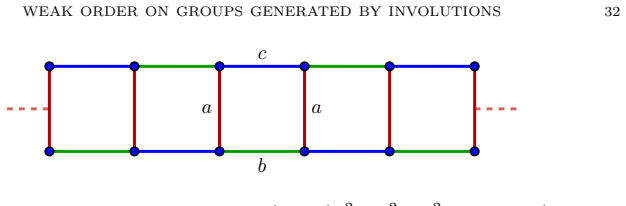
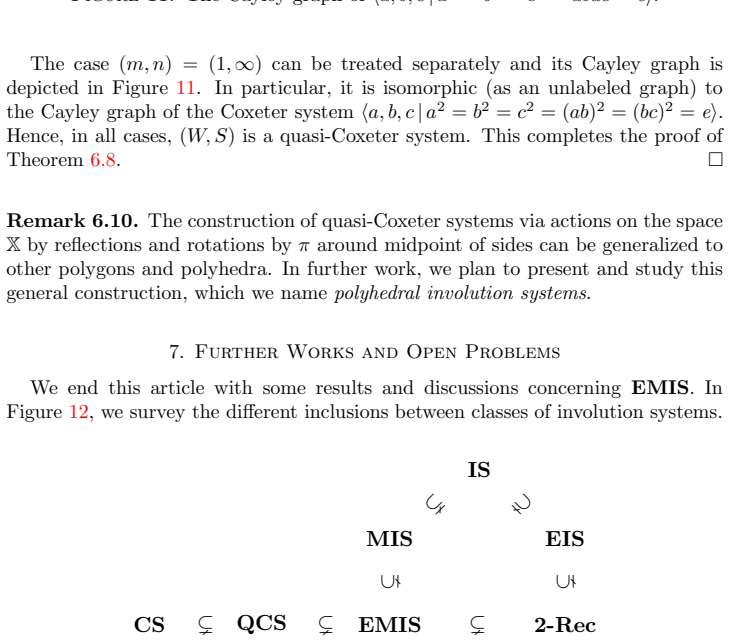
read the original abstract
In this article, we propose to initiate the general study of involution systems. An {\em involution system}, that is, a group $W$ generated by a set of involutions $S$, is naturally endowed with a {\em weak order} arising from orienting the Cayley graph of $(W,S)$. In the case of a Coxeter system $(W,S)$, Bj\"orner showed that the weak order is a complete meet-semilattice. This fact has many important consequences for Coxeter systems and their related structures. In this article, we discuss the following question: For which involution systems is the weak order a complete meet-semilattice? The class of involution systems that satisfies this condition is larger than the class of Coxeter systems (it contains, for instance, Cactus groups). In the case of an involution system with sign character, we provide a finite presentation by generators and relations and a classification in rank 3. We also obtain new characterizations of Coxeter systems in terms of the weak order, and prove a number of results on certain subclasses of these involution systems. Finally, we discuss further works and open problems in relation to biautomatic structures, geometric representations, mediangle graphs, and more.
Editorial analysis
A structured set of objections, weighed in public.
Referee Report
Summary. The manuscript introduces involution systems (W, S), where W is a group generated by a set S of involutions, and defines the weak order by orienting the right Cayley graph of (W, S). It investigates for which such systems the weak order is a complete meet-semilattice, showing that the class properly contains Coxeter systems (with Cactus groups as an example). For involution systems admitting a sign character, the authors supply a finite presentation by generators and relations together with a rank-3 classification. They also derive new characterizations of Coxeter systems in terms of the weak order, establish results on certain subclasses, and discuss open problems concerning biautomatic structures, geometric representations, and mediangle graphs.
Significance. If the central claims hold, the work extends Björner's theorem on the weak order of Coxeter groups to a strictly larger class of involution-generated groups. This could enlarge the scope of poset-theoretic techniques in geometric group theory, particularly for Cactus groups and related structures. The finite presentation, rank-3 classification, and new Coxeter characterizations are concrete contributions that may aid identification of groups with lattice-like weak orders. The paper also supplies explicit connections to biautomaticity and mediangle graphs, which are strengths for future research.
major comments (2)
- [§3] §3 (finite presentation for systems with sign character): the claim that the given presentation yields a complete meet-semilattice requires an explicit argument that the oriented Cayley graph remains acyclic and that the meet operation is well-defined on the quotient; the current statement appears to assume this without a separate verification step.
- [§4] §4 (rank-3 classification): the enumeration of involution systems in rank 3 lists non-Coxeter examples such as certain Cactus groups, but the verification that their weak orders are complete meet-semilattices is only sketched; a concrete check against the oriented-graph definition (e.g., absence of infinite descending chains) is needed to support the claim that the class is strictly larger.
minor comments (3)
- The definition of the sign character (used throughout §§3–4) should be recalled with a short example immediately after its introduction to aid readers unfamiliar with the notion.
- [§1] Notation for the weak order (denoted perhaps by ≤_S) is introduced in the abstract and §1 but could be reinforced with a small diagram of the oriented Cayley graph for a rank-2 example.
- [final section] The discussion of open problems in the final section would benefit from explicit references to the relevant literature on mediangle graphs and biautomatic structures.
Simulated Author's Rebuttal
We thank the referee for their positive evaluation and constructive feedback on our manuscript. The comments highlight areas where additional explicit arguments will improve clarity, and we address each major comment below.
read point-by-point responses
-
Referee: [§3] §3 (finite presentation for systems with sign character): the claim that the given presentation yields a complete meet-semilattice requires an explicit argument that the oriented Cayley graph remains acyclic and that the meet operation is well-defined on the quotient; the current statement appears to assume this without a separate verification step.
Authors: We agree that a separate verification step would strengthen the exposition. In the revised manuscript we will insert a short lemma immediately after the presentation theorem. The lemma shows that the defining relations of the presentation are compatible with the length function induced by the sign character, ensuring that the oriented Cayley graph on the quotient remains acyclic (no directed cycles) and that the meet operation, already well-defined on the free involution system, descends to the quotient. The argument relies on the fact that every relation is either length-preserving or strictly length-increasing with respect to the sign character, which prevents descending chains from closing. revision: yes
-
Referee: [§4] §4 (rank-3 classification): the enumeration of involution systems in rank 3 lists non-Coxeter examples such as certain Cactus groups, but the verification that their weak orders are complete meet-semilattices is only sketched; a concrete check against the oriented-graph definition (e.g., absence of infinite descending chains) is needed to support the claim that the class is strictly larger.
Authors: The referee correctly notes that the verification in §4 is concise. We will expand the section with two additional paragraphs: one providing an explicit check for the finite non-Coxeter examples (by enumerating all reduced words up to length 6 and confirming no infinite descending chains exist in the oriented graph), and one giving a structural argument for the infinite Cactus-group examples, showing that the weak order coincides with the known lattice order on the cactus group and hence inherits the complete meet-semilattice property. These additions will make the strict containment claim fully rigorous. revision: yes
Circularity Check
No significant circularity in the derivation chain
full rationale
The paper defines involution systems directly as groups generated by a set of involutions S and equips them with a weak order obtained by orienting the right Cayley graph. It invokes Björner's theorem solely as an external fact about the Coxeter subclass, then proves new statements (finite presentations under a sign character, rank-3 classification, and characterizations of Coxeter systems) for the strictly larger class that includes Cactus groups. These derivations rest on the given poset structure and independently verifiable properties of the examples; no equation reduces to a fitted parameter, no definition is self-referential, and no load-bearing premise collapses to a self-citation chain.
Axiom & Free-Parameter Ledger
axioms (2)
- domain assumption A group W generated by a set S of involutions (each s in S satisfies s^2 = 1) forms an involution system.
- domain assumption The weak order on W is the partial order induced by orienting the edges of the Cayley graph of (W, S).
Reference graph
Works this paper leans on
-
[1]
Brown.Buildings, volume 248 ofGraduate Texts in Math- ematics
Peter Abramenko and Kenneth S. Brown.Buildings, volume 248 ofGraduate Texts in Math- ematics. Springer, New York, 2008. Theory and applications. 5
2008
-
[2]
Generalized noncrossing partitions and combinatorics of Coxeter groups
Drew Armstrong. Generalized noncrossing partitions and combinatorics of Coxeter groups. Mem. Amer. Math. Soc., 202(949):x+159, 2009. 9
2009
-
[3]
The dual braid monoid.Annales scientifiques de l’ ´Ecole Normale Sup´ erieure (4), 36(5):647–683, 2003
David Bessis. The dual braid monoid.Annales scientifiques de l’ ´Ecole Normale Sup´ erieure (4), 36(5):647–683, 2003. With applications to noncrossing partitions and Garside structures. 9, 10
2003
-
[4]
Orderings of Coxeter groups
Anders Bj¨ orner. Orderings of Coxeter groups. InCombinatorics and algebra (Boulder, Colo., 1983), volume 34 ofContemp. Math., pages 175–195. Amer. Math. Soc., Providence, RI,
1983
-
[5]
Springer, New York, 2005
Anders Bj¨ orner and Francesco Brenti.Combinatorics of Coxeter Groups, volume 231 ofGrad- uate Texts in Mathematics. Springer, New York, 2005. 2, 5, 8, 9, 10, 26
2005
-
[6]
Bourbaki.Groupes et alg` ebres de Lie, Chapitres IV–VI
N. Bourbaki.Groupes et alg` ebres de Lie, Chapitres IV–VI. Actualit´ es Scientifiques et Indus- trielles, No. 1337. Hermann, Paris, 1968. 1
1968
-
[7]
Brady and C
T. Brady and C. Watt. Non-crossing partition lattices in finite reflection groups.Transactions of the American Mathematical Society, 360(4):1983–2005, 2008. Includes uniform proofs of lattice properties for intervals in the reflection order of Coxeter groups. 10
1983
-
[8]
Martin R. Bridson and Andr´ e Haefliger.Metric spaces of non-positive curvature, volume 319 ofGrundlehren der mathematischen Wissenschaften [Fundamental Principles of Mathemat- ical Sciences]. Springer-Verlag, Berlin, 1999. 19
1999
-
[9]
Brigitte Brink and Robert B. Howlett. A finiteness property and an automatic structure for Coxeter groups.Math. Ann., 296(1):179–190, 1993. 26, 34
1993
-
[10]
The intermediate orders of a Coxeter group.Proc
Angela Carnevale, Matthew Dyer, and Paolo Sentinelli. The intermediate orders of a Coxeter group.Proc. Amer. Math. Soc., 151(4):1433–1443, 2023. 9
2023
-
[11]
Abelian ideals of Borel subalgebras and affine Weyl groups
Paola Cellini and Paolo Papi. Abelian ideals of Borel subalgebras and affine Weyl groups. Advances in Mathematics, 187:320–361, 2004. 2
2004
-
[12]
Defining sequences for fundamental root systems and coxeter graphs for super weyl groups, 2024
Changjie Chen, Yiyang Li, and Bin Shu. Defining sequences for fundamental root systems and coxeter graphs for super weyl groups, 2024. 2
2024
-
[13]
Graphs of some CAT(0) complexes.Adv
Victor Chepoi. Graphs of some CAT(0) complexes.Adv. in Appl. Math., 24(2):125–179, 2000. 11
2000
-
[14]
Cell structure of bipartite mediangle graphs, 2025
Victor Chepoi and Kolja Knauer. Cell structure of bipartite mediangle graphs, 2025. arXiv:2505.23293. 36
-
[15]
Davis, T
M. Davis, T. Januszkiewicz, and R. Scott. Fundamental groups of blow-ups.Adv. Math., 177(1):115–179, 2003. 2, 12
2003
-
[16]
Davis.The geometry and topology of Coxeter groups, volume 32 ofLondon Mathematical Society Monographs Series
Michael W. Davis.The geometry and topology of Coxeter groups, volume 32 ofLondon Mathematical Society Monographs Series. Princeton University Press, Princeton, NJ, 2008. 36
2008
-
[17]
Davis and Michael D
Michael W. Davis and Michael D. Shapiro. Coxeter groups are automatic. pages 1–16, 1991. Ohio State Mathematical Research Institute Preprints, no. 91-15. 26
1991
-
[18]
Garside families in Artin-Tits monoids and low elements in Coxeter groups.Comptes Rendus Mathematique, 353:403–408,
Patrick Dehornoy, Matthew Dyer, and Christophe Hohlweg. Garside families in Artin-Tits monoids and low elements in Coxeter groups.Comptes Rendus Mathematique, 353:403–408,
-
[19]
Lattice theory of torsion classes: beyondτ-tilting theory.Trans
Laurent Demonet, Osamu Iyama, Nathan Reading, Idun Reiten, and Hugh Thomas. Lattice theory of torsion classes: beyondτ-tilting theory.Trans. Amer. Math. Soc. Ser. B, 10:542– 612, 2023. 2
2023
-
[20]
Devadoss
Satyan L. Devadoss. Tessellations of moduli spaces and the mosaic operad. InHomotopy invariant algebraic structures (Baltimore, MD, 1998), volume 239 ofContemp. Math., pages 91–114. Amer. Math. Soc., Providence, RI, 1999. 2, 12
1998
-
[21]
Garside shadows and biautomatic structures in Coxeter groups, 2026
Fabricio Dos Santos. Garside shadows and biautomatic structures in Coxeter groups, 2026. To appear inIsr. J. Math., arXiv:2505.21718. 2, 26, 34
-
[22]
Shi arrangements and low elements in Coxeter groups.S´ em
Matthew Dyer, Susanna Fishel, Christophe Hohlweg, and Alice Mark. Shi arrangements and low elements in Coxeter groups.S´ em. Lothar. Combin., 91B:Art. 19, 12, 2024. 2
2024
-
[23]
Matthew J. Dyer. Coxeter groups, root systems and reflection subgroups. Lecture Notes, private communication, 2010. 4, 5
2010
-
[24]
Matthew J. Dyer. On the weak order of Coxeter groups.Canadian Journal of Mathematics, 71(2):299–336, 2019. 2 WEAK ORDER ON GROUPS GENERATED BY INVOLUTIONS 41
2019
-
[25]
Dyer and Christophe Hohlweg
Matthew J. Dyer and Christophe Hohlweg. Small roots, low elements, and the weak order in Coxeter groups.Advances in Mathematics, 301:739–784, 2016. 33, 34
2016
-
[26]
David B. A. Epstein, James W. Cannon, Derek F. Holt, Silvio V. F. Levy, Michael S. Paterson, and William P. Thurston.Word processing in groups. Jones and Bartlett Publishers, Boston, MA, 1992. 8, 26
1992
-
[27]
Beyond graph products and cactus groups: quandle products of groups,
Anthony Genevois. Beyond graph products and cactus groups: quandle products of groups,
- [28]
-
[29]
Cactus groups from the viewpoint of geometric group theory.Topology Proc., 66:59–103, 2025
Anthony Genevois. Cactus groups from the viewpoint of geometric group theory.Topology Proc., 66:59–103, 2025. 2, 12
2025
-
[30]
Anthony Genevois. Rotation groups, mediangle graphs, and periagroups: a unified point of view on Coxeter groups and graph products of groups, 2026. To appear inGroups Geom. Dyn., arXiv:2212.06421. 4, 35, 36
-
[31]
The planar cubic Cayley graphs.Mem
Agelos Georgakopoulos. The planar cubic Cayley graphs.Mem. Amer. Math. Soc., 250(1190):v+82, 2017. 15, 24
2017
-
[32]
Gerasimov
V. Gerasimov. Fixed-point-free actions on cubings [translation ofalgebra, geometry, analysis and mathematical physics (russian) (novosibirsk, 1996), 91–109, 190, Izdat. Ross. Akad. Nauk Sibirsk. Otdel. Inst. Mat., Novosibirsk, 1997; MR1624115 (99c:20049)].Siberian Adv. Math., 8(3):36–58, 1998. 11
1996
-
[33]
Minimal generating set of cactus groups, 2025
Eddy Godelle. Minimal generating set of cactus groups, 2025. Preprint, arXiv:2510.15462. 12
-
[34]
Fr´ ed´ eric Haglund and Daniel T. Wise. Special cube complexes.Geom. Funct. Anal., 17(5):1551–1620, 2008. 36
2008
-
[35]
Crystals and coboundary categories.Duke Math
Andr´ e Henriques and Joel Kamnitzer. Crystals and coboundary categories.Duke Math. J., 132(2):191–216, 2006. 2, 12
2006
-
[36]
Humphreys.Reflection groups and Coxeter groups, volume 29
James E. Humphreys.Reflection groups and Coxeter groups, volume 29. Cambridge Univer- sity Press, Cambridge, 1990. 5
1990
-
[37]
String C-group representations of almost simple groups: a survey
Dimitri Leemans. String C-group representations of almost simple groups: a survey. InPoly- topes and discrete geometry, volume 764 ofContemp. Math., pages 157–178. Amer. Math. Soc., [Providence], RI, [2021]©2021. 2
2021
-
[38]
Mathematics Lecture Notes Series
Ottmar Loos.Symmetric Spaces I: General Theory. Mathematics Lecture Notes Series. W. A. Benjamin, New York, 1969. 2
1969
-
[39]
Lyndon and Paul E
Roger C. Lyndon and Paul E. Schupp.Combinatorial group theory, volume Band 89 of Ergebnisse der Mathematik und ihrer Grenzgebiete [Results in Mathematics and Related Areas]. Springer-Verlag, Berlin-New York, 1977. 3, 22, 33
1977
-
[40]
Springer-Verlag, Berlin,
Bernard Maskit.Kleinian groups, volume 287 ofGrundlehren der mathematischen Wis- senschaften [Fundamental Principles of Mathematical Sciences]. Springer-Verlag, Berlin,
-
[41]
Private communication, December 2025
Jon McCammond. Private communication, December 2025. 34
2025
-
[42]
Cambridge University Press, Cambridge, 2002
Peter McMullen and Egon Schulte.Abstract regular polytopes, volume 92 ofEncyclopedia of Mathematics and its Applications. Cambridge University Press, Cambridge, 2002. 2
2002
-
[43]
ProQuest LLC, Ann Arbor, MI, 1988
Gabor Moussong.Hyperbolic Coxeter groups. ProQuest LLC, Ann Arbor, MI, 1988. Thesis (Ph.D.)–The Ohio State University. 36
1988
-
[44]
Birkh¨ auser/Springer, Basel, 2012
Folkert M¨ uller-Hoissen, Jean Marcel Pallo, and Jim Stasheff, editors.Associahedra, Tamari lattices and related structures, volume 299 ofProgress in Mathematical Physics. Birkh¨ auser/Springer, Basel, 2012. Tamari memorial Festschrift. 2
2012
-
[45]
Coxeter groups are biautomatic.Invent
Damian Osajda and Piotr Przytycki. Coxeter groups are biautomatic.Invent. Math., 242(3):627–637, 2025. 2, 26, 28, 34
2025
-
[46]
Cone types, automata, and regular partitions in Coxeter groups.Adv
James Parkinson and Yeeka Yau. Cone types, automata, and regular partitions in Coxeter groups.Adv. Math., 398:Paper No. 108146, 66, 2022. 26, 34
2022
-
[47]
A pair of Garside shadows.Algebr
Piotr Przytycki and Yeeka Yau. A pair of Garside shadows.Algebr. Comb., 7(6):1879–1885,
-
[48]
Poc sets, median algebras and group actions, 1998
Martin Roller. Poc sets, median algebras and group actions, 1998. arXiv:1607.07747. 11
-
[49]
Right-angled mock reflection and mock Artin groups.Trans
Richard Scott. Right-angled mock reflection and mock Artin groups.Trans. Amer. Math. Soc., 360(8):4189–4210, 2008. 2, 3, 11, 15
2008
-
[50]
Tewari and Stephanie J
Vasu V. Tewari and Stephanie J. van Willigenburg. Modules of the 0-Hecke algebra and quasisymmetric Schur functions.Adv. Math., 285:1025–1065, 2015. 2 WEAK ORDER ON GROUPS GENERATED BY INVOLUTIONS 42 (Fabricio Dos Santos)Department of Mathematics and Statistics, McGill University, Burnside Hall, 805 Sherbrooke Street West, Montr ´eal, Qu´ebec, H3A 0B9, Ca...
2015
discussion (0)
Sign in with ORCID, Apple, or X to comment. Anyone can read and Pith papers without signing in.