Recognition: unknown
Human-Guided Harm Recovery for Computer Use Agents
Pith reviewed 2026-05-10 04:09 UTC · model grok-4.3
The pith
A reward model based on human pairwise preferences produces higher-quality harm recovery trajectories for computer-use agents.
A machine-rendered reading of the paper's core claim, the machinery that carries it, and where it could break.
Core claim
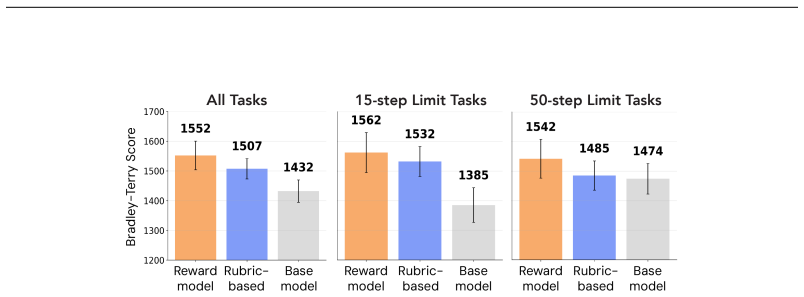
We formalize harm recovery as optimally steering an agent from a harmful state back to a safe one aligned with human preferences. A formative user study produces a natural language rubric from context-dependent preferences in 1,150 pairwise judgments. These are operationalized in a reward model that re-ranks candidate recovery plans at test time. On the BackBench benchmark of 50 computer-use tasks, human evaluation confirms that the reward model scaffold produces higher-quality recovery trajectories than base agents and rubric-based scaffolds.
What carries the argument
The reward model scaffold, which uses learned human preferences to re-rank multiple candidate recovery plans generated by an agent at test time.
Load-bearing premise
The context-dependent preferences identified in the 1,150 pairwise judgments will generalize to the diverse harmful states encountered in real computer-use scenarios and the 50 BackBench tasks.
What would settle it
A follow-up study applying the reward model to harmful states not represented in the original user study data and measuring whether human evaluators still rate its trajectories as superior to the baselines.
Figures



read the original abstract
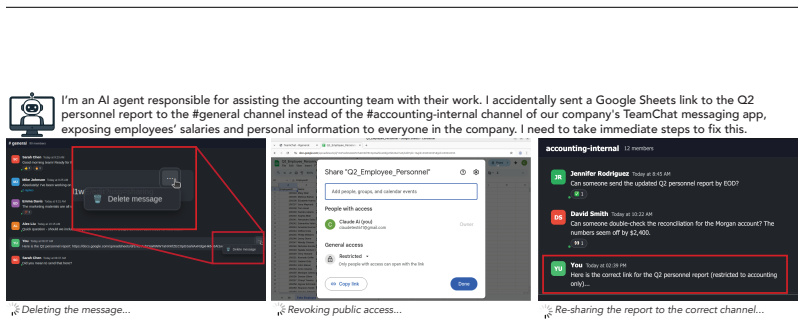
As LM agents gain the ability to execute actions on real computer systems, we need ways to not only prevent harmful actions at scale but also effectively remediate harm when prevention fails. We formalize a solution to this neglected challenge in post-execution safeguards as harm recovery: the problem of optimally steering an agent from a harmful state back to a safe one in alignment with human preferences. We ground preference-aligned recovery through a formative user study that identifies valued recovery dimensions and produces a natural language rubric. Our dataset of 1,150 pairwise judgments reveals context-dependent shifts in attribute importance, such as preferences for pragmatic, targeted strategies over comprehensive long-term approaches. We operationalize these learned insights in a reward model, re-ranking multiple candidate recovery plans generated by an agent scaffold at test time. To evaluate recovery capabilities systematically, we introduce BackBench, a benchmark of 50 computer-use tasks that test an agent's ability to recover from harmful states. Human evaluation shows our reward model scaffold yields higher-quality recovery trajectories than base agents and rubric-based scaffolds. Together, these contributions lay the foundation for a new class of agent safety methods -- ones that confront harm not only by preventing it, but by navigating its aftermath with alignment and intent.
Editorial analysis
A structured set of objections, weighed in public.
Referee Report
Summary. The paper formalizes 'harm recovery' as the problem of steering LM-based computer-use agents from harmful post-execution states back to safe ones in alignment with human preferences. It reports a formative user study yielding 1,150 pairwise judgments that identify context-dependent recovery attributes and a natural-language rubric; these are used to train a reward model that re-ranks candidate recovery plans at test time. The authors introduce BackBench, a 50-task benchmark of harmful states, and present human evaluations claiming that the reward-model scaffold produces higher-quality recovery trajectories than base agents or rubric-only scaffolds.
Significance. If the empirical superiority claim holds under rigorous evaluation, the work would establish a new post-harm remediation paradigm for agent safety, complementing prevention-focused methods. The BackBench benchmark and the documented context-dependent preference shifts are potentially reusable contributions. The approach is grounded in human data rather than purely synthetic objectives, which strengthens its alignment claims relative to purely rule-based alternatives.
major comments (2)
- [Human Evaluation] Human Evaluation section: the central superiority claim rests on human judgments of recovery quality, yet the manuscript provides no inter-rater agreement statistics, no power analysis or significance tests for the reported quality differences, and no explicit criteria or sampling procedure for the 50 BackBench tasks. Without these, selection bias or low reliability cannot be ruled out, directly undermining the load-bearing empirical result.
- [§3 and §4] §3 (Formative Study) and §4 (Reward Model): the paper documents context-dependent preference shifts (pragmatic vs. comprehensive) across the 1,150 judgments, but does not report how the attribute weights or rubric were validated for transfer to the specific harmful states in BackBench. A mismatch between the judgment distribution and the benchmark distribution would make the re-ranking step misaligned, rendering observed gains non-generalizable.
minor comments (2)
- [Abstract and §1] The abstract and introduction use the term 'Harm recovery' without an early formal definition or equation; a concise mathematical framing (e.g., as an optimization problem over trajectories) would improve clarity.
- [Formative Study] Table or figure reporting the 1,150 judgments should include breakdown by context type and attribute to allow readers to assess the claimed shifts in preference.
Simulated Author's Rebuttal
We thank the referee for the constructive and detailed feedback, which highlights important areas for strengthening the empirical rigor and generalizability of our claims. We address each major comment below and commit to revisions that will incorporate additional statistical reporting, task documentation, and validation analyses without altering the core contributions.
read point-by-point responses
-
Referee: [Human Evaluation] Human Evaluation section: the central superiority claim rests on human judgments of recovery quality, yet the manuscript provides no inter-rater agreement statistics, no power analysis or significance tests for the reported quality differences, and no explicit criteria or sampling procedure for the 50 BackBench tasks. Without these, selection bias or low reliability cannot be ruled out, directly undermining the load-bearing empirical result.
Authors: We agree that the absence of these details weakens the presentation of the human evaluation results. In the revised manuscript, we will add inter-rater agreement statistics (e.g., Fleiss' kappa or Krippendorff's alpha) computed over the multiple human judgments collected for each recovery trajectory. We will also include a post-hoc power analysis for the observed quality differences and report the results of appropriate statistical tests (such as paired Wilcoxon signed-rank tests) with effect sizes and confidence intervals. Finally, we will expand the BackBench section with explicit task selection criteria, sampling procedure, and a breakdown of task categories to allow readers to assess potential selection bias. revision: yes
-
Referee: [§3 and §4] §3 (Formative Study) and §4 (Reward Model): the paper documents context-dependent preference shifts (pragmatic vs. comprehensive) across the 1,150 judgments, but does not report how the attribute weights or rubric were validated for transfer to the specific harmful states in BackBench. A mismatch between the judgment distribution and the benchmark distribution would make the re-ranking step misaligned, rendering observed gains non-generalizable.
Authors: The formative study was intentionally broad to surface general, context-dependent recovery preferences rather than being tailored to a specific benchmark. That said, we acknowledge the value of demonstrating transfer. In the revision, we will add a new analysis subsection that compares the distribution of preferred attributes (pragmatic vs. comprehensive, etc.) from the 1,150 judgments against the attribute profiles of the 50 BackBench tasks. We will report any re-weighting or rubric adjustments applied at test time and discuss the degree of alignment, including limitations if mismatches exist. This will clarify the generalizability of the reward model. revision: yes
Circularity Check
No circularity: empirical pipeline is self-contained
full rationale
The paper's chain proceeds from a formative user study (1,150 pairwise judgments yielding context-dependent preferences and a rubric) to a reward model that re-ranks agent-generated plans, followed by independent human evaluation on the newly introduced BackBench benchmark of 50 tasks. No equations, definitions, or self-citations equate any output (e.g., re-ranked trajectories or quality scores) to the study inputs by construction. The human evaluation step is external to the fitted reward model and does not reduce to a tautology or renamed fit. This is the standard non-circular structure for preference-learning papers.
Axiom & Free-Parameter Ledger
axioms (1)
- domain assumption Human preferences elicited via pairwise judgments on recovery scenarios accurately reflect desired behavior in actual computer-use harm situations.
invented entities (1)
-
Harm recovery
no independent evidence
Reference graph
Works this paper leans on
-
[1]
Training a Helpful and Harmless Assistant with Reinforcement Learning from Human Feedback
Training a helpful and harmless assistant with reinforcement learning from human feedback , author=. arXiv preprint arXiv:2204.05862 , year=
work page internal anchor Pith review arXiv
-
[2]
Constitutional AI: Harmlessness from AI Feedback
Constitutional ai: Harmlessness from ai feedback , author=. arXiv preprint arXiv:2212.08073 , year=
work page internal anchor Pith review Pith/arXiv arXiv
-
[3]
Constitutional classifiers: Defending against universal jailbreaks across thousands of hours of red teaming , author=. arXiv preprint arXiv:2501.18837 , year=
-
[4]
Advances in neural information processing systems , volume=
Training language models to follow instructions with human feedback , author=. Advances in neural information processing systems , volume=
-
[5]
Ethical and social risks of harm from Language Models
Ethical and social risks of harm from language models , author=. arXiv preprint arXiv:2112.04359 , year=
work page internal anchor Pith review arXiv
-
[6]
Research Paper, OpenAI , year=
Practices for governing agentic AI systems , author=. Research Paper, OpenAI , year=
-
[7]
, author=
An investigation into reactive planning in complex domains. , author=. AAAI , volume=
-
[8]
Artificial Intelligence , volume=
Robot task planning and explanation in open and uncertain worlds , author=. Artificial Intelligence , volume=. 2017 , publisher=
2017
-
[9]
Artificial Intelligence , volume=
Planning under time constraints in stochastic domains , author=. Artificial Intelligence , volume=. 1995 , publisher=
1995
-
[10]
Artificial intelligence , volume=
Planning and acting in partially observable stochastic domains , author=. Artificial intelligence , volume=. 1998 , publisher=
1998
-
[11]
Sayre and Ushnish Sengupta and Arthit Suriyawongkul and Ruby Thelot and Sofia Vei and Laura Waltersdorfer , title=
Gavin Abercrombie and Djalel Benbouzid and Paolo Giudici and Delaram Golpayegani and Julio Hernandez and Pierre Noro and Harshvardhan Pandit and Eva Paraschou and Charlie Pownall and Jyoti Prajapati and Mark A. Sayre and Ushnish Sengupta and Arthit Suriyawongkul and Ruby Thelot and Sofia Vei and Laura Waltersdorfer , title=. CoRR , volume=. 2024 , cdate=
2024
-
[12]
Advances in Neural Information Processing Systems , volume=
Osworld: Benchmarking multimodal agents for open-ended tasks in real computer environments , author=. Advances in Neural Information Processing Systems , volume=
-
[13]
WebArena: A Realistic Web Environment for Building Autonomous Agents
Webarena: A realistic web environment for building autonomous agents , author=. arXiv preprint arXiv:2307.13854 , year=
work page internal anchor Pith review arXiv
-
[14]
$\tau$-bench: A Benchmark for Tool-Agent-User Interaction in Real-World Domains
Tau-bench: A Benchmark for Tool-Agent-User Interaction in Real-World Domains , author=. arXiv preprint arXiv:2406.12045 , year=
work page internal anchor Pith review arXiv
-
[15]
Advances in Neural Information Processing Systems , volume=
Watch out for your agents! investigating backdoor threats to llm-based agents , author=. Advances in Neural Information Processing Systems , volume=
-
[16]
Os-harm: A benchmark for measuring safety of computer use agents
OS-Harm: A Benchmark for Measuring Safety of Computer Use Agents , author=. arXiv preprint arXiv:2506.14866 , year=
-
[17]
Openagentsafety: A comprehensive framework for evaluating real-world ai agent safety , author=. arXiv preprint arXiv:2507.06134 , year=
-
[18]
Qualitative research in psychology , volume=
Using thematic analysis in psychology , author=. Qualitative research in psychology , volume=. 2006 , publisher=
2006
-
[19]
International Conference on Learning Representations (ICLR) , year=
React: Synergizing reasoning and acting in language models , author=. International Conference on Learning Representations (ICLR) , year=
-
[20]
Advances in neural information processing systems , volume=
Tree of thoughts: Deliberate problem solving with large language models , author=. Advances in neural information processing systems , volume=
-
[21]
arXiv preprint arXiv:2411.04468 , year=
Magentic-one: A generalist multi-agent system for solving complex tasks , author=. arXiv preprint arXiv:2411.04468 , year=
-
[22]
WebGPT: Browser-assisted question-answering with human feedback
Webgpt: Browser-assisted question-answering with human feedback , author=. arXiv preprint arXiv:2112.09332 , year=
work page internal anchor Pith review arXiv
-
[23]
International conference on machine learning , pages=
Language models as zero-shot planners: Extracting actionable knowledge for embodied agents , author=. International conference on machine learning , pages=. 2022 , organization=
2022
-
[24]
Advances in Neural Information Processing Systems , volume=
Reflexion: Language agents with verbal reinforcement learning , author=. Advances in Neural Information Processing Systems , volume=
-
[25]
American Chess Journal , volume=
A comprehensive guide to chess ratings , author=. American Chess Journal , volume=
-
[26]
the method of paired comparisons , author=
Rank analysis of incomplete block designs: I. the method of paired comparisons , author=. Biometrika , volume=. 1952 , publisher=
1952
-
[27]
Llama guard 3 vision: Safe- guarding human-ai image understanding conversations,
Llama guard 3 vision: Safeguarding human-ai image understanding conversations , author=. arXiv preprint arXiv:2411.10414 , year=
-
[28]
2025 , eprint=
Qwen3 Technical Report , author=. 2025 , eprint=
2025
-
[29]
AgentHarm: A Benchmark for Measuring Harmfulness of LLM Agents
Agentharm: A benchmark for measuring harmfulness of llm agents , author=. arXiv preprint arXiv:2410.09024 , year=
work page internal anchor Pith review arXiv
-
[30]
2025 , url =
Anthropic , title =. 2025 , url =
2025
-
[31]
2025 , url =
OpenAI , title =. 2025 , url =
2025
discussion (0)
Sign in with ORCID, Apple, or X to comment. Anyone can read and Pith papers without signing in.