Recognition: unknown
Intrinsic stochasticity in cell polarity and contact inhibition of locomotion
Pith reviewed 2026-05-10 03:25 UTC · model grok-4.3
The pith
At low Rho GTPase copy numbers molecular noise masks weak cell contacts during contact inhibition of locomotion, while high numbers make variability arise mainly from differences in contact geometry and duration.
A machine-rendered reading of the paper's core claim, the machinery that carries it, and where it could break.
Core claim
The authors establish that intrinsic stochasticity from finite Rho GTPase copy numbers drives rotational diffusion of the polarity axis in isolation. When cell-cell contact inhibits GTPase activation over a defined region, successful contact inhibition of locomotion occurs only if the contact overcomes the polarity noise. Low copy numbers render marginal contacts ineffective; high copy numbers stabilize polarity so that observed CIL randomness must originate in stochastic variation of contact geometry, strength, or duration across collisions.
What carries the argument
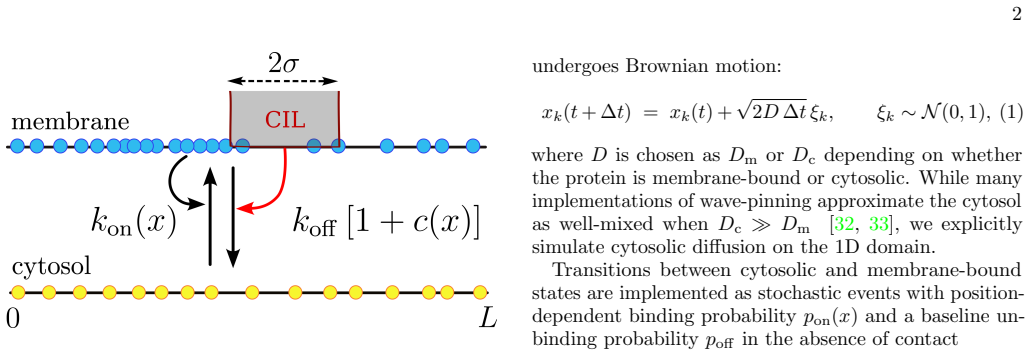
Stochastic diffusion and state-switching of discrete Rho GTPase molecules that set local membrane concentration and thereby orient the cell's polarity axis.
If this is right
- Weak, brief, or narrow contacts fail to trigger reliable repolarization when Rho GTPase numbers are low.
- High Rho GTPase numbers suppress intrinsic polarity noise, shifting the dominant source of CIL randomness to differences in contact properties between collisions.
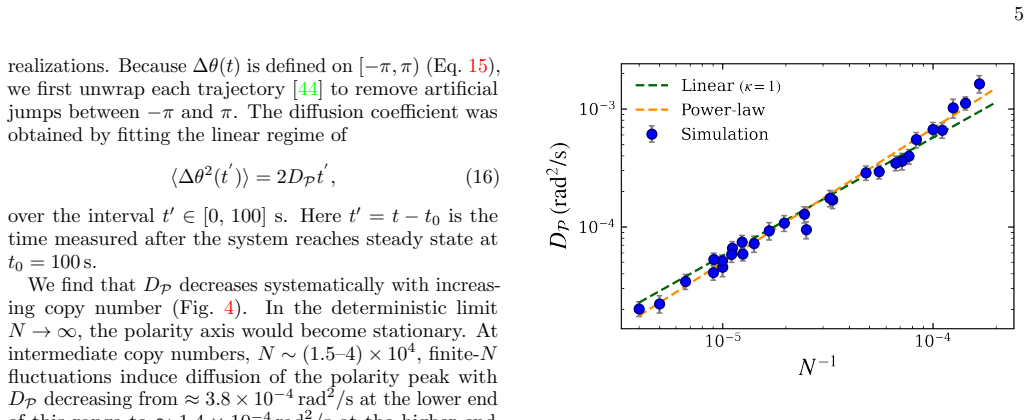
- The rotational diffusion constant of polarity decreases as copy number rises.
- CIL decision reliability becomes more sensitive to contact geometry and duration once copy numbers are large.
Where Pith is reading between the lines
- Titrating Rho GTPase expression while holding contact geometry fixed could separate molecular-noise effects from contact-variability effects.
- The same noise-masking logic may apply to other contact-dependent polarity decisions such as collective migration or wound closure.
- Cells could adjust GTPase abundance to control how sensitively they respond to neighbor contacts in tissues.
Load-bearing premise
Cell-cell contact inhibits Rho GTPase activation in the region of contact.
What would settle it
Measure CIL success rates for controlled weak contacts while varying Rho GTPase copy number; if low numbers produce more failed repolarizations even when contact parameters are fixed, the noise-masking claim is supported.
Figures





read the original abstract
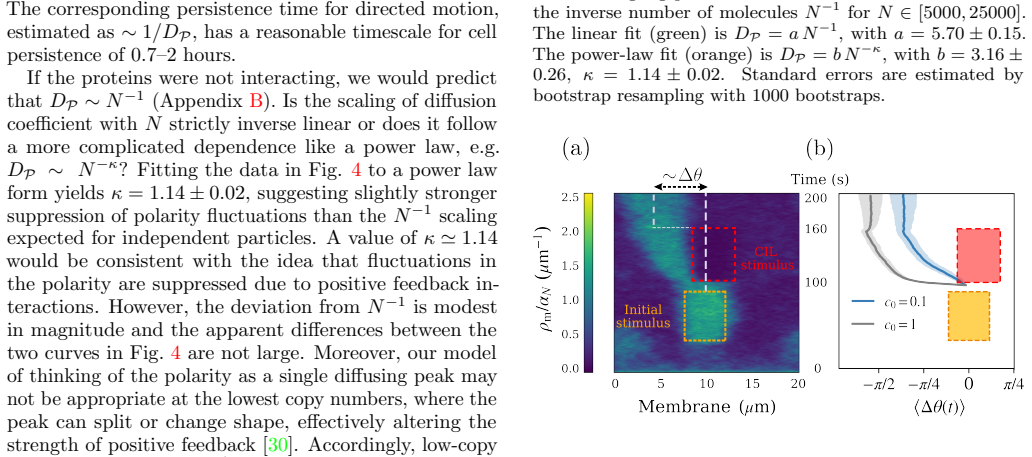
When cells collide, they often exhibit "contact inhibition of locomotion" (CIL), a behavior in which cells repolarize and migrate away from the site of contact. Experimental CIL outcomes are highly variable - why? Here, we develop a minimal stochastic model to quantify how intrinsic noise in cell polarity, arising from the finite number of signaling molecules, influences CIL decision-making. We simulate polarization dynamics by tracking individual Rho GTPase proteins that diffuse and switch stochastically between the cell membrane and cytosol. In the absence of cell-cell contact, the polarity axis diffuses rotationally - the cell's orientation wanders - with a diffusion coefficient that decreases as Rho GTPase copy number increases. Assuming that cell-cell contact inhibits Rho GTPase activation, we investigate how contact geometry, duration, and strength affect CIL sensitivity. At low protein copy number, weak, brief, or spatially narrow contacts are masked by molecular noise. In contrast, at high protein copy number, intrinsic polarity noise is negligible, and randomness in CIL response is more likely to reflect the variability from collision to collision in the cell-cell contact properties.
Editorial analysis
A structured set of objections, weighed in public.
Referee Report
Summary. The manuscript develops a minimal stochastic model of Rho GTPase dynamics to investigate the role of intrinsic molecular noise in contact inhibition of locomotion (CIL). By simulating diffusion and stochastic switching of individual proteins between membrane and cytosol, the authors show that the polarity axis undergoes rotational diffusion whose coefficient decreases with increasing copy number. Under the assumption that cell-cell contact inhibits Rho GTPase activation, they demonstrate that at low copy numbers, weak or brief contacts are masked by noise, whereas at high copy numbers, CIL variability arises primarily from collision-to-collision differences in contact properties.
Significance. If the results hold, this provides a mechanistic explanation for CIL variability grounded in finite-number fluctuation scaling, a standard feature of stochastic chemical kinetics. The minimal model and direct stochastic simulation are strengths, allowing the distinction between intrinsic polarity noise and contact variability to be attributed cleanly to copy-number effects without extraneous parameters. This offers falsifiable predictions for experiments that vary Rho GTPase expression levels while controlling contact geometry.
minor comments (3)
- [Abstract] The abstract states that 'we simulate polarization dynamics by tracking individual Rho GTPase proteins that diffuse and switch stochastically' but does not name the numerical integrator or time-stepping scheme; adding this (e.g., in the Model section) would strengthen reproducibility claims.
- [Model] The implementation of spatially narrow contacts and the precise functional form of inhibition (e.g., local reduction in activation rate) should be stated explicitly, perhaps with a supplementary equation or schematic, to confirm that the reported masking effect at low copy number is not an artifact of discretization.
- [Results] Parameter values for diffusion coefficients, switching rates, and contact duration are listed as free but not tabulated; a short table of baseline values used for the figures would allow readers to assess sensitivity.
Simulated Author's Rebuttal
We thank the referee for their positive assessment of the manuscript and for recommending minor revision. The referee's summary accurately describes our minimal stochastic model of Rho GTPase dynamics and its implications for CIL variability at different copy numbers. As no specific major comments were raised in the report, we have no points requiring rebuttal or revision at this stage.
Circularity Check
No significant circularity; results follow from direct stochastic simulation
full rationale
The paper builds a minimal stochastic model tracking individual Rho GTPase proteins that diffuse and switch between membrane and cytosol, then runs direct simulations of polarization dynamics and CIL responses under the explicit input assumption that cell-cell contact inhibits Rho GTPase activation. The central claims about noise masking at low copy number versus contact variability at high copy number emerge from standard finite-number fluctuation scaling in the described dynamics, without any fitting of parameters to target CIL statistics, self-definitional equations, or load-bearing self-citations. The derivation chain is self-contained against external benchmarks and does not reduce any prediction to its inputs by construction.
Axiom & Free-Parameter Ledger
free parameters (2)
- Rho GTPase copy number
- contact inhibition strength and duration
axioms (2)
- domain assumption Cell-cell contact inhibits Rho GTPase activation
- standard math Rho GTPases diffuse and switch stochastically between membrane and cytosol
Reference graph
Works this paper leans on
-
[1]
Polarity peak stability as a function of copy number N The emergence and long-term persistence of a stable polarity to the cell depend strongly on the total copy number N (Fig. 3). At low copy number, N ∼ 2 × 10³ molecules, no stable polarization peak persists once the initial cue c(i)(x) is removed; instead, multiple transient peaks appear along the memb...
-
[2]
Diffusion of the polarity peak at finite copy number We expect that, in the absence of CIL, the persistence of motion in migrating cells is governed by the protein concentration dynamics shown in the kymographs in Fig
-
[3]
These fluctuations would then be captured by the diffusion coefficient of the polarization vector, DP [17]
For sufficiently large N, the system forms a clearly po- larized state — a single peak of high protein concentration whose center of mass performs an unbiased random walk along the cell perimeter. These fluctuations would then be captured by the diffusion coefficient of the polarization vector, DP [17]. To compute DP, we evaluate the mean-squared angu- la...
-
[4]
We therefore quantify the CIL response by comparing the distributions P (∆θ) with and without CIL across different contact parameters (Fig
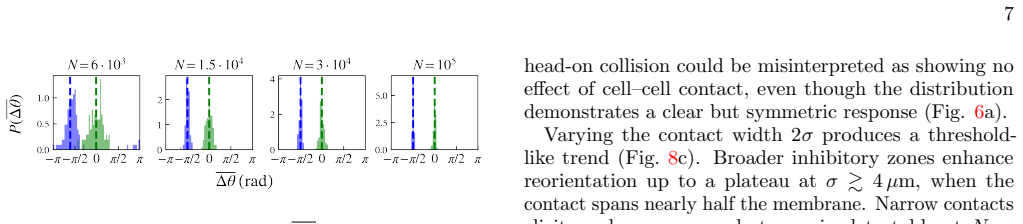
Distribution of cell reorientation angles in the stochastic model Given a cell–cell contact, how much does a cell reorient? Unlike the deterministic model, which predicts a single rotation angle, stochastic simulations at finite N yield a distribution of reorientation angles P (∆θ). We therefore quantify the CIL response by comparing the distributions P (...
-
[5]
Mean angular response across contact parameters How much, on average, does a cell–cell contact reorient a cell? How does this depend on the parameters control- ling cell–cell contact, and is the average response simply given by the original deterministic wave-pinning model? We compute the ensemble-averaged reorientation angle 7 FIG. 7. Probability distrib...
-
[6]
(20) Here ⟨∆θ⟩CIL and ⟨∆θ⟩free are the ensemble-averaged reorientation angles with and without CIL, respectively (Eq
Cell sensitivity to CIL stimuli How reliably can a cell distinguish a contact event from spontaneous reorientation? We quantify this contact sen- sitivity using a signal-to-noise ratio (SNR) as a heuristic separability metric, SNR = ⟨∆θ⟩free − ⟨∆θ⟩CIL 2 δ 2 free + δ 2 CIL . (20) Here ⟨∆θ⟩CIL and ⟨∆θ⟩free are the ensemble-averaged reorientation angles with...
-
[7]
We test this by computing ⟨∆θ⟩ for N = 10 3–105 at fixed contact parameters
Convergence of the stochastic model to the deterministic limit ( N → ∞) We expect that the average CIL response of our stochas- tic model should approach the deterministic prediction in the limit of a large number of proteins. We test this by computing ⟨∆θ⟩ for N = 10 3–105 at fixed contact parameters. As shown in Fig. 10, the mean angular re- orentation ...
-
[8]
contact noise
Acceleration vector analysis of CIL responses One of the standard tools used to quantify cell–cell collisions and infer the presence of contact inhibition in two-dimensional assays is to compute the acceleration of a cell in response to contact [ 4, 7, 46]. Experiments show that in cell types that exhibit CIL, acceleration during collisions is on average ...
-
[9]
Abercrombie and J
M. Abercrombie and J. E. Heaysman, Observations on the social behaviour of cells in tissue culture, Experimental Cell Research 6, 293–306 (1954)
1954
-
[10]
Theveneau and R
E. Theveneau and R. Mayor, Can mesenchymal cells undergo collective cell migration? the case of the neural crest: The case of the neural crest, Cell Adhesion & Migration 5, 490–498 (2011)
2011
-
[11]
Stramer and R
B. Stramer and R. Mayor, Mechanisms and in vivo func- tions of contact inhibition of locomotion, Nature Reviews Molecular Cell Biology 18, 43–55 (2016)
2016
-
[12]
Theveneau, L
E. Theveneau, L. Marchant, S. Kuriyama, M. Gull, B. Moepps, M. Parsons, and R. Mayor, Collective chemo- taxis requires contact-dependent cell polarity, Develop- mental Cell 19, 39–53 (2010)
2010
-
[13]
Abercrombie, Contact inhibition and malignancy, Na- ture 281, 259 (1979)
M. Abercrombie, Contact inhibition and malignancy, Na- ture 281, 259 (1979)
1979
-
[14]
J. W. Astin, J. Batson, S. Kadir, J. Charlet, R. A. Persad, D. Gillatt, J. D. Oxley, and C. D. Nobes, Competition amongst Eph receptors regulates contact inhibition of lo- comotion and invasiveness in prostate cancer cells, Nature Cell Biology 12, 1194 (2010)
2010
-
[15]
Carmona-Fontaine, H
C. Carmona-Fontaine, H. K. Matthews, S. Kuriyama, M. Moreno, G. A. Dunn, M. Parsons, C. D. Stern, and R. Mayor, Contact inhibition of locomotion in vivo controls neural crest directional migration, Nature 456, 957–961 (2008)
2008
-
[16]
Roycroft and R
A. Roycroft and R. Mayor, Molecular basis of contact inhi- bition of locomotion, Cellular and Molecular Life Sciences 73, 1119–1130 (2015)
2015
-
[17]
Poliakov, M
A. Poliakov, M. Cotrina, and D. G. Wilkinson, Diverse roles of eph receptors and ephrins in the regulation of cell migration and tissue assembly, Developmental Cell 7, 465–480 (2004)
2004
-
[18]
Scarpa and R
E. Scarpa and R. Mayor, Collective cell migration in development, Journal of Cell Biology 212, 143–155 (2016)
2016
-
[19]
Mayor and C
R. Mayor and C. Carmona-Fontaine, Keeping in touch with contact inhibition of locomotion, Trends in Cell Biology 20, 319–328 (2010)
2010
-
[20]
Scarpa, A
E. Scarpa, A. Roycroft, E. Theveneau, E. Terriac, M. Piel, and R. Mayor, A novel method to study contact inhibition of locomotion using micropatterned substrates, Biology Open 2, 901–906 (2013)
2013
-
[21]
J. Singh, A. Pagulayan, B. A. Camley, and A. S. Nain, Rules of contact inhibition of locomotion for cells on sus- pended nanofibers, Proceedings of the National Academy of Sciences 118, 10.1073/pnas.2011815118 (2021)
-
[22]
J. R. Davis, A. Luchici, F. Mosis, J. Thackery, J. A. Salazar, Y. Mao, G. A. Dunn, T. Betz, M. Miodownik, and B. M. Stramer, Inter-cellular forces orchestrate contact inhibition of locomotion, Cell 161, 361–373 (2015)
2015
-
[23]
J. E. Ladbury and S. T. Arold, Noise in cellular signal- ing pathways: causes and effects, Trends in Biochemical Sciences 37, 173–178 (2012)
2012
-
[24]
W. Wang and B. A. Camley, Limits on the accuracy of contact inhibition of locomotion, Physical Review E 109, 10.1103/physreve.109.054408 (2024)
-
[25]
B. A. Camley, Y. Zhang, Y. Zhao, B. Li, E. Ben-Jacob, H. Levine, and W.-J. Rappel, Polarity mechanisms such as contact inhibition of locomotion regulate persistent rotational motion of mammalian cells on micropatterns, Proceedings of the National Academy of Sciences 111, 14770–14775 (2014)
2014
-
[26]
D. A. Kulawiak, B. A. Camley, and W.-J. Rappel, Mod- eling contact inhibition of locomotion of colliding cells migrating on micropatterned substrates, PLOS Computa- tional Biology 12, e1005239 (2016)
2016
-
[27]
Merchant, L
B. Merchant, L. Edelstein-Keshet, and J. J. Feng, A rho-gtpase based model explains spontaneous collective migration of neural crest cell clusters, Developmental Biology 444, S262 (2018)
2018
-
[28]
Y. Luo, A. S. Nain, and B. A. Camley, Cell mechanics, environmental geometry, and cell polarity control cell-cell collision outcomes, Soft Matter 21, 7074 (2025)
2025
-
[29]
S. K. Schnyder, J. J. Molina, Y. Tanaka, and R. Ya- mamoto, Collective motion of cells crawling on a substrate: roles of cell shape and contact inhibition, Scientific Re- ports 7, 10.1038/s41598-017-05321-0 (2017)
-
[30]
Smeets, R
B. Smeets, R. Alert, J. Peˇ sek, I. Pagonabarraga, H. Ra- mon, and R. Vincent, Emergent structures and dynam- ics of cell colonies by contact inhibition of locomotion, Proceedings of the National Academy of Sciences 113, 14621–14626 (2016)
2016
-
[31]
B. A. Camley, J. Zimmermann, H. Levine, and W.-J. Rappel, Emergent collective chemotaxis without single- cell gradient sensing, Physical Review Letters 116, 098101 (2016)
2016
-
[32]
Zimmermann, B
J. Zimmermann, B. A. Camley, W.-J. Rappel, and H. Levine, Contact inhibition of locomotion determines cell–cell and cell–substrate forces in tissues, Proceedings of the National Academy of Sciences 113, 2660–2665 (2016)
2016
-
[33]
J. R. Davis, C.-Y. Huang, J. Zanet, S. Harrison, E. Ros- ten, S. Cox, D. Y. Soong, G. A. Dunn, and B. M. Stramer, Emergence of embryonic pattern through contact inhibi- tion of locomotion, Development 139, 4555 (2012)
2012
-
[34]
J. E. Ron, J. d’Alessandro, V. Cellerin, R. Voituriez, B. Ladoux, and N. S. Gov, Polarization and motility of one-dimensional multi-cellular trains, Biophysical Journal 122, 4598–4613 (2023)
2023
-
[35]
Levandosky and C
K. Levandosky and C. Copos, Model supports asymmet- ric regulation across the intercellular junction for collec- tive cell polarization, PLOS Computational Biology 20, e1012216 (2024)
2024
-
[36]
Y. Mori, A. Jilkine, and L. Edelstein-Keshet, Wave- pinning and cell polarity from a bistable reaction- diffusion system, Biophysical Journal 94, 10.1529/bio- physj.107.120824 (2008)
-
[37]
Y. Mori, A. Jilkine, and L. Edelstein-Keshet, Asymptotic and bifurcation analysis of wave-pinning in a reaction- diffusion model for cell polarization, SIAM Journal on Applied Mathematics 71, 1401 (2011)
2011
-
[38]
G. R. Walther, A. F. M. Mar´ ee, L. Edelstein-Keshet, and V. A. Grieneisen, Deterministic versus stochastic cell po- larisation through wave-pinning, Bulletin of Mathematical Biology 10.1007/s11538-012-9766-5 (2012)
-
[39]
Etienne-Manneville and A
S. Etienne-Manneville and A. Hall, Rho GTPases in cell biology, Nature 420, 629–635 (2002)
2002
-
[40]
B. A. Camley and W.-J. Rappel, Physical models of collective cell motility: from cell to tissue, Journal of Physics D: Applied Physics 50, 113002 (2017)
2017
-
[41]
A. R. Singh, T. Leadbetter, and B. A. Camley, Sensing the shape of a cell with reaction diffusion and energy minimization, Proceedings of the National Academy of 12 Sciences 119, e2121302119 (2022)
2022
-
[42]
Jilkine and L
A. Jilkine and L. Edelstein-Keshet, A comparison of math- ematical models for polarization of single eukaryotic cells in response to guided cues, PLoS Computational Biology 7, e1001121 (2011)
2011
-
[43]
A. Buttensch¨ on and L. Edelstein-Keshet, Cell repolariza- tion: A bifurcation study of spatio-temporal perturba- tions of polar cells, Bulletin of Mathematical Biology 84, 10.1007/s11538-022-01053-z (2022)
-
[44]
N. G. Van Kampen, Stochastic processes in physics and chemistry, Elsevier 1 (1992)
1992
-
[45]
B. A. Camley, Y. Zhao, B. Li, H. Levine, and W.-J. Rappel, Crawling and turning in a minimal reaction- diffusion cell motility model: Coupling cell shape and biochemistry, Phys. Rev. E 95, 012401 (2017)
2017
-
[46]
B. A. Camley, Y. Zhao, B. Li, H. Levine, and W.-J. Rappel, Periodic migration in a physical model of cells on micropatterns, Phys. Rev. Lett. 111, 158102 (2013)
2013
-
[47]
B. Hu, W. Chen, W.-J. Rappel, and H. Levine, Physical limits on cellular sensing of spatial gradients, Physical review letters 105, 048104 (2010)
2010
-
[48]
B. Hu, W. Chen, W.-J. Rappel, and H. Levine, How ge- ometry and internal bias affect the accuracy of eukaryotic gradient sensing, Physical Review E—Statistical, Nonlin- ear, and Soft Matter Physics 83, 021917 (2011)
2011
-
[49]
Nwogbaga, A
I. Nwogbaga, A. H. Kim, and B. A. Camley, Physical limits on galvanotaxis, Physical Review E 108, 064411 (2023)
2023
-
[50]
Nwogbaga and B
I. Nwogbaga and B. A. Camley, Cell shape and orienta- tion control galvanotactic accuracy, Soft Matter 20, 8866 (2024)
2024
-
[51]
Nwogbaga, N
I. Nwogbaga, N. M. Belliveau, A. R. Singh, D. Sun, N. Mu- lenga, J. A. Theriot, and B. A. Camley, Protein diffusion controls how single cells respond to electric fields, bioRxiv , 2025 (2025)
2025
-
[52]
C. R. Harris, K. J. Millman, S. J. van der Walt, R. Gom- mers, P. Virtanen, D. Cournapeau, E. Wieser, J. Tay- lor, S. Berg, N. J. Smith, R. Kern, M. Picus, S. Hoyer, M. H. van Kerkwijk, M. Brett, A. Haldane, J. F. del R´ ıo, M. Wiebe, P. Peterson, P. G´ erard-Marchant, K. Sheppard, T. Reddy, W. Weckesser, H. Abbasi, C. Gohlke, and T. E. Oliphant, Array pr...
2020
-
[53]
Copos and A
C. Copos and A. Mogilner, A hybrid stochas- tic–deterministic mechanochemical model of cell polariza- tion, Molecular Biology of the Cell 31, 1637–1649 (2020)
2020
-
[54]
G. A. Dunn and S. W. Paddock, Analysing the motile be- haviour of cells: a general approach with special reference to pairs of cells in collision, Philosophical Transactions of the Royal Society of London. B, Biological Sciences 299, 147–157 (1982)
1982
-
[55]
S. J. Altschuler, S. B. Angenent, Y. Wang, and L. F. Wu, On the spontaneous emergence of cell polarity, Nature 454, 886–889 (2008)
2008
-
[56]
N. A. Kulak, G. Pichler, I. Paron, N. Nagaraj, and M. Mann, Minimal, encapsulated proteomic-sample pro- cessing applied to copy-number estimation in eukaryotic cells, Nature Methods 11, 319–324 (2014)
2014
-
[57]
J. H. Kang, T. P. Miettinen, L. Chen, S. Olcum, G. Kat- sikis, P. S. Doyle, and S. R. Manalis, Noninvasive monitor- ing of single-cell mechanics by acoustic scattering, Nature Methods 16, 263–269 (2019)
2019
-
[58]
I. A. Hatton, E. D. Galbraith, N. S. C. Merleau, T. P. Miettinen, B. M. Smith, and J. A. Shander, The human cell count and size distribution, Proceedings of the Na- tional Academy of Sciences120, 10.1073/pnas.2303077120 (2023)
-
[59]
Milo, What is the total number of protein molecules per cell volume? a call to rethink some published values, BioEssays 35, 1050–1055 (2013)
R. Milo, What is the total number of protein molecules per cell volume? a call to rethink some published values, BioEssays 35, 1050–1055 (2013)
2013
-
[60]
Sorkin and H
B. Sorkin and H. Diamant, Persistent collective motion of a dispersing membrane domain, Biophysical Journal 120, 2030–2039 (2021)
2030
-
[61]
M. H. Gail and C. W. Boone, The locomotion of mouse fibroblasts in tissue culture, Biophysical Journal 10, 980–993 (1970)
1970
-
[62]
P.-H. Wu, A. Giri, S. X. Sun, and D. Wirtz, Three- dimensional cell migration does not follow a random walk, Proceedings of the National Academy of Sciences 111, 3949–3954 (2014)
2014
-
[63]
S. A. Ramirez, M. Pablo, S. Burk, D. J. Lew, and T. C. Elston, A novel stochastic simulation approach enables exploration of mechanisms for regulating polarity site movement, PLOS Computational Biology 17, e1008525 (2021)
2021
-
[64]
R. M. Crossley and S. F. Martina-Perez, Electrotaxis dis- rupts patterns of cell-cell interactions of human corneal ep- ithelial cells in vitro, Biophysical Journal 124, 1245–1254 (2025)
2025
-
[65]
T. P. Prescott, K. Zhu, M. Zhao, and R. E. Baker, Quan- tifying the impact of electric fields on single-cell motility, Biophysical Journal 120, 3363–3373 (2021)
2021
-
[66]
D. B. Br¨ uckner, N. Arlt, A. Fink, P. Ronceray, J. O. R¨ adler, and C. P. Broedersz, Learning the dynamics of cell– cell interactions in confined cell migration, Proceedings of the National Academy of Sciences 118, e2016602118 (2021)
2021
-
[67]
LaBelle, T
J. LaBelle, T. Wyatt, J. Ramirez, and S. Woo, En- dodermal cells use contact inhibition of locomotion to achieve uniform cell dispersal during zebrafish gastrula- tion, Iscience 28 (2025). Appendix A: The choice of the time step for stochastic and deterministic simulations. In our stochastic model, ∆ t is required to satisfy two conditions: (i) the probab...
2025
discussion (0)
Sign in with ORCID, Apple, or X to comment. Anyone can read and Pith papers without signing in.