Recognition: unknown
Revisiting the distance and the globular cluster system of the remarkable galaxy UDG1 in the NGC 5846 group
Pith reviewed 2026-05-10 02:51 UTC · model grok-4.3
The pith
A new distance of 26.5 Mpc places NGC5846_UDG1 inside the NGC 5846 group and shows its globular cluster system totals around 50.
A machine-rendered reading of the paper's core claim, the machinery that carries it, and where it could break.
Core claim
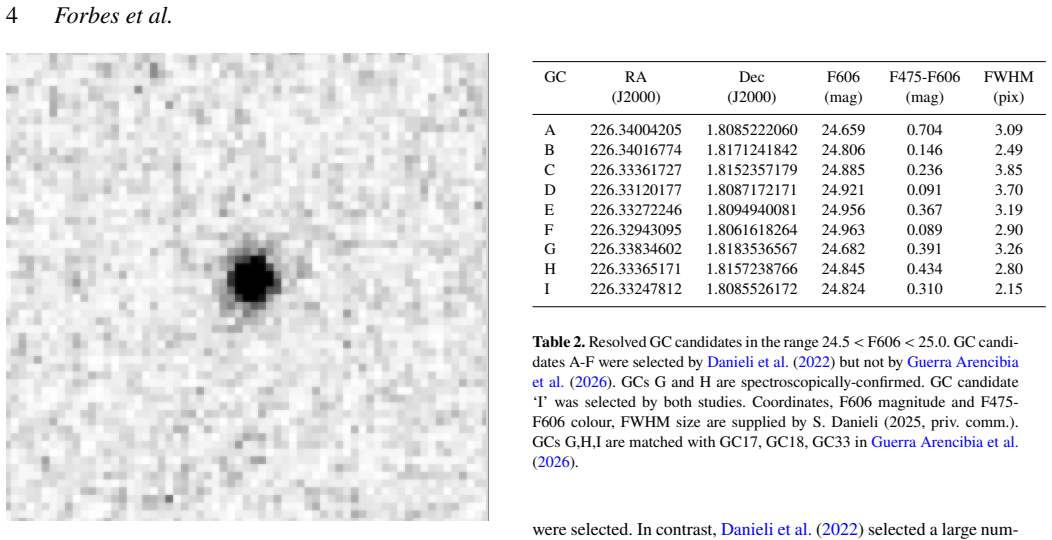
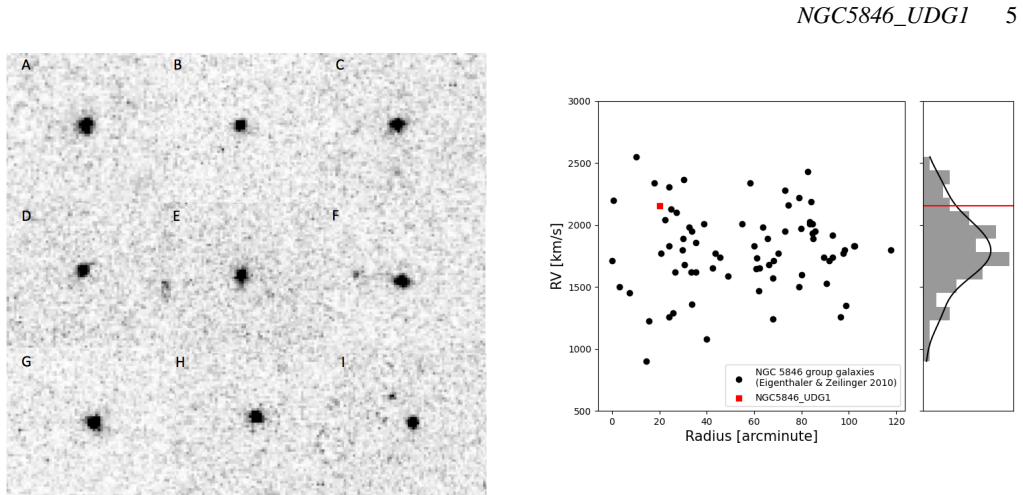
Using HST/ACS imaging we measure a surface brightness fluctuation distance of 26.5 ± 2.7 Mpc for NGC5846_UDG1, placing it inside the NGC 5846 group. When the standard practice of counting only globular clusters brighter than the turnover magnitude is applied, the two previous HST/WFC3 studies become fully consistent with each other and both indicate a total globular cluster population of around 50. This count corresponds to a halo mass exceeding 10^11 solar masses. Six objects of intermediate magnitude are confirmed as associated globular clusters on the basis of their magnitudes, sizes and nearly round appearances.
What carries the argument
Surface brightness fluctuation distance measurement together with the turnover-magnitude cutoff for globular cluster counting.
If this is right
- NGC5846_UDG1 belongs to the NGC 5846 group rather than lying in the field.
- The galaxy hosts one of the richer globular cluster systems known among ultra-diffuse galaxies.
- Its inferred halo mass exceeds 10^11 solar masses.
- Several disputed intermediate-magnitude candidates qualify as genuine globular clusters.
Where Pith is reading between the lines
- Rich globular cluster populations may be more common among group-member ultra-diffuse galaxies than among isolated ones.
- Restricting counts to bright globular clusters could resolve similar discrepancies reported for other ultra-diffuse galaxies.
- The result supplies a concrete test case for models that link globular cluster number directly to halo mass in low-surface-brightness systems.
Load-bearing premise
The surface brightness fluctuation distance is accurate and free of significant systematic bias for this low-surface-brightness galaxy, and counting only globular clusters brighter than the turnover magnitude captures the full population without substantial incompleteness or contamination.
What would settle it
An independent distance measurement, for example from the tip of the red giant branch, that places NGC5846_UDG1 well outside the NGC 5846 group at a distance differing by more than the stated uncertainty.
Figures



read the original abstract
Two studies that utilised the same HST/WFC3 imaging of NGC5846_UDG1 have reported quite different total counts for its globular cluster (GC) system, i.e. 54 $\pm$ 9 vs 33 $\pm$ 3 GCs. In both cases they counted all GCs, that met their selection criteria, down to the faintest magnitudes. They also disagree as to whether NGC5846_UDG1 lies in the NGC 5846 group or well outside the group, in the field. As an ultra diffuse galaxy with one of the richest GC systems known, and therefore implications for its halo mass, it is important to understand which of these is closer to the truth. Here we present a new SBF-based distance to NGC5846_UDG1 from HST/ACS imaging of 26.5 $\pm$ 2.7 Mpc, which places it squarely within the NGC 5846 group. Using this distance we adopt the standard approach of only counting GCs brighter than the turnover magnitude. This has the advantage of considering only the brighter GCs which are resolved in HST imaging and largely confirmed by spectroscopy, while also avoiding the fainter candidates for which contamination is potentially an issue. With this robust approach we find that the two studies are entirely consistent with each other. Both imply a total GC system of around 50 GCs and by inference a massive galaxy halo of greater than 10$^{11}$ M$_{\odot}$. We also revisit the two previous photometric studies focusing on half a dozen intermediate magnitude objects that are selected by one study but excluded by the other. These objects have GC-like magnitudes, sizes and are nearly round with GC-like appearances. They are very unlikely to be background galaxies or interloper GCs and thus bona fide GCs associated with NGC5846_UDG1.
Editorial analysis
A structured set of objections, weighed in public.
Referee Report
Summary. The paper reports a new SBF distance of 26.5 ± 2.7 Mpc to the ultra-diffuse galaxy NGC5846_UDG1 from HST/ACS imaging, placing it within the NGC 5846 group. Using this distance, the authors apply the standard method of counting only GCs brighter than the turnover magnitude to reconcile two prior studies that reported discrepant total GC counts (54 ± 9 vs. 33 ± 3). They conclude both studies are consistent with a total of ~50 GCs, implying a halo mass >10^11 M_⊙, and argue that disputed intermediate-magnitude objects are bona fide GCs based on their magnitudes, sizes, and morphologies.
Significance. If the SBF distance holds, the work resolves an important discrepancy in GC counts for a notable UDG, supporting the presence of a rich GC system and massive halo. This has implications for UDG formation scenarios and demonstrates the value of new imaging to re-examine prior photometry. The adoption of the turnover cutoff is a standard, robust approach that avoids faint-end contamination issues.
major comments (2)
- [SBF distance measurement] The SBF distance section: the quoted total uncertainty of ±2.7 Mpc does not include an explicit assessment of potential systematic biases arising from the low surface brightness and possible differences in stellar population (age, [Fe/H], horizontal-branch morphology) relative to SBF calibrators. A shift of ~1.5–2 Mpc would change the apparent turnover magnitude by ~0.15–0.2 mag, altering which intermediate-magnitude objects are counted above turnover and undermining the claimed consistency at ~50 total GCs.
- [GC population analysis] The GC counting and reconciliation section: the statement that both prior studies imply ~50 GCs after applying the turnover cutoff lacks a quantitative table or explicit object-by-object comparison at the new distance, including how the six disputed intermediate-magnitude candidates are assigned and any completeness corrections for the brighter sample.
minor comments (2)
- The galaxy name alternates between UDG1 and NGC5846_UDG1; adopt a single consistent designation throughout the text, tables, and figures.
- [Abstract] The abstract would benefit from a brief mention of the previous distance estimates that led to the group vs. field discrepancy.
Simulated Author's Rebuttal
We thank the referee for their positive evaluation of the significance of our work and for the constructive major comments. We address each point below and agree that incorporating additional discussion of SBF systematics and a quantitative comparison table will strengthen the manuscript. These changes will be included in the revised version.
read point-by-point responses
-
Referee: The SBF distance section: the quoted total uncertainty of ±2.7 Mpc does not include an explicit assessment of potential systematic biases arising from the low surface brightness and possible differences in stellar population (age, [Fe/H], horizontal-branch morphology) relative to SBF calibrators. A shift of ~1.5–2 Mpc would change the apparent turnover magnitude by ~0.15–0.2 mag, altering which intermediate-magnitude objects are counted above turnover and undermining the claimed consistency at ~50 total GCs.
Authors: We thank the referee for this important observation on the SBF uncertainty. The quoted ±2.7 Mpc represents the total uncertainty from our standard SBF pipeline analysis. We agree that an explicit assessment of additional systematics from the galaxy's low surface brightness and potential stellar population differences (relative to calibrators) would improve the section. In the revision we will add a dedicated paragraph quantifying these effects using literature estimates for SBF biases in metal-poor systems (typically ≲0.1 mag). We have performed a sensitivity test: even allowing a 2 Mpc shift (∼0.2 mag in distance modulus), the bright GC sample above turnover remains consistent between the two studies at ∼50 members, because the six disputed objects lie well above the adjusted turnover. This test will be included to demonstrate that the conclusion is robust. revision: yes
-
Referee: The GC counting and reconciliation section: the statement that both prior studies imply ~50 GCs after applying the turnover cutoff lacks a quantitative table or explicit object-by-object comparison at the new distance, including how the six disputed intermediate-magnitude candidates are assigned and any completeness corrections for the brighter sample.
Authors: We agree that an explicit quantitative comparison would enhance clarity and transparency. In the revised manuscript we will insert a new table that lists all GC candidates from both prior studies, with magnitudes recomputed at the new SBF distance, an indication of whether each lies above the turnover, and notes on inclusion/exclusion. The six disputed intermediate-magnitude objects will be highlighted; all are brighter than the turnover at 26.5 Mpc and exhibit GC-like sizes, round morphologies, and colors. Because the analysis is restricted to the bright end (above turnover), both samples are highly complete in the HST data; we will state this explicitly and note that no significant completeness corrections are required for these luminous objects. This addition will make the reconciliation to ∼50 GCs fully quantitative. revision: yes
Circularity Check
No significant circularity: independent SBF distance anchors standardized GC count
full rationale
The paper's chain begins with a new distance measurement (26.5 ± 2.7 Mpc) obtained from fresh HST/ACS imaging via the surface-brightness-fluctuation method. This distance is independent of the two prior GC catalogs under reconciliation. It is then used only to convert the standard absolute turnover magnitude into an apparent-magnitude limit, after which the authors re-examine a handful of disputed intermediate-magnitude objects on morphological and photometric grounds. No equation or step defines the final GC total (~50) or halo-mass inference in terms of a parameter fitted to the same data; the turnover limit is taken from the literature rather than solved from the present photometry. Self-citations, if present, are not load-bearing for the distance or the counting procedure. The derivation therefore remains self-contained against external benchmarks.
Axiom & Free-Parameter Ledger
axioms (2)
- domain assumption Surface brightness fluctuation method yields an accurate distance for low-surface-brightness galaxies such as NGC5846_UDG1
- domain assumption Globular cluster luminosity function has a well-defined turnover magnitude that can be used to count the total population without significant bias from incompleteness or contamination
Reference graph
Works this paper leans on
-
[1]
The Dependence of Globular Cluster Number on Density for Abell Cluster Central Galaxies. , keywords =. doi:10.1086/310653 , archivePrefix =. astro-ph/9703099 , primaryClass =
-
[2]
Major Mergers Mean Major Offset: Drivers of Intrinsic Scatter in the M _ GCS ─M _ h Scaling Relation for Massive Elliptical Galaxies. , keywords =. doi:10.3847/1538-4357/ade05e , archivePrefix =. 2505.24154 , primaryClass =
-
[3]
S., Ferré-Mateu, A., & Forbes, D
The Dawes Review: A Decade of Ultra-Diffuse Galaxies. arXiv e-prints , keywords =. doi:10.48550/arXiv.2602.21875 , archivePrefix =. 2602.21875 , primaryClass =
-
[4]
Stellar Candles for the Extragalactic Distance Scale , year = 2003, editor =
The Globular Cluster Luminosity Function: New Progress in Understanding an Old Distance Indicator. Stellar Candles for the Extragalactic Distance Scale , year = 2003, editor =. doi:10.1007/978-3-540-39882-0_15 , publisher =
-
[5]
The mysterious globular cluster population of MATLAS-2019. , keywords =. doi:10.1051/0004-6361/202557231 , archivePrefix =. 2512.09990 , primaryClass =
-
[6]
Transformation of HST WFC3/UVIS Filters to the Standard BVI System. , keywords =. doi:10.3847/1538-3881/aaedb8 , adsurl =
-
[7]
The Propagation of Uncertainties in Stellar Population Synthesis Modeling. I. The Relevance of Uncertain Aspects of Stellar Evolution and the Initial Mass Function to the Derived Physical Properties of Galaxies. , keywords =. doi:10.1088/0004-637X/699/1/486 , archivePrefix =. 0809.4261 , primaryClass =
work page internal anchor Pith review Pith/arXiv arXiv doi:10.1088/0004-637x/699/1/486
-
[8]
Calibration of Surface Brightness Fluctuations for Dwarf Galaxies in the Hyper Suprime-Cam gi Filter System. , keywords =. doi:10.3847/1538-4357/ac2d94 , archivePrefix =. 2110.02522 , primaryClass =
-
[9]
Detailed Structural Decomposition of Galaxy Images. , keywords =. doi:10.1086/340952 , archivePrefix =. astro-ph/0204182 , primaryClass =
-
[10]
2001, MNRAS, 322, 231, doi: 10.1046/j.1365-8711.2001.04022.x
A synthesis of data from fundamental plane and surface brightness fluctuation surveys. , keywords =. doi:10.1046/j.1365-8711.2001.04800.x , archivePrefix =. astro-ph/0108194 , primaryClass =
-
[11]
The ACS Virgo Cluster Survey. X. Half-Light Radii of Globular Clusters in Early-Type Galaxies: Environmental Dependencies and a Standard Ruler for Distance Estimation. , keywords =. doi:10.1086/497092 , archivePrefix =. astro-ph/0508219 , primaryClass =
-
[12]
Galaxy Groups Within 3500 km s ^ -1. , keywords =. doi:10.3847/1538-4357/aa76db , archivePrefix =. 1705.08068 , primaryClass =
-
[13]
Revisiting the low-luminosity galaxy population of the NGC 5846 group with SDSS. , keywords =. doi:10.1051/0004-6361/200811013 , archivePrefix =. 0911.5119 , primaryClass =
-
[14]
, keywords =
The ellipticities of globular clusters in the Andromeda galaxy. , keywords =
-
[15]
Extragalactic Globular Clusters and Galaxy Formation. , keywords =. doi:10.1146/annurev.astro.44.051905.092441 , archivePrefix =. astro-ph/0602601 , primaryClass =
-
[16]
Investigating the Ultra-diffuse Galaxy NGC5846\_UDG1 through the Kinematics of its Rich Globular Cluster System. , keywords =. doi:10.1093/mnras/staf559 , archivePrefix =. 2504.03132 , primaryClass =
-
[17]
The NGC 5846 Group: Dynamics and the Luminosity Function to M _ R =-12. , keywords =. doi:10.1086/444560 , archivePrefix =. astro-ph/0506737 , primaryClass =
-
[18]
Connection Between Dwarf Galaxies and Globular Clusters: Insights from the Perseus Cluster Using Subaru Imaging and Keck Spectroscopy. arXiv e-prints , keywords =. doi:10.48550/arXiv.2512.11070 , archivePrefix =. 2512.11070 , primaryClass =
-
[19]
Properties of Nuclear Star Clusters in Low Surface Brightness Galaxies. , keywords =. doi:10.3847/1538-3881/ad4ed3 , archivePrefix =. 2405.14948 , primaryClass =
-
[20]
A Cosmic Miracle: A Remarkably Luminous Galaxy at z_ spec =14.44 Confirmed with JWST. arXiv e-prints , keywords =. doi:10.48550/arXiv.2505.11263 , archivePrefix =. 2505.11263 , primaryClass =
-
[21]
Time to Sparkler: Accurate ages of lensed globular clusters at z = 1.4 with JWST photometry. , keywords =. doi:10.1051/0004-6361/202453368 , archivePrefix =. 2412.06903 , primaryClass =
-
[22]
The ACS Virgo Cluster Survey. XV. The Formation Efficiencies of Globular Clusters in Early-Type Galaxies: The Effects of Mass and Environment. , keywords =. doi:10.1086/587951 , archivePrefix =. 0803.0330 , primaryClass =
-
[23]
The Disturbed and Globular-cluster-rich Ultradiffuse Galaxy UGC 9050-Dw1. , keywords =. doi:10.3847/2041-8213/acf0c3 , archivePrefix =. 2306.06164 , primaryClass =
-
[24]
Star formation at the edge of the Local Group: a rising star formation history in the isolated galaxy WLM. , keywords =. doi:10.1093/mnras/stz2903 , archivePrefix =. 1909.04040 , primaryClass =
-
[25]
Clues from FCC 224, NGC 1052-DF2, and NGC 1052-DF4
A new class of dark matter-free dwarf galaxies?: I. Clues from FCC 224, NGC 1052-DF2, and NGC 1052-DF4. , keywords =. doi:10.1051/0004-6361/202453522 , archivePrefix =. 2502.05405 , primaryClass =
-
[26]
JWST Spectroscopic Confirmation of the Cosmic Gems Arc at z=9.625 -- Insights into the small scale structure of a post-burst system. arXiv e-prints , keywords =. doi:10.48550/arXiv.2507.18705 , archivePrefix =. 2507.18705 , primaryClass =
-
[27]
Do ultra-diffuse galaxies follow the globular cluster halo mass relation?. , keywords =. doi:10.1093/mnrasl/slaf084 , archivePrefix =. 2507.20687 , primaryClass =
-
[28]
Hyper Suprime-Cam Low Surface Brightness Galaxies. II. A Hubble Space Telescope Study of the Globular Cluster Systems of Ultradiffuse Galaxies in Groups. , keywords =. doi:10.3847/1538-4357/abb1b2 , archivePrefix =. 2008.02806 , primaryClass =
-
[29]
Systematically Measuring Ultra-Diffuse Galaxies. VIII. Misfits, Miscasts, and Miscreants. The Open Journal of Astrophysics , keywords =. doi:10.33232/001c.142073 , archivePrefix =. 2505.24755 , primaryClass =
-
[30]
Extending Ultra-Diffuse Galaxy abundances to Milky Way analogues. , keywords =. doi:10.1093/mnras/stac3622 , archivePrefix =. 2210.00009 , primaryClass =
-
[31]
EDGE: The Origin of Scatter in Ultra-faint Dwarf Stellar Masses and Surface Brightnesses. , keywords =. doi:10.3847/2041-8213/ab53dd , archivePrefix =. 1909.04664 , primaryClass =
-
[32]
The Metallicity Distribution of Intracluster Stars in Virgo. , keywords =. doi:10.1086/510149 , archivePrefix =. astro-ph/0610386 , primaryClass =
-
[33]
Discovery of Two Ultra-diffuse Galaxies with Unusually Bright Globular Cluster Luminosity Functions via a Mark-dependently Thinned Point Process (MATHPOP). , keywords =. doi:10.3847/1538-4357/adc71f , archivePrefix =. 2409.06040 , primaryClass =
-
[34]
Candidate Dark Galaxy-2: Validation and Analysis of an Almost Dark Galaxy in the Perseus Cluster. , keywords =. doi:10.3847/2041-8213/adddab , archivePrefix =. 2506.15644 , primaryClass =
-
[35]
Chemical composition and constraints on mass loss for globular clusters in dwarf galaxies: WLM and IKN. , keywords =. doi:10.1051/0004-6361/201322672 , archivePrefix =. 1404.1916 , primaryClass =
-
[36]
The Comparative Chemical Evolution of an Isolated Dwarf Galaxy: A VLT and Keck Spectroscopic Survey of WLM. , keywords =. doi:10.1088/0004-637X/767/2/131 , archivePrefix =. 1302.1879 , primaryClass =
-
[37]
On the assembly of dwarf galaxies in clusters and their efficient formation of globular clusters. , keywords =. doi:10.1093/mnras/stv2435 , archivePrefix =. 1509.00030 , primaryClass =
-
[38]
Phase-space Analysis in the Group and Cluster Environment: Time Since Infall and Tidal Mass Loss. , keywords =. doi:10.3847/1538-4357/aa6d6c , archivePrefix =. 1704.04243 , primaryClass =
-
[39]
An evolutionary continuum from nucleated dwarf galaxies to star clusters. , keywords =. doi:10.1038/s41586-023-06650-z , archivePrefix =. 2311.05448 , primaryClass =
-
[40]
Diversity of nuclear star cluster formation mechanisms revealed by their star formation histories. , keywords =. doi:10.1051/0004-6361/202140644 , archivePrefix =. 2104.06412 , primaryClass =
-
[41]
A Catalog of Globular Cluster Systems: What Determines the Size of a Galaxy's Globular Cluster Population?. , keywords =. doi:10.1088/0004-637X/772/2/82 , archivePrefix =. 1306.2247 , primaryClass =
-
[42]
The Next Generation Virgo Cluster Survey (NGVS). XXVII. The Size and Structure of Globular Cluster Systems and Their Connection to Dark Matter Halos. , keywords =. doi:10.3847/1538-4357/ad3444 , archivePrefix =. 2403.09926 , primaryClass =
-
[43]
How large are the globular cluster systems of early-type galaxies and do they scale with galaxy halo properties?. , keywords =. doi:10.1093/mnrasl/slx148 , archivePrefix =. 1710.01324 , primaryClass =
-
[44]
The influence of globular cluster evolution on the specific frequency in dwarf galaxies. , keywords =. doi:10.1093/mnras/stad3306 , archivePrefix =. 2310.17396 , primaryClass =
-
[45]
Origin of the correlation between stellar kinematics and globular cluster system richness in ultradiffuse galaxies. , keywords =. doi:10.1093/mnras/stae850 , archivePrefix =. 2403.14873 , primaryClass =
-
[46]
The ACS Fornax Cluster Survey. VIII. The Luminosity Function of Globular Clusters in Virgo and Fornax Early-type Galaxies and Its Use as a Distance Indicator. , keywords =. doi:10.1088/0004-637X/717/2/603 , archivePrefix =. 1004.2883 , primaryClass =
-
[47]
Euclid: Early Release Observations Globular clusters in the Fornax galaxy cluster, from dwarf galaxies to the intracluster field. , keywords =. doi:10.1051/0004-6361/202450784 , archivePrefix =. 2405.13500 , primaryClass =
-
[48]
F., Capozziello, S., & Dainotti, M
Globular cluster systems in nearby dwarf galaxies - II. Nuclear star clusters and their relation to massive Galactic globular clusters. , keywords =. doi:10.1111/j.1365-2966.2009.14776.x , archivePrefix =. 0903.2857 , primaryClass =
-
[49]
Globular cluster luminosity function as distance indicator. , keywords =. doi:10.1007/s10509-012-0986-9 , archivePrefix =. 1201.3936 , primaryClass =
-
[50]
Connecting JWST discovered N/O-enhanced galaxies to globular clusters: Evidence from chemical imprints. arXiv e-prints , keywords =. doi:10.48550/arXiv.2505.12505 , archivePrefix =. 2505.12505 , primaryClass =
-
[51]
Testing the Bullet Dwarf Collision Scenario in the NGC 1052 Group through Morphologies and Stellar Populations. , keywords =. doi:10.3847/1538-4357/ad8cd0 , archivePrefix =. 2410.19331 , primaryClass =
-
[52]
An Unexplained Origin for the Unusual Globular Cluster System in the Ultradiffuse Galaxy FCC 224. , keywords =. doi:10.3847/1538-4357/adae11 , archivePrefix =. 2501.10665 , primaryClass =
-
[53]
A Complex Luminosity Function for the Anomalous Globular Clusters in NGC 1052-DF2 and NGC 1052-DF4. , keywords =. doi:10.3847/1538-4357/abdd29 , archivePrefix =. 2010.07324 , primaryClass =
-
[54]
The Age of the Universe with Globular Clusters III: Gaia distances and hierarchical modeling. arXiv e-prints , keywords =. doi:10.48550/arXiv.2503.19481 , archivePrefix =. 2503.19481 , primaryClass =
-
[55]
Spectroscopic study of MATLAS-2019 with MUSE: An ultra-diffuse galaxy with an excess of old globular clusters. , keywords =. doi:10.1051/0004-6361/202038351 , archivePrefix =. 2006.04606 , primaryClass =
-
[56]
Hubble Space TelescopeStudies of the WLM Galaxy. I. The Age and Metallicity of the Globular Cluster. , keywords =. doi:10.1086/307595 , archivePrefix =. astro-ph/9904316 , primaryClass =
-
[57]
Proceedings of the Royal Society of London Series A , keywords =
Globular cluster formation and evolution in the context of cosmological galaxy assembly: open questions. Proceedings of the Royal Society of London Series A , keywords =. doi:10.1098/rspa.2017.0616 , archivePrefix =. 1801.05818 , primaryClass =
-
[58]
Formation of a low-mass galaxy from star clusters in a 600-million-year-old Universe. , keywords =. doi:10.1038/s41586-024-08293-0 , archivePrefix =. 2402.08696 , primaryClass =
-
[59]
Reconstructing the genesis of a globular cluster system at a look-back time of 9.1 Gyr with the JWST. , keywords =. doi:10.1093/mnrasl/slac162 , archivePrefix =. 2212.05078 , primaryClass =
-
[60]
The Sparkler: Evolved High-redshift Globular Cluster Candidates Captured by JWST. , keywords =. doi:10.3847/2041-8213/ac90ca , archivePrefix =. 2208.02233 , primaryClass =
-
[61]
The First Billion Years, According to JWST. arXiv e-prints , keywords =. doi:10.48550/arXiv.2405.21054 , archivePrefix =. 2405.21054 , primaryClass =
-
[62]
and Vanzella, Eros and Claeyssens, Adélaïde and Welch, Brian and Diego, Jose M
Bound star clusters observed in a lensed galaxy 460 Myr after the Big Bang. , keywords =. doi:10.1038/s41586-024-07703-7 , archivePrefix =. 2401.03224 , primaryClass =
-
[63]
Globular clusters as the relics of regular star formation in `normal' high-redshift galaxies. , keywords =. doi:10.1093/mnras/stv2026 , archivePrefix =. 1509.02163 , primaryClass =
-
[64]
Comparing E-MOSAICS predictions of high-redshift proto-globular clusters with JWST observations in lensed galaxies. , keywords =. doi:10.1093/mnras/stae2665 , archivePrefix =. 2410.07498 , primaryClass =
-
[65]
On the fraction of star formation occurring in bound stellar clusters. , keywords =. doi:10.1111/j.1365-2966.2012.21923.x , archivePrefix =. 1208.2963 , primaryClass =
-
[66]
Paving the way for the JWST: witnessing globular cluster formation at z > 3. , keywords =. doi:10.1093/mnras/stx351 , archivePrefix =. 1612.01526 , primaryClass =
-
[67]
Discovery of Two Ultra-Diffuse Galaxies with Unusually Bright Globular Cluster Luminosity Functions via a Mark-Dependently Thinned Point Process (MATHPOP). arXiv e-prints , keywords =. doi:10.48550/arXiv.2409.06040 , archivePrefix =. 2409.06040 , primaryClass =
-
[68]
Ultra-diffuse galaxies in the EAGLE simulation. arXiv e-prints , keywords =. doi:10.48550/arXiv.2504.14973 , archivePrefix =. 2504.14973 , primaryClass =
-
[69]
New Insights from HST Studies of Globular Cluster Systems. I. Colors, Distances, and Specific Frequencies of 28 Elliptical Galaxies. , keywords =. doi:10.1086/321073 , archivePrefix =. astro-ph/0103021 , primaryClass =
-
[70]
The Globular Cluster Luminosity Function and Specific Frequency in Dwarf Elliptical Galaxies. , keywords =. doi:10.1086/522323 , archivePrefix =. 0708.2511 , primaryClass =
-
[71]
The ACS Virgo Cluster Survey. XII. The Luminosity Function of Globular Clusters in Early-Type Galaxies. , keywords =. doi:10.1086/516840 , archivePrefix =. astro-ph/0702496 , primaryClass =
-
[72]
Modeling the Formation of Globular Cluster Systems in the Virgo Cluster. , keywords =. doi:10.1088/0004-637X/796/1/10 , archivePrefix =. 1405.0763 , primaryClass =
-
[73]
The globular cluster-dark matter halo connection. , keywords =. doi:10.1093/mnras/stx2164 , archivePrefix =. 1705.01548 , primaryClass =
-
[74]
Globular cluster numbers in dark matter haloes in a dual formation scenario: an empirical model within EMERGE. , keywords =. doi:10.1093/mnras/stab1701 , archivePrefix =. 2012.09172 , primaryClass =
-
[75]
Extending the globular cluster system-halo mass relation to the lowest galaxy masses. , keywords =. doi:10.1093/mnras/sty2584 , archivePrefix =. 1809.07831 , primaryClass =
-
[76]
A new method for estimating dark matter halo masses using globular cluster systems. , keywords =. doi:10.1111/j.1745-3933.2008.00567.x , archivePrefix =. 0809.5057 , primaryClass =
-
[77]
Globular Cluster Counts around 700 Nearby Galaxies. , keywords =. doi:10.3847/1538-4357/ad932d , archivePrefix =. 2408.07124 , primaryClass =
-
[78]
Dark Matter Halos in Galaxies and Globular Cluster Populations. II. Metallicity and Morphology. , keywords =. doi:10.1088/0004-637X/806/1/36 , archivePrefix =. 1504.03199 , primaryClass =
-
[79]
Discovery of Globular Cluster Candidates in the Dwarf Irregular Galaxy IC 2574 Using HST/ACS Imaging. , keywords =. doi:10.1093/mnras/stae611 , archivePrefix =. 2402.16955 , primaryClass =
-
[80]
I., Iorio, G., Agertz, O., & Fraternali, F
Understanding the shape and diversity of dwarf galaxy rotation curves in CDM. , keywords =. doi:10.1093/mnras/stw1876 , archivePrefix =. 1601.05821 , primaryClass =
discussion (0)
Sign in with ORCID, Apple, or X to comment. Anyone can read and Pith papers without signing in.