Recognition: unknown
Superficial Success vs. Internal Breakdown: An Empirical Study of Generalization in Adaptive Multi-Agent Systems
Pith reviewed 2026-05-10 02:03 UTC · model grok-4.3
The pith
Adaptive multi-agent systems fail to generalize across domains due to topological overfitting while displaying illusory coordination.
A machine-rendered reading of the paper's core claim, the machinery that carries it, and where it could break.
Core claim
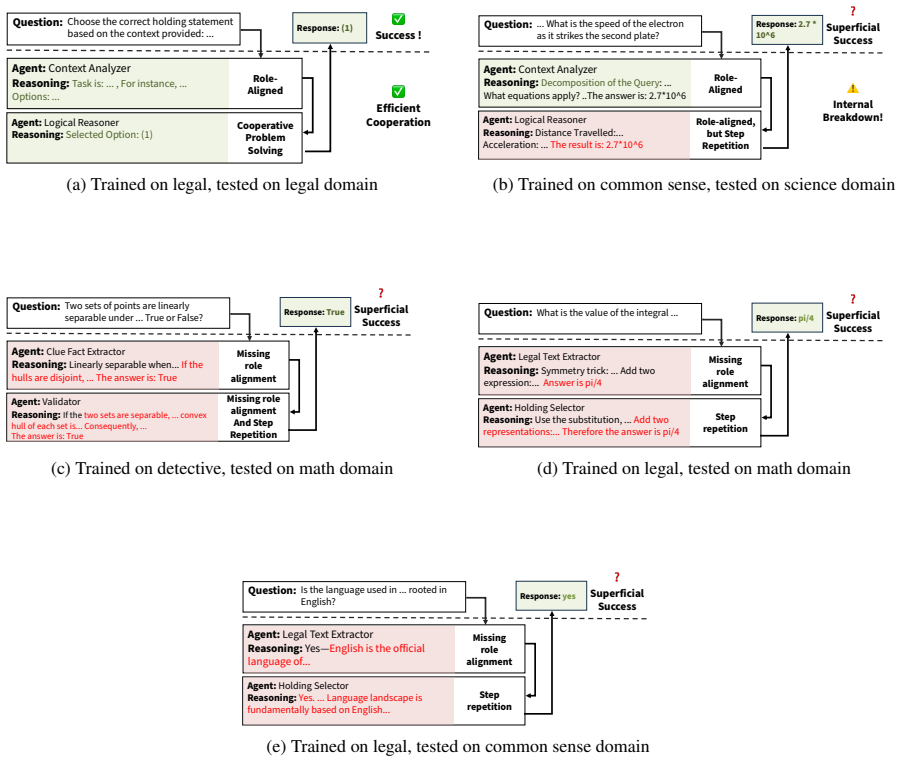
Adaptive MAS exhibit topological overfitting, failing to generalize across different domains, and illusory coordination, where they achieve reasonable surface-level accuracy while the underlying agent interactions diverge from ideal MAS behavior.
What carries the argument
Topological overfitting, the specialization of learned agent structures to training-domain graphs, combined with illusory coordination, the mismatch between external task accuracy and internal interaction quality.
If this is right
- MAS development should prioritize cross-domain generalization over task-specific optimization.
- Evaluation protocols must extend beyond final-answer correctness to include internal interaction analysis.
- Current adaptive MAS approaches carry limited practical utility until their generalization and coordination issues are resolved.
- New methods are needed to enforce domain-agnostic adaptation and verifiable multi-agent dynamics.
Where Pith is reading between the lines
- Similar surface-versus-internal gaps may appear in other adaptive AI systems that rely on learned interaction structures.
- Adding explicit coordination constraints during training could reduce the illusory aspect observed here.
- Extending the study to real-world noisy environments might expose even larger breakdowns in transfer.
Load-bearing premise
The chosen domains and metrics sufficiently represent generalization challenges and the internal interaction measurements accurately reflect deviation from ideal MAS behavior.
What would settle it
Re-running the systems on a fresh collection of diverse, previously unseen domains and finding both high cross-domain accuracy and internal interaction patterns that match ideal MAS behavior would contradict the claims.
Figures





read the original abstract
Adaptive multi-agent systems (MAS) are increasingly adopted to tackle complex problems. However, the narrow task coverage of their optimization raises the question of whether they can function as general-purpose systems. To address this gap, we conduct an extensive empirical study of adaptive MAS, revealing two key findings: (1) topological overfitting -- they fail to generalize across different domains; and (2) illusory coordination -- they achieve reasonable surface-level accuracy while the underlying agent interactions diverge from ideal MAS behavior, raising concerns about their practical utility. These findings highlight the pressing need to prioritize generalization in MAS development and motivate evaluation protocols that extend beyond simple final-answer correctness.
Editorial analysis
A structured set of objections, weighed in public.
Referee Report
Summary. The paper conducts an empirical study of adaptive multi-agent systems (MAS), reporting two main findings: (1) topological overfitting, in which these systems fail to generalize across different domains, and (2) illusory coordination, in which reasonable surface-level accuracy is achieved while underlying agent interactions diverge from ideal MAS behavior. The study uses concrete domain descriptions, metric definitions distinguishing surface accuracy from interaction statistics, and experimental protocols to support these claims.
Significance. If the empirical results hold, the work provides concrete evidence that current adaptive MAS prioritize narrow-task optimization at the expense of generalization and internal fidelity, motivating the development of evaluation protocols that extend beyond final-answer correctness. The manuscript's supply of domain descriptions, metric definitions, and direct-testing protocols constitutes a strength for reproducibility and falsifiability in this area.
minor comments (2)
- The abstract states that the study is 'extensive' but provides no details on experimental setup, datasets, or controls; while the full manuscript supplies these, the abstract should briefly indicate the number of domains, agent counts, and key metrics to allow readers to assess scope immediately.
- Section describing the interaction statistics (e.g., divergence from ideal MAS behavior) would benefit from an explicit equation or pseudocode for the divergence measure to ensure readers can replicate the internal-breakdown metric.
Simulated Author's Rebuttal
We thank the referee for the positive summary of our empirical study on adaptive multi-agent systems, the recognition of our findings on topological overfitting and illusory coordination, and the recommendation for minor revision. The report correctly notes the value of our domain descriptions, metric definitions, and protocols for reproducibility.
Circularity Check
No significant circularity in empirical study
full rationale
The manuscript is a purely empirical study that performs experiments on adaptive MAS, defines specific metrics for accuracy and interaction divergence, and draws conclusions from observed data across domains. There are no claimed derivations, predictions from models, or self-referential definitions that would introduce circularity. The central claims are supported by the experimental protocols and results presented, remaining self-contained without reduction to inputs by construction.
Axiom & Free-Parameter Ledger
Reference graph
Works this paper leans on
-
[1]
SciBench: Evaluating College-Level Scientific Problem-Solving Abilities of Large Language Models
Agentinit: Initializing llm-based multi-agent systems via diversity and expertise orchestration for effective and efficient collaboration. InFindings of the Association for Computational Linguistics: EMNLP 2025, pages 11870–11902. Harsh Trivedi and 1 others. 2022. Musique: Multi- hop questions via single-hop question composition. Transactions of the Assoc...
work page internal anchor Pith review arXiv 2025
-
[2]
Start with Isolated Agents: The process begins with a blank process with a simple ‘solve it’ prompt
-
[3]
Propose and Evaluate Extensions: The frame- work iteratively proposes adding new work- flows by MCTS
-
[4]
Score and Select: It evaluates how much each potential new workflow improves the system’s performance on a given task
-
[5]
Build the Graph: The workflows that provide the most significant performance boost are permanently added to the graph
-
[6]
AgentInitis an automated MASinitialization method that focuses on forming a strong agent team (roles)beforerunning the inference framework
Iterate: This process repeats, gradually build- ing a complex and effective topology (work- flow) optimized for the specific task. AgentInitis an automated MASinitialization method that focuses on forming a strong agent team (roles)beforerunning the inference framework. Instead of optimizing a communication graph di- rectly, AgentInit first generates a po...
-
[7]
This refine- ment repeats for multiple rounds
Multi-round Candidate Generation: A Plan- ner decomposes the user query into sub-tasks and drafts candidate agent roles, while an Ob- server reviews the decomposition and role as- signments and provides feedback. This refine- ment repeats for multiple rounds
-
[8]
NL-to-Format Standardization: A Formatter converts each candidate agent role from free- form natural language into a standardized rep- resentation (e.g., JSON) to ensure consistency for downstream comparison
-
[9]
Construct Candidate Teams: From the can- didate agent pool, enumerate possible teams whose size lies within predefined bounds
-
[10]
Score Teams by Relevance and Diversity: Compute a relevance score between each agent (and team) and the query using embedding-based cosine similarity, and mea- sure intra-team diversity using an embedding- similarity matrix (e.g., via Vendi-style diver- sity)
-
[11]
AgentDropoutis another topology optimization framework, but it takes the opposite approach to AFlow
Pareto-based Selection: Identify the Pareto- optimal set of teams that are non-dominated with respect to relevance and diversity, and use a Selector (LLM-powered) to choose the final team for deployment. AgentDropoutis another topology optimization framework, but it takes the opposite approach to AFlow. It aims to create a communication structure that is ...
-
[12]
Start with a Dense Graph: The process typi- cally begins with a highly-connected graph where most agents can communicate with each other
-
[13]
Identify Redundancy: During different rounds of communication, the framework uses an op- timization method to score the importance of each agent and each communication link
-
[14]
This forces the system to solve the problem without relying on every single voice, making it more robust
Dynamically "Drop" Agents: Agents or links with low importance scores are temporarily dropped out for that round. This forces the system to solve the problem without relying on every single voice, making it more robust
-
[15]
copycats,
Optimize for Efficiency and Performance: By removing unnecessary communication, the method significantly reduces the number of tokens required, lowering computational costs while often improving the final answer by re- ducing noise. C Additional Experimental Results C.1 Cross-Model Comparison on Qwen3-30B-A3B For completeness, Table 8 reports the corre- s...
-
[16]
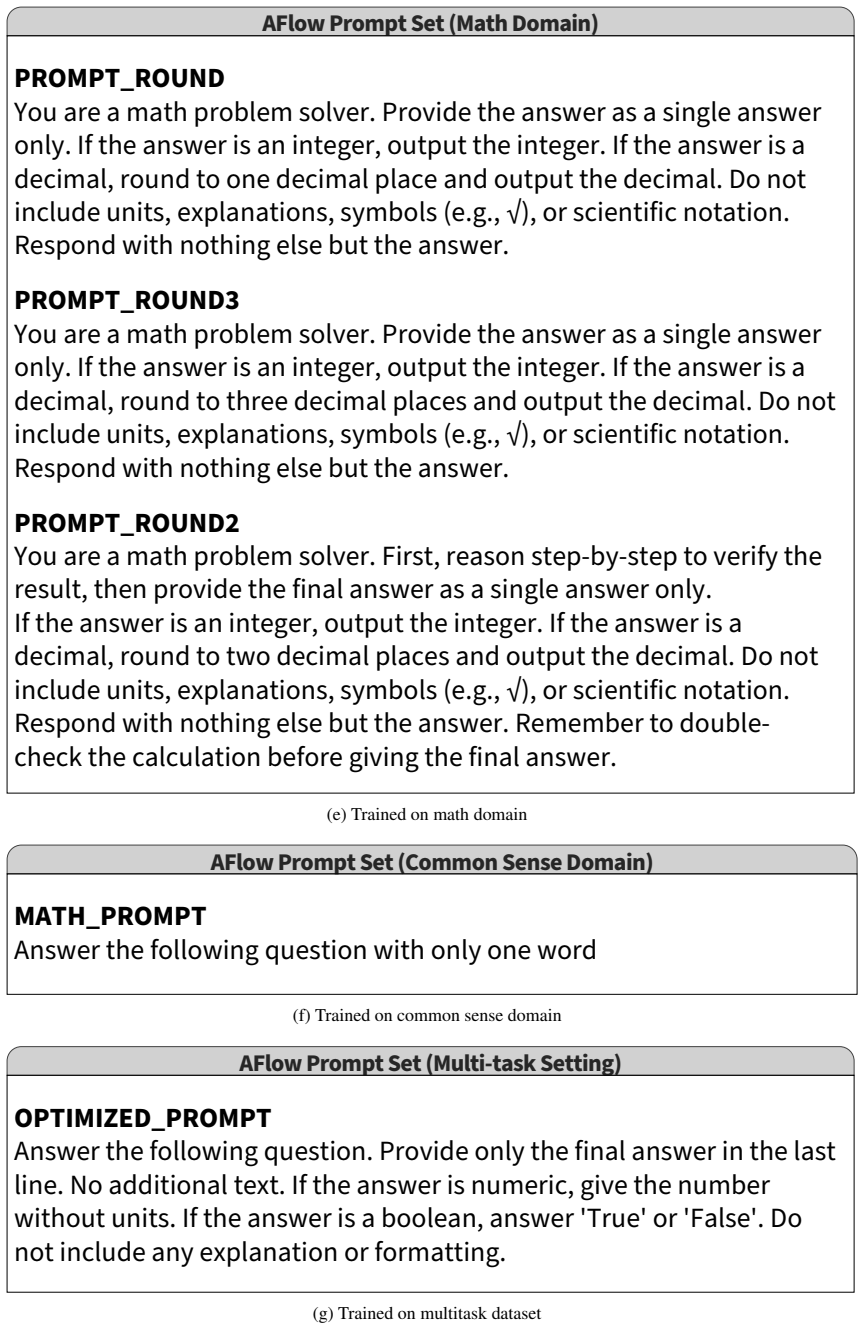
PROMPT_CHECKCheck your answer for correctness. If the answer is a numeric value, replace it with the name of the highest mountain mentioned in the context. If unsure, output
and Qwen3-30B-A3B (Team, 2025). Sec- tion 3 and Section 4 reports the GPT-oss-20B re- sults in the main paper, and Section C.2 reports the corresponding Qwen3-30B-A3B results in the appendix. We used vLLM(Kwon et al., 2023) for efficient inference. We ran the model on a single H200 GPU with 140GB of VRAM. Since we uti- lized the highly parallelizable natu...
2025
discussion (0)
Sign in with ORCID, Apple, or X to comment. Anyone can read and Pith papers without signing in.