Recognition: unknown
Closing the Loop: Deploying Auto-Generating Digital Twins for Particle Accelerators
Pith reviewed 2026-05-10 01:39 UTC · model grok-4.3
The pith
An auto-generating digital twin architecture for particle accelerators creates a virtual control system from a single source of truth to match hardware and simulations.
A machine-rendered reading of the paper's core claim, the machinery that carries it, and where it could break.
Core claim
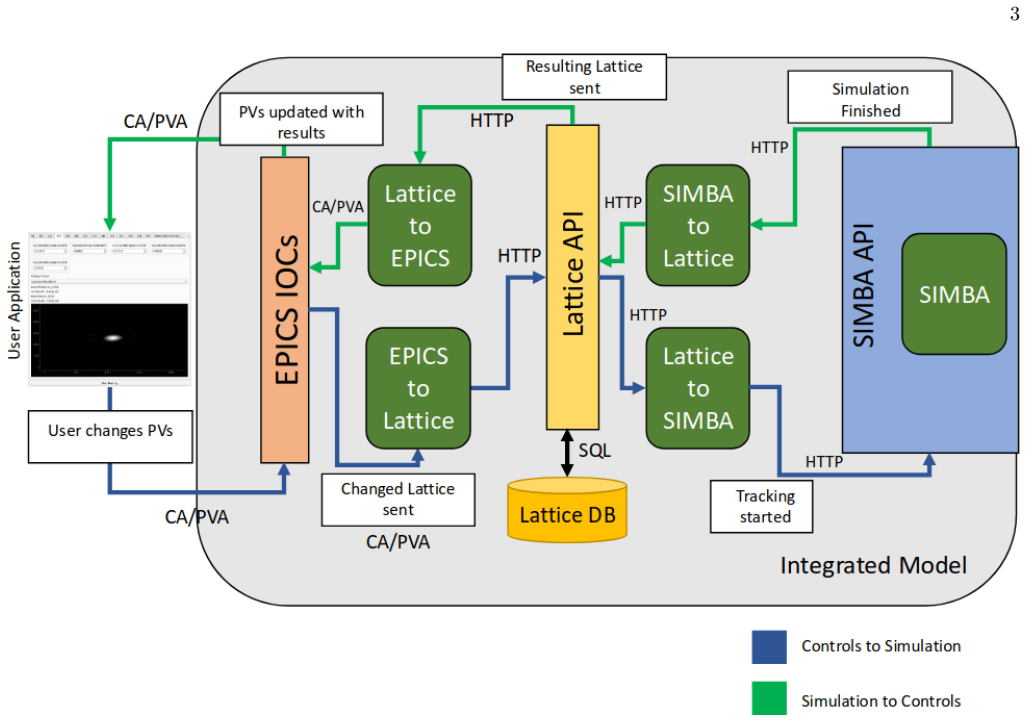
This article presents the implementation of an auto-generating digital twin architecture for particle accelerators: a virtual control system is generated to mirror the physical accelerator hardware, and used to update a simulation model which then feeds back the results into virtual diagnostics. All of the information about the accelerator lattice is cascaded down from a ground source of truth, removing any ambiguity about the naming of parameters between the simulation model and the virtual hardware. This design is modular and extensible, allowing researchers from different institutions to use their own models and accelerator lattices while maintaining the overall structural coherence of a
What carries the argument
The auto-generating digital twin architecture, which generates a virtual control system from a ground source of truth to update and receive feedback from a simulation model.
Load-bearing premise
A single ground source of truth for the accelerator lattice can be established and maintained such that all parameter naming and information cascades unambiguously to both the virtual control system and simulation model across different institutions and models.
What would settle it
If attempts to deploy the system on an additional accelerator facility reveal inconsistencies in parameter naming or failure of the information cascade between the ground source, virtual controls, and simulation models.
Figures


read the original abstract
The simulation of a physical system in a virtual replica, known as a digital twin, is a useful way to interrogate the system non-invasively, providing the ability to perform predictive maintenance and surveillance, and to investigate potential novel configurations without perturbing the system. This article presents the implementation of an auto-generating digital twin architecture for particle accelerators: a virtual control system is generated to mirror the physical accelerator hardware, and used to update a simulation model which then feeds back the results into virtual diagnostics. All of the information about the accelerator lattice is cascaded down from a ground source of truth, removing any ambiguity about the naming of parameters between the simulation model and the virtual hardware. This design is modular and extensible, allowing researchers from different institutions to use their own models (for example, a machine learning model) and accelerator lattices while maintaining the overall structural coherence of the digital twin. This architecture has been tested for three accelerator facilities \textendash~CLARA, the ISIS injector, and the proposed UK XFEL \textendash~and aims to provide the foundation for a collaborative community effort in the development of shared technology towards a generic digital twin solution.
Editorial analysis
A structured set of objections, weighed in public.
Referee Report
Summary. The paper presents an auto-generating digital twin architecture for particle accelerators. A virtual control system is generated from a single ground-truth lattice description to mirror physical hardware; this updates a simulation model whose outputs feed back into virtual diagnostics. The design is modular and extensible to allow institution-specific models and lattices while preserving structural coherence, and it has been tested on the CLARA, ISIS injector, and proposed UK XFEL facilities with the aim of supporting community-wide development of generic digital-twin solutions.
Significance. If the architecture performs as described, it offers a practical, parameter-naming-consistent framework that could reduce duplication of effort across accelerator facilities and enable non-invasive predictive maintenance and optimization. The explicit modularity for substituting simulation models (including machine-learning ones) and the focus on community collaboration are notable strengths that align with ongoing needs in accelerator physics.
major comments (1)
- [Deployment examples / Results] The manuscript states that the architecture has been tested on three facilities (CLARA, ISIS injector, proposed UK XFEL) yet supplies no quantitative performance metrics, error analysis, or detailed validation results. This absence leaves the central claim of successful deployment without measurable support and is load-bearing for the paper's assertion of practical utility.
Simulated Author's Rebuttal
We thank the referee for their constructive review and positive evaluation of the architecture's potential impact. We address the single major comment below regarding the deployment examples.
read point-by-point responses
-
Referee: The manuscript states that the architecture has been tested on three facilities (CLARA, ISIS injector, proposed UK XFEL) yet supplies no quantitative performance metrics, error analysis, or detailed validation results. This absence leaves the central claim of successful deployment without measurable support and is load-bearing for the paper's assertion of practical utility.
Authors: We acknowledge that the manuscript does not include quantitative performance metrics, error bars, or detailed validation statistics for the three deployments. The paper's core contribution is the description of an auto-generating architecture that cascades lattice information from a single ground-truth source to ensure parameter consistency between virtual hardware and simulation models. The tests on CLARA, the ISIS injector, and the proposed UK XFEL are presented to demonstrate that this modular framework can be instantiated on facilities of differing scale and complexity while preserving structural coherence and allowing substitution of simulation engines (including machine-learning models). These deployments confirm functional operation without naming conflicts or structural inconsistencies, but they do not constitute a comprehensive benchmarking study. We agree that additional quantitative evidence would strengthen claims of practical utility. We will revise the manuscript to expand the discussion of the qualitative outcomes observed during deployment and to state explicitly that detailed performance metrics and error analyses are the subject of ongoing work and planned follow-on publications. revision: partial
Circularity Check
No significant circularity
full rationale
The paper's architecture derives the virtual control system and simulation model by cascading parameters from an external ground source of truth lattice description supplied by each facility (CLARA, ISIS injector, UK XFEL). This input is treated as given rather than generated internally, with no equations, fitted parameters, self-citations, or self-definitional steps reducing the central claim to its own outputs. The design is explicitly modular, allowing substitution of models while preserving the cascade from the independent lattice source, rendering the derivation self-contained.
Axiom & Free-Parameter Ledger
axioms (1)
- domain assumption A single ground source of truth exists for all accelerator lattice information and can be cascaded without loss or ambiguity
Reference graph
Works this paper leans on
-
[1]
It provides a flexible architecture for creating IOCs programmatically, making it easier to manage and simulate EPICS records
from YAML configuration files. It provides a flexible architecture for creating IOCs programmatically, making it easier to manage and simulate EPICS records. A schema translator is used to map YAML data to EPICS records; the package is extendable to support various device types and configurations, and EPICS environment variables are configured for seamles...
-
[2]
middle layer package. This software library provides methods for generating a full snapshot of the current state of the accelerator (physical or virtual), and therefore can be used to package the information received from the control system into a suitable format that can be passed between modules – for example, to convert the current in a magnet to its c...
-
[3]
M. Grieves and J. Vickers.Digital Twin: Mitigating Unpredictable, Undesirable Emergent Behavior in Complex Systems, volume Transdisciplinary Perspectives on Complex Systems. Springer, 2017. doi:10.1007/978-3-319-38756-7_4. URL https://link.springer.com/chapter/10.1007/978-3-319-38756-7_4
-
[4]
D. M. Botín-Sanabria, A.-S. Mihaita, R. E. Peimbert-García, M. A. Ramírez-Moreno, R. A. Ramírez-Mendoza, and J. de J. Lozoya-Santos. Digital Twin Technology Challenges and Applications: A Comprehensive Review.Remote Sens., 14:1335, 2022. doi:https://doi.org/10.3390/rs14061335. URLhttps://www.mdpi.com/2072-4292/14/6/1335
-
[5]
M. Singh, E. Fuenmayor, E. P. Hinchy, Y. Qiao, N. Murray, and D. Devine. Digital Twin: Origin to Future.Appl. Syst. Innov, 4(2):36, 2021. doi:https://doi.org/10.3390/asi4020036. URLhttps://www.mdpi.com/2571-5577/4/2/36
-
[6]
Digitaltwinparadigm: Asystematicliteraturereview.Comput
C.Semeraro, M.Lezoche, H.Panetto, andM.Dassisti. Digitaltwinparadigm: Asystematicliteraturereview.Comput. Ind., 130:103469, 2021. doi:https://doi.org/10.1016/j.compind.2021.103469. URLhttps://www.sciencedirect.com/science/ article/abs/pii/S0166361521000762
-
[7]
C. G. Lee and S. C. Park. Survey on the virtual commissioning of manufacturing systems.J. Comput. Des. Eng., 1(3): 213, 2014. doi:https://doi.org/10.7315/JCDE.2014.021. URLhttps://www.sciencedirect.com/science/article/pii/ S2288430014500292
-
[8]
C. Boje, A. Guerriero, S. Kubicki, and Y. Rezgui. Towards a semantic Construction Digital Twin: Directions for future research.Autom. Constr., 114:103179, 2020. doi:https://doi.org/10.1016/j.autcon.2020.103179. URLhttps: //www.sciencedirect.com/science/article/pii/S0926580519314785
-
[9]
Digital twins in health care: ethical implications of an emerging engineering paradigm,
K. Bruynseels, F. Santoni de Sio, and J. van den Hoven. Digital Twins in health care: Ethical implications of an emerging engineering paradigm.Front. Genet., 9:31, 2018. doi:10.3389/fgene.2018.00031. URLhttps://www.frontiersin.org/ journals/genetics/articles/10.3389/fgene.2018.00031/full. 10
-
[10]
F. Tao, F. Y. Sui, A. Liu, Q. L. Qi, M. Zhang, and B. Song. Digital twin-driven product design framework.Int. J. Prod. Res., 57:3935, 2018. doi:https://doi.org/10.1080/00207543.2018.1443229. URLhttps://www.tandfonline.com/doi/abs/ 10.1080/00207543.2018.1443229
-
[11]
H. L. Gong, S. B. Cheng, Z. Chen, and Q. Li. Data-Enabled Physics-Informed Machine Learning for Reduced- Order Modeling Digital Twin: Application to Nuclear Reactor Physics.Nucl. Sci. Eng., 196(6):668–693, 2022. doi: 10.1080/00295639.2021.2014752. URLhttps://doi.org/10.1080/00295639.2021.2014752
-
[12]
X. W. Zhao J. C. Zhang. Digital twin of wind farms via physics-informed deep learning.Energy Convers. Manag., 293: 117507, 2023. doi:https://doi.org/10.1016/j.enconman.2023.117507. URLhttps://www.sciencedirect.com/science/ article/pii/S0196890423008531
- [13]
- [14]
-
[15]
H. van der Valk, H. Haße, F. Möller, and B. Otto. Archetypes of Digital Twins.Bus. Inf. Syst. Eng, 64:375 – 391, 2020. doi:https://doi.org/10.1007/s12599-021-00727-7. URLhttps://link.springer.com/article/10.1007/ s12599-021-00727-7
-
[16]
L. Wright and S. Davidson. How to tell the difference between a model and a digital twin.Adv. Model. Simul. Eng. Sci., 7:13, 2020. doi:https://doi.org/10.1186/s40323-020-00147-4. URLhttps://link.springer.com/article/10.1186/ s40323-020-00147-4
-
[17]
D. Angal-Kalinin, A. Bainbridge, A. D. Brynes, R. K. Buckley, S. R. Buckley, G. C. Burt, R. J. Cash, H. M. Cas- taneda Cortes, D. Christie, J. A. Clarke, R. Clarke, L. S. Cowie, P. A. Corlett, G. Cox, K. D. Dumbell, D. J. Dunning, B. D. Fell, K. Gleave, P. Goudket, A. R. Goulden, S. A. Griffiths, M. D. Hancock, A. Hannah, T. Hartnett, P. W. Heath, J. R. H...
-
[18]
J. W. G. Thomason. The ISIS Spallation Neutron and Muon Source—The first thirty-three years.Nucl. Instrum. Meth. A, 917:61, 2019. doi:https://doi.org/10.1016/j.nima.2018.11.129. URLhttps://www.sciencedirect.com/science/article/ pii/S0168900218317820
-
[19]
UK XFEL Science Case
Jon Marangos et al. UK XFEL Science Case. Technical report, STFC, 2020
2020
-
[20]
URLhttp://xfel.ac.uk
UK XFEL. URLhttp://xfel.ac.uk
-
[21]
URLhttps://fastapi.tiangolo.com/
FastAPI. URLhttps://fastapi.tiangolo.com/
-
[22]
URLhttps://github.com/astec-stfc/ laura
LAURA – Lattice Architecture for a Unified Representation of Accelerators. URLhttps://github.com/astec-stfc/ laura. [21]EPICS- Experimental Physics and Industrial Control System. URLhttps://www.aps.anl.gov/epics
-
[23]
URLhttps://pypi.org/project/Jinja2/
Jinja: a fast, expressive, extensible templating engine. URLhttps://pypi.org/project/Jinja2/
-
[24]
URLhttps://tango-controls.org/
TANGO Controls. URLhttps://tango-controls.org/
-
[25]
URLhttps://github.com/epics-base/p4p
p4p – PVAccess for Python. URLhttps://github.com/epics-base/p4p
-
[26]
M. King, A. D. Brynes, F. Jackson, J. K. Jones, N. Ziyan, M. A. Johnson, K. Baker, D. J. Scott, E. Yang, T. Kabana, C. Garnier, S. Chowdhury, N. Neveu, and R. Roussel. Controls Abstraction Towards Accelerator Physics: A Middle Layer Python Package for Particle Accelerator Control, 2025. URLhttps://arxiv.org/abs/2509.19794
-
[27]
URLhttps://github.com/astec-stfc/simba
SIMBA – Simulations for Integrated Modeling of Beams in Accelerators. URLhttps://github.com/astec-stfc/simba
-
[28]
URLhttps://github.com/ISISNeutronMuon/poly-lithic
Poly-Lithic. URLhttps://github.com/ISISNeutronMuon/poly-lithic
-
[29]
URLhttps://react.dev/
React. URLhttps://react.dev/
-
[30]
URLhttps://www.typescriptlang.org/
TypeScript. URLhttps://www.typescriptlang.org/
-
[31]
URLhttps://github.com/ornl-epics/pvws
PVWS – Process Variable Web Socket. URLhttps://github.com/ornl-epics/pvws
-
[32]
URLhttp://www.desy.de/~mpyflo/
ASTRA. URLhttp://www.desy.de/~mpyflo/
-
[33]
S. R. Lawrie, R. E. Abel, C. A. Cahill, D. C. Faircloth, J. H. Macgregor, S. Patel, T. C. de M. Sarmento, J. Speed, O. A. Tarvainen, M. O. Whitehead, T. Wood, and D. Zacek. A pre-injector upgrade for ISIS, including a medium energy beam transportlineandanRF-drivenH − ionsource.Rev. Sci. Instrum., 90:103310, 2019. doi:https://doi.org/10.1063/1.5127263. URL...
-
[34]
I. D. Finch, B. R. Aljamal, K. R. L. Baker, R. Brodie, J. L. Fernandez-Hernando, G. Howells, M. Leputa, S. A. Medley, A. Saoulis, and A. Kurup. Vsystem to EPICS control system transition at the ISIS accelerators.Proceedings of IPAC’22, Bangkok, Thailand, 2022. URLhttps://proceedings.jacow.org/ipac2022/papers/tupopt063.pdf
2022
-
[35]
C. Davut, O. Apsimon, B. R. Hounsell, B. L. Militsyn, L. S. Cowie, F. Yaman, A. D. Brynes, and P. H. Williams. Balance of bunch compression and emittance preservation for high-brightness x-ray free electron laser injectors.Phys. Rev. Accel. Beams, 28:091602, Sep 2025. doi:10.1103/rjns-vqzt. URLhttps://link.aps.org/doi/10.1103/rjns-vqzt
- [36]
-
[37]
A. Adelmann, P. Calvo, M. Frey, A. Gsell, U. Locans, C. Metzger-Kraus, N. Neveu, C. Rogers, S. Russell, S. Sheehy, J. Snuverink, and D. Winklehner. OPAL a Versatile Tool for Charged Particle Accelerator Simulations, 2019. URL https://arxiv.org/abs/1095.06654
-
[38]
M. Borland. elegant: A flexible SDDS-compliant code for accelerator simulation.Proceedings of ICAP’00, Darmstadt, Germany, 2000. URLhttps://www.aps.anl.gov/files/APS-sync/lsnotes/files/APS_1418218.pdf
2000
-
[39]
S. Reiche. GENESIS 1.3: A fully 3D time-dependent FEL simulation code.Nucl. Instrum. Meth. A, 429(1):243,
-
[40]
URLhttps://www.sciencedirect.com/science/article/ pii/S016890029900114X
doi:https://doi.org/10.1016/S0168-9002(99)00114-X. URLhttps://www.sciencedirect.com/science/article/ pii/S016890029900114X
discussion (0)
Sign in with ORCID, Apple, or X to comment. Anyone can read and Pith papers without signing in.