Recognition: unknown
Implications of the First JUNO Results for Dirac Neutrino Texture Zeros
Pith reviewed 2026-05-10 02:48 UTC · model grok-4.3
The pith
JUNO data disfavors texture C for two-zero Dirac neutrino mass matrices, leaving A1 and A2 viable.
A machine-rendered reading of the paper's core claim, the machinery that carries it, and where it could break.
Core claim
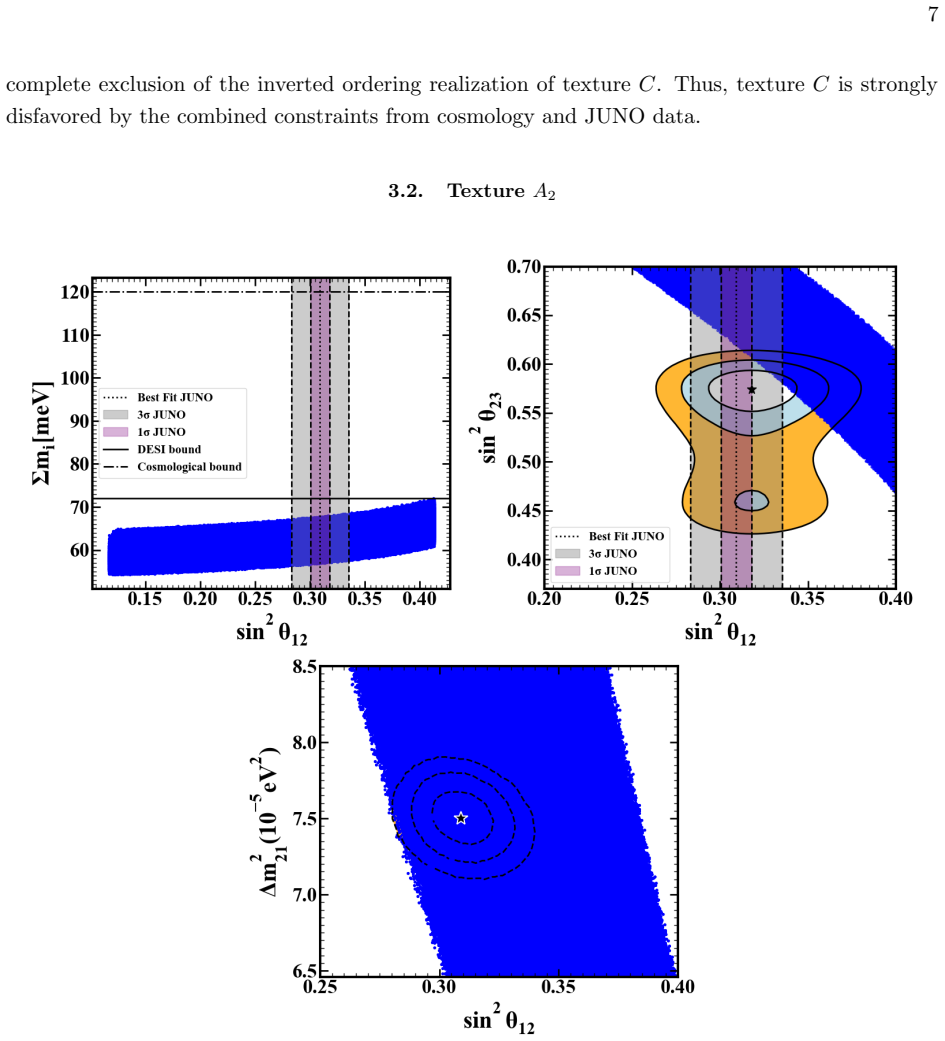
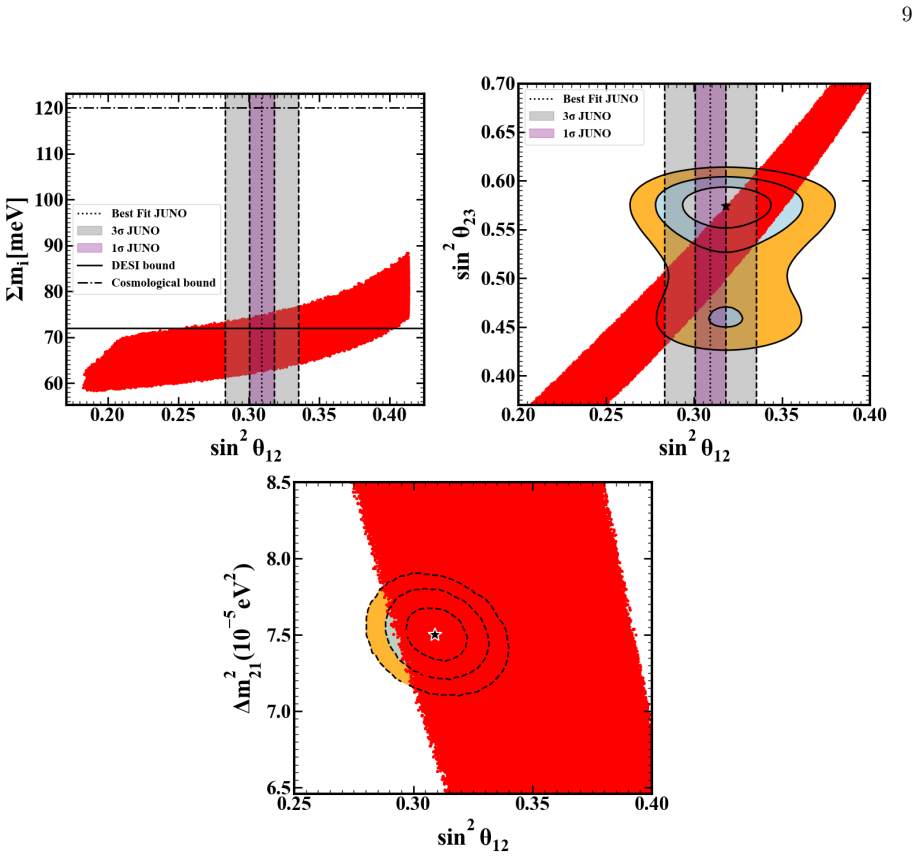
Motivated by the first JUNO results, the analysis performs a scan over the allowed parameter space for two-zero Dirac neutrino textures and finds that current measurements impose stringent constraints. Although textures C, A2, and A1 were previously viable, the data strongly disfavor C, leaving only A2 and A1 compatible with observations. The reduced parameter space generates sharp correlations among oscillation observables that are now tested by the solar sector precision.
What carries the argument
Two-zero texture structures labeled A1, A2, and C in the Dirac neutrino mass matrix, which enforce relations among the neutrino mixing angles and mass-squared differences.
Load-bearing premise
The analysis assumes the standard three-neutrino oscillation framework holds and that a systematic scan of the reduced parameter space for each texture fully determines phenomenological viability without extra theoretical constraints.
What would settle it
An independent high-precision measurement of sin²θ12 or Δm21² lying outside the allowed ranges for A1 and A2 but inside the range for C would show that current JUNO data do not disfavor texture C.
Figures



read the original abstract
Motivated by the first oscillation results from JUNO, we study the phenomenological viability of texture zeros in the Dirac neutrino mass matrix. The improved precision on the solar mixing angle $\sin^2{\theta_{12}}$ and the solar mass-squared difference $\Delta m_{21}^2$ provide a stringent probe for scrutinizing predictive texture zero frameworks. We perform a systematic scan of the allowed parameter space for two-zero textures, identifying sharp correlations among oscillation observables arising from the reduced parameter space. Our analysis reveals that current JUNO measurements impose stringent constraints on the viable texture structures. In particular, although textures $C$, $A_2$, and $A_1$ were previously viable, current JUNO data strongly disfavor $C$, leaving only textures $A_2$ and $A_1$ compatible with the data. These findings underscore the remarkable sensitivity of Dirac texture zero scenarios to the solar sector.
Editorial analysis
A structured set of objections, weighed in public.
Referee Report
Summary. The paper studies the phenomenological viability of two-zero texture patterns in the Dirac neutrino mass matrix in light of the first JUNO oscillation results. A systematic scan of the reduced parameter space is performed, revealing correlations among observables; the analysis concludes that current JUNO measurements on sin²θ₁₂ and Δm²₂₁ strongly disfavor texture C while leaving textures A1 and A2 compatible with the data.
Significance. If the numerical scan is robust and exhaustive, the result provides a concrete phenomenological constraint on predictive Dirac neutrino mass models, demonstrating the sensitivity of texture-zero scenarios to solar-sector parameters. The identification of sharp correlations between observables is a positive feature that could aid future model-building and experimental tests.
major comments (1)
- [Section describing the parameter scan and results for textures A1, A2, and C] The central claim that JUNO data strongly disfavors texture C (while A1 and A2 remain viable) rests on the results of the systematic parameter scan over the two mass ratios and three phases. However, the manuscript provides no details on the scan methodology, including the sampling technique (e.g., Monte Carlo or grid), the exact ranges and priors for the free parameters, the treatment of normal versus inverted hierarchy, the diagonalization procedure for extracting PMNS elements, or the precise statistical criterion (e.g., χ² threshold or direct 3σ comparison) used to determine compatibility with JUNO data. This absence makes it impossible to verify whether all viable configurations for texture C were sampled or whether points inside the JUNO 3σ ellipse were missed.
minor comments (1)
- [Abstract] The abstract states that 'sharp correlations among oscillation observables' arise from the reduced parameter space but does not identify them explicitly or reference the relevant figure or table; adding a brief description or citation would improve clarity for readers.
Simulated Author's Rebuttal
We thank the referee for the careful reading of our manuscript and the constructive comments on the parameter scan methodology. We agree that additional details are necessary to allow full verification of the results and will incorporate them in the revised version.
read point-by-point responses
-
Referee: The central claim that JUNO data strongly disfavors texture C (while A1 and A2 remain viable) rests on the results of the systematic parameter scan over the two mass ratios and three phases. However, the manuscript provides no details on the scan methodology, including the sampling technique (e.g., Monte Carlo or grid), the exact ranges and priors for the free parameters, the treatment of normal versus inverted hierarchy, the diagonalization procedure for extracting PMNS elements, or the precise statistical criterion (e.g., χ² threshold or direct 3σ comparison) used to determine compatibility with JUNO data. This absence makes it impossible to verify whether all viable configurations for texture C were sampled or whether points inside the JUNO 3σ ellipse were missed.
Authors: We acknowledge that the current manuscript does not provide sufficient technical details on the numerical scan. In the revised version we will add a new subsection (Section 3.2) that fully specifies the methodology: a Monte Carlo sampling with 10^6 points per texture using uniform priors on the two mass ratios (0 to 1) and three phases (0 to 2π); separate scans for normal and inverted hierarchies; numerical diagonalization of the Dirac mass matrix via standard eigenvalue routines to extract the PMNS parameters; and compatibility defined by requiring the predicted sin²θ₁₂ and Δm²₂₁ to lie inside the 3σ JUNO contours (using the published central values and covariance). We will also include a brief pseudocode outline and confirm that the sampling density is sufficient to populate the full allowed region for textures A1 and A2 while showing no surviving points for texture C. These additions will enable independent verification. revision: yes
Circularity Check
JUNO external data constrains two-zero textures via numerical scan with no self-referential reduction
full rationale
The paper's central result follows from imposing two-zero conditions on the Dirac neutrino mass matrix in the charged-lepton diagonal basis, then numerically scanning the reduced parameter space (mass ratios and phases) to extract PMNS mixing angles and mass-squared differences, and finally comparing those predictions against the independent JUNO measurements of sin²θ₁₂ and Δm²₂₁. No equation or step equates an output observable to a fitted input by construction, and the viability statements for textures A1, A2, and C rest on external data rather than internal redefinition or self-citation chains. The derivation remains self-contained against the external benchmark.
Axiom & Free-Parameter Ledger
free parameters (1)
- remaining mass matrix entries after texture zeros
axioms (1)
- domain assumption Standard three active neutrino oscillation framework with Dirac neutrinos
Reference graph
Works this paper leans on
-
[1]
INTRODUCTION The precision of neutrino oscillation parameters has improved significantly with the first data release from the Jiangmen Underground Neutrino Observatory (JUNO), enabling precise measure- ments of the solar sector. In particular, JUNO reports the solar mixing angle and solar mass- squared difference at the 1σlevel as [1] sin2 θ12 = 0.3092±0....
work page internal anchor Pith review Pith/arXiv arXiv 2026
-
[2]
TEXTURE ZEROS FOR DIRAC NEUTRINOS We begin by revisiting the two-zero textures of the Dirac neutrino mass matrix [57, 61–63]. Assuming a diagonal charged lepton mass basis, the Hermitian Dirac neutrino mass matrixM ν is brought to diagonal form by the PMNS mixing matrix, U † PMNSMνUPMNS = diag(m1, m2, m3)≡M diag.(3) In its standard parametrization, the PM...
-
[3]
NUMERICAL RESUL TS In our numerical analysis, we perform a random scan over the neutrino oscillation parameters by generating the mass-squared differences and mixing angles within their 3σranges, as obtained from the latest global-fit results [60]. In addition, the phenomenologically viable parameter space of the model is obtained by requiring the mass-ra...
-
[4]
A New Lepton - Quark Mass Relation in a Unified Theory,
DISCUSSIONS AND SUMMAR Y In this work, we revisit the texture zero structures of the Dirac neutrino mass matrix in light of the latest JUNO results. The one-zero textures, owing to their larger parameter freedom, are not much affected by the current JUNO data. In contrast, we find that two-zero textures are now tightly constrained. Although texturesC,A 2,...
-
[5]
Unified Models of Neutrinos, Flavour and CP Violation,
S. F. King, “Unified Models of Neutrinos, Flavour and CP Violation,”Prog. Part. Nucl. Phys.94 (2017) 217–256,arXiv:1701.04413 [hep-ph]
-
[6]
F. Feruglio and A. Romanino, “Lepton flavor symmetries,”Rev. Mod. Phys.93no. 1, (2021) 015007, arXiv:1912.06028 [hep-ph]
-
[7]
Xing,Flavor structures of charged fermions and massive neutrinos,Phys
Z.-z. Xing, “Flavor structures of charged fermions and massive neutrinos,”Phys. Rept.854(2020) 1–147,arXiv:1909.09610 [hep-ph]
-
[8]
Neutrino Flavor Model Building and the Origins of Flavor and CP Violation,
Y. Almumin, M.-C. Chen, M. Cheng, V. Knapp-Perez, Y. Li, A. Mondol, S. Ramos-Sanchez, M. Ratz, and S. Shukla, “Neutrino Flavor Model Building and the Origins of Flavor and CP Violation,” Universe9no. 12, (2023) 512,arXiv:2204.08668 [hep-ph]
-
[9]
G. Chauhan, P. S. B. Dev, I. Dubovyk, B. Dziewit, W. Flieger, K. Grzanka, J. Gluza, B. Karmakar, and S. Zieba, “Phenomenology of lepton masses and mixing with discrete flavor symmetries,”Prog. Part. Nucl. Phys.138(2024) 104126,arXiv:2310.20681 [hep-ph]
-
[10]
Neutrino mass and mixing with modular symmetry,
G.-J. Ding and S. F. King, “Neutrino mass and mixing with modular symmetry,”Rept. Prog. Phys. 87no. 8, (2024) 084201,arXiv:2311.09282 [hep-ph]
-
[11]
The symmetry approach to quark and lepton masses and mixing,
G.-J. Ding and J. W. F. Valle, “The symmetry approach to quark and lepton masses and mixing,” Phys. Rept.1109(2025) 1–105,arXiv:2402.16963 [hep-ph]. [9]Super-KamiokandeCollaboration, Y. Fukudaet al., “Evidence for oscillation of atmospheric neutrinos,”Phys. Rev. Lett.81(1998) 1562–1567,arXiv:hep-ex/9807003. [10]SNOCollaboration, Q. R. Ahmadet al., “Direct...
-
[12]
Predictions from scoto-seesaw with A4 modular symmetry,
R. Kumar, P. Mishra, M. K. Behera, R. Mohanta, and R. Srivastava, “Predictions from scoto-seesaw with A4 modular symmetry,”Phys. Lett. B853(2024) 138635,arXiv:2310.02363 [hep-ph]
-
[13]
Cutting the scotogenic loop: adding flavor to dark matter,
R. Kumar, N. Nath, and R. Srivastava, “Cutting the scotogenic loop: adding flavor to dark matter,” JHEP12(2024) 036,arXiv:2406.00188 [hep-ph]
- [14]
-
[15]
Dirac Scoto inverse-seesaw from A 4 flavor symmetry,
R. Kumar, N. Nath, R. Srivastava, and S. Yadav, “Dirac Scoto inverse-seesaw from A 4 flavor symmetry,”JHEP10(2025) 088,arXiv:2505.01407 [hep-ph]
-
[16]
Flavor imprints on novel low mass dark matter,
R. Kumar, H. K. Prajapati, R. Srivastava, and S. Yadav, “Flavor imprints on novel low mass dark matter,”JHEP11(2025) 094,arXiv:2510.02972 [hep-ph]
- [17]
-
[18]
Zeroes of the neutrino mass matrix,
P. H. Frampton, S. L. Glashow, and D. Marfatia, “Zeroes of the neutrino mass matrix,”Phys. Lett. B 536(2002) 79–82,arXiv:hep-ph/0201008
-
[19]
Three neutrino mass matrices with two texture zeros,
B. R. Desai, D. P. Roy, and A. R. Vaucher, “Three neutrino mass matrices with two texture zeros,” Mod. Phys. Lett. A18(2003) 1355–1366,arXiv:hep-ph/0209035
-
[20]
Texture zeros and Majorana phases of the neutrino mass matrix,
Z.-z. Xing, “Texture zeros and Majorana phases of the neutrino mass matrix,”Phys. Lett. B530 (2002) 159–166,arXiv:hep-ph/0201151
-
[21]
W.-l. Guo and Z.-z. Xing, “Implications of the KamLAND measurement on the lepton flavor mixing matrix and the neutrino mass matrix,”Phys. Rev. D67(2003) 053002,arXiv:hep-ph/0212142
-
[22]
The Elements of the neutrino mass matrix: Allowed ranges and implications of texture zeros,
A. Merle and W. Rodejohann, “The Elements of the neutrino mass matrix: Allowed ranges and implications of texture zeros,”Phys. Rev. D73(2006) 073012,arXiv:hep-ph/0603111
-
[23]
Seesaw realization of the texture zeros in the neutrino mass matrix,
A. Kageyama, S. Kaneko, N. Shimoyama, and M. Tanimoto, “Seesaw realization of the texture zeros in the neutrino mass matrix,”Phys. Lett. B538(2002) 96–106,arXiv:hep-ph/0204291
-
[24]
Z. z. Xing, “Implications of generalized frampton-glashow-yanagida ansaetze on neutrino masses and lepton flavor mixing,”Phys. Rev. D69(2004) 013006,arXiv:hep-ph/0307007
-
[25]
Phenomenology of two-texture zero neutrino mass matrices,
S. Dev, S. Kumar, S. Verma, and S. Gupta, “Phenomenology of two-texture zero neutrino mass matrices,”Phys. Rev. D76(2007) 013002,arXiv:hep-ph/0612102
-
[26]
CP-odd weak basis invariants and texture zeros,
S. Dev, S. Kumar, and S. Verma, “CP-odd weak basis invariants and texture zeros,”Phys. Rev. D79 (2009) 033011,arXiv:0901.2819 [hep-ph]
-
[27]
Neutrino Mass Matrices with a Texture Zero and a Vanishing Minor,
S. Dev, S. Verma, S. Gupta, and R. R. Gautam, “Neutrino Mass Matrices with a Texture Zero and a Vanishing Minor,”Phys. Rev. D81(2010) 053010,arXiv:1003.1006 [hep-ph]
-
[28]
Leptogenesis in a Hybrid Texture Neutrino Mass Model,
S. Dev and S. Verma, “Leptogenesis in a Hybrid Texture Neutrino Mass Model,”Mod. Phys. Lett. A 25(2010) 2837–2848,arXiv:1005.4521 [hep-ph]
-
[29]
Ramifications of texture one-zero neutrino mass model in coherence with the latest neutrino data,
S. Verma and M. Kashav, “Ramifications of texture one-zero neutrino mass model in coherence with the latest neutrino data,”Mod. Phys. Lett. A35no. 20, (2020) 2050165
2020
-
[30]
The one-zero textures of majorana neutrino mass matrix and current experimental tests,
E. I. Lashin and N. Chamoun, “The one-zero textures of majorana neutrino mass matrix and current experimental tests,”Phys. Rev. D85(2012) 113011,arXiv:1108.4010
-
[31]
Neutrino mixing matrices with relatively largeθ 13 and with texture one-zero,
K. N. Deepthi, S. Gollu, and R. Mohanta, “Neutrino mixing matrices with relatively largeθ 13 and with texture one-zero,”Eur. Phys. J. C72(2012) 1888,arXiv:1111.2781
-
[32]
Neutrino mass matrices with one texture zero and a vanishing neutrino mass,
R. R. Gautam, M. Singh, and M. Gupta, “Neutrino mass matrices with one texture zero and a vanishing neutrino mass,”Phys. Rev. D92no. 1, (2015) 013006,arXiv:1506.04868
-
[33]
Confronting predictive texture zeros in lepton mass matrices with current data,
L. M. Cebola, D. Emmanuel-Costa, and R. G. Felipe, “Confronting predictive texture zeros in lepton mass matrices with current data,”Phys. Rev. D92no. 2, (2015) 025005,arXiv:1504.06594. 14
-
[34]
L. Singh, M. Kashav, and S. Verma, “Investigating two-zero textures of inverse neutrino mass matrix under the lamp post of LMA and LMA-D solutions and symmetry realization,”Eur. Phys. J. C82 no. 9, (2022) 841,arXiv:2205.00765 [hep-ph]
-
[35]
L. Singh, M. Kashav, and S. Verma, “Gauged U(1)Lµ−Lτsymmetry and two-zero textures of inverse neutrino mass matrix in light of muon (g−2),”Mod. Phys. Lett. A37no. 30, (2022) 2250202, arXiv:2207.08415 [hep-ph]
-
[36]
Priya, S. Arora, and B. C. Chauhan, “Embedding generalized CP symmetry in one zero texture neutrino mass models,”Int. J. Mod. Phys. A41no. 09, (2026) 2650061,arXiv:2501.00776 [hep-ph]
-
[37]
J. Schechter and J. W. F. Valle, “Neutrinoless Double beta Decay in SU(2) x U(1) Theories,”Phys. Rev. D25(1982) 2951. [37]KamLAND-ZenCollaboration, S. Abeet al., “Search for the Majorana Nature of Neutrinos in the Inverted Mass Ordering Region with KamLAND-Zen,”Phys. Rev. Lett.130no. 5, (2023) 051801, arXiv:2203.02139 [hep-ex]
-
[38]
Quantum field theory approach to neutrino oscillations in dark matter and implications at JUNO,
W. Chao, “Quantum field theory approach to neutrino oscillations in dark matter and implications at JUNO,”arXiv:2511.15494 [hep-ph]
-
[39]
Y.-F. Li, A. Wang, Y. Xu, and J.-y. Zhu, “Terrestrial Matter Effects on Reactor Antineutrino Oscillations: Constant vs. Fluctuated Density Profiles,”arXiv:2511.15702 [hep-ph]
-
[40]
J. Huang and S. Zhou, “Probing unitarity violation of lepton flavor mixing matrix with reactor antineutrinos at JUNO and TAO,”arXiv:2511.15525 [hep-ph]
-
[41]
Neutrinoless Double Beta Decay in Light of JUNO First Data,
S.-F. Ge, C.-F. Kong, M. Lindner, and J. P. Pinheiro, “Neutrinoless Double Beta Decay in Light of JUNO First Data,”arXiv:2511.15391 [hep-ph]
-
[42]
Potential divergence in tracing $\mu$ and $\tau$ flavors of astrophysical neutrinos
Z.-z. Xing, “Divergence in tracing the flavors of astrophysical neutrinos: can JUNO help IceCube?,” arXiv:2511.15127 [hep-ph]
work page internal anchor Pith review Pith/arXiv arXiv
-
[43]
Z.-Q. Chen, G.-X. Fang, and Y.-L. Zhou, “Probing quark-lepton correlation in GUTs with high-precision neutrino measurements,”arXiv:2511.16196 [hep-ph]
-
[44]
Viability of A4, S4 and A5 flavour symmetries in light of the first JUNO result,
S. T. Petcov and A. V. Titov, “Viability of A4, S4 and A5 flavour symmetries in light of the first JUNO result,”Phys. Lett. B874(2026) 140295,arXiv:2511.19408 [hep-ph]
-
[45]
S. Goswami, A. Gupta, U. Rahaman, and S. K. Raut, “Enhancing the sensitivity to neutrino oscillation parameters using synergy between T2K, NOνA and JUNO,”arXiv:2512.00172 [hep-ph]
-
[46]
Discrete flavour and CP symmetries in light of JUNO and neutrino global fit,
G.-J. Ding, C.-C. Li, J.-N. Lu, and S. T. Petcov, “Discrete flavour and CP symmetries in light of JUNO and neutrino global fit,”arXiv:2512.03809 [hep-ph]
-
[47]
AnA 4-Symmetric Double Seesaw for Neutrino Masses and Mixing in Light of JUNO results,
S. K. Nanda, M. Ricky Devi, C. Dash, R. N. Panda, and S. Patra, “AnA 4-Symmetric Double Seesaw for Neutrino Masses and Mixing in Light of JUNO results,”arXiv:2512.24132 [hep-ph]
-
[48]
New modular fixed point models and their phenomenological implications for JUNO, T2HK and DUNE,
E.-H. Shang, J.-N. Lu, G.-J. Ding, and S. F. King, “New modular fixed point models and their phenomenological implications for JUNO, T2HK and DUNE,”arXiv:2601.09598 [hep-ph]
-
[49]
Trimaximal mixing patterns meet the first JUNO result,
D. Zhang, “Trimaximal mixing patterns meet the first JUNO result,”Phys. Rev. D113no. 5, (2026) 055035,arXiv:2511.15654 [hep-ph]
-
[50]
Modified tri-bimaximal neutrino mixing confronted by JUNOθ12 measurement,
X.-G. He, “Modified tri-bimaximal neutrino mixing confronted by JUNOθ12 measurement,”Phys. Lett. B874(2026) 140270,arXiv:2511.15978 [hep-ph]
-
[51]
Modular TM 1 mixing in light of precision measurement in JUNO,
W.-H. Jiang, R. Ouyang, and Y.-L. Zhou, “Modular TM 1 mixing in light of precision measurement in JUNO,”arXiv:2511.16348 [hep-ph]
-
[52]
Zooming in on ‘bi-large’ neutrino mixing with the first JUNO results,
G.-J. Ding, R. Kumar, N. Nath, R. Srivastava, and J. W. F. Valle, “Zooming in on ‘bi-large’ neutrino mixing with the first JUNO results,”arXiv:2511.22689 [hep-ph]
-
[53]
Testing residual-symmetry-fixed columns of 15 UPMNS at DUNE and T2HK with initial JUNO constraints,
D. Dutta, S. Goswami, M. Kashav, and K. M. Patel, “Testing residual-symmetry-fixed columns of 15 UPMNS at DUNE and T2HK with initial JUNO constraints,”arXiv:2601.18397 [hep-ph]
-
[54]
Fate ofθ 12 underµ−τReflection Symmetry in Light of the First JUNO Results,
R. Kumar, “Fate ofθ 12 underµ−τReflection Symmetry in Light of the First JUNO Results,” arXiv:2602.11277 [hep-ph]
work page internal anchor Pith review arXiv
-
[55]
D. Borah, P. Das, and D. Dutta, “Neutrino texture-zeros after JUNO’s first results: Implications for long-baseline neutrino experiments,”arXiv:2512.13587 [hep-ph]
-
[56]
R. Chambyal, Tapender, L. Singh, and S. Verma, “Phenomenology of Vanishing Effective Majorana Mass with a Sterile Neutrino under Cosmological and JUNO Constraints,”arXiv:2604.14983 [hep-ph]
work page internal anchor Pith review Pith/arXiv arXiv
-
[57]
Texture Zeros for Dirac Neutrinos and Current Experimental Tests,
X.-w. Liu and S. Zhou, “Texture Zeros for Dirac Neutrinos and Current Experimental Tests,”Int. J. Mod. Phys. A28(2013) 1350040,arXiv:1211.0472 [hep-ph]. [58]PlanckCollaboration, N. Aghanimet al., “Planck 2018 results. VI. Cosmological parameters,” Astron. Astrophys.641(2020) A6,arXiv:1807.06209 [astro-ph.CO]. [Erratum: Astron.Astrophys. 652, C4 (2021)]. [...
-
[58]
2020 global reassessment of the neutrino oscillation picture,
P. F. de Salas, D. V. Forero, S. Gariazzo, P. Mart´ ınez-Mirav´ e, O. Mena, C. A. Ternes, M. T´ ortola, and J. W. F. Valle, “2020 global reassessment of the neutrino oscillation picture,”JHEP02(2021) 071,arXiv:2006.11237 [hep-ph]
-
[59]
Minimal mass matrices for dirac neutrinos,
C. Hagedorn and W. Rodejohann, “Minimal mass matrices for dirac neutrinos,”JHEP07(2005) 034, arXiv:hep-ph/0503143
-
[60]
H. Borgohain and D. Borah, “Survey of Texture Zeros with Light Dirac Neutrinos,”J. Phys. G48 no. 7, (2021) 075005,arXiv:2007.06249 [hep-ph]
-
[61]
Two-zero textures for Dirac neutrinos*,
Y. Lenis, R. Martinez-Ramirez, E. Peinado, and W. A. Ponce, “Two-zero textures for Dirac neutrinos*,”Chin. Phys. C49no. 1, (2025) 013105,arXiv:2311.06431 [hep-ph]. [64]Particle Data Group and 2025 updateCollaboration, S. Navaset al., “Review of particle physics,”Phys. Rev. D110no. 3, (2024) 030001
-
[62]
M. C. Gonzalez-Garcia, M. Maltoni, and T. Schwetz, “NuFIT: Three-Flavour Global Analyses of Neutrino Oscillation Experiments,”Universe7no. 12, (2021) 459,arXiv:2111.03086 [hep-ph]
discussion (0)
Sign in with ORCID, Apple, or X to comment. Anyone can read and Pith papers without signing in.