Recognition: no theorem link
Fate of θ₁₂ under μ-τ Reflection Symmetry in Light of the First JUNO Results
Pith reviewed 2026-05-16 05:13 UTC · model grok-4.3
The pith
A model deriving μ-τ reflection symmetry from A4 flavor symmetry in type-II seesaw yields θ12 predictions tested by JUNO, with one scenario now disfavored.
A machine-rendered reading of the paper's core claim, the machinery that carries it, and where it could break.
Core claim
In this framework the μ-τ reflection symmetry that emerges from A4 within the type-II seesaw produces θ23 equal to 45 degrees and δCP equal to plus or minus π/2, together with two distinct ranges for sin²θ12; the higher range above roughly 0.335 is excluded by the first JUNO results while the lower range remains viable and carries additional parameter correlations.
What carries the argument
μ-τ reflection symmetry derived from A4 flavor symmetry inside the type-II seesaw, which enforces the mixing-angle relations and the specific θ12 scenarios.
If this is right
- The model fixes θ23 exactly at 45 degrees and δCP at ±π/2 regardless of the θ12 scenario.
- One of the two θ12 ranges is ruled out, leaving only the lower sin²θ12 branch as consistent with JUNO.
- Parameter correlations link θ12 to other observables, increasing the number of independent tests.
- Data from DUNE and T2HK can distinguish the remaining scenario through oscillation measurements.
Where Pith is reading between the lines
- If the surviving low-θ12 branch holds, it may favor specific ultraviolet embeddings of the A4 symmetry beyond the effective seesaw description.
- The JUNO exclusion narrows the space of A4-based models that can be realized without additional symmetry-breaking sources.
- Complementary long-baseline experiments could reveal whether the remaining predictions remain stable when higher-order corrections are included.
Load-bearing premise
That μ-τ reflection symmetry emerges naturally from A4 flavor symmetry in the type-II seesaw without extra breaking terms that would alter the θ12 predictions.
What would settle it
A future high-precision measurement of sin²θ12 that lands well above 0.335 while preserving θ23 near 45 degrees and δCP near ±90 degrees would revive the disfavored scenario.
Figures



read the original abstract
The recent Jiangmen Underground Neutrino Observatory (JUNO) measurements of $\theta_{12}$ and $\Delta m^2_{21}$ open a new avenue for probing flavor symmetric structures in the lepton sector. Motivated by this, we study a model in which $\mu-\tau$ reflection symmetry naturally emerges from an underlying $A_4$ flavor symmetry within a type-II seesaw framework. Beyond its standard predictions of $\theta_{23}=45^{\circ}$ and $\delta_{\rm CP}=\pm \pi/2$, the framework yields testable predictions for $\theta_{12}$ that can be probed by JUNO. Two viable scenarios arise, one predicting $\sin^2\theta_{12} \gsim 0.335$, which is strongly disfavored by the latest JUNO results. Correlations between $\theta_{12}$ and model parameters further enhance the model's predictivity. Future measurements at DUNE and T2HK will provide complementary tests of this scenario.
Editorial analysis
A structured set of objections, weighed in public.
Referee Report
Summary. The manuscript studies a model in which μ-τ reflection symmetry emerges from an underlying A4 flavor symmetry in a type-II seesaw framework. It derives predictions for the solar mixing angle θ12 (including a lower bound sin²θ12 ≳ 0.335 in one scenario) and its correlations with model parameters, claiming that recent JUNO data strongly disfavor one of the two viable scenarios while future DUNE and T2HK measurements can provide further tests.
Significance. If the symmetry emergence is shown to be robust without additional tuning, the work supplies concrete, falsifiable links between discrete flavor symmetries and observable neutrino parameters, with direct implications for ongoing and planned oscillation experiments. The emphasis on θ12–parameter correlations increases the model's testability beyond the standard μ-τ predictions of θ23 = 45° and δCP = ±π/2.
major comments (1)
- [model-construction section] The central assertion that μ-τ reflection symmetry 'naturally emerges' from A4 in the type-II seesaw (abstract and model-construction section) is not supported by an explicit minimization of the scalar potential or demonstration that the required triplet VEV alignment is stable against generic A4-breaking terms or higher-dimensional operators. Without this, the lower bound sin²θ12 ≳ 0.335 may depend on parameter choices rather than symmetry alone, weakening the JUNO disfavoring claim.
minor comments (1)
- [abstract] The abstract refers to 'model parameters controlling θ12 correlations' without specifying their number or ranges; adding a brief enumeration or reference to the relevant equations would improve clarity.
Simulated Author's Rebuttal
We thank the referee for the careful reading and constructive feedback on our manuscript. We address the major comment below and outline the corresponding revisions.
read point-by-point responses
-
Referee: [model-construction section] The central assertion that μ-τ reflection symmetry 'naturally emerges' from A4 in the type-II seesaw (abstract and model-construction section) is not supported by an explicit minimization of the scalar potential or demonstration that the required triplet VEV alignment is stable against generic A4-breaking terms or higher-dimensional operators. Without this, the lower bound sin²θ12 ≳ 0.335 may depend on parameter choices rather than symmetry alone, weakening the JUNO disfavoring claim.
Authors: We appreciate the referee's observation that the claim of natural emergence requires stronger support. The A4 assignments in our type-II seesaw construction are chosen such that the triplet VEV alignment yielding μ-τ reflection is the unique direction consistent with the symmetry, and the resulting lower bound on sin²θ12 follows directly from the residual symmetry after breaking. Nevertheless, we acknowledge that the original manuscript did not include an explicit minimization of the scalar potential or a dedicated discussion of stability against A4-breaking terms. In the revised version we will add a concise subsection to the model-construction section that (i) presents the relevant scalar potential terms, (ii) demonstrates that the desired alignment is the minimum, and (iii) argues that generic A4-breaking operators and higher-dimensional contributions are suppressed by the flavor-breaking scale, preserving the symmetry-protected bound. This addition will make explicit that the JUNO disfavoring of the sin²θ12 ≳ 0.335 scenario is a robust consequence of the symmetry rather than a parameter-dependent feature. revision: yes
Circularity Check
No significant circularity; derivation rests on explicit symmetry assumptions rather than self-referential fits or citations
full rationale
The paper defines a model in which μ-τ reflection symmetry is stated to emerge from an A4 flavor symmetry in a type-II seesaw framework, then derives standard predictions (θ23=45°, δCP=±π/2) plus additional correlations for θ12. These are presented as testable outputs of the symmetry structure, not as parameters fitted to data and then relabeled as predictions. No equations or sections are shown that reduce the θ12 lower bound (sin²θ12 ≳ 0.335) to a fitted input by construction, nor does the central claim rely on a load-bearing self-citation whose content is itself unverified. The derivation chain is therefore self-contained against the stated symmetry assumptions, yielding an honest non-finding of circularity.
Axiom & Free-Parameter Ledger
free parameters (1)
- model parameters controlling θ12 correlations
axioms (2)
- domain assumption μ-τ reflection symmetry naturally emerges from an underlying A4 flavor symmetry
- domain assumption type-II seesaw framework
Forward citations
Cited by 1 Pith paper
-
Implications of the First JUNO Results for Dirac Neutrino Texture Zeros
JUNO data strongly disfavors Dirac neutrino texture zero pattern C, leaving only patterns A1 and A2 compatible with current oscillation observables.
Reference graph
Works this paper leans on
-
[1]
Fate of $\theta_{12}$ under $\mu-\tau$ Reflection Symmetry in Light of the First JUNO Results
INTRODUCTION The precision era of neutrino oscillation physics has been marked by substantial progress in probing lepton mixing parameters [1–8]. Recently, the next-generation Jiangmen Under- ground Neutrino Observatory (JUNO) has released its first measurements based on reactor antineutrino data [9–11]. With only 59.1 days of exposure, JUNO has already a...
work page internal anchor Pith review Pith/arXiv arXiv 2026
-
[2]
MODEL FRAMEWORK We consider a type-II seesaw model embedded within anA 4 flavor symmetry, in which µ−τreflection symmetry emerges naturally. Neutrino masses are generated via the type-II seesaw mechanism, and theA 4 symmetry governs the leptonic mixing pattern. We intro- duce two types ofSU(2) L triplet scalars, ∆ i and ∆ ′, transforming asA 4 singlets (1...
-
[3]
(7), which exhibits an exactµ−τreflection symmetry
NUMERICAL ANAL YSIS AND MODEL PREDICTIONS We now present a detailed numerical analysis of the model based on the neutrino mass matrix obtained in Eq. (7), which exhibits an exactµ−τreflection symmetry. Since the charged lepton mass matrix is diagonal, the leptonic mixing arises solely from the neutrino sector. As a consequence of theµ−τreflection symmetry...
-
[4]
constraints are imposed, the free parameters of the model become correlated, leading to fixed ratios. The additional requirement of compatibility with sin 2 θ12 further confines these ratios to a narrow region. 7 FIG. 2: Correlation between sin 2 θ12 and the model parameter ratior 2. The color code remains the same as in Fig. 1. FIG. 3: Correlation betwee...
-
[5]
Figure 4 illustrates the model correlations in the (sin2 θ12 −∆m2 21) plane
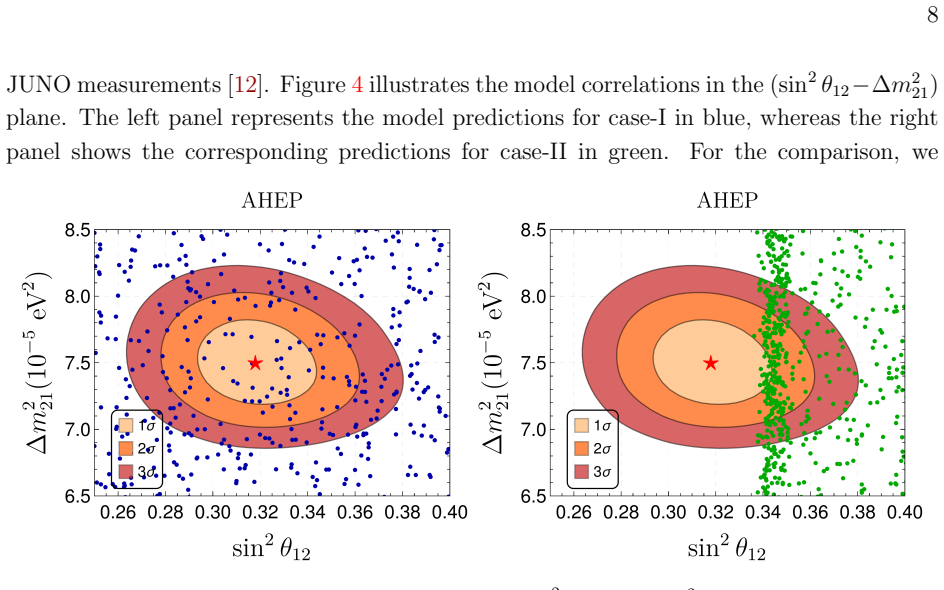
The resulting predictions can be directly compared with the AHEP global fit data [80] and the 8 JUNO measurements [12]. Figure 4 illustrates the model correlations in the (sin2 θ12 −∆m2 21) plane. The left panel represents the model predictions for case-I in blue, whereas the right panel shows the corresponding predictions for case-II in green. For the co...
-
[6]
plane, with the corresponding best-fit point indicated by a red star. After imposing the constraints from the reactor mixing angleθ 13 and the atmospheric mass-squared difference ∆m 2 31, we find that the predictions of case-I, shown by blue points, span the entire allowed region. In contrast, the predictions of case-II, shown by green points, exhibit a l...
-
[7]
Evidence for oscillation of atmospheric neutrinos
CONCLUSIONS We have developed a framework in whichµ−τreflection symmetry is naturally realized as a consequence of an underlyingA 4 flavor symmetry. Neutrino masses are generated via the type-II seesaw mechanism through the introduction of twoSU(2) L triplet scalars: ∆ i and ∆′, transforming as singlets and a triplet underA 4, respectively. The specific v...
work page internal anchor Pith review Pith/arXiv arXiv 1990
-
[8]
B. T. Cleveland, T. Daily, R. Davis, Jr., J. R. Distel, K. Lande, C. K. Lee, P. S. Wildenhain, and J. Ullman, “Measurement of the solar electron neutrino flux with the Homestake chlorine detector,”Astrophys. J.496(1998) 505–526. [5]SNOCollaboration, Q. R. Ahmadet al., “Direct evidence for neutrino flavor transformation from neutral current interactions in...
work page internal anchor Pith review Pith/arXiv arXiv 1998
-
[9]
Unified Models of Neutrinos, Flavour and CP Violation
S. F. King, “Unified Models of Neutrinos, Flavour and CP Violation,”Prog. Part. Nucl. Phys.94(2017) 217–256,arXiv:1701.04413 [hep-ph]
work page internal anchor Pith review Pith/arXiv arXiv 2017
-
[10]
F. Feruglio and A. Romanino, “Lepton flavor symmetries,”Rev. Mod. Phys.93no. 1, (2021) 015007,arXiv:1912.06028 [hep-ph]. 13
-
[11]
Flavor structures of charged fermions and massive neutrinos,
Z.-z. Xing, “Flavor structures of charged fermions and massive neutrinos,”Phys. Rept.854 (2020) 1–147,arXiv:1909.09610 [hep-ph]
-
[12]
Neutrino Flavor Model Building and the Origins of Flavor and CP Violation,
Y. Almumin, M.-C. Chen, M. Cheng, V. Knapp-Perez, Y. Li, A. Mondol, S. Ramos-Sanchez, M. Ratz, and S. Shukla, “Neutrino Flavor Model Building and the Origins of Flavor and CP Violation,”Universe9no. 12, (2023) 512,arXiv:2204.08668 [hep-ph]
-
[13]
Phenomenology of lepton masses and mixing with discrete flavor symmetries,
G. Chauhan, P. S. B. Dev, I. Dubovyk, B. Dziewit, W. Flieger, K. Grzanka, J. Gluza, B. Karmakar, and S. Zieba, “Phenomenology of lepton masses and mixing with discrete flavor symmetries,”Prog. Part. Nucl. Phys.138(2024) 104126,arXiv:2310.20681 [hep-ph]
-
[14]
Neutrino mass and mixing with modular symmetry,
G.-J. Ding and S. F. King, “Neutrino mass and mixing with modular symmetry,”Rept. Prog. Phys.87no. 8, (2024) 084201,arXiv:2311.09282 [hep-ph]
-
[15]
The symmetry approach to quark and lepton masses and mixing,
G.-J. Ding and J. W. F. Valle, “The symmetry approach to quark and lepton masses and mixing,”Phys. Rept.1109(2025) 1–105,arXiv:2402.16963 [hep-ph]. [22]DUNECollaboration, R. Acciarriet al., “Long-Baseline Neutrino Facility (LBNF) and Deep Underground Neutrino Experiment (DUNE): Conceptual Design Report, Volume 1: The LBNF and DUNE Projects,”arXiv:1601.054...
-
[16]
Quantum field theory approach to neutrino oscillations in dark matter and implications at JUNO,
W. Chao, “Quantum field theory approach to neutrino oscillations in dark matter and implications at JUNO,”arXiv:2511.15494 [hep-ph]
-
[17]
Y.-F. Li, A. Wang, Y. Xu, and J.-y. Zhu, “Terrestrial Matter Effects on Reactor Antineutrino Oscillations: Constant vs. Fluctuated Density Profiles,”arXiv:2511.15702 [hep-ph]
-
[18]
J. Huang and S. Zhou, “Probing unitarity violation of lepton flavor mixing matrix with reactor antineutrinos at JUNO and TAO,”arXiv:2511.15525 [hep-ph]
-
[19]
Neutrinoless Double Beta Decay in Light of JUNO First Data,
S.-F. Ge, C.-F. Kong, M. Lindner, and J. P. Pinheiro, “Neutrinoless Double Beta Decay in Light of JUNO First Data,”arXiv:2511.15391 [hep-ph]
-
[20]
Potential divergence in tracing $\mu$ and $\tau$ flavors of astrophysical neutrinos
Z.-z. Xing, “Divergence in tracing the flavors of astrophysical neutrinos: can JUNO help IceCube?,”arXiv:2511.15127 [hep-ph]. 14
work page internal anchor Pith review Pith/arXiv arXiv
-
[21]
Probing quark-lepton correlation in GUTs with high-precision neutrino measurements,
Z.-Q. Chen, G.-X. Fang, and Y.-L. Zhou, “Probing quark-lepton correlation in GUTs with high-precision neutrino measurements,”arXiv:2511.16196 [hep-ph]
-
[22]
Discrete flavour and CP symmetries in light of JUNO and neutrino global fit,
G.-J. Ding, C.-C. Li, J.-N. Lu, and S. T. Petcov, “Discrete flavour and CP symmetries in light of JUNO and neutrino global fit,”arXiv:2512.03809 [hep-ph]
-
[23]
D. Borah, P. Das, and D. Dutta, “Neutrino texture-zeros after JUNO’s first results: Implications for long-baseline neutrino experiments,”arXiv:2512.13587 [hep-ph]
-
[24]
AnA 4-Symmetric Double Seesaw for Neutrino Masses and Mixing in Light of JUNO results,
S. K. Nanda, M. Ricky Devi, C. Dash, R. N. Panda, and S. Patra, “AnA 4-Symmetric Double Seesaw for Neutrino Masses and Mixing in Light of JUNO results,” arXiv:2512.24132 [hep-ph]
-
[25]
New modular fixed point models and their phenomenological implications for JUNO, T2HK and DUNE,
E.-H. Shang, J.-N. Lu, G.-J. Ding, and S. F. King, “New modular fixed point models and their phenomenological implications for JUNO, T2HK and DUNE,”arXiv:2601.09598 [hep-ph]
-
[26]
Trimaximal Mixing Patterns Meet the First JUNO Result,
D. Zhang, “Trimaximal Mixing Patterns Meet the First JUNO Result,”arXiv:2511.15654 [hep-ph]
-
[27]
Modified Tri-bimaximal neutrino mixing confront with JUNOθ 12 measurement,
X.-G. He, “Modified Tri-bimaximal neutrino mixing confront with JUNOθ 12 measurement,” arXiv:2511.15978 [hep-ph]
-
[28]
Modular TM 1 mixing in light of precision measurement in JUNO,
W.-H. Jiang, R. Ouyang, and Y.-L. Zhou, “Modular TM 1 mixing in light of precision measurement in JUNO,”arXiv:2511.16348 [hep-ph]
-
[29]
Zooming in on ‘bi-large’ neutrino mixing with the first JUNO results,
G.-J. Ding, R. Kumar, N. Nath, R. Srivastava, and J. W. F. Valle, “Zooming in on ‘bi-large’ neutrino mixing with the first JUNO results,”arXiv:2511.22689 [hep-ph]
-
[30]
Testing residual-symmetry-fixed columns ofU PMNS at DUNE and T2HK with initial JUNO constraints,
D. Dutta, S. Goswami, M. Kashav, and K. M. Patel, “Testing residual-symmetry-fixed columns ofU PMNS at DUNE and T2HK with initial JUNO constraints,”arXiv:2601.18397 [hep-ph]
-
[31]
Mu-Tau Reflection Symmetry in Lepton Mixing and Neutrino Oscillations
P. F. Harrison and W. G. Scott, “mu - tau reflection symmetry in lepton mixing and neutrino oscillations,”Phys. Lett. B547(2002) 219–228,arXiv:hep-ph/0210197
work page internal anchor Pith review Pith/arXiv arXiv 2002
-
[32]
Generalized $\mu-\tau$ reflection symmetry and leptonic CP violation
P. Chen, G.-J. Ding, F. Gonzalez-Canales, and J. W. F. Valle, “Generalizedµ−τreflection symmetry and leptonic CP violation,”Phys. Lett. B753(2016) 644–652, arXiv:1512.01551 [hep-ph]
work page internal anchor Pith review Pith/arXiv arXiv 2016
-
[33]
µ−τReflection Symmetry Embedded in Minimal Seesaw,
N. Nath, Z.-z. Xing, and J. Zhang, “µ−τReflection Symmetry Embedded in Minimal Seesaw,”Eur. Phys. J. C78no. 4, (2018) 289,arXiv:1801.09931 [hep-ph]
-
[34]
Exploring Partial $\mu$-$\tau$ Reflection Symmetry at DUNE and Hyper-Kamiokande
K. Chakraborty, K. N. Deepthi, S. Goswami, A. S. Joshipura, and N. Nath, “Exploring partialµ-τreflection symmetry at DUNE and Hyper-Kamiokande,”Phys. Rev. D98no. 7, (2018) 075031,arXiv:1804.02022 [hep-ph]
work page internal anchor Pith review Pith/arXiv arXiv 2018
-
[35]
µ−τreflection symmetry and its explicit breaking for leptogenesis in a minimal seesaw model,
N. Nath, “µ−τreflection symmetry and its explicit breaking for leptogenesis in a minimal seesaw model,”Mod. Phys. Lett. A34no. 39, (2019) 1950329,arXiv:1808.05062 [hep-ph]
-
[36]
Consequences of $ \mu-\tau $ Reflection Symmetry at DUNE
N. Nath, “Consequences ofµ−τReflection Symmetry at DUNE,”Phys. Rev. D98no. 7, (2018) 075015,arXiv:1805.05823 [hep-ph]. 15
work page internal anchor Pith review Pith/arXiv arXiv 2018
-
[37]
N. Nath, “Impact of RGE-inducedµ−τreflection symmetry breaking on the effective Majorana neutrino mass in 0νββdecay,”Phys. Rev. D99no. 3, (2019) 035026, arXiv:1810.07938 [hep-ph]
work page internal anchor Pith review Pith/arXiv arXiv 2019
-
[38]
Nonstandard neutrino interactions and mu-tau reflection symmetry,
J. Liao, N. Nath, T. Wang, and Y.-L. Zhou, “Nonstandard neutrino interactions and mu-tau reflection symmetry,”Phys. Rev. D101no. 9, (2020) 095036,arXiv:1911.00213 [hep-ph]
-
[39]
RGE-inducedµ-τsymmetry breaking: an analysis of the latest T2K results,
G.-y. Huang and N. Nath, “RGE-inducedµ-τsymmetry breaking: an analysis of the latest T2K results,”Eur. Phys. J. C80no. 10, (2020) 914,arXiv:2004.12391 [hep-ph]
-
[40]
Interplay between exactµ-τreflection symmetries, four-zero texture and universal texture,
M. J. S. Yang, “Interplay between exactµ-τreflection symmetries, four-zero texture and universal texture,”Phys. Lett. B806(2020) 135483,arXiv:2002.09152 [hep-ph]
-
[41]
Z.-h. Zhao, “Combinations of theµ-τreflection symmetry and texture zeros in the Dirac neutrino mass matrix of the seesaw model,”Eur. Phys. J. Plus138no. 11, (2023) 1055
work page 2023
-
[42]
Low scale leptogenesis under neutrinoµ−τreflection symmetry,
Y. Shao and Z.-h. Zhao, “Low scale leptogenesis under neutrinoµ−τreflection symmetry,” Phys. Rev. D111no. 3, (2025) 035011,arXiv:2409.04089 [hep-ph]
-
[43]
M. J. S. Yang, “Almost general analysis ofµ-τreflection symmetry perturbed by charged leptons and its testability by DUNE and T2HK,”Nucl. Phys. B1018(2025) 117092, arXiv:2504.00365 [hep-ph]
-
[44]
Underlying A_4 Symmetry for the Neutrino Mass Matrix and the Quark Mixing Matrix
K. S. Babu, E. Ma, and J. W. F. Valle, “Underlying A(4) symmetry for the neutrino mass matrix and the quark mixing matrix,”Phys. Lett. B552(2003) 207–213, arXiv:hep-ph/0206292
work page internal anchor Pith review Pith/arXiv arXiv 2003
-
[45]
Hybrid Seesaw Neutrino Masses with A_4 Family Symmetry
S.-L. Chen, M. Frigerio, and E. Ma, “Hybrid seesaw neutrino masses with A(4) family symmetry,”Nucl. Phys. B724(2005) 423–431,arXiv:hep-ph/0504181
work page internal anchor Pith review Pith/arXiv arXiv 2005
-
[46]
Tri-Bimaximal Neutrino Mixing, A4 and the Modular Symmetry
G. Altarelli and F. Feruglio, “Tri-bimaximal neutrino mixing, A(4) and the modular symmetry,”Nucl. Phys. B741(2006) 215–235,arXiv:hep-ph/0512103
work page internal anchor Pith review Pith/arXiv arXiv 2006
-
[47]
$A_4$ Flavour Model for Dirac Neutrinos: Type I and Inverse Seesaw
D. Borah and B. Karmakar, “A 4 flavour model for Dirac neutrinos: Type I and inverse seesaw,”Phys. Lett. B780(2018) 461–470,arXiv:1712.06407 [hep-ph]
work page internal anchor Pith review Pith/arXiv arXiv 2018
-
[48]
S. Centelles Chuli´ a, R. Srivastava, and J. W. F. Valle, “Generalized Bottom-Tau unification, neutrino oscillations and dark matter: predictions from a lepton quarticity flavor approach,” Phys. Lett. B773(2017) 26–33,arXiv:1706.00210 [hep-ph]
work page internal anchor Pith review Pith/arXiv arXiv 2017
-
[49]
Linear Seesaw for Dirac Neutrinos with $A_4$ Flavour Symmetry
D. Borah and B. Karmakar, “Linear seesaw for Dirac neutrinos withA 4 flavour symmetry,” Phys. Lett. B789(2019) 59–70,arXiv:1806.10685 [hep-ph]
work page internal anchor Pith review Pith/arXiv arXiv 2019
-
[50]
Trimaximal neutrino mixing from scotogenicA 4 family symmetry,
G.-J. Ding, J.-N. Lu, and J. W. F. Valle, “Trimaximal neutrino mixing from scotogenicA 4 family symmetry,”Phys. Lett. B815(2021) 136122,arXiv:2009.04750 [hep-ph]. [Erratum: Phys.Lett.B 845, 138151 (2023)]
-
[51]
Linking resonant leptogenesis with dynamics of the inverse seesaw theory withA 4 flavor symmetry,
M. Ricky Devi and K. Bora, “Linking resonant leptogenesis with dynamics of the inverse seesaw theory withA 4 flavor symmetry,”arXiv:2304.13546 [hep-ph]
-
[52]
Neutrino mass sum rules from modular A4 symmetry,
S. Centelles Chuli´ a, R. Kumar, O. Popov, and R. Srivastava, “Neutrino mass sum rules from modular A4 symmetry,”Phys. Rev. D109no. 3, (2024) 035016,arXiv:2308.08981 [hep-ph]. 16
-
[53]
Predictions from scoto-seesaw with A4 modular symmetry,
R. Kumar, P. Mishra, M. K. Behera, R. Mohanta, and R. Srivastava, “Predictions from scoto-seesaw with A4 modular symmetry,”Phys. Lett. B853(2024) 138635, arXiv:2310.02363 [hep-ph]
-
[54]
Minimal type-I Dirac seesaw and leptogenesis under A4 modular invariance,
L. Singh, M. Kashav, and S. Verma, “Minimal type-I Dirac seesaw and leptogenesis under A4 modular invariance,”Nucl. Phys. B1007(2024) 116666,arXiv:2405.07165 [hep-ph]
-
[55]
Cutting the scotogenic loop: adding flavor to dark matter,
R. Kumar, N. Nath, and R. Srivastava, “Cutting the scotogenic loop: adding flavor to dark matter,”JHEP12(2024) 036,arXiv:2406.00188 [hep-ph]
-
[56]
Type-II seesaw of a non-holomorphic modular A4 symmetry,
T. Nomura and H. Okada, “Type-II seesaw of a non-holomorphic modular A4 symmetry,” Phys. Lett. B868(2025) 139763,arXiv:2408.01143 [hep-ph]
-
[57]
Discrete leptonic flavor symmetries: UV mediators and phenomenology,
A. Palavri´ c, “Discrete leptonic flavor symmetries: UV mediators and phenomenology,”Phys. Rev. D110no. 11, (2024) 115025,arXiv:2408.16044 [hep-ph]
-
[58]
Leptonic flavor from a modular A4 symmetry: UV mediators and SMEFT realizations,
A. Moreno-S´ anchez and A. Palavri´ c, “Leptonic flavor from a modular A4 symmetry: UV mediators and SMEFT realizations,”Phys. Rev. D112no. 7, (2025) 075002, arXiv:2505.01535 [hep-ph]
-
[59]
Dirac Scoto inverse-seesaw from A 4 flavor symmetry,
R. Kumar, N. Nath, R. Srivastava, and S. Yadav, “Dirac Scoto inverse-seesaw from A 4 flavor symmetry,”JHEP10(2025) 088,arXiv:2505.01407 [hep-ph]
-
[60]
Flavor imprints on novel low mass dark matter,
R. Kumar, H. K. Prajapati, R. Srivastava, and S. Yadav, “Flavor imprints on novel low mass dark matter,”JHEP11(2025) 094,arXiv:2510.02972 [hep-ph]
-
[61]
Minimal A4 Type-II Seesaw Realization of Testable Neutrino Mass Sum Rules,
S. Centelles Chuli´ a and R. Kumar, “Minimal A4 Type-II Seesaw Realization of Testable Neutrino Mass Sum Rules,”arXiv:2512.22343 [hep-ph]
-
[62]
Non-Abelian Discrete Symmetries in Particle Physics
H. Ishimori, T. Kobayashi, H. Ohki, Y. Shimizu, H. Okada, and M. Tanimoto, “Non-Abelian Discrete Symmetries in Particle Physics,”Prog. Theor. Phys. Suppl.183(2010) 1–163, arXiv:1003.3552 [hep-th]
work page internal anchor Pith review Pith/arXiv arXiv 2010
-
[63]
Neutrino Masses in SU(2) x U(1) Theories,
J. Schechter and J. W. F. Valle, “Neutrino Masses in SU(2) x U(1) Theories,”Phys. Rev. D 22(1980) 2227
work page 1980
-
[64]
Neutrino Mass Problem and Gauge Hierarchy,
M. Magg and C. Wetterich, “Neutrino Mass Problem and Gauge Hierarchy,”Phys. Lett. B 94(1980) 61–64
work page 1980
-
[65]
Neutrino Masses, Mixings and Oscillations in SU(2) x U(1) Models of Electroweak Interactions,
T. P. Cheng and L.-F. Li, “Neutrino Masses, Mixings and Oscillations in SU(2) x U(1) Models of Electroweak Interactions,”Phys. Rev. D22(1980) 2860
work page 1980
-
[66]
Neutrino Masses and Mixings in Gauge Models with Spontaneous Parity Violation,
R. N. Mohapatra and G. Senjanovic, “Neutrino Masses and Mixings in Gauge Models with Spontaneous Parity Violation,”Phys. Rev. D23(1981) 165
work page 1981
-
[67]
Geometric minimization of highly symmetric potentials
A. Degee, I. P. Ivanov, and V. Keus, “Geometric minimization of highly symmetric potentials,”JHEP02(2013) 125,arXiv:1211.4989 [hep-ph]
work page internal anchor Pith review Pith/arXiv arXiv 2013
-
[68]
Conditions for global minimum in theA 4 symmetric 3HDM,
S. Carrolo, J. C. Romao, and J. P. Silva, “Conditions for global minimum in theA 4 symmetric 3HDM,”Eur. Phys. J. C82no. 8, (2022) 749,arXiv:2207.02928 [hep-ph]
-
[69]
2020 global reassessment of the neutrino oscillation picture,
P. F. de Salas, D. V. Forero, S. Gariazzo, P. Mart´ ınez-Mirav´ e, O. Mena, C. A. Ternes, M. T´ ortola, and J. W. F. Valle, “2020 global reassessment of the neutrino oscillation picture,”JHEP02(2021) 071,arXiv:2006.11237 [hep-ph]. 17
-
[70]
Symmetrical Parametrizations of the Lepton Mixing Matrix
W. Rodejohann and J. W. F. Valle, “Symmetrical Parametrizations of the Lepton Mixing Matrix,”Phys. Rev. D84(2011) 073011,arXiv:1108.3484 [hep-ph]
work page internal anchor Pith review Pith/arXiv arXiv 2011
discussion (0)
Sign in with ORCID, Apple, or X to comment. Anyone can read and Pith papers without signing in.