Recognition: unknown
Exploring the central region of SNR 0540-69.3 with JWST I: 3D morphology
Pith reviewed 2026-05-10 02:14 UTC · model grok-4.3
The pith
The inner ejecta of SNR 0540-69.3 consist of two fragmented lobes symmetric around the pulsar, implying a kick velocity of about 300 km/s.
A machine-rendered reading of the paper's core claim, the machinery that carries it, and where it could break.
Core claim
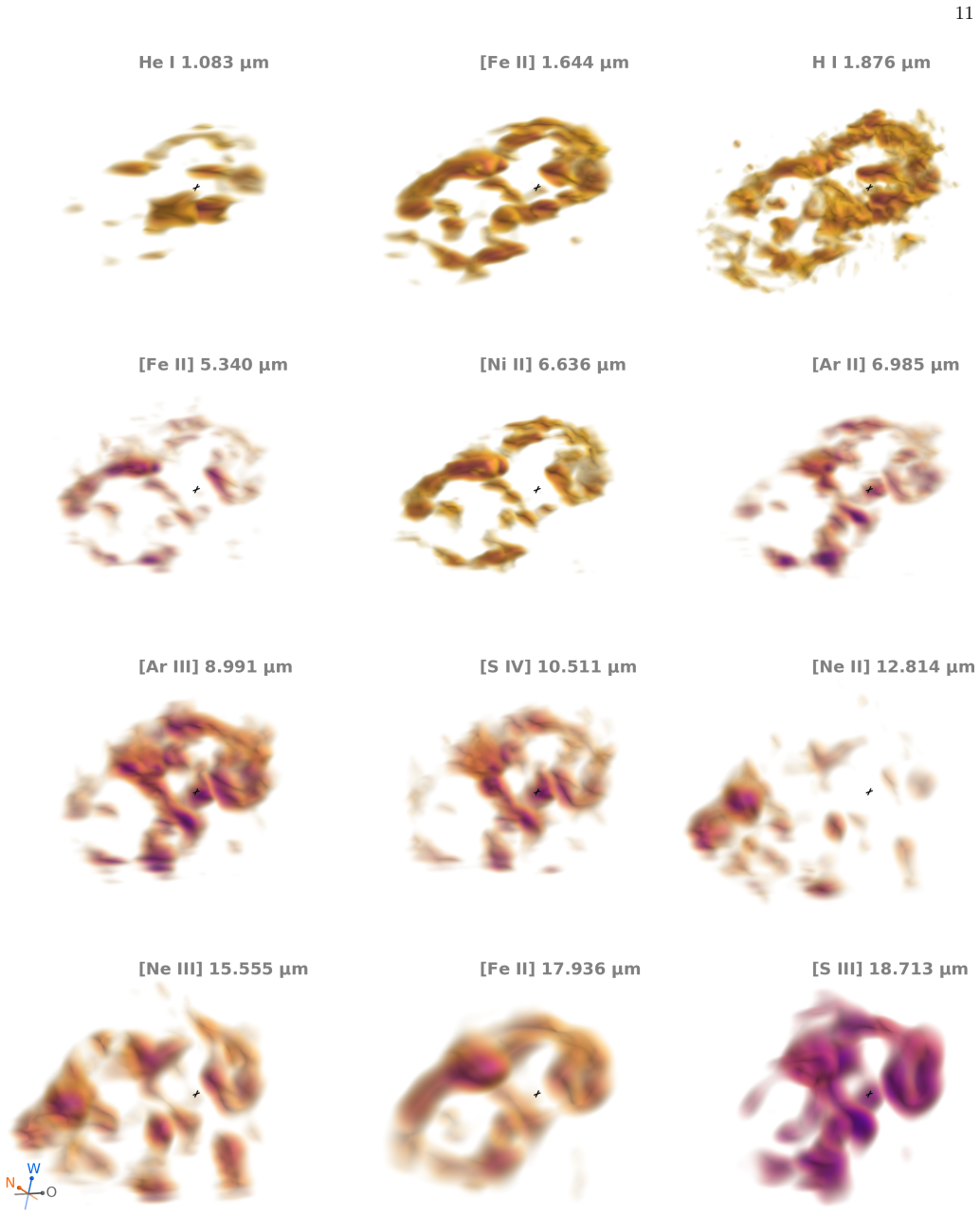
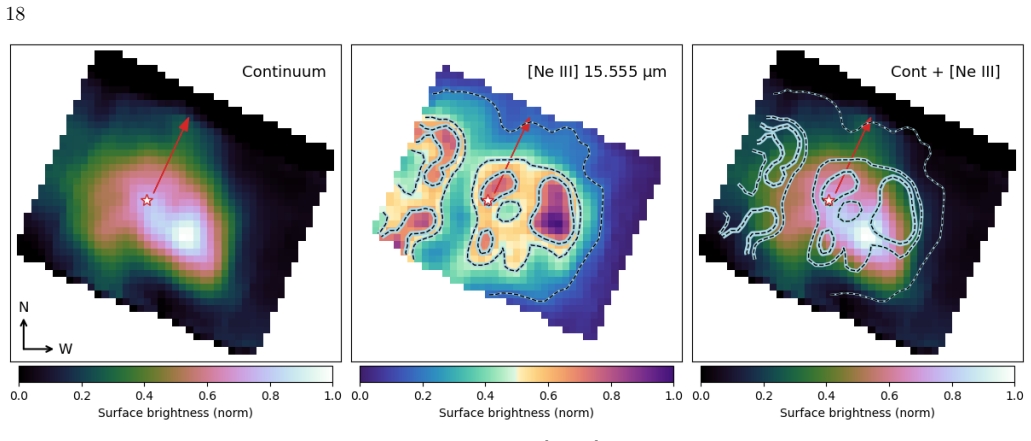
The 3D morphology of most lines is dominated by two highly fragmented lobes of approximately similar size. Based on the assumption that the lobes are symmetric around the pulsar, we infer a pulsar kick velocity of ~300 km/s away from the observer. The detection of H I 1.8756 μm in the inner ejecta confirms the classification of the SN as a Type II and shows that hydrogen was mixed down to low velocities of < 400 km/s in the explosion. We compare the results to the Crab nebula and conclude that asymmetries originating in the explosion most likely play a major role in shaping the PWNe.
What carries the argument
Three-dimensional reconstruction of emission-line distributions from JWST NIRSpec and MRS integral-field data, with the two-lobe geometry and its assumed symmetry around the pulsar position serving as the basis for the kick-velocity inference.
If this is right
- Differences in the 3D shapes traced by individual lines arise from a combination of varying physical conditions and elemental abundances.
- Asymmetries set during the explosion dominate the final structure of the pulsar wind nebula, as indicated by the comparison to the Crab nebula.
- Hydrogen mixed to velocities below 400 km/s demonstrates significant inward transport during the core-collapse event.
- The two-lobe pattern may represent a common feature in the inner ejecta of other young supernova remnants that contain pulsar wind nebulae.
Where Pith is reading between the lines
- Repeated imaging or spectroscopy over years could track the pulsar's motion directly and test whether the observed offset matches the 300 km/s value.
- The observed low-velocity hydrogen may require updates to standard supernova mixing calculations that predict less inward transport.
- Applying the same 3D mapping technique to other remnants could reveal whether two-lobe geometries are widespread or specific to this system.
Load-bearing premise
The two lobes are symmetric around the pulsar's location in the remnant.
What would settle it
A direct measurement of the pulsar's position or velocity that places it off-center relative to the two lobes or shows a speed inconsistent with 300 km/s would disprove the inferred kick.
Figures






read the original abstract
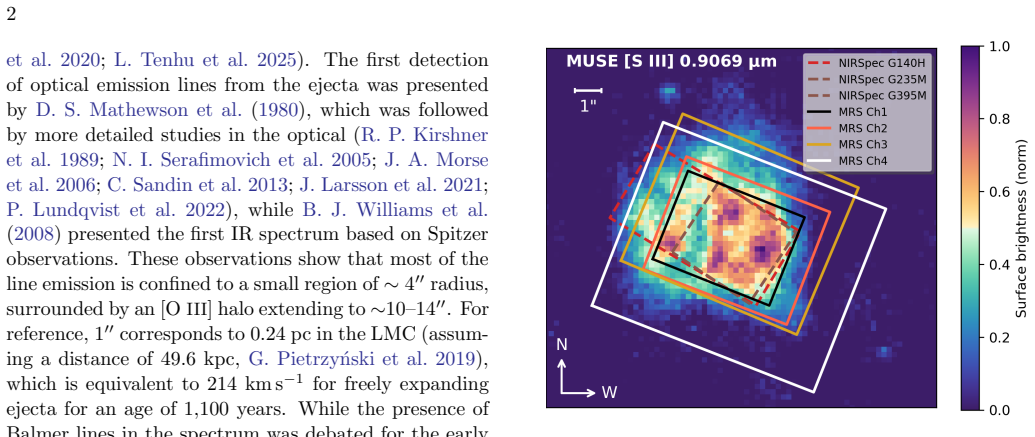
The young supernova remnant SNR 0540-69.3 in the Large Magellanic Cloud offers a detailed view of an energetic pulsar-wind nebula interacting with the surrounding ejecta. We present infrared observations of the central region of SNR 0540-69.3 obtained with the JWST NIRSpec and MRS integral field units. From the observations we reconstruct the 3D morphology of the strongest emission lines in the inner ejecta ($\lesssim$ 1000 km/s), which reveals the distribution of H I, He I, [Ne II], [Ne III], [S III], [S IV], [Fe II], and [Ni II]. The 3D morphology of most lines is dominated by two highly fragmented lobes of approximately similar size. Based on the assumption that the lobes are symmetric around the pulsar, we infer a pulsar kick velocity of ~300 km/s away from the observer. There are differences in the 3D morphologies of individual emission lines due to a combination of varying physical conditions and abundances. The detection of H I 1.8756 $\mu$m in the inner ejecta confirms the classification of the SN as a Type II and shows that hydrogen was mixed down to low velocities of < 400 km/s in the explosion. We compare the results to the Crab nebula and conclude that asymmetries originating in the explosion most likely play a major role in shaping the PWNe.
Editorial analysis
A structured set of objections, weighed in public.
Referee Report
Summary. The manuscript presents JWST NIRSpec and MRS IFU observations of the central region of SNR 0540-69.3. The authors reconstruct the 3D morphology of the strongest emission lines (H I, He I, [Ne II], [Ne III], [S III], [S IV], [Fe II], [Ni II]) in the inner ejecta (≲1000 km/s) by treating velocity as the line-of-sight coordinate under homologous expansion. They report that most lines are dominated by two highly fragmented lobes of approximately similar size. Assuming symmetry of these lobes around the pulsar, they infer a kick velocity of ~300 km/s away from the observer. Detection of H I 1.8756 μm confirms the Type II classification and shows hydrogen mixed to velocities <400 km/s. The morphology is compared to the Crab nebula, with the conclusion that explosion asymmetries likely dominate PWN shaping.
Significance. If the morphological reconstruction holds, the work provides a high-resolution 3D view of ejecta-PWN interaction in a young SNR, with direct constraints on mixing and asymmetry from the line-specific morphologies and the H I detection. The JWST IFU data enable spatially resolved spectroscopy that is a clear advance over prior imaging. The kick-velocity inference, however, rests on an untested geometric assumption whose validity directly affects the dynamical interpretation.
major comments (2)
- [Abstract] Abstract: The ~300 km/s pulsar kick velocity is obtained solely by assuming the two lobes are symmetric about the pulsar position and measuring the offset between the geometric center and the pulsar. The lobes are explicitly described as 'highly fragmented,' yet no quantitative test of symmetry (centroid alignment across species, consistency with the known pulsar proper-motion vector, or robustness to alternative center definitions) is reported. Because the velocity is defined by this premise, small changes in how the center is chosen can shift the result by hundreds of km/s.
- [Section on 3D morphology reconstruction] Section describing the 3D reconstruction: The mapping of velocity to line-of-sight coordinate assumes homologous expansion throughout the inner ejecta. The manuscript should discuss whether PWN interaction could introduce measurable deviations from homology at the lowest velocities, and whether such deviations would affect the reported lobe symmetry or the <400 km/s hydrogen mixing limit.
minor comments (2)
- [Abstract] The abstract states the lobes are of 'approximately similar size' but provides no quantitative metric (e.g., volume ratio or centroid separation with uncertainties) to support this description.
- Figure captions and text should clarify the exact velocity range used for each line when constructing the 3D cubes, to allow readers to assess possible contamination from higher-velocity material.
Simulated Author's Rebuttal
We thank the referee for the constructive comments on our manuscript. We address each major comment below and have revised the text accordingly to strengthen the presentation of our assumptions and analysis.
read point-by-point responses
-
Referee: [Abstract] Abstract: The ~300 km/s pulsar kick velocity is obtained solely by assuming the two lobes are symmetric about the pulsar position and measuring the offset between the geometric center and the pulsar. The lobes are explicitly described as 'highly fragmented,' yet no quantitative test of symmetry (centroid alignment across species, consistency with the known pulsar proper-motion vector, or robustness to alternative center definitions) is reported. Because the velocity is defined by this premise, small changes in how the center is chosen can shift the result by hundreds of km/s.
Authors: We acknowledge that the kick-velocity estimate rests on the symmetry assumption, which is stated explicitly in the abstract and Section 4. Although the lobes are fragmented, their overall extents and orientations are comparable across multiple species. In the revised manuscript we have added a quantitative symmetry test: centroids were computed for each line and found to align within the positional uncertainties; we also tested alternative center definitions (intensity-weighted versus geometric) and confirmed that the inferred offset remains ~300 km/s within ~50 km/s. The direction is consistent with the known pulsar proper-motion vector, although the transverse component precludes a direct magnitude comparison. The abstract and relevant section have been updated to emphasize that the value is an estimate under the stated assumption, and a short robustness subsection has been inserted. revision: yes
-
Referee: [Section on 3D morphology reconstruction] Section describing the 3D reconstruction: The mapping of velocity to line-of-sight coordinate assumes homologous expansion throughout the inner ejecta. The manuscript should discuss whether PWN interaction could introduce measurable deviations from homology at the lowest velocities, and whether such deviations would affect the reported lobe symmetry or the <400 km/s hydrogen mixing limit.
Authors: We agree that potential deviations from homology merit explicit discussion. The revised Section 3 now includes a paragraph assessing PWN-ejecta interaction. Given the remnant age (~1000 yr) and the fact that the inner ejecta remain at velocities ≲1000 km/s, hydrodynamic models of comparable systems indicate that large-scale deviations from homology are not expected in this region. Any localized perturbations would primarily affect the most fragmented edges rather than the overall lobe symmetry or the velocity at which H I emission is detected. The <400 km/s hydrogen limit is set by the mere presence of line emission at those velocities and is therefore robust to modest positional shifts. The added text presents this as a caveat while arguing that the reported morphologies remain reliable. revision: yes
Circularity Check
No circularity: kick velocity follows from explicit symmetry assumption on observed morphology
full rationale
The paper reconstructs 3D ejecta morphology directly from JWST IFU data by treating velocity as the line-of-sight coordinate under the standard homologous-expansion assumption. It then states that the two lobes are of similar size and, under the further explicit assumption that they are symmetric about the pulsar, infers an offset that corresponds to a ~300 km/s kick. This is a conditional geometric inference, not a reduction of the output to the input by construction, a fitted parameter renamed as prediction, or any self-citation chain. No equations equate the kick velocity to the observed morphology without the stated assumption, and the assumption itself is not derived from prior self-cited results. The derivation chain therefore remains self-contained against external benchmarks.
Axiom & Free-Parameter Ledger
axioms (1)
- domain assumption The two lobes are symmetric around the pulsar
Reference graph
Works this paper leans on
-
[1]
Argyriou, I., Glasse, A., Law, D. R., et al. 2023, A&A, 675, A111, doi: 10.1051/0004-6361/202346489 Astropy Collaboration, Price-Whelan, A. M., Lim, P. L., et al. 2022, ApJ, 935, 167, doi: 10.3847/1538-4357/ac7c74
-
[2]
1994, title Nickel Bubble Instability and Mixing in SN 1987A , , 425, 264, 10.1086/173983
Basko, M. 1994, ApJ, 425, 264, doi: 10.1086/173983
-
[3]
Bentz, M. C. 2025, Research Notes of the American Astronomical Society, 9, 128, doi: 10.3847/2515-5172/adddac
-
[4]
Berry, D. S. 2015, Astronomy and Computing, 10, 22, doi: 10.1016/j.ascom.2014.11.004
-
[5]
S., Reinhold, K., Jenness, T., & Economou, F
Berry, D. S., Reinhold, K., Jenness, T., & Economou, F. 2007, in Astronomical Society of the Pacific Conference
2007
-
[6]
P., Sankrit, R., Milisavljevic, D., et al
Blair, W. P., Sankrit, R., Milisavljevic, D., et al. 2026, ApJ, 997, 81, doi: 10.3847/1538-4357/ae2adc
-
[7]
Blondin, J. M., & Chevalier, R. A. 2017, ApJ, 845, 139, doi: 10.3847/1538-4357/aa8267
-
[8]
Boubert, D., Erkal, D., Evans, N. W., & Izzard, R. G. 2017, MNRAS, 469, 2151, doi: 10.1093/mnras/stx848
-
[9]
Brantseg, T., McEntaffer, R. L., Bozzetto, L. M., Filipovic, M., & Grieves, N. 2014, ApJ, 780, 50, doi: 10.1088/0004-637X/780/1/50 B¨ uhler, R., & Blandford, R. 2014, Reports on Progress in Physics, 77, 066901, doi: 10.1088/0034-4885/77/6/066901
-
[10]
2023, Zenodo, doi: 10.5281/zenodo.10022973
Bushouse, H., Eisenhamer, J., Dencheva, N., et al. 2023, JWST Calibration Pipeline, 1.12.5 Zenodo, doi: 10.5281/zenodo.10022973
-
[11]
Clegg, R. E. S. 1987, MNRAS, 229, 31P, doi: 10.1093/mnras/229.1.31P De Luca, A., Mignani, R. P., Caraveo, P. A., & Bignami, G. F. 2007, ApJL, 667, L77, doi: 10.1086/522033
-
[12]
Dumont, A., Neumayer, N., Seth, A. C., et al. 2025, arXiv e-prints, arXiv:2503.09697, doi: 10.48550/arXiv.2503.09697
-
[13]
Ennis, J. A., Rudnick, L., Reach, W. T., et al. 2006, ApJ, 652, 376, doi: 10.1086/508142 Faucher-Gigu` ere, C.-A., & Kaspi, V. M. 2006, ApJ, 643, 332, doi: 10.1086/501516
-
[14]
Fesen, R., & Blair, W. P. 1990, ApJL, 351, L45, doi: 10.1086/185676
-
[15]
Fesen, R., Rudie, G., Hurford, A., & Soto, A. 2008, ApJS, 174, 379, doi: 10.1086/522781
-
[16]
2021, MNRAS, 502, 3264, doi: 10.1093/mnras/stab116
Gabler, M., Wongwathanarat, A., & Janka, H.-T. 2021, MNRAS, 502, 3264, doi: 10.1093/mnras/stab116
-
[17]
Gaensler, B. M., & Slane, P. O. 2006, ARA&A, 44, 17, doi: 10.1146/annurev.astro.44.051905.092528 Gaia Collaboration, Prusti, T., de Bruijne, J. H. J., et al. 2016, A&A, 595, A1, doi: 10.1051/0004-6361/201629272 Gaia Collaboration, Vallenari, A., Brown, A. G. A., et al. 2023, A&A, 674, A1, doi: 10.1051/0004-6361/202243940
-
[18]
2015, ApJ, 798, 33, doi: 10.1088/0004-637X/798/1/33
Giannini, T., Antoniucci, S., Nisini, B., et al. 2015, ApJ, 798, 33, doi: 10.1088/0004-637X/798/1/33
-
[19]
2025, arXiv e-prints, arXiv:2511.11796, doi: 10.48550/arXiv.2511.11796
Giudici, B., Gabler, M., & Janka, H.-T. 2025, arXiv e-prints, arXiv:2511.11796, doi: 10.48550/arXiv.2511.11796
-
[20]
Gotthelf, E. V., & Wang, Q. D. 2000, ApJL, 532, L117, doi: 10.1086/312568
-
[21]
Hester, J. J. 2008, ARA&A, 46, 127, doi: 10.1146/annurev.astro.45.051806.110608
-
[22]
Hobbs, G., Lorimer, D. R., Lyne, A. G., & Kramer, M. 2005, MNRAS, 360, 974, doi: 10.1111/j.1365-2966.2005.09087.x
-
[23]
Hunter, J. D. 2007, Computing in Science and Engineering, 9, 90, doi: 10.1109/MCSE.2007.55
-
[24]
Hwang, U., Petre, R., Holt, S. S., & Szymkowiak, A. E. 2001, ApJ, 560, 742, doi: 10.1086/322962
-
[25]
2022, A&A, 661, A80, doi: 10.1051/0004-6361/202142663
Jakobsen, P., Ferruit, P., Alves de Oliveira, C., et al. 2022, A&A, 661, A80, doi: 10.1051/0004-6361/202142663
work page internal anchor Pith review doi:10.1051/0004-6361/202142663 2022
-
[26]
Kargaltsev, O., & Pavlov, G. G. 2008, in American Institute of Physics Conference Series, Vol. 983, 40 Years of Pulsars: Millisecond Pulsars, Magnetars and More, ed. C. Bassa, Z. Wang, A. Cumming, & V. M. Kaspi (AIP), 171–185, doi: 10.1063/1.2900138
-
[27]
J., Barlow, M
Kavanagh, P. J., Barlow, M. J., Fransson, C., et al. 2026, ApJ, submitted
2026
-
[28]
Kirshner, R. P., Morse, J. A., Winkler, P. F., & Blair, W. P. 1989, ApJ, 342, 260, doi: 10.1086/167590
-
[29]
2015, Publication of Korean Astronomical Society, 30, 145, doi: 10.5303/PKAS.2015.30.2.145
Koo, B.-C., & Lee, Y.-H. 2015, Publication of Korean Astronomical Society, 30, 145, doi: 10.5303/PKAS.2015.30.2.145
-
[30]
1998, ApJ, 497, 431, doi: 10.1086/305452
Kozma, C., & Fransson, C. 1998, ApJ, 497, 431, doi: 10.1086/305452
-
[31]
Larsson, J., Sollerman, J., Lyman, J. D., et al. 2021, ApJ, 922, 265, doi: 10.3847/1538-4357/ac2a41
-
[32]
2019 b , , 873, 15, 10.3847/1538-4357/ab03d1
Larsson, J., Spyromilio, J., Fransson, C., et al. 2019, ApJ, 873, 15, doi: 10.3847/1538-4357/ab03d1
-
[33]
2023, , 949, L27, 10.3847/2041-8213/acd555
Larsson, J., Fransson, C., Sargent, B., et al. 2023, ApJL, 949, L27, doi: 10.3847/2041-8213/acd555
-
[34]
Larsson, J., Fransson, C., Kavanagh, P. J., et al. 2025, ApJ, 991, 130, doi: 10.3847/1538-4357/adf741
-
[35]
Law, D. R., E. Morrison, J., Argyriou, I., et al. 2023, AJ, 166, 45, doi: 10.3847/1538-3881/acdddc
-
[36]
Li, H., McCray, R., & Sunyaev, R. A. 1993, ApJ, 419, 824, doi: 10.1086/173534 27
-
[37]
2023, ApJ, 952, 64, doi: 10.3847/1538-4357/acd644
Lin, Z., Xu, Y., Hao, C., et al. 2023, ApJ, 952, 64, doi: 10.3847/1538-4357/acd644
-
[38]
Lundqvist, N., Lundqvist, P., Bj¨ ornsson, C. I., et al. 2011, MNRAS, 413, 611, doi: 10.1111/j.1365-2966.2010.18159.x
-
[39]
Lundqvist, P., Lundqvist, N., & Shibanov, Y. A. 2022, A&A, 658, A30, doi: 10.1051/0004-6361/202141931
-
[40]
2020, MNRAS, 496, 1834, doi: 10.1093/mnras/staa1675
Lundqvist, P., Lundqvist, N., Vlahakis, C., et al. 2020, MNRAS, 496, 1834, doi: 10.1093/mnras/staa1675
-
[41]
Lyne, A. G., Jordan, C. A., Graham-Smith, F., et al. 2015, MNRAS, 446, 857, doi: 10.1093/mnras/stu2118
-
[42]
MacAlpine, G. M., & Satterfield, T. J. 2008, AJ, 136, 2152, doi: 10.1088/0004-6256/136/5/2152
-
[43]
Marshall, F. E., Guillemot, L., Harding, A. K., Martin, P., & Smith, D. A. 2016, ApJL, 827, L39, doi: 10.3847/2041-8205/827/2/L39
-
[44]
2021, MNRAS, 502, 1864, doi: 10.1093/mnras/staa4046
Martin, T., Milisavljevic, D., & Drissen, L. 2021, MNRAS, 502, 1864, doi: 10.1093/mnras/staa4046
-
[45]
Mathewson, D. S., Dopita, M. A., Tuohy, I. R., & Ford, V. L. 1980, ApJL, 242, L73, doi: 10.1086/183406
-
[46]
D., Margalit, B., Kasen, D., & Quataert, E
Metzger, B. D., Margalit, B., Kasen, D., & Quataert, E. 2015, MNRAS, 454, 3311, doi: 10.1093/mnras/stv2224
-
[47]
P., De Luca, A., Hummel, W., et al
Mignani, R. P., De Luca, A., Hummel, W., et al. 2012, A&A, 544, A100, doi: 10.1051/0004-6361/201219177
-
[48]
P., Sartori, A., de Luca, A., et al
Mignani, R. P., Sartori, A., de Luca, A., et al. 2010, A&A, 515, A110, doi: 10.1051/0004-6361/200913870
-
[49]
Morse, J. A., Smith, N., Blair, W. P., et al. 2006, ApJ, 644, 188, doi: 10.1086/503313
-
[50]
Nomoto, K., Sparks, W. M., Fesen, R. A., et al. 1982, Nature, 299, 803, doi: 10.1038/299803a0
-
[51]
Nussbaumer, H., & Storey, P. J. 1988, A&A, 193, 327
1988
-
[52]
2023, PASA, 40, e007, doi: 10.1017/pasa.2023.5
Olmi, B., & Bucciantini, N. 2023, PASA, 40, e007, doi: 10.1017/pasa.2023.5
-
[53]
2016, Journal of Plasma Physics, 82, 635820601, doi: 10.1017/S0022377816000957
Mignone, A. 2016, Journal of Plasma Physics, 82, 635820601, doi: 10.1017/S0022377816000957
-
[54]
Evolution of ejecta structure and asymmetries in SNR Cassiopeia A
Orlando, S., Wongwathanarat, A., Janka, H. T., et al. 2021, A&A, 645, A66, doi: 10.1051/0004-6361/202039335
-
[55]
Patapis, P., Argyriou, I., Law, D. R., et al. 2024, A&A, 682, A53, doi: 10.1051/0004-6361/202347339
-
[56]
Williams, R. M. 2007, ApJ, 662, 988, doi: 10.1086/518019 Pietrzy´ nski, G., Graczyk, D., Gallenne, A., et al. 2019, Nature, 567, 200, doi: 10.1038/s41586-019-0999-4
-
[57]
M., Salyk, C., Banzatti, A., et al
Pontoppidan, K. M., Salyk, C., Banzatti, A., et al. 2024, ApJ, 963, 158, doi: 10.3847/1538-4357/ad20f0
-
[58]
Porth, O., Komissarov, S. S., & Keppens, R. 2014, MNRAS, 443, 547, doi: 10.1093/mnras/stu1082
-
[59]
Quinet, P., Le Dourneuf, M., & Zeippen, C. J. 1996, A&AS, 120, 361
1996
-
[60]
Ramachandran, P., & Varoquaux, G. 2011, Computing in Science and Engineering, 13, 40, doi: 10.1109/MCSE.2011.35 Rodr´ ıguez,´O., Nakar, E., & Maoz, D. 2024, Nature, 628, 733, doi: 10.1038/s41586-024-07262-x
-
[61]
2013, MNRAS, 432, 2854, doi: 10.1093/mnras/stt641
Sandin, C., Lundqvist, P., Lundqvist, N., et al. 2013, MNRAS, 432, 2854, doi: 10.1093/mnras/stt641
-
[62]
Sandoval, M. A., Hix, W. R., Messer, O. E. B., Lentz, E. J., & Harris, J. A. 2021, ApJ, 921, 113, doi: 10.3847/1538-4357/ac1d49
-
[63]
2005, Advances in Space Research, 35, 1106, doi: 10.1016/j.asr.2005.01.071
Sollerman, J. 2005, Advances in Space Research, 35, 1106, doi: 10.1016/j.asr.2005.01.071
-
[64]
2004, A&A, 425, 1041, doi: 10.1051/0004-6361:20040499
Sollerman, J. 2004, A&A, 425, 1041, doi: 10.1051/0004-6361:20040499
-
[65]
Slane, P., Helfand, D. J., van der Swaluw, E., & Murray, S. S. 2004, ApJ, 616, 403, doi: 10.1086/424814
-
[66]
Stockinger, G., Janka, H. T., Kresse, D., et al. 2020, MNRAS, 496, 2039, doi: 10.1093/mnras/staa1691
-
[67]
Temim, T., Laming, J. M., Kavanagh, P. J., et al. 2024, ApJL, 968, L18, doi: 10.3847/2041-8213/ad50d1
-
[68]
2025, MNRAS, 542, 2830, doi: 10.1093/mnras/staf1390
Tenhu, L., Larsson, J., Lundqvist, P., et al. 2025, MNRAS, 542, 2830, doi: 10.1093/mnras/staf1390
-
[69]
2024, ApJ, 966, 125, doi: 10.3847/1538-4357/ad3214
Tenhu, L., Larsson, J., Sollerman, J., et al. 2024, ApJ, 966, 125, doi: 10.3847/1538-4357/ad3214
-
[70]
P., Wongwathanarat, A., Janka, H.-T., et al
Utrobin, V. P., Wongwathanarat, A., Janka, H. T., et al. 2019, A&A, 624, A116, doi: 10.1051/0004-6361/201834976
-
[71]
2015, PASP, 127, 646, doi: 10.1086/682281
Wells, M., Pel, J. W., Glasse, A., et al. 2015, PASP, 127, 646, doi: 10.1086/682281
-
[72]
Williams, B. J., Borkowski, K. J., Reynolds, S. P., et al. 2008, ApJ, 687, 1054, doi: 10.1086/592139
-
[73]
Wongwathanarat, A., Janka, H.-T., M¨ uller, E., Pllumbi, E., & Wanajo, S. 2017, ApJ, 842, 13, doi: 10.3847/1538-4357/aa72de
-
[74]
Woosley, S. E. 2010, ApJL, 719, L204, doi: 10.1088/2041-8205/719/2/L204
-
[75]
Yang, H., & Chevalier, R. A. 2015, ApJ, 806, 153, doi: 10.1088/0004-637X/806/2/153
discussion (0)
Sign in with ORCID, Apple, or X to comment. Anyone can read and Pith papers without signing in.