Recognition: unknown
Local Depth-Based Corrections to Maxmin Landmark Selection for Lazy Witness Persistence
Pith reviewed 2026-05-10 01:12 UTC · model grok-4.3
The pith
Support-weighted partial recentering of maxmin seeds improves geometric quality in lazy witness persistence without changing the thresholded H1 summary
A machine-rendered reading of the paper's core claim, the machinery that carries it, and where it could break.
Core claim
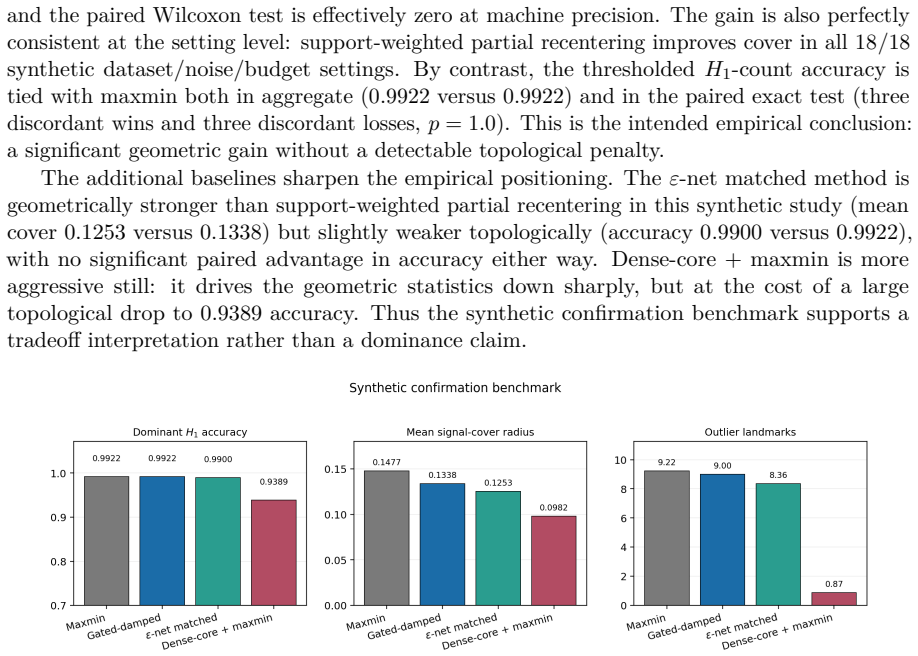
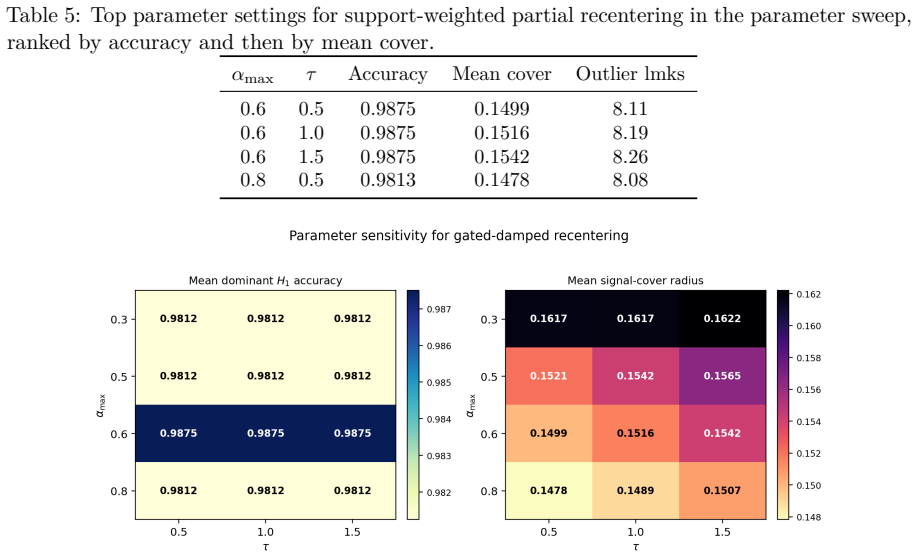
Starting from maxmin seeds, the support-weighted partial recentering rule partitions the cloud into nearest-seed cells and moves each seed toward a deep representative of its cell, with the movement scaled by cell support. This yields local geometric guarantees: a convex-core robustness lemma from halfspace depth, a 2r cover bound, and projected cover bounds. In the main planar experiments the corrected landmarks produce a consistent geometric improvement over plain maxmin while the thresholded H1 summary stays unchanged; the 3D torus test shows the same geometric tendency but only mixed topological behavior.
What carries the argument
Support-weighted partial recentering, which scales the displacement of each maxmin seed toward a high-depth representative of its nearest-seed cell by the relative support size of that cell.
If this is right
- The corrected landmarks satisfy convex-core robustness and 2r cover bounds derived from depth measures.
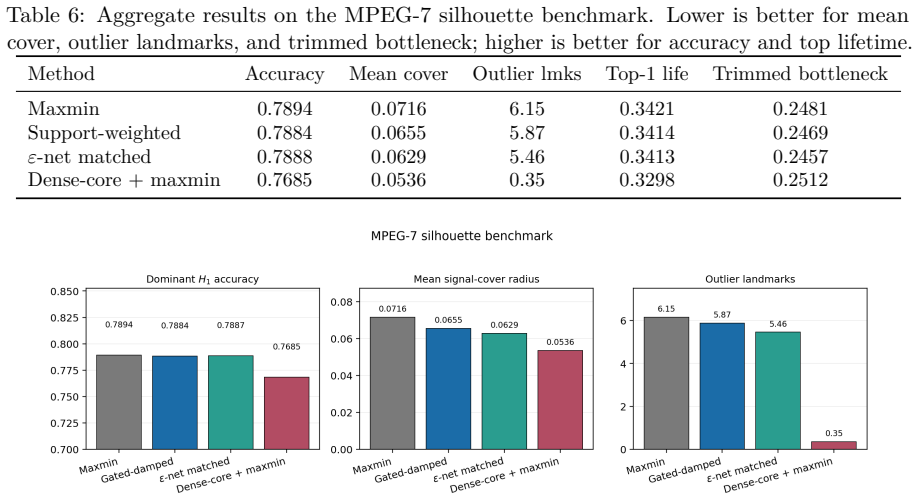
- Geometric error decreases consistently on planar synthetic benchmarks and MPEG-7 silhouettes.
- The thresholded H1 persistence summary remains identical to the maxmin baseline in the planar regime.
- In 3D torus tests the geometric improvement persists while topological stability holds only partially.
- The method supplies a practical local alternative to maxmin rather than a global witness-approximation theorem.
Where Pith is reading between the lines
- The same depth-weighted adjustment could be tested inside other landmark selectors or persistence constructions to see whether the geometric gain generalizes.
- Applications that tolerate small changes in landmark placement might achieve equivalent topological output with fewer landmarks after recentering.
- The mixed 3D topological results point to a need for controlled tests that vary noise level and cell-size distribution to locate the boundary between stable and unstable H1 behavior.
- Combining the local recentering step with a final global optimization pass could tighten both geometry and topology simultaneously.
Load-bearing premise
The local depth-based adjustments preserve the essential topological features captured by the lazy witness complex across the tested regimes without introducing new artifacts not captured by the H1 threshold.
What would settle it
A point cloud where applying support-weighted partial recentering causes the thresholded H1 persistence diagram to gain or lose long-lived features compared with plain maxmin would falsify the topological preservation claim.
Figures
read the original abstract
We study a family of local depth-based corrections to maxmin landmark selection for lazy witness persistence. Starting from maxmin seeds, we partition the cloud into nearest-seed cells and replace or move each seed toward a deep representative of its cell. The principal implemented variant, \emph{support-weighted partial recentering}, scales the amount of movement by cell support. The contributions are both mathematical and algorithmic. On the mathematical side, we prove local geometric guarantees for these corrections: a convex-core robustness lemma derived from halfspace depth, a $2r$ cover bound for subset recentering, and projected cover bounds for the implemented partial-recentering rules. On the algorithmic side, we identify a practically effective variant through a layered empirical study consisting of planar synthetic benchmarks, a parameter-sensitivity study, and an MPEG-7 silhouette benchmark, together with a modest three-dimensional torus extension. The main planar experiments show that support-weighted partial recentering gives a consistent geometric improvement over maxmin while preserving the thresholded $H_1$ summary used in the study. The three-dimensional experiment shows the same geometric tendency but only mixed topological behavior. The paper should therefore be read as a controlled study of a local depth-based alternative to maxmin, rather than as a global witness-approximation theorem or a claim of uniform empirical superiority.
Editorial analysis
A structured set of objections, weighed in public.
Referee Report
Summary. The paper studies local depth-based corrections to maxmin landmark selection for lazy witness persistence. Starting from maxmin seeds, it partitions the point cloud into nearest-seed cells and applies corrections (replace or move toward a deep representative), with the principal variant being support-weighted partial recentering. Mathematical contributions include proofs of a convex-core robustness lemma from halfspace depth, a 2r cover bound for subset recentering, and projected cover bounds for partial recentering. Empirically, planar synthetic and MPEG-7 benchmarks show consistent geometric improvement over maxmin with preserved thresholded H1, while a 3D torus extension shows similar geometric trends but mixed topological results. The work is framed as a controlled study of the alternative rather than a general approximation theorem.
Significance. If the empirical observations on H1 preservation generalize, the approach could provide a practical, locally justified improvement to landmark selection in persistent homology pipelines, yielding better geometric fidelity in the witness complex without altering the key topological summaries. The local geometric proofs are a clear strength, offering rigorous insight into the behavior of the corrections independent of the empirical fits.
major comments (2)
- [empirical study sections] Planar experiments and 3D torus extension: the claim of consistent geometric improvement with H1 preservation is presented without error bars, multiple random seeds, or statistical tests on the reported gains; this makes the 'consistent' qualifier difficult to assess quantitatively, especially given the mixed 3D topological outcomes.
- [mathematical guarantees and abstract] Mathematical contributions and central claim: the proven local cover bounds and convex-core robustness are independent of the empirical fits, but no theorem or argument connects these bounds to the stability of the lazy witness complex persistence diagram; the assertion that no new artifacts appear outside the H1 threshold therefore rests entirely on dataset-specific thresholding rather than a general guarantee.
minor comments (3)
- [abstract] The abstract and conclusion could more explicitly qualify the 3D mixed results as a limitation rather than a minor extension.
- [algorithmic description] Notation for cell support and the scaling in support-weighted partial recentering should be defined more formally early in the algorithmic description to aid readability.
- [figures] Figure captions for the recentering illustrations would benefit from explicit labels indicating the depth-based movement vectors and cell boundaries.
Simulated Author's Rebuttal
We thank the referee for the constructive report, which correctly identifies both the local geometric contributions and the scope limitations of the work. We respond to each major comment below and indicate the revisions we will make.
read point-by-point responses
-
Referee: [empirical study sections] Planar experiments and 3D torus extension: the claim of consistent geometric improvement with H1 preservation is presented without error bars, multiple random seeds, or statistical tests on the reported gains; this makes the 'consistent' qualifier difficult to assess quantitatively, especially given the mixed 3D topological outcomes.
Authors: We agree that the empirical sections would be strengthened by additional statistical controls. The current presentation relies on single runs of maxmin and reports point estimates without variability measures. In the revised manuscript we will execute the planar benchmarks across multiple random seeds for the initial maxmin selection, report mean geometric improvements together with standard deviations, and include simple statistical comparisons (e.g., paired t-tests) against the baseline. For the 3D torus extension we will expand the discussion to characterize the specific instances in which the thresholded H1 summary changes, thereby clarifying the mixed topological behavior. revision: yes
-
Referee: [mathematical guarantees and abstract] Mathematical contributions and central claim: the proven local cover bounds and convex-core robustness are independent of the empirical fits, but no theorem or argument connects these bounds to the stability of the lazy witness complex persistence diagram; the assertion that no new artifacts appear outside the H1 threshold therefore rests entirely on dataset-specific thresholding rather than a general guarantee.
Authors: The referee accurately observes that the mathematical results (convex-core robustness, 2r cover bound, and projected cover bounds) are purely local geometric statements and do not yield a stability guarantee for the persistence diagrams of the lazy witness complex. The manuscript already states that the work is a controlled study of a local correction rather than a general approximation theorem, and the H1 preservation claim is explicitly tied to the thresholding used in the reported benchmarks. We will revise the abstract and the final discussion paragraph to reinforce this framing and to remove any phrasing that could be read as implying a general absence of new artifacts. revision: partial
Circularity Check
No significant circularity; proofs and empirical claims remain independent
full rationale
The paper separates its mathematical contributions (convex-core robustness lemma from halfspace depth, 2r cover bound for subset recentering, and projected cover bounds for partial recentering) from its empirical study of support-weighted partial recentering on planar benchmarks and 3D torus. No equation or claim reduces a 'prediction' to a fitted parameter by construction, nor does any central result depend on a self-citation chain or ansatz smuggled from prior work. The H1 preservation statement is explicitly presented as an empirical observation rather than a derived theorem, avoiding any definitional loop. The derivation chain is therefore self-contained against external benchmarks.
Axiom & Free-Parameter Ledger
axioms (1)
- domain assumption Halfspace depth defines a robust central representative within each nearest-seed cell
Reference graph
Works this paper leans on
-
[1]
Topological estimation using witness complexes
Vin de Silva and Gunnar Carlsson. Topological estimation using witness complexes. In Proceedings of the Eurographics Symposium on Point-Based Graphics, pages 157–166, 2004. DOI:https://doi.org/10.2312/SPBG/SPBG04/157-166
-
[2]
Porter, Ulrike Tillmann, Peter Grindrod, and Heather A
Nina Otter, Mason A. Porter, Ulrike Tillmann, Peter Grindrod, and Heather A. Harrington. A roadmap for the computation of persistent homology.EPJ Data Science, 6(17):1–38,
-
[3]
DOI:https://doi.org/10.1140/epjds/s13688-017-0109-5
-
[4]
Bernadette J. Stolz. Outlier-robust subsampling techniques for persistent homology.Journal of Machine Learning Research, 24(90):1–35, 2023. Available at:https://www.jmlr.org/ papers/v24/21-1526.html
2023
-
[5]
Naheed Anjum Arafat, Debabrota Basu, and Stéphane Bressan. Topological data analysis with ϵ-net induced lazy witness complexes.arXiv preprint arXiv:1906.06122, 2019. DOI: https://doi.org/10.48550/arXiv.1906.06122. 23
-
[6]
Maria Herick, Michael Joachim, and Jan Vahrenhold. Adaptive approximation of persistent homology.Journal of Applied and Computational Topology, 8:2327–2366, 2024. DOI: https://doi.org/10.1007/s41468-024-00192-7
-
[7]
Tverberg’s theorem is 50 years old: A survey.Bulletin of the American Mathematical Society, 55(4):459–492, 2018
Imre Bárány and Pablo Soberón. Tverberg’s theorem is 50 years old: A survey.Bulletin of the American Mathematical Society, 55(4):459–492, 2018. DOI:https://doi.org/10. 1090/bull/1634
2018
-
[8]
American Mathematical Society, 2010
Herbert Edelsbrunner and John Harer.Computational Topology: An Introduction. American Mathematical Society, 2010. DOI:https://doi.org/10.1090/mbk/069
-
[9]
Topology and data.Bulletin of the American Mathematical Society, 46(2):255–308, 2009
Gunnar Carlsson. Topology and data.Bulletin of the American Mathematical Society, 46(2):255–308, 2009. DOI:https://doi.org/10.1090/S0273-0979-09-01249-X
-
[10]
Guibas and Steve Y
Leonidas J. Guibas and Steve Y. Oudot. Reconstruction using witness complexes.Dis- crete & Computational Geometry, 40(3):325–356, 2008. DOI:https://doi.org/10.1007/ s00454-008-9094-6
2008
-
[11]
Alpha-beta witness complexes
Dominique Attali, Herbert Edelsbrunner, John Harer, and Yuriy Mileyko. Alpha-beta witness complexes. InAlgorithms and Data Structures, volume 4619 ofLecture Notes in Computer Science, pages 386–397. Springer, 2007. DOI:https://doi.org/10.1007/ 978-3-540-73951-7_34
2007
-
[12]
Bodlaender, Corinne Feremans, Alexander Grigoriev, Eelko Penninkx, Ren´ e Sitters, and Thomas Wolle
Tamal K. Dey, Fengtao Fan, and Yusu Wang. Graph induced complex on point data.Com- putational Geometry, 48(8):575–588, 2015. DOI:https://doi.org/10.1016/j.comgeo. 2015.04.003
-
[13]
Subsampling methods for persistent homology
Frédéric Chazal, Brittany Terese Fasy, Fabrizio Lecci, Bertrand Michel, Alessandro Rinaldo, and Larry Wasserman. Subsampling methods for persistent homology. InProceedings of the 32nd International Conference on Machine Learning, volume 37 ofProceedings of Machine Learning Research, pages 2143–2151. PMLR, 2015. Available at: https: //proceedings.mlr.press...
2015
-
[14]
Sammy Brunson and Clara Skaf. Sampling from pseudometric spaces with applications to persistent homology.arXiv preprint arXiv:2212.09826, 2022. DOI:https://doi.org/10. 48550/arXiv.2212.09826
-
[15]
Shreesh Jadhav and Asish Mukhopadhyay. Computing a centerpoint of a finite planar set of points in linear time.Discrete & Computational Geometry, 12(3):291–312, 1994. DOI: https://doi.org/10.1007/BF02574382
-
[16]
Agarwal, Micha Sharir, and Emo Welzl
Pankaj K. Agarwal, Micha Sharir, and Emo Welzl. Algorithms for center and Tverberg points.ACM Transactions on Algorithms, 5(1):Article 5, 2008. DOI:https://doi.org/ 10.1145/1435375.1435380
-
[17]
Wolfgang Mulzer and Daniel Werner. Approximating tverberg points in linear time for any fixed dimension.Discrete & Computational Geometry, 50(2):520–535, 2013. DOI: https://doi.org/10.1007/s00454-013-9528-7
-
[18]
Katharine Turner, Sayan Mukherjee, and Doug M. Boyer. Persistent homology transform for modeling shapes and surfaces.Information and Inference, 3(4):310–344, 2014. DOI: https://doi.org/10.1093/imaiai/iau011
-
[19]
Exploring uses of persistent homology for statistical analysis of landmark-based shape data.Journal of Multivariate Analysis, 101(9):2184–2199,
Jennifer Gamble and Giseon Heo. Exploring uses of persistent homology for statistical analysis of landmark-based shape data.Journal of Multivariate Analysis, 101(9):2184–2199,
-
[20]
DOI:https://doi.org/10.1016/j.jmva.2010.04.016. 24
-
[21]
Serge Belongie, Jitendra Malik, and Jan Puzicha. Shape matching and object recognition using shape contexts.IEEE Transactions on Pattern Analysis and Machine Intelligence, 24(4):509–522, 2002. DOI:https://doi.org/10.1109/34.993558
-
[22]
Shape descriptors for non-rigid shapes with a single closed contour
Longin Jan Latecki, Rolf Lakämper, and Ulrich Eckhardt. Shape descriptors for non-rigid shapes with a single closed contour. InProceedings of the IEEE Conference on Computer Vision and Pattern Recognition, pages 424–429, 2000. DOI:https://doi.org/10.1109/ CVPR.2000.855850
-
[23]
The GUDHI library: Simplicial complexes and persistent homology
Clément Maria, Jean-Daniel Boissonnat, Marc Glisse, and Mariette Yvinec. The GUDHI library: Simplicial complexes and persistent homology. InInternational Congress on Mathematical Software, volume 8592 ofLecture Notes in Computer Science, pages 167–174. Springer, 2014. DOI:https://doi.org/10.1007/978-3-662-44199-2_28
-
[24]
GUDHI Editorial Board, 3.12.0 edition, 2026
The GUDHI Project.GUDHI User and Reference Manual. GUDHI Editorial Board, 3.12.0 edition, 2026. URL:https://gudhi.inria.fr/doc/3.12.0/
2026
-
[25]
Filtered complexes
Clément Maria. Filtered complexes. InGUDHI User and Reference Manual. GUDHI EditorialBoard, 3.12.0edition, 2026. URL:https://gudhi.inria.fr/doc/3.12.0/group_ _simplex__tree.html
2026
-
[26]
Persistent cohomology
Clément Maria. Persistent cohomology. InGUDHI User and Reference Manual. GUDHI EditorialBoard, 3.12.0edition, 2026. URL:https://gudhi.inria.fr/doc/3.12.0/group_ _persistent__cohomology.html
2026
-
[27]
Experimental datasets and supporting scripts for depth-based landmark recentering in lazy witness complexes, 2026
Yifan Zhang. Experimental datasets and supporting scripts for depth-based landmark recentering in lazy witness complexes, 2026. Dataset. DOI:https://doi.org/10.5281/ zenodo.19676292. 25
2026
discussion (0)
Sign in with ORCID, Apple, or X to comment. Anyone can read and Pith papers without signing in.