Recognition: unknown
The eigenvector centrality of hypergraphs
Pith reviewed 2026-05-10 00:47 UTC · model grok-4.3
The pith
A single adjacency tensor extends eigenvector centrality to all hypergraphs, uniform or not.
A machine-rendered reading of the paper's core claim, the machinery that carries it, and where it could break.
Core claim
The authors define an adjacency tensor for hypergraphs and propose eigenvector centrality as the principal eigenvector of this tensor. When the hypergraph is uniform the new centrality coincides with Benson's definition; when the hypergraph is 2-uniform it recovers the standard eigenvector centrality of graphs.
What carries the argument
The adjacency tensor defined for arbitrary hypergraphs, whose principal eigenvector supplies the centrality vector.
If this is right
- The centrality can be computed directly on non-uniform hypergraphs without first converting them to uniform form.
- It supplies an alternative ranking of vertices in email and co-authorship networks that differs from degree or other standard measures.
- For any uniform hypergraph the scores match the previously proposed tensor-based centrality.
- When restricted to ordinary graphs the scores are identical to classical eigenvector centrality.
Where Pith is reading between the lines
- The tensor construction offers a route to generalize other graph-theoretic measures such as Katz or PageRank to hypergraphs of mixed edge cardinality.
- Empirical tests on additional datasets could show whether the new scores better predict outcomes such as information spread or collaboration impact.
- The approach may enable systematic comparison of centrality across hypergraph datasets that previously required separate normalization steps.
Load-bearing premise
The newly defined adjacency tensor for non-uniform hypergraphs possesses a well-defined, unique principal eigenvector that meaningfully ranks vertex importance.
What would settle it
A non-uniform hypergraph whose defined adjacency tensor has no principal eigenvector or whose eigenvector scores fail to distinguish vertices in any intuitive way on a concrete dataset.
Figures



read the original abstract
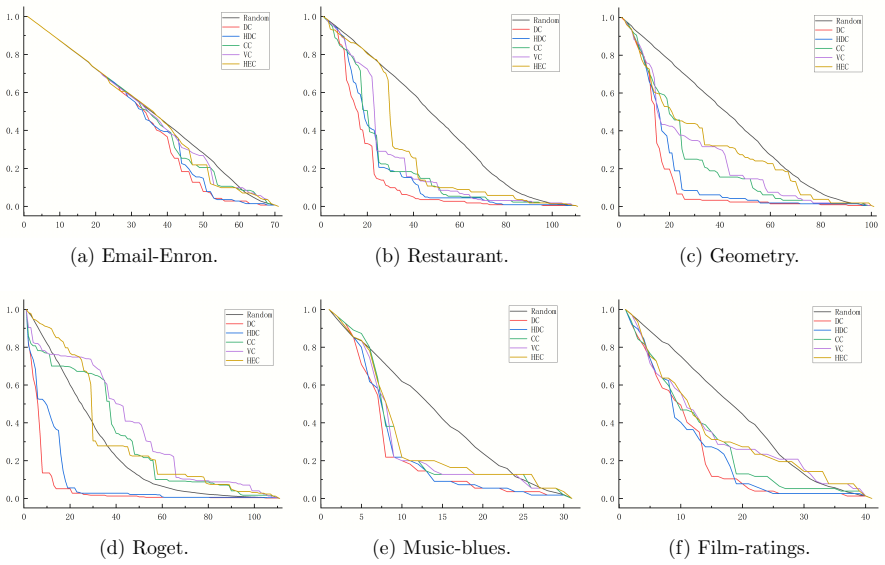
A hypergraph is called uniform when every hyperedge contains the same number of vertices, otherwise, it is called non-uniform. In the real world, many systems give rise to non-uniform hypergraphs, such as email networks and co-authorship networks. A uniform hypergraph has a natural one-to-one correspondence with its adjacency tensor. In 2019, Benson proposed the eigenvector centrality of uniform hypergraphs via its adjacency tensor. In this paper, we define an adjacency tensor for hypergraphs and propose the eigenvector centrality for hypergraphs. When the hypergraph is uniform, our proposed eigenvector centrality reduces to Benson's. When each edge of the uniform hypergraph contains exactly two vertices, our proposed centrality reduces to the eigenvector centrality of graphs. We conducted experiments on several real-world hypergraph datasets. The results show that, compared to traditional centrality measures, the proposed centrality measure provides a unique perspective for identifying important vertices and can also effectively identify them.
Editorial analysis
A structured set of objections, weighed in public.
Referee Report
Summary. The manuscript defines an adjacency tensor for hypergraphs (uniform and non-uniform) and proposes eigenvector centrality based on the principal eigenvector of this tensor. It claims that the measure reduces to Benson's 2019 tensor-based centrality when the hypergraph is uniform and to standard graph eigenvector centrality when the hypergraph is 2-uniform. Experiments on real-world hypergraph datasets (e.g., email and co-authorship networks) are reported to show that the measure offers a distinct perspective for ranking vertex importance compared to traditional centrality measures.
Significance. A rigorously justified extension of eigenvector centrality to non-uniform hypergraphs would be valuable, as such structures are common in empirical networks and the claimed reductions to Benson's and graph cases would anchor the proposal in existing literature. The empirical comparisons could demonstrate practical utility if the measure is shown to be well-defined. However, the absence of an explicit tensor construction and supporting proofs for the non-uniform case means the core technical contribution remains unverified at present.
major comments (1)
- [Abstract / Definition of adjacency tensor] The central claim rests on a new adjacency tensor defined for non-uniform hypergraphs, yet the abstract (and by extension the manuscript's core contribution) supplies neither the explicit tensor construction that accommodates edges of differing orders nor a proof or reference establishing existence and uniqueness of a positive principal eigenvector. Standard Perron-Frobenius results for fixed-order tensors do not apply directly, making this a load-bearing gap for the proposed centrality measure.
minor comments (2)
- [Experiments] The abstract states that experiments were conducted on several real-world datasets and that the measure 'provides a unique perspective,' but supplies no dataset names, baseline methods, quantitative metrics, or statistical comparisons; adding these details would strengthen the empirical section without altering the central claim.
- [Notation and definitions] Notation for the proposed tensor and eigenvector equation should be introduced with explicit reference to the uniform and 2-uniform reduction cases to make the consistency claims easier to verify.
Simulated Author's Rebuttal
We thank the referee for their detailed and insightful comments on our work. We value the feedback on the need for a clearer presentation of the adjacency tensor definition and its theoretical foundations. We respond to the major comment below and will make the necessary revisions to address the concerns raised.
read point-by-point responses
-
Referee: [Abstract / Definition of adjacency tensor] The central claim rests on a new adjacency tensor defined for non-uniform hypergraphs, yet the abstract (and by extension the manuscript's core contribution) supplies neither the explicit tensor construction that accommodates edges of differing orders nor a proof or reference establishing existence and uniqueness of a positive principal eigenvector. Standard Perron-Frobenius results for fixed-order tensors do not apply directly, making this a load-bearing gap for the proposed centrality measure.
Authors: We agree with the referee that an explicit construction of the adjacency tensor for non-uniform hypergraphs, along with guarantees on the principal eigenvector, is crucial to substantiate the central claims. While the manuscript outlines the definition and its reductions to known cases, we acknowledge that the details for handling edges of varying orders may not be sufficiently explicit, and the proof of eigenvector existence and uniqueness is not fully developed. In the revised manuscript, we will provide a precise mathematical definition of the tensor that accommodates non-uniform edge sizes, for instance by constructing it from the incidence structure in a way that generalizes the uniform case. We will also include a theorem and proof establishing the existence and uniqueness of a positive principal eigenvector, potentially by referencing or adapting results from the literature on nonnegative tensors of varying orders or by demonstrating a reduction to the uniform hypergraph setting. Furthermore, we will update the abstract to mention the tensor construction more explicitly. These revisions will strengthen the technical contribution and address the identified gap. revision: yes
Circularity Check
No significant circularity; definitional generalization is self-contained
full rationale
The paper's core contribution is a new definition of an adjacency tensor for (non-uniform) hypergraphs together with the associated eigenvector centrality. The stated reductions—to Benson's centrality when the hypergraph is uniform and to ordinary graph eigenvector centrality when edges are 2-uniform—hold by explicit construction of the tensor so that it coincides with the earlier objects in those special cases. No equation is shown to be derived from a fitted parameter, no load-bearing premise rests on a self-citation, and no uniqueness theorem is imported from the authors' prior work. The derivation chain therefore consists of a definition plus verification of consistency with known special cases; it does not reduce any claimed result to its own inputs.
Axiom & Free-Parameter Ledger
axioms (1)
- domain assumption The defined adjacency tensor admits a unique positive principal eigenvector (Perron-Frobenius type property).
Reference graph
Works this paper leans on
-
[1]
Higher order learning with graphs
Sameer Agarwal, Kristin Branson, and Serge Belongie. Higher order learning with graphs. InProceedings of the 23rd international conference on Machine learning, pages 17–24, 2006
2006
-
[2]
Hypernetwork science via high-order hypergraph walks.EPJ Data Science, 9(1):16, 2020
Sinan G Aksoy, Cliff Joslyn, Carlos Ortiz Marrero, Brenda Praggastis, and Emilie Purvine. Hypernetwork science via high-order hypergraph walks.EPJ Data Science, 9(1):16, 2020
2020
-
[3]
Centrality in heterogeneous social networks for lurkers de- tection: An approach based on hypergraphs.Concurrency and Computation: Practice and Experience, 30(3):e4188, 2018
Flora Amato, Vincenzo Moscato, Antonio Picariello, Francesco Piccialli, and Giancarlo Sperl´ ı. Centrality in heterogeneous social networks for lurkers de- tection: An approach based on hypergraphs.Concurrency and Computation: Practice and Experience, 30(3):e4188, 2018. 17
2018
-
[4]
Diverse and experienced group discovery via hypergraph clustering
Ilya Amburg, Nate Veldt, and Austin R Benson. Diverse and experienced group discovery via hypergraph clustering. InProceedings of the 2022 SIAM International Conference on Data Mining (SDM), pages 145–153. SIAM, 2022
2022
-
[5]
Springer Berlin Heidelberg, Berlin, Heidelberg, 2004
Vladimir Batagelj and Andrej Mrvar.Pajek — Analysis and Visualization of Large Networks, pages 77–103. Springer Berlin Heidelberg, Berlin, Heidelberg, 2004
2004
-
[6]
Three hypergraph eigenvector centralities.SIAM Journal on Mathematics of Data Science, 1(2):293–312, 2019
Austin R Benson. Three hypergraph eigenvector centralities.SIAM Journal on Mathematics of Data Science, 1(2):293–312, 2019
2019
-
[7]
Benson, Rediet Abebe, Michael T
Austin R. Benson, Rediet Abebe, Michael T. Schaub, Ali Jadbabaie, and Jon Kleinberg. Simplicial closure and higher-order link prediction.Proceedings of the National Academy of Sciences, 2018
2018
-
[8]
Factoring and weighting approaches to status scores and clique identification.Journal of mathematical sociology, 2(1):113–120, 1972
Phillip Bonacich. Factoring and weighting approaches to status scores and clique identification.Journal of mathematical sociology, 2(1):113–120, 1972
1972
-
[9]
Hypergraph theory.An introduction
Alain Bretto. Hypergraph theory.An introduction. Mathematical Engineering. Cham: Springer, 1:209–216, 2013
2013
-
[10]
Hypergraph clustering using a new laplacian tensor with applications in image processing.SIAM Journal on Imaging Sciences, 13(3):1157–1178, 2020
Jingya Chang, Yannan Chen, Liqun Qi, and Hong Yan. Hypergraph clustering using a new laplacian tensor with applications in image processing.SIAM Journal on Imaging Sciences, 13(3):1157–1178, 2020
2020
-
[11]
Spectra of power hy- pergraphs and signed graphs via parity-closed walks.Journal of Combinatorial Theory, Series A, 207:105909, 2024
Lixiang Chen, Edwin R van Dam, and Changjiang Bu. Spectra of power hy- pergraphs and signed graphs via parity-closed walks.Journal of Combinatorial Theory, Series A, 207:105909, 2024
2024
-
[12]
The c-eigenvalue of third order tensors and its application in crystals.Journal of Industrial and Management Optimization, 19(1):265–281, 2023
Yannan Chen, Antal J´ akli, and Liqun Qi. The c-eigenvalue of third order tensors and its application in crystals.Journal of Industrial and Management Optimization, 19(1):265–281, 2023
2023
-
[13]
Robustness of the public transport network against attacks on its routes.Chaos, Solitons & Fractals, 184:115019, 2024
Tom´ as Cicchini, In´ es Caridi, and Leonardo Ermann. Robustness of the public transport network against attacks on its routes.Chaos, Solitons & Fractals, 184:115019, 2024
2024
-
[14]
Hypergraph ego-networks and their temporal evolution
Cazamere Comrie and Jon Kleinberg. Hypergraph ego-networks and their temporal evolution. In2021 IEEE international conference on data mining (ICDM), pages 91–100. IEEE, 2021. 18
2021
-
[15]
Spectra of uniform hypergraphs.Linear Algebra and its Applications, 436(9):3268–3292, 2012
Joshua Cooper and Aaron Dutle. Spectra of uniform hypergraphs.Linear Algebra and its Applications, 436(9):3268–3292, 2012
2012
-
[16]
A novel multi-modal incremental tensor decomposition for anomaly detection in large-scale networks.Information Sciences, 681:121210, 2024
Rongqiao Fan, Qiyuan Fan, Xue Li, Puming Wang, Jing Xu, Xin Jin, Shaowen Yao, and Peng Liu. A novel multi-modal incremental tensor decomposition for anomaly detection in large-scale networks.Information Sciences, 681:121210, 2024
2024
-
[17]
Perron–frobenius theo- rem for nonnegative multilinear forms and extensions.Linear Algebra and its Applications, 438(2):738–749, 2013
Shmuel Friedland, St´ ephane Gaubert, and Lixing Han. Perron–frobenius theo- rem for nonnegative multilinear forms and extensions.Linear Algebra and its Applications, 438(2):738–749, 2013
2013
-
[18]
Degree centrality, eigenvector centrality and the relation between them in twitter
Prantik Howlader and KS Sudeep. Degree centrality, eigenvector centrality and the relation between them in twitter. In2016 IEEE international confer- ence on recent trends in electronics, information & communication technology (RTEICT), pages 678–682. IEEE, 2016
2016
-
[19]
Identifying vital nodes in hypergraphs based on von neumann entropy.Entropy, 25(9):1263, 2023
Feng Hu, Kuo Tian, and Zi-Ke Zhang. Identifying vital nodes in hypergraphs based on von neumann entropy.Entropy, 25(9):1263, 2023
2023
-
[20]
´ atude comparative de la distribution florale dans une portion des alpes et du jura.Bull Soc Vaudoise Sci Nat, 37(1):547–579, 1901
Paul Jaccard. ´ atude comparative de la distribution florale dans une portion des alpes et du jura.Bull Soc Vaudoise Sci Nat, 37(1):547–579, 1901
1901
-
[21]
Weighted node degree centrality for hypergraphs
Komal Kapoor, Dhruv Sharma, and Jaideep Srivastava. Weighted node degree centrality for hypergraphs. In2013 IEEE 2nd network science workshop (NSW), pages 152–155. IEEE, 2013
2013
-
[22]
Vector centrality in hypergraphs.Chaos, Solitons & Fractals, 162:112397, 2022
Kirill Kovalenko, Miguel Romance, Ekaterina Vasilyeva, David Aleja, Regino Criado, Daniil Musatov, Andrei M Raigorodskii, Julio Flores, Ivan Samoylenko, Karin Alfaro-Bittner, et al. Vector centrality in hypergraphs.Chaos, Solitons & Fractals, 162:112397, 2022
2022
-
[23]
Konect: the koblenz network collection
J´ erˆ ome Kunegis. Konect: the koblenz network collection. InProceedings of the 22nd international conference on world wide web, pages 1343–1350, 2013
2013
-
[24]
A survey of eigenvector methods for web information retrieval.SIAM Review, 47(1):135–161, 2005
Amy N Langville and Carl D Meyer. A survey of eigenvector methods for web information retrieval.SIAM Review, 47(1):135–161, 2005
2005
-
[25]
Betweenness centrality of teams in social networks.Chaos: An Interdisciplinary Journal of Nonlinear Science, 31(6), 2021
Jongshin Lee, Yongsun Lee, Soo Min Oh, and B Kahng. Betweenness centrality of teams in social networks.Chaos: An Interdisciplinary Journal of Nonlinear Science, 31(6), 2021. 19
2021
-
[26]
Singular values and eigenvalues of tensors: a variational ap- proach
Lek-Heng Lim. Singular values and eigenvalues of tensors: a variational ap- proach. In1st IEEE International Workshop on Computational Advances in Multi-Sensor Adaptive Processing, pages 129–132. IEEE, 2005
2005
-
[27]
A survey of statistical measures for higher-order networks.Acta Physica Sinica, 73(12):128901–1– 128901–18, 2024
Bo Liu, Yujie Zeng, Rongmei Yang, and Linyuan L¨ u. A survey of statistical measures for higher-order networks.Acta Physica Sinica, 73(12):128901–1– 128901–18, 2024. (in Chinese)
2024
-
[28]
Eigenvector centrality mapping for analyzing con- nectivity patterns in fMRI Data of the human brain.PloS ONE, 5(4):e10232, 2010
Gabriele Lohmann, Daniel S Margulies, Annette Horstmann, Burkhard Pleger, Joeran Lepsien, Dirk Goldhahn, Haiko Schloegl, Michael Stumvoll, Arno Vill- ringer, and Robert Turner. Eigenvector centrality mapping for analyzing con- nectivity patterns in fMRI Data of the human brain.PloS ONE, 5(4):e10232, 2010
2010
-
[29]
A learning convolutional neural network approach for network robustness predic- tion.IEEE Transactions on Cybernetics, 53(7):4531–4544, 2022
Yang Lou, Ruizi Wu, Junli Li, Lin Wang, Xiang Li, and Guanrong Chen. A learning convolutional neural network approach for network robustness predic- tion.IEEE Transactions on Cybernetics, 53(7):4531–4544, 2022
2022
-
[30]
A hypergraph model for representing scientific output.Scientometrics, 117(3):1361–1379, 2018
Rodica Ioana Lung, No´ emi Gask´ o, and Mihai Alexandru Suciu. A hypergraph model for representing scientific output.Scientometrics, 117(3):1361–1379, 2018
2018
-
[31]
Justifying recommendations using distantly-labeled reviews and fine-grained aspects
Jianmo Ni, Jiacheng Li, and Julian McAuley. Justifying recommendations using distantly-labeled reviews and fine-grained aspects. InProceedings of the 2019 conference on empirical methods in natural language processing and the 9th in- ternational joint conference on natural language processing (EMNLP-IJCNLP), pages 188–197, 2019
2019
-
[32]
Eigenvalue problems of a tensor and a tensor-block ma- trix (tmb) of any even rank with some applications in mechanics
Mikhail U Nikabadze. Eigenvalue problems of a tensor and a tensor-block ma- trix (tmb) of any even rank with some applications in mechanics. InGeneral- ized Continua as Models for Classical and Advanced Materials, pages 279–317. Springer, 2016
2016
-
[33]
Finding the most reliable strat- egy on stochastic and time-dependent transportation networks: A hypergraph based formulation.Networks and Spatial Economics, 17(3):809–840, 2017
A Arun Prakash and Karthik K Srinivasan. Finding the most reliable strat- egy on stochastic and time-dependent transportation networks: A hypergraph based formulation.Networks and Spatial Economics, 17(3):809–840, 2017
2017
-
[34]
Eigenvalues of a real supersymmetric tensor.Journal of Symbolic Computation, 40(6):1302–1324, 2005
Liqun Qi. Eigenvalues of a real supersymmetric tensor.Journal of Symbolic Computation, 40(6):1302–1324, 2005. 20
2005
-
[35]
SIAM, Philadelphia, 2017
Liqun Qi and Ziyan Luo.Tensor Analysis: Spectral Theory and Special Tensors. SIAM, Philadelphia, 2017
2017
-
[36]
Hygnn: Drug-drug interaction prediction via hypergraph neural net- work
Khaled Mohammed Saifuddin, Briana Bumgardner, Farhan Tanvir, and Esra Akbas. Hygnn: Drug-drug interaction prediction via hypergraph neural net- work. In2023 IEEE 39th International Conference on Data Engineering (ICDE), pages 1503–1516. IEEE, 2023
2023
-
[37]
Moore–penrose in- verse of tensors via einstein product.Linear and Multilinear Algebra, 64(4):686– 698, 2016
Lizhu Sun, Baodong Zheng, Changjiang Bu, and Yimin Wei. Moore–penrose in- verse of tensors via einstein product.Linear and Multilinear Algebra, 64(4):686– 698, 2016
2016
-
[38]
Identifying influential nodes in hypergraph using isolating centrality
Anupoju Tejaswi, Murali Krishna Enduri, and Srilatha Tokala. Identifying influential nodes in hypergraph using isolating centrality. In2024 Beyond Technology Summit on Informatics International Conference (BTS-I2C), pages 451–455. IEEE, 2024
2024
-
[39]
Matrix centrality for annotated hypergraphs.Chaos, Solitons & Fractals, 186:115256, 2024
E Vasilyeva, I Samoylenko, K Kovalenko, D Musatov, AM Raigorodskii, and S Boccaletti. Matrix centrality for annotated hypergraphs.Chaos, Solitons & Fractals, 186:115256, 2024
2024
-
[40]
Efficient algorithms for computing the largest eigenvalue of a nonnegative tensor.Frontiers of mathematics in China, 8:155–168, 2013
Guanglu Zhou, Liqun Qi, and Soon-Yi Wu. Efficient algorithms for computing the largest eigenvalue of a nonnegative tensor.Frontiers of mathematics in China, 8:155–168, 2013
2013
-
[41]
Multilevel spectral hyper- graph partitioning with arbitrary vertex sizes.IEEE Transactions on computer- aided design of integrated circuits and systems, 18(9):1389–1399, 2002
Jason Y Zien, Martine DF Schlag, and Pak K Chan. Multilevel spectral hyper- graph partitioning with arbitrary vertex sizes.IEEE Transactions on computer- aided design of integrated circuits and systems, 18(9):1389–1399, 2002. 21
2002
discussion (0)
Sign in with ORCID, Apple, or X to comment. Anyone can read and Pith papers without signing in.