Recognition: unknown
On Fourier decay and the distance set problem
Pith reviewed 2026-05-10 00:42 UTC · model grok-4.3
The pith
A Borel set with Fourier dimension at least 2 has a distance set of full Hausdorff dimension in any ambient space.
A machine-rendered reading of the paper's core claim, the machinery that carries it, and where it could break.
Core claim
In any dimension d a Borel set E with Fourier dimension at least 2 satisfies dim_H Delta(E) = 1, where Delta(E) denotes the set of all pairwise distances. The same full dimension holds when the Fourier spectrum of E is at least d/4 + 1 at theta = 1/2. Both statements are valid for sets whose Hausdorff dimension may be smaller than d/2, and the authors supply examples demonstrating that the Fourier-dimension threshold of 2 is close to optimal.
What carries the argument
The Fourier dimension (or Fourier spectrum at a fixed theta) of the set, which quantifies the decay of its Fourier transform and is used to bound the L^2 integral that controls the dimension of the distance set.
If this is right
- In dimensions d at least 5 the classical d/2 threshold for the Falconer problem can be exceeded under these Fourier conditions.
- The same conclusions hold for pinned distance sets.
- When d is at least 4 the spectrum condition allows sets with Fourier dimension zero to determine a full-dimensional distance set.
- Examples constructed in the paper show that the Fourier-dimension bound of 2 cannot be lowered much without losing the conclusion.
Where Pith is reading between the lines
- The same Fourier-decay hypothesis might be applied to other Falconer-type problems involving triangles or higher-order configurations.
- Explicit self-similar sets satisfying the spectrum bound could be constructed and measured numerically to test the sharpness of the d/4 + 1 threshold.
- The results suggest that Fourier dimension is a more powerful assumption than Hausdorff dimension alone for guaranteeing rich distance sets.
Load-bearing premise
The set must obey a quantitative lower bound on its Fourier dimension or spectrum; without that decay the integral estimates that produce full distance dimension may fail.
What would settle it
A single Borel set E in R^d with Fourier dimension exactly 2 whose distance set has Hausdorff dimension strictly less than 1 would disprove the main claim.
Figures
read the original abstract
We study the Falconer distance set problem in Euclidean space and obtain improved dimensional estimates under natural Fourier analytic assumptions cast in terms of the Fourier dimension and spectrum. Interestingly, under reasonably mild assumptions, we are able to beat the $d/2$ dimension threshold in dimensions $d \geq 5$. For example, we show that (in any ambient spatial dimension $d$) a Borel set with Fourier dimension at least $2$ has a distance set of full Hausdorff dimension. We also show that (in any ambient spatial dimension $d$) a Borel set with Fourier spectrum at least $d/4+1$ at $\theta=1/2$ has a distance set of full Hausdorff dimension. In particular, this can hold for sets with Fourier dimension zero (provided $d \geq 4$). We also consider pinned variants of these problems and construct examples that demonstrate the sharpness (or near sharpness) of our results.
Editorial analysis
A structured set of objections, weighed in public.
Referee Report
Summary. The paper studies the Falconer distance set problem in R^d under Fourier-analytic hypotheses. It proves that any Borel set E with Fourier dimension at least 2 has distance set of Hausdorff dimension 1, and that any Borel set whose Fourier spectrum is at least d/4 + 1 at θ = 1/2 likewise has distance set of dimension 1 (even when the Fourier dimension of E is zero, provided d ≥ 4). Pinned variants are treated, and examples are constructed to demonstrate sharpness or near-sharpness of the stated thresholds.
Significance. If the central claims hold, the work supplies concrete improvements to the d/2 threshold that has been the standard benchmark for distance-set dimension results. The Fourier-spectrum condition at a single θ-value allows the conclusion to apply to sets whose Fourier dimension vanishes, which is a notable relaxation. The proofs rely on standard radial Fourier estimates for the push-forward measure, and the sharpness constructions delineate the boundary of the method.
minor comments (4)
- §2, definition of the Fourier spectrum: the normalization constant in the integral defining β_E(θ) should be stated explicitly so that the lower bound d/4 + 1 is unambiguously comparable to the classical Fourier dimension.
- Theorem 1.3 and the subsequent pinned variant: the dependence of the implicit constant on d is not tracked; a brief remark on whether the argument remains uniform in d would clarify the scope.
- §4, construction of the sharpness example: the Hausdorff dimension of the constructed set is asserted to be zero while the spectrum condition holds; a short calculation verifying that the Fourier dimension is indeed zero would strengthen the example.
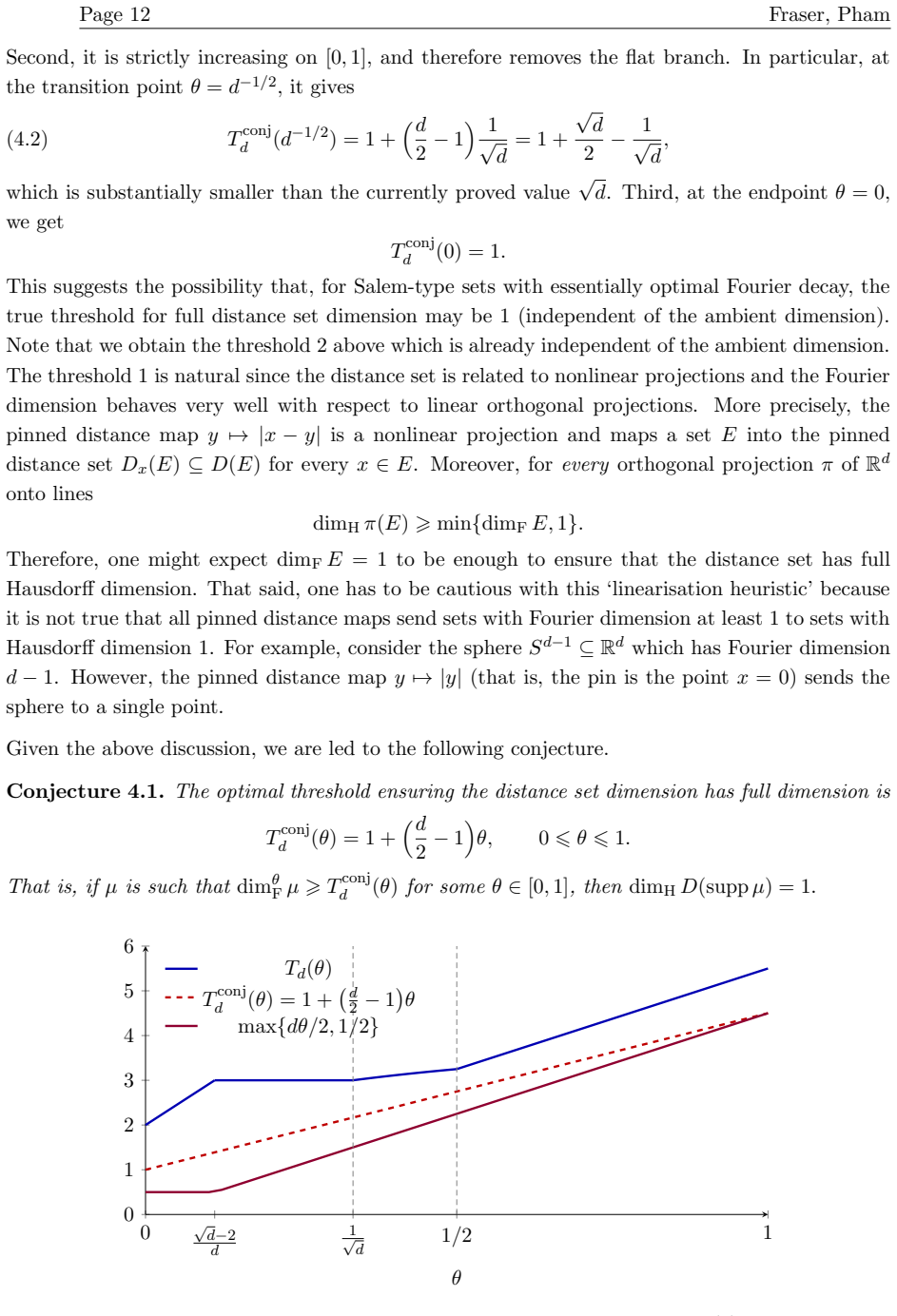
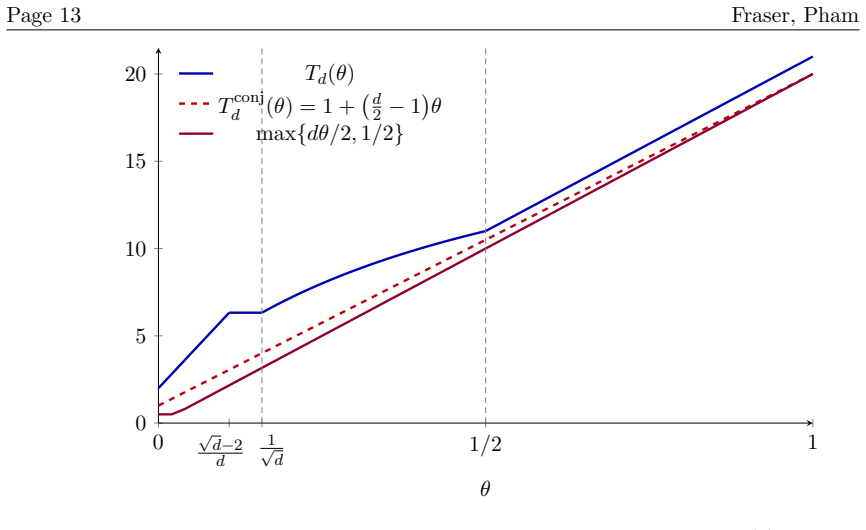
- Figure 1: the caption does not indicate the ambient dimension d used for the plotted example; adding this information would aid readers.
Simulated Author's Rebuttal
We thank the referee for their careful reading of our manuscript and for the positive assessment of our results on the Falconer distance set problem under Fourier-analytic hypotheses. The recommendation for minor revision is noted, and we will incorporate any necessary adjustments in the revised version.
Circularity Check
No significant circularity; results follow directly from stated Fourier assumptions via standard estimates
full rationale
The paper states explicit hypotheses on Fourier dimension (at least 2) or Fourier spectrum (at least d/4 + 1 at θ=1/2) and derives full Hausdorff dimension for the distance set in any dimension d. These follow from radial Fourier decay estimates and convergence of s-energy integrals for s<1 on the pushforward measure, with no parameter fitting, self-definitional loops, or load-bearing self-citations that reduce the central claim to its inputs. The sharpness examples are constructed separately and do not feed back into the positive results. The derivation chain is self-contained against external Fourier analysis benchmarks.
Axiom & Free-Parameter Ledger
axioms (2)
- standard math Standard properties of Hausdorff dimension and the distance set in Euclidean space
- standard math Definitions and basic decay properties of the Fourier dimension and Fourier spectrum
Reference graph
Works this paper leans on
-
[1]
M. Carnovale, J. M. Fraser and A. E. de Orellana, L^2 restriction estimates from the Fourier spectrum, arXiv:2412.14896 https://arxiv.org/abs/2412.14896, (2024)
-
[2]
Carnovale, J
M. Carnovale, J. M. Fraser and A. E. de Orellana, Obtaining the Fourier spectrum via Fourier coefficients, Proc. Amer. Math. Soc., 154 (2026), 2005-2017
2026
-
[3]
Chen, Sets of Salem type and sharpness of the L^2 -Fourier restriction theorem, Trans
X. Chen, Sets of Salem type and sharpness of the L^2 -Fourier restriction theorem, Trans. Amer. Math. Soc., 368(3) (2016), 1959--1977
2016
- [4]
-
[5]
X. Du, A. Iosevich, Y. Ou, H. Wang and R. Zhang, An improved result for Falconer’s distance set problem in even dimensions, Math. Ann., 380 (3), (2021), 1215--1231
2021
- [6]
-
[7]
Du and R
X. Du and R. Zhang, Sharp L^2 estimates of the Schrödinger maximal function in higher dimensions, Ann. Math., 189(3), (2019), 837–861
2019
-
[8]
K. J. Falconer, On the Hausdorff dimensions of distance sets, Mathematika, 32 (2) (1985), 206--212
1985
-
[9]
K. J. Falconer, Fractal Geometry: Mathematical Foundations and Applications , John Wiley & Sons, Hoboken, NJ, 3rd. ed., (2014)
2014
- [10]
-
[11]
J. M. Fraser, The Fourier spectrum and sumset type problems, Math. Ann., 390(3) (2024), 3891--3930
2024
-
[12]
L. Guth, A. Iosevich, Y. Ou and H. Wang, On Falconer's distance set problem in the plane, Invent. Math., 219 (3), (2020), 779--830
2020
-
[13]
Kahane, Some Random series of functions, 2nd edition, Cambridge Studies in Advanced Mathematics, 5 , Cambridge, (1985)
J.-P. Kahane, Some Random series of functions, 2nd edition, Cambridge Studies in Advanced Mathematics, 5 , Cambridge, (1985)
1985
-
[14]
Keleti and P
T. Keleti and P. Shmerkin, New bounds on the dimensions of planar distance sets, Geom. Funct. Anal., 29 , (2019), 1886--1948
2019
-
[15]
Mattila, Spherical averages of Fourier transforms of measures with finite energy; dimension of intersections and distance sets, Mathematika, 34 (2), (1987), 207--228
P. Mattila, Spherical averages of Fourier transforms of measures with finite energy; dimension of intersections and distance sets, Mathematika, 34 (2), (1987), 207--228
1987
-
[16]
Mattila, Fourier analysis and Hausdorff dimension, Cambridge Studies in Advanced Mathematics, 150 , Cambridge, (2015)
P. Mattila, Fourier analysis and Hausdorff dimension, Cambridge Studies in Advanced Mathematics, 150 , Cambridge, (2015)
2015
-
[17]
Shmerkin and H
P. Shmerkin and H. Wang, On the distance sets spanned by sets of dimension d/2 in , Geom. Funct. Anal., 35 , (2025), 283--358
2025
discussion (0)
Sign in with ORCID, Apple, or X to comment. Anyone can read and Pith papers without signing in.