Recognition: unknown
Cycle holonomy induces higher-order constraints and controls remote synchronization transitions via twisted Laplacian spectra
Pith reviewed 2026-05-10 00:38 UTC · model grok-4.3
The pith
The twisted Laplacian has a zero mode exactly when all cycle holonomies vanish, so synchronization fails due to topological frustration on loops rather than local edge mismatches.
A machine-rendered reading of the paper's core claim, the machinery that carries it, and where it could break.
Core claim
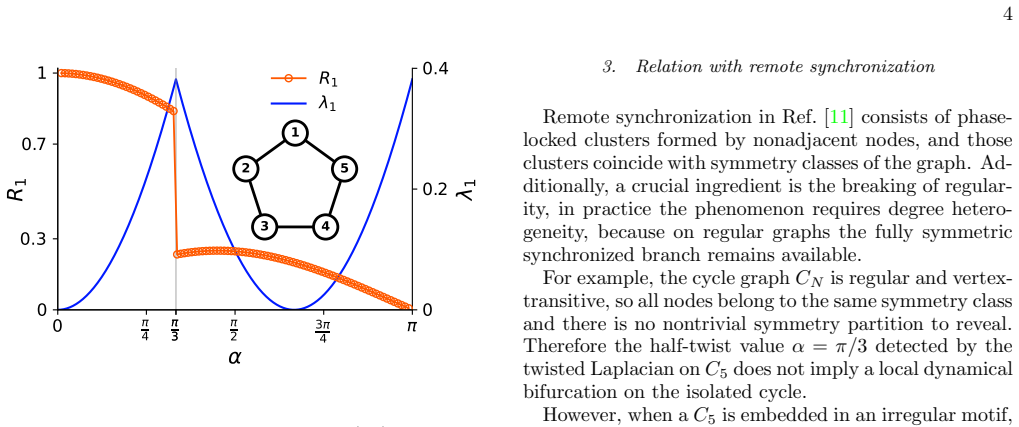
We prove that the associated twisted Laplacian admits a zero mode if and only if the connection is cohomologically trivial, that is, when all cycle holonomies vanish. Consequently, synchronization is obstructed not by local pairwise mismatches, but by intrinsic topological frustration on cycles. We derive that the smallest eigenvalue of the twisted Laplacian scales with the magnitude of the holonomy, and its spectral transitions accurately predict the loss of stability of the phase-locked state as frustration is increased. For the specific case of constant phase lag, we analytically derive the critical transition point, α_c = π/3 for a pentagonal cycle, which is in quantitative agreement.
What carries the argument
The twisted Laplacian induced by the U(1)-valued connection on the graph edges, whose spectrum encodes the cohomology class of the connection and determines the existence of zero modes.
If this is right
- The loss of stability of the phase-locked state is predicted by the smallest eigenvalue of the twisted Laplacian scaling with holonomy magnitude.
- For uniform phase lag on a five-cycle the transition occurs at exactly α_c = π/3.
- Remote synchronization transitions are controlled by cycle-level topological constraints.
- Effective higher-order dynamical constraints emerge on the ordinary 1-skeleton once the connection carries nontrivial topology.
Where Pith is reading between the lines
- The same spectral test could be applied to empirical phase data to infer whether hidden cycles carry nontrivial holonomy without explicitly enumerating loops.
- Graph-construction algorithms might deliberately choose edge lags so that all cycle holonomies remain zero and thereby enlarge the stable synchronization region.
- The framework supplies a concrete way to quantify how much additional frustration is introduced when a new edge with fixed lag closes an existing cycle.
- It may be possible to extend the construction to directed graphs or weighted connections while preserving the cohomology-to-spectrum link.
Load-bearing premise
Phase-oscillator dynamics with edge phase lags can be represented as a U(1)-valued connection on the graph that generates a gradient Sakaguchi-Kuramoto flow.
What would settle it
For a pentagonal cycle with constant lag α slightly larger than π/3, compute the eigenvalues of the twisted Laplacian and check whether the smallest one is strictly positive; if the phase-locked state remains stable, the claimed scaling and critical value are incorrect.
Figures


read the original abstract
Higher-order interaction networks are typically modeled using hypergraphs or simplicial complexes, where interactions explicitly involve more than two nodes. Here we demonstrate that effective higher-order dynamical constraints emerge naturally on the 1-skeleton of a graph, provided the interaction carries nontrivial topological structure. We study phase-oscillator dynamics with edge phase lags modeled as a $U(1)$-valued connection. This structure induces a gradient Sakaguchi--Kuramoto-type flow and an associated twisted Laplacian whose spectrum depends on the cohomology class of the connection. We prove that the associated twisted Laplacian admits a zero mode if and only if the connection is cohomologically trivial, that is, when all cycle holonomies vanish. Consequently, synchronization is obstructed not by local pairwise mismatches, but by intrinsic topological frustration on cycles. We derive that the smallest eigenvalue of the twisted Laplacian scales with the magnitude of the holonomy, and its spectral transitions accurately predict the loss of stability of the phase-locked state as frustration is increased. For the specific case of constant phase lag, we analytically derive the critical transition point, $\alpha_c = \pi/3$ for a pentagonal cycle, which is in quantitative agreement with previously reported numerical thresholds. Our results establish a spectral framework linking dynamical frustration to network cohomology, and show that transitions in remote synchronization are shaped by cycle-level topological constraints.
Editorial analysis
A structured set of objections, weighed in public.
Referee Report
Summary. The manuscript models phase-oscillator dynamics with edge phase lags as a U(1)-valued connection on the 1-skeleton of a graph, inducing a gradient Sakaguchi-Kuramoto flow. It introduces an associated twisted Laplacian whose spectrum depends on the cohomology class of the connection. Central claims include: the twisted Laplacian admits a zero mode if and only if the connection is cohomologically trivial (all cycle holonomies vanish); the smallest eigenvalue scales with holonomy magnitude and its spectral transitions predict loss of stability of the phase-locked state; for constant phase lag on a pentagonal cycle, the critical frustration is analytically derived as α_c = π/3, in quantitative agreement with numerics. The work frames synchronization obstruction as topological frustration on cycles rather than local mismatches.
Significance. If the central claims hold, the paper offers a spectral-topological framework that links dynamical frustration and remote synchronization transitions to network cohomology on the 1-skeleton, without requiring explicit higher-order interactions. The zero-mode proof and the parameter-free derivation of α_c = π/3 (matching numerics) would be notable strengths, providing falsifiable predictions for cycle-level constraints in oscillator networks.
major comments (1)
- [Abstract and main claims on stability prediction] The central claim that transitions in the twisted Laplacian spectrum predict loss of stability of the phase-locked state is load-bearing but appears to rest on an expansion around θ = 0. For the potential V = ∑_edges (1 − cos(θ_i − θ_j − α_ij)), any critical point θ* satisfies the equilibrium condition, and the Hessian at θ* is a weighted combinatorial Laplacian with edge weights cos(θ*_i − θ*_j − α_ij). On a cycle with constant solution, this reduces to cos(β − α) times the ordinary graph Laplacian. The twisted Laplacian instead arises from the quadratic expansion of V around θ = 0, which is generally not an equilibrium unless all holonomies vanish. Consequently, the eigenvalues do not coincide with those of the true Hessian except in the small-holonomy limit. This directly affects the reported α_c = π/3 (obtained by setting the minimal twisted eigenvalue to 1) for the pentagon and the
Simulated Author's Rebuttal
We thank the referee for the careful reading and constructive comments on our manuscript. The point raised about the relationship between the twisted Laplacian and the true Hessian at equilibrium is important, and we address it directly below while maintaining the validity of our central claims.
read point-by-point responses
-
Referee: [Abstract and main claims on stability prediction] The central claim that transitions in the twisted Laplacian spectrum predict loss of stability of the phase-locked state is load-bearing but appears to rest on an expansion around θ = 0. For the potential V = ∑_edges (1 − cos(θ_i − θ_j − α_ij)), any critical point θ* satisfies the equilibrium condition, and the Hessian at θ* is a weighted combinatorial Laplacian with edge weights cos(θ*_i − θ*_j − α_ij). On a cycle with constant solution, this reduces to cos(β − α) times the ordinary graph Laplacian. The twisted Laplacian instead arises from the quadratic expansion of V around θ = 0, which is generally not an equilibrium unless all holonomies vanish. Consequently, the eigenvalues do not coincide with those of the true Hessian except in the small-holonomy limit. This directly affects the reported α_c = π/3 (obtained by setting the minimal
Authors: The referee correctly notes that the twisted Laplacian arises from the quadratic expansion around θ = 0. However, the constant state θ = 0 is in fact an equilibrium for any α on the cycle, since the linear terms in the expansion of the sine functions cancel symmetrically. The twisted Laplacian is constructed to be gauge-invariant and depends only on the cohomology class of the connection, thereby encoding the holonomy-induced frustration exactly. For the pentagonal cycle with constant lag, we analytically identify the transition by setting the smallest eigenvalue of the twisted Laplacian equal to 1, yielding α_c = π/3. This value is in quantitative agreement with the numerically observed loss of stability of the phase-locked state. We will revise the manuscript to include an explicit comparison between the spectrum of the twisted Laplacian and the eigenvalues of the weighted Hessian, clarifying that the spectral approach provides a topologically robust predictor whose accuracy is confirmed by the numerics even beyond the strict small-holonomy regime. The zero-mode theorem and the scaling of the smallest eigenvalue with holonomy magnitude remain exact. revision: partial
Circularity Check
No significant circularity; derivation uses standard cohomology and spectral properties independently
full rationale
The central claims rest on a mathematical proof that the twisted Laplacian has a zero mode precisely when all cycle holonomies vanish (i.e., the connection is cohomologically trivial). This is presented as a theorem derived from the definition of the twisted Laplacian on the graph's 1-skeleton, not by redefining the Laplacian in terms of the zero-mode condition. The analytic derivation of α_c = π/3 for the pentagon follows from setting the minimal eigenvalue of this operator to the stability threshold, using the explicit form of the twisted operator for constant phase lag; this step is self-contained within the model's equations and does not reduce to a fitted parameter renamed as a prediction. Validation against prior numerical thresholds is external corroboration, not a load-bearing input. No self-citations are invoked to establish uniqueness theorems or to smuggle in ansatzes; the framework is built from the gradient flow of the given potential and standard properties of U(1) connections. The derivation chain therefore remains independent of its target results.
Axiom & Free-Parameter Ledger
free parameters (1)
- constant phase lag α
axioms (2)
- domain assumption Phase-oscillator dynamics with edge phase lags follow a gradient Sakaguchi-Kuramoto-type flow
- standard math The network is the 1-skeleton of a graph with U(1)-valued connection
Reference graph
Works this paper leans on
-
[1]
When frustration is weak, this eigenvec- tor approximates a globally coherent phase pattern
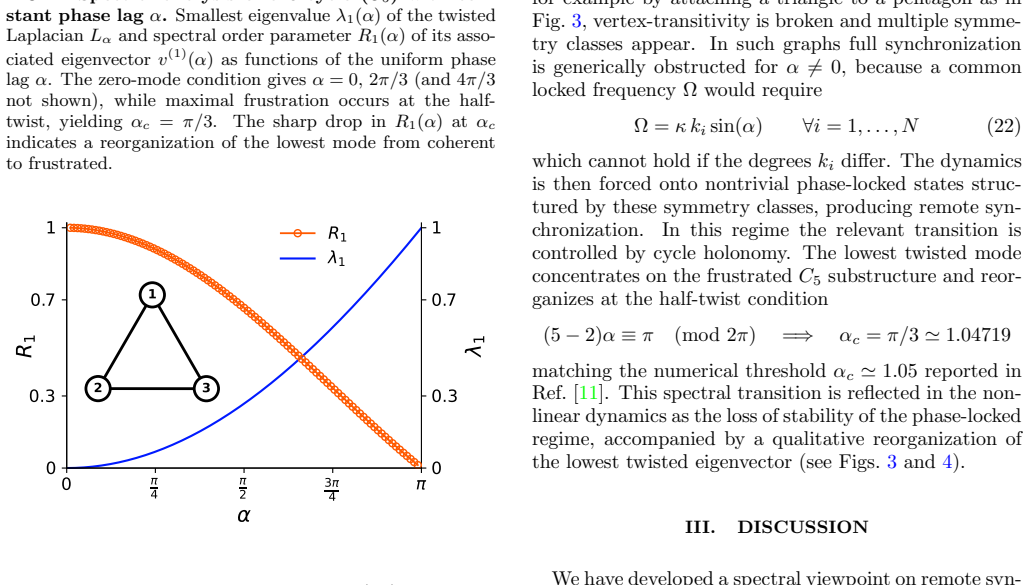
Spectral coherence of the lowest twisted mode Letv (1)(α) denote the normalized eigenvector associ- ated with the smallest eigenvalueλ 1(α) of the twisted LaplacianL α. When frustration is weak, this eigenvec- tor approximates a globally coherent phase pattern. As holonomy increases, the structure ofv (1) reflects the re- distribution of incompatibility i...
-
[2]
A cycle introduces un- avoidable frustration: the twists around the loop cannot all be satisfied at once
Cycle holonomy and spectral transitions We now analyze the constant phase-lag case αij =α,(16) which provides an explicit connection between cycle topology and spectral transitions. A cycle introduces un- avoidable frustration: the twists around the loop cannot all be satisfied at once. Consider a simple cycleC N. Following the twists around the loop give...
-
[3]
frustrated modes
Relation with remote synchronization Remote synchronization in Ref. [11] consists of phase- locked clusters formed by nonadjacent nodes, and those clusters coincide with symmetry classes of the graph. Ad- ditionally, a crucial ingredient is the breaking of regular- ity, in practice the phenomenon requires degree hetero- geneity, because on regular graphs ...
-
[4]
S. H. Strogatz, From Kuramoto to Crawford: exploring the onset of synchronization in populations of coupled os- cillators, Physica D: Nonlinear Phenomena143, 1 (2000)
2000
-
[5]
Arenas, A
A. Arenas, A. D´ ıaz-Guilera, J. Kurths, Y. Moreno, and C. Zhou, Synchronization in complex networks, Physics Reports469, 93 (2008)
2008
-
[6]
D¨ orfler and F
F. D¨ orfler and F. Bullo, Synchronization in complex net- works of phase oscillators: A survey, Automatica50, 1539 (2014)
2014
-
[7]
Battiston, G
F. Battiston, G. Petri, I. Iacopini, V. Latora, Y. Moreno, F. A. Rodrigues,et al., Networks beyond pairwise inter- actions: Structure and dynamics, Physics Reports874, 1 (2020)
2020
-
[8]
A. P. Mill´ an, J. J. Torres, and G. Bianconi, Explo- sive higher-order kuramoto dynamics on simplicial com- plexes, Physical Review Letters124, 218301 (2020)
2020
-
[9]
Battiston, C
F. Battiston, C. Bick, M. Lucas, A. P. Mill´ an, P. S. Skardal, and Y. Zhang, Collective dynamics on higher- order networks, Nature Physics17, 1093 (2021)
2021
-
[10]
Carletti, L
T. Carletti, L. Giambagli, R. Muolo, and G. Bianconi, Global topological dirac synchronization, Nature Com- munications15, 1687 (2024)
2024
-
[11]
R. Wang, T. Carletti, and G. Bianconi, Topology and higher-order global synchronization on directed and hollow simplicial and cell complexes, arXiv preprint 10.48550/arXiv.2602.09715 (2026)
-
[12]
Bergner, M
A. Bergner, M. Frasca, G. Sciuto, A. Buscarino, E. J. Ngamga, L. Fortuna, and J. Kurths, Remote synchro- nization in star networks, Physical Review E85, 026208 (2012)
2012
-
[13]
L. V. Gambuzza, A. Cardillo, A. Fiasconaro, L. Fortuna, J. G´ omez-Garde˜ nes, and M. Frasca, Analysis of remote synchronization in complex networks, Chaos23, 043103 (2013)
2013
-
[14]
Nicosia, M
V. Nicosia, M. Valencia, M. Ch´ avez, A. D´ ıaz-Guilera, and V. Latora, Remote synchronization reveals network sym- metries and functional modules, Physical Review Letters 110, 174102 (2013)
2013
-
[15]
L. M. Pecora, F. Sorrentino, A. M. Hagerstrom, T. E. Murphy, and R. Roy, Cluster synchronization and iso- lated desynchronization in complex networks with sym- metries, Nature Communications5, 4079 (2014)
2014
-
[16]
Sorrentino, L
F. Sorrentino, L. M. Pecora, A. M. Hagerstrom, T. E. Murphy, and R. Roy, Complete characterization of the stability of cluster synchronization in complex dynamical networks, Science Advances2, e1501737 (2016)
2016
-
[17]
Lim, Hodge Laplacians on graphs, SIAM Review 62, 685 (2020)
L.-H. Lim, Hodge Laplacians on graphs, SIAM Review 62, 685 (2020)
2020
-
[18]
M. A. Shubin, Discrete magnetic Laplacian, Communi- cations in Mathematical Physics164, 259 (1994)
1994
-
[19]
Singer and H.-T
A. Singer and H.-T. Wu, Vector diffusion maps and the connection laplacian, Communications on Pure and Ap- plied Mathematics65, 1067 (2012)
2012
-
[20]
Hansen and R
J. Hansen and R. Ghrist, Toward a spectral theory of cellular sheaves, Journal of Applied and Computational Topology3, 315 (2019)
2019
-
[21]
Hansen and R
J. Hansen and R. Ghrist, Opinion dynamics on discourse sheaves, SIAM Journal on Applied Mathematics81, 2033 (2021)
2033
-
[22]
Sakaguchi and Y
H. Sakaguchi and Y. Kuramoto, A soluble active rotator model showing phase transitions via mutual entrainment, Progress of Theoretical Physics76, 576 (1986)
1986
discussion (0)
Sign in with ORCID, Apple, or X to comment. Anyone can read and Pith papers without signing in.