Recognition: unknown
A practical theorem on gravitational-wave background statistics
Pith reviewed 2026-05-10 01:36 UTC · model grok-4.3
The pith
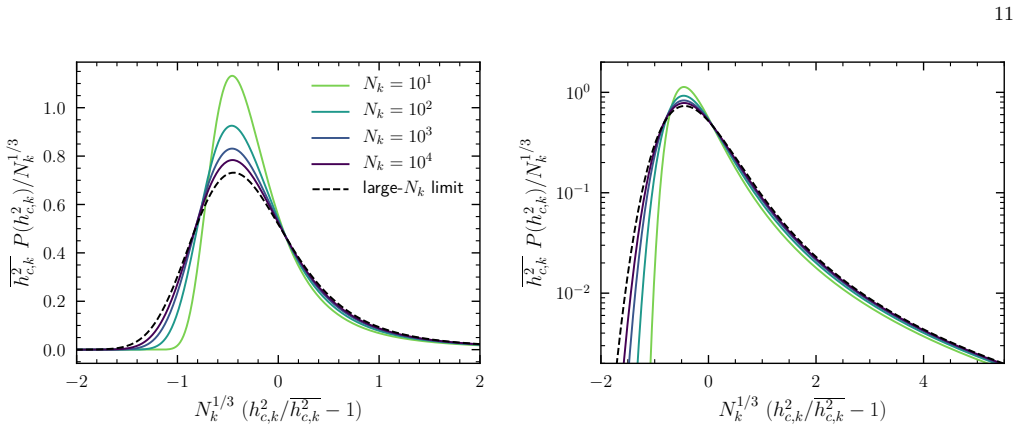
The probability distribution of the gravitational wave background strain squared takes a universal self-similar form for large but finite source numbers.
A machine-rendered reading of the paper's core claim, the machinery that carries it, and where it could break.
Core claim
For N much greater than one, the PDF of y defined as h_c squared over its mean takes the universal self-similar form approximately N to the one third times P of N to the one third times (y minus one), where P is the reflected map-Airy distribution. The effective number of in-band sources N is fully specified by the mean h_c squared and the cubic shot-noise strain scale h_0 cubed. This result holds for any population of supermassive black hole binaries, whether circular or eccentric and independent of the dominant orbital hardening mechanism.
What carries the argument
The rescaled variable y equals h_c squared divided by its mean, combined with the effective source number N fixed by the cubic strain scale, which collapses the full PDF onto the reflected map-Airy distribution.
If this is right
- Pulsar timing array analyses can insert this PDF directly into likelihoods for the lowest frequency bins instead of assuming infinitely many sources.
- The cubic strain scale becomes a new summary statistic for the background that depends only on local properties and can be measured independently of the full distribution.
- The large-N approximation can be tested for accuracy against any specific supermassive black hole binary population model.
- The same self-similar form applies regardless of whether binaries are circular or eccentric and independent of the orbital evolution mechanism.
Where Pith is reading between the lines
- Incorporating this non-Gaussian PDF into PTA pipelines could tighten constraints on binary populations by properly accounting for shot-noise fluctuations.
- Analogous universal distributions may appear in other stochastic backgrounds with finite Poisson sources whenever the cubic moment dominates the scaling.
- The independence assumption could be relaxed in future work to include source correlations and test how they modify the reflected map-Airy form.
Load-bearing premise
The background is produced by a Poisson process of independent sources whose statistics are fully captured by local population properties through the mean and cubic strain scales.
What would settle it
Pulsar timing array measurements showing that the spread of h_c squared values around the mean fails to follow the predicted N to the one third scaling when frequency band or population parameters are varied would falsify the universal form.
Figures


read the original abstract
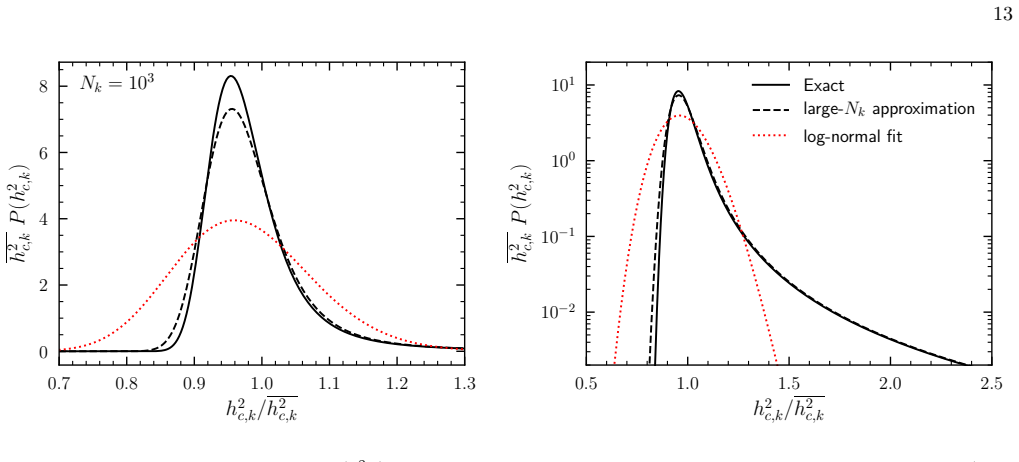
Inspiralling supermassive black-hole binaries (SMBHBs) are expected to be the main source of the nanohertz gravitational-wave background (GWB) targeted by pulsar timing arrays (PTAs). We provide a simple and general analytic expression for the probability distribution function (PDF) of the GWB characteristic strain squared $h_c^2$ in the limit of a large but finite effective number of sources, $N$, relevant for the lowest-frequency bands where PTAs are most sensitive. Explicitly, we show that for $N \gg 1$, the PDF of the rescaled variable $y \equiv h_c^2/\overline{h_c^2}$ takes the universal self-similar form $P(y) \simeq N^{1/3} \mathcal{P}(N^{1/3} (y -1))$, where $\mathcal{P}$ is the reflected map-Airy distribution. The effective number of in-band sources $N$ is fully specified by the mean $\overline{h_c^2}$ and the cubic shot-noise strain scale $\overline{h_0^3}$, a new summary statistic of the GWB that depends only on the local properties of the SMBHB population. This result is universal: it applies to any population of SMBHBs, regardless of whether they are circular or eccentric, and of the mechanism dominating orbital hardening. We explicitly quantify the accuracy of the large-source-count PDF for a simple but physically realistic SMBHB model, and outline its practical application to PTA data analysis.
Editorial analysis
A structured set of objections, weighed in public.
Referee Report
Summary. The manuscript derives an analytic expression for the PDF of the GWB characteristic strain squared h_c² from a compound Poisson process of independent SMBHB sources. For large but finite effective source count N, the rescaled variable y ≡ h_c² / mean(h_c²) has the universal self-similar form P(y) ≃ N^{1/3} P(N^{1/3}(y-1)), where P is the reflected map-Airy distribution. The effective N is fully determined by the mean strain and the new cubic shot-noise strain scale, which depends only on local population moments. The result is claimed to hold for any SMBHB population (circular or eccentric, any hardening mechanism), with accuracy quantified via direct numerical comparison to a realistic population model.
Significance. If the central derivation holds, the result supplies a practical, parameter-light analytic tool for non-Gaussian GWB statistics in PTA analyses, particularly at the lowest frequencies where the Gaussian limit is least accurate. Strengths include the explicit derivation from the compound Poisson process, the independence of the cubic scale from global PDF details, the universality statement, and the numerical validation showing convergence at relevant N. This advances beyond the central-limit Gaussian approximation while remaining computationally simple for data analysis.
minor comments (2)
- The definition and explicit formula for the cubic shot-noise strain scale should appear in the main text before its use in the effective-N expression.
- The numerical validation section would benefit from a short table or inset quantifying the fractional error of the map-Airy approximation as a function of N for the eccentric and circular cases.
Simulated Author's Rebuttal
We thank the referee for their positive evaluation of the manuscript, their recognition of its potential utility for PTA analyses, and their recommendation to accept. No major comments were raised in the report.
Circularity Check
Derivation is self-contained from Poisson process assumptions
full rationale
The paper derives the universal self-similar PDF form P(y) ≃ N^{1/3} P(N^{1/3}(y-1)) directly from the compound Poisson statistics of independent sources in the large-N limit, with the effective N and cubic scale h0^3 defined explicitly from local population moments (mean strain and third moment) without reference to the global PDF shape. The reflected map-Airy distribution is introduced via its own integral or characteristic-function definition, and the result is validated by direct numerical sampling for concrete SMBHB populations rather than by fitting. No equation reduces to a tautology, no parameter is fitted then relabeled as a prediction, and no load-bearing step relies on a self-citation whose content is itself unverified; the chain is therefore independent of its own outputs.
Axiom & Free-Parameter Ledger
axioms (1)
- domain assumption The effective number of in-band sources N is large but finite and the sources contribute as a Poisson process of independent emitters
Forward citations
Cited by 1 Pith paper
-
Are PTA measurements sensitive to gravitational wave non-Gaussianities?
PTA statistical tests lose sensitivity to non-Gaussian GW features after decorrelation and cannot distinguish them model-agnostically.
Reference graph
Works this paper leans on
-
[1]
typical”, distant sources. On the other hand, the small-h 2 c,k limit corresponds to a collective downward fluctuation of a large number of “typical
= 1, we may replaceJ(v/N k) with its limit J(0) = 1 4√π Z ∞ 0 dt eit −1−it t5/2 =− 1 +i 3 √ 2 ,(32) so that L(v≪N k) =− 1 +i 3 √ 2 v3/2 √Nk .(33) Inserting this expression into Eq. (28), and using L(−v) =L(v) ∗, we find that the PDF ofy=h 2 c,k/h2 c,k is approximately P(y)≃ Z ∞ 0 dv π cos (y−1)v+ v3/2 3√2Nk ×exp − v3/2 3√2Nk .(34) Finally, changing variab...
2018
-
[2]
(37) is exactly equivalent to the reflected map-Airy function, Eq
This appendix is thus dedicated to explicitly proving that Eq. (37) is exactly equivalent to the reflected map-Airy function, Eq. (38). We recall that the Airy function can be defined by its Fourier transform [37] Ai(x) = Z ∞ −∞ dz 2π eixz+iz 3/3.(73) This implies that the reflected map-Airy distribution given in Eq. (38), can be rewritten as PEq(38)(x) =...
- [3]
-
[4]
EPTA Collaboration, Astron. Astrophys.685, A94 (2024), arXiv:2306.16227
-
[5]
H. Xuet al., Research in Astronomy and Astrophysics 23, 075024 (2023), arXiv:2306.16216 [astro-ph.HE]
work page internal anchor Pith review arXiv 2023
-
[6]
D. J. Reardonet al., Astrophys. J. Lett.951, L6 (2023), arXiv:2306.16215
work page internal anchor Pith review arXiv 2023
-
[7]
R. W. Hellings and G. S. Downs, Astrophys. J. Lett.265, L39 (1983)
1983
- [8]
- [9]
- [10]
-
[11]
The NANOGrav Collaboration, The Astrophysical Jour- nal978, 31 (2024)
2024
-
[12]
The NANOGrav Collaboration, The Astrophysical Jour- nal Letters951, L11 (2023)
2023
- [13]
-
[14]
W. G. Lamb, J. M. Wachter, A. Mitridate, S. C. Sarde- sai, B. B´ ecsy, E. L. Hagen, S. R. Taylor, and L. Z. Kel- ley, arXiv e-prints (2025), 10.48550/arXiv.2511.09659, arXiv:2511.09659
- [15]
-
[16]
Exploring the spectrum of stochastic gravitational-wave anisotropies with pulsar timing arrays,
G. Sato-Polito and M. Kamionkowski, Phys. Rev. D109, 123544 (2024), arXiv:2305.05690
- [17]
-
[18]
M.-X. Lin, A. Lidz, and C.-P. Ma, arXiv e-prints (2026), 10.48550/arXiv.2602.16808, arXiv:2602.16808
-
[19]
The Heavy Tailed Non-Gaussianity of the Supermassive Black Hole Gravitational Wave Background
J. Raidal, J. Urrutia, V. Vaskonen, and H. Veerm¨ ae, (2026), 10.48550/arXiv.2604.08506, arXiv:2604.08506
work page internal anchor Pith review Pith/arXiv arXiv doi:10.48550/arxiv.2604.08506 2026
- [20]
- [21]
-
[22]
G. Sato-Polito and M. Zaldarriaga, Phys. Rev. D111, 023043 (2025), arXiv:2406.17010
-
[23]
Banderier, P
C. Banderier, P. Flajolet, G. Schaeffer, and M. Soria, Random Structures & Algorithms19, 194 (2001)
2001
-
[24]
Y. Ali-Ha¨ ımoud, T. L. Smith, and C. M. F. Mingarelli, Phys. Rev. D102, 122005 (2020), arXiv:2006.14570
-
[25]
P. C. Peters and J. Mathews, Phys. Rev.131, 435 (1963)
1963
-
[26]
Planck 2018 results. VI. Cosmological parameters
Planck Collaboration, Astron. Astrophys.641, A6 (2020), arXiv:1807.06209
work page internal anchor Pith review arXiv 2020
-
[27]
Map-airy distribution,
E. W. Weisstein, “Map-airy distribution,”https:// mathworld.wolfram.com/Map-AiryDistribution.html (2026), from MathWorld—A Wolfram Web Resource
2026
- [28]
- [29]
- [30]
-
[31]
H. Middleton, W. Del Pozzo, W. M. Farr, A. Sesana, and A. Vecchio, Mon. Not. R. Astron. Soc.455, L72 (2016), arXiv:1507.00992
- [32]
-
[33]
Sato-Polito, M
G. Sato-Polito, M. Zaldarriaga, and E. Quataert, Phys. Rev. D110, 063020 (2024)
2024
-
[34]
G. Sato-Polito, M. Zaldarriaga, and E. Quataert, Phys. Rev. D112, 123018 (2025), arXiv:2501.09786
-
[35]
NANOGrav Collaboration, ApJL951, L8 (2023)
2023
-
[36]
L. Lentati, P. Alexander, M. P. Hobson, S. Taylor, J. Gair, S. T. Balan, and R. van Haasteren, Phys. Rev. D87, 104021 (2013), arXiv:1210.3578
-
[37]
L. Lentati, P. Alexander, M. P. Hobson, F. Feroz, R. van Haasteren, K. J. Lee, and R. M. Shannon, Mon. Not. R. Astron. Soc.437, 3004 (2014), arXiv:1310.2120
-
[38]
L. Addario-Berry, ALEA, Lat. Am. J. Probab. Math. Stat.16, 1 (2019), arXiv:1503.08159
-
[39]
Airy function,
E. W. Weisstein, “Airy function,”https: //mathworld.wolfram.com/AiryFunctions.html (2026), from MathWorld—A Wolfram Web Resource
2026
discussion (0)
Sign in with ORCID, Apple, or X to comment. Anyone can read and Pith papers without signing in.