Recognition: unknown
The Heavy Tailed Non-Gaussianity of the Supermassive Black Hole Gravitational Wave Background
Pith reviewed 2026-05-10 16:50 UTC · model grok-4.3
The pith
The distribution of gravitational wave amplitudes from supermassive black hole binaries has a universal heavy tail proportional to the inverse fourth power of amplitude.
A machine-rendered reading of the paper's core claim, the machinery that carries it, and where it could break.
Core claim
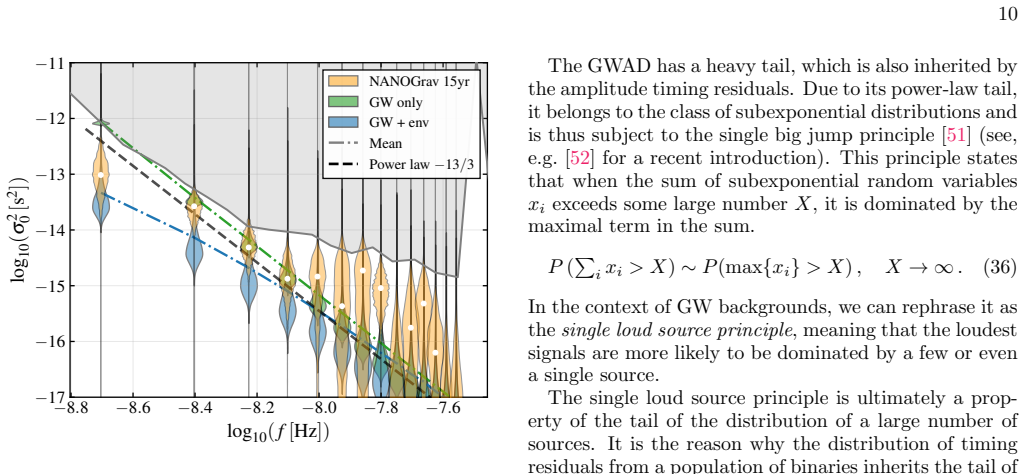
The SMBH GW amplitude distribution features a universal heavy power-law tail proportional to A^{-4}, while the low-amplitude tail depends on the SMBH merger rate and the energy-loss mechanisms of the binaries. The distribution of the induced timing residuals inherits this heavy tail. As a result, the ensemble averaged statistical moments of order three and higher diverge, limiting their usefulness as measures of non-Gaussianity, and the GW background from SMBH binaries exhibits the single loud source principle, according to which the strongest signals are more likely to be caused by a small number of loud sources. The variance-averaged Gaussian approximation accurately describes the timing,
What carries the argument
The gravitational wave amplitude distribution (GWAD) of supermassive black hole binaries, which carries a universal heavy tail that sets the non-Gaussian statistics of the background.
If this is right
- Timing residuals inherit the heavy-tailed distribution of the wave amplitudes.
- Moments of order three and higher diverge, so they cannot serve as reliable non-Gaussianity diagnostics.
- The background obeys the single loud source principle, with strongest signals produced by few loud binaries.
- The variance-averaged Gaussian approximation remains accurate for the residuals.
- A factored likelihood lets standard Gaussian-process PTA posteriors be combined with the non-Gaussian population prior.
Where Pith is reading between the lines
- Future PTA observations could search for the predicted power-law tail directly in the distribution of residuals instead of relying on moment statistics.
- The supplied Python implementation allows rapid checks of how alternate merger-rate histories alter the low-amplitude part of the distribution.
- Reporting of stochastic-background upper limits in PTA papers may need to account for the possibility that a few loud sources dominate the signal.
- Similar heavy-tailed behavior could appear in other astrophysical backgrounds whose source populations follow power-law statistics.
Load-bearing premise
The universal heavy tail and its consequences rest on a particular model of the supermassive black hole binary population together with chosen energy-loss mechanisms during inspiral.
What would settle it
Pulsar timing array data that yields finite third- or higher-order moments of the timing residuals, or that shows no power-law tail in the amplitude distribution, would falsify the central claim.
Figures






read the original abstract
We study the non-Gaussian features of the gravitational wave (GW) background generated by a population of inspiraling supermassive black hole (SMBH) binaries. We show that the SMBH GW amplitude distribution (GWAD) features a universal heavy power-law tail $\propto A^{-4}$, while the low-amplitude tail depends on the SMBH merger rate and the energy-loss mechanisms of the binaries. The distribution of the induced timing residuals inherits this heavy tail. As a result, the ensemble averaged statistical moments of order three and higher diverge, limiting their usefulness as measures of non-Gaussianity, and the GW background from SMBH binaries exhibits the single loud source principle, according to which the strongest signals are more likely to be caused by a small number of loud sources. We confirm that the variance-averaged Gaussian approximation accurately describes the timing residual statistics. This approximation justifies a factored likelihood structure that combines standard Gaussian-process PTA posteriors with the non-Gaussian population prior, enabling consistent incorporation of non-Gaussian effects into SMBH model inference. We provide a fast and flexible Python implementation to compute the distribution of timing residuals from a given SMBH merger rate or GWAD.
Editorial analysis
A structured set of objections, weighed in public.
Referee Report
Summary. The manuscript analyzes the non-Gaussian statistics of the stochastic gravitational wave background from inspiraling supermassive black hole binaries. It shows that the GW amplitude distribution (GWAD) has a universal heavy power-law tail scaling as A^{-4} independent of merger-rate and energy-loss details, while the low-amplitude regime depends on those astrophysical inputs. The induced timing residuals inherit the same heavy tail, causing moments of order three and higher to diverge and enforcing the single-loud-source principle. The authors confirm that a variance-averaged Gaussian approximation accurately captures the residual statistics and supply a fast Python implementation that accepts arbitrary merger-rate or GWAD inputs.
Significance. If the central geometric derivation holds, the result is significant for pulsar-timing-array analyses of the nanohertz gravitational-wave background. It cleanly separates universal Poisson-plus-inverse-distance effects from model-dependent low-amplitude behavior, thereby justifying factored likelihood constructions that combine standard Gaussian-process PTA posteriors with non-Gaussian population priors. The explicit provision of reproducible Python code is a concrete strength that allows immediate community verification and application to specific SMBH population models.
minor comments (2)
- The abstract and introduction state that the tail index is exactly -4; a short appendix deriving the index from the Poisson point process and the h ∝ 1/D scaling would make the universality argument fully self-contained without requiring the reader to reconstruct it from the cited literature.
- Figure captions and the code documentation should explicitly note the numerical integration limits used to separate the universal tail from the low-amplitude regime so that users can reproduce the plotted distributions with their own merger-rate models.
Simulated Author's Rebuttal
We thank the referee for their positive and constructive review of our manuscript. Their summary accurately captures the key results, and we are pleased that they recognize the significance for pulsar-timing-array analyses and the value of the provided Python implementation. The recommendation to accept is appreciated.
Circularity Check
No significant circularity; universal tail derived from independent geometric statistics
full rationale
The paper's central derivation of the universal heavy tail ∝ A^{-4} in the GW amplitude distribution follows directly from Poisson spatial statistics of sources combined with the amplitude scaling h ∝ 1/D (or equivalent strain scaling). This geometric argument is independent of the specific merger rate or energy-loss mechanisms, which the paper correctly assigns only to the low-amplitude regime. No load-bearing step reduces by construction to a fitted parameter, self-citation, or ansatz imported from the authors' prior work. The inheritance to timing residuals and divergence of higher moments are immediate consequences of the same statistics. The derivation is self-contained against external benchmarks and does not rely on renaming known results or smuggling assumptions via citation.
Axiom & Free-Parameter Ledger
free parameters (2)
- SMBH merger rate
- energy-loss mechanism parameters
axioms (2)
- domain assumption The gravitational wave background is produced by a population of inspiraling supermassive black hole binaries
- domain assumption Binaries evolve according to standard energy-loss mechanisms
Forward citations
Cited by 2 Pith papers
-
A practical theorem on gravitational-wave background statistics
For large but finite source counts, the PDF of rescaled GWB characteristic strain squared follows the universal form N^{1/3} times the reflected map-Airy distribution evaluated at N^{1/3}(y-1), fully determined by the...
-
Are PTA measurements sensitive to gravitational wave non-Gaussianities?
PTA statistical tests lose sensitivity to non-Gaussian GW features after decorrelation and cannot distinguish them model-agnostically.
Reference graph
Works this paper leans on
-
[1]
It originates from the possibility of having nearby sources and can be derived analytically by considering potentialz≪1 bina- ries
High-amplitude tail The high-Aasymptotic of GWAD is independent of the modeling of the SMBH merger rate. It originates from the possibility of having nearby sources and can be derived analytically by considering potentialz≪1 bina- ries. The probability of finding such a nearby binary is proportional to the area of the shell around the observer, dλ∝D 2 LdD...
-
[2]
2, where we also show that the tail varies when the parameter determining the low-Mpower-law of the merger rate is varied
Low-amplitude tail The emergence of the low-Apower-law can clearly be seen in Fig. 2, where we also show that the tail varies when the parameter determining the low-Mpower-law of the merger rate is varied. This suggests that the low- amplitude tail of the GWAD is largely governed by the low-mass binary population. When ignoring redshift ef- fects, a merge...
-
[3]
The width of the band is conditional on the amount of leakage allowed by the window function in Eq
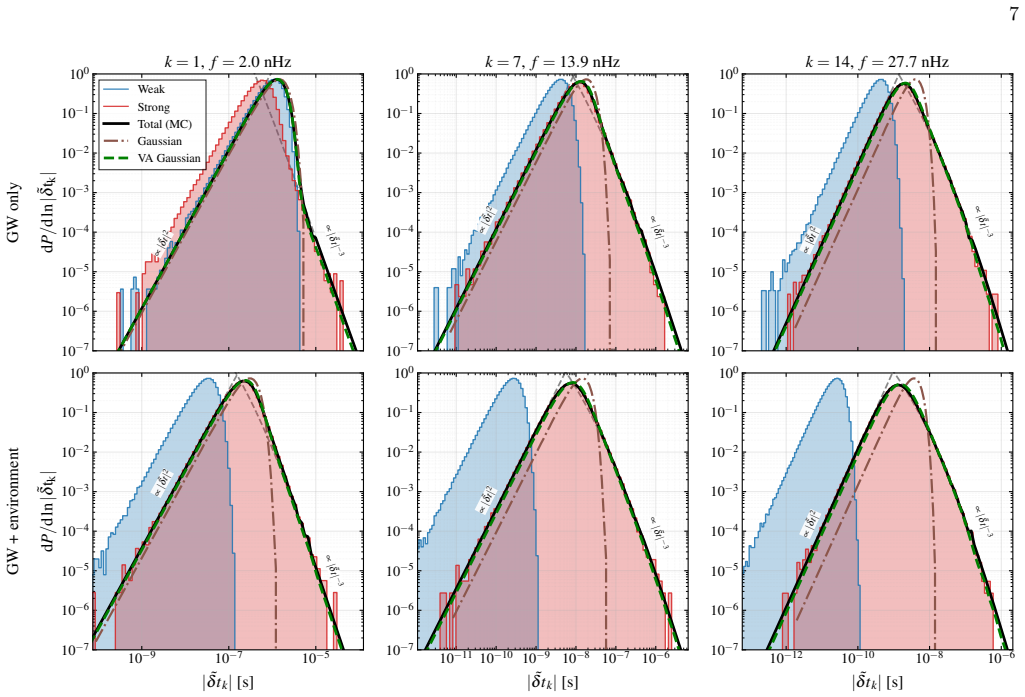
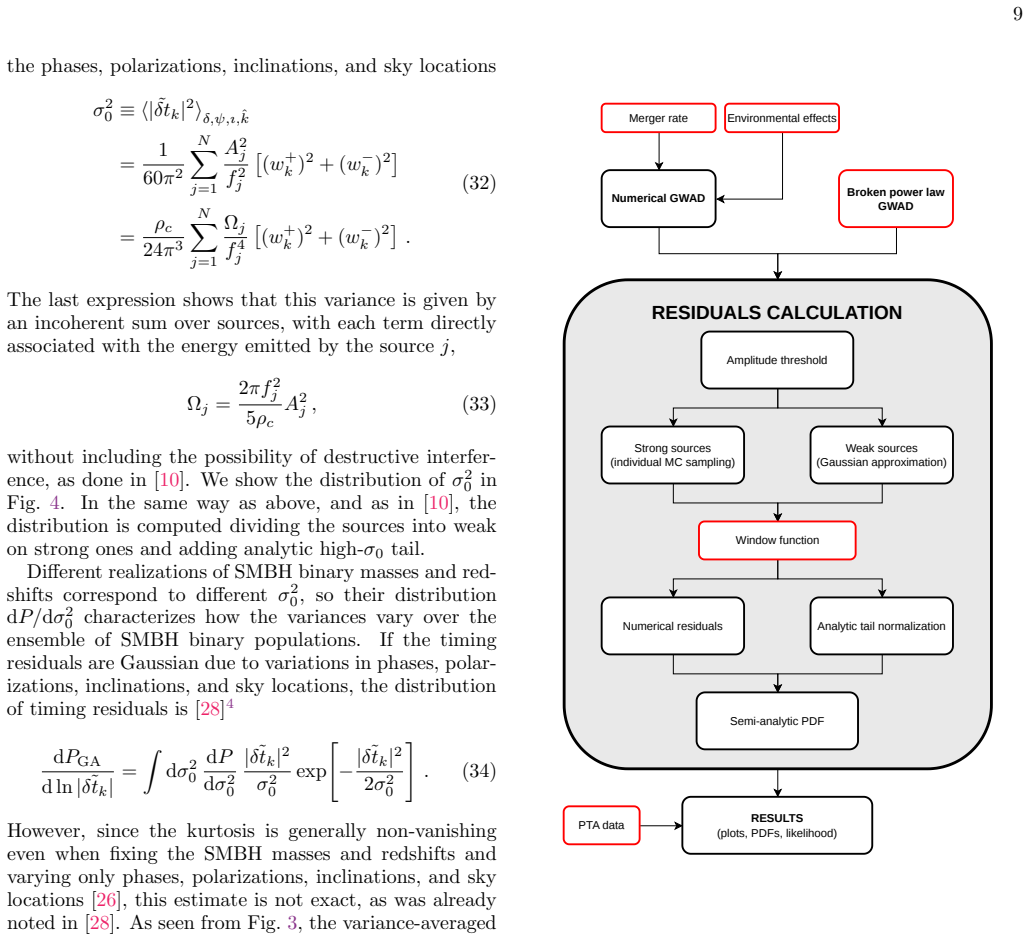
Strong sources To sample the contributions of the timing residuals, we divide a broad frequency band into a large number Nbins of narrow bins in binary frequency. The width of the band is conditional on the amount of leakage allowed by the window function in Eq. (7). For a given Fourier mode atf k, the amplitudes of theN S strong sources are sampled expli...
-
[4]
Weak sources The weak sources are far more numerous but also in- dividually insignificant. Their contribution is included in each binary frequency bin as ˜δt W J,k = NbinsX j=1 h Tjw+ k,j − T ∗ j w− k,j i ,(25) whereT j is a complex random variable whose statistical moments are all finite, and by the central limit theorem, it is expected to follow a compl...
-
[5]
(V A)), the statistics of the timing residuals at high| ˜δtJ,k|are dominated by a single loud source, whose amplitude is described by the high-Atail of the GWAD
Analytic tails Due to the single big jump principle of heavy-tailed distributions (see Sec. (V A)), the statistics of the timing residuals at high| ˜δtJ,k|are dominated by a single loud source, whose amplitude is described by the high-Atail of the GWAD. The distribution in the high-| ˜δtJ,k|tail can be estimated by considering the distribution of timing r...
-
[6]
In the K≫1 limit, these intervals correspond tok/K≤1+y < (k+1)/K, wherekis an integer in the range 0≤k <2K
Formally, it is given by p(|R0|2) = Z 1 −1 dy 2 δ(|R0|2 − |R0|2(y)),(A6) So, we need to invert the mappingy7→ |R 0|by con- sidering intervals of|R 0|where it is one-to-one. In the K≫1 limit, these intervals correspond tok/K≤1+y < (k+1)/K, wherekis an integer in the range 0≤k <2K. For simplicity, we can further assume thatKis an inte- ger, as the contribut...
-
[7]
Such terms are removed in the analysis of PTA data [14]
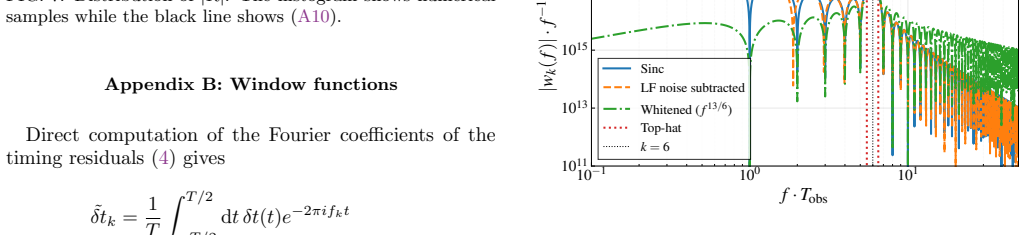
Low-frequency noise subtraction Deterministic slowly changing components cannot gen- erally be distinguished from low-frequency (LF) back- ground noise. Such terms are removed in the analysis of PTA data [14]. We consider terms with at most quadratic dependence in time, so that δt(t) =δt 0(t)− 2X n=0 An t T n ,(B4) whereδt 0(t) denotes the timing residual...
-
[8]
Whitening To mitigate spectral leakage, the time series can first be whitened, i.e., transformed so that the residual noise becomes approximately uncorrelated with unit variance. A whitened time seriesδt W (t) is obtained by convolving the dataδt(t) with a filter kernelW(t): δtW (t) = Z dt′δt(t−t ′)W(t ′).(B9) The Fourier coefficients computed in the whit...
-
[9]
9 and 10, respec- tively
Impact on timing residuals and correlations To illustrate the impact of different window functions on inter-mode leakage, the timing residual PDFs and mode correlations are plotted in Figs. 9 and 10, respec- tively. The correlations, following Eq. (19), depend ex- clusively on the window function, which modulates sig- nal leakage across frequencies, and a...
-
[10]
The NANOGrav 15-year Data Set: Evidence for a Gravitational-Wave Background
G. Agazieet al.(NANOGrav), The NANOGrav 15 yr Data Set: Evidence for a Gravitational-wave Background, Astrophys. J. Lett.951, L8 (2023), arXiv:2306.16213 [astro-ph.HE]
work page internal anchor Pith review arXiv 2023
-
[11]
Antoniadiset al.(EPTA, InPTA:), Astron
J. Antoniadiset al.(EPTA, InPTA:), The second data release from the European Pulsar Timing Array - III. Search for gravitational wave signals, Astron. Astrophys. 678, A50 (2023), arXiv:2306.16214 [astro-ph.HE]
-
[12]
D. J. Reardonet al., Search for an Isotropic Gravitational-wave Background with the Parkes Pul- sar Timing Array, Astrophys. J. Lett.951, L6 (2023), arXiv:2306.16215 [astro-ph.HE]
work page internal anchor Pith review arXiv 2023
-
[13]
H. Xuet al., Searching for the Nano-Hertz Stochastic Gravitational Wave Background with the Chinese Pulsar Timing Array Data Release I, Res. Astron. Astrophys. 23, 075024 (2023), arXiv:2306.16216 [astro-ph.HE]
work page internal anchor Pith review arXiv 2023
-
[14]
M. Rajagopal and R. W. Romani, Ultralow frequency gravitational radiation from massive black hole binaries, Astrophys. J.446, 543 (1995), arXiv:astro-ph/9412038
- [15]
-
[16]
A. Sesana, F. Haardt, P. Madau, and M. Volonteri, Low 16 −8.8 −8.6 −8.4 −8.2 −8.0 −7.8 −7.6 log10( f [Hz]) −8.5 −8.0 −7.5 −7.0 −6.5 −6.0 −5.5 log10(|˜δt|[s]) GW only −8.8 −8.6 −8.4 −8.2 −8.0 −7.8 −7.6 log10( f [Hz]) GW + env Sinc LF noise subtracted Top-hat Whitened Power law −13/6 RMS mean FIG. 9. Violin plot showing the distributions of timing residuals...
-
[17]
Agazieet al.(NANOGrav Collaboration), Astrophys
G. Agazieet al.(NANOGrav), The NANOGrav 15 yr Data Set: Constraints on Supermassive Black Hole Bina- ries from the Gravitational-wave Background, Astrophys. J. Lett.952, L37 (2023), arXiv:2306.16220 [astro-ph.HE]
-
[18]
Antoniadiset al.(EPTA, InPTA), Astron
J. Antoniadiset al.(EPTA, InPTA), The second data release from the European Pulsar Timing Array - IV. Implications for massive black holes, dark matter, and the early Universe, Astron. Astrophys.685, A94 (2024), arXiv:2306.16227 [astro-ph.CO]
- [19]
-
[20]
Afzalet al.(NANOGrav), Astrophys
A. Afzalet al.(NANOGrav), The NANOGrav 15 yr Data Set: Search for Signals from New Physics, Astrophys. J. Lett.951, L11 (2023), [Erratum: Astrophys.J.Lett. 971, L27 (2024), Erratum: Astrophys.J. 971, L27 (2024)], arXiv:2306.16219 [astro-ph.HE]. 17
-
[21]
What is the source of the PTA GW signal?,
J. Ellis, M. Fairbairn, G. Franciolini, G. H¨ utsi, A. Iovino, M. Lewicki, M. Raidal, J. Urrutia, V. Vaskonen, and H. Veerm¨ ae, What is the source of the PTA GW sig- nal?, Phys. Rev. D109, 023522 (2024), arXiv:2308.08546 [astro-ph.CO]
- [22]
- [23]
- [24]
- [25]
- [26]
- [27]
- [28]
- [29]
- [30]
-
[31]
Exploring the spectrum of stochastic gravitational-wave anisotropies with pulsar timing arrays,
G. Sato-Polito and M. Kamionkowski, Exploring the spectrum of stochastic gravitational-wave anisotropies with pulsar timing arrays, Phys. Rev. D109, 123544 (2024), arXiv:2305.05690 [astro-ph.CO]
- [32]
- [33]
-
[34]
B. Allen and S. Valtolina, Pulsar timing array source ensembles, Phys. Rev. D109, 083038 (2024), arXiv:2401.14329 [gr-qc]
- [35]
-
[36]
G. Sato-Polito and M. Zaldarriaga, Distribution of the gravitational-wave background from supermas- sive black holes, Phys. Rev. D111, 023043 (2025), arXiv:2406.17010 [astro-ph.CO]
- [37]
- [38]
-
[39]
L. Lentati, M. P. Hobson, and P. Alexander, Bayesian Estimation of Non-Gaussianity in Pulsar Timing Anal- ysis, Mon. Not. Roy. Astron. Soc.444, 3863 (2014), arXiv:1405.2460 [astro-ph.IM]
- [40]
-
[41]
M. Falxa and A. Sesana, Modeling non-Gaussianities in pulsar timing array data analysis using Gaussian mixture models, Phys. Rev. D113, 043047 (2026), arXiv:2508.08365 [astro-ph.IM]
- [42]
-
[43]
Raidal, J
J. Raidal, J. Urrutia, V. Vaskonen, and H. Veerm¨ ae, GWADpy (2026)
2026
- [44]
- [45]
- [46]
-
[47]
D. Merritt, Loss-cone dynamics, Classical and Quan- tum Gravity30, 244005 (2013), arXiv:1307.3268 [astro- ph.GA]
-
[48]
L. Z. Kelley, L. Blecha, and L. Hernquist, Massive Black Hole Binary Mergers in Dynamical Galactic Environ- ments, Mon. Not. Roy. Astron. Soc.464, 3131 (2017), arXiv:1606.01900 [astro-ph.HE]
work page Pith review arXiv 2017
- [49]
-
[50]
W. H. Press and P. Schechter, Formation of galaxies and clusters of galaxies by selfsimilar gravitational condensa- tion, Astrophys. J.187, 425 (1974)
1974
-
[51]
J. R. Bond, S. Cole, G. Efstathiou, and N. Kaiser, Ex- cursion set mass functions for hierarchical Gaussian fluc- tuations, Astrophys. J.379, 440 (1991)
1991
-
[52]
Lacey and S
C. Lacey and S. Cole, Merger rates in hierarchical models of galaxy formation, MNRAS262, 627 (1993)
1993
-
[53]
G. Girelli, L. Pozzetti, M. Bolzonella, C. Giocoli, F. Marulli, and M. Baldi, The stellar-to-halo mass re- lation over the past 12 Gyr: I. Standard ΛCDM model, Astron. Astrophys.634, A135 (2020), arXiv:2001.02230 [astro-ph.CO]. 18
- [54]
-
[55]
H. Middleton, W. Del Pozzo, W. M. Farr, A. Sesana, and A. Vecchio, Astrophysical constraints on massive black hole binary evolution from Pulsar Timing Ar- rays, Mon. Not. Roy. Astron. Soc.455, L72 (2016), arXiv:1507.00992 [astro-ph.CO]
-
[56]
G. Agazieet al.(NANOGrav), The NANOGrav 15 yr Data Set: Bayesian Limits on Gravitational Waves from Individual Supermassive Black Hole Binaries, Astrophys. J. Lett.951, L50 (2023), arXiv:2306.16222 [astro-ph.HE]
- [57]
-
[58]
G. Agazieet al., The NANOGrav 15 yr Data Set: Looking for Signs of Discreteness in the Gravitational- wave Background, Astrophys. J.978, 31 (2025), arXiv:2404.07020 [astro-ph.HE]
-
[59]
Nanohertz Gravitational Waves,
A. Sesana and D. G. Figueroa, Nanohertz Gravitational Waves, arXiv preprint (2025), arXiv:2512.18822 [astro- ph.CO]
-
[60]
V. P. Chistyakov, A theorem on sums of independent pos- itive random variables and its applications to branching random processes, Theory of Probability & Its Applica- tions9, 640 (1964)
1964
-
[61]
S. Foss, D. Korshunov, and S. Zachary,An Introduction to Heavy-Tailed and Subexponential Distributions, 2nd ed., Springer Series in Operations Research and Financial Engineering (Springer, New York, 2013)
2013
-
[62]
R. W. Hellings and G. S. Downs, Upper limits on the isotropic gravitational radiation background from pulsar timing analysis, Astrophys. J. Lett.265, L39 (1983)
1983
discussion (0)
Sign in with ORCID, Apple, or X to comment. Anyone can read and Pith papers without signing in.