Recognition: unknown
Are PTA measurements sensitive to gravitational wave non-Gaussianities?
Pith reviewed 2026-05-08 16:33 UTC · model grok-4.3
The pith
PTA data after decorrelation cannot distinguish Gaussian from non-Gaussian gravitational wave backgrounds without strong assumptions.
A machine-rendered reading of the paper's core claim, the machinery that carries it, and where it could break.
Core claim
Even in an idealized signal-dominated setup, after decorrelating data to avoid spurious detections, statistical tests applied to PTA data cannot distinguish between Gaussian and non-Gaussian GWBs in a model-agnostic way. In particular, without making strong assumptions on the GW spectrum or the properties of the population, the sensitivity to any distinctive non-Gaussian feature is washed out.
What carries the argument
The decorrelation of PTA timing residuals to suppress spurious correlations, which inadvertently removes sensitivity to non-Gaussian statistics in the absence of model assumptions.
Load-bearing premise
The assumption that decorrelating the data removes only artificial correlations without eliminating real non-Gaussian information from the gravitational wave background.
What would settle it
A numerical simulation injecting a known non-Gaussian gravitational wave background into PTA timing residuals, applying decorrelation, and verifying whether model-agnostic tests can recover the non-Gaussianity.
Figures

read the original abstract
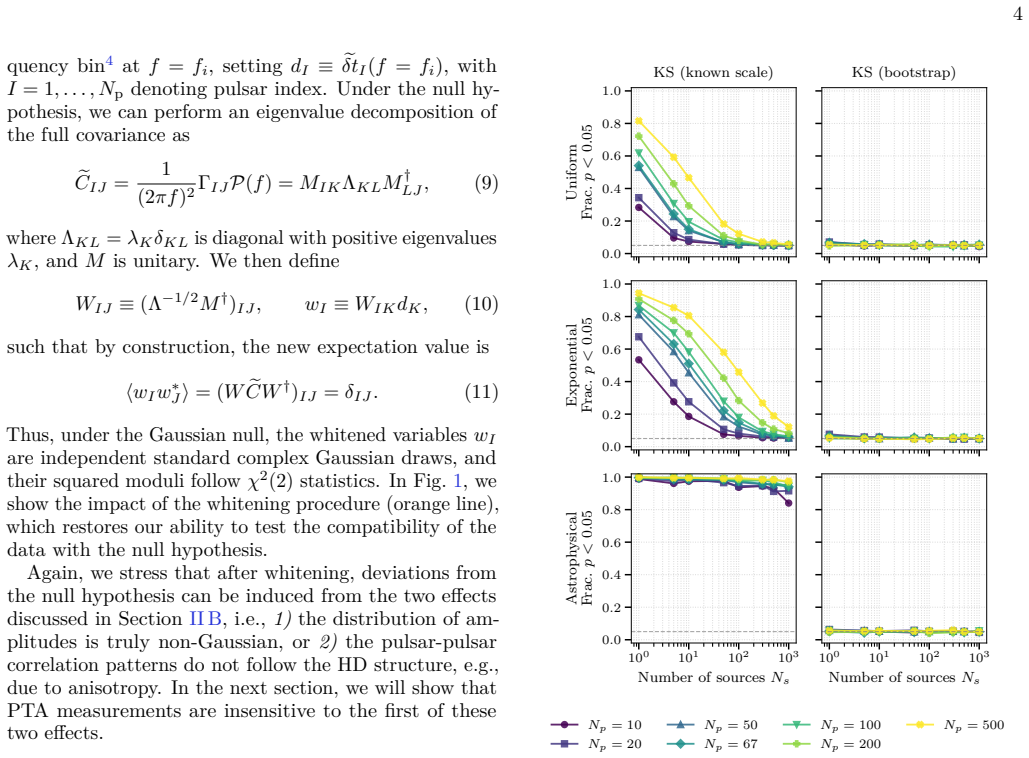
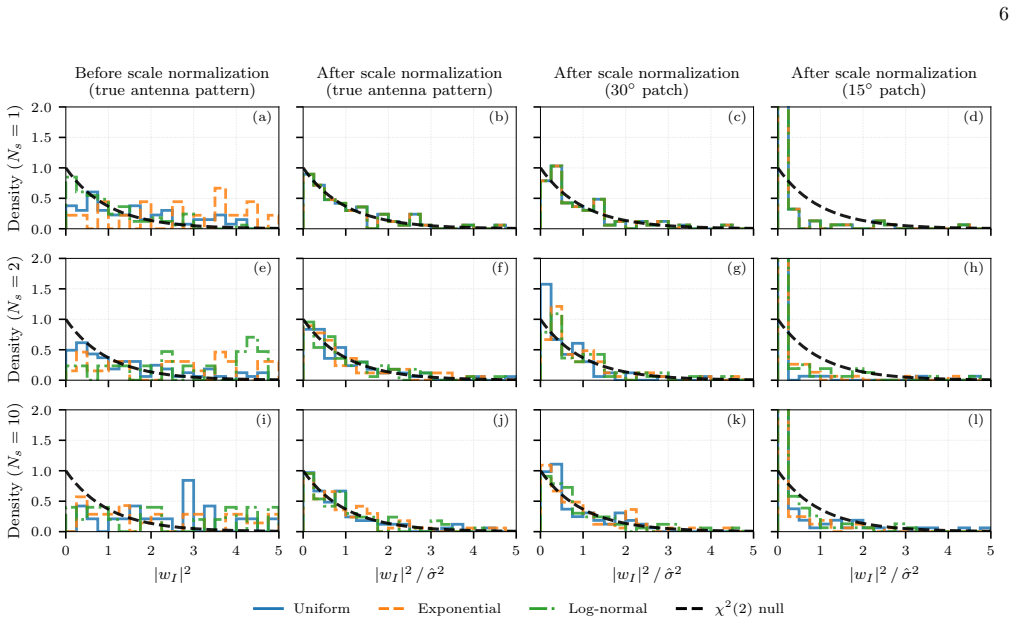
Observing non-Gaussianity in the timing residuals of Pulsar Timing Arrays (PTAs) has recently attracted attention as a potential discriminator between astrophysical and cosmological origins of the observed Gravitational Wave (GW) signal. In this work, we show that even in an idealized signal-dominated setup, after decorrelating data to avoid spurious detections, statistical tests applied to PTA data cannot distinguish between Gaussian and non-Gaussian GWBs in a model-agnostic way. In particular, without making strong assumptions on the GW spectrum or the properties of the population, the sensitivity to any distinctive non-Gaussian feature is washed out.
Editorial analysis
A structured set of objections, weighed in public.
Referee Report
Summary. The manuscript investigates whether Pulsar Timing Array (PTA) observations can detect non-Gaussianities in the stochastic gravitational wave background (GWB) as a way to discriminate between astrophysical and cosmological origins. The central claim is that, even in an idealized signal-dominated setup, a decorrelation procedure applied to the timing residuals to suppress spurious correlations renders standard statistical tests insensitive to non-Gaussian features in a model-agnostic manner; without strong priors on the GWB spectrum or source population, any distinctive higher-order signatures are washed out.
Significance. If the result holds, it carries substantial significance for the PTA and gravitational-wave cosmology communities. It supplies a concrete negative finding that cautions against over-reliance on model-independent non-Gaussianity searches with current or near-term PTA data sets. The idealized, signal-dominated framework isolates the effect of decorrelation cleanly, which is a methodological strength and makes the limitation on distinguishability falsifiable within the stated assumptions.
minor comments (3)
- Abstract: the phrase 'statistical tests' is used without naming the specific estimators (e.g., bispectrum, kurtosis, or higher-order correlation functions); a single sentence listing the tests would improve clarity for readers.
- Section 2 (or equivalent methods section): the decorrelation operator is introduced but its action on the three-point and four-point functions is not shown explicitly; adding a short analytic step or reference to an appendix derivation would make the 'washing out' claim easier to verify.
- Figure 1 or 2 (whichever shows the test-statistic distributions): the caption should state the number of realizations used and whether the plotted curves are normalized to unit variance, to allow direct comparison with the text.
Simulated Author's Rebuttal
We thank the referee for their positive assessment of our manuscript, accurate summary of its central claim, and recommendation for minor revision. We appreciate the recognition that the idealized, signal-dominated framework isolates the effect of decorrelation and provides a falsifiable limitation on model-agnostic distinguishability.
Circularity Check
No significant circularity; negative result follows from statistical properties of decorrelation
full rationale
The paper derives a negative result on model-agnostic distinguishability of Gaussian vs. non-Gaussian GWBs from the mathematical effect of decorrelation on higher-order statistics in an idealized signal-dominated PTA setup. No load-bearing step reduces to a fitted parameter renamed as prediction, self-definition, or self-citation chain; the conclusion is obtained directly from the properties of the decorrelation operator and the structure of statistical tests applied to timing residuals. The derivation remains self-contained against external benchmarks and does not invoke uniqueness theorems or ansatzes from prior author work as justification for the central claim.
Axiom & Free-Parameter Ledger
axioms (1)
- standard math Standard statistical assumptions underlying tests for Gaussianity and decorrelation procedures in correlated time-series data.
Reference graph
Works this paper leans on
-
[1]
R. w. Hellings and G. s. Downs, Astrophys. J. Lett.265, L39 (1983)
1983
-
[2]
The NANOGrav 15-year Data Set: Evidence for a Gravitational-Wave Background
G. Agazieet al.(NANOGrav), Astrophys. J. Lett.951, L8 (2023), arXiv:2306.16213 [astro-ph.HE]
work page internal anchor Pith review arXiv 2023
-
[3]
Antoniadiset al.(EPTA, InPTA:), Astron
J. Antoniadiset al.(EPTA, InPTA:), Astron. Astrophys. 678, A50 (2023), arXiv:2306.16214 [astro-ph.HE]
-
[4]
D. J. Reardonet al., Astrophys. J. Lett.951, L6 (2023), arXiv:2306.16215 [astro-ph.HE]
work page internal anchor Pith review arXiv 2023
-
[5]
H. Xuet al., Res. Astron. Astrophys.23, 075024 (2023), arXiv:2306.16216 [astro-ph.HE]
work page internal anchor Pith review arXiv 2023
- [6]
-
[7]
Afzalet al.(NANOGrav), Astrophys
A. Afzalet al.(NANOGrav), Astrophys. J. Lett.951, L11 (2023), [Erratum: Astrophys.J.Lett. 971, L27 (2024), Erratum: Astrophys.J. 971, L27 (2024)], arXiv:2306.16219 [astro-ph.HE]
-
[8]
Antoniadiset al.(EPTA, InPTA), Astron
J. Antoniadiset al.(EPTA, InPTA), Astron. Astrophys. 685, A94 (2024), arXiv:2306.16227 [astro-ph.CO]
- [9]
-
[10]
What is the source of the PTA GW signal?,
J. Ellis, M. Fairbairn, G. Franciolini, G. Hütsi, A. Iovino, M. Lewicki, M. Raidal, J. Urrutia, V. Vaskonen, and H. Veermäe, Phys. Rev. D109, 023522 (2024), arXiv:2308.08546 [astro-ph.CO]
-
[11]
Caprini, Nature Rev
C. Caprini, Nature Rev. Phys.6, 291 (2024)
2024
- [12]
- [13]
- [14]
- [15]
- [16]
-
[17]
G. Agazieet al., Astrophys. J. Lett.956, L3 (2023), arXiv:2306.16222 [astro-ph.HE]
-
[18]
Y. Ali-Haïmoud, T. L. Smith, and C. M. F. Mingarelli, Phys. Rev. D103, 042009 (2021), arXiv:2010.13958 [gr- qc]
- [19]
- [20]
- [21]
-
[22]
T. Konstandin, A.-M. Lemke, A. Mitridate, and E. Per- boni, JCAP04, 059 (2025), arXiv:2408.07741 [astro- ph.CO]
- [23]
- [24]
- [25]
-
[26]
B. Bécsyet al., Astrophys. J.959, 9 (2023), arXiv:2309.04443 [gr-qc]
- [27]
-
[28]
Cosmological Backgrounds of Gravitational Waves,
C. Caprini and D. G. Figueroa, Class. Quant. Grav.35, 163001 (2018), arXiv:1801.04268 [astro-ph.CO]
-
[29]
G. Franciolini, D. Racco, and F. Rompineve, Phys. Rev. Lett.132, 081001 (2024), [Erratum: Phys.Rev.Lett. 133, 189901 (2024)], arXiv:2306.17136 [astro-ph.CO]
-
[30]
Allen, inLes Houches School of Physics: Astrophysical Sources of Gravitational Radiation (1996) pp
B. Allen, inLes Houches School of Physics: Astrophysical Sources of Gravitational Radiation(1996) pp. 373–417, arXiv:gr-qc/9604033
-
[31]
N. Bartolo, V. De Luca, G. Franciolini, M. Peloso, D. Racco, and A. Riotto, Phys. Rev. D99, 103521 (2019), arXiv:1810.12224 [astro-ph.CO]
- [32]
-
[33]
M. Falxa and A. Sesana, Phys. Rev. D113, 043047 (2026), arXiv:2508.08365 [astro-ph.IM]
- [34]
- [35]
-
[36]
Probing Gravitational-Wave Four-Point Correlators,
M. Ciprini, M. L. Marcelli, and G. Tasinato, (2026), arXiv:2603.15514 [astro-ph.CO]
-
[37]
The Heavy Tailed Non-Gaussianity of the Supermassive Black Hole Gravitational Wave Background
J. Raidal, J. Urrutia, V. Vaskonen, and H. Veermäe, (2026), arXiv:2604.08506 [astro-ph.CO]
work page internal anchor Pith review Pith/arXiv arXiv 2026
- [38]
-
[39]
S. Burke-Spolaor, S. R. Taylor, M. Charisi, T. Dolch, J. S. Hazboun, A. M. Holgado, L. Z. Kelley, T. J. W. Lazio, D. R. Madison, N. McMann, C. M. F. Mingarelli, A. Rasskazov, X. Siemens, J. J. Simon, and T. L. Smith, Astron. Astrophys. Rev.27, 5 (2019), arXiv:1811.08826 [astro-ph.HE]. 8
-
[40]
S. R. Taylor, CRC Press (2022), 10.1201/9781003240648, arXiv:2105.13270 [astro-ph.HE]
- [41]
- [42]
-
[43]
C. Unal, Phys. Rev. D99, 041301 (2019), arXiv:1811.09151 [astro-ph.CO]
- [44]
-
[45]
D. Anninos, V. De Luca, G. Franciolini, A. Kehagias, and A. Riotto, JCAP04, 045 (2019), arXiv:1902.01251 [hep-th]
-
[46]
P. Adshead, K. D. Lozanov, and Z. J. Weiner, JCAP10, 080 (2021), arXiv:2105.01659 [astro-ph.CO]
-
[47]
C. Yuan, D.-S. Meng, and Q.-G. Huang, JCAP12, 036 (2023), arXiv:2308.07155 [astro-ph.CO]
-
[48]
N. Bartolo, D. Bertacca, S. Matarrese, M. Peloso, A. Ric- ciardone, A. Riotto, and G. Tasinato, Phys. Rev. D100, 121501 (2019), arXiv:1908.00527 [astro-ph.CO]
-
[49]
N. Bartolo, D. Bertacca, S. Matarrese, M. Peloso, A. Ric- ciardone, A. Riotto, and G. Tasinato, Phys. Rev. D102, 023527 (2020), arXiv:1912.09433 [astro-ph.CO]
- [50]
- [51]
- [52]
-
[53]
N. Bartolo, V. Domcke, D. G. Figueroa, J. García-Bellido, M. Peloso, M. Pieroni, A. Ricciardone, M. Sakellari- adou, L. Sorbo, and G. Tasinato, JCAP11, 034 (2018), arXiv:1806.02819 [astro-ph.CO]
-
[54]
N. Bartolo, V. De Luca, G. Franciolini, A. Lewis, M. Peloso, and A. Riotto, Phys. Rev. Lett.122, 211301 (2019), arXiv:1810.12218 [astro-ph.CO]
-
[55]
A. Margalit, C. R. Contaldi, and M. Pieroni, Phys. Rev. D102, 083506 (2020), arXiv:2004.01727 [astro-ph.CO]
-
[56]
E. Dimastrogiovanni, M. Fasiello, and G. Tasinato, Phys. Rev. Lett.124, 061302 (2020), arXiv:1906.07204 [astro- ph.CO]
- [57]
- [58]
-
[59]
G. Cusin and G. Tasinato, JCAP08, 036 (2022), arXiv:2201.10464 [astro-ph.CO]
-
[60]
Kinematic anisotropies and pulsar timing arrays,
G. Tasinato, Phys. Rev. D108, 103521 (2023), arXiv:2309.00403 [gr-qc]
-
[61]
G. F. Smoot, M. V. Gorenstein, and R. A. Muller, Phys. Rev. Lett.39, 898 (1977)
1977
- [62]
-
[63]
E. S. Phinney, (2001), arXiv:astro-ph/0108028
work page internal anchor Pith review arXiv 2001
- [64]
-
[65]
M. Enoki and M. Nagashima, Prog. Theor. Phys.117, 241 (2007), arXiv:astro-ph/0609377
-
[66]
B. Kocsis and A. Sesana, Mon. Not. Roy. Astron. Soc. 411, 1467–1479 (2011), arXiv:1002.0584 [astro-ph.CO]
- [67]
-
[68]
L. Z. Kelley, L. Blecha, and L. Hernquist, Mon. Not. Roy. Astron. Soc.464, 3131 (2017), arXiv:1606.01900 [astro-ph.HE]
work page Pith review arXiv 2017
- [69]
- [70]
- [71]
-
[72]
G. Agazieet al., Astrophys. J.978, 31 (2025), arXiv:2404.07020 [astro-ph.HE]
- [73]
- [74]
-
[75]
A. Sesana, Mon. Not. Roy. Astron. Soc.433, L1 (2013), arXiv:1211.5375 [astro-ph.CO]
- [76]
- [77]
-
[78]
M. Frommert, R. Durrer, and J. Michaud, JCAP01, 009 (2012), arXiv:1108.5354 [astro-ph.CO]
-
[79]
M. Crisostomi, R. van Haasteren, P. M. Meyers, and M. Vallisneri, (2025), arXiv:2506.13866 [astro-ph.IM]
-
[80]
A practical theorem on gravitational-wave background statistics
Y. Ali-Haïmoud, (2026), arXiv:2604.19701 [astro-ph.CO]
work page internal anchor Pith review Pith/arXiv arXiv 2026
discussion (0)
Sign in with ORCID, Apple, or X to comment. Anyone can read and Pith papers without signing in.