Recognition: unknown
Proximal Discontinuous Galerkin Methods for Variational Inequalities
Pith reviewed 2026-05-10 01:34 UTC · model grok-4.3
The pith
Proximal discontinuous Galerkin methods for variational inequalities are analyzed in a unified framework that establishes existence, uniqueness, energy dissipation, and error estimates, with the hybrid high-order variant achieving higher-
A machine-rendered reading of the paper's core claim, the machinery that carries it, and where it could break.
Core claim
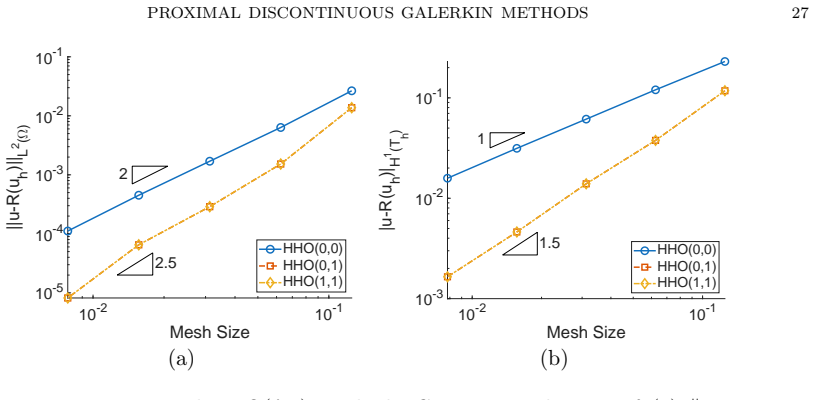
We introduce a family of proximal discontinuous Galerkin methods for variational inequalities obtained by applying nonconforming discretizations to the Bregman proximal point method. For the obstacle problem we prove existence and uniqueness of the discrete solutions, discrete energy dissipation, and error estimates for the primal variable and the dual variable. In particular the proximal hybrid high-order method with piecewise constant cell unknowns and piecewise affine facet unknowns yields higher-order convergence rates.
What carries the argument
The Bregman proximal point iteration discretized via nonconforming finite element methods and analyzed uniformly for the obstacle problem, with the hybrid high-order scheme using piecewise constant cell unknowns and piecewise affine facet unknowns as the variant delivering the new convergence result.
If this is right
- Discrete solutions exist and are unique for each proximal subproblem under the unified framework.
- A discrete energy functional dissipates monotonically at every proximal iteration step.
- Error estimates hold for both the primal solution and the dual multiplier variable across the four methods.
- The hybrid high-order variant realizes higher-order convergence in the energy norm for the first time among proximal Galerkin schemes.
Where Pith is reading between the lines
- The proximal discretization approach could be carried over to other variational inequalities, such as those modeling contact or phase transitions.
- The dual-variable error control might improve active-set identification in practical constrained optimization codes.
- Time-dependent or evolutionary versions of the obstacle problem could be treated by applying the same proximal iteration at each time step.
Load-bearing premise
The unified analysis framework applies without additional restrictions to the four chosen nonconforming discretizations when applied to the Bregman proximal point iteration for the obstacle problem.
What would settle it
Numerical experiments in which the proximal hybrid high-order method fails to attain convergence rates higher than first order on a smooth obstacle problem would falsify the higher-order convergence claim.
Figures


read the original abstract
We introduce a family of proximal discontinuous Galerkin methods for variational inequalities, focusing on the obstacle problem as a didactic example. Each member of this family is born from applying a different well-known nonconforming finite element discretization to the Bregman proximal point method. We explicitly treat four examples: the symmetric interior penalty discontinuous Galerkin, the enriched Galerkin, the hybridizable interior penalty and the hybrid high-order methods. We formulate a unified analysis framework for this family of methods and prove the existence and uniqueness of solutions, energy dissipation, and error estimates for both the primal and dual variables. Remarkably, the proximal hybrid high-order method with piecewise constant cell unknowns and piecewise affine facet unknowns leads to the first higher-order convergence result for any proximal Galerkin method.
Editorial analysis
A structured set of objections, weighed in public.
Referee Report
Summary. The manuscript introduces a family of proximal discontinuous Galerkin methods for variational inequalities, using the obstacle problem as the main example. It combines the Bregman proximal point iteration with four nonconforming discretizations (symmetric interior penalty DG, enriched Galerkin, hybridizable interior penalty, and hybrid high-order methods) and develops a unified analysis framework proving existence and uniqueness of solutions, energy dissipation, and error estimates for both primal and dual variables. The paper emphasizes that the proximal HHO method (piecewise constant cell unknowns and piecewise affine facet unknowns) yields the first higher-order convergence result for any proximal Galerkin method.
Significance. If the central claims hold, the work offers a valuable unified framework for applying proximal methods to nonconforming finite element discretizations of variational inequalities, with explicit proofs of well-posedness and energy stability. The potential for higher-order convergence via the proximal HHO variant would be a notable advance, as it addresses a gap in existing proximal Galerkin literature. The manuscript credits the combination of standard proximal and DG ingredients without introducing new ad-hoc parameters.
major comments (2)
- [§4 and Theorem 5.3] §4 (unified analysis framework) and Theorem 5.3 (error estimates for proximal HHO): the claim that the unified framework delivers higher-order convergence for the proximal HHO method (P0 cell + P1 facet) without additional restrictions beyond the other three methods is load-bearing for the headline result. The obstacle problem solution has at most H^2 regularity away from the free boundary; the consistency terms arising from the nonconforming HHO space and the proximal mapping must be controlled without mesh-dependent deterioration or implicit higher-regularity assumptions. The provided proof sketch does not explicitly verify this control for the HHO choice.
- [§3.3 and §5] §3.3 (proximal HHO formulation) and the dual-variable error estimate in §5: the analysis treats the proximal mapping applied to the obstacle constraint uniformly across methods, but the HHO facet unknowns (P1) introduce additional consistency terms whose bounding relies on the same regularity as the other methods. If this step invokes a constant that grows with the polynomial degree or mesh size near the free boundary, the stated higher-order rate fails to hold in the claimed generality.
minor comments (3)
- [§2] The notation for the Bregman proximal operator and the discrete dual variable is introduced without a dedicated table of symbols; adding one would improve readability when comparing the four methods.
- [Figure 1] Figure 1 (schematic of the four discretizations) uses inconsistent line styles for cell vs. facet unknowns; clarifying the legend would help readers distinguish the HHO variant.
- [§1 and §4] A few references to prior work on proximal methods for VIs (e.g., on conforming FEM) are cited only in the introduction; moving one or two to the unified analysis section would better contextualize the novelty.
Simulated Author's Rebuttal
We thank the referee for the thorough review and valuable feedback on our work. We address the major comments point by point below, providing clarifications on the analysis for the proximal HHO method.
read point-by-point responses
-
Referee: [§4 and Theorem 5.3] §4 (unified analysis framework) and Theorem 5.3 (error estimates for proximal HHO): the claim that the unified framework delivers higher-order convergence for the proximal HHO method (P0 cell + P1 facet) without additional restrictions beyond the other three methods is load-bearing for the headline result. The obstacle problem solution has at most H^2 regularity away from the free boundary; the consistency terms arising from the nonconforming HHO space and the proximal mapping must be controlled without mesh-dependent deterioration or implicit higher-regularity assumptions. The provided proof sketch does not explicitly verify this control for the HHO choice.
Authors: We appreciate this observation. The unified framework in Section 4 is designed to apply to all four methods, including HHO, by relying on abstract properties of the discrete spaces and the proximal operator. Specifically, the consistency error for the HHO method with P0 cell and P1 facet unknowns is controlled using the standard approximation properties and the H^2 regularity of the solution away from the free boundary, which is the same as assumed for the other methods. The proximal mapping does not introduce additional regularity requirements because the estimates are based on the variational inequality structure and the energy dissipation. We acknowledge that the proof sketch in Theorem 5.3 could be expanded to explicitly detail the HHO case. We will revise the manuscript to include a more detailed verification of the consistency terms for the HHO method in the revised version. revision: partial
-
Referee: [§3.3 and §5] §3.3 (proximal HHO formulation) and the dual-variable error estimate in §5: the analysis treats the proximal mapping applied to the obstacle constraint uniformly across methods, but the HHO facet unknowns (P1) introduce additional consistency terms whose bounding relies on the same regularity as the other methods. If this step invokes a constant that grows with the polynomial degree or mesh size near the free boundary, the stated higher-order rate fails to hold in the claimed generality.
Authors: Thank you for pointing this out. In Section 3.3, the proximal HHO formulation is presented, and the dual error estimates in Section 5 follow from the unified framework. The additional consistency terms from the P1 facet unknowns are bounded using trace inequalities and the local regularity, without dependence on the mesh size in a deteriorating way or on the polynomial degree beyond the fixed degree 1. The higher-order convergence is achieved because the HHO space allows for better approximation in the dual variable compared to standard DG methods. We do not invoke constants that grow with mesh size near the free boundary; the estimates are global but localized via the proximal iteration. We maintain that the analysis holds as stated. We will add a remark in the revised manuscript to clarify the bounding of these terms. revision: partial
Circularity Check
No significant circularity; unified framework derives error estimates independently
full rationale
The paper constructs a unified analysis for proximal DG methods (SIPG, EG, HDG, HHO) applied to the Bregman proximal point iteration on the obstacle problem. Existence, uniqueness, energy dissipation, and primal/dual error estimates follow from standard nonconforming DG consistency and stability arguments plus proximal mapping properties. The higher-order claim for P0-cell/P1-facet HHO is obtained by plugging the specific approximation properties of that space into the same abstract estimates; no parameter is fitted to data and then renamed a prediction, no self-citation supplies a uniqueness theorem that forces the result, and the derivation chain does not reduce any claimed quantity to itself by definition. The framework remains self-contained against external benchmarks (standard DG theory and proximal-point convergence).
Axiom & Free-Parameter Ledger
axioms (1)
- domain assumption Standard well-posedness assumptions for variational inequalities and nonconforming finite-element spaces
Forward citations
Cited by 2 Pith papers
-
Proximal Galerkin for the isometry constraint
Proximal Galerkin method exactly enforces the isometry constraint for nonlinear plates at mesh cell barycenters without preprocessing, yielding asymptotically mesh-independent convergence.
-
Proximal Galerkin for Phase Field Fracture
The proximal Galerkin method reformulates phase-field fracture constraints into saddle-point problems to enforce physical bounds and irreversibility for static and dynamic cases.
Reference graph
Works this paper leans on
-
[1]
D. N. Arnold, F. Brezzi, B. Cockburn, and L. D. Marini. Uni fied analysis of discontinuous Galerkin methods for elliptic problems. SIAM J. Numer. Anal. , 39(5):1749–1779, 2002
2002
-
[2]
G. Baker. Finite element methods for elliptic equations using nonconforming elements. Math. Comp. , 31(137):45–59, 1977
1977
-
[3]
H. H. Bauschke and J. M. Borwein. Legendre functions and t he method of random Bregman projections. J. Convex Anal. , 4(1):27–67, 1997
1997
- [4]
-
[5]
S. C. Brenner. Two-level additive Schwarz precondition ers for nonconforming finite elements. In D. E. Keyes and J. Xue, editors, Domain decomposition methods in scientific and engineering computing. AMS, 1993. Proceedings of the 7th International Conference on Domain Decomposition Methods. http://www.ddm.org/DD07/index-neu.htm
1993
-
[6]
S. C. Brenner. Poincar´ e–Friedrichs inequalities for p iecewise H 1 functions. SIAM J. Numer. Anal. , 41(1):306–324, 2003
2003
-
[7]
Chen and M
G. Chen and M. Teboulle. Convergence analysis of a proxim al-like minimization algorithm using Bregman functions. SIAM J. Optim. , 3(3):538–543, 1993
1993
-
[8]
P. G. Ciarlet. Linear and Nonlinear Functional Analysis with Application s, volume 130. SIAM, 2013
2013
-
[9]
Cicuttin, A
M. Cicuttin, A. Ern, and T. Gudi. Hybrid high-order metho ds for the elliptic obstacle problem. J. Sci. Comput., 83(1):8, March 2020
2020
-
[10]
Cicuttin, A
M. Cicuttin, A. Ern, and N. Pignet. Hybrid high-order methods. A primer with application to sol id me- chanics. SpringerBriefs in Mathematics, 2021
2021
-
[11]
Cockburn, D
B. Cockburn, D. A. Di Pietro, and A. Ern. Bridging the hyb rid high-order and hybridizable discontinuous G alerkin methods. ESAIM Math. Model. Numer. Anal. , 50(3):635–650, 2016. 28 PROXIMAL DISCONTINUOUS GALERKIN METHODS
2016
-
[12]
Cockburn, J
B. Cockburn, J. Gopalakrishnan, and R. Lazarov. Unified hybridization of discontinuous Galerkin, mixed, and continuous Galerkin methods for second order elliptic p roblems. SIAM J. Numer. Anal. , 47(2):1319– 1365, 2009
2009
-
[13]
Cockburn, J
B. Cockburn, J. Guzm´ an, S. Soon, and H.K. Stolarski. An analysis of the embedded discontinuous Galerkin method for second-order elliptic problems. SIAM J. Numer. Anal. , 47(4):2686–2707, 2009
2009
-
[14]
Cockburn and C.-W
B. Cockburn and C.-W. Shu. The local discontinuous Gale rkin method for time-dependent convection- diffusion systems. SIAM J. Numer. Anal. , 35(6):2440–2463, 1998
1998
-
[15]
D. A. Di Pietro and A. Ern. Mathematical Aspects of Discontinuous Galerkin Methods , volume 69. Springer Science & Business Media, 2011
2011
-
[16]
D. A. Di Pietro and A. Ern. A hybrid high-order locking-f ree method for linear elasticity on general meshes. Comput. Methods Appl. Mech. Engrg. , 283:1–21, 2015
2015
-
[17]
D. A. Di Pietro, A. Ern, and S. Lemaire. An arbitrary-ord er and compact-stencil discretization of diffusion on general meshes based on local reconstruction operators. Comput. Methods Appl. Math. , 14(4):461–472, 2014
2014
-
[18]
J. S. Dokken, P. E. Farrell, B. Keith, I. Papadopoulos, a nd T. M. Surowiec. The latent variable proximal point algorithm for variational problems with inequality c onstraints. Comput. Methods Appl. Mech. Engrg. , 445:118181, 2025
2025
-
[19]
Ern and J.-L
A. Ern and J.-L. Guermond. Finite element quasi-interp olation and best approximation. ESAIM Math. Model. Numer. Anal. , 51(4):1367–1385, 2017
2017
-
[20]
Etangsale, M
G. Etangsale, M. Fahs, V. Fontaine, and N. Rajaonison. I mproved error estimates of hybridizable interior penalty methods using a variable penalty for highly anisotr opic diffusion problems. Comput. Math. Appl. , 119:89–99, 2022
2022
-
[21]
M. S. Fabien, M. G. Knepley, and B. Rivi` ere. Families of interior penalty hybridizable discontinuous Galerkin methods for second order elliptic problems. J. Numer. Math. , 28(3):161–174, 2020
2020
- [22]
-
[23]
G. Fu, B. Keith, and R. Masri. A locally-conservative pr oximal Galerkin method for pointwise bound constraints. Math. Comp. (to appear) , 2026
2026
-
[24]
F¨ uhrer
T. F¨ uhrer. On a mixed FEM and a FOSLS with H − 1 loads. Comput. Methods Appl. Math. , 24(2):363–378, 2024
2024
-
[25]
Glowinski
R. Glowinski. Numerical Methods for Nonlinear Variational Problems . Springer Berlin Heidelberg, 1984
1984
-
[26]
G¨ uzey, B
S. G¨ uzey, B. Cockburn, and H. K. Stolarski. The embedde d discontinuous Galerkin method: application to linear shell problems. Int. J. Numer. Methods Eng , 70(7):757–790, 2007
2007
-
[27]
Keith, D
B. Keith, D. Kim, B. S. Lazarov, and T. M. Surowiec. Analy sis of the SiMPL method for density-based topology optimization. SIAM J. Optim. , 35(2):1134–1164, 2025
2025
-
[28]
arXiv preprint arXiv:2507.13516 (2025)
B. Keith, R. Masri, and M. Zeinhofer. A priori error anal ysis of the proximal Galerkin method. arXiv preprint arXiv:2507.13516 , 2025
-
[29]
Keith and T
B. Keith and T. M. Surowiec. Proximal Galerkin: A struct ure-preserving finite element method for point- wise bound constraints. Found. Comput. Math. , pages 1–97, 2024
2024
-
[30]
K. L. A. Kirk, B. Rivi` ere, and R. Masri. Numerical analy sis of a hybridized discontinuous Galerkin method for the Cahn–Hilliard problem. IMA J. Numer. Anal. , 44(5):2752–2792, 11 2023
2023
-
[31]
R. J. Labeur and G. N. Wells. A Galerkin interface stabil isation method for the advection-diffusion and incompressible Navier-Stokes equations. Comput. Methods Appl. Mech. Engrg. , 196(49-52):4985–5000, 2007
2007
-
[32]
Lee, Y.-J
S. Lee, Y.-J. Lee, and M. F. Wheeler. A locally conservat ive enriched Galerkin approximation and efficient solver for elliptic and parabolic problems. SIAM J. Sci. Comput. , 38(3):A1404–A1429, 2016
2016
-
[33]
I. Oikawa. Hybridized discontinuous Galerkin method w ith lifting operator. JSIAM Lett., 2:99–102, 2010
2010
-
[34]
P. Oswald. On a BPX-preconditioner for P1 elements. Computing, 51:125–133, 1993
1993
-
[35]
arXiv preprint arXiv:2412.13733 (2024)
I. Papadopoulos. Hierarchical proximal Galerkin: a fa st hp-FEM solver for variational problems with pointwise inequality constraints. arXiv preprint arXiv:2412.13733 , 2024
-
[36]
Rhebergen and G
S. Rhebergen and G. N. Wells. Analysis of a hybridized/i nterface stabilized finite element method for the Stokes equations. SIAM J. Numer. Anal. , 55(4):1982–2003, 2017
1982
-
[37]
Rivi` ere
B. Rivi` ere. Discontinuous Galerkin Methods for Solving Elliptic and Pa rabolic Equations: Theory and Implementation. SIAM, 2008. PROXIMAL DISCONTINUOUS GALERKIN METHODS 29
2008
-
[38]
R. T. Rockafellar. Conjugates and Legendre transforms of convex functions. Canad. J. Math. , 19:200–205, 1967
1967
-
[39]
R. T. Rockafellar. Convex Analysis . Princeton University Press, Princeton, 1970
1970
-
[40]
L. R. Scott and S. Zhang. Finite element interpolation o f nonsmooth functions satisfying boundary con- ditions. Math. Comp. , 54(190):483–493, 1990
1990
-
[41]
Sun and J
S. Sun and J. Liu. A locally conservative finite element m ethod based on piecewise constant enrichment of the continuous Galerkin method. SIAM J. Sci. Comput. , 31(4):2528–2548, 2009
2009
-
[42]
M. F. Wheeler. An elliptic collocation-finite element m ethod with interior penalties. SIAM J. Numer. Anal., 15:152–161, 1978
1978
discussion (0)
Sign in with ORCID, Apple, or X to comment. Anyone can read and Pith papers without signing in.