Recognition: 1 theorem link
· Lean TheoremProximal Galerkin for the isometry constraint
Pith reviewed 2026-05-11 02:44 UTC · model grok-4.3
The pith
The proximal Galerkin method exactly enforces the isometry constraint at mesh cell barycenters in nonlinear plate models without preprocessing.
A machine-rendered reading of the paper's core claim, the machinery that carries it, and where it could break.
Core claim
We resolve a longstanding open problem in the computational modeling of nonlinear plates by introducing a numerical method that exactly enforces the isometry constraint, namely, that the first fundamental form of the mid-surface coincides with the identity tensor. The resulting method preserves the geometric structure of the feasible set and yields an efficient algorithm in which each iterate is an exact isometry at the barycenter of every mesh cell. In contrast to existing methods, no preprocessing step is required, enabling broader applicability of this important category of mathematical models.
What carries the argument
The proximal operator for the isometry constraint within a finite-element discretization, which enforces exact satisfaction at cell barycenters while allowing direct iteration.
If this is right
- Each iterate satisfies the isometry constraint exactly at cell barycenters, so the isometry defect does not accumulate.
- The method applies directly to problems without first constructing an initial isometry guess or satisfying boundary conditions separately.
- Convergence to a prescribed tolerance occurs in an asymptotically mesh-independent number of iterations.
- The total iteration count remains substantially lower than tangent-space gradient-flow methods on the same benchmarks, even for coarse meshes.
Where Pith is reading between the lines
- The barycenter-exact property could support simple a-posteriori checks or local corrections to improve global isometry quality.
- Similar proximal-Galerkin constructions might handle other pointwise manifold constraints arising in shell or membrane models.
- The absence of preprocessing steps suggests the approach could scale more readily to problems with complex or time-varying boundary data.
Load-bearing premise
The proximal operator for the isometry constraint can be efficiently computed within the finite-element discretization while preserving exact enforcement at cell barycenters.
What would settle it
On any standard plate benchmark, run the algorithm and check whether every iterate is an exact isometry at all cell barycenters; failure of this property on even one cell would falsify the central claim.
Figures
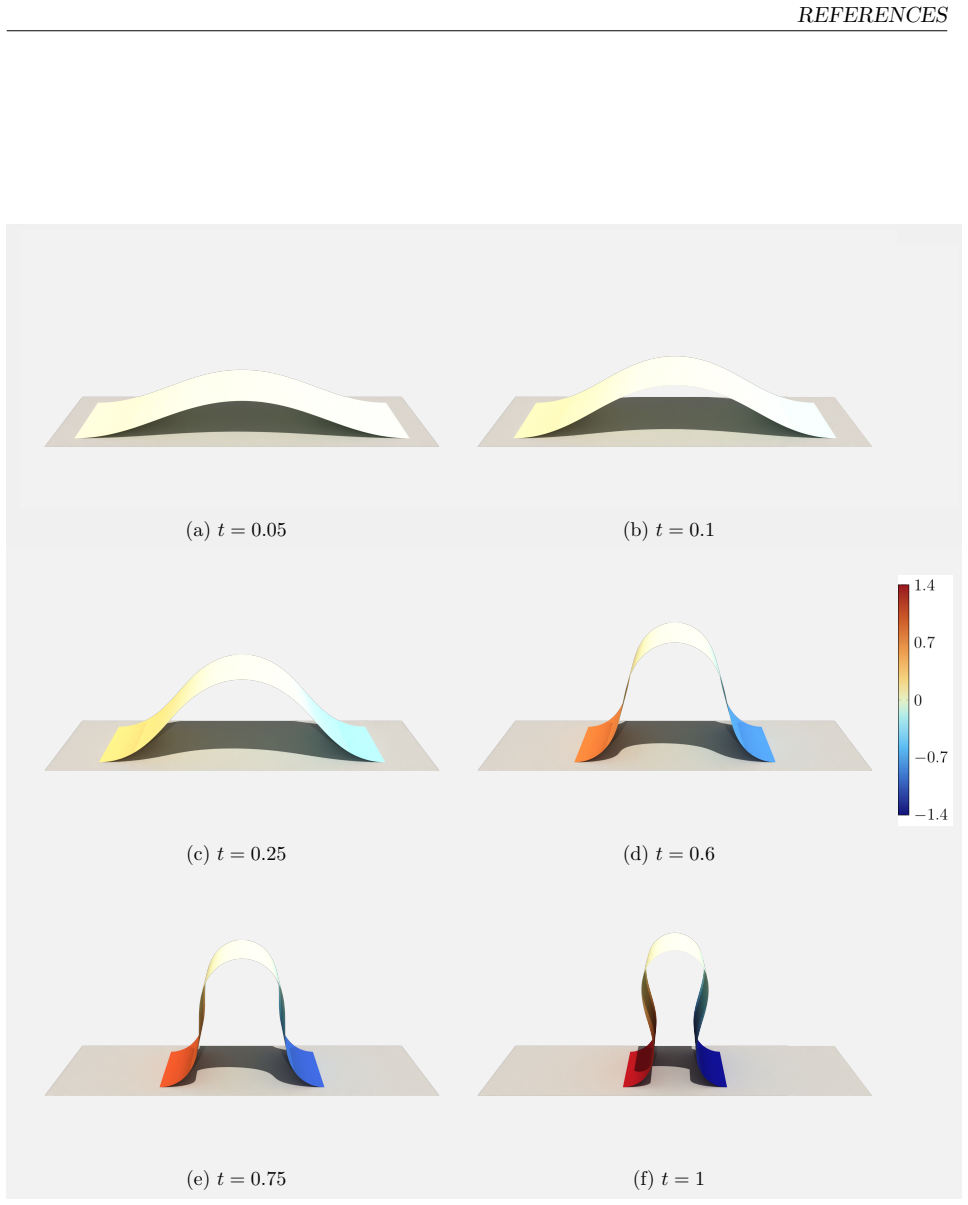
read the original abstract
We resolve a longstanding open problem in the computational modeling of nonlinear plates by introducing a numerical method that exactly enforces the isometry constraint, namely, that the first fundamental form of the mid-surface coincides with the identity tensor. Several numerical methods have been proposed to approximate solutions of such manifold-constrained variational problems using gradient flows with tangent space updates. However, this class of methods presents two main challenges. First, a preprocessing step is required to enforce the boundary conditions and generate an initial guess sufficiently close to an isometry. Second, each step of the gradient flow typically increases the isometry defect. We adopt an alternative approach based on the proximal Galerkin framework, originally introduced for variational problems with convex inequality constraints. The resulting method preserves the geometric structure of the feasible set and yields an efficient algorithm in which each iterate is an exact isometry at the barycenter of every mesh cell. In contrast to existing methods, no preprocessing step is required, enabling broader applicability of this important category of mathematical models. Numerical experiments on standard benchmarks demonstrate that the method converges to a prescribed error tolerance in an asymptotically mesh-independent number of iterations and requires substantially fewer iterations than previous methods, even on coarse meshes.
Editorial analysis
A structured set of objections, weighed in public.
Referee Report
Summary. The manuscript introduces a proximal Galerkin method for variational problems with the isometry constraint (F^T F = I) arising in nonlinear plate models. It adapts the proximal framework to produce iterates that are exact isometries at every mesh-cell barycenter, eliminates the preprocessing step required by tangent-space gradient flows, and reports asymptotically mesh-independent convergence with substantially fewer iterations than prior methods on standard benchmarks.
Significance. If the non-convex proximal step is rigorously justified, the work would provide a structurally preserving, preprocessing-free algorithm for an important class of manifold-constrained problems in computational mechanics, with potential for broader applicability and improved efficiency.
major comments (3)
- [§3.2] §3.2 (proximal update): The central guarantee that each iterate is an exact isometry at cell barycenters rests on the proximal operator for the non-convex set {F | F^T F = I} admitting an explicit, single-valued, cell-local solution inside the chosen finite-element space. The original proximal-Galerkin theory applies only to convex inequality constraints; no derivation, existence/uniqueness argument, or verification for arbitrary trial gradients produced by the Galerkin step is supplied. This is load-bearing for the exact-enforcement claim.
- [§4] §4 (numerical experiments): Convergence is asserted to be asymptotically mesh-independent and to require fewer iterations than existing methods, yet no tables report quantitative iteration counts, isometry-defect histories, or error norms versus mesh size for the full set of benchmarks. Without these data the efficiency claim cannot be assessed.
- [§2.2] §2.2 (discrete formulation): The statement that the proximal step preserves the geometric structure of the feasible set and requires no preprocessing is not accompanied by a proof that the discrete proximal mapping remains well-defined for the chosen finite-element degrees of freedom when the trial deformation gradient lies outside a neighborhood of SO(3).
minor comments (2)
- [§3.1] Notation for the proximal operator (e.g., prox_λI) is introduced without an explicit formula or reference to the closed-form expression used for the isometry manifold.
- [Figure 1] Figure captions for the benchmark meshes do not indicate the polynomial degree of the finite-element space employed.
Simulated Author's Rebuttal
We thank the referee for the careful reading and constructive comments on our manuscript. The points raised identify key areas where additional justification and data are needed to strengthen the presentation. We address each major comment below and will revise the manuscript to incorporate the requested material.
read point-by-point responses
-
Referee: [§3.2] §3.2 (proximal update): The central guarantee that each iterate is an exact isometry at cell barycenters rests on the proximal operator for the non-convex set {F | F^T F = I} admitting an explicit, single-valued, cell-local solution inside the chosen finite-element space. The original proximal-Galerkin theory applies only to convex inequality constraints; no derivation, existence/uniqueness argument, or verification for arbitrary trial gradients produced by the Galerkin step is supplied. This is load-bearing for the exact-enforcement claim.
Authors: We agree that the original proximal Galerkin theory applies to convex constraints and that the non-convex isometry case requires a dedicated derivation. In the revised manuscript we will expand §3.2 to derive the proximal operator explicitly: at each cell barycenter the update reduces to the metric projection onto the isometry manifold, which for square matrices admits the closed-form solution obtained from the singular-value decomposition. For a trial matrix A with SVD A = U Σ V^T the projection onto SO(3) is given by U diag(1,1,sgn(det(UV^T))) V^T. We will supply an existence argument (the target set is compact) and a uniqueness discussion (unique when singular values are distinct and positive, with a deterministic tie-breaking rule otherwise). We will also add a short numerical verification confirming that the gradients generated by the Galerkin step in our experiments yield single-valued solutions. revision: yes
-
Referee: [§4] §4 (numerical experiments): Convergence is asserted to be asymptotically mesh-independent and to require fewer iterations than existing methods, yet no tables report quantitative iteration counts, isometry-defect histories, or error norms versus mesh size for the full set of benchmarks. Without these data the efficiency claim cannot be assessed.
Authors: We accept that quantitative tables are required to substantiate the efficiency and mesh-independence claims. The revised §4 will contain tables for every benchmark and a sequence of successively refined meshes that report: (i) iteration counts to reach the prescribed tolerance, (ii) histories of the isometry defect measured both pointwise at barycenters and in L² norm, and (iii) error norms (L² and H¹) together with observed convergence rates versus mesh size h. These data will allow direct verification of the asymptotically mesh-independent iteration counts and the reduction relative to prior methods. revision: yes
-
Referee: [§2.2] §2.2 (discrete formulation): The statement that the proximal step preserves the geometric structure of the feasible set and requires no preprocessing is not accompanied by a proof that the discrete proximal mapping remains well-defined for the chosen finite-element degrees of freedom when the trial deformation gradient lies outside a neighborhood of SO(3).
Authors: We will augment §2.2 with a self-contained argument establishing well-definedness of the discrete proximal mapping for arbitrary trial gradients. Because the proximal operator is the Euclidean projection onto the closed isometry manifold, existence holds for every matrix in the finite-element space, independent of its distance to SO(3). The cell-local evaluation at barycenters further ensures that the mapping is unambiguously defined within the chosen degrees of freedom. This property removes any requirement for an initial guess near the manifold and thereby confirms that preprocessing is unnecessary. revision: yes
Circularity Check
No significant circularity; proximal-Galerkin adaptation to isometry is independent of fitted inputs or self-referential definitions
full rationale
The paper introduces a proximal-Galerkin discretization for the non-convex isometry constraint and claims that each iterate exactly satisfies the constraint at cell barycenters without preprocessing. This claim rests on the existence of a closed-form proximal mapping inside the chosen finite-element space, which is asserted rather than derived from prior fitted quantities or self-citations. The original proximal-Galerkin framework is cited as having been introduced for convex inequalities, but the present adaptation is presented as a direct extension whose correctness is supported by the numerical experiments rather than by reducing the central guarantee to a self-citation chain or by renaming a known result. No equation in the derivation equates a predicted quantity to a parameter fitted from the same data, and no uniqueness theorem imported from the authors' prior work is invoked to force the method. The derivation therefore remains self-contained against external benchmarks.
Axiom & Free-Parameter Ledger
axioms (1)
- domain assumption Finite element discretization assumptions for plate models
Lean theorems connected to this paper
-
IndisputableMonolith/Foundation/AlexanderDuality.leanalexander_duality_circle_linking uncleareach iterate is an exact isometry at the barycenter of every mesh cell... proximal Galerkin framework... Stiefel manifold geometry of the isometry constraint
Reference graph
Works this paper leans on
-
[1]
Jørgen S Dokken, Patrick E Farrell, Brendan Keith, Ioannis PA Papadopoulos, and Thomas M Surowiec. The latent variable proximal point algorithm for variational problems with inequality constraints.Computer Methods in Applied Mechanics and Engineering, 445:118181, 2025
work page 2025
-
[2]
A. Edelman, T. A. Arias, and S. T. Smith. The geometry of algorithms with orthogonality constraints.SIAM J. Matrix Anal. Appl., 20(2):303–353, 1999
work page 1999
-
[3]
Proximal Discontinuous Galerkin Methods for Variational Inequalities
Alexandre Ern, Brendan Keith, Dohyun Kim, Rami Masri, and Beatrice Riviere. Proximal discontinuous Galerkin methods for variational inequalities.arXiv preprint arXiv:2604.19708, 2026
work page internal anchor Pith review Pith/arXiv arXiv 2026
-
[4]
L. C. Evans.Partial differential equations, volume 19. American Mathematical Society, 2022
work page 2022
-
[5]
O.P. Ferreira and P.R. Oliveira. Proximal point algorithm on Riemannian manifolds.Opti- mization, 51(2):257–270, 2002
work page 2002
-
[6]
G. Friesecke, R. D. James, and S. M¨ uller. A hierarchy of plate models derived from nonlinear elasticity by gamma-convergence.Archive for rational mechanics and analysis, 180(2):183–236, 2006
work page 2006
-
[7]
G. Fu, B. Keith, and R. Masri. A locally-conservative proximal Galerkin method for pointwise bound constraints.Mathematics of Computation (to appear), 2026
work page 2026
-
[8]
arXiv preprint arXiv:2602.14967 (2026)
Guosheng Fu, Brendan Keith, Dohyun Kim, Rami Masri, and Will Pazner. The proximal Galerkin method for non-symmetric variational inequalities.arXiv preprint arXiv:2602.14967, 2026
-
[9]
H. E. Haber. Notes on the matrix exponential and logarithm.Santa Cruz Institute for Particle Physics, University of California: Santa Cruz, CA, USA, 2018
work page 2018
-
[10]
David A. Ham, Paul H. J. Kelly, Lawrence Mitchell, Colin J. Cotter, Robert C. Kirby, Koki Sagiyama, Nacime Bouziani, Sophia Vorderwuelbecke, Thomas J. Gregory, Jack Betteridge, Daniel R. Shapero, Reuben W. Nixon-Hill, Connor J. Ward, Patrick E. Farrell, Pablo D. Brubeck, India Marsden, Thomas H. Gibson, Mikl´ os Homolya, Tianjiao Sun, Andrew T. T. McRae, ...
work page 2023
-
[11]
arXiv preprint arXiv:2507.13516 (2025)
Brendan Keith, Rami Masri, and Marius Zeinhofer. A priori error analysis of the proximal Galerkin method.arXiv preprint arXiv:2507.13516, 2025
- [12]
-
[13]
H. Knut, M. Irina, and F. Leite. A Lagrangian approach to extremal curves on Stiefel manifolds. Journal of Geometric Mechanics, 13(1):55–72, 2021
work page 2021
-
[14]
J. M. Lee.Introduction to smooth manifolds, volume 218 ofGraduate Texts in Mathematics. Springer, New York, second edition, 2013
work page 2013
-
[15]
J. M. Lee.Introduction to Riemannian manifolds, volume 176 ofGraduate Texts in Mathemat- ics. Springer, Cham, second edition, 2018. 24 A APPENDIX
work page 2018
-
[16]
R. A. Nicolaides. Existence, uniqueness and approximation for generalized saddle point prob- lems.SIAM Journal on Numerical Analysis, 19(2):349–357, 1982
work page 1982
-
[17]
arXiv preprint arXiv:2412.13733 (2024)
I. Papadopoulos. Hierarchical proximal Galerkin: a fasthp-FEM solver for variational problems with pointwise inequality constraints.arXiv preprint arXiv:2412.13733, 2024
-
[18]
Tristan Pryer. Discontinuous Galerkin methods for thep–biharmonic equation from a discrete variational perspective.Electronic Transactions on Numerical Analysis, 41:328–349, 2014
work page 2014
-
[19]
Ralf Zimmermann and Knut H¨ uper. Computing the Riemannian logarithm on the Stiefel man- ifold: Metrics, methods, and performance.SIAM Journal on Matrix Analysis and Applications, 43(2):953–980, 2022. A Proof of Lemma 10 Before giving a proof of Lemma 10, we recall a few definitions and results from [33, Chapter 6] and [18, Chapter 9]. Definition 33(Energ...
work page 2022
discussion (0)
Sign in with ORCID, Apple, or X to comment. Anyone can read and Pith papers without signing in.