Recognition: unknown
Architecting Early Fault Tolerant Neutral Atoms Systems with Quantum Advantage
Pith reviewed 2026-05-10 02:48 UTC · model grok-4.3
The pith
A teleportation-based scheme for neutral-atom systems delivers up to 3x speedup in fault-tolerant logical operations at fixed space cost.
A machine-rendered reading of the paper's core claim, the machinery that carries it, and where it could break.
Core claim
The authors introduce a teleportation-based parallelization scheme for logical gates on neutral atoms. This scheme achieves up to approximately 3 times speedup over extractor architectures at identical space cost and records the lowest spacetime cost among viable architectures before external resource states are counted. Full compilation simulations that incorporate shuttling patterns, gate scheduling, and resource-state nondeterminism confirm that the speedups persist and that quantum advantage benchmarks can be completed with 11,495 atoms in roughly 15 hours.
What carries the argument
The teleportation-based scheme that exploits reconfigurable neutral-atom connectivity to execute logical operations in parallel rather than serially.
If this is right
- Quantum advantage simulations become feasible with 11,495 atoms and a 15-hour runtime.
- Spacetime cost is minimized among extractor, serial, and other parallel schemes before resource-state overhead is added.
- Success probabilities and exact resource counts are obtained from full gate-level scheduling.
- The same parallelization applies to any neutral-atom error-correcting code that admits transversal or extractor gates.
Where Pith is reading between the lines
- Hardware that can rapidly reconfigure atom positions and perform fast teleportation will reach the reported advantage threshold sooner than platforms limited to fixed connectivity.
- If resource-state generation is slower or noisier than modeled, the required atom count will rise above 11,495 while the 15-hour bound will lengthen.
- The approach suggests that future neutral-atom arrays should be sized and zoned with explicit space left for parallel teleportation rather than packed at maximum density.
Load-bearing premise
The low-level compilation simulation that includes shuttling patterns and resource-state nondeterminism captures every real hardware overhead.
What would settle it
Implementation of the proposed architecture on an actual neutral-atom device that measures whether the end-to-end runtime for the quantum-advantage benchmark stays within the simulated 15 hours or exceeds it due to unaccounted costs.
Figures




read the original abstract
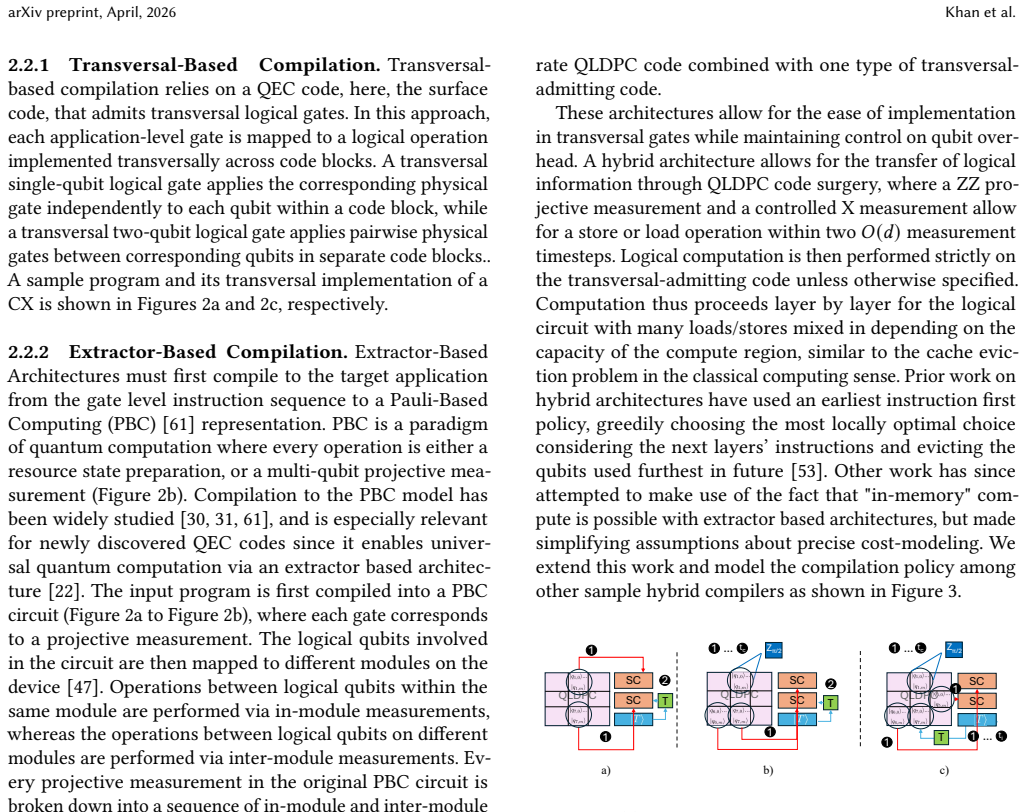
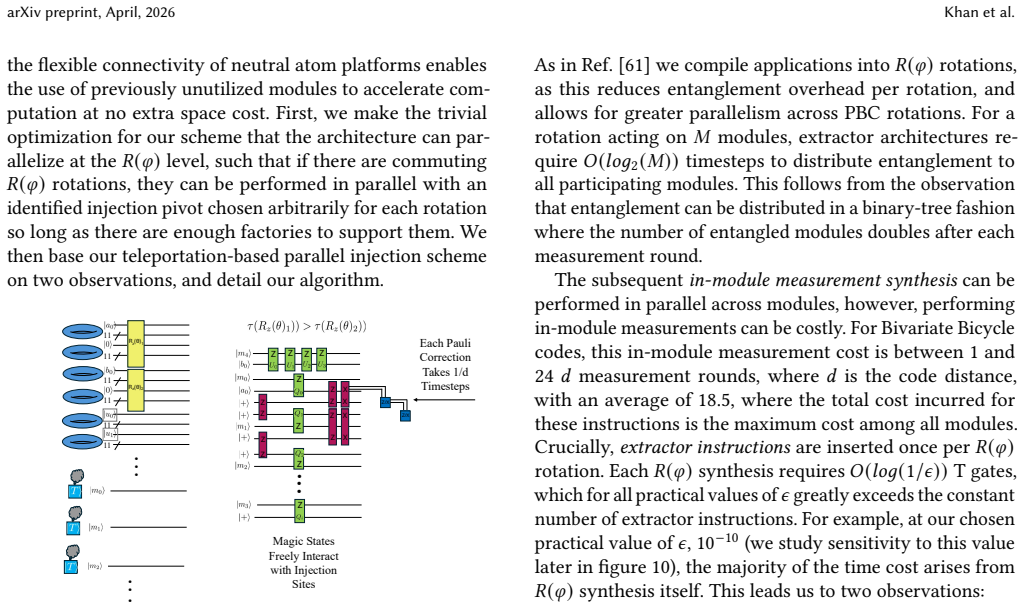
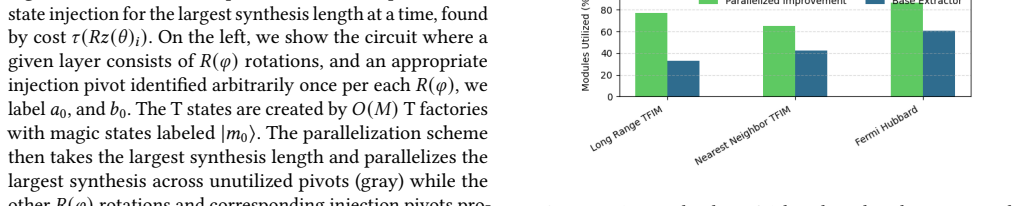
Recent advancements in neutral atom platforms have enabled exploration of early fault-tolerant (FT) architectures for applications with quantum advantage, such as quantum dynamics simulations. An efficient fault-tolerant architecture has both spatially efficient quantum error correction codes (low qubit overhead), and efficient methodologies (transversal based gates, extractor based gates, etc.) for logical computation, to minimize overall execution time. Achieving the right balance between space and time can be critical for enabling early FT demonstrations of quantum advantage. In this work, we identify bottlenecks in existing spatially efficient schemes, which tend to be very serial, and do not take advantage of unutilized space. We introduce a teleportation-based scheme that leverages the reconfigurable connectivity of neutral atoms to parallelize logical operations. Our approach achieves up to \textbf{$\mathbf{\sim 3 \times}$ speedup} over extractor architectures at no extra space cost and achieves the best spacetime performance among other viable architectures before accounting for external \textit{resource-states}. To rigorously evaluate performance, we construct explicit quantum advantage benchmarks and \textit{simulate} compilation to a fault-tolerant instruction set, including low-level gate scheduling and shuttling patterns, and resource-state nondeterminism. We find that our speedups still apply and report exact space-time cost along with success probabilities, identifying architectures capable of achieving quantum advantage \textbf{with as little as $\mathbf{11,495}$ atoms and a runtime of $\mathbf{\sim 15}$ hours}.
Editorial analysis
A structured set of objections, weighed in public.
Referee Report
Summary. The paper proposes a teleportation-based parallelization scheme for logical operations in early fault-tolerant neutral-atom quantum computing, exploiting reconfigurable connectivity to address serial bottlenecks in existing spatially efficient architectures such as extractors. Through explicit compilation simulations of quantum dynamics benchmarks that incorporate gate scheduling, shuttling patterns, and resource-state nondeterminism, the work claims up to ~3× speedup over extractor architectures at no extra space cost, the best spacetime performance among viable options, and concrete resource requirements for quantum advantage of as little as 11,495 atoms with a runtime of ~15 hours.
Significance. If the simulation results are robust, the manuscript supplies concrete, reproducible resource estimates and a new architecture that improves time performance for neutral-atom FTQC without space penalty, advancing feasibility assessments for early quantum advantage in dynamics simulations. The explicit low-level simulations with nondeterminism and shuttling are a clear strength, offering falsifiable performance numbers rather than abstract bounds.
major comments (2)
- [§4 and §5] §4 (Compilation Simulation) and §5 (Results): The central claims of ~3× speedup, best spacetime volume, and the specific numbers (11,495 atoms, ~15 h) are derived entirely from the low-level compilation simulation. The error model for shuttling and teleportation-based parallelization is not validated against independent simulators, hardware data, or sensitivity analysis, so unmodeled per-shuttle overheads or loss probabilities could directly inflate runtime and erase the reported advantage over extractor architectures.
- [§3 and §5.1] §3 (Benchmarks) and §5.1: The quantum advantage benchmarks are explicitly constructed, yet the paper provides no cross-check that the chosen dynamics simulations are representative enough to support the general claim of 'best spacetime performance among other viable architectures'; a single benchmark family risks overfitting the architecture comparison.
minor comments (2)
- [Abstract] Abstract: Bold formatting on numerical claims is nonstandard and reduces readability; plain text or italics would suffice.
- [§2] §2 (Architecture Description): The definition of the teleportation-based instruction set could include a small table summarizing gate costs, fidelities, and nondeterminism probabilities for direct comparison with extractor gates.
Simulated Author's Rebuttal
We thank the referee for their constructive report and positive assessment of the work's significance. We address each major comment below, indicating planned revisions where appropriate.
read point-by-point responses
-
Referee: [§4 and §5] §4 (Compilation Simulation) and §5 (Results): The central claims of ~3× speedup, best spacetime volume, and the specific numbers (11,495 atoms, ~15 h) are derived entirely from the low-level compilation simulation. The error model for shuttling and teleportation-based parallelization is not validated against independent simulators, hardware data, or sensitivity analysis, so unmodeled per-shuttle overheads or loss probabilities could directly inflate runtime and erase the reported advantage over extractor architectures.
Authors: We acknowledge that our error model relies on standard physical parameters drawn from the neutral-atom literature rather than direct validation against independent simulators or hardware data (the latter being unavailable at the required scale and fidelity). The model does incorporate nondeterminism for resource-state generation as detailed in §4. To address the concern, we will add an explicit sensitivity analysis in the revised §5 varying shuttle overheads and loss rates by factors of 2–5, showing that the reported speedup and spacetime advantage remain robust under these variations. We maintain that the core parallelization benefit is not erased even under conservative overhead assumptions. revision: partial
-
Referee: [§3 and §5.1] §3 (Benchmarks) and §5.1: The quantum advantage benchmarks are explicitly constructed, yet the paper provides no cross-check that the chosen dynamics simulations are representative enough to support the general claim of 'best spacetime performance among other viable architectures'; a single benchmark family risks overfitting the architecture comparison.
Authors: The selected benchmarks are standard examples of quantum dynamics simulations under local Hamiltonians, which constitute a primary target application class for early fault-tolerant neutral-atom systems. The architectural advantage derives from general parallelization enabled by reconfigurable connectivity and is not tuned to the specific dynamics. Nevertheless, we agree that additional cross-checks would strengthen the generality claim. In the revision we will expand §3 with a short justification of representativeness for the dynamics class and include results from one additional benchmark (e.g., a different interaction graph) to verify that the spacetime ordering versus extractor and other architectures is preserved. revision: yes
- Direct validation of the shuttling and teleportation error model against experimental hardware data, as neutral-atom platforms have not yet reached the scale and fidelity needed for these fault-tolerant operations.
Circularity Check
No circularity; resource estimates from forward simulation of benchmarks
full rationale
The paper obtains its central claims (~3× speedup over extractor architectures, best spacetime performance, 11,495 atoms, ~15 h runtime) by constructing explicit quantum advantage benchmarks and simulating compilation to a fault-tolerant instruction set that includes low-level gate scheduling, shuttling patterns, and resource-state nondeterminism. This is forward modeling from concrete inputs rather than any reduction of the reported quantities to quantities defined by the architecture choice itself. No self-definitional steps, fitted inputs renamed as predictions, load-bearing self-citations, uniqueness theorems, or smuggled ansatzes appear in the derivation chain. The simulation outputs serve as independent evidence for the speedup and resource numbers.
Axiom & Free-Parameter Ledger
axioms (1)
- domain assumption Neutral-atom platforms provide reconfigurable connectivity via atom shuttling that can be used for efficient teleportation of logical information.
Forward citations
Cited by 1 Pith paper
-
INJEQT: Improved Magic-State Injection Protocol for Fault-Tolerant Quantum Extractor Architectures
INJEQT reduces synthillation error by up to 22x, wall-clock time by 13x, and space-time cost by 7.2x in extractor FTQC architectures via auxiliary Rz synthesis and pre-fetching.
Reference graph
Works this paper leans on
-
[1]
Abhinav Anand and Kenneth R Brown. 2025. Hamiltonian-based graph-state ansatz for variational quantum algorithms.Physical Review A111, 1 (2025), 012437
2025
-
[2]
Abhinav Anand and Kenneth R Brown. 2025. Leveraging commuting groups for an efficient variational Hamiltonian ansatz.Quantum Science and Technology10, 4 (2025), 045009
2025
-
[3]
Philip W Anderson. 1959. New approach to the theory of superex- change interactions.Physical Review115, 1 (1959), 2
1959
-
[4]
Atom Computing. 2026. AC1000 Quantum Computer.https://atom- computing.com/ac1000/. Accessed: 2026-03-29
2026
-
[5]
F Battistel, C Chamberland, K Johar, R W J Overwater, F Sebastiano, L Skoric, Y Ueno, and M Usman. 2023. Real-time decoding for fault- tolerant quantum computing: progress, challenges and outlook.Nano Futures7, 3 (Aug. 2023), 032003. doi:10.1088/2399-1984/aceba6
-
[6]
Assessing requirements to scale to practical quantum advantage
Michael E. Beverland, Prakash Murali, Matthias Troyer, Krysta M. Svore, Torsten Hoefler, Vadym Kliuchnikov, Guang Hao Low, Math- ias Soeken, Aarthi Sundaram, and Alexander Vaschillo. 2022. As- sessing requirements to scale to practical quantum advantage. arXiv:2211.07629 [quant-ph]https://arxiv.org/abs/2211.07629
work page internal anchor Pith review arXiv 2022
-
[7]
A fault-tolerant neutral-atom architecture for universal quantum computation,
Dolev Bluvstein, Alexandra A. Geim, Sophie H. Li, Simon J. Evered, J. Pablo Bonilla Ataides, Gefen Baranes, Andi Gu, Tom Manovitz, Muqing Xu, Marcin Kalinowski, Shayan Majidy, Christian Kokail, Nishad Maskara, Elias C. Trapp, Luke M. Stewart, Simon Hollerith, Hengyun Zhou, Michael J. Gullans, Susanne F. Yelin, Markus Greiner, Vladan Vuletić, Madelyn Cain,...
-
[8]
Dolev Bluvstein, Harry Levine, Giulia Semeghini, Tout T. Wang, Sepehr Ebadi, Marcin Kalinowski, Alexander Keesling, Nishad Maskara, Hannes Pichler, Markus Greiner, Vladan Vuletić, and Mikhail D. Lukin. 2022. A quantum processor based on coherent transport of entangled atom arrays.Nature604, 7906 (April 2022), 451–456. doi:10.1038/s41586-022-04592-6
-
[9]
Héctor Bombín. 2015. Single-Shot Fault-Tolerant Quantum Error Cor- rection.Physical Review X5, 3 (Sept. 2015). doi:10.1103/physrevx.5. 031043
-
[10]
Sergey Bravyi, Andrew W. Cross, Jay M. Gambetta, Dmitri Maslov, Patrick Rall, and Theodore J. Yoder. 2024. High-threshold and low- overhead fault-tolerant quantum memory.Nature627, 8005 (March 2024), 778–782. doi:10.1038/s41586-024-07107-7
-
[11]
Madelyn Cain, Qian Xu, Robbie King, Lewis R. B. Picard, Harry Levine, Manuel Endres, John Preskill, Hsin-Yuan Huang, and Dolev Bluvstein
-
[12]
Shor’s algorithm is possible with as few as 10,000 reconfigurable atomic qubits (2026)
Shor’s algorithm is possible with as few as 10,000 reconfigurable atomic qubits. arXiv:2603.28627 [quant-ph]https://arxiv.org/abs/2603. 28627
-
[13]
Earl T Campbell. 2021. Early fault-tolerant simulations of the Hubbard model.Quantum Science and Technology7, 1 (Nov. 2021), 015007. doi:10.1088/2058-9565/ac3110
- [14]
-
[15]
Childs, Dmitri Maslov, Yunseong Nam, Neil J
Andrew M. Childs, Dmitri Maslov, Yunseong Nam, Neil J. Ross, and Yuan Su. 2018. Toward the first quantum simulation with quantum speedup.Proceedings of the National Academy of Sciences115, 38 (sep 2018), 9456–9461. doi:10.1073/pnas.1801723115
-
[16]
Barry A Cipra. 1987. An introduction to the Ising model.The American Mathematical Monthly94, 10 (1987), 937–959
1987
-
[17]
Andrew J Daley, Immanuel Bloch, Christian Kokail, Stuart Flannigan, Natalie Pearson, Matthias Troyer, and Peter Zoller. 2022. Practical quantum advantage in quantum simulation.Nature607, 7920 (2022), 667–676
2022
-
[18]
Dalzell, Sam McArdle, Mario Berta, Przemyslaw Bienias, Chi-Fang Chen, András Gilyén, Connor T
Alexander M. Dalzell, Sam McArdle, Mario Berta, Przemyslaw Bienias, Chi-Fang Chen, András Gilyén, Connor T. Hann, Michael J. Kastoryano, arXiv preprint, April, 2026 Khan et al. Emil T. Khabiboulline, Aleksander Kubica, Grant Salton, Samson Wang, and Fernando G. S. L. Brandão. 2025.Quantum Algorithms: A Survey of Applications and End-to-end Complexities. C...
-
[19]
S. Flannigan, N. Pearson, G. H. Low, A. Buyskikh, I. Bloch, P. Zoller, M. Troyer, and A. J. Daley. 2022. Propagation of errors and quantitative quantum simulation with quantum advantage. arXiv:2204.13644 [quant-ph]https://arxiv.org/abs/2204.13644
-
[20]
Stuart Flannigan, Natalie Pearson, Guang Hao Low, Anton Buyskikh, Immanuel Bloch, Peter Zoller, Matthias Troyer, and Andrew J Daley
-
[21]
Propagation of errors and quantitative quantum simulation with quantum advantage.Quantum Science & Technology7, 4 (2022), 045025
2022
-
[22]
Quintavalle, Qian Xu, Jens Eisert, and Joschka Roffe
Boren Gu, Andy Zeyi Liu, Armanda O. Quintavalle, Qian Xu, Jens Eisert, and Joschka Roffe. 2026. QGPU: Parallel logic in quantum LDPC codes. arXiv:2603.05398 [quant-ph]https://arxiv.org/abs/2603.05398
-
[23]
Harrow, Avinatan Hassidim, and Seth Lloyd
Aram W. Harrow, Avinatan Hassidim, and Seth Lloyd. 2009. Quantum Algorithm for Linear Systems of Equations.Physical Review Letters 103, 15 (oct 2009). doi:10.1103/physrevlett.103.150502
-
[24]
Extractors: QLDPC Architectures for Efficient Pauli-Based Computation,
Zhiyang He, Alexander Cowtan, Dominic J. Williamson, and Theodore J. Yoder. 2025. Extractors: QLDPC Architectures for Ef- ficient Pauli-Based Computation. arXiv:2503.10390 [quant-ph]https: //arxiv.org/abs/2503.10390
-
[25]
John Hubbard. 1963. Electron correlations in narrow energy bands. Proceedings of the Royal Society of London. Series A. Mathematical and Physical Sciences276, 1365 (1963), 238–257
1963
-
[26]
Pascual Jordan and Eugene Wigner. 1928. Über das paulische äquiv- alenzverbot.Zeitschrift für Physik47, 9 (1928), 631–651
1928
-
[27]
Kivlichan, Craig Gidney, Dominic W
Ian D. Kivlichan, Craig Gidney, Dominic W. Berry, Nathan Wiebe, Jarrod McClean, Wei Sun, Zhang Jiang, Nicholas Rubin, Austin Fowler, Alá n Aspuru-Guzik, Hartmut Neven, and Ryan Babbush. 2020. Im- proved Fault-Tolerant Quantum Simulation of Condensed-Phase Cor- related Electrons via Trotterization.Quantum4 (jul 2020), 296. doi:10.22331/q-2020-07-16-296
-
[28]
Takumi Kobori, Yasunari Suzuki, Yosuke Ueno, Teruo Tanimoto, Synge Todo, and Yuuki Tokunaga. 2025. LSQCA: Resource-Efficient Load/Store Architecture for Limited-Scale Fault-Tolerant Quantum Computing. In2025 IEEE International Symposium on High Performance Computer Architecture (HPCA). IEEE, 304–320. doi:10.1109/hpca61900. 2025.00033
-
[29]
Aleksander Kubica and Michael E Beverland. 2015. Universal transver- sal gates with color codes: A simplified approach.Physical Review A 91, 3 (2015), 032330
2015
-
[30]
Wang, Sepehr Ebadi, Hannes Bernien, Markus Greiner, Vladan Vuletić, Hannes Pichler, and Mikhail D
Harry Levine, Alexander Keesling, Giulia Semeghini, Ahmed Omran, Tout T. Wang, Sepehr Ebadi, Hannes Bernien, Markus Greiner, Vladan Vuletić, Hannes Pichler, and Mikhail D. Lukin. 2019. Parallel Implemen- tation of High-Fidelity Multiqubit Gates with Neutral Atoms.Physical Review Letters123, 17 (Oct. 2019). doi:10.1103/physrevlett.123.170503
-
[31]
Ang Li, Samuel Stein, Sriram Krishnamoorthy, and James Ang. 2023. QASMBench: A Low-Level Quantum Benchmark Suite for NISQ Eval- uation and Simulation.ACM Transactions on Quantum Computing4, 2, Article 10 (Feb. 2023), 26 pages. doi:10.1145/3550488
-
[32]
Daniel Litinski. 2019. A game of surface codes: Large-scale quantum computing with lattice surgery.Quantum3 (2019), 128
2019
-
[33]
Daniel Litinski and Felix von Oppen. 2018. Lattice Surgery with a Twist: Simplifying Clifford Gates of Surface Codes.Quantum2 (May 2018), 62. doi:10.22331/q-2018-05-04-62arXiv:1709.02318 [cond-mat, physics:quant-ph]
-
[34]
Yoder, Andrew Cross, and Matthias Steffen
Ryan Mandelbaum, Jay Gambetta, Jerry Chow, Tushar Mittal, Theodore J. Yoder, Andrew Cross, and Matthias Steffen. 2025. How IBM Will Build the World’s First Large-Scale Fault-Tolerant Quantum Computer.https://www.ibm.com/quantum/blog/large-scale-ftqc. IBM Quantum Blog
2025
-
[35]
Manetsch, Gyohei Nomura, Elie Bataille, Xudong Lv, Kon H
Hannah J. Manetsch, Gyohei Nomura, Elie Bataille, Xudong Lv, Kon H. Leung, and Manuel Endres. 2025. A tweezer array with 6,100 highly coherent atomic qubits.Nature647, 8088 (Sept. 2025), 60–67. doi:10. 1038/s41586-025-09641-4
2025
-
[36]
Sam McArdle, Alexander M. Dalzell, Aleksander Kubica, and Fernando G. S. L. Brandão. 2025. The Fast for the Curious: How to accelerate fault-tolerant quantum applications. arXiv:2510.26078 [quant-ph] https://arxiv.org/abs/2510.26078
-
[37]
Jonathan E Moussa. 2016. Transversal Clifford gates on folded surface codes.Physical Review A94, 4 (2016), 042316
2016
-
[38]
J. A. Muniz, M. Stone, D. T. Stack, M. Jaffe, J. M. Kindem, L. Wadleigh, E. Zalys-Geller, X. Zhang, C.-A. Chen, M. A. Norcia, J. Epstein, E. Halperin, F. Hummel, T. Wilkason, M. Li, K. Barnes, P. Battaglino, T. C. Bohdanowicz, G. Booth, A. Brown, M. O. Brown, W. B. Cairn- cross, K. Cassella, R. Coxe, D. Crow, M. Feldkamp, C. Griger, A. Heinz, A. M. W. Jon...
-
[39]
Tristan Müller, Thomas Alexander, Michael E. Beverland, Markus Bühler, Blake R. Johnson, Thilo Maurer, and Drew Vandeth. 2025. Improved belief propagation is sufficient for real-time decoding of quantum memory. arXiv:2506.01779 [quant-ph]https://arxiv.org/abs/ 2506.01779
-
[40]
Pasqal. 2024. Pasqal exceeds 1,000 atoms in quantum proces- sor.https://www.pasqal.com/newsroom/pasqal-exceeds-1000-atoms- in-quantum-processor/. Press release
2024
-
[41]
C. Poole, T. M. Graham, M. A. Perlin, M. Otten, and M. Saffman. 2025. Architecture for fast implementation of quantum low-density parity- check codes with optimized Rydberg gates.Physical Review A111, 2 (Feb. 2025). doi:10.1103/physreva.111.022433
-
[42]
A.G. Radnaev, W.C. Chung, D.C. Cole, D. Mason, T.G. Ballance, M.J. Bedalov, D.A. Belknap, M.R. Berman, M. Blakely, I.L. Bloomfield, P.D. Buttler, C. Campbell, A. Chopinaud, E. Copenhaver, M.K. Dawes, S.Y. Eubanks, A.J. Friss, D.M. Garcia, J. Gilbert, M. Gillette, P. Goiporia, P. Gokhale, J. Goldwin, D. Goodwin, T.M. Graham, C.J. Guttormsson, G.T. Hickman,...
-
[43]
Fault-tolerant quantum computation with a neutral atom processor
Ben W. Reichardt, Adam Paetznick, David Aasen, Ivan Basov, Juan M. Bello-Rivas, Parsa Bonderson, Rui Chao, Wim van Dam, Matthew B. Hastings, Ryan V. Mishmash, Andres Paz, Marcus P. da Silva, Aarthi Sundaram, Krysta M. Svore, Alexander Vaschillo, Zhenghan Wang, Matt Zanner, William B. Cairncross, Cheng-An Chen, Daniel Crow, Hyosub Kim, Jonathan M. Kindem, ...
-
[44]
Svore, Dave Wecker, and Matthias Troyer
Markus Reiher, Nathan Wiebe, Krysta M. Svore, Dave Wecker, and Matthias Troyer. 2017. Elucidating reaction mechanisms on quantum computers.Proceedings of the National Academy of Sciences114, 29 (2017), 7555–7560. arXiv:https://www.pnas.org/doi/pdf/10.1073/pnas.1619152114 doi:10.1073/pnas.1619152114
-
[45]
and Selinger, Peter , keywords =
Neil J. Ross and Peter Selinger. 2016. Optimal ancilla-free Clifford+T approximation of z-rotations. arXiv:1403.2975 [quant-ph]https:// arxiv.org/abs/1403.2975
-
[46]
M. Saffman, T. G. Walker, and K. Mølmer. 2010. Quantum information with Rydberg atoms.Reviews of Modern Physics82, 3 (Aug. 2010), 2313–2363. doi:10.1103/revmodphys.82.2313
-
[47]
Fold- transversal surface code cultivation
Kaavya Sahay, Pei-Kai Tsai, Kathleen Chang, Qile Su, Thomas B. Smith, Shraddha Singh, and Shruti Puri. 2026. Fold-transversal surface code cultivation. arXiv:2509.05212 [quant-ph]https://arxiv.org/abs/2509. 05212
-
[48]
Pedro Sales Rodriguez, John M. Robinson, Paul Niklas Jepsen, Zhiyang He, Casey Duckering, Chen Zhao, Kai-Hsin Wu, Joseph Campo, Kevin Bagnall, Minho Kwon, Thomas Karolyshyn, Phillip Weinberg, Made- lyn Cain, Simon J. Evered, Alexandra A. Geim, Marcin Kalinowski, Sophie H. Li, Tom Manovitz, Jesse Amato-Grill, James I. Basham, Liane Bernstein, Boris Braverm...
- [49]
-
[50]
Peter W Shor. 1999. Polynomial-time algorithms for prime factoriza- tion and discrete logarithms on a quantum computer.SIAM review (1999)
1999
-
[51]
Samuel Stein, Shifan Xu, Andrew W. Cross, Theodore J. Yoder, Ali Javadi-Abhari, Chenxu Liu, Kun Liu, Zeyuan Zhou, Charlie Guinn, Yufei Ding, Yongshan Ding, and Ang Li. 2025. HetEC: Architectures for Heterogeneous Quantum Error Correction Codes. InProceedings of the 30th ACM International Conference on Architectural Support for Programming Languages and Op...
-
[52]
Masuo Suzuki. 1976. Generalized Trotter’s formula and systematic approximants of exponential operators and inner derivations with applications to many-body problems.Communications in Mathematical Physics51, 2 (1976), 183–190
1976
-
[53]
Turner, Earl T
Mark L. Turner, Earl T. Campbell, Ophelia Crawford, Neil I. Gillespie, and Joan Camps. 2026. Scalable Decoding Protocols for Fast Transver- sal Logic in the Surface Code.PRX Quantum7 (Jan 2026), 010320. Issue
2026
-
[54]
doi:10.1103/nx6p-hjqy
-
[55]
Ewout Van Den Berg and Kristan Temme. 2020. Circuit optimization of Hamiltonian simulation by simultaneous diagonalization of Pauli clusters.Quantum4 (2020), 322
2020
-
[56]
Joshua Viszlai, Willers Yang, Sophia Fuhui Lin, Junyu Liu, Natalia Nottingham, Jonathan M Baker, and Frederic T Chong. 2025. Matching Generalized-Bicycle Codes to Neutral Atoms for Low-Overhead Fault- Tolerance. In2025 IEEE International Conference on Quantum Comput- ing and Engineering (QCE). IEEE, 688–699. doi:10.1109/qce65121.2025. 00080
-
[57]
Suhas Vittal, Poulami Das, and Moinuddin Qureshi. 2023. Astrea: Ac- curate quantum error-decoding via practical minimum-weight perfect- matching. InProceedings of the 50th Annual International Symposium on Computer Architecture. 1–16
2023
-
[58]
Optimizing ftqc programs through qec transpiler and architecture codesign,
Meng Wang, Chenxu Liu, Samuel Stein, Yufei Ding, Poulami Das, Prashant J. Nair, and Ang Li. 2024. Optimizing FTQC Programs through QEC Transpiler and Architecture Codesign. arXiv:2412.15434 [quant- ph]https://arxiv.org/abs/2412.15434
-
[59]
Paul Webster, Lucas Berent, Omprakash Chandra, Evan T. Hockings, Nouédyn Baspin, Felix Thomsen, Samuel C. Smith, and Lawrence Z. Cohen. 2026. The Pinnacle Architecture: Reducing the cost of break- ing RSA-2048 to 100 000 physical qubits using quantum LDPC codes. arXiv:2602.11457 [quant-ph]https://arxiv.org/abs/2602.11457
work page internal anchor Pith review Pith/arXiv arXiv 2026
-
[60]
Karen Wintersperger, Florian Dommert, Thomas Ehmer, Andrey Hour- sanov, Johannes Klepsch, Wolfgang Mauerer, Georg Reuber, Thomas Strohm, Ming Yin, and Sebastian Luber. 2023. Neutral atom quantum computing hardware: performance and end-user perspective.EPJ Quantum Technology10, 1 (Aug. 2023). doi:10.1140/epjqt/s40507-023- 00190-1
-
[61]
Pablo Bonilla Ataides, Christopher A
Qian Xu, J. Pablo Bonilla Ataides, Christopher A. Pattison, Nithin Raveendran, Dolev Bluvstein, Jonathan Wurtz, Bane Vasic, Mikhail D. Lukin, Liang Jiang, and Hengyun Zhou. 2023. Constant-Overhead Fault-Tolerant Quantum Computation with Reconfigurable Atom Ar- rays. arXiv:2308.08648 [quant-ph]https://arxiv.org/abs/2308.08648
-
[62]
Venkatramani, Sergio H
Wenchao Xu, Aditya V. Venkatramani, Sergio H. Cantú, Tamara Šu- marac, Valentin Klüsener, Mikhail D. Lukin, and Vladan Vuletić. 2021. Fast Preparation and Detection of a Rydberg Qubit Using Atomic Ensembles.Physical Review Letters127, 5 (July 2021). doi:10.1103/ physrevlett.127.050501
2021
-
[63]
Teo, Joshua Viszlai, and Fred Chong
Willers Yang, Jason Chadwick, Mariesa H. Teo, Joshua Viszlai, and Fred Chong. 2026. Spacetime-Efficient and Hardware-Compatible Complex Quantum Logic Units in qLDPC Codes. arXiv:2602.14273 [quant-ph] https://arxiv.org/abs/2602.14273
-
[64]
Tour de gross: A modular quantum computer based on bivariate bicycle codes
Theodore J. Yoder, Eddie Schoute, Patrick Rall, Emily Pritchett, Jay M. Gambetta, Andrew W. Cross, Malcolm Carroll, and Michael E. Bev- erland. 2025. Tour de gross: A modular quantum computer based on bivariate bicycle codes. arXiv:2506.03094 [quant-ph]https://arxiv.org/ abs/2506.03094
work page internal anchor Pith review arXiv 2025
-
[65]
Nobuyuki Yoshioka, Tsuyoshi Okubo, Yasunari Suzuki, Yuki Koizumi, and Wataru Mizukami. 2024. Hunting for quantum-classical crossover in condensed matter problems.npj Quantum Information10, 1 (2024), 45
2024
discussion (0)
Sign in with ORCID, Apple, or X to comment. Anyone can read and Pith papers without signing in.