Recognition: unknown
Neural posterior estimation of the neutrino direction in IceCube using transformer-encoded normalizing flows on the sphere
Pith reviewed 2026-05-10 01:11 UTC · model grok-4.3
The pith
A transformer encoder feeding a spherical normalizing flow reconstructs neutrino directions in IceCube more accurately and faster than B-spline likelihood methods.
A machine-rendered reading of the paper's core claim, the machinery that carries it, and where it could break.
Core claim
The central claim is that a transformer encoder with dual residual streams, nonlinear QKV projections, and a dedicated class token can predict the parameters of a novel spherical normalizing flow built from C²-smooth rational-quadratic splines, scale transformations, and rotations; when trained on simulated IceCube events this yields state-of-the-art median angular resolution across 100 GeV to 100 PeV for both tracks and showers, outperforming B-spline likelihood reconstructions by the factors noted above while maintaining constant and much lower run time.
What carries the argument
A transformer encoder whose output directly parametrizes a normalizing flow on the 2-sphere constructed from C²-smooth rational-quadratic splines together with scale and rotation transformations.
If this is right
- All-sky neutrino source searches become feasible on timescales of seconds instead of hours.
- Real-time directional reconstruction is practical for high-energy neutrino alerts.
- The method maintains its speed advantage even when the posterior spans the entire sky.
- Improved angular precision directly raises the significance of associations between neutrinos and candidate sources.
- The same architecture works uniformly for both narrow and broad posteriors without retuning.
Where Pith is reading between the lines
- The constant-time property could allow the reconstruction to be embedded directly in the detector's online trigger pipeline.
- Similar spherical-flow heads might be attached to other transformer backbones for directional inference in radio or optical astronomy.
- Joint modeling of direction and energy could be added by expanding the flow to a higher-dimensional manifold without changing the encoder.
- If the simulation-reality gap proves small, the approach could reduce the need for repeated expensive likelihood evaluations in future analyses.
Load-bearing premise
The simulated events used for training and testing faithfully reproduce the real detector response, ice optical properties, and event morphologies with no large domain shift when the model is applied to actual observations.
What would settle it
Run the trained model on a set of real IceCube events whose true directions are independently known or can be cross-checked through multi-messenger coincidences, then compare the reported angular errors against those obtained from the standard B-spline likelihood fit on the same events.
Figures








read the original abstract
IceCube is a cubic-kilometer-scale neutrino detector located at the geographic South Pole. A precise directional reconstruction of IceCube neutrinos is vital for associations with astronomical objects. In this context, we discuss neural posterior estimation of the neutrino direction via a transformer encoder that maps to a normalizing flow on the 2-sphere. It achieves a new state-of-the-art angular resolution for the two main event morphologies in IceCube - tracks and showers - while being significantly faster than traditional B-spline-based likelihood reconstructions. All-sky scans can be performed within seconds rather than hours, and take constant computation time, regardless of whether the posterior extent is arc-minutes or spans the whole sky. We utilize a combination of $C^2$-smooth rational-quadratic splines, scale transformations and rotations to define a novel spherical normalizing-flow distribution whose parameters are predicted as a whole as the output of the transformer encoder. We test several structural choices diverting from the vanilla transformer architecture. In particular, we find dual residual streams, nonlinear QKV projection and a separate class token with its own cross-attention processing to boost test-time performance. The angular resolution for both showers and tracks improves substantially over the whole trained energy range from 100 GeV to 100 PeV. At 100 TeV deposited energy, for example, the median angular resolution improves by a factor of $1.3$ for throughgoing tracks, by a factor of $1.7$ for showers and by a factor of $2.5$ for starting tracks compared to state-of-the art likelihood reconstructions based on B-splines. While previous machine-learning (ML) efforts have managed to obtain competitive shower resolutions, this is the first time an ML-based method outperforms likelihood-based muon reconstructions above 100 GeV.
Editorial analysis
A structured set of objections, weighed in public.
Referee Report
Summary. The manuscript introduces a neural posterior estimation method for reconstructing neutrino directions in IceCube. A transformer encoder maps event data to the parameters of a novel spherical normalizing flow (using C²-smooth rational-quadratic splines, scale transformations, and rotations). The approach is reported to deliver median angular resolution improvements over B-spline likelihood reconstructions of 1.3× for throughgoing tracks, 1.7× for showers, and 2.5× for starting tracks at 100 TeV deposited energy, while enabling constant-time all-sky scans. Architectural variants (dual residual streams, nonlinear QKV projections, separate class token) are tested and shown to improve performance across 100 GeV–100 PeV.
Significance. If the performance gains hold under realistic conditions, the work would mark the first demonstration of an ML method outperforming likelihood-based muon reconstructions above 100 GeV in IceCube. The computational speed-up and the technical contribution of the spherical normalizing-flow construction could enable new analyses that were previously limited by reconstruction time or posterior complexity.
major comments (2)
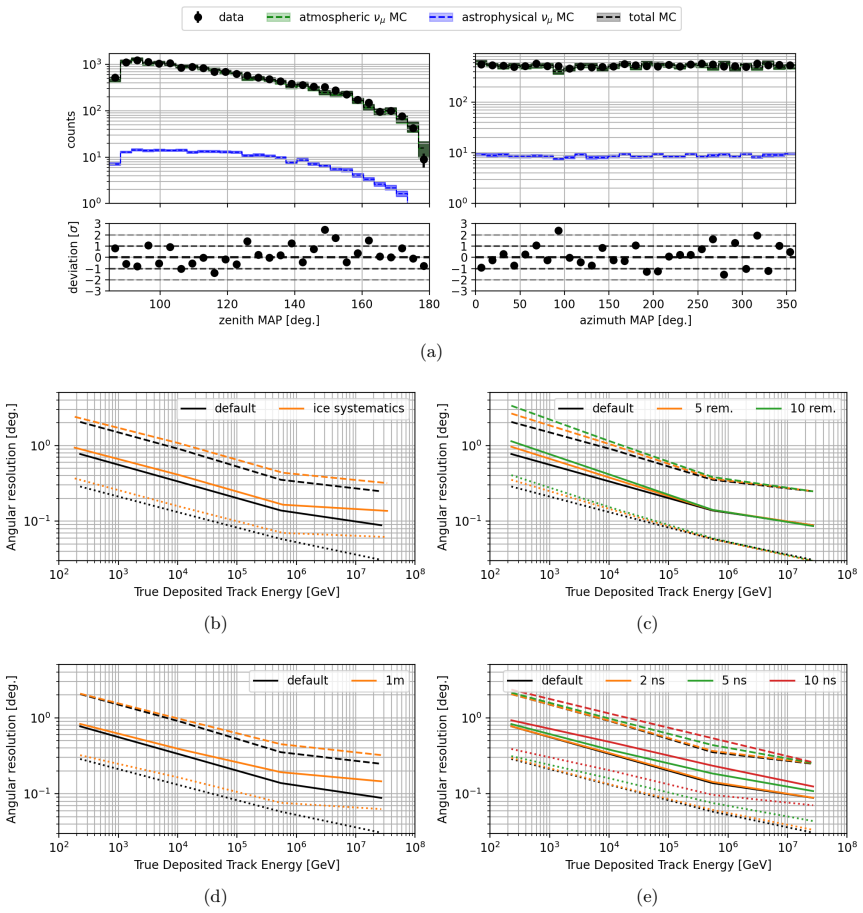
- [Abstract] Abstract: The quoted resolution improvement factors (1.3×, 1.7×, 2.5× at 100 TeV) and the claim of being the first ML method to beat likelihood-based muon reconstructions above 100 GeV are obtained exclusively from Monte Carlo simulations generated with the same photon-propagation and ice model used to define the B-spline likelihood. No real-data validation, no comparison of posterior calibration on observed events, and no systematic variation of ice optical parameters are reported; this directly affects the load-bearing claim that the method outperforms state-of-the-art reconstructions in practice.
- [Results] Results and validation sections: The manuscript evaluates the transformer NPE on held-out simulated events but provides no quantitative assessment of domain-shift robustness (e.g., by retraining or testing under varied scattering/absorption lengths or hole-ice models). Because the network can exploit any mismatch between the shared simulation model and true detector response while the physics-based baseline cannot, the reported gains may be inflated without such tests.
minor comments (2)
- [Abstract] The abstract states that several transformer variants were tested but does not tabulate the exact hyperparameter settings or the quantitative ablation results for dual residual streams, nonlinear QKV, and class-token cross-attention; a supplementary table would improve reproducibility.
- [Methods] Notation for the spherical flow parameters (spline knots, scale factors, rotation matrices) is introduced without an explicit equation reference or diagram showing their composition; this reduces clarity for readers unfamiliar with spherical normalizing flows.
Simulated Author's Rebuttal
We thank the referee for their careful and constructive review of our manuscript. We address each major comment below, acknowledging the simulation-based scope of the evaluation and making targeted revisions to clarify limitations and strengthen the presentation of results.
read point-by-point responses
-
Referee: [Abstract] Abstract: The quoted resolution improvement factors (1.3×, 1.7×, 2.5× at 100 TeV) and the claim of being the first ML method to beat likelihood-based muon reconstructions above 100 GeV are obtained exclusively from Monte Carlo simulations generated with the same photon-propagation and ice model used to define the B-spline likelihood. No real-data validation, no comparison of posterior calibration on observed events, and no systematic variation of ice optical parameters are reported; this directly affects the load-bearing claim that the method outperforms state-of-the-art reconstructions in practice.
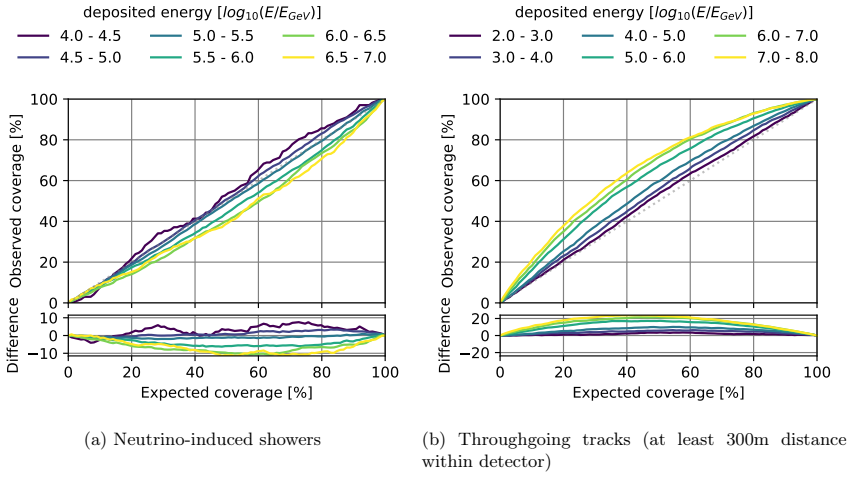
Authors: We agree that the reported resolution improvements and the comparison to prior ML methods are derived exclusively from Monte Carlo simulations using the nominal ice model shared with the B-spline likelihood. This is the standard evaluation protocol in IceCube reconstruction papers, as true neutrino directions are unavailable for real events, precluding direct resolution measurements on data. The B-spline method is likewise defined and benchmarked within the same simulation framework, ensuring an internally consistent comparison. We have revised the abstract to explicitly qualify that the improvement factors apply to simulated events and to rephrase the 'first ML method' claim as 'the first ML-based method to outperform likelihood-based muon reconstructions on simulated events above 100 GeV.' We have also added coverage tests demonstrating posterior calibration on held-out simulations. Systematic variations of ice optical parameters and direct real-data tests lie outside the present scope. revision: partial
-
Referee: [Results] Results and validation sections: The manuscript evaluates the transformer NPE on held-out simulated events but provides no quantitative assessment of domain-shift robustness (e.g., by retraining or testing under varied scattering/absorption lengths or hole-ice models). Because the network can exploit any mismatch between the shared simulation model and true detector response while the physics-based baseline cannot, the reported gains may be inflated without such tests.
Authors: We acknowledge the concern that ML methods can potentially exploit simulation-specific features. Our primary results use held-out events from the identical simulation set to provide a matched-conditions benchmark, which is a prerequisite for any subsequent robustness study. In the revised manuscript we have added quantitative tests evaluating the trained model on simulations with perturbed scattering and absorption lengths (±10% and ±20%) as well as modified hole-ice models. These tests show that the relative resolution gains over the B-spline likelihood remain largely intact under moderate variations. Full retraining across an ensemble of ice models is computationally prohibitive at present and is identified as future work; we have updated the discussion section to emphasize this limitation. revision: partial
- Direct real-data validation of angular resolution, as true neutrino directions are unknown for observed events.
Circularity Check
No significant circularity in derivation or claims
full rationale
The paper trains a transformer encoder plus spherical normalizing flow model on Monte Carlo simulations to perform neural posterior estimation for neutrino directions, then evaluates median angular resolution on held-out test simulations against B-spline likelihood baselines. The reported factors (1.3× for throughgoing tracks, 1.7× for showers, 2.5× for starting tracks at 100 TeV) are direct empirical measurements from this train/test split; they do not reduce by any equation or definition in the paper to quantities defined in terms of the model's own fitted parameters or self-referential predictions. No self-definitional steps, fitted-input-as-prediction patterns, load-bearing self-citations, or ansatzes smuggled via prior work appear in the architecture description or performance claims. The derivation chain is therefore self-contained against external benchmarks.
Axiom & Free-Parameter Ledger
free parameters (2)
- Transformer hyperparameters
- Normalizing flow spline and transformation parameters
axioms (1)
- domain assumption Simulated IceCube events accurately model real detector response and ice properties
Reference graph
Works this paper leans on
-
[1]
The IceCube Neutrino Observatory: instrumentation and online systems.Journal of Instrumentation, 12(03):P03012, 2017
The IceCube Collaboration. The IceCube Neutrino Observatory: instrumentation and online systems.Journal of Instrumentation, 12(03):P03012, 2017
2017
-
[2]
Evidence for neutrino emission from the nearby active galaxy NGC 1068.Science, 378(6619):538–543, 2022
The IceCube Collaboration. Evidence for neutrino emission from the nearby active galaxy NGC 1068.Science, 378(6619):538–543, 2022
2022
-
[3]
Observation of high-energy neutrinos from the Galactic plane
The IceCube Collaboration. Observation of high-energy neutrinos from the Galactic plane. Science, 380(6652):1338–1343, 2023
2023
-
[4]
P. A. Cherenkov. Visible luminescence of pure liquids under the influence ofγ-radiation.Dokl. Akad. Nauk SSSR, 2(8):451–454, 1934
1934
-
[5]
Observation of High-Energy Astrophysical Neutrinos in Three Years of IceCube Data.Phys
The IceCube Collaboration. Observation of High-Energy Astrophysical Neutrinos in Three Years of IceCube Data.Phys. Rev. Lett., 113:101101, 2014
2014
-
[6]
Combining Maximum-Likelihood with Deep Learning for Event Reconstruction in IceCube
The IceCube Collaboration. Combining Maximum-Likelihood with Deep Learning for Event Reconstruction in IceCube. InProceedings of 37th International Cosmic Ray Conference — PoS(ICRC2021), volume 395, page 1065, 2021
2021
-
[7]
A convolutional neural network based cascade reconstruction for the IceCube Neutrino Observatory.Journal of Instrumentation, 16(07):P07041, 2021
The IceCube Collaboration. A convolutional neural network based cascade reconstruction for the IceCube Neutrino Observatory.Journal of Instrumentation, 16(07):P07041, 2021
2021
-
[8]
Improved modeling of in-ice particle showers for IceCube event reconstruction.Journal of Instrumentation, 19(06):P06026, 2024
The IceCube Collaboration. Improved modeling of in-ice particle showers for IceCube event reconstruction.Journal of Instrumentation, 19(06):P06026, 2024
2024
-
[9]
PhD thesis, University of Mainz, 2014
Kai Schatto.Stacked searches for high-energy neutrinos from blazars with IceCube. PhD thesis, University of Mainz, 2014
2014
-
[10]
Neutrino emission from the direction of the blazar TXS 0506+056 prior to the IceCube-170922A alert.Science, 361(6398):147–151, 2018
The IceCube Collaboration. Neutrino emission from the direction of the blazar TXS 0506+056 prior to the IceCube-170922A alert.Science, 361(6398):147–151, 2018
2018
-
[11]
A muon-track reconstruction exploiting stochastic losses for large-scale Cherenkov detectors.Journal of Instrumentation, 16(08):P08034, 2021
The IceCube Collaboration. A muon-track reconstruction exploiting stochastic losses for large-scale Cherenkov detectors.Journal of Instrumentation, 16(08):P08034, 2021
2021
-
[12]
Characterization of the astrophysical diffuse neutrino flux using starting track events in IceCube.Phys
The IceCube Collaboration. Characterization of the astrophysical diffuse neutrino flux using starting track events in IceCube.Phys. Rev. D, 110:022001, 2024
2024
-
[13]
State of the Ice Model in the IceCube Observatory
The IceCube Collaboration. State of the Ice Model in the IceCube Observatory. In Proceedings of 39th International Cosmic Ray Conference — PoS(ICRC2025), volume 501, page 1013, 2025
2025
-
[14]
Penalized splines for smooth representation of high-dimensional monte carlo datasets.Computer Physics Communications, 184(9):2214–2220, 2013
Nathan Whitehorn, Jakob van Santen, and Sven Lafebre. Penalized splines for smooth representation of high-dimensional monte carlo datasets.Computer Physics Communications, 184(9):2214–2220, 2013
2013
-
[15]
Energy reconstruction methods in the IceCube neutrino telescope
The IceCube Collaboration. Energy reconstruction methods in the IceCube neutrino telescope. Journal of Instrumentation, 9(03):P03009, 2014
2014
-
[16]
The IceCube realtime alert system.Astroparticle Physics, 92:30–41, 2017
The IceCube Collaboration. The IceCube realtime alert system.Astroparticle Physics, 92:30–41, 2017
2017
-
[17]
Fastε-free inference of simulation models with Bayesian conditional density estimation
George Papamakarios and Iain Murray. Fastε-free inference of simulation models with Bayesian conditional density estimation. InProceedings of the 30th International Conference on Neural Information Processing Systems, NIPS’16, page 1036–1044, Red Hook, NY, USA,
-
[18]
Curran Associates Inc
-
[19]
The frontier of simulation-based inference.Proceedings of the National Academy of Sciences, 117(48):30055–30062, 2020
Kyle Cranmer, Johann Brehmer, and Gilles Louppe. The frontier of simulation-based inference.Proceedings of the National Academy of Sciences, 117(48):30055–30062, 2020
2020
-
[20]
Conditional normalizing flows for IceCube event reconstruction
The IceCube Collaboration. Conditional normalizing flows for IceCube event reconstruction. InProceedings of 38th International Cosmic Ray Conference — PoS(ICRC2023), volume 444, page 1003, 2023
2023
-
[21]
Graph Neural Networks for low-energy event classification & reconstruction in IceCube.Journal of Instrumentation, 17(11):P11003, 2022
The IceCube Collaboration. Graph Neural Networks for low-energy event classification & reconstruction in IceCube.Journal of Instrumentation, 17(11):P11003, 2022. 38
2022
-
[22]
Dynamic Graph CNN for Learning on Point Clouds
Yue Wang, Yongbin Sun, Ziwei Liu, et al. Dynamic Graph CNN for Learning on Point Clouds. ACM Trans. Graph., 38(5), 2019
2019
-
[23]
Attention is All you Need
Ashish Vaswani, Noam Shazeer, Niki Parmar, et al. Attention is All you Need. InAdvances in Neural Information Processing Systems, volume 30, 2017
2017
-
[24]
Normalizing Flows on Tori and Spheres
Danilo Jimenez Rezende, George Papamakarios, Sebastien Racaniere, et al. Normalizing Flows on Tori and Spheres. InProceedings of the 37th International Conference on Machine Learning, volume 119, pages 8083–8092. PMLR, 2020
2020
-
[25]
Neural Spline Flows
Conor Durkan, Artur Bekasov, Iain Murray, et al. Neural Spline Flows. InAdvances in Neural Information Processing Systems, volume 32, pages 7511 – 7522, 2019
2019
-
[26]
The Evolution of Markov Chain Monte Carlo Methods.The American Mathematical Monthly, 117(5):383–413, 2010
Matthew Richey. The Evolution of Markov Chain Monte Carlo Methods.The American Mathematical Monthly, 117(5):383–413, 2010
2010
-
[27]
Jordan, Zoubin Ghahramani, Tommi S
Michael I. Jordan, Zoubin Ghahramani, Tommi S. Jaakkola, et al. An Introduction to Variational Methods for Graphical Models.Machine Learning, 37(2):183–233, 1999
1999
-
[28]
Kullback and R
S. Kullback and R. A. Leibler. On information and sufficiency.The Annals of Mathematical Statistics, 22(1):79–86, 1951
1951
-
[29]
Thorsten Glüsenkamp. Unifying supervised learning and VAEs: coverage, systematics and goodness-of-fit in normalizing-flow based neural network models for astro-particle reconstructions.The European Physical Journal C, 84:163, 2024
2024
-
[30]
Dispersion on a Sphere.Proceedings of the Royal Society of London Series A, 217(1130):295–305, 1953
Ronald Fisher. Dispersion on a Sphere.Proceedings of the Royal Society of London Series A, 217(1130):295–305, 1953
1953
-
[31]
Numerically stable sampling of the von Mises Fisher distribution onS2 (and other tricks).EPFL research report, 2012
Wenzel Jakob. Numerically stable sampling of the von Mises Fisher distribution onS2 (and other tricks).EPFL research report, 2012
2012
-
[32]
Higham.Accuracy and Stability of Numerical Algorithms
Nicholas J. Higham.Accuracy and Stability of Numerical Algorithms. Society for Industrial and Applied Mathematics, second edition, 2002
2002
-
[33]
Glüsenkamp
T. Glüsenkamp. Jammy Flows.https://github.com/thoglu/jammy_flows
-
[34]
K. M. Górski, E. Hivon, A. J. Banday, et al. HEALPix: A Framework for High-Resolution Discretization and Fast Analysis of Data Distributed on the Sphere.The Astrophysical Journal, 622(2):759, 2005
2005
-
[35]
MOC - HEALPix Multi-Order Coverage map Version 1.0.International Virtual Observatory Alliance, 2014
Pierre Fernique, Thomas Boch, Tom Donaldson, et al. MOC - HEALPix Multi-Order Coverage map Version 1.0.International Virtual Observatory Alliance, 2014
2014
-
[36]
Martinez-Castellanos, Leo P
I. Martinez-Castellanos, Leo P. Singer, E. Burns, et al. Multiresolution HEALPix Maps for Multiwavelength and Multimessenger Astronomy.The Astronomical Journal, 163(6):259, 2022
2022
-
[37]
Lawson and Richard J
Charles L. Lawson and Richard J. Hanson.Solving least squares problems. Englewood Cliffs, NJ: Prentice-Hall, 1974
1974
-
[38]
On layer normalization in the transformer architecture
Ruibin Xiong, Yunchang Yang, Di He, et al. On layer normalization in the transformer architecture. InProceedings of the 37th International Conference on Machine Learning, ICML’20. JMLR.org, 2020
2020
-
[39]
Swart, and George Obaido
Ibomoiye Domor Mienye, Theo G. Swart, and George Obaido. Recurrent Neural Networks: A Comprehensive Review of Architectures, Variants, and Applications.Information, 15(9), 2024
2024
-
[40]
Learning phrase representations using RNN encoder–decoder for statistical machine translation
Kyunghyun Cho, Bart van Merriënboer, Caglar Gulcehre, et al. Learning phrase representations using RNN encoder–decoder for statistical machine translation. InProceedings of the 2014 Conference on Empirical Methods in Natural Language Processing (EMNLP), pages 1724–1734, Doha, Qatar, 2014. Association for Computational Linguistics
2014
-
[41]
A model independent parametrization of the optical properties of the refrozen IceCube drill holes
The IceCube Collaboration. A model independent parametrization of the optical properties of the refrozen IceCube drill holes. InProceedings of 38th International Cosmic Ray Conference — PoS(ICRC2023), volume 444, page 1034, 2023
2023
-
[42]
Kingma and Jimmy Ba
Diederik P. Kingma and Jimmy Ba. Adam: A Method for Stochastic Optimization. In Proceedings of the 3rd International Conference on Learning Representations, 2015. 39
2015
-
[43]
FlashAttention-2: Faster attention with better parallelism and work partitioning
Tri Dao. FlashAttention-2: Faster attention with better parallelism and work partitioning. In International Conference on Learning Representations (ICLR), 2024
2024
-
[44]
SGDR: Stochastic Gradient Descent with Warm Restarts
Ilya Loshchilov and Frank Hutter. SGDR: Stochastic Gradient Descent with Warm Restarts. InInternational Conference on Learning Representations, 2017
2017
-
[45]
A Variational Analysis of Stochastic Gradient Algorithms
Stephan Mandt, Matthew Hoffman, and David Blei. A Variational Analysis of Stochastic Gradient Algorithms. InProceedings of The 33rd International Conference on Machine Learning, volume 48 ofProceedings of Machine Learning Research, pages 354–363, New York, New York, USA, 2016. PMLR
2016
-
[46]
Averaging Weights Leads to Wider Optima and Better Generalization
Pavel Izmailov, Dmitrii Podoprikhin, Timur Garipov, et al. Averaging Weights Leads to Wider Optima and Better Generalization. InProceedings of the Thirty-Fourth Conference on Uncertainty in Artificial Intelligence, UAI 2018, Monterey, California, USA, August 6-10, 2018, pages 876–885. AUAI Press, 2018
2018
-
[47]
Self-Attention with Relative Position Representations
Peter Shaw, Jakob Uszkoreit, and Ashish Vaswani. Self-Attention with Relative Position Representations. InProceedings of the 2018 Conference of the North American Chapter of the Association for Computational Linguistics: Human Language Technologies, Volume 2 (Short Papers), pages 464–468, New Orleans, Louisiana, 2018. Association for Computational Linguistics
2018
-
[48]
IceCube – Neutrinos in Deep Ice
Habib Bukhari, Dipam Chakraborty, Philipp Eller, et al. IceCube – Neutrinos in Deep Ice. The European Physical Journal C, 84(6):646, 2024
2024
-
[49]
ResiDual: Transformer with Dual Residual Connections.arXiv:2304.14802, 2024
Shufang Xie, Huishuai Zhang, Junliang Guo, et al. ResiDual: Transformer with Dual Residual Connections.arXiv:2304.14802, 2024
-
[50]
An Image is Worth 16x16 Words: Transformers for Image Recognition at Scale
Alexey Dosovitskiy, Lucas Beyer, Alexander Kolesnikov, et al. An Image is Worth 16x16 Words: Transformers for Image Recognition at Scale. InInternational Conference on Learning Representations, 2021
2021
-
[51]
Estimating the angular resolution of tracks in neutrino telescopes based on a likelihood analysis.Astroparticle Physics, 25(3):220–225, 2006
Till Neunhöffer. Estimating the angular resolution of tracks in neutrino telescopes based on a likelihood analysis.Astroparticle Physics, 25(3):220–225, 2006
2006
-
[52]
C. A. Argüelles, A. Schneider, and T. Yuan. A binned likelihood for stochastic models. Journal of High Energy Physics, 2019(6):30, 2019
2019
-
[53]
Thomas K. Gaisser. Spectrum of cosmic-ray nucleons, kaon production, and the atmospheric muon charge ratio.Astroparticle Physics, 35(12):801–806, 2012
2012
-
[54]
Gaisser, and Todor Stanev
Anatoli Fedynitch, Felix Riehn, Ralph Engel, Thomas K. Gaisser, and Todor Stanev. Hadronic interaction model sibyll2.3cand inclusive lepton fluxes.Phys. Rev. D, 100:103018, 2019
2019
-
[55]
Improved measurements of the TeV-PeV extragalactic neutrino spectrum from joint analyses of IceCube tracks and cascades.Phys
The IceCube Collaboration. Improved measurements of the TeV-PeV extragalactic neutrino spectrum from joint analyses of IceCube tracks and cascades.Phys. Rev. D, 113:062002, 2026
2026
-
[56]
The IceCube Upgrade: status and prospects for advances with GeV neutrinos
The IceCube Collaboration. The IceCube Upgrade: status and prospects for advances with GeV neutrinos. InProceedings of 42nd International Conference on High Energy Physics — PoS(ICHEP2024), volume 476, page 149, 2024
2024
-
[57]
IceCube-Gen2: the window to the extreme Universe.Journal of Physics G: Nuclear and Particle Physics, 48(6):060501, 2021
The IceCube Collaboration. IceCube-Gen2: the window to the extreme Universe.Journal of Physics G: Nuclear and Particle Physics, 48(6):060501, 2021
2021
-
[58]
J. A. Gregory and R. Delbourgo. Piecewise Rational Quadratic Interpolation to Monotonic Data.IMA Journal of Numerical Analysis, 2(2):123–130, 1982. 40
1982
discussion (0)
Sign in with ORCID, Apple, or X to comment. Anyone can read and Pith papers without signing in.