Recognition: unknown
A population-based approach to understanding radio AGN feedback with LOFAR: The LoTSS Deep Fields
Pith reviewed 2026-05-10 01:56 UTC · model grok-4.3
The pith
Radio AGN jets supply a steady kinetic power density of 10^{32} to 10^{33} W Mpc^{-3} out to redshift 2.5.
A machine-rendered reading of the paper's core claim, the machinery that carries it, and where it could break.
Core claim
Applying a semi-analytic model to 5187 radio AGN in the LoTSS Deep Fields, the authors derive kinetic luminosity functions after weighting for shorter source lifetimes and obtain an integrated kinetic luminosity density of approximately 10^{32} to 10^{33} W Mpc^{-3} from z = 0 to z = 2.5, with moderate positive evolution from z = 0 to 1 and little evolution from z = 1 to 2.
What carries the argument
A semi-analytic model that converts observed radio luminosities and source sizes into jet kinetic powers, with lifetime weighting to produce population luminosity functions and densities
If this is right
- The energy supplied by radio AGN jets is sufficient to balance radiative cooling in galaxy environments out to redshift 2.5.
- Cosmological models can use these power levels to regulate galaxy growth without overproducing stars or gas.
- Short-lived, lower-power sources dominate the contribution to the total output.
- Moderate evolution in power density occurs only at low redshift while the output remains stable at higher redshift.
Where Pith is reading between the lines
- This power level suggests radio jets remain an effective feedback channel even when the universe was denser and more star-forming.
- Extending the same analysis to higher redshifts with future telescopes could reveal whether the density stays flat or drops beyond z = 2.5.
- The dominance of short-lived sources points to episodic rather than steady feedback, testable by counting remnant radio sources in deeper surveys.
Load-bearing premise
The semi-analytic model accurately converts observed radio luminosities and source sizes into jet kinetic powers without large systematic errors from lifetime or environment assumptions.
What would settle it
A large sample of direct jet-power measurements in radio AGN that yields an integrated density well below 10^{32} W Mpc^{-3} at any redshift between 0 and 2.5.
Figures
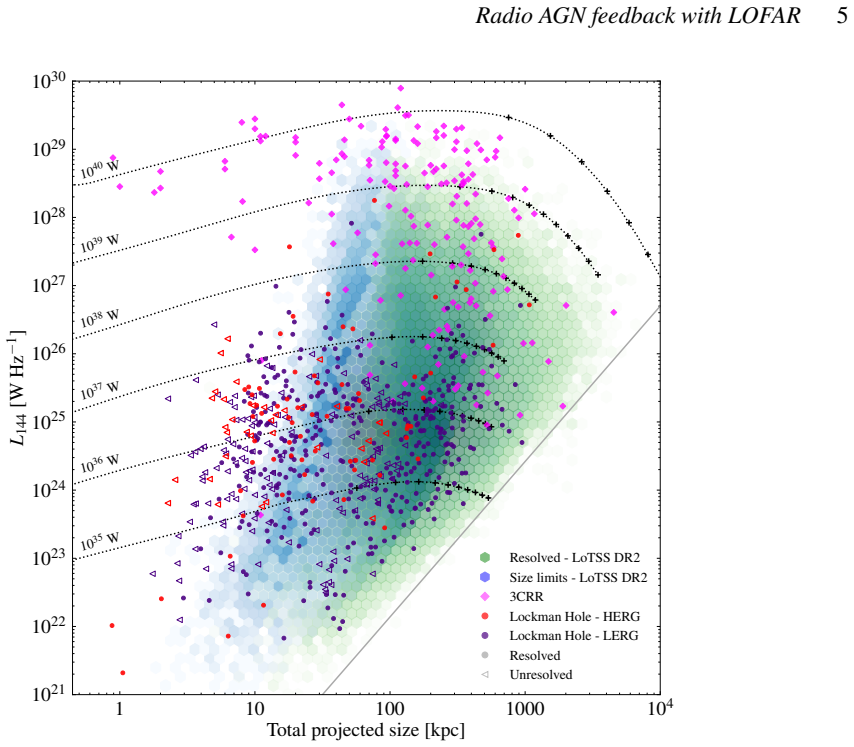

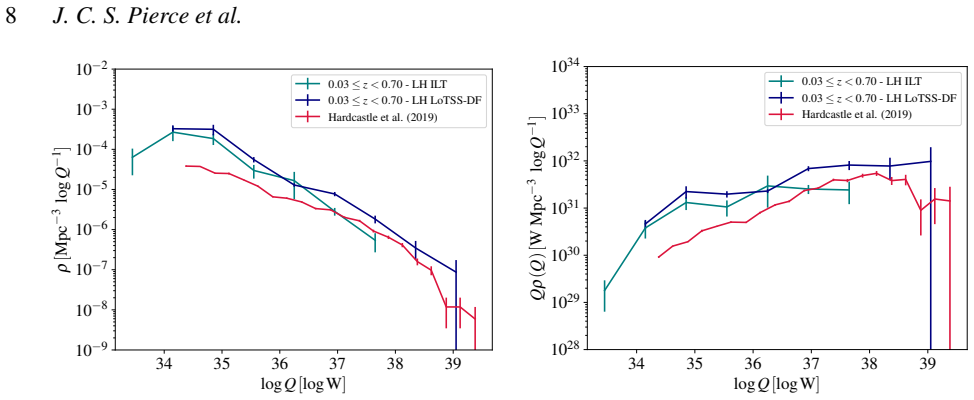

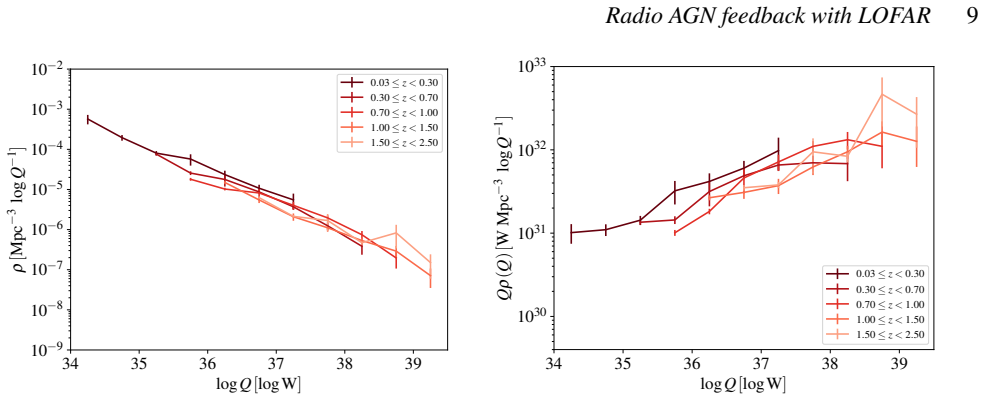
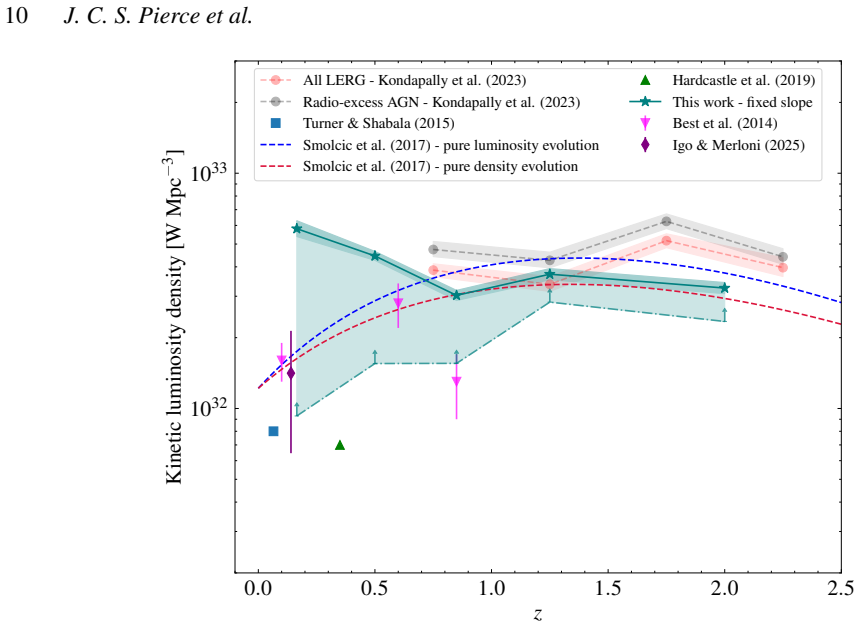
read the original abstract
Feedback from radio AGN jets is regularly implemented into contemporary models of galaxy evolution to offset radiative cooling in the large-scale environments in which they typically reside. While previous studies suggest that the total kinetic power output from radio AGN is sufficient for this purpose, many have relied on jet-power estimation from radio luminosities using generalised scaling relations that neglect additional information such as source size and environment. We here infer the cosmic evolution of radio AGN kinetic jet powers using a physically motivated semi-analytic model for the first time. Initial analysis on a sample of 619 radio AGN at $z < 2.5$ from LoTSS Deep Field and International LOFAR Telescope images of the Lockman Hole implies a population dominated by short-lived sources typically of lower jet power. After incorporating weighting towards shorter lifetimes in the inference models, we utilise ELAIS-N1 and Bo\"otes LoTSS Deep Field data to expand our analysis to a much larger sample of 5,187 objects, deriving jet kinetic luminosity functions and integrated kinetic luminosity densities for the radio AGN population out to $z = 2.5$. In broad agreement with previous results in the literature, we find the total power output per comoving volume to be $\sim$10$^{32}-$10$^{33}$ W Mpc$^{-3}$ across the full redshift range, with some suggestions of moderate positive evolution from $z$ = 0$-$1 and little evolution from $z$ = 1$-$2. These values are compatible with expectations from some cosmological models, providing strong evidence for the viability of feedback from radio AGN jets across cosmic time.
Editorial analysis
A structured set of objections, weighed in public.
Referee Report
Summary. The paper uses LOFAR LoTSS Deep Field data to analyze a sample of 5187 radio AGN at z < 2.5. It applies a semi-analytic model (for the first time) to convert 150 MHz luminosities and projected sizes into jet kinetic powers, incorporates weighting for shorter source lifetimes, derives kinetic luminosity functions, and reports an integrated comoving kinetic power density of ∼10^{32}–10^{33} W Mpc^{-3} with mild positive evolution from z=0–1 and little evolution from z=1–2, values compatible with some cosmological models.
Significance. If the model conversion and weighting are shown to be robust, the work supplies a large-sample, physically motivated constraint on the cosmic history of radio AGN jet feedback power, directly relevant to galaxy evolution simulations that include AGN heating. The expansion from an initial 619-source analysis to the full 5187-source sample and the explicit use of source size information are strengths.
major comments (2)
- [Abstract and §3] Abstract and §3 (semi-analytic model): the jet-power conversion relies on a semi-analytic model whose parameters link observed radio properties to jet power, yet no quantitative external validation (e.g., against X-ray cavity powers, hydrodynamical simulations, or other independent estimators) is reported. A systematic offset of even 0.4 dex would move the integrated density outside the quoted 10^{32}–10^{33} W Mpc^{-3} range and invalidate the compatibility statement.
- [§4] §4 (lifetime weighting and luminosity functions): the post-hoc weighting toward shorter lifetimes is applied after the initial analysis on the 619-source subsample and then used for the full sample; however, no explicit propagation of uncertainties from this weighting into the high-z bins of the luminosity functions or the integrated densities is shown. The abstract presents the derived densities without error bars or uncertainty ranges.
minor comments (1)
- [Abstract] Abstract: the phrase 'providing strong evidence' is stronger than the reported 'broad agreement' and 'compatible with expectations'; consider moderating the language or adding a quantitative measure of agreement.
Simulated Author's Rebuttal
We thank the referee for their constructive comments and positive assessment of the work's significance. We address each major comment below, indicating where revisions will be made to improve clarity and robustness.
read point-by-point responses
-
Referee: [Abstract and §3] Abstract and §3 (semi-analytic model): the jet-power conversion relies on a semi-analytic model whose parameters link observed radio properties to jet power, yet no quantitative external validation (e.g., against X-ray cavity powers, hydrodynamical simulations, or other independent estimators) is reported. A systematic offset of even 0.4 dex would move the integrated density outside the quoted 10^{32}–10^{33} W Mpc^{-3} range and invalidate the compatibility statement.
Authors: We acknowledge that the manuscript does not present a direct quantitative comparison of the semi-analytic model to independent estimators such as X-ray cavity powers or hydrodynamical simulations. The model is introduced as a physically motivated approach applied for the first time to this dataset, with parameters calibrated to match observed radio properties and source lifetimes as described in §3. To address the concern about potential systematic offsets, we will revise §3 to include an expanded discussion of model uncertainties and literature-based estimates of possible biases in the jet-power conversion. We will also update the abstract to report the integrated kinetic power density with explicit uncertainty ranges, allowing a more cautious statement on compatibility with cosmological models. revision: yes
-
Referee: [§4] §4 (lifetime weighting and luminosity functions): the post-hoc weighting toward shorter lifetimes is applied after the initial analysis on the 619-source subsample and then used for the full sample; however, no explicit propagation of uncertainties from this weighting into the high-z bins of the luminosity functions or the integrated densities is shown. The abstract presents the derived densities without error bars or uncertainty ranges.
Authors: We agree that the propagation of uncertainties arising from the lifetime weighting should be made explicit. The weighting was derived from the initial 619-source analysis, which showed a population dominated by short-lived sources, and then applied to the full 5,187-source sample. In the revised manuscript we will add a clear description in §4 of how these uncertainties are propagated into the high-redshift bins of the luminosity functions and the integrated densities. We will also include error bars or uncertainty ranges on the values reported in the abstract. revision: yes
Circularity Check
No significant circularity in the derivation chain
full rationale
The paper applies a semi-analytic model to observed 150 MHz luminosities and projected sizes from LoTSS Deep Field samples (initially 619 sources, then expanded to 5187) to estimate jet kinetic powers, incorporates post-hoc weighting for shorter source lifetimes after initial inspection, and integrates the resulting luminosity functions to obtain comoving kinetic power densities of ∼10^{32}–10^{33} W Mpc^{-3}. No quoted step reduces the final integrated density to its inputs by construction, such as a fitted weighting parameter being relabeled as a prediction of the same quantity or a self-citation chain that forbids alternatives. The model is presented as newly applied here rather than smuggled via prior self-citation, and compatibility with external cosmological models functions as an independent check rather than an internal tautology, leaving the derivation self-contained.
Axiom & Free-Parameter Ledger
free parameters (1)
- lifetime weighting factor
axioms (1)
- standard math Standard flat Lambda-CDM cosmology for converting redshifts to comoving volumes and look-back times
Reference graph
Works this paper leans on
-
[1]
doi:10.1051/0004-6361/201322068 , Eid =. arXiv , Author =:1307.6212 , Journal =
-
[2]
The Astronomical Journal , author =
The Astropy Project: Building an Open-science Project and Status of the v2.0 Core Package. , keywords =. doi:10.3847/1538-3881/aabc4f , archivePrefix =. 1801.02634 , primaryClass =
-
[3]
The Astropy Project: Sustaining and Growing a Community-oriented Open-source Project and the Latest Major Release (v5.0) of the Core Package. , keywords =. doi:10.3847/1538-4357/ac7c74 , archivePrefix =. 2206.14220 , primaryClass =
work page internal anchor Pith review Pith/arXiv arXiv doi:10.3847/1538-4357/ac7c74
-
[4]
Hunter, J. D. , Title =. Computing in Science & Engineering , Volume =
-
[5]
Astronomical Data Analysis Software and Systems XIV , year = 2005, editor =
TOPCAT & STIL: Starlink Table/VOTable Processing Software. Astronomical Data Analysis Software and Systems XIV , year = 2005, editor =
2005
-
[6]
The radio galaxy population in the SIMBA simulations. , keywords =. doi:10.1093/mnras/stab654 , archivePrefix =. 2010.11225 , primaryClass =
-
[7]
Evidence for Supermassive Black Hole Binaries. arXiv e-prints , keywords =. doi:10.48550/arXiv.2510.07534 , archivePrefix =. 2510.07534 , primaryClass =
-
[8]
Particle content, radio-galaxy morphology, and jet power: all radio-loud AGN are not equal. , keywords =. doi:10.1093/mnras/sty274 , archivePrefix =. 1801.10172 , primaryClass =
-
[9]
Interpreting radiative efficiency in radio-loud AGNs. Nature Astronomy , keywords =. doi:10.1038/s41550-018-0424-1 , archivePrefix =. 1804.04043 , primaryClass =
-
[10]
GAMA/WiggleZ: the 1.4 GHz radio luminosity functions of high- and low-excitation radio galaxies and their redshift evolution to z = 0.75. , keywords =. doi:10.1093/mnras/stw910 , archivePrefix =. 1604.04332 , primaryClass =
-
[11]
2004, MNRAS, 351, 1379, doi: 10.1111/j.1365-2966.2004.07876.x
Structural stability of cooling flows. , eprint =. doi:10.1111/j.1365-2966.2004.07809.x , adsurl =
-
[12]
Numerical modelling of the lobes of radio galaxies in cluster environments. , archivePrefix = "arXiv", eprint =. doi:10.1093/mnras/sts564 , adsurl =
-
[13]
, year = 2024, month = sep, volume =
Black hole jets on the scale of the cosmic web. , year = 2024, month = sep, volume =. doi:10.1038/s41586-024-07879-y , adsurl =
-
[14]
2001, MNRAS, 322, 231, doi: 10.1046/j.1365-8711.2001.04022.x
The radio luminosity function from the low-frequency 3CRR, 6CE and 7CRS complete samples. , keywords =. doi:10.1046/j.1365-8711.2001.04101.x , archivePrefix =. astro-ph/0010419 , primaryClass =
-
[15]
, year = 1990, month = nov, volume =
The redshift cut-off in the luminosity function of radio galaxies and quasars. , year = 1990, month = nov, volume =
1990
-
[16]
First data release of the Hyper Suprime-Cam Subaru Strategic Program. , keywords =. doi:10.1093/pasj/psx081 , archivePrefix =. 1702.08449 , primaryClass =
-
[17]
The LOFAR Two-metre Sky Survey Deep Fields: new probabilistic spectroscopic classifications and the accretion rates of radio galaxies. , keywords =. doi:10.1093/mnras/staf1347 , archivePrefix =. 2508.18347 , primaryClass =
-
[18]
Jet-induced molecular gas excitation and turbulence in the Teacup. , keywords =. doi:10.1051/0004-6361/202345964 , archivePrefix =. 2302.13884 , primaryClass =
-
[19]
Molecular gas excitation and outflow properties of obscured quasars at z 0.1. , keywords =. doi:10.1051/0004-6361/202453291 , archivePrefix =. 2505.02759 , primaryClass =
-
[20]
The nature of compact radio sources: the case of FR 0 radio galaxies. , keywords =. doi:10.1007/s00159-023-00148-3 , archivePrefix =. 2307.08379 , primaryClass =
-
[21]
Extragalactic Radio Sources , year = 1982, editor =
Evolutionary tracks of extended radio sources. Extragalactic Radio Sources , year = 1982, editor =
1982
-
[22]
I: A semi-analytical model for the evolution of radio galaxies
AGN hosting jets. I: A semi-analytical model for the evolution of radio galaxies. arXiv e-prints , keywords =. doi:10.48550/arXiv.2509.24939 , archivePrefix =. 2509.24939 , primaryClass =
-
[23]
On the fundamental dichotomy in the local radio-AGN population: accretion, evolution and host galaxy properties. , keywords =. doi:10.1111/j.1365-2966.2012.20414.x , archivePrefix =. 1201.2397 , primaryClass =
-
[24]
The cosmic evolution of radio-AGN feedback to z = 1. , keywords =. doi:10.1093/mnras/stu1776 , archivePrefix =. 1409.0263 , primaryClass =
-
[25]
The LOFAR Two-metre Sky Survey: Deep Fields data release 1. V. Survey description, source classifications, and host galaxy properties. , keywords =. doi:10.1093/mnras/stad1308 , archivePrefix =. 2305.05782 , primaryClass =
-
[26]
A Systematic Study of Radio-induced X-Ray Cavities in Clusters, Groups, and Galaxies. , keywords =. doi:10.1086/383519 , archivePrefix =. astro-ph/0402348 , primaryClass =
-
[27]
Radiative Efficiency and Content of Extragalactic Radio Sources: Toward a Universal Scaling Relation between Jet Power and Radio Power. , keywords =. doi:10.1086/591416 , archivePrefix =. 0806.1929 , primaryClass =
-
[28]
The duty cycle of radio-mode feedback in complete samples of clusters. , keywords =. doi:10.1111/j.1365-2966.2012.22083.x , archivePrefix =. 1210.7100 , primaryClass =
-
[29]
Electromagnetic extraction of energy from Kerr black holes. , keywords =. doi:10.1093/mnras/179.3.433 , adsurl =
-
[30]
K-Corrections and Filter Transformations in the Ultraviolet, Optical, and Near-Infrared. , keywords =. doi:10.1086/510127 , archivePrefix =. astro-ph/0606170 , primaryClass =
-
[31]
The extended ROSAT-ESO Flux Limited X-ray Galaxy Cluster Survey (REFLEX II). IV. X-ray luminosity function and first constraints on cosmological parameters. , keywords =. doi:10.1051/0004-6361/201323155 , archivePrefix =. 1403.2927 , primaryClass =
-
[32]
Ram Pressure Stripping of Disc Galaxies: The Role of the Inclination Angle , shorttitle =
Breaking the hierarchy of galaxy formation. , keywords =. doi:10.1111/j.1365-2966.2006.10519.x , archivePrefix =. astro-ph/0511338 , primaryClass =
-
[33]
The XXL Survey. XXXVI. Evolution and black hole feedback of high-excitation and low-excitation radio galaxies in XXL-S. , keywords =. doi:10.1051/0004-6361/201834581 , archivePrefix =. 1904.12507 , primaryClass =
-
[34]
An optical spectroscopic survey of the 3CR sample of radio galaxies with z < 0.3 . II. Spectroscopic classes and accretion modes in radio-loud AGN. , keywords =. doi:10.1051/0004-6361/200913290 , archivePrefix =. 0911.0536 , primaryClass =
-
[35]
Ubiquitous radio emission in quasars: Predominant AGN origin and a connection to jets, dust, and winds. , keywords =. doi:10.1051/0004-6361/202348982 , archivePrefix =. 2312.10177 , primaryClass =
-
[36]
2022, , 134, 114501, 10.1088/1538-3873/ac9642
CASA, the Common Astronomy Software Applications for Radio Astronomy. , keywords =. doi:10.1088/1538-3873/ac9642 , archivePrefix =. 2210.02276 , primaryClass =
-
[37]
A Relationship Between AGN Jet Power and Radio Power. , keywords =. doi:10.1088/0004-637X/720/2/1066 , archivePrefix =. 1006.5699 , primaryClass =
-
[38]
2018, A&A, 620, A192, doi: 10.1051/0004-6361/201833935
The VLA-COSMOS 3 GHz Large Project: Star formation properties and radio luminosity functions of AGN with moderate-to-high radiative luminosities out to z 6. , keywords =. doi:10.1051/0004-6361/201833935 , archivePrefix =. 1811.02966 , primaryClass =
-
[39]
The 1.4 GHz Luminosity Function and Its Evolution. , keywords =. doi:10.1086/167176 , adsurl =
-
[40]
Radio emission from normal galaxies. , keywords =. doi:10.1146/annurev.aa.30.090192.003043 , adsurl =
-
[41]
The many lives of active galactic nuclei: cooling flows, black holes and the luminosities and colours of galaxies. , keywords =. doi:10.1111/j.1365-2966.2005.09675.x , archivePrefix =. astro-ph/0508046 , primaryClass =
-
[42]
, archivePrefix = "arXiv", eprint =
Semi-Analytic Galaxy Evolution (SAGE): Model Calibration and Basic Results. , keywords =. doi:10.3847/0067-0049/222/2/22 , archivePrefix =. 1601.04709 , primaryClass =
-
[43]
Simba: Cosmological Simulations with Black Hole Growth and Feedback
SIMBA: Cosmological simulations with black hole growth and feedback. , keywords =. doi:10.1093/mnras/stz937 , archivePrefix =. 1901.10203 , primaryClass =
-
[44]
COLOSSUS: A Python Toolkit for Cosmology, Large-scale Structure, and Dark Matter Halos. , keywords =. doi:10.3847/1538-4365/aaee8c , archivePrefix =. 1712.04512 , primaryClass =
-
[45]
The LOFAR two metre sky survey data release 2: probabilistic spectral source classifications and faint radio source demographics. , keywords =. doi:10.1093/mnras/stae2117 , archivePrefix =. 2409.11465 , primaryClass =
-
[46]
The LOFAR Two-meter Sky Survey: Deep Fields Data Release 1. IV. Photometric redshifts and stellar masses. , keywords =. doi:10.1051/0004-6361/202038809 , archivePrefix =. 2011.08204 , primaryClass =
-
[47]
Euclid: I. Overview of the Euclid mission. , keywords =. doi:10.1051/0004-6361/202450810 , archivePrefix =. 2405.13491 , primaryClass =
-
[48]
Cosmological Effects of Powerful AGN Outbursts in Galaxy Clusters: Insights from an XMM-Newton Observation of MS 0735+7421. , keywords =. doi:10.1086/512800 , archivePrefix =. astro-ph/0701386 , primaryClass =
-
[49]
Advances in Astronomy , keywords =
Evidence for AGN Feedback in Galaxy Clusters and Groups. Advances in Astronomy , keywords =. doi:10.1155/2012/950641 , archivePrefix =. 1109.3334 , primaryClass =
-
[50]
Mutual distance dependence drives the observed jet-power-radio-luminosity scaling relations in radio galaxies. , keywords =. doi:10.1093/mnras/stv2712 , archivePrefix =. 1511.06007 , primaryClass =
-
[51]
American Astronomical Society Meeting Abstracts \#216 , year = 2010, series =
A NEWFIRM Survey of the Spitzer Deep Wide Field. American Astronomical Society Meeting Abstracts \#216 , year = 2010, series =
2010
-
[52]
MIGHTEE: the continuum survey Data Release 1. , keywords =. doi:10.1093/mnras/stae2528 , archivePrefix =. 2411.04958 , primaryClass =
-
[53]
The Merger Rates and Mass Assembly Histories of Dark Matter Haloes in the Two
Searching for the inverse-Compton emission from bright cluster-centre radio galaxies. , keywords =. doi:10.1111/j.1365-2966.2010.16420.x , archivePrefix =. 1001.4742 , primaryClass =
-
[54]
A simulation-based analytic model of radio galaxies. , keywords =. doi:10.1093/mnras/stx3358 , archivePrefix =. 1801.00667 , primaryClass =
-
[55]
Radio-loud AGN in the first LoTSS data release. The lifetimes and environmental impact of jet-driven sources. , keywords =. doi:10.1051/0004-6361/201833893 , archivePrefix =. 1811.07943 , primaryClass =
-
[56]
Radio galaxies and feedback from AGN jets. , keywords =. doi:10.1016/j.newar.2020.101539 , archivePrefix =. 2003.06137 , primaryClass =
-
[57]
Radio AGN selection in LoTSS DR2. , keywords =. doi:10.1093/mnras/staf622 , archivePrefix =. 2504.09303 , primaryClass =
-
[58]
The Coevolution of Galaxies and Supermassive Black Holes: Insights from Surveys of the Contemporary Universe. , keywords =. doi:10.1146/annurev-astro-081913-035722 , archivePrefix =. 1403.4620 , primaryClass =
work page internal anchor Pith review doi:10.1146/annurev-astro-081913-035722
-
[59]
Precise physical conditions for the warm gas outflows in the nearby active galaxy IC 5063. , keywords =. doi:10.1093/mnras/stad123 , archivePrefix =. 2301.03999 , primaryClass =
-
[60]
The LOFAR - eFEDS survey: The incidence of radio and X-ray AGN and the disk-jet connection. , keywords =. doi:10.1051/0004-6361/202349069 , archivePrefix =. 2402.16943 , primaryClass =
-
[61]
2025, A&A, 697, A196, doi: 10.1051/0004-6361/202452888
The global energetics of radio AGN kinetic feedback in the local Universe. , keywords =. doi:10.1051/0004-6361/202452888 , archivePrefix =. 2504.00090 , primaryClass =
-
[62]
Prevalence of radio jets associated with galactic outflows and feedback from quasars. , keywords =. doi:10.1093/mnras/stz556 , archivePrefix =. 1902.07727 , primaryClass =
-
[63]
The quasar feedback survey: discovering hidden Radio-AGN and their connection to the host galaxy ionized gas. , keywords =. doi:10.1093/mnras/stab549 , archivePrefix =. 2103.00014 , primaryClass =
-
[64]
The LOFAR Two-meter Sky Survey: Deep Fields Data Release 1. III. Host-galaxy identifications and value added catalogues. , keywords =. doi:10.1051/0004-6361/202038813 , archivePrefix =. 2011.08201 , primaryClass =
-
[65]
Cosmic evolution of low-excitation radio galaxies in the LOFAR two-metre sky survey deep fields. , keywords =. doi:10.1093/mnras/stac1128 , archivePrefix =. 2204.07588 , primaryClass =
-
[66]
Cosmic evolution of radio-AGN feedback: confronting models with data. , keywords =. doi:10.1093/mnras/stad1813 , archivePrefix =. 2306.11795 , primaryClass =
-
[67]
Ionised gas outflows over the radio AGN life cycle. , keywords =. doi:10.1051/0004-6361/202245691 , archivePrefix =. 2305.03725 , primaryClass =
-
[68]
Feedback from low-to-moderate-luminosity radio-active galactic nuclei with MaNGA. , keywords =. doi:10.1051/0004-6361/202453307 , archivePrefix =. 2503.20889 , primaryClass =
-
[69]
Bright radio sources at 178 MHz : flux densities, optical identifications and the cosmological evolution of powerful radio galaxies. , keywords =. doi:10.1093/mnras/204.1.151 , adsurl =
-
[70]
The Structure of Galactic H i in Directions of Low Total Column Density. , keywords =. doi:10.1086/164002 , adsurl =
-
[71]
doi:10.1146/annurev.astro.45.051806.110625 , eprint =
Heating Hot Atmospheres with Active Galactic Nuclei. , keywords =. doi:10.1146/annurev.astro.45.051806.110625 , archivePrefix =. 0709.2152 , primaryClass =
-
[72]
New Journal of Physics , keywords =
Mechanical feedback from active galactic nuclei in galaxies, groups and clusters. New Journal of Physics , keywords =. doi:10.1088/1367-2630/14/5/055023 , archivePrefix =. 1204.0006 , primaryClass =
-
[73]
Modelling observable signatures of jet-ISM interaction: thermal emission and gas kinematics. , keywords =. doi:10.1093/mnras/stac2251 , archivePrefix =. 2203.10251 , primaryClass =
-
[74]
Revisiting the Fanaroff-Riley dichotomy and radio-galaxy morphology with the LOFAR Two-Metre Sky Survey (LoTSS). , keywords =. doi:10.1093/mnras/stz1901 , archivePrefix =. 1907.03726 , primaryClass =
-
[75]
PyBDSF: Python Blob Detection and Source Finder
-
[76]
Identifying active galactic nuclei via brightness temperature with sub-arcsecond international LOFAR telescope observations. , keywords =. doi:10.1093/mnras/stac2129 , archivePrefix =. 2207.13096 , primaryClass =
-
[77]
A hidden active galactic nucleus population: the first radio luminosity functions constructed by physical process. , keywords =. doi:10.1093/mnrasl/slae104 , archivePrefix =. 2411.05069 , primaryClass =
-
[78]
Taking snapshots of the jet-ISM interplay: The case of PKS 0023-26. , keywords =. doi:10.1051/0004-6361/202141766 , archivePrefix =. 2109.13516 , primaryClass =
-
[79]
Narrow-line region gas kinematics of 24 264 optically selected AGN: the radio connection. , keywords =. doi:10.1093/mnras/stt751 , archivePrefix =. 1305.0263 , primaryClass =
-
[80]
The jet-ISM interactions in IC 5063. , keywords =. doi:10.1093/mnras/sty067 , archivePrefix =. 1801.06875 , primaryClass =
discussion (0)
Sign in with ORCID, Apple, or X to comment. Anyone can read and Pith papers without signing in.