Recognition: unknown
Neural Simulation-based Inference with Hierarchical Priors for Detached Eclipsing Binaries
Pith reviewed 2026-05-10 01:15 UTC · model grok-4.3
The pith
A neural network approximates the full posterior over 16 parameters of detached eclipsing binaries from light curves, SEDs and parallaxes alone.
A machine-rendered reading of the paper's core claim, the machinery that carries it, and where it could break.
Core claim
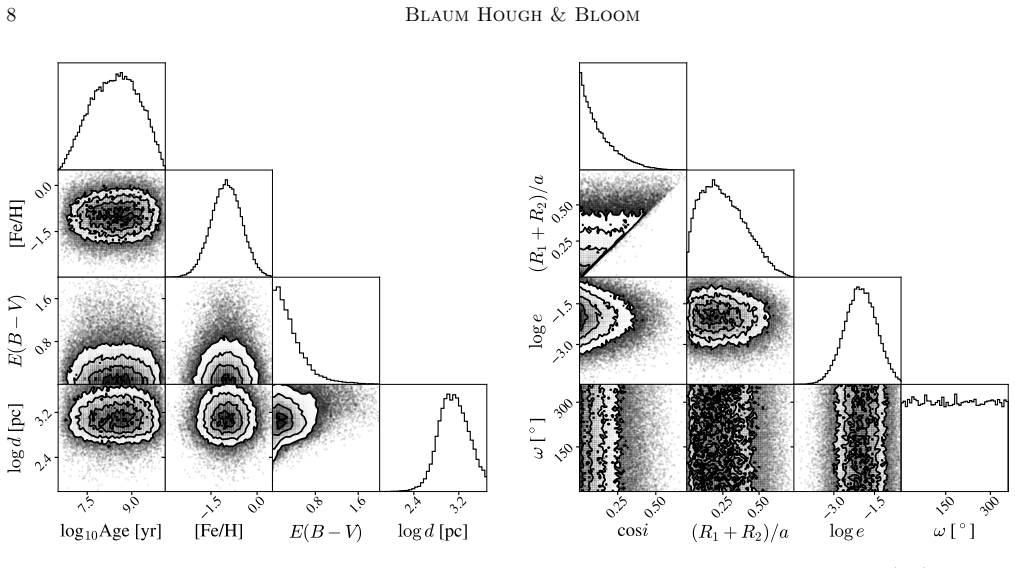
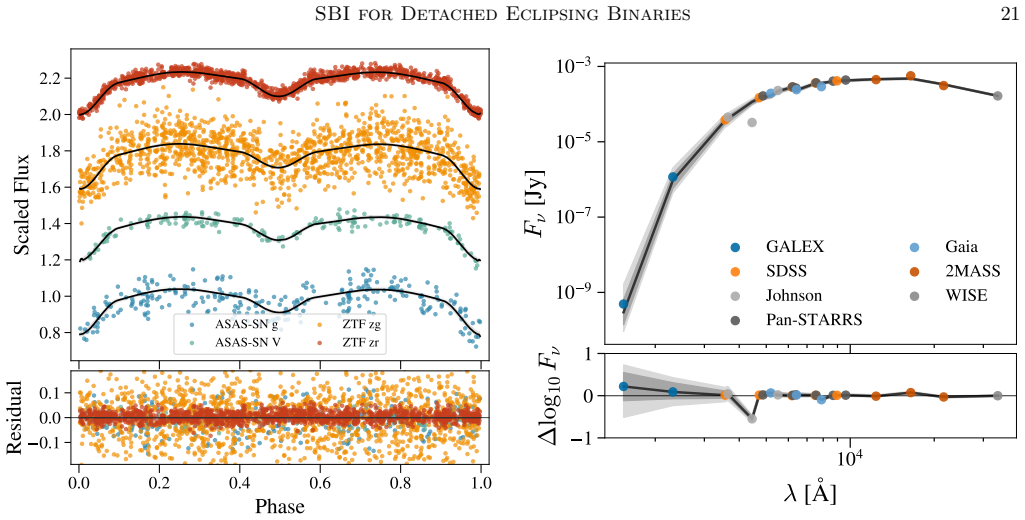
The authors introduce multimodal amortized neural posterior estimation that combines survey-realistic light curves, broadband SEDs and Gaia parallaxes inside a physically motivated hierarchical prior. A conditional normalizing flow, fed by modality-specific encoders, directly approximates the 16-dimensional posterior. The generative model enforces MIST isochrone consistency and geometric eclipse constraints while injecting empirically derived cadence patterns and flux-dependent noise. Across thousands of held-out simulations the method recovers parameters accurately and produces statistically calibrated uncertainties, with geometry- and flux-linked quantities tightly constrained and age-met
What carries the argument
Conditional normalizing flow that approximates the joint posterior from encoded multimodal observations under a hierarchical prior enforcing MIST isochrone consistency and geometric eclipse constraints.
If this is right
- Parameters tied to eclipse geometry and overall flux scale are recovered with high precision while age and metallicity posteriors remain appropriately broad.
- The cost of generating the entire training set is comparable to a single traditional MCMC analysis of one system.
- Posterior evaluation for any new system is effectively instantaneous after training.
- The framework directly supports population-level statistical studies of large photometrically selected DEB catalogs without requiring radial-velocity follow-up for every target.
Where Pith is reading between the lines
- The same amortized approach could be retrained for other classes of variable stars or transiting planets once suitable generative models exist.
- Catalogs produced by this method would enable direct comparison of observed binary populations against binary evolution simulations across wide ranges of age and metallicity.
- When sparse radial-velocity measurements become available for a subset of systems they could be added as an additional conditioning modality to shrink the remaining degeneracies.
Load-bearing premise
The simulated light curves, SEDs and noise properties used for training are statistically close enough to real observations that the network generalizes without large domain shift.
What would settle it
Apply the trained network to a sample of real detached eclipsing binaries that already have independent MCMC or RV-based parameter estimates; systematic offsets in the recovered means or failure of the reported uncertainties to cover the true values at the expected rate would falsify the claim.
Figures








read the original abstract
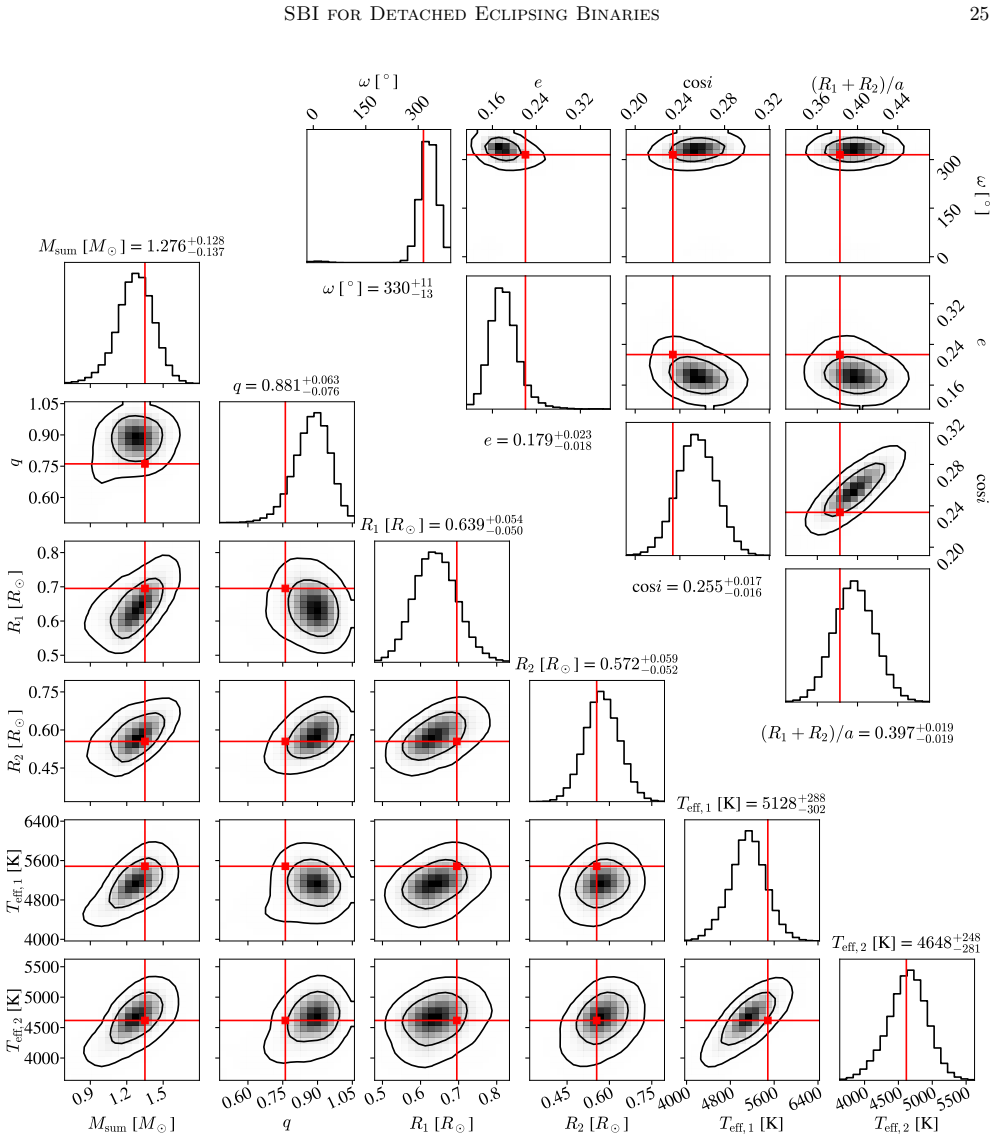
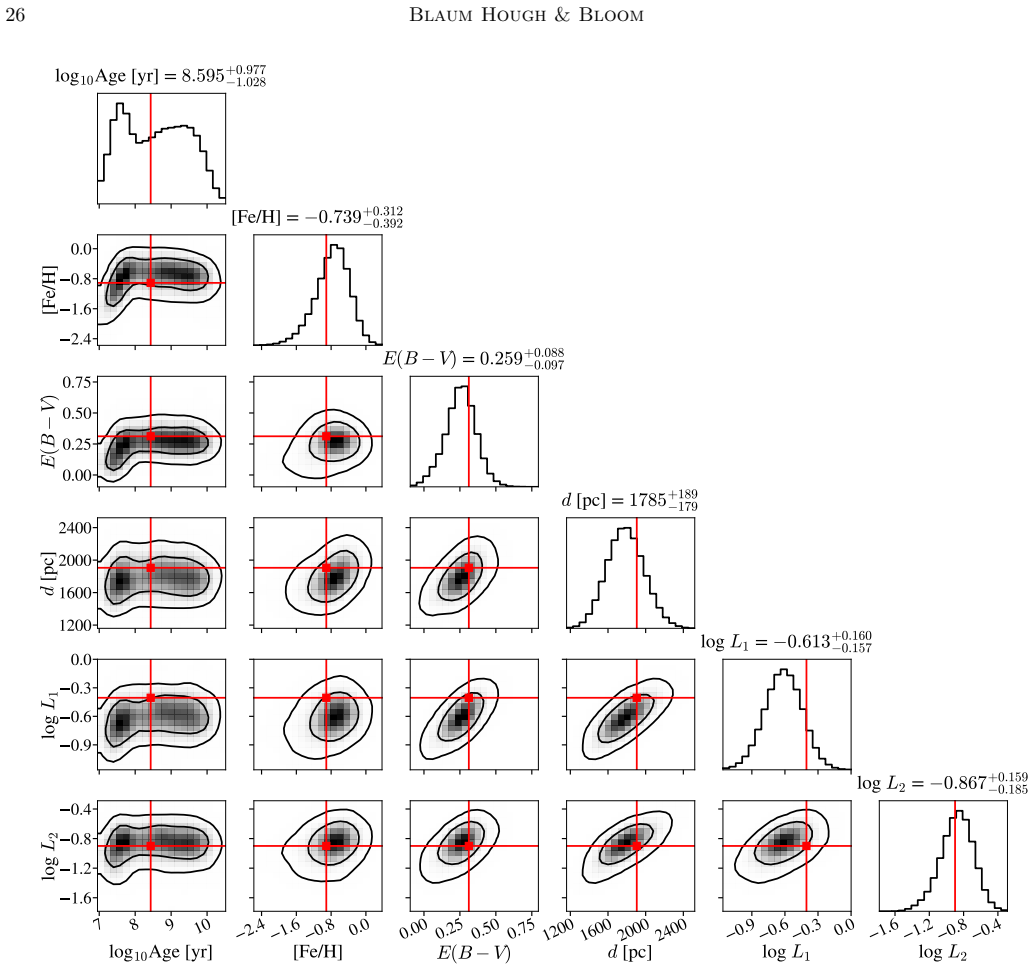
Detached eclipsing binaries (DEBs) enable direct inference of stellar and orbital properties across diverse stellar populations. However, inference typically requires computationally intensive forward modeling and radial velocity (RV) measurements, limiting homogeneous analyses to relatively small samples. The growing number of photometrically identified DEBs from modern time-domain surveys motivates scalable methods for extracting physical parameters without RVs. We present multimodal amortized neural posterior estimation for DEB inference that combines survey-realistic light curves, broadband SEDs, and Gaia parallaxes within a physically motivated hierarchical prior framework. The generative model enforces broad stellar evolution consistency through MIST isochrones and geometric eclipse prior constraints while incorporating empirically derived survey cadence patterns and flux-dependent noise models to produce realistic training data. A conditional normalizing flow, informed by modality-specific encoders, approximates the full 16-dimensional posterior distribution. Across nearly 5000 held-out simulations, the amortized posterior recovers parameters accurately and yields statistically calibrated uncertainties, verified through simulation-based calibration and empirical coverage tests. Parameters tied directly to eclipse geometry and flux scale are tightly constrained, while quantities intrinsically degenerate in broadband photometry (e.g., age and metallicity) exhibit broader posteriors consistent with expectations. Generating the training set requires computational effort similar to a traditional MCMC analysis of only a single system, and posterior inference for new systems is effectively instantaneous. This framework enables scalable, statistically calibrated inference for large DEB samples, providing a pathway toward population-level analysis in the era of large time-domain surveys.
Editorial analysis
A structured set of objections, weighed in public.
Referee Report
Summary. The paper presents a multimodal amortized neural posterior estimation framework using conditional normalizing flows to infer 16-dimensional posteriors for detached eclipsing binary (DEB) parameters from survey light curves, broadband SEDs, and Gaia parallaxes. It employs a generative model with MIST isochrone-based hierarchical priors, geometric eclipse constraints, and empirically derived cadence/noise models to produce realistic training simulations, demonstrating accurate parameter recovery and statistically calibrated uncertainties on nearly 5000 held-out simulations via simulation-based calibration (SBC) and empirical coverage tests.
Significance. If the results hold, this provides a scalable, computationally efficient alternative to traditional MCMC for analyzing large photometrically identified DEB samples without radial velocities, enabling population-level studies in the era of time-domain surveys. Credit is due for the use of SBC and coverage diagnostics to verify calibration within the simulated domain, and for the amortized approach that reduces per-system inference to near-instantaneous after upfront training cost comparable to a single MCMC run.
major comments (2)
- [Abstract and validation results] Abstract and validation results: the central claim that the framework enables scalable, calibrated inference for real survey DEBs rests on the untested assumption that the MIST-based generative model (with flux-dependent noise and cadence) produces training data sufficiently representative of observations; no quantitative comparison of simulated vs. observed distributions (e.g., eclipse depth/period histograms, SED shapes, or parallax-flux relations) or application to any real DEB system is provided, leaving potential domain shift from unmodeled effects (spots, third light, non-MIST evolution) unaddressed.
- [Generative model and prior section] Generative model and prior section: while the hierarchical prior enforces MIST isochrone consistency and geometric constraints, the manuscript does not report metrics (e.g., Kolmogorov-Smirnov tests or posterior predictive checks) quantifying how well the simulated population matches real DEB catalogs, which is load-bearing for transferring the reported calibration to actual data.
minor comments (2)
- [Methods] Notation for the 16-dimensional parameter vector and modality-specific encoders could be introduced earlier with a clear table to improve readability for readers unfamiliar with the exact parameterization.
- [Results] The abstract states 'nearly 5000 held-out simulations' but the precise number, selection criteria, and any stratification by parameter ranges should be stated explicitly in the results section for reproducibility.
Simulated Author's Rebuttal
We thank the referee for their positive evaluation of the work's significance and for the constructive comments, which correctly identify the need for stronger support when transferring simulation-based results to real observations. We respond point-by-point below and will incorporate revisions to add quantitative comparisons, statistical metrics, and an explicit limitations discussion while preserving the paper's focus on methodological validation within the simulated domain.
read point-by-point responses
-
Referee: [Abstract and validation results] Abstract and validation results: the central claim that the framework enables scalable, calibrated inference for real survey DEBs rests on the untested assumption that the MIST-based generative model (with flux-dependent noise and cadence) produces training data sufficiently representative of observations; no quantitative comparison of simulated vs. observed distributions (e.g., eclipse depth/period histograms, SED shapes, or parallax-flux relations) or application to any real DEB system is provided, leaving potential domain shift from unmodeled effects (spots, third light, non-MIST evolution) unaddressed.
Authors: We agree that the absence of direct comparisons to observed DEB distributions and real-system applications leaves the transferability of the reported calibration untested, which is a substantive limitation for claims about survey applicability. The manuscript's scope is the introduction and simulation-based validation of the amortized NPE framework, with SBC and coverage tests providing calibration diagnostics under the assumed generative model (standard for SBI). In revision we will: add a limitations subsection explicitly discussing unmodeled effects (spots, third light, non-MIST evolution) and their potential impact on domain shift; include qualitative and quantitative comparisons (histograms and KS tests) of simulated vs. observed distributions for periods, eclipse depths, SED shapes, and parallax-flux relations using public catalogs (e.g., Kepler EB catalog); and revise the abstract and conclusions to state that calibration holds within the simulated domain, with real-data applications requiring additional systematics handling and planned as follow-up. Full re-analysis of real systems is beyond the current methodological focus but can be noted as future work. revision: partial
-
Referee: [Generative model and prior section] Generative model and prior section: while the hierarchical prior enforces MIST isochrone consistency and geometric constraints, the manuscript does not report metrics (e.g., Kolmogorov-Smirnov tests or posterior predictive checks) quantifying how well the simulated population matches real DEB catalogs, which is load-bearing for transferring the reported calibration to actual data.
Authors: We concur that explicit quantitative metrics are needed to assess generative-model fidelity and support transfer of calibration results. The hierarchical prior and empirically derived noise/cadence components were chosen for broad consistency with stellar evolution and survey data, but without reported statistics the match remains qualitative. In the revised manuscript we will add a new subsection reporting KS tests (with p-values) and posterior predictive checks on key observables including orbital period, eclipse depth, effective temperature, surface gravity, and color-magnitude distributions, benchmarked against reference DEB catalogs. These additions will directly quantify the simulated population's fidelity and clarify the conditions under which the reported calibration can be expected to hold for actual survey data. revision: yes
Circularity Check
No significant circularity; results are empirical validation on held-out simulations
full rationale
The paper trains a conditional normalizing flow on data generated from an explicit forward model (MIST isochrones, geometric eclipse constraints, empirical noise) and reports recovery accuracy plus calibration metrics exclusively on a separate held-out simulation set. No step equates a claimed prediction to a fitted quantity by construction, no load-bearing self-citation chain is invoked to justify the central result, and the generative model is stated as an input rather than derived from the inference outputs. The evaluation therefore remains independent of the target data and does not reduce to a tautology.
Axiom & Free-Parameter Ledger
axioms (1)
- domain assumption MIST isochrones provide a sufficiently accurate representation of stellar evolution for generating plausible DEB systems
Reference graph
Works this paper leans on
-
[1]
1991, A&A Rv, 3, 91, doi: 10.1007/BF00873538
Andersen, J. 1991, A&A Rv, 3, 91, doi: 10.1007/BF00873538
-
[2]
Bellm, E. C., Kulkarni, S. R., Graham, M. J., et al. 2019, PASP, 131, 018002, doi: 10.1088/1538-3873/aaecbe Blaum Hough, J. 2026, ebsbi v1.0.0: Neural simulation-based inference for eclipsing binaries, v1.0.0, Zenodo, doi: 10.5281/zenodo.19560120 Blaum Hough, J., Zhang, K., Bloom, J., van der Walt, S., & Cassese, B. 2026, Modified NBI (v0.4.1): Multi-moda...
-
[3]
Chen, X., Wang, S., Deng, L., et al. 2020, ApJS, 249, 18, doi: 10.3847/1538-4365/ab9cae
-
[4]
E., Kochoska, A., Hey, D., et al
Conroy, K. E., Kochoska, A., Hey, D., et al. 2020, ApJS, 250, 34, doi: 10.3847/1538-4365/abb4e2
-
[5]
2020, Proceedings of the National Academy of Science, 117, 30055, doi: 10.1073/pnas.1912789117
Cranmer, K., Brehmer, J., & Louppe, G. 2020, Proceedings of the National Academy of Science, 117, 30055, doi: 10.1073/pnas.1912789117
-
[6]
Deistler, M., Boelts, J., Steinbach, P., et al. 2025, arXiv e-prints, arXiv:2508.12939, doi: 10.48550/arXiv.2508.12939
-
[7]
Eggleton, P. P. 1983, ApJ, 268, 368, doi: 10.1086/160960
-
[8]
Fitzpatrick, E. L. 1999, PASP, 111, 63, doi: 10.1086/316293 Gaia Collaboration, Prusti, T., de Bruijne, J. H. J., et al. 2016, A&A, 595, A1, doi: 10.1051/0004-6361/201629272 Gaia Collaboration, Vallenari, A., Brown, A. G. A., et al. 2023, A&A, 674, A1, doi: 10.1051/0004-6361/202243940
-
[9]
Graham, M. J., Kulkarni, S. R., Bellm, E. C., et al. 2019, PASP, 131, 078001, doi: 10.1088/1538-3873/ab006c
-
[10]
, year = 2019, month = dec, volume =
Finkbeiner, D. 2019, ApJ, 887, 93, doi: 10.3847/1538-4357/ab5362
-
[11]
Hermans, J., Delaunoy, A., Rozet, F., et al. 2021, arXiv e-prints, arXiv:2110.06581, doi: 10.48550/arXiv.2110.06581 Ivezi´ c,ˇZ., Kahn, S. M., Tyson, J. A., et al. 2019, ApJ, 873, 111, doi: 10.3847/1538-4357/ab042c SBI for Detached Eclipsing Binaries33
-
[12]
2016, AJ, 151, 68, doi: 10.3847/0004-6256/151/3/68 18
Kirk, B., Conroy, K., Prˇ sa, A., et al. 2016, AJ, 151, 68, doi: 10.3847/0004-6256/151/3/68
-
[13]
Kochanek, C. S., Shappee, B. J., Stanek, K. Z., et al. 2017, PASP, 129, 104502, doi: 10.1088/1538-3873/aa80d9
-
[14]
Lueckmann, J.-M., Boelts, J., Greenberg, D. S., Gon¸ calves, P. J., & Macke, J. H. 2021, arXiv e-prints, arXiv:2101.04653, doi: 10.48550/arXiv.2101.04653
-
[15]
Maxted, P. F. L. 2016, A&A, 591, A111, doi: 10.1051/0004-6361/201628579
-
[16]
Miller, A. A., Abrams, N. S., Aldering, G., et al. 2025, PASP, 137, 094204, doi: 10.1088/1538-3873/ae02c5 Paczy´ nski, B., Szczygie l, D. M., Pilecki, B., & Pojma´ nski, G. 2006, MNRAS, 368, 1311, doi: 10.1111/j.1365-2966.2006.10223.x
-
[17]
Neural Density Estimation and Likelihood-free Inference , school =
Papamakarios, G. 2019, arXiv e-prints, arXiv:1910.13233, doi: 10.48550/arXiv.1910.13233 Pietrzy´ nski, G., Graczyk, D., Gieren, W., et al. 2013, Nature, 495, 76, doi: 10.1038/nature11878 Prˇ sa, A., & Zwitter, T. 2005, ApJ, 628, 426, doi: 10.1086/430591 Prˇ sa, A., Batalha, N., Slawson, R. W., et al. 2011, AJ, 141, 83, doi: 10.1088/0004-6256/141/3/83 Prˇ ...
-
[18]
Rowan, D. M., Jayasinghe, T., Stanek, K. Z., et al. 2022, MNRAS, 517, 2190, doi: 10.1093/mnras/stac2520
-
[19]
Shappee, B. J., Prieto, J. L., Grupe, D., et al. 2014, ApJ, 788, 48, doi: 10.1088/0004-637X/788/1/48 Soszy´ nski, I., Pawlak, M., Pietrukowicz, P., et al. 2016, AcA, 66, 405, doi: 10.48550/arXiv.1701.03105
-
[20]
M., Torres G., Zejda M., eds, Astronomical Society of the Pacific Conference Series Vol
Southworth, J. 2015, in Astronomical Society of the Pacific Conference Series, Vol. 496, Living Together: Planets, Host Stars and Binaries, ed. S. M. Rucinski, G. Torres, & M. Zejda, 164, doi: 10.48550/arXiv.1411.1219
-
[21]
2010, A&A Rv, 18, 67, doi: 10.1007/s00159-009-0025-1
Torres, G., Andersen, J., & Gim´ enez, A. 2010, A&A Rv, 18, 67, doi: 10.1007/s00159-009-0025-1
-
[22]
2019, MNRAS, 489, 1644, doi: 10.1093/mnras/stz2137
Windemuth, D., Agol, E., Ali, A., & Kiefer, F. 2019, MNRAS, 489, 1644, doi: 10.1093/mnras/stz2137
-
[23]
2023, in Machine Learning for Astrophysics, 38, doi: 10.48550/arXiv.2312.03824
Zhang, K., Bloom, J., & Hernitschek, N. 2023, in Machine Learning for Astrophysics, 38, doi: 10.48550/arXiv.2312.03824
-
[24]
Zhang, K., Bloom, J. S., Gaudi, B. S., et al. 2021, AJ, 161, 262, doi: 10.3847/1538-3881/abf42e
discussion (0)
Sign in with ORCID, Apple, or X to comment. Anyone can read and Pith papers without signing in.