Recognition: unknown
On-chain Peak Shaving
Pith reviewed 2026-05-10 00:42 UTC · model grok-4.3
The pith
Firms reduce gas fees on Ethereum by scheduling transactions in low-congestion periods, with savings varying by how deferrable and gas-intensive their transactions are.
A machine-rendered reading of the paper's core claim, the machinery that carries it, and where it could break.
Core claim
On-chain peak shaving is the deliberate scheduling of Ethereum transactions into low-congestion windows to limit gas fee exposure. Analysis of 62,142 transactions from seven firms across seven industries shows heterogeneous responses: three firms disproportionately use off-peak hours while four concentrate activity in peaks due to governance or deadline constraints. The authors formalize the moderators into an On-Chain Scheduling Matrix that places each firm into one of four regimes—full peak shaving, selective peak shaving, cost provisioning, or accept-market-rate—according to its transaction deferrability and gas intensity. Regime membership predicts both realized fee savings and residual
What carries the argument
The On-Chain Scheduling Matrix that maps firms to four regimes using transaction deferrability and gas intensity as moderators to predict fee savings and residual cost floors.
If this is right
- Firms assigned to full peak shaving move all deferrable transactions off-peak and realize the largest fee reductions.
- Selective peak shaving firms achieve partial savings by timing only their most flexible transactions.
- Cost provisioning firms budget for unavoidable peak fees due to fixed external deadlines.
- Accept-market-rate firms incur full prevailing fees without systematic timing adjustments.
- Regime assignment forecasts both achieved savings and the minimum cost floor each firm faces.
Where Pith is reading between the lines
- The same regime logic could apply to fee structures on other blockchains that experience congestion.
- Managers may treat on-chain timing as a routine operational task comparable to energy procurement or currency hedging.
- Longer panels or larger firm samples could test whether the four-regime boundaries remain stable across industries.
- The dual view of fees as timing versus adaptation costs may illuminate variable costs in other digital platforms.
Load-bearing premise
That observed differences in scheduling behavior are driven primarily by transaction deferrability and gas intensity rather than unmeasured factors such as firm size, industry deadlines, or governance constraints, and that the seven-firm sample generalizes.
What would settle it
Collecting timing and fee data from additional firms outside the original seven industries or time window and testing whether their savings and cost floors match the regime predictions of 40-92 percent residual expenditure.
Figures


read the original abstract
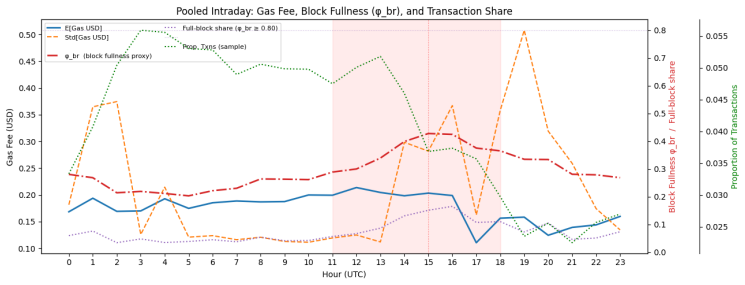
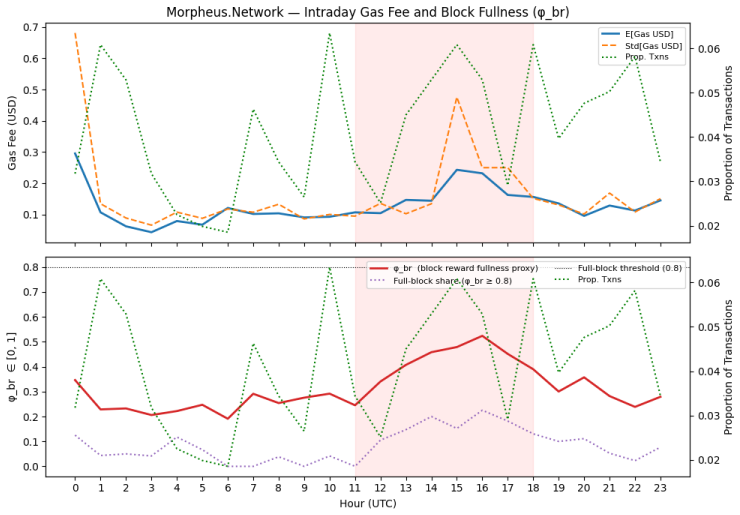
Blockchain technology is widely expected to reduce transaction costs by automating contract enforcement and eliminating intermediaries; yet, the execution costs imposed by network congestion have received little attention in the operations management literature. We study on-chain peak shaving, the systematic scheduling of Ethereum transactions toward low-congestion windows to reduce gas fee exposure. We use transaction-level data from seven firms across seven industries (N = 62,142 transactions, January-March 2026). Gas fees vary significantly throughout the day: the peak-hour premium at 10 AM Eastern Time reaches USD 0.220 per transaction above the overnight baseline, driven primarily by speculative-arbitrage demand rather than operational activity. Firm-level scheduling responses are heterogeneous and not uniformly disciplined. Only three of seven firms transact disproportionately during off-peak hours; four transact counter-cyclically, concentrated in peak windows due to external deadlines or governance cycles. This heterogeneity is explained by two moderators: transaction deferrability and gas intensity. We formalize these into an On-Chain Scheduling Matrix that maps firms to four regimes: 1) full peak shaving, 2) selective peak shaving, 3) cost provisioning, and 4) accept-market-rate, with regime membership predicting both fee savings and residual cost floors (40-92 percent of actual expenditure). Theoretically, we extend Transaction Cost Economics to account for time-varying execution costs imposed by congestion externalities. In addition to extending Williamson's original cost taxonomy, we introduce a dual classification of gas fees as execution costs in timing but maladaptation costs in origin. The findings reposition on-chain gas-fee management alongside energy procurement and foreign exchange hedging as a domain requiring systematic operational planning.
Editorial analysis
A structured set of objections, weighed in public.
Referee Report
Summary. The paper examines on-chain peak shaving on Ethereum, using transaction-level data from seven firms across seven industries (N=62,142 transactions, January-March 2026). It documents substantial daily variation in gas fees, with a peak-hour premium of USD 0.220 at 10 AM ET driven by speculative demand, and heterogeneous firm scheduling: three firms disproportionately transact off-peak while four are counter-cyclical. This heterogeneity is attributed to two moderators—transaction deferrability and gas intensity—which are formalized into an On-Chain Scheduling Matrix classifying firms into four regimes (full peak shaving, selective peak shaving, cost provisioning, accept-market-rate). Regime membership is claimed to predict realized fee savings and residual cost floors ranging from 40-92% of actual expenditure. The paper extends Transaction Cost Economics by incorporating time-varying execution costs from congestion externalities and reclassifying gas fees as execution costs in timing but maladaptation costs in origin.
Significance. If the descriptive patterns and matrix classification hold after addressing identification issues, the work contributes to operations management and blockchain economics by treating gas-fee timing as a systematic operational decision comparable to energy procurement or FX hedging. The large transaction sample provides clear evidence of fee variation and firm-level heterogeneity, and the theoretical extension of Williamson's taxonomy is a coherent conceptual step. However, the small firm sample and absence of controls limit generalizability and causal claims.
major comments (3)
- [Abstract and Results] The central attribution of scheduling heterogeneity to transaction deferrability and gas intensity (Abstract; Results section) lacks any reported regression controls, matching, or robustness checks for confounding factors such as firm size, industry deadlines, or internal governance. With only seven firms, this leaves open that the observed 3/7 vs. 4/7 split and the subsequent regime mapping are driven by unmeasured variables rather than the claimed moderators.
- [On-Chain Scheduling Matrix] The On-Chain Scheduling Matrix is constructed directly from the same behavioral patterns observed in the seven-firm sample and then asserted to predict fee savings and 40-92% cost floors (Abstract). No formal statistical model, out-of-sample test, or validation is described, rendering the predictive relationship an in-sample accounting summary rather than an independently tested claim.
- [Data and Methods] No details are provided on how the four regimes were assigned to firms, what thresholds or criteria were used for deferrability and gas intensity, or any econometric specification linking regimes to savings (Data and Methods; Results). This is load-bearing because the matrix is presented as the key formalization that extends theory and delivers operational predictions.
minor comments (2)
- [Abstract] Clarify the data period (January-March 2026) and confirm whether the sample is historical or projected; if the latter, discuss implications for external validity.
- [Theoretical Extension] The dual classification of gas fees (execution costs in timing, maladaptation costs in origin) is introduced in the theoretical section but would benefit from an explicit table or diagram mapping it to Williamson's original taxonomy.
Simulated Author's Rebuttal
We thank the referee for the constructive and detailed comments. We address each major point below, acknowledging limitations where appropriate while clarifying the descriptive and conceptual nature of the study.
read point-by-point responses
-
Referee: The central attribution of scheduling heterogeneity to transaction deferrability and gas intensity (Abstract; Results section) lacks any reported regression controls, matching, or robustness checks for confounding factors such as firm size, industry deadlines, or internal governance. With only seven firms, this leaves open that the observed 3/7 vs. 4/7 split and the subsequent regime mapping are driven by unmeasured variables rather than the claimed moderators.
Authors: We agree that the firm-level sample size of seven precludes meaningful regression controls, matching, or robustness checks for confounders such as firm size or governance structures. The analysis is descriptive and exploratory, documenting observed scheduling patterns across 62,142 transactions. Attribution to deferrability and gas intensity draws on both quantitative timing deviations and qualitative operational context for each firm. We will add a dedicated limitations subsection discussing potential unmeasured factors and the non-causal nature of the observed 3/7 versus 4/7 split. revision: partial
-
Referee: The On-Chain Scheduling Matrix is constructed directly from the same behavioral patterns observed in the seven-firm sample and then asserted to predict fee savings and 40-92% cost floors (Abstract). No formal statistical model, out-of-sample test, or validation is described, rendering the predictive relationship an in-sample accounting summary rather than an independently tested claim.
Authors: The matrix is a conceptual typology that organizes the two moderators into four regimes to extend Transaction Cost Economics; the 40-92% figures are in-sample descriptive summaries of observed expenditures under each regime. We do not claim statistical prediction or out-of-sample validation. The revision will reword the abstract and results to present the matrix explicitly as a theoretical classification framework that generates operational insights rather than a validated predictive model. revision: yes
-
Referee: No details are provided on how the four regimes were assigned to firms, what thresholds or criteria were used for deferrability and gas intensity, or any econometric specification linking regimes to savings (Data and Methods; Results). This is load-bearing because the matrix is presented as the key formalization that extends theory and delivers operational predictions.
Authors: We will expand the Data and Methods section to detail the classification process. Deferrability is determined by whether a transaction type can be postponed without disrupting core operations (e.g., settlement deadlines versus periodic reporting). Gas intensity is measured as mean gas units per transaction. Regime assignment maps each firm's observed off-peak share and operational profile onto the two dimensions. No econometric specification is used; the linkage remains theoretical. An appendix will provide firm-by-firm justification for the assignments. revision: yes
Circularity Check
No significant circularity; claims rest on direct observation and post-hoc classification
full rationale
The paper reports an empirical study using N=62,142 transactions from seven firms. It observes heterogeneous scheduling, attributes it to two moderators (deferrability and gas intensity), and presents the On-Chain Scheduling Matrix as a formalization that groups firms into four regimes. The 40-92% savings and cost-floor figures are stated as direct accounting from the same observed data rather than outputs of a model whose parameters were fitted to a subset and then used to 'predict' closely related quantities. No equations, uniqueness theorems, or ansatzes are shown that reduce by construction to the inputs; no self-citations are invoked as load-bearing justification for the central mapping. The derivation chain is therefore self-contained observational description, not a closed loop.
Axiom & Free-Parameter Ledger
free parameters (1)
- peak-hour premium =
0.220
axioms (1)
- domain assumption Network congestion creates time-varying execution costs that firms can partially control through scheduling.
invented entities (1)
-
On-Chain Scheduling Matrix
no independent evidence
Reference graph
Works this paper leans on
-
[1]
, title =
Coase, Ronald H. , title =. Economica , volume =
-
[2]
, title =
Williamson, Oliver E. , title =
-
[3]
and Yates, JoAnne and Benjamin, Robert I
Malone, Thomas W. and Yates, JoAnne and Benjamin, Robert I. , title =. Communications of the
-
[4]
Communications of the
Gurbaxani, Vijay and Whang, Seungjin , title =. Communications of the
-
[5]
Strategic Management Journal , volume =
Poppo, Laura and Zenger, Todd , title =. Strategic Management Journal , volume =
-
[6]
Manufacturing & Service Operations Management , volume =
Babich, Volodymyr and Hilary, Gilles , title =. Manufacturing & Service Operations Management , volume =
-
[7]
Logistics , volume =
Francisco, Kelly and Swanson, David , title =. Logistics , volume =
-
[8]
Proceedings of the 2017 International Conference on Service Systems and Service Management , publisher =
Tian, Feng , title =. Proceedings of the 2017 International Conference on Service Systems and Service Management , publisher =
2017
-
[9]
JMIR Research Protocols , volume =
Sylim, Patrick and Liu, Fang and Marcelo, Alvin and Fontelo, Paul , title =. JMIR Research Protocols , volume =
-
[10]
Proceedings of the Hamburg International Conference of Logistics (
Hackius, Niels and Petersen, Moritz , title =. Proceedings of the Hamburg International Conference of Logistics (
-
[11]
International Journal of Production Economics , volume =
Kouhizadeh, Madjid and Saberi, Sara and Sarkis, Joseph , title =. International Journal of Production Economics , volume =
-
[12]
Financial Innovation , volume =
Guo, Ye and Liang, Chen , title =. Financial Innovation , volume =
-
[13]
and Panayi, Efstathios , title =
Peters, Gareth W. and Panayi, Efstathios , title =. Banking Beyond Banks and Money , editor =
-
[14]
Organization Science , volume =
Lumineau, Fabrice and Wang, Wenqian and Schilke, Oliver , title =. Organization Science , volume =
-
[15]
MIS Quarterly , volume =
Halaburda, Hanna and Levina, Natalia and Min, Soonchul , title =. MIS Quarterly , volume =
-
[16]
When Blockchain Creates Shareholder Value: Empirical Evidence from International Firm Announcements , journal =
Kl. When Blockchain Creates Shareholder Value: Empirical Evidence from International Firm Announcements , journal =
-
[17]
Manufacturing & Service Operations Management , volume =
Cui, Yao and Hu, Ming and Liu, Jun , title =. Manufacturing & Service Operations Management , volume =
-
[18]
International Journal of Production Economics , volume =
Wang, Yingli and Singgih, Moses and Wang, Jin and Rit, Marie , title =. International Journal of Production Economics , volume =
-
[19]
Energy Policy , volume =
Strbac, Goran , title =. Energy Policy , volume =
-
[20]
and Caramanis, Michael C
Schweppe, Fred C. and Caramanis, Michael C. and Tabors, Richard D. and Bohn, Roger E. , title =
-
[21]
Proceedings of the 22nd
Roughgarden, Tim , title =. Proceedings of the 22nd
-
[22]
Proceedings of the 2020
Daian, Philip and Goldfeder, Steven and Kell, Tyler and Li, Yunqi and Zhao, Xueyuan and Bentov, Iddo and Breidenbach, Lorenz and Juels, Ari , title =. Proceedings of the 2020
2020
-
[23]
and Saleh, Fahad , title =
John, Kose and Rivera, Thomas J. and Saleh, Fahad , title =
-
[24]
Journal of Operations Management , volume =
Shang, Guangzhi and Ilk, Nurcin and Fan, Shaokun , title =. Journal of Operations Management , volume =
-
[25]
Proceedings of the 6th International Conference on Principles of Security and Trust (POST) , series =
Atzei, Nicola and Bartoletti, Massimo and Cimoli, Tiziana , title =. Proceedings of the 6th International Conference on Principles of Security and Trust (POST) , series =. 2017 , doi =
2017
-
[26]
Manufacturing & Service Operations Management , volume =
Babich, Volodymyr and Hilary, Gilles , title =. Manufacturing & Service Operations Management , volume =. 2020 , doi =
2020
-
[27]
Chainlink White Paper , volume =
Breidenbach, Lorenz and Cachin, Christian and Chan, Benedict and Coventry, Alex and Ellis, Steve and Juels, Ari and Karpinski, Konrad and Zhang, Fan , title =. Chainlink White Paper , volume =. 2021 , url =
2021
-
[28]
2014 , url =
Buterin, Vitalik , title =. 2014 , url =
2014
-
[29]
and Patsakis, Constantinos , title =
Casino, Fran and Dasaklis, Thomas K. and Patsakis, Constantinos , title =. Telematics and Informatics , volume =. 2019 , doi =
2019
-
[30]
Technological Forecasting and Social Change , volume =
Chang, She-I and Chen, Yi-Cheng and Lu, Ming-Fang , title =. Technological Forecasting and Social Change , volume =. 2020 , doi =
2020
-
[31]
, title =
Coase, Ronald H. , title =. Economica , volume =. 1937 , doi =
1937
-
[32]
Proceedings of the 2020 IEEE Symposium on Security and Privacy (SP) , pages =
Daian, Philip and Goldfeder, Steven and Kell, Tyler and Li, Yunqi and Zhao, Xueyuan and Bentov, Iddo and Breidenbach, Lorenz and Juels, Ari , title =. Proceedings of the 2020 IEEE Symposium on Security and Privacy (SP) , pages =. 2020 , doi =
2020
-
[33]
, title =
Eisenhardt, Kathleen M. , title =. Academy of Management Review , volume =. 1989 , doi =
1989
-
[34]
Logistics , volume =
Francisco, Kelly and Swanson, David , title =. Logistics , volume =. 2018 , doi =
2018
-
[35]
Financial Innovation , volume =
Guo, Ye and Liang, Chen , title =. Financial Innovation , volume =. 2016 , doi =
2016
-
[36]
Communications of the ACM , volume =
Gurbaxani, Vijay and Whang, Seungjin , title =. Communications of the ACM , volume =. 1991 , doi =
1991
-
[37]
Proceedings of the Hamburg International Conference of Logistics (HICL) , pages =
Hackius, Niels and Petersen, Moritz , title =. Proceedings of the Hamburg International Conference of Logistics (HICL) , pages =. 2017 , doi =
2017
-
[38]
International Journal of Production Economics , volume =
Kouhizadeh, Madjid and Saberi, Sara and Sarkis, Joseph , title =. International Journal of Production Economics , volume =. 2021 , doi =
2021
-
[39]
International Journal of Information Management , volume =
Kshetri, Nir , title =. International Journal of Information Management , volume =. 2018 , doi =
2018
-
[40]
and Yates, JoAnne and Benjamin, Robert I
Malone, Thomas W. and Yates, JoAnne and Benjamin, Robert I. , title =. Communications of the ACM , volume =. 1987 , doi =
1987
-
[41]
Proceedings of the IEEE 18th International Conference on e-Health Networking, Applications and Services (Healthcom) , pages =
Mettler, Matthias , title =. Proceedings of the IEEE 18th International Conference on e-Health Networking, Applications and Services (Healthcom) , pages =. 2016 , doi =
2016
-
[42]
and Huberman, A
Miles, Matthew B. and Huberman, A. Michael and Salda. Qualitative Data Analysis: A Methods Sourcebook , edition =. 2019 , isbn =
2019
-
[43]
2008 , url =
Nakamoto, Satoshi , title =. 2008 , url =
2008
-
[44]
, title =
North, Douglass C. , title =. 1990 , doi =
1990
-
[45]
Proceedings of the Hamburg International Conference of Logistics (HICL) , publisher =
Omran, Yousef and Henke, Michael and Heines, Roland and Hofmann, Erik , title =. Proceedings of the Hamburg International Conference of Logistics (HICL) , publisher =
-
[46]
and Panayi, Efstathios , title =
Peters, Gareth W. and Panayi, Efstathios , title =. Banking Beyond Banks and Money , editor =. 2016 , doi =
2016
-
[47]
and Telles, Renato and Bonilla, Silvia H
Queiroz, Maciel M. and Telles, Renato and Bonilla, Silvia H. , title =. Supply Chain Management: An International Journal , volume =. 2019 , doi =
2019
-
[48]
, title =
Rindfleisch, Aric and Heide, Jan B. , title =. Journal of Marketing , volume =. 1997 , doi =
1997
-
[49]
Business & Information Systems Engineering , volume =
Sedlmeir, Johannes and Buhl, Hans Ulrich and Fridgen, Gilbert and Keller, Robert , title =. Business & Information Systems Engineering , volume =. 2020 , doi =
2020
-
[50]
JMIR Research Protocols , volume =
Sylim, Patrick and Liu, Fang and Marcelo, Alvin and Fontelo, Paul , title =. JMIR Research Protocols , volume =. 2018 , doi =
2018
-
[51]
, title =
Tang, Christopher S. , title =. Production and Operations Management , volume =. 2022 , doi =
2022
-
[52]
Proceedings of the 2017 International Conference on Service Systems and Service Management , pages =
Tian, Feng , title =. Proceedings of the 2017 International Conference on Service Systems and Service Management , pages =. 2017 , doi =
2017
-
[53]
, title =
Williamson, Oliver E. , title =. Journal of Law and Economics , volume =. 1979 , doi =
1979
-
[54]
, title =
Williamson, Oliver E. , title =. 1985 , isbn =
1985
-
[55]
, title =
Williamson, Oliver E. , title =. American Economic Review , volume =. 2010 , doi =
2010
-
[56]
2014 , url =
Wood, Gavin , title =. 2014 , url =
2014
-
[57]
Proceedings of the IEEE International Conference on Software Architecture (ICSA) , pages =
Xu, Xiwei and Weber, Ingo and Staples, Mark and Zhu, Liming and Bosch, Jan and Bass, Len and Pautasso, Cesare and Rimba, Paul , title =. Proceedings of the IEEE International Conference on Software Architecture (ICSA) , pages =. 2017 , doi =
2017
-
[58]
, title =
Yin, Robert K. , title =. 2018 , isbn =
2018
-
[59]
and Buckley, Ross P
Zetzsche, Dirk A. and Buckley, Ross P. and Arner, Douglas W. and Fern. The. Harvard International Law Journal , volume =. 2018 , url =
2018
-
[60]
, title =
Williamson, Oliver E. , title =. Journal of Law and Economics , volume =
-
[61]
, title =
Williamson, Oliver E. , title =. American Economic Review , volume =
-
[62]
, title =
Rindfleisch, Aric and Heide, Jan B. , title =. Journal of Marketing , volume =
-
[63]
, title =
North, Douglass C. , title =
-
[64]
Ostrom, Elinor , title =
-
[65]
Nakamoto, Satoshi , title =
-
[66]
Wood, Gavin , title =
-
[67]
Proceedings of the
Xu, Xiwei and Weber, Ingo and Staples, Mark and Zhu, Liming and Bosch, Jan and Bass, Len and Pautasso, Cesare and Rimba, Paul , title =. Proceedings of the
-
[68]
Breidenbach, Lorenz and Cachin, Christian and Chan, Benedict and Coventry, Alex and Ellis, Steve and Juels, Ari and Karpinski, Konrad and Zhang, Fan , title =
-
[69]
Proceedings of the 6th International Conference on Principles of Security and Trust (
Atzei, Nicola and Bartoletti, Massimo and Cimoli, Tiziana , title =. Proceedings of the 6th International Conference on Principles of Security and Trust (
-
[70]
and Patsakis, Constantinos , title =
Casino, Fran and Dasaklis, Thomas K. and Patsakis, Constantinos , title =. Telematics and Informatics , volume =
-
[71]
International Journal of Information Management , volume =
Kshetri, Nir , title =. International Journal of Information Management , volume =
-
[72]
and Telles, Renato and Bonilla, Silvia H
Queiroz, Maciel M. and Telles, Renato and Bonilla, Silvia H. , title =. Supply Chain Management: An International Journal , volume =
-
[73]
Technological Forecasting and Social Change , volume =
Chang, She-I and Chen, Yi-Cheng and Lu, Ming-Fang , title =. Technological Forecasting and Social Change , volume =
-
[74]
Proceedings of the 2017 International Conference on Service Systems and Service Management , pages =
Tian, Feng , title =. Proceedings of the 2017 International Conference on Service Systems and Service Management , pages =
2017
-
[75]
Proceedings of the
Mettler, Matthias , title =. Proceedings of the
-
[76]
Sylim, Patrick and Liu, Fang and Marcelo, Alvin and Fontelo, Paul , title =
-
[77]
Proceedings of the Hamburg International Conference of Logistics (
Omran, Yousef and Henke, Michael and Heines, Roland and Hofmann, Erik , title =. Proceedings of the Hamburg International Conference of Logistics (
-
[78]
, title =
Eisenhardt, Kathleen M. , title =. Academy of Management Review , volume =
-
[79]
, title =
Yin, Robert K. , title =
-
[80]
and Huberman, A
Miles, Matthew B. and Huberman, A. Michael and Salda. Qualitative Data Analysis: A Methods Sourcebook , edition =
discussion (0)
Sign in with ORCID, Apple, or X to comment. Anyone can read and Pith papers without signing in.