Recognition: unknown
Purely Quadratic Non-Gaussianity from Tachyonic Instability: Primordial Black Holes and Scalar-Induced Gravitational Waves
Pith reviewed 2026-05-10 00:48 UTC · model grok-4.3
The pith
Narrow curvature spectra exponentially suppress primordial black hole formation while keeping gravitational waves strong.
A machine-rendered reading of the paper's core claim, the machinery that carries it, and where it could break.
Core claim
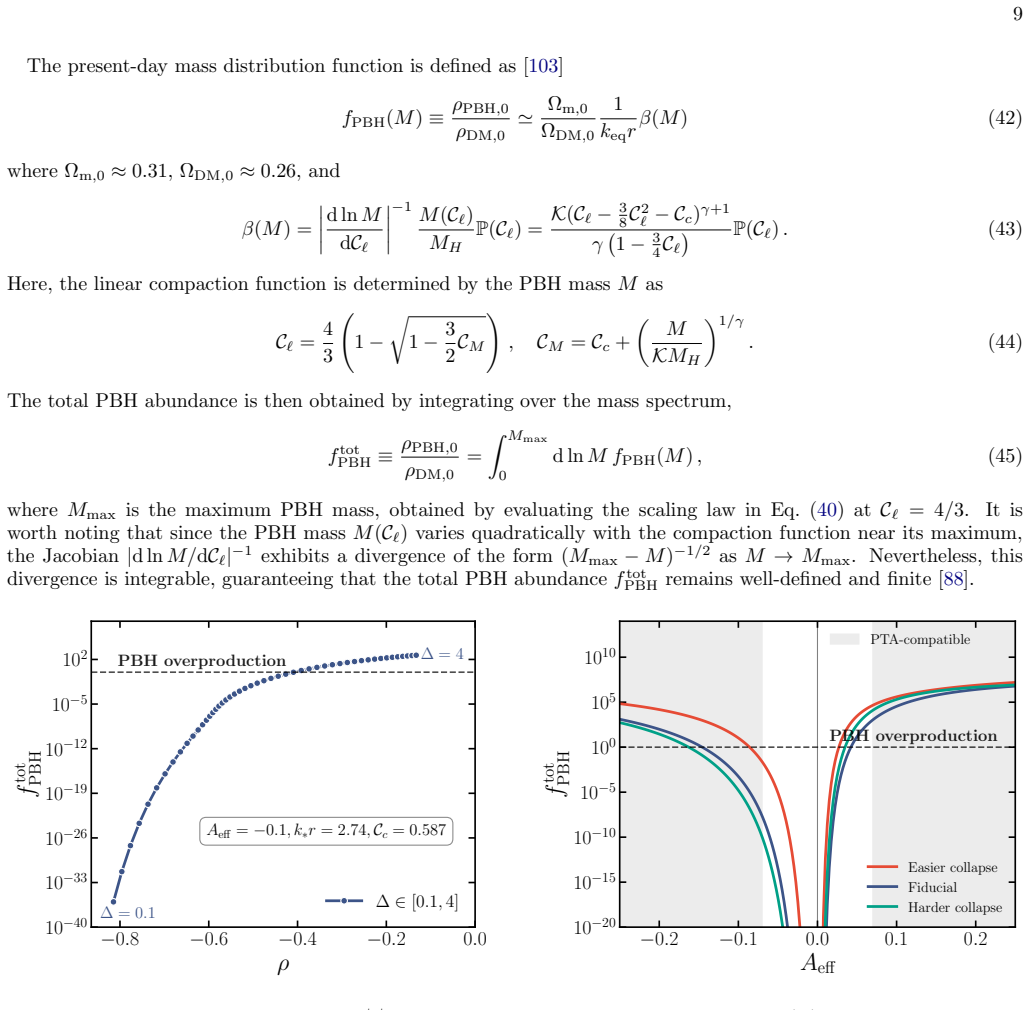
In the tachyonic amplification scenario with curvature perturbations given by ζ = A(φ² − ⟨φ²⟩), the PBH abundance is exponentially sensitive to the amplitude of perturbations and the correlation coefficient ρ between the smoothed field and its radial gradient. Broad spectra yield mildly negative ρ and fail to suppress PBH formation, while sufficiently narrow spectra drive ρ toward −1, resulting in exponential suppression of the PBH abundance while maintaining a sizable gravitational-wave signal.
What carries the argument
The correlation coefficient ρ between the smoothed curvature field and its radial gradient, which sets the asymptotic exponential tail of the probability distribution for the linear compaction function.
If this is right
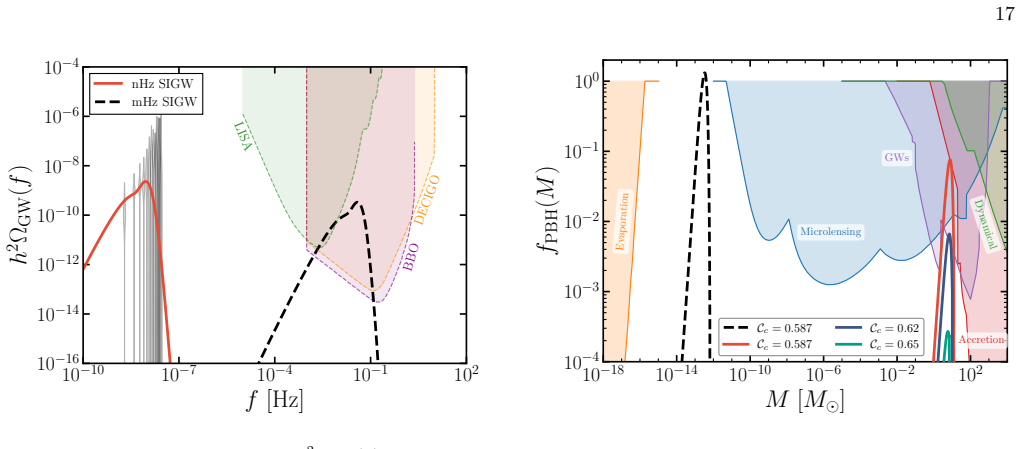
- For sufficiently narrow spectra, PBH abundance can be exponentially suppressed while a sizable scalar-induced gravitational wave signal remains potentially detectable by future space-based interferometers.
- Asteroid-mass PBHs could serve as dark matter in such narrow-spectrum cases without overproduction.
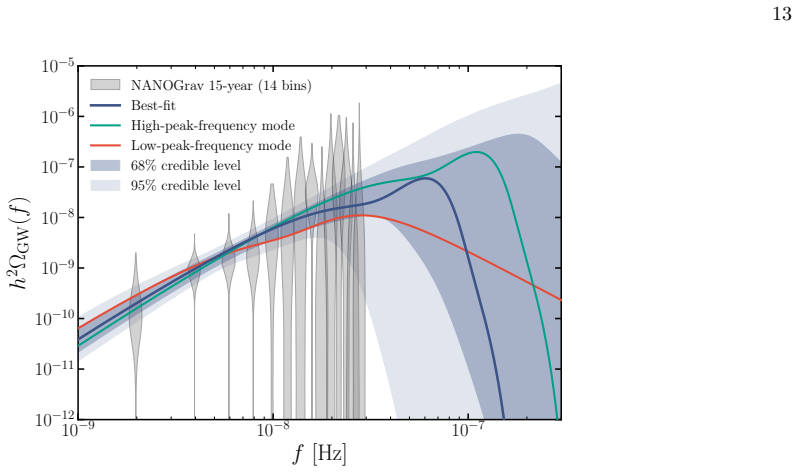
- Broad spectra, as in typical thermal inflation, make it difficult to reconcile PTA observations with PBH constraints simultaneously.
- The PBH formation probability depends exponentially on both the perturbation amplitude and the value of ρ fixed by spectral shape.
Where Pith is reading between the lines
- Future gravitational wave observations at high frequencies could indirectly constrain the allowed width of the curvature power spectrum in tachyonic models.
- The same exponential suppression might appear in other multi-field inflationary scenarios that generate quadratic non-Gaussianity, offering a route to satisfy both PBH and GW bounds without tuning amplitudes.
- Direct probes of the curvature spectrum shape, if available, would provide a sharp test of whether observed GW signals align with the narrow-spectrum regime required for suppression.
Load-bearing premise
Curvature perturbations follow exactly the purely quadratic non-Gaussian form ζ = A(φ² − ⟨φ²⟩) from tachyonic instability, and the extended Press-Schechter framework based on the compaction function correctly calculates PBH abundance under this non-Gaussian statistics.
What would settle it
A measurement of the width of the primordial curvature power spectrum together with an observed PBH abundance that deviates from the predicted exponential dependence on ρ would test the mechanism.
Figures



read the original abstract
We investigate primordial black hole (PBH) formation in a cosmological scenario where curvature perturbations follow purely quadratic non-Gaussianity, $\zeta = A(\phi^2-\langle\phi^2\rangle)$, arising from tachyonic instability in multi-component inflationary models. Within an extended Press-Schechter framework based on the compaction function, we derive the probability distribution of the linear compaction function and its asymptotic exponential tail, demonstrating that the PBH abundance is exponentially sensitive not only to the amplitude of perturbations but also to the correlation coefficient $\rho$ between the smoothed field and its radial gradient. We further find that, in this tachyonic amplification scenario, the spectral width of the curvature power spectrum plays a decisive role in avoiding PBH overproduction: broad spectra yield mildly negative $\rho$ and fail to suppress PBH formation, while sufficiently narrow spectra drive $\rho \to -1$, resulting in exponential suppression while maintaining a sizable gravitational-wave signal. Thermal inflation provides a useful benchmark scenario with asteroid-mass PBH dark matter and high-frequency scalar-induced gravitational waves potentially detectable by future space-based interferometers, but its typically broad spectra make it challenging to reconcile PTA observations with PBH constraints.
Editorial analysis
A structured set of objections, weighed in public.
Referee Report
Summary. The manuscript claims that curvature perturbations with purely quadratic non-Gaussianity ζ = A(φ² − ⟨φ²⟩) arising from tachyonic instability in multi-component inflation lead to PBH formation whose abundance is exponentially sensitive to the correlation coefficient ρ between the smoothed curvature perturbation and its radial gradient. Using an extended Press-Schechter formalism based on the compaction function, it derives the probability distribution and asymptotic tail of the linear compaction function, showing that narrow spectra drive ρ → −1 and exponentially suppress PBH overproduction while preserving a sizable scalar-induced gravitational wave signal; thermal inflation is presented as a benchmark that struggles with broad spectra.
Significance. If the central derivations hold, the work identifies spectral width as a tunable parameter that controls non-Gaussian suppression of PBH formation, offering a concrete route to reconcile asteroid-mass PBH dark matter with PTA gravitational-wave data and future interferometer signals in tachyonic multi-field models. The explicit link between quadratic non-Gaussianity, ρ, and the exponential tail constitutes a useful addition to the literature on non-Gaussian PBH constraints.
major comments (2)
- [Sections deriving the probability distribution and asymptotic tail (referenced in abstract)] The derivation of the ρ-dependent asymptotic exponential tail for the linear compaction function (central to the suppression claim) is presented without an explicit large-deviation calculation or the resulting functional form of the tail probability when the underlying field is quadratic in a multivariate Gaussian; this step is load-bearing for the statement that narrow spectra yield exponential suppression.
- [Extended Press-Schechter framework section] The application of the extended Press-Schechter formalism with the compaction function to this quadratic non-Gaussian case is used to compute PBH abundance without any cross-check against numerical simulations or alternative methods; given that EPS is already an approximation whose accuracy is known to degrade for non-Gaussian tails, the quantitative reliability of the reported suppression factors remains unverified.
minor comments (3)
- [Notation and definitions] Clarify the precise definition and numerical evaluation of the correlation coefficient ρ for different spectral shapes, including any assumptions on the window function used for smoothing.
- [Thermal inflation benchmark] The discussion of thermal inflation as a benchmark would benefit from explicit values of the spectral width parameter and the resulting ρ to make the tension with PTA/PBH constraints quantitative.
- [Introduction and references] Add references to prior literature on quadratic non-Gaussianity in PBH formation and on the validity of compaction-based EPS for non-Gaussian fields.
Simulated Author's Rebuttal
We thank the referee for their careful reading of the manuscript, the positive assessment of its significance, and the constructive major comments. We address each point below and have revised the manuscript to incorporate clarifications and additional details where feasible.
read point-by-point responses
-
Referee: [Sections deriving the probability distribution and asymptotic tail (referenced in abstract)] The derivation of the ρ-dependent asymptotic exponential tail for the linear compaction function (central to the suppression claim) is presented without an explicit large-deviation calculation or the resulting functional form of the tail probability when the underlying field is quadratic in a multivariate Gaussian; this step is load-bearing for the statement that narrow spectra yield exponential suppression.
Authors: We thank the referee for this observation. The probability distribution and asymptotic tail in the manuscript are obtained by starting from the joint Gaussian distribution of the smoothed curvature perturbation and its radial gradient (which are correlated with coefficient ρ), noting that the linear compaction function is a quadratic form in these variables due to the purely quadratic non-Gaussianity. The tail is then extracted by evaluating the relevant integral over the super-threshold region. To make the derivation fully explicit, we have added a new appendix that performs the large-deviation calculation for this quadratic form in the multivariate Gaussian case and states the resulting functional form of the tail probability. revision: yes
-
Referee: [Extended Press-Schechter framework section] The application of the extended Press-Schechter formalism with the compaction function to this quadratic non-Gaussian case is used to compute PBH abundance without any cross-check against numerical simulations or alternative methods; given that EPS is already an approximation whose accuracy is known to degrade for non-Gaussian tails, the quantitative reliability of the reported suppression factors remains unverified.
Authors: We agree that the extended Press-Schechter (EPS) formalism with the compaction function is an approximation whose accuracy can degrade for strongly non-Gaussian tails, and that direct numerical simulations would provide valuable verification. In the revised manuscript we have added an expanded discussion of the known limitations of EPS for non-Gaussian PBH calculations, together with references to existing literature that compares EPS results against simulations for comparable non-Gaussian models. We also stress that the reported exponential suppression is a qualitative trend driven by the ρ dependence rather than a precise numerical prediction. Performing dedicated N-body or lattice simulations for this specific tachyonic quadratic non-Gaussianity lies beyond the scope of the present theoretical study. revision: partial
Circularity Check
No circularity: derivation of compaction tail from quadratic mapping is self-contained
full rationale
The paper derives the probability distribution and asymptotic exponential tail of the linear compaction function directly from the quadratic non-Gaussian mapping ζ = A(φ² − ⟨φ²⟩) by considering the joint statistics of the smoothed curvature perturbation and its radial gradient. The correlation coefficient ρ emerges as a calculable property of the power spectrum shape rather than a fitted parameter renamed as a prediction. The extended Press-Schechter application is presented as an approximation whose accuracy is not claimed to be proven within the paper itself, but no step reduces the central result to its inputs by construction, self-citation, or ansatz smuggling. The link between spectral width and ρ is obtained from explicit integrals over the spectrum and does not constitute a tautology.
Axiom & Free-Parameter Ledger
free parameters (3)
- amplitude A
- correlation coefficient ρ
- spectral width parameter
axioms (2)
- domain assumption Curvature perturbations obey the purely quadratic form ζ = A(φ² - ⟨φ²⟩) generated by tachyonic instability in multi-component inflation.
- domain assumption The extended Press-Schechter formalism based on the compaction function accurately captures PBH formation probability under this non-Gaussianity.
Reference graph
Works this paper leans on
-
[1]
The NANOGrav 15-year Data Set: Evidence for a Gravitational-Wave Background
G. Agazieet al.(NANOGrav), The NANOGrav 15 yr Data Set: Evidence for a Gravitational-wave Background, Astrophys. J. Lett.951, L8 (2023), arXiv:2306.16213 [astro-ph.HE]
work page internal anchor Pith review arXiv 2023
-
[2]
Agazieet al.(NANOGrav), Astrophys
G. Agazieet al.(NANOGrav), The NANOGrav 15 yr Data Set: Observations and Timing of 68 Millisecond Pulsars, Astrophys. J. Lett.951, L9 (2023), arXiv:2306.16217 [astro-ph.HE]
-
[3]
Antoniadiset al.(EPTA, InPTA:), Astron
J. Antoniadiset al.(EPTA, InPTA:), The second data release from the European Pulsar Timing Array - III. Search for gravitational wave signals, Astron. Astrophys.678, A50 (2023), arXiv:2306.16214 [astro-ph.HE]
-
[4]
Antoniadiset al.(EPTA), Astron
J. Antoniadiset al.(EPTA), The second data release from the European Pulsar Timing Array - I. The dataset and timing analysis, Astron. Astrophys.678, A48 (2023), arXiv:2306.16224 [astro-ph.HE]
-
[5]
J. Antoniadiset al.(EPTA, InPTA), The second data release from the European Pulsar Timing Array - IV. Implications for massive black holes, dark matter, and the early Universe, Astron. Astrophys.685, A94 (2024), arXiv:2306.16227 [astro-ph.CO]
-
[6]
D. J. Reardonet al., Search for an Isotropic Gravitational-wave Background with the Parkes Pulsar Timing Array, Astrophys. J. Lett.951, L6 (2023), arXiv:2306.16215 [astro-ph.HE]
work page internal anchor Pith review arXiv 2023
-
[7]
A. Zicet al., The Parkes Pulsar Timing Array third data release, Publ. Astron. Soc. Austral.40, e049 (2023), arXiv:2306.16230 [astro-ph.HE]
- [8]
-
[9]
H. Xuet al., Searching for the Nano-Hertz Stochastic Gravitational Wave Background with the Chinese Pulsar Timing Array Data Release I, Res. Astron. Astrophys.23, 075024 (2023), arXiv:2306.16216 [astro-ph.HE]
work page internal anchor Pith review arXiv 2023
-
[10]
G. Franciolini, A. Iovino, Junior., V. Vaskonen, and H. Veermae, Recent Gravitational Wave Observation by Pulsar Timing Arrays and Primordial Black Holes: The Importance of Non-Gaussianities, Phys. Rev. Lett.131, 201401 (2023), arXiv:2306.17149 [astro-ph.CO]
- [11]
-
[12]
G. Franciolini, D. Racco, and F. Rompineve, Footprints of the QCD Crossover on Cosmological Gravitational Waves at Pulsar Timing Arrays, Phys. Rev. Lett.132, 081001 (2024), [Erratum: Phys.Rev.Lett. 133, 189901 (2024)], arXiv:2306.17136 [astro-ph.CO]
-
[13]
K. Inomata, K. Kohri, and T. Terada, Detected stochastic gravitational waves and subsolar-mass primordial black holes, Phys. Rev. D109, 063506 (2024), arXiv:2306.17834 [astro-ph.CO]
- [14]
-
[15]
S. Wang, Z.-C. Zhao, J.-P. Li, and Q.-H. Zhu, Implications of pulsar timing array data for scalar-induced gravitational waves and primordial black holes: Primordial non-Gaussianity fNL considered, Phys. Rev. Res.6, L012060 (2024), arXiv:2307.00572 [astro-ph.CO]
-
[16]
Gravitational Waves from Stochastic Scalar Fluctuations,
R. Ebadi, S. Kumar, A. McCune, H. Tai, and L.-T. Wang, Gravitational waves from stochastic scalar fluctuations, Phys. Rev. D109, 083519 (2024), arXiv:2307.01248 [astro-ph.CO]
-
[17]
Y. Gouttenoire, S. Trifinopoulos, G. Valogiannis, and M. Vanvlasselaer, Scrutinizing the primordial black hole inter- pretation of PTA gravitational waves and JWST early galaxies, Phys. Rev. D109, 123002 (2024), arXiv:2307.01457 [astro-ph.CO]
-
[18]
Implications for the non-Gaussianity of curvature perturbation from pulsar timing arrays,
L. Liu, Z.-C. Chen, and Q.-G. Huang, Implications for the non-Gaussianity of curvature perturbation from pulsar timing arrays, Phys. Rev. D109, L061301 (2024), arXiv:2307.01102 [astro-ph.CO]
- [19]
- [20]
- [21]
-
[22]
H. Firouzjahi and A. Talebian, Induced gravitational waves from ultra slow-roll inflation and pulsar timing arrays obser- vations, JCAP10, 032, arXiv:2307.03164 [gr-qc]
-
[23]
A. Salvio, Supercooling in Radiative Symmetry Breaking: Theory Extensions, Gravitational Wave Detection and Primor- dial Black Holes, JCAP12, 046, arXiv:2307.04694 [hep-ph]
- [24]
- [25]
- [26]
- [27]
- [28]
-
[29]
S. Balaji, G. Dom` enech, and G. Franciolini, Scalar-induced gravitational wave interpretation of PTA data: the role of scalar fluctuation propagation speed, JCAP10, 041, arXiv:2307.08552 [gr-qc]
- [30]
-
[31]
M. Bousder, A. Riadsolh, A. E. Fatimy, M. E. Belkacemi, and H. Ez-Zahraouy, Implications of the NANOGrav results for primordial black holes and Hubble tension, (2023), arXiv:2307.10940 [gr-qc]
- [32]
- [33]
-
[34]
I. Ben-Dayan, U. Kumar, U. Thattarampilly, and A. Verma, Probing the early Universe cosmology with NANOGrav: Possibilities and limitations, Phys. Rev. D108, 103507 (2023), arXiv:2307.15123 [astro-ph.CO]
- [35]
-
[36]
Probing the equation of state of the early Universe with pulsar timing arrays,
L. Liu, Z.-C. Chen, and Q.-G. Huang, Probing the equation of state of the early Universe with pulsar timing arrays, JCAP11, 071, arXiv:2307.14911 [astro-ph.CO]
- [37]
-
[38]
Inflationary interpretation of the nHz gravitational-wave background,
L. Frosina and A. Urbano, Inflationary interpretation of the nHz gravitational-wave background, Phys. Rev. D108, 103544 (2023), arXiv:2308.06915 [astro-ph.CO]
-
[39]
N. Bhaumik, R. K. Jain, and M. Lewicki, Ultralow mass primordial black holes in the early Universe can explain the pulsar timing array signal, Phys. Rev. D108, 123532 (2023), arXiv:2308.07912 [astro-ph.CO]
-
[40]
C. Yuan, D.-S. Meng, and Q.-G. Huang, Full analysis of the scalar-induced gravitational waves for the curvature pertur- bation with local-type non-Gaussianities, JCAP12, 036, arXiv:2308.07155 [astro-ph.CO]
- [41]
- [42]
- [43]
-
[44]
Z.-C. Chen and L. Liu, Can we distinguish between adiabatic and isocurvature fluctuations with pulsar timing arrays?, Sci. China Phys. Mech. Astron.68, 250412 (2025), arXiv:2402.16781 [astro-ph.CO]
-
[45]
Tomita, Evolution of Irregularities in a Chaotic Early Universe, Prog
K. Tomita, Evolution of Irregularities in a Chaotic Early Universe, Prog. Theor. Phys.54, 730 (1975)
1975
-
[46]
S. Matarrese, O. Pantano, and D. Saez, General relativistic dynamics of irrotational dust: Cosmological implications, Phys. Rev. Lett.72, 320 (1994), arXiv:astro-ph/9310036
-
[47]
V. Acquaviva, N. Bartolo, S. Matarrese, and A. Riotto, Second order cosmological perturbations from inflation, Nucl. Phys. B667, 119 (2003), arXiv:astro-ph/0209156
-
[48]
S. Mollerach, D. Harari, and S. Matarrese, CMB polarization from secondary vector and tensor modes, Phys. Rev. D69, 063002 (2004), arXiv:astro-ph/0310711
- [49]
-
[50]
D. Baumann, P. J. Steinhardt, K. Takahashi, and K. Ichiki, Gravitational Wave Spectrum Induced by Primordial Scalar Perturbations, Phys. Rev. D76, 084019 (2007), arXiv:hep-th/0703290
-
[51]
B. J. Carr, K. Kohri, Y. Sendouda, and J. Yokoyama, New cosmological constraints on primordial black holes, Phys. Rev. D81, 104019 (2010), arXiv:0912.5297 [astro-ph.CO]
work page Pith review arXiv 2010
-
[52]
Planck Constraint on Relic Primordial Black Holes
S. Clark, B. Dutta, Y. Gao, L. E. Strigari, and S. Watson, Planck Constraint on Relic Primordial Black Holes, Phys. Rev. D95, 083006 (2017), arXiv:1612.07738 [astro-ph.CO]
work page Pith review arXiv 2017
-
[53]
Voyager 1 $e^\pm$ Further Constrain Primordial Black Holes as Dark Matter
M. Boudaud and M. Cirelli, Voyager 1e ± Further Constrain Primordial Black Holes as Dark Matter, Phys. Rev. Lett. 122, 041104 (2019), arXiv:1807.03075 [astro-ph.HE]
work page Pith review arXiv 2019
-
[54]
R. A. Allsmanet al.(Macho), MACHO project limits on black hole dark matter in the 1-30 solar mass range, Astrophys. J. Lett.550, L169 (2001), arXiv:astro-ph/0011506
work page Pith review arXiv 2001
-
[55]
Limits on the Macho Content of the Galactic Halo from the EROS-2 Survey of the Magellanic Clouds
P. Tisserandet al.(EROS-2), Limits on the Macho Content of the Galactic Halo from the EROS-2 Survey of the Magellanic Clouds, Astron. Astrophys.469, 387 (2007), arXiv:astro-ph/0607207
work page Pith review arXiv 2007
-
[56]
Experimental Limits on Primordial Black Hole Dark Matter from the First Two Years of Kepler Data
K. Griest, A. M. Cieplak, and M. J. Lehner, Experimental Limits on Primordial Black Hole Dark Matter from the First 2 yr of Kepler Data, Astrophys. J.786, 158 (2014), arXiv:1307.5798 [astro-ph.CO]
work page Pith review arXiv 2014
-
[57]
Mr´ oz et al.,No massive black holes in the Milky Way halo,Nature632(2024) 749 [2403.02386]
P. Mr´ ozet al., No massive black holes in the Milky Way halo, Nature632, 749 (2024), arXiv:2403.02386 [astro-ph.GA]
-
[58]
P. Mr´ ozet al., Limits on Planetary-mass Primordial Black Holes from the OGLE High-cadence Survey of the Magellanic Clouds, Astrophys. J. Lett.976, L19 (2024), arXiv:2410.06251 [astro-ph.CO]
-
[59]
P. Mr´ ozet al., Microlensing Optical Depth, Event Rate, and Limits on Compact Objects in Dark Matter Based on 20 Yr of OGLE Observations of the Small Magellanic Cloud, Astrophys. J. Suppl.280, 49 (2025), arXiv:2507.13794 [astro-ph.GA]
- [60]
-
[61]
B. P. Abbottet al.(LIGO Scientific, Virgo), GWTC-1: A Gravitational-Wave Transient Catalog of Compact Binary Mergers Observed by LIGO and Virgo during the First and Second Observing Runs, Phys. Rev. X9, 031040 (2019), arXiv:1811.12907 [astro-ph.HE]
work page internal anchor Pith review arXiv 2019
-
[62]
R. Abbottet al.(LIGO Scientific, Virgo), GWTC-2: Compact Binary Coalescences Observed by LIGO and Virgo During the First Half of the Third Observing Run, Phys. Rev. X11, 021053 (2021), arXiv:2010.14527 [gr-qc]
work page internal anchor Pith review arXiv 2021
-
[63]
R. Abbottet al.(KAGRA, VIRGO, LIGO Scientific), GWTC-3: Compact Binary Coalescences Observed by LIGO and Virgo during the Second Part of the Third Observing Run, Phys. Rev. X13, 041039 (2023), arXiv:2111.03606 [gr-qc]
work page internal anchor Pith review arXiv 2023
-
[64]
A. G. Abacet al.(LIGO Scientific, VIRGO, KAGRA), GWTC-4.0: Updating the Gravitational-Wave Transient Catalog with Observations from the First Part of the Fourth LIGO-Virgo-KAGRA Observing Run, (2025), arXiv:2508.18082 [gr-qc]
work page internal anchor Pith review arXiv 2025
- [65]
-
[66]
T. D. Brandt, Constraints on MACHO Dark Matter from Compact Stellar Systems in Ultra-Faint Dwarf Galaxies, Astrophys. J. Lett.824, L31 (2016), arXiv:1605.03665 [astro-ph.GA]
work page Pith review arXiv 2016
-
[67]
Cosmic microwave background limits on accreting primordial black holes
Y. Ali-Ha¨ ımoud and M. Kamionkowski, Cosmic microwave background limits on accreting primordial black holes, Phys. Rev. D95, 043534 (2017), arXiv:1612.05644 [astro-ph.CO]
work page Pith review arXiv 2017
-
[68]
CMB bounds on disk-accreting massive Primordial Black Holes
V. Poulin, P. D. Serpico, F. Calore, S. Clesse, and K. Kohri, CMB bounds on disk-accreting massive primordial black holes, Phys. Rev. D96, 083524 (2017), arXiv:1707.04206 [astro-ph.CO]
work page Pith review arXiv 2017
- [69]
-
[70]
B. Carr and F. Kuhnel, Primordial Black Holes as Dark Matter: Recent Developments, Ann. Rev. Nucl. Part. Sci.70, 355 (2020), arXiv:2006.02838 [astro-ph.CO]
-
[71]
A. M. Green and B. J. Kavanagh, Primordial Black Holes as a dark matter candidate, J. Phys. G48, 043001 (2021), arXiv:2007.10722 [astro-ph.CO]
work page internal anchor Pith review arXiv 2021
-
[72]
B. Carr, K. Kohri, Y. Sendouda, and J. Yokoyama, Constraints on primordial black holes, Rept. Prog. Phys.84, 116902 (2021), arXiv:2002.12778 [astro-ph.CO]
work page internal anchor Pith review arXiv 2021
-
[73]
Laser Interferometer Space Antenna
P. Amaro-Seoaneet al.(LISA), Laser Interferometer Space Antenna, (2017), arXiv:1702.00786 [astro-ph.IM]
work page internal anchor Pith review Pith/arXiv arXiv 2017
- [74]
-
[75]
Z. Luo, Z. Guo, G. Jin, Y. Wu, and W. Hu, A brief analysis to Taiji: Science and technology, Results Phys.16, 102918 (2020)
2020
-
[76]
Luo et al.,Progress of the TianQin project,Class
J. Luoet al., Progress of the TianQin project, Class. Quant. Grav.42, 173001 (2025), arXiv:2502.11328 [gr-qc]
-
[77]
Fundamental Physics and Cosmology with TianQin,
J. Luoet al., Fundamental Physics and Cosmology with TianQin, (2025), arXiv:2502.20138 [gr-qc]
-
[78]
Kawamuraet al., The Japanese space gravitational wave antenna DECIGO, Class
S. Kawamuraet al., The Japanese space gravitational wave antenna DECIGO, Class. Quant. Grav.23, S125 (2006)
2006
-
[79]
Kawamuraet al., The Japanese space gravitational wave antenna: DECIGO, Class
S. Kawamuraet al., The Japanese space gravitational wave antenna: DECIGO, Class. Quant. Grav.28, 094011 (2011)
2011
-
[80]
J. Crowder and N. J. Cornish, Beyond LISA: Exploring future gravitational wave missions, Phys. Rev. D72, 083005 (2005), arXiv:gr-qc/0506015
discussion (0)
Sign in with ORCID, Apple, or X to comment. Anyone can read and Pith papers without signing in.