Recognition: unknown
Detections of nearly bias-free core shifts with 5-30 μas precisions at 8-43 GHz in BL Lacertae
Pith reviewed 2026-05-09 23:59 UTC · model grok-4.3
The pith
VLBI astrometry detects a 250 microarcsecond core shift in BL Lacertae between 8.4 and 43.2 GHz, with the shift index consistent with equipartition.
A machine-rendered reading of the paper's core claim, the machinery that carries it, and where it could break.
Core claim
The observations reveal that the apparent core position shifts by up to 250 μas from 8.4 to 43.2 GHz, scaling as frequency to the power of minus one over k_r, where k_r is measured as 1.18 with uncertainties allowing consistency with 1. This supports the presence of an optically thick region upstream in the jet and energy equipartition between particles and magnetic fields, even during a flaring state.
What carries the argument
The inverse phase-referencing technique with a nearby steep-spectrum calibrator, which enables nearly bias-free astrometric positions, combined with fitting the core shifts to a power-law model in frequency.
Load-bearing premise
The nearby calibrator introduces no residual position biases and the flaring jet structure follows the assumed power-law dependence for core shifts.
What would settle it
Repeated VLBI observations at the same frequencies during a quiescent state of BL Lacertae yielding a core-shift index outside the current uncertainty range would challenge the result.
Figures




read the original abstract
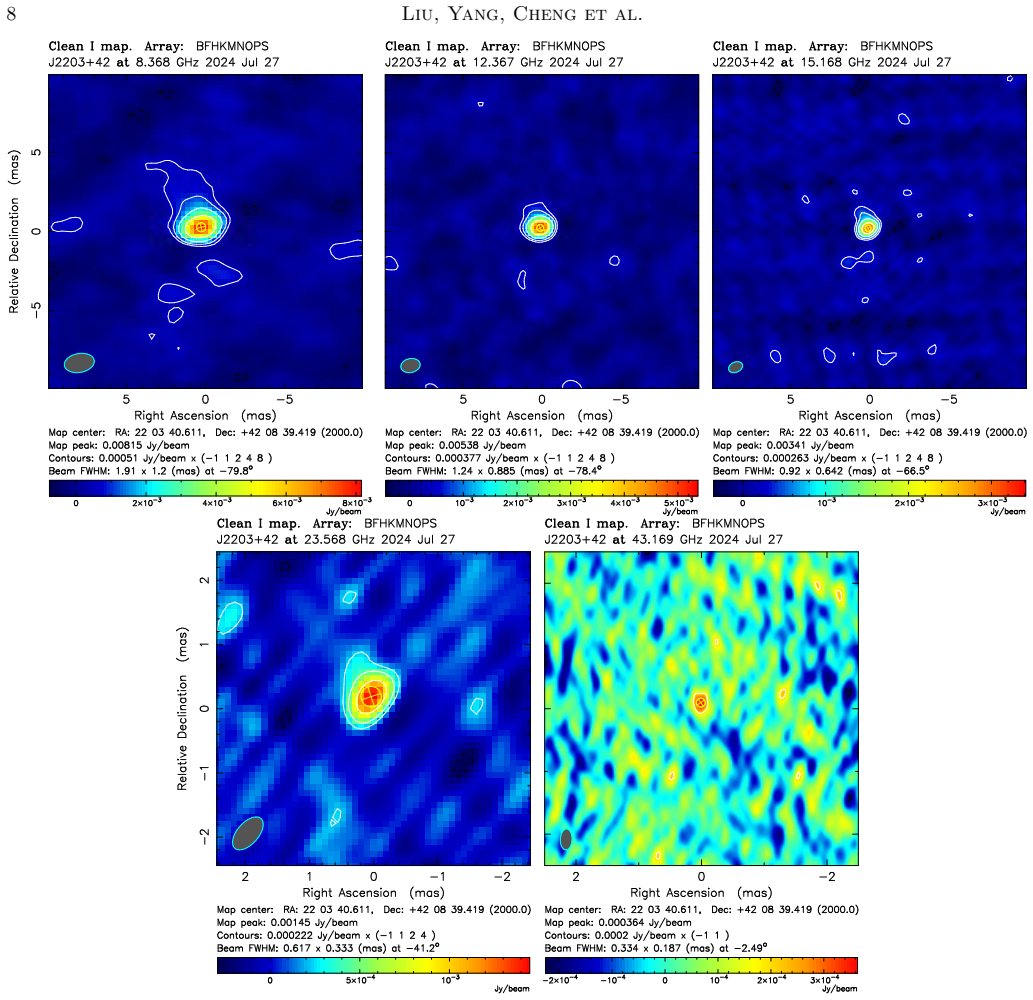
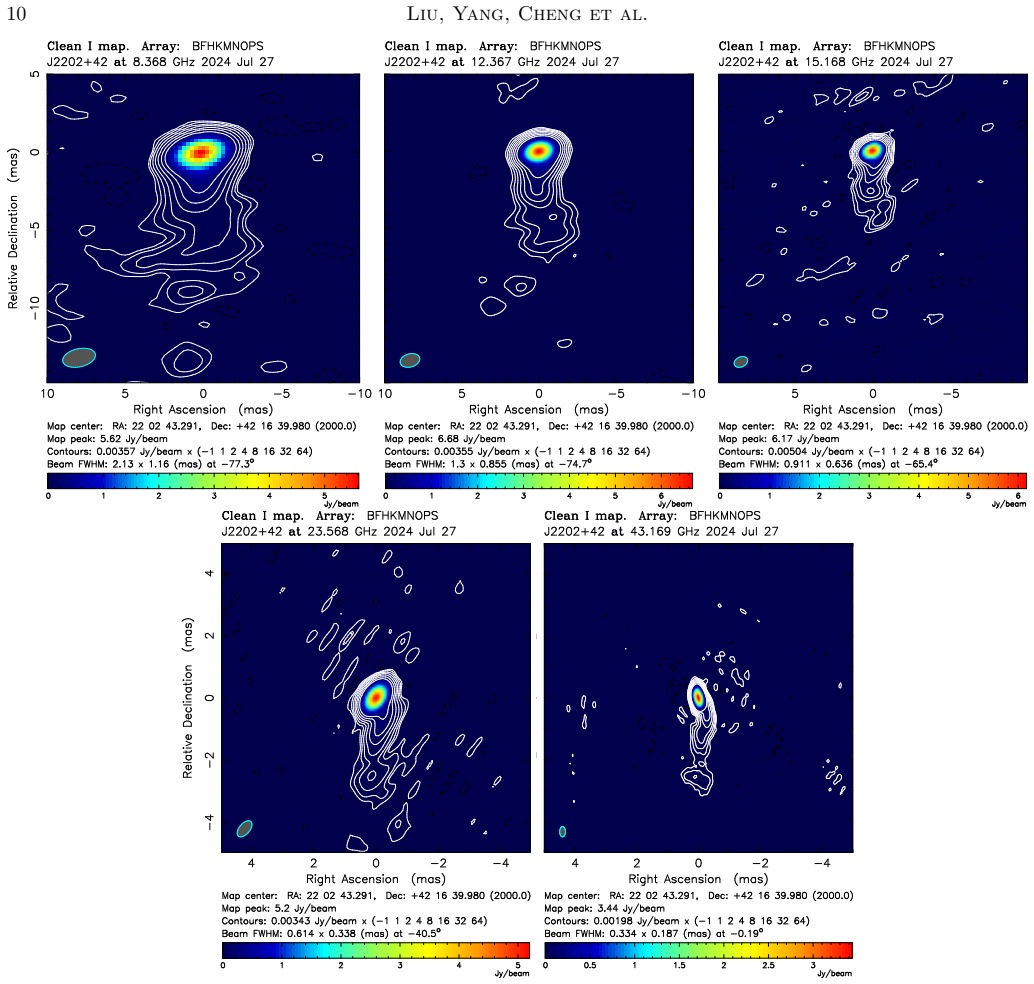
When a radio jet is partially optically thick in the launching region, its apparent compact core may display frequency-dependent positional shifts. High-precision astrometric measurements of core shifts enable astronomers to pinpoint the jet's origin and place tight constraints on the magnetic field. BL Lacertae, the archetypal BL Lac object, hosts a highly variable and well-collimated jet. To independently constrain its innermost core shifts, we conducted very long baseline interferometric (VLBI) observations at 8.4, 12.4, 15.2, 23.6, and 43.2 GHz. By exploiting a nearby (13.3 arcmin) steep-spectrum calibrator (NVSS J220340+420839) through inverse phase-referencing VLBI astrometry, we detect nearly unbiased two-dimensional core shift measurements with state-of-the-art precisions of 5-30 $\mu$as, which are significant at $>3\sigma$ confidence. The core shift between 8.4 and 43.2 GHz reaches 250 $\mu$as. The apparent core shifts scale with frequency as $\nu^{-1/k_r}$, implying the existence of an optically thick region in the upstream of jet. The derived core-shift index, $k_r\!=\!1.18^{+0.59}_{-0.34}$, is consistent, within uncertainties, with the canonical $k_r\!=\!1$ expected under energy equipartition between the jet particle and magnetic field energy densities, while allowing for modest deviations given that BL Lacertae was captured in a flaring state.
Editorial analysis
A structured set of objections, weighed in public.
Referee Report
Summary. The paper claims to have obtained high-precision, nearly bias-free two-dimensional core shift measurements in BL Lacertae at five radio frequencies (8.4–43.2 GHz) using inverse phase-referencing VLBI astrometry with a nearby calibrator. The largest measured shift is 250 μas, and the frequency dependence is fitted to yield a core-shift index k_r = 1.18^{+0.59}_{-0.34}, consistent with the canonical value of 1 under equipartition assumptions, despite the source being in a flaring state.
Significance. Should the core positions prove robust against potential contamination from flaring-induced jet components, these results would offer state-of-the-art astrometric constraints on the jet launching region in a prototypical BL Lac object. The reported precisions of 5–30 μas and >3σ significances highlight the capability of the inverse phase-referencing technique for such measurements.
major comments (1)
- [Core-shift analysis and power-law fitting] The derivation of k_r relies on the assumption that the measured core positions follow r ∝ ν^{-1/k_r} as expected for a steady, self-absorbed conical jet. Given that the observations occurred during a flaring state (as stated in the abstract), it is necessary to demonstrate that transient components do not introduce frequency-dependent or independent offsets that could alter the best-fit k_r within its reported uncertainties.
minor comments (2)
- Providing the individual core position measurements and their error budgets in a table would allow readers to reproduce the k_r fit and assess the impact of any potential biases.
- [Abstract] The term 'nearly bias-free' is used; a short clause explaining the role of the steep-spectrum calibrator in mitigating position biases would enhance accessibility.
Simulated Author's Rebuttal
We thank the referee for their constructive feedback and positive assessment of the potential significance of our core-shift measurements. We address the major comment below and agree that further discussion is needed to strengthen the manuscript.
read point-by-point responses
-
Referee: [Core-shift analysis and power-law fitting] The derivation of k_r relies on the assumption that the measured core positions follow r ∝ ν^{-1/k_r} as expected for a steady, self-absorbed conical jet. Given that the observations occurred during a flaring state (as stated in the abstract), it is necessary to demonstrate that transient components do not introduce frequency-dependent or independent offsets that could alter the best-fit k_r within its reported uncertainties.
Authors: We agree that the flaring state warrants explicit discussion to confirm that transient components have not biased the fitted k_r. The inverse phase-referencing technique with the nearby calibrator NVSS J220340+420839 is designed to deliver nearly unbiased astrometric positions by calibrating out common-mode errors, yielding the reported 5–30 μas precisions and >3σ detections in two dimensions. The measured 250 μas shift between 8.4 and 43.2 GHz and the resulting k_r = 1.18^{+0.59}_{-0.34} already incorporate substantial uncertainties that comfortably include the canonical value of 1. In the revised manuscript we will add a dedicated subsection discussing possible contamination from flaring-induced jet components, arguing that the observed monotonic frequency dependence, the consistency of the two-dimensional shifts across all five frequencies, and the external-calibrator reference together limit any such offsets to levels smaller than the quoted uncertainties. We will also note that any residual frequency-dependent bias would likely increase the scatter in the power-law fit rather than systematically shift k_r outside the reported range. revision: yes
Circularity Check
No significant circularity in core-shift measurements and k_r derivation
full rationale
The paper reports direct VLBI astrometric observations at five frequencies (8.4–43.2 GHz) using inverse phase-referencing to a nearby calibrator, yielding measured two-dimensional core shifts with 5–30 μas precision. The core-shift index k_r is obtained by fitting these measured positions to the standard functional form r ∝ ν^{-1/k_r}. This is ordinary parameter estimation from independent data rather than a self-definitional loop, a fitted input relabeled as prediction, or any load-bearing self-citation. The subsequent statement that the fitted value is consistent with the canonical k_r=1 is a post-hoc comparison, not an input assumption that forces the result. No uniqueness theorems, ansatzes smuggled via citation, or renaming of known results appear in the derivation chain. The central claims rest on the raw positional measurements and their statistical uncertainties, which remain falsifiable against external VLBI data.
Axiom & Free-Parameter Ledger
free parameters (1)
- k_r
axioms (1)
- domain assumption The jet core position follows a power-law shift with frequency of the form ν^{-1/k_r}.
Reference graph
Works this paper leans on
-
[1]
, year = 2008, month = apr, volume =
The inner jet of an active galactic nucleus as revealed by a radio-to- -ray outburst. , year = 2008, month = apr, volume =. doi:10.1038/nature06895 , adsurl =
-
[2]
Planck 2018 results. VI. Cosmological parameters. , keywords =. doi:10.1051/0004-6361/201833910 , archivePrefix =. 1807.06209 , primaryClass =
-
[3]
SciPy 1.0: fundamental algorithms for scientific computing in Python. Nature Medicine , keywords =. doi:10.1038/s41592-019-0686-2 , archivePrefix =. 1907.10121 , primaryClass =
-
[4]
Computing in Science and Engineering , keywords =
Matplotlib: A 2D Graphics Environment. Computing in Science and Engineering , keywords =. doi:10.1109/MCSE.2007.55 , adsurl =
-
[5]
Astropy: A community Python package for astronomy. , keywords =. doi:10.1051/0004-6361/201322068 , archivePrefix =. 1307.6212 , primaryClass =
-
[6]
emcee: The MCMC Hammer. , keywords =. doi:10.1086/670067 , archivePrefix =. 1202.3665 , primaryClass =
-
[7]
The Astronomical Journal , author =
The Astropy Project: Building an Open-science Project and Status of the v2.0 Core Package. , keywords =. doi:10.3847/1538-3881/aabc4f , archivePrefix =. 1801.02634 , primaryClass =
-
[8]
The Astropy Project: Sustaining and Growing a Community-oriented Open-source Project and the Latest Major Release (v5.0) of the Core Package. , keywords =. doi:10.3847/1538-4357/ac7c74 , archivePrefix =. 2206.14220 , primaryClass =
work page internal anchor Pith review Pith/arXiv arXiv doi:10.3847/1538-4357/ac7c74
-
[9]
The NRAO VLA Sky Survey. , keywords =. doi:10.1086/300337 , adsurl =
-
[10]
The NumPy Array: A Structure for Efficient Numerical Computation. Computing in Science and Engineering , keywords =. doi:10.1109/MCSE.2011.37 , archivePrefix =. 1102.1523 , primaryClass =
-
[11]
2016, in ELPUB, 87–90, doi: 10.3233/978-1-61499-649-1-87
Jupyter Notebooks a publishing format for reproducible computational workflows. IOS Press , year = 2016, pages =. doi:10.3233/978-1-61499-649-1-87 , adsurl =
-
[12]
Relativistic jets as compact radio sources. , keywords =. doi:10.1086/157262 , adsurl =
-
[13]
The Karl G. Jansky Very Large Array Sky Survey (VLASS). Science Case and Survey Design. , keywords =. doi:10.1088/1538-3873/ab63eb , archivePrefix =. 1907.01981 , primaryClass =
-
[14]
Polarimetric Observations of 15 Active Galactic Nuclei at High Frequencies: Jet Kinematics from Bimonthly Monitoring with the Very Long Baseline Array. , keywords =. doi:10.1086/444593 , archivePrefix =. astro-ph/0502501 , primaryClass =
-
[15]
BASS. XXII. The BASS DR2 AGN Catalog and Data. , keywords =. doi:10.3847/1538-4365/ac6c05 , archivePrefix =. 2207.12432 , primaryClass =
-
[16]
Astronomical Data Analysis Software and Systems VI , year = 1997, editor =
Difmap: an Interactive Program for Synthesis Imaging. Astronomical Data Analysis Software and Systems VI , year = 1997, editor =
1997
-
[17]
Ultracompact jets in active galactic nuclei. , keywords =. doi:10.48550/arXiv.astro-ph/9712132 , archivePrefix =. astro-ph/9712132 , primaryClass =
-
[18]
The Radio Fundamental Catalog. I. Astrometry. , keywords =. doi:10.3847/1538-4365/ad8c36 , archivePrefix =. 2410.11794 , primaryClass =
-
[19]
Information Handling in Astronomy - Historical Vistas , year = 2003, series =
AIPS, the VLA, and the VLBA. Information Handling in Astronomy - Historical Vistas , year = 2003, editor =. doi:10.1007/0-306-48080-8_7 , adsurl =
-
[20]
, year = 2014, month = jun, volume =
Dynamically important magnetic fields near accreting supermassive black holes. , year = 2014, month = jun, volume =. doi:10.1038/nature13399 , adsurl =
-
[21]
MOJAVE. XV. VLBA 15 GHz Total Intensity and Polarization Maps of 437 Parsec-scale AGN Jets from 1996 to 2017. , keywords =. doi:10.3847/1538-4365/aa9c44 , archivePrefix =. 1711.07802 , primaryClass =
-
[22]
Significant core shift variability in parsec-scale jets of active galactic nuclei. , keywords =. doi:10.1093/mnras/stz504 , archivePrefix =. 1811.02544 , primaryClass =
-
[23]
Tracing Milky Way scattering by compact extragalactic radio sources. , keywords =. doi:10.1093/mnras/stac1898 , archivePrefix =. 2201.04359 , primaryClass =
-
[24]
MOJAVE: Monitoring of Jets in Active galactic nuclei with VLBA Experiments. IX. Nuclear opacity. , keywords =. doi:10.1051/0004-6361/201219173 , archivePrefix =. 1207.5457 , primaryClass =
-
[25]
Time variability of the core-shift effect in the blazar 3C 454.3. , keywords =. doi:10.1051/0004-6361/202243435 , archivePrefix =. 2209.13301 , primaryClass =
-
[26]
, year = 2011, month = sep, volume = 477, pages =
An origin of the radio jet in M87 at the location of the central black hole. , year = 2011, month = sep, volume =. doi:10.1038/nature10387 , adsurl =
-
[27]
A VLBA survey of the core shift effect in AGN jets. I. Evidence of dominating synchrotron opacity. , keywords =. doi:10.1051/0004-6361/201016072 , archivePrefix =. 1103.6032 , primaryClass =
-
[28]
Testing particle acceleration in blazar jets with continuous high-cadence optical polarization observations. , keywords =. doi:10.1051/0004-6361/202451037 , archivePrefix =. 2406.15554 , primaryClass =
-
[29]
Precise radio astrometry and new developments for the next-generation of instruments. , keywords =. doi:10.1007/s00159-020-00126-z , archivePrefix =. 2010.02156 , primaryClass =
-
[30]
Magnetic field strength and spectral distribution of six parsec-scale active galactic nuclei jets. , keywords =. doi:10.1111/j.1365-2966.2009.15428.x , archivePrefix =. 0907.5211 , primaryClass =
-
[31]
On the possible core shift break in relativistic jets. , keywords =. doi:10.1093/mnras/stae2515 , archivePrefix =. 2411.02925 , primaryClass =
-
[32]
Dissecting the AGN Disk-Jet System with Joint VLBI-Gaia Analysis. , keywords =. doi:10.3847/1538-4357/aaf650 , archivePrefix =. 1808.05115 , primaryClass =
-
[33]
Single-epoch VLBI imaging study of bright active galactic nuclei at 2 GHz and 8 GHz. , keywords =. doi:10.1051/0004-6361/201219352 , archivePrefix =. 1205.5559 , primaryClass =
-
[34]
A connection between -ray and parsec-scale radio flares in the blazar 3C 273. , keywords =. doi:10.1093/mnras/stx710 , archivePrefix =. 1703.07976 , primaryClass =
-
[35]
Studies of the Jet in Bl Lacertae. I. Recollimation Shock and Moving Emission Features. , keywords =. doi:10.1088/0004-637X/787/2/151 , archivePrefix =. 1404.0976 , primaryClass =
-
[36]
Probing the Innermost Regions of AGN Jets and Their Magnetic Fields with RadioAstron. I. Imaging BL Lacertae at 21 Microarcsecond Resolution. , keywords =. doi:10.3847/0004-637X/817/2/96 , archivePrefix =. 1512.04690 , primaryClass =
-
[37]
, year = 1968, month = may, volume =
BL Lac identified as a Radio Source. , year = 1968, month = may, volume =. doi:10.1038/218663a0 , adsurl =
-
[38]
VLBI study of 1038+528A and B : discovery of wavelength dependence of peak brightness location. , keywords =. doi:10.1086/161592 , adsurl =
-
[39]
Relativistic Jets in the Radio Reference Frame Image Database. II. Blazar Jet Accelerations from the First 10 Years of Data (1994-2003). , keywords =. doi:10.1088/0004-637X/758/2/84 , archivePrefix =. 1208.4399 , primaryClass =
-
[40]
The core shift effect in the blazar 3C 454.3. , keywords =. doi:10.1093/mnras/stt2133 , archivePrefix =. 1307.4100 , primaryClass =
-
[41]
The VLBA-BU-BLAZAR Multi-Wavelength Monitoring Program. Galaxies , keywords =. doi:10.3390/galaxies4040047 , adsurl =
-
[42]
Aligning VLBI images of active galactic nuclei at different frequencies. , keywords =. doi:10.1111/j.1365-2966.2008.13087.x , archivePrefix =. 0809.3313 , primaryClass =
-
[43]
Spectral distributions in compact radio sources. I. Imaging with VLBI data. , keywords =. doi:10.1051/aas:1998446 , archivePrefix =. astro-ph/9804112 , primaryClass =
-
[44]
Radio astrometry with chromatic AGN core positions. , keywords =. doi:10.1051/0004-6361/200912846 , archivePrefix =. 0909.0933 , primaryClass =
-
[45]
Erratic Flaring of BL Lac in 2012-2013: Multiwavelength Observations. , keywords =. doi:10.3847/0004-637X/816/2/53 , adsurl =
-
[46]
Core shift effect in blazars. , keywords =. doi:10.1093/mnras/stx847 , archivePrefix =. 1704.03229 , primaryClass =
-
[47]
Opacity, variability, and kinematics of AGN jets. , keywords =. doi:10.1093/mnras/stz885 , archivePrefix =. 1809.05536 , primaryClass =
-
[48]
, year = 1965, month = jan, volume =
A 610.5 MHz survey of the sky between declinations +40 and +44 degrees. , year = 1965, month = jan, volume =. doi:10.1086/109815 , adsurl =
-
[49]
Astronomy Reports , keywords =
Frequency-Dependent Core Shifts in Ultracompact Quasars. Astronomy Reports , keywords =. doi:10.1134/S1063772918110094 , archivePrefix =. 1809.10011 , primaryClass =
-
[50]
High-precision Astrometric Millimeter Very Long Baseline Interferometry Using a New Method for Multi-frequency Calibration. , keywords =. doi:10.3847/1538-4357/834/2/177 , archivePrefix =. 1612.02958 , primaryClass =
-
[51]
Extragalactic Jets: Theory and Observation from Radio to Gamma Ray , year = 2008, editor =
Phase-Referencing on BL Lac. Extragalactic Jets: Theory and Observation from Radio to Gamma Ray , year = 2008, editor =. doi:10.48550/arXiv.0711.3564 , archivePrefix =. 0711.3564 , primaryClass =
-
[52]
The jet collimation profile at high resolution in BL Lacertae. , keywords =. doi:10.1051/0004-6361/202039616 , archivePrefix =. 2102.08952 , primaryClass =
-
[53]
Relativistic jets as X-ray and gamma-ray sources. , keywords =. doi:10.1086/158638 , adsurl =
-
[54]
Jets in Active Galactic Nuclei
Marscher, A.P. Jets in Active Galactic Nuclei. The Jet Paradigm: From Microquasars to Quasars. 2010. doi:10.1007/978-3-540-76937-8_7
-
[55]
Toward Microarcsecond Astrometry for the Innermost Wobbling Jet of the BL Lacertae Object OJ 287. , keywords =. doi:10.3847/2041-8213/acf71c , archivePrefix =. 2309.03635 , primaryClass =
-
[56]
, year = 2022, month = sep, volume =
Rapid quasi-periodic oscillations in the relativistic jet of BL Lacertae. , year = 2022, month = sep, volume =. doi:10.1038/s41586-022-05038-9 , adsurl =
-
[57]
The Radio Fundamental Catalog , publisher =
Petrov, Leonid , keywords =. The Radio Fundamental Catalog , publisher =. doi:10.25966/DHRK-ZH08 , url =
discussion (0)
Sign in with ORCID, Apple, or X to comment. Anyone can read and Pith papers without signing in.