Recognition: unknown
No planar degeneracy for the Landau gauge quark-gluon vertex
Pith reviewed 2026-05-10 00:35 UTC · model grok-4.3
The pith
The transverse quark-gluon vertex in Landau gauge shows weak but non-negligible angular dependence, ruling out planar degeneracy.
A machine-rendered reading of the paper's core claim, the machinery that carries it, and where it could break.
Core claim
Based on a suitable basis for the transverse tensor structures and chosen kinematical variables, the transverse part of the quark-gluon vertex is obtained from the Dyson-Schwinger equations. Analysis shows seemingly weak angular dependence of the form factors, but this mild dependence cannot be neglected for reasonably precise results on derived quantities, so there is no planar degeneracy. In the self-consistent 3PI system, the core to dynamical chiral symmetry breaking is the tensor coupling of glue to quarks made possible by the breaking itself.
What carries the argument
The self-consistent system of 3PI Dyson-Schwinger equations for the quark propagator and the quark-gluon vertex, solved with a basis of transverse tensor structures.
If this is right
- The quark propagator obtained is identical within errors for both decoupling and scaling solutions of the Yang-Mills sector.
- A specific relation holds between the calculated chirality-violating vertex form factors.
- The resulting quark propagator is consistent with poles only on the real time-like half-axis.
- High-precision fits to the form factors are available using simple model functions.
Where Pith is reading between the lines
- If the angular dependence is retained, calculations of meson properties or other observables may show improved accuracy compared to degenerate approximations.
- The finding that tensor coupling drives chiral symmetry breaking suggests testing this mechanism in other functional approaches or models of QCD.
- High-precision fits could simplify future computations while preserving accuracy in vertex-dependent quantities.
Load-bearing premise
The truncation of the Dyson-Schwinger hierarchy to a self-consistent 3PI system involving only the quark propagator and quark-gluon vertex, in the quenched approximation, suffices to capture the essential physics of the transverse vertex structures and chiral symmetry breaking.
What would settle it
A lattice QCD computation of the full angular dependence of the quark-gluon vertex form factors in the Landau gauge that shows either significantly stronger angular variation or confirms the mild dependence to high precision would test the result.
Figures




read the original abstract
Based on a suitable basis system for the quark-gluon vertex' transverse tensor structures and on carefully chosen kinematical variables, the transverse part of the quark-gluon vertex in quenched QCD in the Landau gauge is obtained from a system of Dyson-Schwinger equations. We demonstrate by analysing this solution that the angular dependence of these transverse quark-gluon vertex form factors is seemingly weak. We nevertheless argue that this does not imply a planar degeneracy for this vertex because even this mild dependence cannot be neglected when aiming for reasonably precise results for derived quantities. Last but not least, for a self-consistently coupled systems of 3PI Dyson-Schwinger equations for the quark propagator and the quark-gluon vertex we confirm that the core ingredient to dynamical chiral symmetry breaking is the dynamically generated tensor coupling of glue to quarks which itself is only possible because of chiral symmetry breaking. Furthermore, we find (i) a relation in between the calculated chirality violating vertex form factors; (ii) that the quark propagator is identical within numerical errors when obtained either from a decoupling solution or the scaling solution for the Yang-Mills propagators and vertex functions; and (iii) that the resulting quark propagator is consistent with possessing poles only on the real time-like half-axis. Furthermore, we provide high-precision fits for the form factors based on sometimes astonishingly simple model functions.
Editorial analysis
A structured set of objections, weighed in public.
Referee Report
Summary. The paper solves the truncated 3PI Dyson-Schwinger equations for the quark propagator and the transverse tensor structures of the Landau-gauge quark-gluon vertex in quenched QCD. It reports that the angular dependence of the transverse form factors is weak, yet argues that this does not justify a planar-degeneracy approximation because the dependence affects precision in derived quantities. Additional results include a relation among chirality-violating form factors, equivalence of the quark propagator obtained from decoupling versus scaling Yang-Mills solutions, consistency with real time-like poles only, confirmation that the tensor coupling is central to dynamical chiral symmetry breaking, and high-precision model fits to the form factors.
Significance. If the numerical findings are robust, the work clarifies the structure of the quark-gluon vertex relevant to non-perturbative QCD, hadron phenomenology, and studies of dynamical chiral symmetry breaking. The high-precision fits constitute a concrete, reusable output that can be adopted in model calculations. The equivalence between decoupling and scaling solutions for the quark propagator is a useful consistency check within the truncation.
major comments (1)
- [Abstract / numerical results section] Abstract and the section presenting the numerical analysis of the transverse form factors: the central claim that the observed mild angular dependence 'cannot be neglected when aiming for reasonably precise results for derived quantities' is not supported by any explicit side-by-side computation. No comparison is shown between a derived quantity (e.g., the quark mass function, chiral condensate, or a meson observable) evaluated with the full angular-dependent vertex versus an angle-averaged or planar-degenerate approximation, leaving the non-degeneracy conclusion as an assertion rather than a quantified result.
minor comments (2)
- [section on model fits] The high-precision model fits are a positive contribution, but the text should state the fitting procedure, the number of data points used, and any goodness-of-fit measures (e.g., reduced chi-squared) to allow readers to assess their reliability.
- [basis and kinematics section] The kinematical variables chosen for the vertex are described as 'carefully chosen'; a brief explicit definition or reference to the precise momentum routing would improve reproducibility.
Simulated Author's Rebuttal
We thank the referee for the careful reading of our manuscript and the constructive feedback. We appreciate the positive assessment of the work's significance for non-perturbative QCD and hadron phenomenology. We address the single major comment below in detail.
read point-by-point responses
-
Referee: [Abstract / numerical results section] Abstract and the section presenting the numerical analysis of the transverse form factors: the central claim that the observed mild angular dependence 'cannot be neglected when aiming for reasonably precise results for derived quantities' is not supported by any explicit side-by-side computation. No comparison is shown between a derived quantity (e.g., the quark mass function, chiral condensate, or a meson observable) evaluated with the full angular-dependent vertex versus an angle-averaged or planar-degenerate approximation, leaving the non-degeneracy conclusion as an assertion rather than a quantified result.
Authors: We agree that the manuscript presents the claim regarding the necessity of retaining the mild angular dependence primarily through analysis of the vertex form factors themselves, without an explicit quantitative comparison of a derived quantity (such as the quark mass function or chiral condensate) obtained from the full solution versus a planar-degenerate or angle-averaged approximation. This leaves the argument somewhat qualitative. In the revised version we will add a dedicated subsection in the numerical results section that performs and displays such a side-by-side comparison for at least one derived quantity, thereby converting the statement into a quantified result. We expect this addition to directly address the concern while preserving the overall conclusions. revision: yes
Circularity Check
No significant circularity; results from explicit numerical solution of truncated DSE system
full rationale
The paper solves a self-consistent but explicitly truncated 3PI Dyson-Schwinger system for the quenched Landau-gauge quark propagator and quark-gluon vertex, extracts the transverse form factors, and reports their mild angular dependence together with several consistency relations. These outputs are generated by the integral equations under the stated truncation and quenched approximation; they do not reduce to the inputs by algebraic identity, redefinition, or load-bearing self-citation. The argument that the observed dependence precludes planar degeneracy rests on the numerical results themselves rather than on any fitted parameter being relabeled as a prediction or on an unverified uniqueness theorem imported from prior work by the same authors. The truncation is openly declared as an assumption, not smuggled in. No step satisfies the criteria for any of the enumerated circularity kinds.
Axiom & Free-Parameter Ledger
free parameters (1)
- parameters in high-precision model fits
axioms (2)
- domain assumption Quenched approximation (no dynamical quark loops)
- ad hoc to paper Truncation to 3PI Dyson-Schwinger system for quark propagator and quark-gluon vertex
Forward citations
Cited by 1 Pith paper
-
Quark-gluon vertex in the complex plane
The nonperturbative quark-gluon vertex is mapped for the first time in the complex plane, yielding all eight form factors inside a parabolic domain bounded by the first singularity.
Reference graph
Works this paper leans on
-
[1]
fixed vertex
(see also, e.g., [101]), f2 π =Z 2 N π2 Z dq2q2 M(q 2) M(q 2) + q2 2 dM(q 2) dq2 A(q2) (q2 +M(q 2))2 (26) are displayed, and in the lower panel the ones for the quark condensate. These plots lead to the conclusion that even restricting thew-dependence of an already fully iterated solution to only one value ofwis already suffi- cient for quite some sizeabl...
-
[2]
For the parametersa 2 =M(0) andb 2 ≈2 GeV 2 one finds five roots, three real ones and one complex-conjugated pair. The appearance of a complex-conjugated pair of poles in the quark propagator might or might not be an artefact of the various employed approximations and truncations. The lowest-lying pole can now easily be approximated to occur at P 2 llp ≈ ...
-
[3]
50 Years of Quantum Chromodynamics,
F. Gross, et al., 50 Years of Quantum Chromodynamics, Eur. Phys. J. C 83 (2023) 1125.arXiv:2212.11107, doi:10.1140/epjc/s10052-023-11949-2
-
[4]
Pagels, A Nonperturbative Approach to Quantum Chromodynamics, Phys
H. Pagels, A Nonperturbative Approach to Quantum Chromodynamics, Phys. Rev. D 15 (1977) 2991.doi: 10.1103/PhysRevD.15.2991
-
[5]
W. J. Marciano, H. Pagels, Quantum Chromodynamics: A Review, Phys. Rept. 36 (1978) 137.doi:10.1016/ 0370-1573(78)90208-9
1978
-
[6]
Pagels, Dynamical Chiral Symmetry Breaking in Quantum Chromodynamics, Phys
H. Pagels, Dynamical Chiral Symmetry Breaking in Quantum Chromodynamics, Phys. Rev. D 19 (1979) 3080.doi:10.1103/PhysRevD.19.3080
-
[7]
V. P. Gusynin, V. A. Miransky, On the Vacuum Rear- rangement in Massless Chromodynamics, Phys. Lett. B 76 (1978) 585–588.doi:10.1016/0370-2693(78) 90860-2
-
[8]
Eichmann, arXiv:2503.10397 [hep-ph] (2025)
G. Eichmann, Hadron physics with functional meth- ods,arXiv:2503.10397
- [9]
-
[10]
J. Braun, A. Geißel, J. M. Pawlowski, F. R. Sattler, N. Wink, Juggling with tensor bases in functional ap- proaches, Annals Phys. 484 (2026) 170250.arXiv: 2503.05580,doi:10.1016/j.aop.2025.170250
-
[11]
Eichmann, Getting a handle on correlation func- tions,arXiv:2603.00804
G. Eichmann, Getting a handle on correlation func- tions,arXiv:2603.00804
-
[12]
J. I. Skullerud, A Study of the quark - gluon vertex, Nucl. Phys. B Proc. Suppl. 47 (1996) 398–401.arXiv:hep-lat/9509068,doi:10.1016/ 0920-5632(96)00082-5. 17 Note that with Abelian diagram added Σ (7) and Σ (8) are in- dividually sizeable but cancel each other pretty precisely thus matching the picture without Abelian diagram. We attribute this as a pecu...
- [13]
-
[14]
J. Skullerud, A. Kizilersu, A. G. Williams, Quark gluon vertex in a momentum subtraction scheme, Nucl. Phys. B Proc. Suppl. 106 (2002) 841–843.arXiv:hep-lat/ 0109027,doi:10.1016/S0920-5632(01)01861-8
-
[15]
J. Skullerud, P. O. Bowman, A. Kizilersu, The Nonper- turbative quark gluon vertex, in: 5th International Con- ference on Quark Confinement and the Hadron Spec- trum, 2002, pp. 270–272.arXiv:hep-lat/0212011, doi:10.1142/9789812704269_0033
-
[16]
J. I. Skullerud, A. Kizilersu, P. O. Bowman, D. B. Lein- weber, A. G. Williams, Looking inside the quark-gluon vertex, Nucl. Phys. B Proc. Suppl. 128 (2004) 117–124. doi:10.1016/S0920-5632(03)02467-8
-
[17]
Lin, Quark-gluon vertex with an off-shell O(a)- improved chiral fermion action, Phys
H.-W. Lin, Quark-gluon vertex with an off-shell O(a)- improved chiral fermion action, Phys. Rev. D 73 (2006) 094511.arXiv:hep-lat/0510110,doi:10.1103/ PhysRevD.73.094511
-
[18]
A. Kizilersu, D. B. Leinweber, J.-I. Skullerud, A. G. Williams, Quark-gluon vertex in general kinematics, Eur. Phys. J. C 50 (2007) 871–875.arXiv:hep-lat/ 0610078,doi:10.1140/epjc/s10052-007-0250-6
-
[19]
S. Furui, A Study of quark-gluon vertices using the lat- tice Coulomb gauge domain wall fermion, PoS LAT- TICE2008 (2008) 130.arXiv:0808.1796,doi:10. 22323/1.066.0130
-
[20]
O. Oliveira, A. Kızılersu, P. J. Silva, J.-I. Skullerud, A. Sternbeck, A. G. Williams, Lattice Landau gauge quark propagator and the quark-gluon vertex, Acta Phys. Polon. Supp. 9 (2016) 363–368.arXiv:1605. 09632,doi:10.5506/APhysPolBSupp.9.363
-
[21]
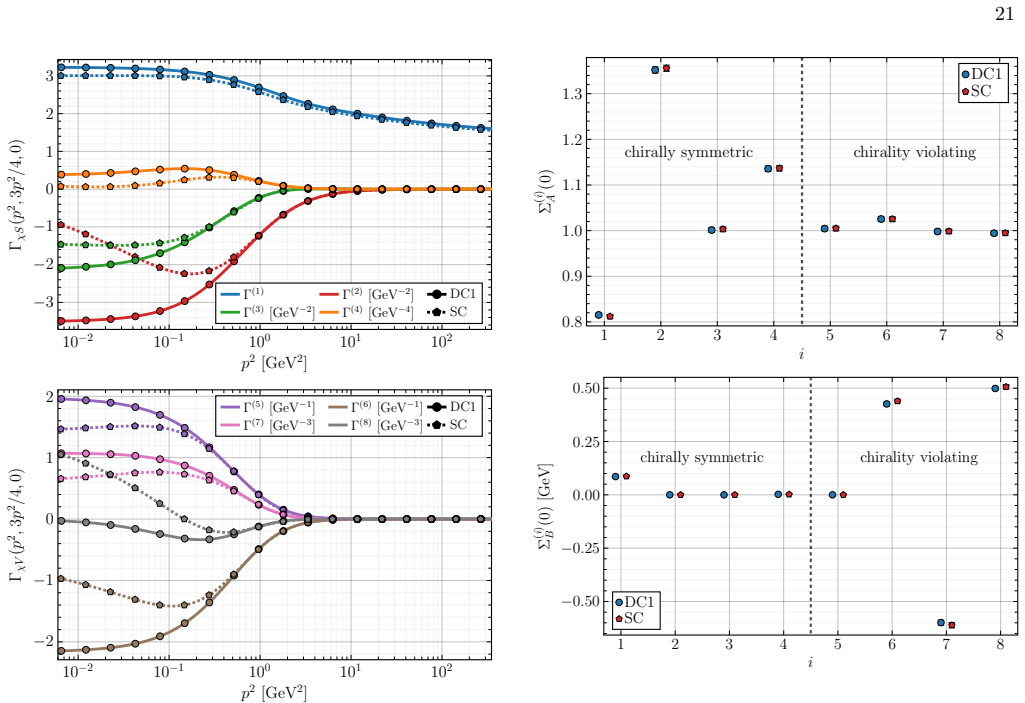
A. Sternbeck, P.-H. Balduf, A. Kızılersu, O. Oliveira, P. J. Silva, J.-I. Skullerud, A. G. Williams, Triple-gluon and quark-gluon vertex from lattice QCD in Landau gauge, PoS LATTICE2016 (2017) 349.arXiv:1702. 00612,doi:10.22323/1.256.0349. 21 10−2 10−1 100 101 102 −3 −2 −1 0 1 2 3 p2 [GeV2] ΓχS(p2,3p2/4,0) Γ (1) Γ (2) [GeV−2] DC1 Γ (3) [GeV−2] Γ (4) [GeV...
-
[22]
A. Kızılers¨ u, O. Oliveira, P. J. Silva, J.-I. Skullerud, A. Sternbeck, Quark-gluon vertex from Nf=2 lattice QCD, Phys. Rev. D 103 (11) (2021) 114515.arXiv: 2103.02945,doi:10.1103/PhysRevD.103.114515
-
[23]
J.-I. Skullerud, A. Kızılers¨ u, O. Oliveira, P. Silva, A. Sternbeck, Quark-gluon vertex with 2 flavours of O(a) improved Wilson fermions, PoS LATTICE2021 (2022) 305.arXiv:2111.13455,doi:10.22323/1.396. 0305
-
[24]
J. Marques, G. Kalusche, T. Mendes, P. J. Silva, J.- I. Skullerud, O. Oliveira, The quark propagator and quark-gluon vertex from lattice QCD at finite temper- ature, PoS LATTICE2022 (2023) 280.arXiv:2301. 10607,doi:10.22323/1.430.0280
-
[25]
A. I. Davydychev, P. Osland, L. Saks, Quark gluon vertex in arbitrary gauge and dimension, Phys. Rev. D 63 (2001) 014022.arXiv:hep-ph/0008171,doi: 10.1103/PhysRevD.63.014022
-
[26]
A. I. Davydychev, P. Osland, L. Saks, One loop results for the quark gluon vertex in arbitrary dimension, Nucl. Phys. B Proc. Suppl. 89 (2000) 277–282.arXiv:hep-ph/ 0008202,doi:10.1016/S0920-5632(00)00856-2
-
[27]
J. A. Gracey, Two loop QCD vertices at the symmetric point, Phys. Rev. D 84 (2011) 085011.arXiv:1108. 4806,doi:10.1103/PhysRevD.84.085011. 1 2 3 4 5 6 7 8 0.8 0.9 1.0 1.1 1.2 1.3 chirally symmetric chirality violating i Σ (i) A (0) DC1 SC 1 2 3 4 5 6 7 8 −0.50 −0.25 0.00 0.25 0.50 chirally symmetric chirality violating i Σ (i) B (0) [GeV] DC1 SC FIG. 22. ...
- [28]
-
[29]
L. von Smekal, P. A. Amundsen, R. Alkofer, A Co- variant model for dynamical chiral symmetry break- ing in QCD, Nucl. Phys. A 529 (1991) 633–652.doi: 10.1016/0375-9474(91)90589-X
-
[30]
A. Bender, W. Detmold, C. D. Roberts, A. W. Thomas, Bethe-Salpeter equation and a nonperturbative quark gluon vertex, Phys. Rev. C 65 (2002) 065203.arXiv: nucl-th/0202082,doi:10.1103/PhysRevC.65.065203
-
[31]
P. Watson, W. Cassing, P. C. Tandy, Bethe-Salpeter meson masses beyond ladder approximation, Few Body Syst. 35 (2004) 129–153.arXiv:hep-ph/0406340,doi: 10.1007/s00601-004-0067-x
- [32]
-
[33]
A. Holl, A. Krassnigg, C. D. Roberts, Confinement, DCSB, bound states, and the quark-gluon vertex, Nucl. Phys. B Proc. Suppl. 141 (2005) 47–52.arXiv:nucl-th/ 0408015,doi:10.1016/j.nuclphysbps.2004.12.009
-
[34]
C. S. Fischer, F. J. Llanes-Estrada, R. Alkofer, Dynam- ical mass generation in Landau gauge QCD, Nucl. Phys. B Proc. Suppl. 141 (2005) 128–133.arXiv:hep-ph/ 22 0407294,doi:10.1016/j.nuclphysbps.2004.12.020
-
[35]
F. J. Llanes-Estrada, C. S. Fischer, R. Alkofer, Semiper- turbative construction for the quark-gluon vertex, Nucl. Phys. B Proc. Suppl. 152 (2006) 43–46.arXiv:hep-ph/ 0407332,doi:10.1016/j.nuclphysbps.2005.08.008
-
[36]
R. Alkofer, C. S. Fischer, F. J. Llanes-Estrada, Dynam- ically induced scalar quark confinement, Mod. Phys. Lett. A 23 (2008) 1105–1113.arXiv:hep-ph/0607293, doi:10.1142/S021773230802700X
-
[37]
H. H. Matevosyan, A. W. Thomas, P. C. Tandy, Quark- gluon vertex dressing and meson masses beyond ladder- rainbow truncation, Phys. Rev. C 75 (2007) 045201. arXiv:nucl-th/0605057,doi:10.1103/PhysRevC.75. 045201
- [38]
-
[39]
R. Alkofer, C. S. Fischer, R. Williams, U(A)(1) anomaly and eta-prime mass from an infrared singular quark- gluon vertex, Eur. Phys. J. A 38 (2008) 53–60.arXiv: 0804.3478,doi:10.1140/epja/i2008-10646-x
-
[40]
R. Alkofer, C. S. Fischer, F. J. Llanes-Estrada, K. Schwenzer, The Quark-gluon vertex in Landau gauge QCD: Its role in dynamical chiral symmetry breaking and quark confinement, Annals Phys. 324 (2009) 106– 172.arXiv:0804.3042,doi:10.1016/j.aop.2008.07. 001
-
[41]
He, Transverse Symmetry Transformations and the Quark-Gluon Vertex Function in QCD, Phys
H.-x. He, Transverse Symmetry Transformations and the Quark-Gluon Vertex Function in QCD, Phys. Rev. D 80 (2009) 016004.arXiv:0906.2834,doi:10.1103/ PhysRevD.80.016004
-
[42]
C. S. Fischer, R. Williams, Probing the gluon self- interaction in light mesons, Phys. Rev. Lett. 103 (2009) 122001.arXiv:0905.2291,doi:10.1103/PhysRevLett. 103.122001
-
[43]
A. Windisch, M. Hopfer, R. Alkofer, Towards a self- consistent solution of the Landau gauge quark-gluon vertex Dyson-Schwinger equation, Acta Phys. Polon. Supp. 6 (2013) 347–352.arXiv:1210.8428,doi:10. 5506/APhysPolBSupp.6.347
-
[44]
M. Hopfer, A. Windisch, R. Alkofer, The Quark-Gluon Vertex in Landau gauge QCD, PoS ConfinementX (2012) 073.arXiv:1301.3672,doi:10.22323/1.171. 0073
-
[45]
A. C. Aguilar, D. Binosi, J. C. Cardona, J. Papavas- siliou, Nonperturbative results on the quark-gluon ver- tex, PoS ConfinementX (2012) 103.arXiv:1301.4057, doi:10.22323/1.171.0103
-
[46]
A. Ayala, A. Bashir, D. Binosi, M. Cristoforetti, J. Rodriguez-Quintero, Quark flavour effects on gluon and ghost propagators, Phys. Rev. D 86 (2012) 074512. arXiv:1208.0795,doi:10.1103/PhysRevD.86.074512
-
[47]
E. Rojas, J. P. B. C. de Melo, B. El-Bennich, O. Oliveira, T. Frederico, On the Quark-Gluon Vertex and Quark-Ghost Kernel: combining Lattice Simula- tions with Dyson-Schwinger equations, JHEP 10 (2013) 193.arXiv:1306.3022,doi:10.1007/JHEP10(2013) 193
-
[48]
R. Alkofer, G. Eichmann, C. S. Fischer, M. Hopfer, M. Vujinovic, R. Williams, A. Windisch, On propaga- tors and three-point functions in Landau gauge QCD and QCD-like theories, PoS QCD-TNT-III (2013) 003. arXiv:1405.7310,doi:10.22323/1.193.0003
-
[49]
Williams, The quark-gluon vertex in Landau gauge bound-state studies, Eur
R. Williams, The quark-gluon vertex in Landau gauge bound-state studies, Eur. Phys. J. A 51 (5) (2015) 57. arXiv:1404.2545,doi:10.1140/epja/i2015-15057-4
-
[50]
A. C. Aguilar, D. Binosi, D. Iba˜ nez, J. Papavassiliou, New method for determining the quark-gluon vertex, Phys. Rev. D 90 (6) (2014) 065027.arXiv:1405.3506, doi:10.1103/PhysRevD.90.065027
- [51]
-
[52]
A. Ayala, J. J. Cobos-Mart´ ınez, M. Loewe, M. E. Tejeda-Yeomans, R. Zamora, Finite temperature quark- gluon vertex with a magnetic field in the Hard Ther- mal Loop approximation, Phys. Rev. D 91 (1) (2015) 016007.arXiv:1410.6388,doi:10.1103/PhysRevD.91. 016007
- [53]
-
[54]
H. Chen, J. B. Wei, M. Baldo, G. F. Burgio, H. J. Schulze, Hybrid neutron stars with the Dyson- Schwinger quark model and various quark-gluon ver- tices, Phys. Rev. D 91 (10) (2015) 105002.arXiv: 1503.02795,doi:10.1103/PhysRevD.91.105002
-
[55]
M. Pel´ aez, M. Tissier, N. Wschebor, Quark-gluon vertex from the Landau gauge Curci-Ferrari model, Phys. Rev. D 92 (4) (2015) 045012.arXiv:1504.05157,doi:10. 1103/PhysRevD.92.045012
-
[56]
D. Binosi, L. Chang, J. Papavassiliou, S.-X. Qin, C. D. Roberts, Natural constraints on the gluon-quark vertex, Phys. Rev. D 95 (3) (2017) 031501.arXiv:1609.02568, doi:10.1103/PhysRevD.95.031501
-
[57]
R. Williams, H. Sanchis-Alepuz, Influence of the non- perturbative quark-gluon vertex on the meson and baryon spectrum, AIP Conf. Proc. 1701 (1) (2016) 040021.doi:10.1063/1.4938638
-
[58]
A. L. Blum, R. Alkofer, M. Q. Huber, A. Windisch, Unquenching the three-gluon vertex: A status report, Acta Phys. Polon. Supp. 8 (2) (2015) 321.arXiv:1506. 04275,doi:10.5506/APhysPolBSupp.8.321
-
[59]
A. L. Blum, R. Alkofer, M. Q. Huber, A. Windisch, Three-point vertex functions in Yang-Mills Theory and QCD in Landau gauge, EPJ Web Conf. 137 (2017) 03001.arXiv:1611.04827,doi:10.1051/epjconf/ 201713703001
-
[60]
M. G´ omez-Rocha, T. Hilger, A. Krassnigg, First Look at Heavy–Light Mesons with a Dressed Quark–Gluon Vertex, Few Body Syst. 56 (6-9) (2015) 475–480.arXiv: 1408.1077,doi:10.1007/s00601-014-0938-8
-
[61]
M. Gomez-Rocha, T. Hilger, A. Krassnigg, Effects of a dressed quark-gluon vertex in pseudoscalar heavy-light mesons, Phys. Rev. D 92 (5) (2015) 054030.arXiv: 1506.03686,doi:10.1103/PhysRevD.92.054030
-
[62]
M. G´ omez-Rocha, T. Hilger, A. Krassnigg, Effects of a dressed quark-gluon vertex in vector heavy-light mesons and theory average of theB ∗ c meson mass, Phys. Rev. D 93 (7) (2016) 074010.arXiv:1602.05002,doi:10. 1103/PhysRevD.93.074010
-
[63]
R. Bermudez, L. Albino, L. X. Guti´ errez-Guerrero, M. E. Tejeda-Yeomans, A. Bashir, Quark-gluon Ver- 23 tex: A Perturbation Theory Primer and Beyond, Phys. Rev. D 95 (3) (2017) 034041.arXiv:1702.04437,doi: 10.1103/PhysRevD.95.034041
-
[65]
R. Contant, M. Q. Huber, C. S. Fischer, C. A. Welzbacher, R. Williams, On the quark-gluon ver- tex at non-vanishing temperature, Acta Phys. Polon. Supp. 11 (2018) 483.arXiv:1805.05885,doi:10.5506/ APhysPolBSupp.11.483
-
[66]
O. Oliveira, T. Frederico, W. de Paula, J. P. B. C. de Melo, Exploring the Quark-Gluon Vertex with Slavnov-Taylor Identities and Lattice Simulations, Eur. Phys. J. C 78 (7) (2018) 553.arXiv:1807.00675, doi:10.1140/epjc/s10052-018-6037-0
-
[69]
M. Vujinovic, R. Alkofer, Low-energy spectrum of an SU(2) gauge theory with dynamical fermions, Phys. Rev. D 98 (9) (2018) 095030.arXiv:1809.02650,doi: 10.1103/PhysRevD.98.095030
-
[70]
O. Oliveira, T. Frederico, W. de Paula, The soft-gluon limit and the infrared enhancement of the quark-gluon vertex, Eur. Phys. J. C 80 (5) (2020) 484.arXiv:2006. 04982,doi:10.1140/epjc/s10052-020-8037-0
-
[71]
F. Gao, J. Papavassiliou, J. M. Pawlowski, Fully coupled functional equations for the quark sector of QCD, Phys. Rev. D 103 (9) (2021) 094013.arXiv:2102.13053,doi: 10.1103/PhysRevD.103.094013
-
[72]
B. El-Bennich, F. E. Serna, R. C. da Silveira, L. A. F. Rangel, A. Bashir, E. Rojas, Dressed quark-gluon ver- tex form factors from gauge symmetry, Rev. Mex. Fis. Suppl. 3 (3) (2022) 0308092.arXiv:2201.04144,doi: 10.31349/SuplRevMexFis.3.0308092
-
[73]
A. C. Aguilar, M. . N. Ferreira, D. Iba˜ nez, J. Papavassil- iou, Schwinger displacement of the quark–gluon vertex, Eur. Phys. J. C 83 (10) (2023) 967.arXiv:2308.16297, doi:10.1140/epjc/s10052-023-12103-8
-
[74]
A. C. Aguilar, M. N. Ferreira, B. M. Oliveira, J. Pa- pavassiliou, G. T. Linhares, Infrared properties of the quark-gluon vertex in general kinematics, Eur. Phys. J. C 84 (11) (2024) 1231.arXiv:2408.15370,doi: 10.1140/epjc/s10052-024-13605-9
-
[75]
R. Alkofer, Dynamical Chiral Symmetry Breaking in Quantum Chromo Dynamics: Delicate and Intricate, Symmetry 15 (9) (2023) 1787.arXiv:2309.09679,doi: 10.3390/sym15091787
-
[76]
R. Alkofer, F. J. Llanes-Estrada, A. Salas-Bernardez, Spinning pairs: Supporting P03 quark-pair creation from Landau-gauge Green’s functions, Phys. Rev. D 109 (7) (2024) 074015.arXiv:2312.14994,doi:10. 1103/PhysRevD.109.074015
- [78]
-
[80]
M. N. Ferreira, A. S. Miramontes, J. M. Morgado, J. Pa- pavassiliou, Light mesons in the symmetric-vertex ap- proximation,arXiv:2604.07221
work page internal anchor Pith review Pith/arXiv arXiv
-
[81]
R. Alkofer, W. Detmold, C. S. Fischer, P. Maris, An- alytic properties of the Landau gauge gluon and quark propagators, Phys. Rev. D 70 (2004) 014014.arXiv: hep-ph/0309077,doi:10.1103/PhysRevD.70.014014
-
[83]
M. Q. Huber, https://github.com/markusqh/YM data
-
[85]
M. Q. Huber, Nonperturbative properties of Yang–Mills theories, Phys. Rept. 879 (2020) 1–92.arXiv:1808. 05227,doi:10.1016/j.physrep.2020.04.004
-
[87]
M. Q. Huber, C. S. Fischer, H. Sanchis-Alepuz, Higher spin glueballs from functional methods, Eur. Phys. J. C 81 (12) (2021) 1083, [Erratum: Eur.Phys.J.C 82, 38 (2022)].arXiv:2110.09180,doi:10.1140/epjc/ s10052-021-09864-5
-
[88]
M. Q. Huber, C. S. Fischer, H. Sanchis-Alepuz, Ap- parent convergence in functional glueball calculations, Eur. Phys. J. C 85 (8) (2025) 859.arXiv:2503.03821, doi:10.1140/epjc/s10052-025-14590-3
discussion (0)
Sign in with ORCID, Apple, or X to comment. Anyone can read and Pith papers without signing in.