Recognition: unknown
Quark-gluon vertex in the complex plane
Pith reviewed 2026-05-08 08:26 UTC · model grok-4.3
The pith
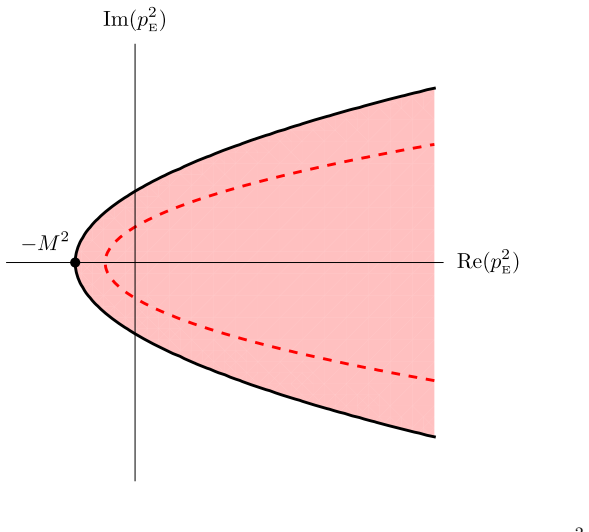
Complexifying the momentum variable in the quark-gluon vertex integrals yields all eight form factors inside a parabolic domain in the complex plane.
A machine-rendered reading of the paper's core claim, the machinery that carries it, and where it could break.
Core claim
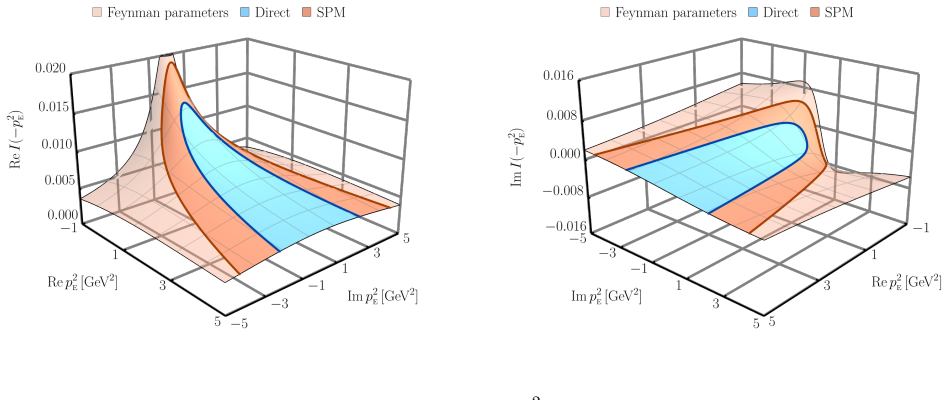
In the soft-gluon limit of the transversely-projected quark-gluon vertex, complexifying the single momentum variable inside the defining integrals provides all eight vertex form factors unambiguously within a domain of the complex plane delimited by a characteristic parabola. The reliable domain ends at the first singularity in the integrands, where the standard Wick rotation must be supplemented by additional contributions. Standard extrapolation methods can extend this region until complex structures associated with the onset of physical processes appear.
What carries the argument
The transversely-projected quark-gluon vertex in the soft-gluon limit, reduced to dependence on a single momentum variable, with analytic continuation achieved by direct complexification of the integration variable.
If this is right
- The approach generalizes to arbitrary gluon momenta.
- It supports determination of the quark propagator in the complex plane.
- The form factors enable meson studies beyond rainbow-ladder truncation.
- Extrapolation extends the domain up to the appearance of structures from physical processes.
Where Pith is reading between the lines
- The method could improve off-shell quark modeling in processes such as deep-inelastic scattering or hadron decays.
- Combining these complex-plane vertices with Dyson-Schwinger studies of other Green functions may yield consistent nonperturbative frameworks for more observables.
- Direct comparison with lattice data for the vertex at complex momenta would test the parabolic boundary and singularity handling.
Load-bearing premise
The first singularity encountered can be handled by supplementing the Wick rotation with additional contributions, and standard extrapolation methods remain valid until the onset of complex structures associated with physical processes.
What would settle it
A lattice computation or direct numerical evaluation showing that the eight form factors become inconsistent or diverge immediately after the parabolic boundary without the expected supplementary contributions from the Wick rotation.
Figures





read the original abstract
In the present work we explore for the first time the general structure and properties of the nonperturbative quark-gluon vertex in the complex plane. Specifically, we focus on the transversely-projected quark-gluon vertex that emerges from a recently developed symmetry-preserving approach for the study of meson properties beyond the rainbow-ladder approximation. The analysis focuses on the so-called "soft-gluon" limit, which reduces the momentum-dependence of the corresponding vertex form factors to a single momentum variable. The complexification of this variable inside the defining integrals furnishes unambiguously all eight vertex form factors within a concrete domain of the complex variable, delimited by a characteristic parabola. The extent of this reliable domain is determined by the appearance of the first singularity in the integrands of the vertex integrals, where the standard Wick rotation must be duly supplemented by additional crucial contributions. This primary analytic region may be extended considerably by resorting to standard extrapolation methods, which remain valid up until the appearance of complex structures associated with the onset of physical processes. The generalization of the method to arbitrary gluon momenta, and its relevance for the determination of the quark propagator in the complex plane, are briefly discussed.
Editorial analysis
A structured set of objections, weighed in public.
Referee Report
Summary. The paper explores the nonperturbative transversely-projected quark-gluon vertex in the complex plane using a symmetry-preserving truncation of the Dyson-Schwinger equations. In the soft-gluon limit, where the vertex depends on a single momentum variable, the authors complexify this variable inside the defining integrals to obtain all eight form factors. They identify a parabolic domain of reliability delimited by the first integrand singularity, supplement the standard Wick rotation with additional contributions at that point, and propose extending the domain via standard extrapolation methods until the onset of physical thresholds. The generalization to arbitrary gluon momenta and implications for the complex quark propagator are briefly discussed.
Significance. If the supplemented contour and extrapolation procedure are shown to be faithful, the work supplies a parameter-free route to the quark-gluon vertex at complex momenta. This is a load-bearing ingredient for symmetry-preserving calculations of meson properties beyond the rainbow-ladder truncation, where the vertex enters the Bethe-Salpeter kernel. The absence of free parameters and the preservation of the underlying symmetries are concrete strengths that could improve predictions for spectra, decay constants, and form factors once the complex-plane results are validated.
major comments (2)
- The central claim that supplementing the Wick rotation with additional contributions at the first singularity, followed by extrapolation, reproduces the correct analytic continuation of all eight form factors is not accompanied by explicit verification. No checks are presented that the resulting functions satisfy dispersion relations, preserve transversality, or reproduce known perturbative limits in overlapping regions of the complex plane.
- The manuscript provides no numerical results, error estimates, or direct comparisons with independent determinations of the vertex (e.g., lattice data or other truncations) inside the claimed parabolic domain. Without such benchmarks, the assertion that the eight form factors are furnished 'unambiguously' remains untested.
minor comments (2)
- The abstract and introductory sections would benefit from a clearer statement of the precise contour deformation or residue contributions that supplement the Wick rotation, including any explicit integral expressions.
- Notation for the eight form factors and the single momentum variable should be introduced with a compact table or diagram early in the text to aid readability.
Simulated Author's Rebuttal
We thank the referee for the positive evaluation of the work's significance and for the constructive major comments. We address each point below and indicate the revisions planned for the manuscript.
read point-by-point responses
-
Referee: The central claim that supplementing the Wick rotation with additional contributions at the first singularity, followed by extrapolation, reproduces the correct analytic continuation of all eight form factors is not accompanied by explicit verification. No checks are presented that the resulting functions satisfy dispersion relations, preserve transversality, or reproduce known perturbative limits in overlapping regions of the complex plane.
Authors: We agree that explicit verifications would strengthen the presentation. Transversality is preserved by construction through the symmetry-preserving truncation of the Dyson-Schwinger equations, as established in the referenced framework. We will revise the manuscript to include a dedicated discussion and numerical checks demonstrating consistency with the perturbative limit in the overlapping real-axis region. Regarding dispersion relations, we will add an explanation of how the supplemented contour respects the analytic properties of the integrands. These additions address the verification concern without altering the core results. revision: yes
-
Referee: The manuscript provides no numerical results, error estimates, or direct comparisons with independent determinations of the vertex (e.g., lattice data or other truncations) inside the claimed parabolic domain. Without such benchmarks, the assertion that the eight form factors are furnished 'unambiguously' remains untested.
Authors: The manuscript does present the eight form factors obtained from the integrals within the parabolic domain, with the 'unambiguous' character arising from the parameter-free, symmetry-preserving truncation. We acknowledge the value of error estimates and will add quantitative estimates derived from the numerical integration procedure in the revised version. Direct comparisons with lattice data or other truncations are not feasible at present, as independent results for the full vertex at complex momenta are unavailable; lattice computations are typically restricted to Euclidean momenta. We will include a discussion clarifying this limitation and the scope of the current work as the first exploration of the complex-plane domain. revision: partial
- Direct comparisons with independent determinations (lattice or other truncations) at complex momenta are not currently possible due to the absence of such data.
Circularity Check
No significant circularity; complex-plane extension is direct integral evaluation
full rationale
The paper computes the eight form factors of the transversely-projected quark-gluon vertex (soft-gluon limit) by complexifying the single momentum variable inside the defining integrals of a prior symmetry-preserving framework. The domain is delimited by the first integrand singularity, with standard Wick-rotation supplementation and extrapolation applied beyond it. No equation reduces by construction to a fitted parameter renamed as a prediction, no ansatz is smuggled via self-citation, and no uniqueness theorem or renaming of a known result is invoked. The self-reference to the base approach supplies the real-axis integrands but does not force the complex-plane results; the extension itself is presented as an independent, parameter-free numerical procedure. This satisfies the criteria for a self-contained derivation against external benchmarks.
Axiom & Free-Parameter Ledger
axioms (2)
- domain assumption The transversely-projected quark-gluon vertex obtained from the recently developed symmetry-preserving approach for meson properties
- domain assumption The soft-gluon limit reduces the momentum dependence to a single variable whose complexification is unambiguous inside the parabolic domain
Reference graph
Works this paper leans on
-
[1]
+c b Z k,ω K b 5 1 2 R′(k2)a(k2
-
[2]
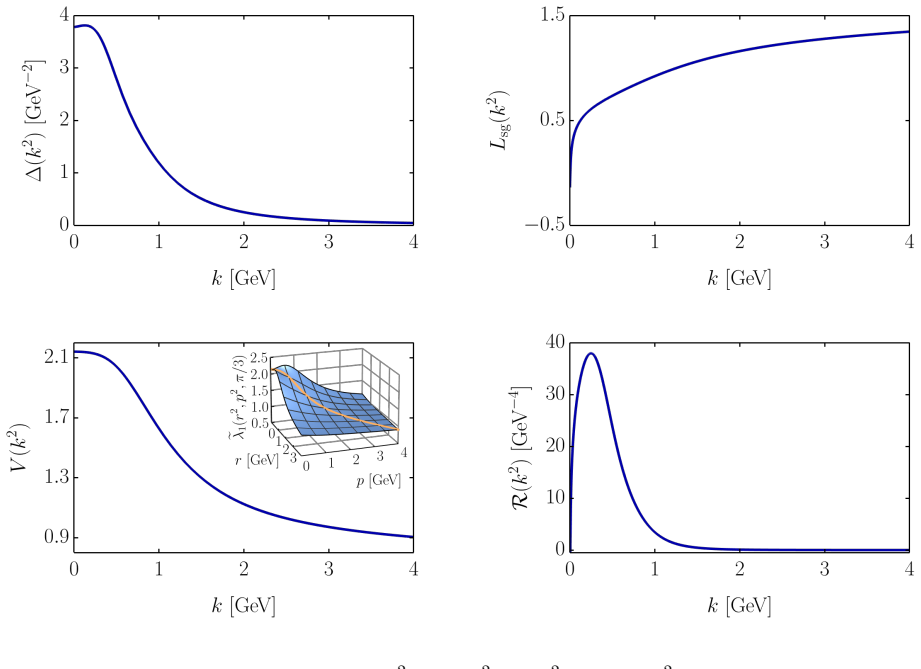
+R(k 2)a′(k2 1) ; λsg i (p2) =c b Z k,ω R(k2)Kib(k2 1),fori= 2,3,5,8 ; (3.7) 8 where we usef ′(x) :=d f(x)/dx, andK i :=K i(k2, p2, ω). The two-dimensional integration is defined as Z k,ω := 1 2(2π)3 Z ∞ 0 k2dk2 Z π 0 sin2ω dω ,(3.8) and we have introduced the key dynamical quantity R(k2) =V 2(k2)∆2(k2)Lsg(k2),(3.9) together with a(p2) := A(p2) p2A2(p2) +...
-
[3]
soft-gluon
Note that in the above expression,pis still a Minkowski space momentum. 10 FIG. 2. Left: The functionf(k 0,k, p) is analytic on and inside the contours (blue solid and blue dashed lines), and Eq. (4.3) is valid. Center: The poles move vertically into the first and/or third quadrants (red arrows indicate the motion of the poles). The contours are deformed ...
2022
-
[4]
Alkofer and L
R. Alkofer and L. von Smekal, Phys. Rept.353, 281 (2001)
2001
-
[5]
J. M. Pawlowski, D. F. Litim, S. Nedelko, and L. von Smekal, Phys. Rev. Lett.93, 152002 (2004)
2004
-
[6]
Binosi and J
D. Binosi and J. Papavassiliou, Phys. Rept.479, 1 (2009)
2009
-
[7]
Maas, Phys
A. Maas, Phys. Rept.524, 203 (2013)
2013
-
[8]
I. C. Cloet and C. D. Roberts, Prog. Part. Nucl. Phys.77, 1 (2014)
2014
-
[9]
M. Q. Huber, Phys. Rept.879, 1 (2020)
2020
-
[10]
Dupuis, L
N. Dupuis, L. Canet, A. Eichhorn, W. Metzner, J. M. Pawlowski, M. Tissier, and N. Wsche- bor, Phys. Rept.910, 1 (2021)
2021
-
[11]
M. N. Ferreira and J. Papavassiliou, Particles6, 312 (2023)
2023
-
[12]
M. N. Ferreira and J. Papavassiliou, Prog. Part. Nucl. Phys.144, 104186 (2025)
2025
- [13]
-
[14]
Alkofer, W
R. Alkofer, W. Detmold, C. S. Fischer, and P. Maris, Phys. Rev. D70, 014014 (2004)
2004
-
[15]
Strauss, C
S. Strauss, C. S. Fischer, and C. Kellermann, Phys. Rev. Lett.109, 252001 (2012)
2012
-
[16]
Frederico, G
T. Frederico, G. Salm` e, and M. Viviani, Phys. Rev. D89, 016010 (2014)
2014
-
[17]
Dudal, O
D. Dudal, O. Oliveira, and P. J. Silva, Phys. Rev. D89, 014010 (2014)
2014
-
[18]
de Paula, T
W. de Paula, T. Frederico, G. Salm` e, and M. Viviani, Phys. Rev. D94, 071901 (2016)
2016
-
[19]
El-Bennich, G
B. El-Bennich, G. Krein, E. Rojas, and F. E. Serna, Few Body Syst.57, 955 (2016)
2016
-
[20]
Tripolt, P
R.-A. Tripolt, P. Gubler, M. Ulybyshev, and L. Von Smekal, Comput. Phys. Commun.237, 129 (2019)
2019
-
[21]
Binosi and R.-A
D. Binosi and R.-A. Tripolt, Phys. Lett. B801, 135171 (2020)
2020
-
[22]
Dudal, O
D. Dudal, O. Oliveira, M. Roelfs, and P. Silva, Nucl. Phys. B952, 114912 (2020)
2020
-
[23]
Eichmann, P
G. Eichmann, P. Duarte, M. T. Pe˜ na, and A. Stadler, Phys. Rev. D100, 094001 (2019). 30
2019
-
[24]
S. W. Li, P. Lowdon, O. Oliveira, and P. J. Silva, Phys. Lett. B803, 135329 (2020)
2020
-
[25]
S. W. Li, P. Lowdon, O. Oliveira, and P. J. Silva, Phys. Lett. B823, 136753 (2021)
2021
-
[26]
C. S. Fischer and M. Q. Huber, Phys. Rev. D102, 094005 (2020)
2020
-
[27]
Horak, J
J. Horak, J. Papavassiliou, J. M. Pawlowski, and N. Wink, Phys. Rev. D104, 074017 (2021)
2021
-
[28]
Horak, J
J. Horak, J. M. Pawlowski, J. Rodr´ ıguez-Quintero, J. Turnwald, J. M. Urban, N. Wink, and S. Zafeiropoulos, Phys. Rev. D105, 036014 (2022)
2022
-
[29]
Horak, J
J. Horak, J. M. Pawlowski, and N. Wink, SciPost Phys. Core8, 048 (2025)
2025
-
[30]
Eichmann, E
G. Eichmann, E. Ferreira, and A. Stadler, Phys. Rev. D105, 034009 (2022)
2022
-
[31]
Horak, J
J. Horak, J. M. Pawlowski, and N. Wink, SciPost Phys.15, 149 (2023)
2023
-
[32]
M. Q. Huber, W. J. Kern, and R. Alkofer, Phys. Rev. D107, 074026 (2023)
2023
-
[33]
M. Q. Huber, W. J. Kern, and R. Alkofer, Symmetry15, 414 (2023)
2023
-
[34]
J. M. Pawlowski and J. Wessely, Eur. Phys. J. C85, 970 (2025)
2025
-
[35]
Bhagwat and P
M. Bhagwat and P. Tandy, Phys. Rev.D70, 094039 (2004)
2004
-
[36]
F. J. Llanes-Estrada, C. S. Fischer, and R. Alkofer, Nucl. Phys. Proc. Suppl.152, 43 (2006)
2006
-
[37]
H. H. Matevosyan, A. W. Thomas, and P. C. Tandy, Phys. Rev.C75, 045201 (2007)
2007
-
[38]
C. S. Fischer, J. Phys. G32, R253 (2006)
2006
-
[39]
A. C. Aguilar, J. C. Cardona, M. N. Ferreira, and J. Papavassiliou, Phys. Rev.D98, 014002 (2018)
2018
-
[40]
S.-X. Qin, L. Chang, Y.-X. Liu, C. D. Roberts, and S. M. Schmidt, Phys. Lett.B722, 384 (2013)
2013
-
[41]
Hopfer, A
M. Hopfer, A. Windisch, and R. Alkofer, PoSConfinementX, 073 (2012)
2012
-
[42]
Rojas, J
E. Rojas, J. de Melo, B. El-Bennich, O. Oliveira, and T. Frederico, J. High Energy Phys. 2013(10), 193
2013
-
[43]
Williams, Eur
R. Williams, Eur. Phys. J.A51, 57 (2015)
2015
-
[44]
Williams, C
R. Williams, C. S. Fischer, and W. Heupel, Phys. Rev.D93, 034026 (2016)
2016
-
[45]
Sanchis-Alepuz and R
H. Sanchis-Alepuz and R. Williams, Phys. Lett.B749, 592 (2015)
2015
-
[46]
Pel´ aez, M
M. Pel´ aez, M. Tissier, and N. Wschebor, Phys. Rev. D92, 045012 (2015)
2015
-
[47]
Alkofer, C
R. Alkofer, C. S. Fischer, F. J. Llanes-Estrada, and K. Schwenzer, Annals Phys.324, 106 (2009)
2009
-
[48]
Mitter, J
M. Mitter, J. M. Pawlowski, and N. Strodthoff, Phys. Rev.D91, 054035 (2015)
2015
-
[49]
A. K. Cyrol, M. Mitter, J. M. Pawlowski, and N. Strodthoff, Phys. Rev.D97, 054006 (2018). 31
2018
-
[50]
A. C. Aguilar, D. Binosi, D. Iba˜ nez, and J. Papavassiliou, Phys. Rev.D90, 065027 (2014)
2014
-
[51]
F. Gao, J. Papavassiliou, and J. M. Pawlowski, Phys. Rev. D103, 094013 (2021)
2021
-
[52]
A. C. Aguilar, J. C. Cardona, M. N. Ferreira, and J. Papavassiliou, Phys. Rev.D96, 014029 (2017)
2017
-
[53]
Oliveira, W
O. Oliveira, W. de Paula, T. Frederico, and J. P. B. C. de Melo, Eur. Phys. J. C79, 116 (2019)
2019
-
[54]
Albino, A
L. Albino, A. Bashir, L. X. G. Guerrero, B. E. Bennich, and E. Rojas, Phys. Rev. D100, 054028 (2019)
2019
-
[55]
C. Tang, F. Gao, and Y.-X. Liu, Phys. Rev. D100, 056001 (2019)
2019
-
[56]
Albino, A
L. Albino, A. Bashir, B. El-Bennich, E. Rojas, F. E. Serna, and R. C. da Silveira, JHEP 2021(11), 196
2021
-
[57]
Windisch, M
A. Windisch, M. Hopfer, and R. Alkofer, Acta Phys. Polon. Supp.6, 347 (2013)
2013
-
[58]
Oliveira, T
O. Oliveira, T. Frederico, and W. de Paula, Eur. Phys. J. C80, 484 (2020)
2020
-
[59]
No planar degeneracy for the Landau gauge quark-gluon vertex
G. Wieland and R. Alkofer, arXiv:2604.20235 [hep-ph] (2026)
work page internal anchor Pith review Pith/arXiv arXiv 2026
-
[60]
Skullerud, P
J. Skullerud, P. O. Bowman, and A. Kizilersu, in5th International Conference on Quark Confinement and the Hadron Spectrum(2002) pp. 270–272
2002
-
[61]
Skullerud and A
J. Skullerud and A. Kizilersu, J. High Energy Phys.2002(09), 013
2002
-
[62]
J. I. Skullerud, P. O. Bowman, A. Kizilersu, D. B. Leinweber, and A. G. Williams, J. High Energy Phys.2003(04), 047
2003
-
[63]
J. I. Skullerud, P. O. Bowman, A. Kizilersu, D. B. Leinweber, and A. G. Williams, Nucl. Phys. Proc. Suppl.141, 244 (2005)
2005
-
[64]
Lin, Phys
H.-W. Lin, Phys. Rev.D73, 094511 (2006)
2006
-
[65]
Kızılers¨ u, O
A. Kızılers¨ u, O. Oliveira, P. J. Silva, J.-I. Skullerud, and A. Sternbeck, Phys. Rev. D103, 114515 (2021)
2021
-
[66]
Kizilersu, D
A. Kizilersu, D. B. Leinweber, J.-I. Skullerud, and A. G. Williams, Eur. Phys. J.C50, 871 (2007)
2007
-
[67]
Sternbeck, P.-H
A. Sternbeck, P.-H. Balduf, A. Kizilersu, O. Oliveira, P. J. Silva, J.-I. Skullerud, and A. G. Williams, PoSLATTICE2016, 349 (2017)
2017
-
[68]
Skullerud, A
J.-I. Skullerud, A. Kızılers¨ u, O. Oliveira, P. Silva, and A. Sternbeck, PoSLATTICE2021, 305 (2022)
2022
-
[69]
Oliveira, A
O. Oliveira, A. Kizilersu, P. J. Silva, J.-I. Skullerud, A. Sternbeck, and A. G. Williams, Acta 32 Phys. Polon. Supp.9, 363 (2016)
2016
-
[70]
Oliveira, T
O. Oliveira, T. Frederico, W. de Paula, and J. P. B. C. de Melo, Eur. Phys. J.C78, 553 (2018)
2018
-
[71]
A. S. Miramontes, J. M. Morgado, J. Papavassiliou, and J. M. Pawlowski, Eur. Phys. J. C 85, 1055 (2025)
2025
-
[72]
M. N. Ferreira, A. S. Miramontes, J. M. Morgado, J. Papavassiliou, and J. M. Pawlowski, Eur. Phys. J. C86, 325 (2026)
2026
-
[73]
M. N. Ferreira, A. S. Miramontes, J. M. Morgado, and J. Papavassiliou, arXiv:2604.07221 [hep-ph] (2026)
work page internal anchor Pith review Pith/arXiv arXiv 2026
-
[74]
E. E. Salpeter and H. A. Bethe, Phys. Rev.84, 1232 (1951)
1951
-
[75]
Gell-Mann and F
M. Gell-Mann and F. Low, Phys. Rev.84, 350 (1951)
1951
-
[76]
H. A. Bethe and E. E. Salpeter, Quantum mechanics of one- and two-electron systems, in Atoms I / Atome I(Springer Berlin Heidelberg, Berlin, Heidelberg, 1957) pp. 88–436
1957
-
[77]
Nakanishi, Prog
N. Nakanishi, Prog. Theor. Phys. Suppl.43, 1 (1969)
1969
-
[78]
Jain and H
P. Jain and H. J. Munczek, Phys. Rev. D48, 5403 (1993)
1993
-
[79]
Munczek, Phys
H. Munczek, Phys. Rev.D52, 4736 (1995)
1995
-
[80]
C. S. Fischer, P. Watson, and W. Cassing, Phys. Rev. D72, 094025 (2005)
2005
discussion (0)
Sign in with ORCID, Apple, or X to comment. Anyone can read and Pith papers without signing in.