Recognition: unknown
Hamiltonian simulation for 3D elastic wave equations in homogeneous elastic media
Pith reviewed 2026-05-10 00:41 UTC · model grok-4.3
The pith
Explicit quantum circuits simulate the three-dimensional elastic wave equation by recasting it as a Schrödinger Hamiltonian.
A machine-rendered reading of the paper's core claim, the machinery that carries it, and where it could break.
Core claim
Starting from the first-order velocity-stress formulation, finite-difference discretization of the three-dimensional elastic wave equation in homogeneous isotropic media is transformed into Schrödinger form; the resulting Hamiltonian separates into tensor-product terms between component and spatial registers, yielding explicit implementations of first-order and second-order Trotter formulas for the time-evolution operator along with corresponding error bounds and constant-sensitive qubit and CNOT complexity estimates in terms of the discretization parameter, simulation time, target accuracy, and material parameters.
What carries the argument
The separation between the component register and the spatial register in the discretized Hamiltonian, which permits decomposition into structured tensor-product terms for explicit gate implementation.
If this is right
- Explicit gate sequences realize both first-order and second-order Trotter approximations to the time-evolution operator.
- Rigorous error bounds are obtained that scale with the number of Trotter steps and the discretization parameters.
- Qubit count and CNOT-gate count are expressed explicitly in terms of discretization, simulation time, target accuracy, and material parameters.
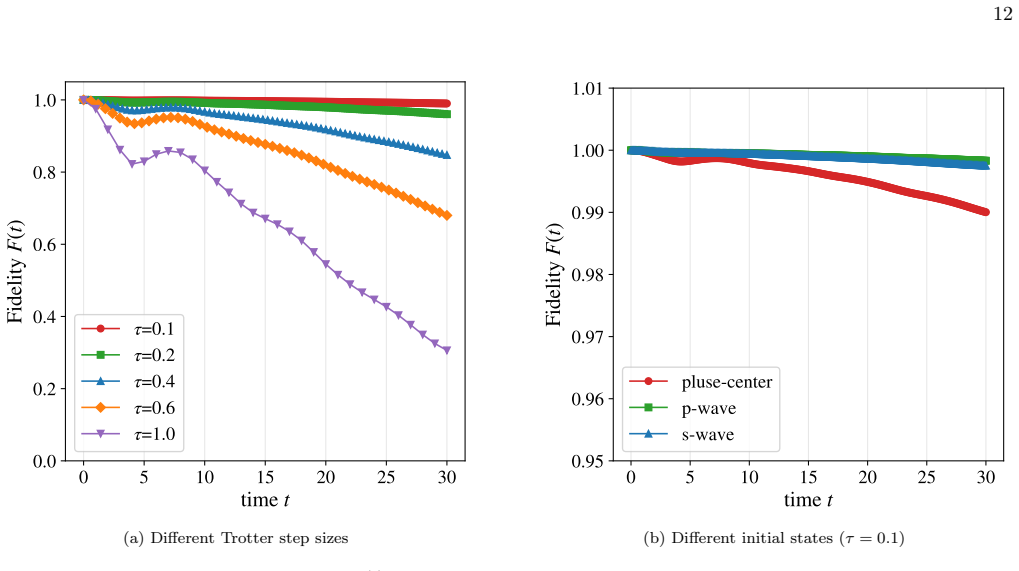
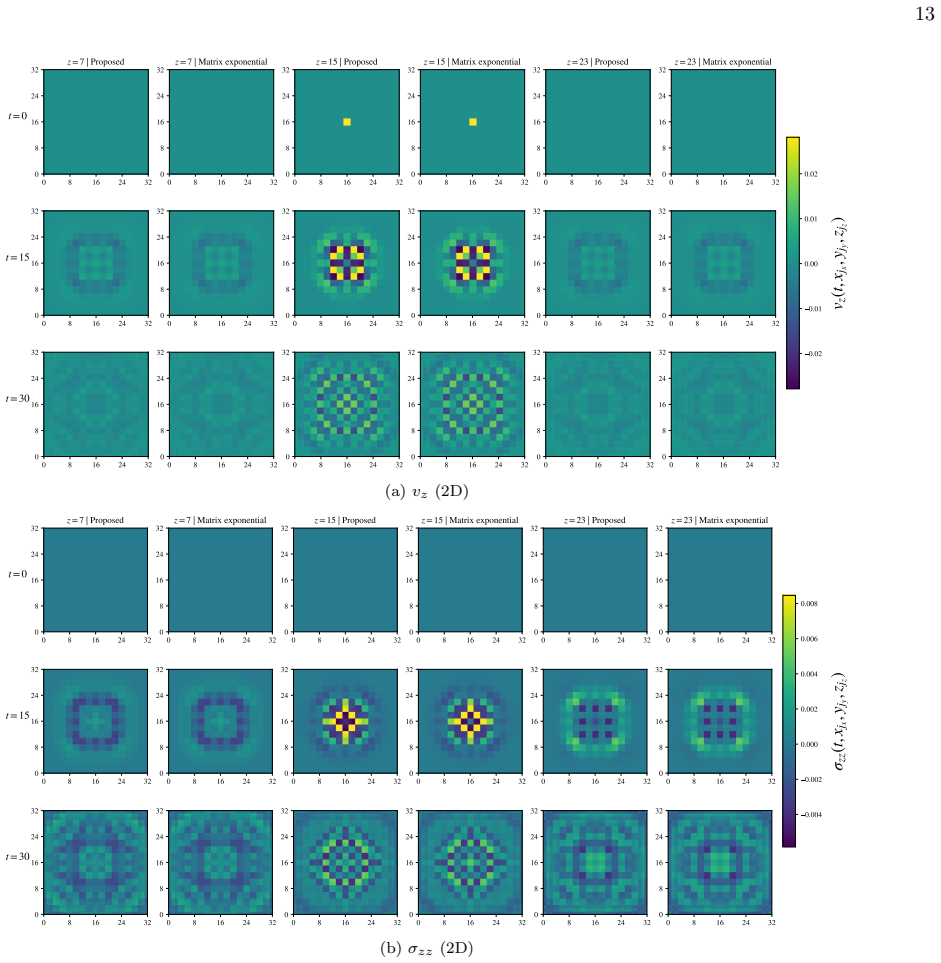
- Numerical experiments demonstrate agreement between the quantum-circuit output and exact time evolution while recovering the physical wave fields.
Where Pith is reading between the lines
- The same register-separation approach could be extended to media whose material properties vary in space by allowing the Hamiltonian coefficients to become position-dependent operators.
- The explicit circuit could be combined with quantum linear-system or optimization routines to solve inverse problems that recover material parameters from observed wave data.
- Analogous tensor-product decompositions may simplify Hamiltonian simulation of other first-order vector wave systems in acoustics or electromagnetism.
Load-bearing premise
The finite-difference discretization of the velocity-stress system can be rewritten exactly as a Schrödinger Hamiltonian whose tensor-product structure supports direct and efficient gate decomposition without hidden costs that grow with dimension or material variation.
What would settle it
Execute the circuit for a point-source excitation in uniform material, reconstruct the velocity and stress fields, and test whether the deviation from the known analytic solution stays inside the error bound derived from the Trotter analysis.
Figures

read the original abstract
We present an explicit quantum circuit construction for Hamiltonian simulation of a first-order velocity--stress formulation of the three-dimensional elastic wave equation in homogeneous isotropic media. Previous studies have shown how elastic wave equations can be cast into forms amenable to Hamiltonian simulation, but they typically rely on black box Hamiltonian access assumptions, making gate complexity estimation difficult. Starting from the first-order velocity--stress formulation, we discretize the system by finite differences, transform it into Schr\"odinger form, and exploit the separation between the component register and the spatial register to decompose the Hamiltonian into structured tensor product terms. This yields explicit implementations of first-order and second-order Trotter formulas for the resulting time evolution operator. We derive corresponding error bounds and constant sensitive qubit and CNOT complexity estimates in terms of the discretization parameter, simulation time, target accuracy, and material parameters. Numerical experiments validate the proposed framework through comparisons with the exact time evolution and reconstructed physical fields.
Editorial analysis
A structured set of objections, weighed in public.
Referee Report
Summary. The manuscript claims an explicit quantum circuit construction for Hamiltonian simulation of a first-order velocity-stress formulation of the three-dimensional elastic wave equation in homogeneous isotropic media. It discretizes the system via finite differences, transforms it into Schrödinger form, exploits the separation between a component register and a spatial register to decompose the Hamiltonian into structured tensor-product terms, provides explicit first- and second-order Trotter implementations, derives corresponding error bounds together with constant-sensitive qubit and CNOT complexity estimates (in terms of discretization parameter, simulation time, target accuracy, and material parameters), and validates the framework numerically against exact time evolution with reconstruction of physical fields.
Significance. If the central decomposition and explicit gate implementations hold without hidden overheads, the work supplies a concrete, non-black-box resource estimate for quantum simulation of 3D elastic waves. This moves beyond prior abstract Hamiltonian-access assumptions and could support applications in seismic modeling or materials science where quantifiable gate counts are required.
major comments (2)
- [Hamiltonian decomposition and circuit construction] The transformation of the finite-difference velocity-stress system into Schrödinger form (described after the discretization step) must be shown to produce an operator that is exactly a sum of terms of the form α_{c,d} (C_c ⊗ D_d), with C_c acting only on the small component register and D_d being purely spatial finite-difference operators on the 3D grid register. Any residual cross-component or cross-direction couplings would prevent the claimed tensor-product decomposition and invalidate the subsequent Trotter circuit constructions and complexity formulas.
- [Complexity estimates and error bounds] The constant-sensitive CNOT complexity estimates (given in the complexity analysis section) do not yet explicitly account for the cost of realizing the 3D spatial derivative operators (partial_x, partial_y, partial_z) on the grid register. Standard implementations via QFT-based shifts or direct stencil circuits introduce factors of log N (where N is the discretization parameter) or additional factors of 3 for the three spatial directions; these must be shown to be either absorbed into the stated constants or included in the bounds, as they are load-bearing for the claimed explicit implementations.
minor comments (2)
- [Numerical validation] The numerical experiments section should report the specific grid sizes, time-step values, and quantitative error metrics (e.g., L2 norms) used in the comparisons with exact evolution to facilitate reproducibility.
- [Preliminaries] Notation for the component register versus the spatial register should be introduced with a clear table or diagram early in the manuscript to avoid ambiguity when discussing tensor-product structure.
Simulated Author's Rebuttal
We thank the referee for the careful reading and constructive comments. We address the two major comments point by point below, providing clarifications and indicating revisions where appropriate. We believe these responses strengthen the presentation of the explicit circuit constructions and complexity estimates.
read point-by-point responses
-
Referee: The transformation of the finite-difference velocity-stress system into Schrödinger form (described after the discretization step) must be shown to produce an operator that is exactly a sum of terms of the form α_{c,d} (C_c ⊗ D_d), with C_c acting only on the small component register and D_d being purely spatial finite-difference operators on the 3D grid register. Any residual cross-component or cross-direction couplings would prevent the claimed tensor-product decomposition and invalidate the subsequent Trotter circuit constructions and complexity formulas.
Authors: We thank the referee for this observation. Section III of the manuscript derives the Schrödinger-form Hamiltonian from the discretized first-order velocity-stress system. Under the homogeneous isotropic assumption, the resulting operator is exactly a sum of terms α_{c,d} (C_c ⊗ D_d), where the component operators C_c act only on the 6-dimensional register (three velocity and three stress components) and the D_d are purely spatial finite-difference operators (no cross-direction couplings appear because the material parameters are scalars). The explicit expansion of all 18 terms (accounting for the three spatial directions and the six components) is already present in the derivation, confirming the absence of residual cross terms. To make this structure fully transparent, we will add a dedicated paragraph and table in the revised manuscript that lists every term in the sum and verifies the tensor-product form before proceeding to the Trotter decompositions. revision: yes
-
Referee: The constant-sensitive CNOT complexity estimates (given in the complexity analysis section) do not yet explicitly account for the cost of realizing the 3D spatial derivative operators (partial_x, partial_y, partial_z) on the grid register. Standard implementations via QFT-based shifts or direct stencil circuits introduce factors of log N (where N is the discretization parameter) or additional factors of 3 for the three spatial directions; these must be shown to be either absorbed into the stated constants or included in the bounds, as they are load-bearing for the claimed explicit implementations.
Authors: We appreciate the referee highlighting the need for explicit accounting of derivative costs. Our complexity formulas are stated as constant-sensitive (rather than purely asymptotic) precisely so that implementation overheads for the spatial operators can be folded into the constants. In the revised manuscript we will insert a short subsection that (i) specifies the chosen implementation of each partial derivative (QFT-based shift with cost O(log N) per direction), (ii) shows that the factor of 3 arising from the three spatial directions is absorbed into the overall constant multiplying the leading term, and (iii) confirms that the log N factor likewise resides inside the stated constants. Because the paper already supplies constant-sensitive rather than leading-order-only bounds, the numerical values of the constants will be updated to reflect these contributions, but the functional dependence on grid size, time, accuracy, and material parameters remains unchanged. revision: partial
Circularity Check
No circularity: derivation proceeds from standard first-order equations via explicit discretization and tensor-product decomposition.
full rationale
The paper begins from the established first-order velocity-stress formulation of the 3D elastic wave equation in homogeneous isotropic media, applies standard finite-difference discretization to obtain a discrete operator, recasts it into Schrödinger form by separating the small component register from the spatial grid register, and decomposes the resulting Hamiltonian into explicit tensor-product terms. From this structure it constructs first- and second-order Trotter circuits, derives error bounds via standard Trotter analysis, and obtains qubit/CNOT counts whose leading terms are expressed in terms of the discretization parameter, time, accuracy, and material constants. None of these steps reduces to a self-definition, a fitted parameter renamed as a prediction, or a load-bearing self-citation; the tensor-product decomposition follows directly from the finite-difference stencil on the 9-component system and the product structure of the 3D grid. The construction is therefore self-contained against external benchmarks and receives the default non-circularity finding.
Axiom & Free-Parameter Ledger
axioms (2)
- domain assumption Finite-difference discretization of the first-order velocity-stress system yields a Hamiltonian whose spectrum and time evolution remain faithful to the continuous PDE for the chosen grid sizes.
- domain assumption The component and spatial degrees of freedom can be separated into distinct registers so that the Hamiltonian decomposes into a sum of tensor-product operators implementable by elementary gates.
Reference graph
Works this paper leans on
-
[1]
H (α) jk , 15X l=1 nX m=1 H (α) lm + nX m=k+1 H (α) jm # , (79) Ξcross αβ := 15X j=0 nX k=1
The first order Trotter formula We analyze the first-order formula: one step error bound, one step implementation cost, and the resulting global complexity. We start from the standard commu- tator scaling bound [30]. Proposition 1(Commutator scaling bound for the first-order Trotter formula: Proposition 9 of Ref. [30]). Let H= RX r=1 Hr,(50) where eachH r...
-
[2]
(90) The details are given in Appendix B
Hence ∥S−1 comp∥= ( E 1−2ν for 0≤ν < 1 2 , E 1+ν for−1< ν <0. (90) The details are given in Appendix B. Equivalently, we can rewrite ∥S−1 comp∥= max{3K,2µ},(91) where the bulk modulusKand shear modulusµare given by K= E 3(1−2ν) , µ= E 2(1 +ν) .(92) Therefore, the error and gate bound increase with mate- rial stiffness (largeK, µ) and decrease with mass de...
-
[3]
As in the first-order case, we first state the generic norm scaling error bound, and then specialize it to the Hamiltonian in Eq
The second order Trotter formula We next analyze the second-order formulaU2(τ). As in the first-order case, we first state the generic norm scaling error bound, and then specialize it to the Hamiltonian in Eq. (32) to obtain explicit parameter dependence. Proposition 8(Norm scaling bound for the sec- ond-order Trotter formula: Lemma 1 in Ref. [29]).Let H=...
-
[4]
pulse” denotes a localized excitation supported on the central 2×2×2 grid block, while “p
Comparison with classical time integration of the same semidiscrete system To make the comparison as direct as possible, we com- pare the quantum algorithm with a classical explicit in- tegrator applied to the same semidiscrete ODE defined by Eq. (25), rather than with a different PDE-level dis- cretization. Since the seven zero-padded components are dyna...
-
[5]
M. E. Taylor,Partial Differential Equations I: Basic The- ory, Applied Mathematical Sciences, Vol. 115 (Springer International Publishing, Cham, 2023)
2023
-
[6]
Navier, M´ emoire sur les lois du mouvement des fluides, M´ emoires de l’Acad´ emie des sciences6, 389 (1822)
H. Navier, M´ emoire sur les lois du mouvement des fluides, M´ emoires de l’Acad´ emie des sciences6, 389 (1822). 13 0 8 16 24 32 0 8 16 24 32 t = 0 z = 7 | Proposed 0 8 16 24 32 0 8 16 24 32 z = 7 | Matrix exponential 0 8 16 24 32 0 8 16 24 32 z = 15 | Proposed 0 8 16 24 32 0 8 16 24 32 z = 15 | Matrix exponential 0 8 16 24 32 0 8 16 24 32 z = 23 | Propo...
-
[7]
Aki and P
K. Aki and P. G. Richards,Quantitative Seismology(Uni- versity Science Books, 2002)
2002
-
[8]
K. J. Marfurt, Accuracy of finite-difference and finite- element modeling of the scalar and elastic wave equa- tions, Geophysics49, 533 (1984)
1984
-
[9]
R. J. LeVeque, 1. Finite Difference Approximations, in Finite Difference Methods for Ordinary and Partial Dif- ferential Equations(Society for Industrial and Applied Mathematics, 2007) pp. 3–11
2007
-
[10]
Virieux, H
J. Virieux, H. Calandra, and R.- ´E. Plessix, A review of the spectral, pseudo-spectral, finite-difference and finite- element modelling techniques for geophysical imaging, Geophysical Prospecting59, 794 (2011)
2011
-
[11]
I. Y. Dodin and E. A. Startsev, On applications of quan- tum computing to plasma simulations, Physics of Plas- mas28, 10.1063/5.0056974 (2021)
-
[12]
Krovi, Improved quantum algorithms for linear and nonlinear differential equations, Quantum7, 913 (2023)
H. Krovi, Improved quantum algorithms for linear and nonlinear differential equations, Quantum7, 913 (2023)
2023
-
[13]
Y. Sato, H. Tezuka, R. Kondo, and N. Yamamoto, Quan- tum algorithm for partial differential equations of non- conservative systems with spatially varying parameters, Phys. Rev. Appl.23, 014063 (2025)
2025
-
[14]
Meng and Y
Z. Meng and Y. Yang, Quantum computing of fluid dy- namics using the hydrodynamic Schr¨ odinger equation, Phys. Rev. Res.5, 033182 (2023)
2023
-
[15]
S. Jin, N. Liu, and Y. Yu, Time complexity analysis of quantum algorithms via linear representations for nonlin- 14 ear ordinary and partial differential equations, Journal of Computational Physics487, 112149 (2023)
2023
-
[16]
A. W. Harrow, A. Hassidim, and S. Lloyd, Quantum Algorithm for Linear Systems of Equations, Phys. Rev. Lett.103, 150502 (2009)
2009
-
[17]
S. Jin, N. Liu, and Y. Yu, Quantum Simulation of Partial Differential Equations via Schr¨ odingerization, Phys. Rev. Lett.133, 230602 (2024)
2024
-
[18]
S. Jin, N. Liu, and Y. Yu, Quantum simulation of partial differential equations: Applications and detailed analy- sis, Phys. Rev. A108, 032603 (2023)
2023
-
[19]
An, J.-P
D. An, J.-P. Liu, and L. Lin, Linear combination of Hamiltonian simulation for nonunitary dynamics with optimal state preparation cost, Phys. Rev. Lett.131, 150603 (2023)
2023
-
[20]
Y. Sato, R. Kondo, I. Hamamura, T. Onodera, and N. Yamamoto, Hamiltonian simulation for hyperbolic partial differential equations by scalable quantum cir- cuits, Phys. Rev. Res.6, 033246 (2024)
2024
-
[21]
P. C. S. Costa, S. Jordan, and A. Ostrander, Quantum algorithm for simulating the wave equation, Phys. Rev. A99, 012323 (2019)
2019
-
[22]
Babbush, D
R. Babbush, D. W. Berry, R. Kothari, R. D. Somma, and N. Wiebe, Exponential Quantum Speedup in Simulating Coupled Classical Oscillators, Phys. Rev. X13, 041041 (2023)
2023
-
[23]
B¨ osch, M
C. B¨ osch, M. Schade, G. Aloisi, S. D. Keating, and A. Fichtner, Quantum wave simulation with sources and loss functions, Phys. Rev. Res.7, 033225 (2025)
2025
-
[24]
Schade, C
M. Schade, C. B¨ osch, V. Hapla, and A. Fichtner, A quan- tum computing concept for 1-D elastic wave simulation with exponential speedup, Geophysical Journal Interna- tional238, 321 (2024)
2024
- [25]
- [26]
- [27]
-
[28]
Kiffner and D
M. Kiffner and D. Jaksch, Tensor network reduced or- der models for wall-bounded flows, Phys. Rev. Fluids8, 124101 (2023)
2023
-
[29]
G. H. Low and I. L. Chuang, Hamiltonian Simulation by Qubitization, Quantum3, 163 (2019)
2019
-
[30]
G. H. Low and I. L. Chuang, Optimal Hamiltonian Sim- ulation by Quantum Signal Processing, Phys. Rev. Lett. 118, 010501 (2017)
2017
-
[31]
Gily´ en, Y
A. Gily´ en, Y. Su, G. H. Low, and N. Wiebe, Quantum singular value transformation and beyond: Exponential improvements for quantum matrix arithmetics, inPro- ceedings of the 51st Annual ACM SIGACT Symposium on Theory of Computing(2019) pp. 193–204
2019
-
[32]
Lloyd, Universal Quantum Simulators, Science273, 1073 (1996)
S. Lloyd, Universal Quantum Simulators, Science273, 1073 (1996)
1996
-
[33]
D. W. Berry, G. Ahokas, R. Cleve, and B. C. Sanders, Ef- ficient quantum algorithms for simulating sparse Hamil- tonians, Commun. Math. Phys.270, 359 (2007)
2007
-
[34]
A. M. Childs, Y. Su, M. C. Tran, N. Wiebe, and S. Zhu, Theory of Trotter Error with Commutator Scaling, Phys. Rev. X11, 011020 (2021)
2021
-
[35]
R. Vale, T. M. D. Azevedo, I. C. S. Ara´ ujo, I. F. Araujo, and A. J. da Silva, Circuit Decomposition of Multicon- trolled Special Unitary Single-Qubit Gates, IEEE Trans- actions on Computer-Aided Design of Integrated Circuits and Systems43, 802 (2024)
2024
-
[36]
M. A. Nielsen and I. L. Chuang,Quantum Computation and Quantum Information: 10th Anniversary Edition (Cambridge University Press, Cambridge ; New York, 2010)
2010
-
[37]
Lecture notes on quantum algorithms for scientific computation.arXiv preprint arXiv:2201.08309, 2022
L. Lin, Lecture Notes on Quantum Algorithms for Scien- tific Computation (2022), arXiv:2201.08309 [quant-ph]
-
[38]
A. Javadi-Abhari, M. Treinish, K. Krsulich, C. J. Wood, J. Lishman, J. Gacon, S. Martiel, P. D. Nation, L. S. Bishop, A. W. Cross, B. R. Johnson, and J. M. Gambetta, Quantum computing with Qiskit (2024), arXiv:2405.08810 [quant-ph]. 15 Appendix A: Auxiliary Lemmas and Deferred Proof for the First-Order Commutator Bound In the following,∥·∥ tr denotes trac...
work page internal anchor Pith review arXiv 2024
discussion (0)
Sign in with ORCID, Apple, or X to comment. Anyone can read and Pith papers without signing in.