Recognition: unknown
Fast and Provably Accurate Sequential Designs using Hilbert Space Gaussian Processes
Pith reviewed 2026-05-09 23:04 UTC · model grok-4.3
The pith
Hilbert space Gaussian process approximation turns the IMSE integral into closed form with sharp error bounds.
A machine-rendered reading of the paper's core claim, the machinery that carries it, and where it could break.
Core claim
We propose a novel and computationally efficient Hilbert space Gaussian process approximation for the IMSE acquisition function, where a truncated eigenbasis representation of the integral enables closed-form evaluation. We establish sharp global non-asymptotic bounds for both the approximation error of isotropic kernels and the resulting error in the acquisition function.
What carries the argument
Truncated eigenbasis representation within the Hilbert space Gaussian process approximation, which converts the IMSE integral into a closed-form expression.
If this is right
- IMSE becomes evaluable in closed form for isotropic kernels without numerical integration.
- The derived bounds guarantee that approximation error stays controlled and does not invalidate the sequential design procedure.
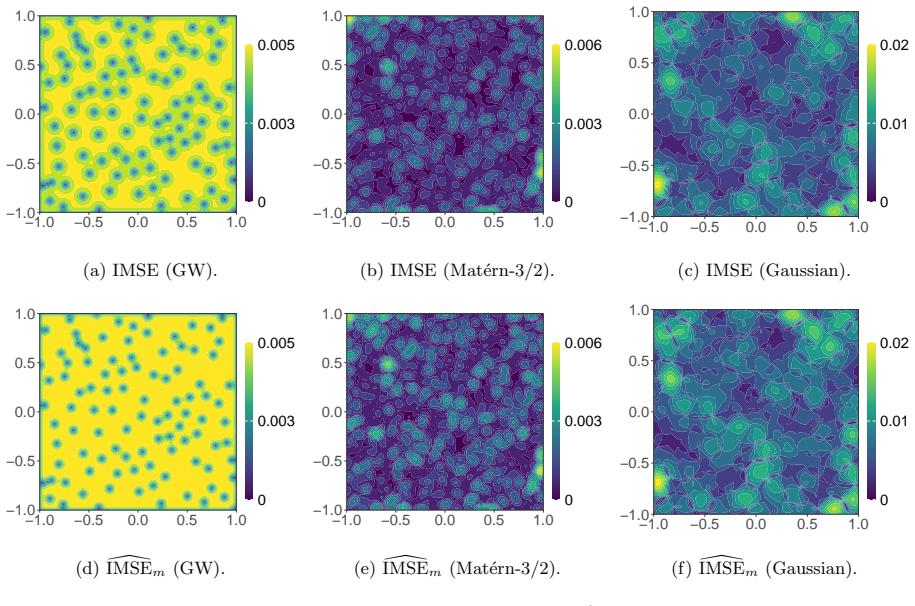
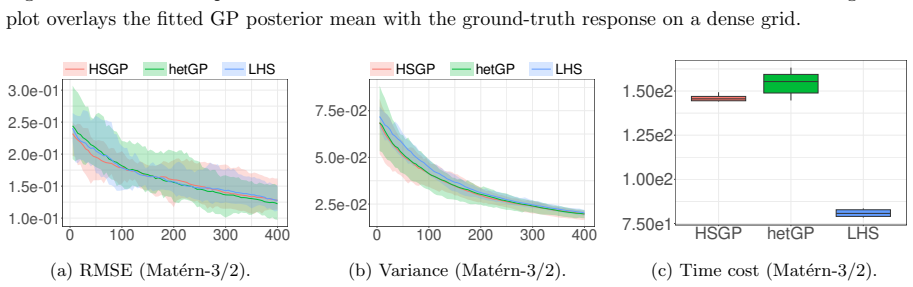
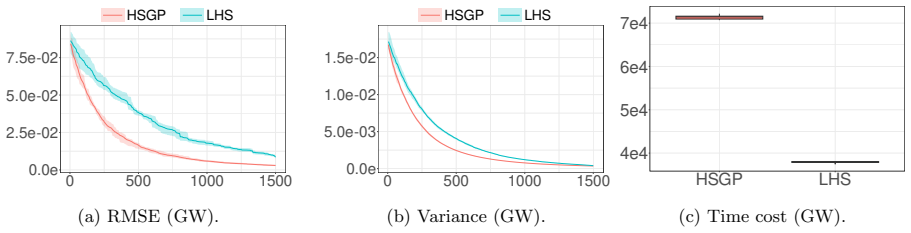
- Experiments show the method produces sequential designs with lower prediction error than existing benchmarks.
- Computation time drops substantially, enabling more iterations or higher-dimensional problems.
Where Pith is reading between the lines
- The same eigenbasis truncation could be applied to other integral-based acquisition functions such as expected improvement.
- The computational savings may allow IMSE-based designs to be used in online adaptive experiments where runtime was previously prohibitive.
- Similar representations might accelerate Gaussian process methods in related tasks like Bayesian optimization.
Load-bearing premise
The truncated eigenbasis remains accurate enough for the kernels and design spaces used in practice.
What would settle it
A low-dimensional test problem with an analytically known IMSE integral where the approximated value deviates from the true value by more than the stated non-asymptotic bound.
Figures




read the original abstract
Gaussian processes are widely used for accurate emulation of unknown surfaces in sequential design of expensive simulation experiments. Integrated mean squared error (IMSE) is an effective acquisition function for sequential designs based on Gaussian processes. However, existing approaches struggle with its implementation because the required integrals often lack closed-form expressions for most kernel functions. We propose a novel and computationally efficient Hilbert space Gaussian process approximation for the IMSE acquisition function, where a truncated eigenbasis representation of the integral enables closed-form evaluation. We establish sharp global non-asymptotic bounds for both the approximation error of isotropic kernels and the resulting error in the acquisition function. In a series of numerical experiments with $\gamma$-stabilizing, the proposed method achieves substantially lower prediction error and reduced computation time compared to existing benchmarks. These results demonstrate that the proposed Hilbert space Gaussian process framework provides an accurate and computationally efficient approach for Gaussian process based sequential design.
Editorial analysis
A structured set of objections, weighed in public.
Referee Report
Summary. The manuscript proposes a novel Hilbert space Gaussian process approximation for the IMSE acquisition function in sequential designs. A truncated eigenbasis representation allows for closed-form evaluation of the integral, and sharp global non-asymptotic bounds are established for the approximation error of isotropic kernels and the error in the acquisition function. Numerical experiments using γ-stabilizing demonstrate lower prediction error and reduced computation time compared to benchmarks.
Significance. Should the bounds prove tight and the method generalize, this framework offers a promising way to make IMSE-based sequential design more efficient and theoretically supported for Gaussian process emulators of expensive experiments.
major comments (2)
- The sharp bounds on the truncation error for isotropic kernels are central to the closed-form claim, but the manuscript does not appear to provide explicit analysis of how the bound constants scale with dimension or length-scale parameters, which could affect the required truncation level in practice.
- The experiments focus on γ-stabilizing cases without systematic variation across kernel families, dimensions, or domain geometries, leaving open whether the observed advantages hold more generally as suggested by the skeptic's note on potential degradation.
minor comments (2)
- The term 'γ-stabilizing' is used in the abstract and experiments without an immediate definition or citation, which could be clarified for broader accessibility.
- Figure captions or table descriptions could benefit from more detail on the specific settings used for the comparisons.
Simulated Author's Rebuttal
We thank the referee for their constructive and insightful comments on our manuscript. We address each major comment point by point below, indicating the revisions we plan to incorporate.
read point-by-point responses
-
Referee: The sharp bounds on the truncation error for isotropic kernels are central to the closed-form claim, but the manuscript does not appear to provide explicit analysis of how the bound constants scale with dimension or length-scale parameters, which could affect the required truncation level in practice.
Authors: We thank the referee for this observation. The non-asymptotic bounds in Theorems 3.1 and 3.2 are stated explicitly in terms of the truncation level N, dimension d, and length-scale parameter, with the constants derived directly from the eigenfunction decay rates for isotropic kernels. However, we acknowledge that a dedicated discussion of the scaling behavior of these constants (e.g., polynomial or exponential dependence on d and the length-scale) is not provided. In the revised manuscript we will add a short subsection (or corollary) analyzing this scaling, including practical guidelines for selecting N based on dimension and length-scale. revision: yes
-
Referee: The experiments focus on γ-stabilizing cases without systematic variation across kernel families, dimensions, or domain geometries, leaving open whether the observed advantages hold more generally as suggested by the skeptic's note on potential degradation.
Authors: The experiments in Section 5 were deliberately focused on the γ-stabilizing regime because this is the setting in which the Hilbert-space approximation yields the greatest computational and accuracy gains for IMSE-based sequential design. We agree that broader validation would strengthen the generality of the claims. In the revision we will expand the numerical section to include additional kernel families (Matérn with varying smoothness), higher input dimensions, and alternative domain geometries, while retaining the γ-stabilizing focus as the primary case. revision: yes
Circularity Check
No significant circularity in the claimed derivation
full rationale
The paper derives a truncated eigenbasis representation of the IMSE integral within the Hilbert space GP framework to obtain closed-form evaluation, then establishes non-asymptotic error bounds for isotropic kernels and the induced acquisition-function error. These steps rest on standard Hilbert-space spectral theory applied to the integral operator rather than any self-definitional loop, fitted parameter renamed as prediction, or load-bearing self-citation whose validity is presupposed by the present work. No equation in the abstract or described chain reduces the bounds or closed-form claim to the paper's own inputs by construction; the approach is self-contained against external mathematical benchmarks.
Axiom & Free-Parameter Ledger
axioms (1)
- domain assumption Truncated eigenbasis of the kernel operator yields a valid approximation to the Gaussian process for the purpose of IMSE computation
Reference graph
Works this paper leans on
-
[1]
Hilbert space methods for reduced-rank Gaussian process regression , journal =
Arno Solin and Simo S. Hilbert space methods for reduced-rank Gaussian process regression , journal =. 2020 , volume =
2020
-
[2]
Practical
Gabriel Riutort-Mayol and Paul-Christian B. Practical. Statistics and Computing , year =
-
[3]
Applied and Computational Harmonic Analysis , year =
Alex Barnett and Philip Greengard and Manas Rachh , title =. Applied and Computational Harmonic Analysis , year =
-
[4]
Journal of Approximation Theory , year =
Tizian Wenzel and Gabriele Santin and Bernard Haasdonk , title =. Journal of Approximation Theory , year =
-
[5]
Gaussian Processes and Kernel Methods: A Review on Connections and Equivalences
Motonobu Kanagawa and Philipp Hennig and Dino Sejdinovic and Bharath K. Sriperumbudur , title =. CoRR , year =. 1807.02582 , archivePrefix =
-
[6]
Replication or exploration? Sequential design for stochastic simulation experiments , journal =
Micha. Replication or exploration? Sequential design for stochastic simulation experiments , journal =. 2019 , volume =
2019
-
[7]
Gramacy , journal=
Binois, Mickael and Robert B. Gramacy , journal=
-
[8]
Narcowich and Joseph D
Francis J. Narcowich and Joseph D. Ward and Holger Wendland , title =. Mathematics of Computation , year =
-
[9]
Optimization Letters , year =
Federico Piazzon and Marco Vianello , title =. Optimization Letters , year =
-
[10]
and Faouzi, T
Bevilacqua, M. and Faouzi, T. and Furrer, R. and Porcu, E. , title =. The Annals of Statistics , year =
-
[11]
and Gerstoft, Peter and Park, Yongsung , title =
Jenkins II, William F. and Gerstoft, Peter and Park, Yongsung , title =. The Journal of the Acoustical Society of America , year =
-
[12]
, title =
Koermer, Scott and Loda, Justin and Noble, Aaron and Gramacy, Robert B. , title =. Technometrics , year =
-
[13]
Reliability Engineering & System Safety , year =
Ding, Chunfeng and Wang, Jianjun and Zhang, Suying and Yang, Shijuan and Ma, Yizhong , title =. Reliability Engineering & System Safety , year =
-
[14]
Peterson and Alexis F
Wiley Willard and Andrew A. Peterson and Alexis F. Schinazi and Brent A. Johnson and Edsel A. P. Pea and Peter M. Bayesian Optimization for Personalized Dose-Finding Trials with Combination Therapies , journal =. 2025 , volume =
2025
-
[15]
Zhehui Chen and Simon Mak and C. F. Jeff Wu , title =. Journal of the American Statistical Association , year =
-
[16]
Journal of Machine Learning Research , year =
Yu Nishiyama and Kenji Fukumizu , title =. Journal of Machine Learning Research , year =
-
[17]
Probabilistic Integration: A Role in Statistical Computation?
Fran. Statistical Science , year =. 1512.00933 , archivePrefix =
-
[18]
Stein's Method Meets Computational Statistics: A Review of Some Recent Developments , journal =
Andreas Anastasiou and Alessandro Barp and Fran. Stein's Method Meets Computational Statistics: A Review of Some Recent Developments , journal =. 2023 , volume =
2023
-
[19]
Convergence Guarantees for Gaussian Process Means With Misspecified Likelihoods and Smoothness , journal =
George Wynne and Fran. Convergence Guarantees for Gaussian Process Means With Misspecified Likelihoods and Smoothness , journal =. 2021 , volume =
2021
-
[20]
Advances in Computational Mathematics , year =
Stefano De Marchi and Robert Schaback , title =. Advances in Computational Mathematics , year =
-
[21]
2024 , volume =
Weichert, Dorina and Kister, Alexander and Houben, Sebastian and Link, Patrick and Ernis, Gunar , booktitle =. 2024 , volume =
2024
-
[22]
Houston Warren and Fabio Ramos , booktitle =. Fast. 2024 , volume =
2024
-
[23]
2022 , volume =
Chatalic, Antoine and Schreuder, Nicolas and Rosasco, Lorenzo and Rudi, Alessandro , booktitle =. 2022 , volume =
2022
-
[24]
Sampling-based
Hayakawa, Satoshi and Oberhauser, Harald and Lyons, Terry , booktitle =. Sampling-based. 2023 , volume =
2023
-
[25]
2005 , address =
Holger Wendland , title =. 2005 , address =
2005
-
[26]
2014 , series =
Loukas Grafakos , title =. 2014 , series =
2014
-
[27]
Poisson summation formula --- W ikipedia , The Free Encyclopedia
Wikipedia. Poisson summation formula --- W ikipedia , The Free Encyclopedia. 2026
2026
-
[28]
2022 , month = may, note =
Thomas Caspar Fischer , title =. 2022 , month = may, note =
2022
discussion (0)
Sign in with ORCID, Apple, or X to comment. Anyone can read and Pith papers without signing in.