Recognition: unknown
How Invisible: Regressing The Key Model Parameter for Semi-visible Jet Searches
Pith reviewed 2026-05-10 00:26 UTC · model grok-4.3
The pith
A regression model reconstructs the invisible fraction r_inv in semi-visible jet events using only high-level physics objects and achieves higher precision than analytical methods.
A machine-rendered reading of the paper's core claim, the machinery that carries it, and where it could break.
Core claim
The central claim is that a regression model trained to predict r_inv from high-level reconstructed objects in photon-associated SVJ events achieves robust performance across varying signal parameters and significantly higher precision than the previously developed analytical method, providing a new way to conduct SVJ searches that can unify s-channel and t-channel productions.
What carries the argument
The regression model that takes high-level physics objects as input to predict the value of r_inv, the invisible fraction of dark hadrons.
Load-bearing premise
The regression trained on Monte Carlo simulations will generalize to real experimental data, and that high-level reconstructed objects alone contain sufficient information to recover r_inv without low-level features or detailed detector response modeling.
What would settle it
Applying the trained model to actual collider data and finding that the reconstructed r_inv values deviate substantially from those expected from the true underlying parameters, or that performance improves markedly when low-level detector information is added.
Figures




read the original abstract
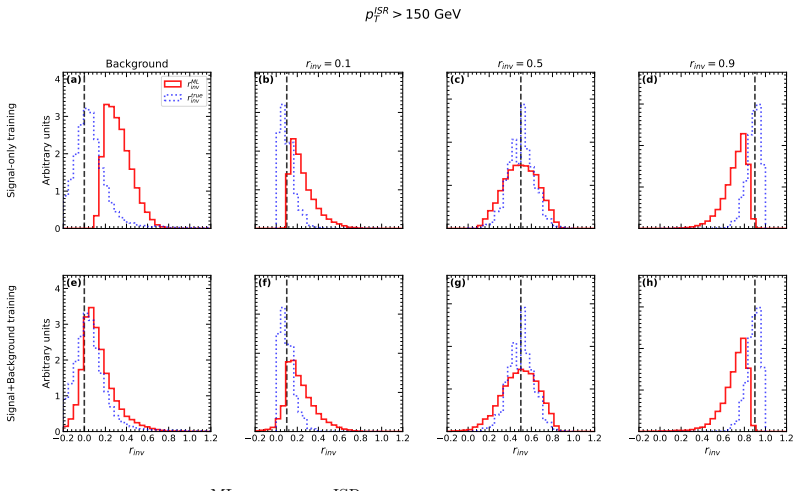
Semi-visible jets (SVJs) provide a characteristic collider signature of strongly interacting dark sectors, in which the key model parameter $r_{\mathrm{inv}}$ controls the fraction of dark hadrons decaying to dark matter candidates. In this work, a regression model is developed to reconstruct $r_{\mathrm{inv}}$ in SVJ events produced in association with an energetic photon. The model uses information from high-level physics objects only, and the training procedure is optimized to ensure applicability. The performance is found to be robust against varying signal parameters and $r_{\mathrm{inv}}$ can be reconstructed at a much higher precision, compared to previously developed analytical method. It offers a new approach to conduct SVJ searches that can potentially unify both $s$-channel and $t$-channel productions, enhancing the sensitivities.
Editorial analysis
A structured set of objections, weighed in public.
Referee Report
Summary. The manuscript develops a regression model using high-level reconstructed physics objects to estimate the invisible fraction parameter r_inv in semi-visible jet events produced in association with an energetic photon. Trained on Monte Carlo simulations, the model is claimed to achieve substantially higher precision than a prior analytical method, to remain robust under variations in signal parameters, and to enable a unified approach to s-channel and t-channel SVJ searches.
Significance. If the regression generalizes reliably beyond simulation, the ability to extract r_inv with improved precision would be a useful addition to dark-sector search strategies at colliders. Because r_inv directly sets the visible-to-invisible energy fraction, a data-driven estimator could tighten signal modeling, improve background discrimination, and increase sensitivity in both production modes.
major comments (3)
- Abstract: the claim that r_inv 'can be reconstructed at a much higher precision' is unsupported by any quantitative metrics, resolution figures, bias values, or direct comparison to the analytical method; without these numbers the performance advantage cannot be evaluated.
- Training procedure: no description is given of the loss function, network architecture, hyper-parameter optimization, or validation strategy used to ensure applicability; the robustness claim therefore lacks a concrete test (e.g., explicit parameter scans or cross-validation results).
- Generalization to data: the central applicability claim rests on an MC-trained mapping that is never tested against simulation-to-data discrepancies (jet energy scale, pile-up, fragmentation, or dark-sector hadronization mismodeling); absent data-driven closure tests or systematic variations, the unification of s- and t-channel searches remains unproven.
minor comments (2)
- Abstract: the phrase 'previously developed analytical method' requires a citation.
- Notation: ensure r_inv is defined once and used consistently in all equations and figures.
Simulated Author's Rebuttal
We thank the referee for the constructive comments, which have helped us improve the clarity and completeness of the manuscript. We address each major point below and have made revisions to incorporate additional details and discussions where feasible.
read point-by-point responses
-
Referee: Abstract: the claim that r_inv 'can be reconstructed at a much higher precision' is unsupported by any quantitative metrics, resolution figures, bias values, or direct comparison to the analytical method; without these numbers the performance advantage cannot be evaluated.
Authors: We agree that the abstract should provide quantitative support for the performance claim to allow proper evaluation. The body of the manuscript contains the relevant results from our Monte Carlo studies, including resolution, bias, and comparisons. In the revised version, we have updated the abstract to explicitly include key metrics (e.g., the achieved resolution on r_inv and the factor of improvement over the analytical method) drawn from those studies. revision: yes
-
Referee: Training procedure: no description is given of the loss function, network architecture, hyper-parameter optimization, or validation strategy used to ensure applicability; the robustness claim therefore lacks a concrete test (e.g., explicit parameter scans or cross-validation results).
Authors: We acknowledge the need for explicit details on the training setup. The revised manuscript now includes a dedicated subsection describing the network architecture, the loss function (mean squared error), the hyper-parameter tuning procedure, and the validation approach, including cross-validation results and explicit scans over signal parameters to substantiate the robustness claim. revision: yes
-
Referee: Generalization to data: the central applicability claim rests on an MC-trained mapping that is never tested against simulation-to-data discrepancies (jet energy scale, pile-up, fragmentation, or dark-sector hadronization mismodeling); absent data-driven closure tests or systematic variations, the unification of s- and t-channel searches remains unproven.
Authors: We agree this is a limitation of the current work, which relies entirely on Monte Carlo simulation. In the revised manuscript, we have added a discussion of potential systematic effects from jet energy scale, pile-up, and hadronization variations, along with how they could impact the regression. However, full data-driven closure tests and experimental validation of the unification approach are beyond the scope of this simulation study and would require collaboration with experimental analyses. revision: partial
- Full data-driven validation and closure tests against real collider data or detailed mismodeling effects cannot be performed within this Monte Carlo-based study.
Circularity Check
No circularity: regression performance is empirical evaluation on labeled MC, not a derivation reducing to inputs.
full rationale
The paper trains a supervised regression on Monte Carlo events in which r_inv is an explicit input label used to generate the samples. Reported precision, robustness, and comparison to an analytical method are measured on held-out simulated events; this is standard ML evaluation and does not invoke any self-definitional equations, fitted parameters renamed as predictions, or load-bearing self-citations that would make the claimed reconstruction equivalent to the training inputs by construction. The approach is self-contained against external benchmarks (MC truth) and contains no first-principles derivation chain.
Axiom & Free-Parameter Ledger
axioms (1)
- domain assumption Monte Carlo simulation of SVJ events with photon association accurately represents the detector response and underlying physics for the purpose of training and validation.
Reference graph
Works this paper leans on
-
[1]
The details of the model can be found in ref
Algorithm training samples The training samples consider aZ ′ boson produced via ans-channel process, decaying into a pair of dark quarks,χ, i.e.,Z ′ →χ¯χ. The details of the model can be found in ref. [18]. Since this work studies the case with an energetic ISR object, we require at least one ISR photon at the generation level. Processes with an addition...
-
[2]
Fors-channel SVJ events, the baseline parameter configuration is chosen to be probVector= 0.75,Λ = 35.1539 GeV, m πD =m ρD = 20 GeV
Robustness testing samples To validate the robustness of the trained model, additional datasets are generated under different dark sector model assumptions. Fors-channel SVJ events, the baseline parameter configuration is chosen to be probVector= 0.75,Λ = 35.1539 GeV, m πD =m ρD = 20 GeV. Single-parameter variations are then performed for the following qu...
-
[3]
As shown in Fig
Generality testing samples In addition to the resonants-channel production mode, SVJs can also be produced through a non-resonantt-channel production. As shown in Fig. 1, the connection between SM and the dark sector is established by a scalar mediator Φ, which couples a quark in SM to a dark quark through a Yukawa-type interaction. The partonic process i...
2000
-
[4]
Rubin, N
V.C. Rubin, N. Thonnard and W.K. Ford, Jr.,Rotational properties of 21 SC galaxies with a large range of luminosities and radii, from NGC 4605 /R = 4kpc/ to UGC 2885 /R = 122 kpc/,Astrophys. J.238(1980) 471
1980
-
[5]
The Universal Rotation Curve of Spiral Galaxies: I. the Dark Matter Connection
M. Persic, P. Salucci and F. Stel,The Universal rotation curve of spiral galaxies: 1. The Dark matter connection,Mon. Not. Roy. Astron. Soc.281(1996) 27 [astro-ph/9506004]
work page Pith review arXiv 1996
-
[6]
A direct empirical proof of the existence of dark matter
D. Clowe, M. Bradac, A.H. Gonzalez, M. Markevitch, S.W. Randall, C. Jones et al.,A direct empirical proof of the existence of dark matter,Astrophys. J. Lett.648(2006) L109 [astro-ph/0608407]. [4]DEScollaboration,Dark Energy Survey Year 1 Results: Curved-Sky Weak Lensing Mass Map,Mon. Not. Roy. Astron. Soc.475(2018) 3165 [1708.01535]. [5]Planckcollaboratio...
work page Pith review arXiv 2006
-
[7]
G. Jungman, M. Kamionkowski and K. Griest,Supersymmetric dark matter,Phys. Rept. 267(1996) 195 [hep-ph/9506380]. [7]ATLAScollaboration,Search for new phenomena in events with an energetic jet and missing transverse momentum inppcollisions at √s=13 TeV with the ATLAS detector, Phys. Rev. D103(2021) 112006 [2102.10874]. [8]CMScollaboration,Search for new pa...
-
[8]
M.J. Strassler and K.M. Zurek,Echoes of a hidden valley at hadron colliders,Phys. Lett. B 651(2007) 374 [hep-ph/0604261]
- [9]
- [10]
- [11]
-
[12]
H. Beauchesne, E. Bertuzzo and G. Grilli Di Cortona,Dark matter in Hidden Valley models with stable and unstable light dark mesons,JHEP04(2019) 118 [1809.10152]
-
[13]
H. Beauchesne, E. Bertuzzo, G. Grilli Di Cortona and Z. Tabrizi,Collider phenomenology of Hidden Valley mediators of spin 0 or 1/2 with semivisible jets,JHEP08(2018) 030 [1712.07160]
-
[14]
G. Albouy et al.,Theory, phenomenology, and experimental avenues for dark showers: a Snowmass 2021 report,Eur. Phys. J. C82(2022) 1132 [2203.09503]. [18]CMScollaboration,Search for resonant production of strongly coupled dark matter in proton-proton collisions at 13 TeV,JHEP06(2022) 156 [2112.11125]. [19]ATLAScollaboration,Search for new physics in final ...
- [15]
-
[16]
M. Park and M. Zhang,Tagging a jet from a dark sector with Jet-substructures at colliders, Phys. Rev. D100(2019) 115009 [1712.09279]
- [17]
- [18]
-
[19]
T. Faucett, S.-C. Hsu and D. Whiteson,Learning to identify semi-visible jets,JHEP12 (2022) 132 [2208.10062]
- [20]
-
[21]
E. Bernreuther, T. Finke, F. Kahlhoefer, M. Kr¨ amer and A. M¨ uck,Casting a graph net to catch dark showers,SciPost Phys.10(2021) 046 [2006.08639]
-
[22]
F. Canelli, A. de Cosa, L.L. Pottier, J. Niedziela, K. Pedro and M. Pierini,Autoencoders for semivisible jet detection,JHEP02(2022) 074 [2112.02864]
-
[23]
A. Bhardwaj, C. Englert, W. Naskar, V.S. Ngairangbam and M. Spannowsky,Equivariant, safe and sensitive — graph networks for new physics,JHEP07(2024) 245 [2402.12449]
-
[24]
K. Pedro and P. Shyamsundar,Optimal mass variables for semivisible jets,SciPost Phys. Core6(2023) 067 [2303.16253]. [31]ATLAScollaboration,Search for low-mass resonances decaying into two jets and produced in association with a photon or a jet at s=13 TeV with the ATLAS detector,Phys. Rev. D 110(2024) 032002 [2403.08547]
- [25]
-
[26]
J. Alwall, R. Frederix, S. Frixione, V. Hirschi, F. Maltoni, O. Mattelaer et al.,The automated computation of tree-level and next-to-leading order differential cross sections, and their matching to parton shower simulations,JHEP07(2014) 079 [1405.0301]
work page internal anchor Pith review arXiv 2014
-
[27]
T. Sj¨ ostrand, S. Ask, J.R. Christiansen, R. Corke, N. Desai, P. Ilten et al.,An introduction to PYTHIA 8.2,Comput. Phys. Commun.191(2015) 159 [1410.3012]. [35]DELPHES 3collaboration,DELPHES 3, A modular framework for fast simulation of a generic collider experiment,JHEP02(2014) 057 [1307.6346]
work page internal anchor Pith review arXiv 2015
-
[28]
The anti-k_t jet clustering algorithm
M. Cacciari, G.P. Salam and G. Soyez,The anti-k t jet clustering algorithm,JHEP04(2008) 063 [0802.1189]
work page internal anchor Pith review arXiv 2008
-
[29]
M. Cacciari, G.P. Salam and G. Soyez,FastJet User Manual,Eur. Phys. J. C72(2012) 1896 [1111.6097]
work page internal anchor Pith review arXiv 2012
- [30]
- [31]
-
[32]
A. Buckley, J. Butterworth, L. Corpe, C. Doglioni, D. Kar, C. Prat et al.,Probing the sensitivity of semi-visible jets to current LHC measurements using the CONTUR toolkit, 25 2502.11237
-
[33]
C. Cazzaniga and A. de Cosa,Leptons lurking in semi-visible jets at the LHC,Eur. Phys. J. C82(2022) 793 [2206.03909]. [42]CMScollaboration,Search fors-channel production of lepton-enriched semivisible jets in proton-proton collisions at 13 TeV, CMS-PAS-EXO-24-029. [43]CMScollaboration,Search for s-channel production of tau-enriched semivisible jets in pro...
- [34]
-
[35]
J. Carrasco, S. Kulkarni, W. Liu, J. Lockyer and J. Zurita,Semi-visible emerging jets, 2511.02918. 26
discussion (0)
Sign in with ORCID, Apple, or X to comment. Anyone can read and Pith papers without signing in.