Recognition: unknown
Time Like Geodesics of Regular Black Holes with Scalar Hair
Pith reviewed 2026-05-09 23:42 UTC · model grok-4.3
The pith
The scalar charge A modifies the locations of circular orbits, the ISCO, and perihelion precession in regular black holes.
A machine-rendered reading of the paper's core claim, the machinery that carries it, and where it could break.
Core claim
The central claim is that the phantom scalar charge A continuously deforms the Schwarzschild geometry into a regular, asymptotically flat metric whose physical scales are expressed through the invariant areal radius R(r) = sqrt(r^2 + A^2). This deformation alters the effective potential for timelike geodesics, shifting the radii of unstable and stable circular orbits, relocating the ISCO, and changing the threshold angular momentum for scattering. The same charge produces perihelion precession corrections proportional to A that remain compatible with Solar System constraints, while radial plunge orbits with zero angular momentum keep the same qualitative structure as the Schwarzschild limit.
What carries the argument
The scalar charge A that supports the regular metric and permits all orbital quantities to be written in terms of the areal radius R(r) = sqrt(r^2 + A^2).
If this is right
- The ISCO radius grows with A, pushing the inner edge of any accretion disk farther out than in Schwarzschild.
- Perihelion precession gains an extra term linear in A, allowing Solar System observations to constrain the allowed range of the charge.
- The critical angular momentum separating captured and scattered trajectories acquires a nontrivial dependence on A.
- Bounded and unbounded orbits are classified by energy and angular momentum with quantitative shifts set by the scalar hair.
- Zero-angular-momentum radial trajectories remain qualitatively similar to Schwarzschild but show measurable quantitative deviations.
Where Pith is reading between the lines
- If A is observationally bounded but nonzero, these regular black holes could serve as singularity-free models for astrophysical objects while remaining consistent with weak-field tests.
- The areal-radius formulation may simplify geodesic calculations in other regular metrics that lack an obvious coordinate singularity.
- Strong-field probes such as extreme-mass-ratio inspirals could reveal larger orbital deviations than those seen in planetary precession.
- Tighter ephemeris data or future astrometric missions could independently limit A without relying on the specific scalar-field derivation.
Load-bearing premise
The given metric is an exact solution of the Einstein-scalar equations and test particles follow geodesics without back-reacting on the background.
What would settle it
A measurement of Mercury's perihelion advance that matches the pure Schwarzschild prediction to a precision tighter than the expected linear correction in A would rule out nonzero scalar charge for this metric family.
Figures




read the original abstract
We investigate timelike geodesics in asymptotically flat regular black holes supported by a phantom scalar field characterized by a scalar charge $A$. This parameter removes the central singularity and continuously deforms the Schwarzschild geometry while preserving asymptotic flatness. We derive the equations of motion for massive test particles and classify bounded and unbounded trajectories in terms of the conserved energy and angular momentum. We determine circular and critical orbits, including the innermost stable circular orbit (ISCO), and analyze the transition between capture and scattering. We show that the scalar charge modifies the location of the unstable and stable circular orbits, the ISCO, and the threshold angular momentum for scattering, exhibiting a nontrivial dependence on the radial coordinate. Their physical scales are naturally described in terms of the invariant areal radius $R(r)=\sqrt{r^2+A^2}$. In the weak-field regime, we compute the perihelion precession and obtain corrections proportional to the scalar charge, allowing us to constrain the scalar charge from Solar System observations. We also analyze the motion with vanishing angular momentum and show that, while the qualitative structure of the trajectories remains connected to the Schwarzschild limit $A\to 0$, the quantitative deviations encode the geometric effects of the scalar hair.
Editorial analysis
A structured set of objections, weighed in public.
Referee Report
Summary. The paper investigates timelike geodesics in asymptotically flat regular black holes supported by a phantom scalar field with scalar charge A. Starting from the given metric deformed from Schwarzschild by A, with areal radius R(r)=√(r²+A²), it derives conserved energy and angular momentum, classifies bounded and unbounded orbits, locates circular orbits including the ISCO, determines the threshold for scattering, computes weak-field perihelion precession with corrections proportional to A, and analyzes zero-angular-momentum motion, claiming these modifications allow constraints on A from Solar System observations.
Significance. If the metric is a valid solution to the Einstein-phantom-scalar equations, this provides a detailed study of how scalar hair affects geodesic motion, with the perihelion precession offering a way to observationally constrain the scalar charge. The approach is standard in general relativity and the focus on the invariant areal radius is a strength for interpreting the results physically.
major comments (1)
- The central claim that the scalar charge A modifies the ISCO, circular orbits, scattering threshold, and perihelion precession (allowing Solar System constraints) requires the background metric to be a genuine solution of the Einstein-phantom-scalar system. The abstract states the metric is 'supported by' the field and introduces R(r), but the manuscript appears to provide no derivation or explicit verification that the Einstein tensor equals 8π times the phantom stress-energy tensor. Without this, the physical meaning of the quantitative orbit shifts is not established.
minor comments (1)
- The abstract could more explicitly state the range of A values considered or any assumptions on the sign of A.
Simulated Author's Rebuttal
We thank the referee for the careful review and for highlighting the need to explicitly establish the metric as a solution of the Einstein-phantom-scalar equations. We address this point below and will revise the manuscript accordingly.
read point-by-point responses
-
Referee: The central claim that the scalar charge A modifies the ISCO, circular orbits, scattering threshold, and perihelion precession (allowing Solar System constraints) requires the background metric to be a genuine solution of the Einstein-phantom-scalar system. The abstract states the metric is 'supported by' the field and introduces R(r), but the manuscript appears to provide no derivation or explicit verification that the Einstein tensor equals 8π times the phantom stress-energy tensor. Without this, the physical meaning of the quantitative orbit shifts is not established.
Authors: We agree that the manuscript should contain an explicit verification that the given metric satisfies the Einstein equations sourced by the phantom scalar field. The original text introduced the metric and the areal radius R(r) as the background for the geodesic analysis but did not include the direct computation of the Einstein tensor components or the matching with the phantom stress-energy tensor. In the revised version we will add a short section (or appendix) that performs this verification: we will compute the non-vanishing components of G_μν for the metric ds² = −f(r)dt² + dr²/f(r) + R(r)² dΩ² with f(r) = 1 − 2M r / R(r)² and R(r) = √(r² + A²), and show that they equal 8π T_μν where T_μν is the stress-energy tensor of a phantom scalar field with the appropriate negative kinetic term. This addition will substantiate the physical interpretation of the orbit shifts, ISCO displacement, scattering threshold, and perihelion-precession corrections, thereby supporting the proposed observational constraints on A. The main results themselves remain unchanged. revision: yes
Circularity Check
No circularity: standard geodesic derivations from given metric
full rationale
The paper takes the regular black hole metric (with scalar charge A and areal radius R(r)=√(r²+A²)) as an input definition of the spacetime, then applies the standard timelike geodesic Lagrangian to derive conserved quantities, effective potential, circular orbit conditions, ISCO location, scattering threshold, and weak-field perihelion precession. These are explicit calculations (solving for turning points, stability via second derivative, series expansion for precession) whose outputs are nontrivial functions of A and not equivalent to the metric by construction. No fitted parameters are renamed as predictions, no self-citations load-bear the central claims, and no ansatz or uniqueness theorem is smuggled in. The analysis remains self-contained against the geodesic equation and the supplied metric.
Axiom & Free-Parameter Ledger
free parameters (1)
- scalar charge A
axioms (2)
- domain assumption Einstein field equations coupled to a phantom scalar field
- standard math Timelike geodesic equation for test particles
invented entities (1)
-
phantom scalar field with charge A
no independent evidence
Reference graph
Works this paper leans on
-
[1]
Second kind trajectories 8
-
[2]
Unbounded Orbits 10
Critical trajectories whithE <18 B. Unbounded Orbits 10
-
[3]
Scattering trajectories 10
-
[4]
Second kind trajectories 10
-
[5]
Critical trajectories 11
-
[6]
Time Like Geodesics of Regular Black Holes with Scalar Hair
Capture zone 11 V. Motion withL= 012 A. Bounded trajectories:0< E <112 B. Unbounded trajectories:E≥113 VI. Conclusions13 ∗Electronic address: pablo.gonzalez@udp.cl †Electronic address: marco.olivaresr@mail.udp.cl ‡Electronic address: lpapa@central.ntua.gr §Electronic address: yvasquez@userena.cl Acknowledgments13 References14 I. INTRODUCTION Recent cosmol...
work page internal anchor Pith review Pith/arXiv arXiv 2026
-
[7]
The existence of extrema in the effective potential de- termines the presence of circular geodesics
Circular orbits. The existence of extrema in the effective potential de- termines the presence of circular geodesics. In particular, a local maximum corresponds to an unstable circular or- bit (rU), while a local minimum corresponds to a stable one (rS). These radii are obtained from the standard conditionV 2′ (r) = 0. Using the explicit form of the ef- f...
-
[8]
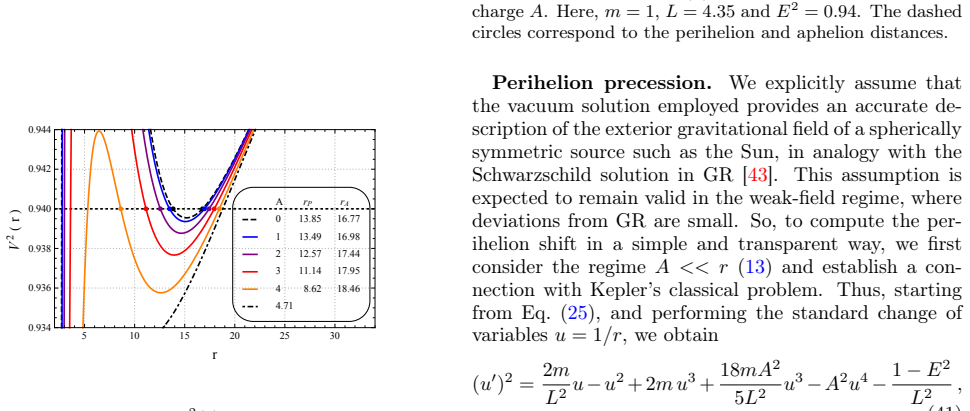
Planetary orbits Planetary orbits can exist for values of the angular mo- mentumL > L ISCO, whereL ISCO denotes the angular momentum corresponding to the innermost stable circu- lar orbit (ISCO). Fig. 3 displays the effective potential V 2(r)for fixed parametersm= 1,L= 4.35, and energy E2 = 0.94, for several values of the scalar chargeA. The horizontal li...
-
[9]
In this regime, equation E2 −V 2(r) = 0admits a single positive root, which de- termines the turning pointrF
Second kind trajectories Second kind trajectories correspond to bounded con- figurations in which the particle starts at a finite radial distance and inevitably plunges into the black hole after reaching a single turning point. In this regime, equation E2 −V 2(r) = 0admits a single positive root, which de- termines the turning pointrF. The particle approa...
-
[10]
The qual- itative behavior of the trajectories is determined by the structure of the radial roots of the equation E2 −V 2(r) = 0,(68) which fixes the turning points
Critical trajectories whithE <1 Using the angular geodesic equation (25), the orbital motion can be expressed in integral form φ(r) =± Z r R0 L dr′ R(r′)2 p E2 −V 2(r′) ,(67) whereR 0 denotes the initial radial position. The qual- itative behavior of the trajectories is determined by the structure of the radial roots of the equation E2 −V 2(r) = 0,(68) wh...
-
[11]
11 displays the corresponding scattering trajecto- ries
Scattering trajectories Fig. 11 displays the corresponding scattering trajecto- ries. These trajectories illustrate the unbounded motion in the regimeL > LS, where particles with1< E2 < E 2 U coming from infinity are scattered by the effective poten- tial barrier and eventually escape back to infinity. The closest approach point corresponds to the turning...
-
[12]
10, and subsequently plunge 11 into the black hole
Second kind trajectories Here, particles located outside the event horizon reach a turning pointrF, see Fig. 10, and subsequently plunge 11 into the black hole. Fig. 12 illustrates representative sec- ond kind trajectories for1< E 2 < E 2 U. As the scalar charge increases, for fixed values ofL, the turning point rF– andRF– increases. -4 -2 0 2 4 -4 -2 0 2...
-
[13]
Critical trajectories In the unbounded regime, a critical configuration oc- curs when the particle energy coincides with the maxi- mum of the effective potential. Fig. 13 displays the criti- cal first-kind (CFK) and critical second-kind (CSK) tra- jectories in this regime. In the CFK case, the particle ap- proaches the unstable circular orbit from the ext...
-
[14]
In this region the potential barrier can be overcome, and the particle either plunges intotheblackholeorescapestospatialinfinitydepending on its trajectory
Capture zone In this regime, the particles satisfyE > E U, corre- sponding to the capture zone. In this region the potential barrier can be overcome, and the particle either plunges intotheblackholeorescapestospatialinfinitydepending on its trajectory. Representative trajectories are shown in Fig. 14 for several values of the scalar chargeA. As Aincreases...
-
[15]
Dynamical dark energy: Current constraints and forecasts
A. Upadhye, M. Ishak and P. J. Steinhardt, “Dynam- ical dark energy: Current constraints and forecasts,” Phys. Rev. D72(2005), 063501 [arXiv:astro-ph/0411803 [astro-ph]]
work page Pith review arXiv 2005
-
[16]
New dark energy constraints from supernovae, microwave background and galaxy clus- tering,
Y. Wang and M. Tegmark, “New dark energy constraints from supernovae, microwave background and galaxy clus- tering,” Phys. Rev. Lett.92(2004), 241302 [arXiv:astro- ph/0403292 [astro-ph]]
-
[17]
U. Seljaket al.[SDSS], “Cosmological parameter analysis including SDSS Ly-alpha forest and galaxy bias: Con- straints on the primordial spectrum of fluctuations, neu- trino mass, and dark energy,” Phys. Rev. D71(2005), 103515 [arXiv:astro-ph/0407372 [astro-ph]]
work page Pith review arXiv 2005
-
[18]
Cosmological constraints on the dark energy equation of state and its evolution
S. Hannestad and E. Mortsell, “Cosmological constraints on the dark energy equation of state and its evolution,” JCAP09(2004), 001 [arXiv:astro-ph/0407259 [astro- ph]]
work page Pith review arXiv 2004
-
[19]
Is there Supernova Evidence for Dark Energy Metamorphosis ?
U. Alam, V. Sahni, T. D. Saini and A. A. Starobinsky, “Is there supernova evidence for dark energy metamor- phosis ?,” Mon. Not. Roy. Astron. Soc.354(2004), 275 [arXiv:astro-ph/0311364 [astro-ph]]
work page Pith review arXiv 2004
-
[20]
Constraints on dark energy from Chandra observations of the largest relaxed galaxy clusters
S. W. Allen, R. W. Schmidt, H. Ebeling, A. C. Fabian and L. van Speybroeck, “Constraints on dark energy from Chandra observations of the largest relaxed galaxy clusters,” Mon. Not. Roy. Astron. Soc.353(2004), 457 [arXiv:astro-ph/0405340 [astro-ph]]
work page Pith review arXiv 2004
-
[21]
A. Sen, “Rolling tachyon,” JHEP04(2002), 048 [arXiv:hep-th/0203211 [hep-th]]. “Tachyon matter,” JHEP07(2002), 065 [arXiv:hep-th/0203265 [hep-th]]
work page Pith review arXiv 2002
-
[22]
Tachyons, Scalar Fields and Cosmology
V. Gorini, A. Y. Kamenshchik, U. Moschella and V. Pasquier, “Tachyons, scalar fields and cosmology,” Phys. Rev. D69(2004), 123512 [arXiv:hep-th/0311111 [hep-th]]
work page Pith review arXiv 2004
-
[23]
Phantom cosmology with general potentials
V. Faraoni, “Phantom cosmology with general po- tentials,” Class. Quant. Grav.22(2005), 3235-3246 [arXiv:gr-qc/0506095 [gr-qc]]
work page Pith review arXiv 2005
-
[24]
Quantum deSitter cosmology and phantom matter
S. Nojiri and S. D. Odintsov, “Quantum de Sitter cos- mology and phantom matter,” Phys. Lett. B562(2003), 147-152 [arXiv:hep-th/0303117 [hep-th]]
work page Pith review arXiv 2003
-
[25]
Can the dark energy equation-of-state parameterwbe less than −1?,
S. M. Carroll, M. Hoffman and M. Trodden, “Can the dark energy equation-of-state parameterwbe less than −1?,” Phys. Rev. D68(2003), 023509 [arXiv:astro- ph/0301273 [astro-ph]]
-
[26]
D. Farrah, K. S. Croker, G. Tarlé, V. Faraoni, S. Petty, J. Afonso, N. Fernandez, K. A. Nishimura, C. Pearson and L. Wang,et al.“Observational Evidence for Cos- mological Coupling of Black Holes and its Implications for an Astrophysical Source of Dark Energy,” Astrophys. J. Lett.944, no.2, L31 (2023) [arXiv:2302.07878 [astro- ph.CO]]
-
[27]
2022, The Astrophysical Journal Letters, 930, L12
Akiyama, K., Alberdi, A., Alef, W., et al. 2022, The Astrophysical Journal Letters, 930, L12
2022
-
[28]
K. A. Bronnikov and J. C. Fabris, “Regular phan- tom black holes,” Phys. Rev. Lett.96(2006), 251101 [arXiv:gr-qc/0511109 [gr-qc]]. K. A. Bronnikov, “Scalar fields as sources for wormholes and regular black holes,” Particles1(2018) no.1, 56-81 [arXiv:1802.00098 [gr-qc]]
work page Pith review arXiv 2006
-
[29]
Vacuum nonsingular black hole,
I. Dymnikova, “Vacuum nonsingular black hole,” Gen. Rel. Grav.24, 235-242 (1992)
1992
-
[30]
Regular Magnetic Black Holes and Monopoles from Nonlinear Electrodynamics
K. A. Bronnikov, “Regular magnetic black holes and monopoles from nonlinear electrodynamics,” Phys. Rev. D63(2001), 044005 [arXiv:gr-qc/0006014 [gr-qc]]
work page Pith review arXiv 2001
-
[31]
Nonsingular vacuum cosmologies with a variable cosmological term
K. A. Bronnikov, A. Dobosz and I. G. Dymnikova, “Non- singular vacuum cosmologies with a variable cosmolog- ical term,” Class. Quant. Grav.20(2003), 3797-3814 [arXiv:gr-qc/0302029 [gr-qc]]
work page Pith review arXiv 2003
-
[32]
A new exact rotating spacetime in vac- uum: The Kerr–Levi-Civita spacetime,
J. Barrientos, A. Cisterna, M. Hassaine, K. Müller and K. Pallikaris, “A new exact rotating spacetime in vac- uum: The Kerr–Levi-Civita spacetime,” Phys. Lett. B 871, 140035 (2025) [arXiv:2506.07166 [gr-qc]]
-
[33]
Regular compact objects with scalar hair,
T. Karakasis, N. E. Mavromatos and E. Papantonopou- los, “Regular compact objects with scalar hair,” Phys. Rev. D108, no.2, 024001 (2023) [arXiv:2305.00058 [gr- qc]]
-
[34]
Instabilities of wormholes and regular black holes supported by a phantom scalar field
K. A. Bronnikov, R. A. Konoplya and A. Zhidenko, “Instabilities of wormholes and regular black holes sup- ported by a phantom scalar field,” Phys. Rev. D86 (2012), 024028 [arXiv:1205.2224 [gr-qc]]
work page Pith review arXiv 2012
-
[35]
Strong gravitational lensing in a black-hole spacetime dominated by dark energy,
C. Ding, C. Liu, Y. Xiao, L. Jiang and R. G. Cai, “Strong gravitational lensing in a black-hole spacetime dominated by dark energy,” Phys. Rev. D88(2013) no.10, 104007 [arXiv:1308.5035 [gr-qc]]
-
[36]
Circular orbits and accretion process near a regular phantom black hole,
A. Ditta and G. Abbas, “Circular orbits and accretion process near a regular phantom black hole,” Gen. Rel. Grav. 52 (2020) no.8, 77
2020
-
[37]
Anomalous Decay Rate and Greybody Factors for Regular Black Holes with Scalar Hair
R. Bécar, P. A. González, E. Papantonopoulos and Y. Vásquez, “Anomalous Decay Rate and Greybody Factors for Regular Black Holes with Scalar Hair,” [arXiv:2602.16972 [gr-qc]]
work page internal anchor Pith review Pith/arXiv arXiv
-
[38]
Massive particle motion around Horndeski black holes,
D. A. Carvajal, P. A. González, M. Olivares, E. Pa- pantonopoulos and Y. Vásquez, “Massive particle motion around Horndeski black holes,” Phys. Rev. D112(2025) no.10, 104040 [arXiv:2507.09819 [gr-qc]]
-
[39]
Constraints on scalar–tensor theory of grav- ity by solar system tests,
P. A. González, M. Olivares, E. Papantonopoulos and Y. Vásquez, “Constraints on scalar–tensor theory of grav- ity by solar system tests,” Eur. Phys. J. C80(2020) no.10, 981 [arXiv:2002.03394 [gr-qc]]
-
[40]
Motion and collision of particles near DST Black holes,
P. A. González, M. Olivares, Y. Vásquez, J. Saavedra and A. Övgün, “Motion and collision of particles near DST Black holes,” Eur. Phys. J. C79(2019) no.6, 528 [arXiv:1811.08551 [gr-qc]]
-
[41]
Motion of particles on a Four-Dimensional Asymptotically AdS Black Hole with Scalar Hair,
P. A. Gonzalez, M. Olivares and Y. Vasquez, “Motion of particles on a Four-Dimensional Asymptotically AdS Black Hole with Scalar Hair,” Eur. Phys. J. C75(2015) no.10, 464 [arXiv:1507.03610 [gr-qc]]
-
[42]
Observational Tests of Regular Black Holes with Scalar Hair and their Stability,
P. A. González, M. Olivares, E. Papantonopoulos and Y. Vásquez, “Observational Tests of Regular Black Holes with Scalar Hair and their Stability,” [arXiv:2510.18647 [gr-qc]]
- [43]
-
[44]
M. Heydari-Fard, M. Heydari-Fard and H. R. Sepa- ngi, “Null geodesics and shadow of hairy black holes in Einstein-Maxwell-dilaton gravity,” Phys. Rev. D105 (2022) no.12, 124009 [arXiv:2110.02713 [gr-qc]]
-
[45]
D. P. Theodosopoulos, T. Karakasis, G. Koutsoumbas and E. Papantonopoulos, “Motion of particles around a magnetically charged Euler–Heisenberg black hole with scalar hair and the Event Horizon Telescope,” Eur. Phys. J. C84(2024) no.6, 592 [arXiv:2311.02740 [gr-qc]]
-
[46]
Geodesic motion of 15 test particles around the scalar hairy black holes with asymmetric vacua,
H. Chen, W. Fan and X. Y. Chew, “Geodesic motion of 15 test particles around the scalar hairy black holes with asymmetric vacua,” Eur. Phys. J. C85(2025) no.3, 338 [arXiv:2411.00565 [gr-qc]]
-
[47]
Exploring null geodesic of Finslerian hairy black hole,
Z. Nekouee, S. K. Narasimhamurthy, B. R. Yashwanth and T. Sanjay, “Exploring null geodesic of Finslerian hairy black hole,” Class. Quant. Grav.42(2025) no.4, 045002
2025
-
[48]
Study of null geodesics and their stability in Horndeski black holes,
D. A. Carvajal, P. A. González, M. Olivares, E. Pa- pantonopoulos and Y. Vásquez, “Study of null geodesics and their stability in Horndeski black holes,” Eur. Phys. J. C85(2025) no.9, 978 [arXiv:2503.02083 [gr-qc]]
-
[49]
Geodesic Study of Regular Hayward Black Hole,
G. Abbas and U. Sabiullah, “Geodesic Study of Regular Hayward Black Hole,” Astrophys. Space Sci.352(2014), 769-774 [arXiv:1406.0840 [gr-qc]]
-
[50]
Circular geodesic of Bardeen and Ayon–Beato–Garcia regular black-hole and no- horizon spacetimes,
Z. Stuchlík and J. Schee, “Circular geodesic of Bardeen and Ayon–Beato–Garcia regular black-hole and no- horizon spacetimes,” Int. J. Mod. Phys. D24(2014) no.02, 1550020 [arXiv:1501.00015 [astro-ph.HE]]
-
[51]
Geodesicstructureofmagneticallychargedregularblack hole,
M. Azam, G. Abbas, S. Sumera and A. R. Nizami, “Geodesicstructureofmagneticallychargedregularblack hole,” Int. J. Geom. Meth. Mod. Phys.14(2017) no.09, 1750120
2017
-
[52]
Geodesic motion around regular magnetic black hole in non-minimal Ein- stein–Yang–Mills theory,
M. Azam, G. Abbas and S. Sumera, “Geodesic motion around regular magnetic black hole in non-minimal Ein- stein–Yang–Mills theory,” Can. J. Phys.95(2017) no.11, 1062-1067
2017
-
[53]
R. Becerril, S. Valdez-Alvarado, U. Nucamendi, P. Sheo- ranandJ.M.Dávila, “Massparameterandtheboundson redshifts and blueshifts of photons emitted from geodesic particle orbiting in the vicinity of regular black holes,” Phys. Rev. D103(2021) no.8, 084054 [arXiv:2007.15300 [gr-qc]]
-
[54]
Geodesic incompleteness of some popular regular black holes,
T. Zhou and L. Modesto, “Geodesic incompleteness of some popular regular black holes,” Phys. Rev. D107 (2023) no.4, 044016 [arXiv:2208.02557 [gr-qc]]
-
[55]
Geodesic structure of a rotating regular black hole,
B. Bautista-Olvera, J. C. Degollado and G. German, “Geodesic structure of a rotating regular black hole,” Gen. Rel. Grav.55(2023) no.5, 66 [arXiv:1908.01886 [gr-qc]]
-
[56]
Geodesic structure of test particles in different regular black holes,
Z. Xi, C. Wu and W. Guo, “Geodesic structure of test particles in different regular black holes,” Can. J. Phys. 102(2024) no.12, 615-622 [arXiv:2309.12932 [gr-qc]]
-
[57]
The mathematical theory of black holes
S. Chandrasekhar, “The mathematical theory of black holes", Oxford University Press, 2002
2002
-
[58]
The Geodesic structure of the Schwarzschild anti-de Sitter black hole,
N. Cruz, M. Olivares and J. R. Villanueva, “The Geodesic structure of the Schwarzschild anti-de Sitter black hole,” Class. Quant. Grav.22(2005), 1167-1190 [arXiv:gr- qc/0408016 [gr-qc]]
-
[59]
Null paths on a toroidal topological black hole in con- formal Weyl gravity,
J. R. Villanueva, F. Tapia, M. Molina and M. Olivares, “Null paths on a toroidal topological black hole in con- formal Weyl gravity,” Eur. Phys. J. C78(2018) no.10, 853 [arXiv:1808.04298 [gr-qc]]
-
[60]
J. Ramos-Caro, J. F. Pedraza and P. S. Letelier, “Motion around a Monopole + Ring system: I. Stability of Equa- torial Circular Orbits vs Regularity of Three-dimensional Motion,” Mon. Not. Roy. Astron. Soc.414, 3105 (2011) [arXiv:1103.4616 [astro-ph.EP]]
-
[61]
IntroductiontoGen- eral Relativity,
R.Adler, M.BazinandM.Schiffer, “IntroductiontoGen- eral Relativity,” McGraw-Hill, New York, 1965
1965
discussion (0)
Sign in with ORCID, Apple, or X to comment. Anyone can read and Pith papers without signing in.