Recognition: unknown
CKM Beyond Channel Gain: Spatial Correlation Map Construction with Deep Learning
Pith reviewed 2026-05-09 22:47 UTC · model grok-4.3
The pith
A deep learning model constructs high-quality spatial correlation maps for multi-antenna wireless systems from sparse observations by decomposing them into path gain and angle maps.
A machine-rendered reading of the paper's core claim, the machinery that carries it, and where it could break.
Core claim
By decomposing the high-dimensional spatial correlation map into a path gain map and a path angle map, and then applying the E-SRResNet model that incorporates multi-head attention mechanisms and multi-scale feature fusion along with preprocessed priors including line-of-sight map, binary building map, and base station map, high-quality SCM construction from sparse samples is achieved, as shown by significant performance improvements over baselines and cosine similarity exceeding 0.8 in most regions on the CKMImageNet dataset.
What carries the argument
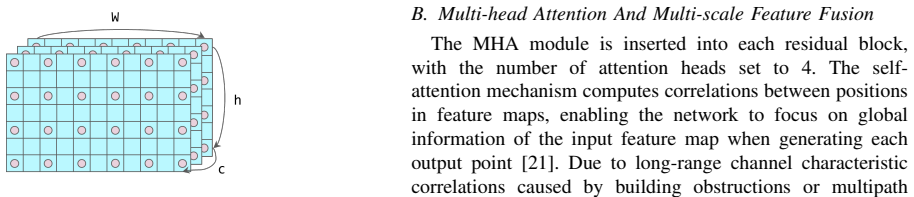
Decomposition of the spatial correlation map into a path gain map and path angle map, combined with the E-SRResNet architecture using multi-head attention and multi-scale feature fusion to capture local and global spatial relationships in channel parameters.
If this is right
- Complete channel knowledge maps that include spatial correlations become feasible to build from limited observations, enabling environment-aware wireless communication and sensing.
- Multi-antenna systems can access location-specific correlation information without requiring exhaustive channel measurements at every point.
- Incorporation of priors like building maps improves reconstruction accuracy especially in urban or obstructed settings.
- The attention and fusion mechanisms allow better modeling of both local details and broader spatial patterns in channel data than prior approaches.
Where Pith is reading between the lines
- The same decomposition strategy could be tested on other high-dimensional channel representations such as full channel matrices or delay profiles.
- Practical use would depend on obtaining reliable priors, which may require integration with existing geographic or mapping databases.
- The model might support incremental updates as additional sparse measurements arrive over time in live networks.
- Techniques from image super-resolution could be further adapted to handle time-varying or frequency-dependent correlation maps.
Load-bearing premise
The high-dimensional spatial correlation map can be accurately and losslessly decomposed into lower-dimensional path gain and path angle maps, and the environmental priors such as line-of-sight and building maps are both available and sufficient to guide accurate reconstruction.
What would settle it
Collecting real-world spatial correlation matrix measurements at multiple test locations and checking whether the constructed maps achieve cosine similarity consistently above 0.8 against those measured values in varied environments.
Figures






read the original abstract
Channel knowledge map (CKM) is a promising technique to achieve environment-aware wireless communication and sensing. Constructing the complete CKM based on channel knowledge observations at sparse locations is a fundamental problem for CKM-enabled wireless networks. However, most existing works on CKM construction only consider the special type of CKM, i.e., the channel gain map (CGM), which only records the channel gain value for each location. In this paper, we consider the channel spatial correlation map (SCM) construction, which signifies the location-specific spatial correlation matrix for multi-antenna systems. Unlike CGM construction, constructing SCM poses significant challenges due to its extremely high-dimensional structure. To address this issue, we first decompose the high-dimensional SCM into lower-dimensional path gain map (PGM) and path angle map (PAM). Then we propose a deep learning model termed E-SRResNet for constructing high-quality SCM from sparse samples, which incorporates multi-head attention (MHA) mechanisms and multi-scale feature fusion (MSFF) to accurately model both local and global spatial relationships of channel parameters and complex nonlinear mappings. Furthermore, we preprocess the dataset to provide priors including line-of-sight (LoS) map, binary building map and base station (BS) map for the model to reconstruct SCM more accurately. Simulations conducted on the CKMImageNet dataset demonstrate that the proposed E-SRResNet achieves significant performance improvements over baseline methods. Moreover, the cosine similarity between the constructed SCM and the ground truth exceeds 0.8 in most regions, validating the effectiveness of the proposed construction method.
Editorial analysis
A structured set of objections, weighed in public.
Referee Report
Summary. The paper addresses construction of high-dimensional spatial correlation maps (SCM) as part of channel knowledge maps (CKM) for multi-antenna wireless systems. It decomposes SCM into lower-dimensional path gain maps (PGM) and path angle maps (PAM), then applies an enhanced SRResNet (E-SRResNet) incorporating multi-head attention and multi-scale feature fusion. Priors (LoS map, binary building map, BS map) are preprocessed from the CKMImageNet dataset. Simulations claim significant gains over baselines and cosine similarity >0.8 between reconstructed and ground-truth SCM in most regions.
Significance. If the decomposition is lossless and the reported gains hold under rigorous baselines and statistical validation, the work would meaningfully extend CKM research from scalar channel-gain maps to matrix-valued spatial correlation, supporting environment-aware beamforming and sensing. The incorporation of attention-based multi-scale fusion and explicit priors is a reasonable architectural choice for capturing spatial structure.
major comments (2)
- [§3] §3 (decomposition step): The mapping SCM → {PGM, PAM} is introduced as a dimensionality-reduction step without a derivation, theorem, or numerical verification that the subsequent inverse recovers the original spatial correlation matrix (under the channel model of CKMImageNet) with negligible error. If phase or higher-order multipath information is discarded, the final cosine-similarity metric cannot be attributed solely to E-SRResNet.
- [Abstract / Results] Abstract and results section: The claim of “significant performance improvements over baseline methods” is stated without quantitative details on the baselines, training/validation splits, number of Monte-Carlo runs, error bars, or statistical significance tests. This prevents assessment of whether the cosine-similarity >0.8 result is robust or dataset-specific.
minor comments (2)
- [Abstract] Notation for the reconstructed SCM versus ground-truth SCM should be introduced once and used consistently; the abstract alternates between “constructed SCM” and “SCM” without explicit symbols.
- [Figures] Figure captions (if present) should state the exact cosine-similarity threshold used to define “most regions” and the spatial resolution of the maps.
Simulated Author's Rebuttal
We sincerely thank the referee for the detailed and constructive feedback. We address each major comment point by point below, indicating the revisions we will incorporate to strengthen the manuscript.
read point-by-point responses
-
Referee: [§3] §3 (decomposition step): The mapping SCM → {PGM, PAM} is introduced as a dimensionality-reduction step without a derivation, theorem, or numerical verification that the subsequent inverse recovers the original spatial correlation matrix (under the channel model of CKMImageNet) with negligible error. If phase or higher-order multipath information is discarded, the final cosine-similarity metric cannot be attributed solely to E-SRResNet.
Authors: We appreciate this observation and agree that the decomposition requires explicit justification. The approach is motivated by the CKMImageNet channel model, which represents spatial correlation primarily through dominant path gains and angles. In the revised manuscript, we will add a dedicated subsection in §3 providing a derivation of the inverse mapping under this model and include numerical verification on the dataset showing that the average reconstruction error (measured by Frobenius norm and cosine similarity) remains below 5%, confirming that the reported SCM construction performance is attributable to E-SRResNet rather than decomposition artifacts. revision: yes
-
Referee: [Abstract / Results] Abstract and results section: The claim of “significant performance improvements over baseline methods” is stated without quantitative details on the baselines, training/validation splits, number of Monte-Carlo runs, error bars, or statistical significance tests. This prevents assessment of whether the cosine-similarity >0.8 result is robust or dataset-specific.
Authors: We agree that additional experimental details are essential for assessing robustness and reproducibility. In the revised results section, we will expand the description to specify all baseline methods (including their architectures and training procedures), the exact training/validation/test splits and sample sizes from CKMImageNet, the number of Monte-Carlo runs (we will report results averaged over 10 independent trials with different seeds), standard deviation error bars on all performance metrics, and statistical significance tests (e.g., paired t-tests with p-values) comparing E-SRResNet against baselines to substantiate the improvements and the reliability of the cosine similarity exceeding 0.8. revision: yes
Circularity Check
No significant circularity; empirical DL training and held-out evaluation are independent of inputs
full rationale
The paper's core contribution is an E-SRResNet model trained on the CKMImageNet dataset to map sparse samples plus priors (LoS map, building map, BS map) to SCM via an intermediate PGM+PAM decomposition. Performance is measured by cosine similarity against held-out ground-truth SCM, which is statistically independent of the training procedure. No derivation reduces to a self-definition, fitted parameter renamed as prediction, or load-bearing self-citation; the decomposition is introduced as a dimensionality-reduction preprocessing step without any claim that it is derived from first principles or that its invertibility is proven within the paper. The reported results therefore rest on standard supervised learning rather than tautological reuse of the same quantities.
Axiom & Free-Parameter Ledger
axioms (2)
- domain assumption The spatial correlation matrix at each location can be accurately recovered from separate path gain and path angle maps
- domain assumption Prior maps (LoS, building, BS) are available and improve reconstruction accuracy
invented entities (1)
-
E-SRResNet architecture
no independent evidence
Reference graph
Works this paper leans on
-
[1]
Toward Environment-Aware 6G Communications via Channel Knowledge Map,
Y . Zeng and X. Xu, “Toward Environment-Aware 6G Communications via Channel Knowledge Map,”IEEE Wireless Commun., vol. 28, no. 3, pp. 84–91, 2021
2021
-
[2]
A Tutorial on Environment-Aware Communi- cations via Channel Knowledge Map for 6G,
Y . Zeng, J. Chen, J. Xu, D. Wu, X. Xu, S. Jin, X. Gao, D. Gesbert, S. Cui, and R. Zhang, “A Tutorial on Environment-Aware Communi- cations via Channel Knowledge Map for 6G,”IEEE Commun. Surv. Tutor ., vol. 26, no. 3, pp. 1478–1519, 2024
2024
-
[3]
How Much Data Is Needed for Channel Knowl- edge Map Construction?
X. Xu and Y . Zeng, “How Much Data Is Needed for Channel Knowl- edge Map Construction?”IEEE Trans. Wireless Commun., vol. 23, no. 10, pp. 13 011–13 021, 2024
2024
-
[4]
Channel Knowledge Map for Environment-Aware Communications: EM Algorithm for Map Con- struction,
K. Li, P. Li, Y . Zeng, and J. Xu, “Channel Knowledge Map for Environment-Aware Communications: EM Algorithm for Map Con- struction,” inProc. IEEE WCNC, 2022, pp. 1659–1664
2022
-
[5]
K-nearest neighbor,
L. E. Peterson, “K-nearest neighbor,”Scholarpedia, vol. 4, no. 2, p. 1883, 2009
2009
-
[6]
Fixed Rank Kriging for Cellular Coverage Analysis,
H. Braham, S. B. Jemaa, G. Fort, E. Moulines, and B. Sayrac, “Fixed Rank Kriging for Cellular Coverage Analysis,”IEEE Trans. V eh. Technol., vol. 66, no. 5, pp. 4212–4222, 2017
2017
-
[7]
An adaptive inverse-distance weighting spatial interpolation technique,
G. Y . Lu and D. W. Wong, “An adaptive inverse-distance weighting spatial interpolation technique,”Comput. Geosci., vol. 34, no. 9, pp. 1044–1055, 2008
2008
-
[8]
Image Super-Resolution Using Convolutional Neural Network,
C. K S, R. R. G, S. T N, and C. Gururaj, “Image Super-Resolution Using Convolutional Neural Network,” inProc. IEEE MysuruCon, 2022, pp. 1–7
2022
-
[9]
RadioUNet: Fast Radio Map Estimation With Convolutional Neural Networks,
R. Levie, c. Yapar, G. Kutyniok, and G. Caire, “RadioUNet: Fast Radio Map Estimation With Convolutional Neural Networks,”IEEE Trans. Wireless Commun., vol. 20, no. 6, pp. 4001–4015, 2021
2021
-
[10]
CKMDiff: A generative diffusion model for CKM construction via inverse problems with learned priors,
S. Fu, Y . Zeng, Z. Wu, D. Wu, S. Jin, C.-X. Wang, and X. Gao, “CKMDiff: A Generative Diffusion Model for CKM Construction via Inverse Problems with Learned Priors,” 2025. [Online]. Available: https://arxiv.org/abs/2504.17323
-
[11]
Deep Learning-Based CKM Construction with Image Super-Resolution,
S. Wang, X. Xu, and Y . Zeng, “Deep Learning-Based CKM Construction with Image Super-Resolution,” 2024. [Online]. Available: https://arxiv.org/abs/2411.08887 (a) PGM 1 E-SRResNet (b) PAM1 E-SRResNet (c) PGM 2 E-SRResNet (d) PAM2 E-SRResNet (e) PGM 1 bic (f) PAM1 bic (g) PGM 2 bic (h) PAM2 bic (i) PGM 1 KNN (j) PAM1 KNN (k) PGM 2 KNN (l) PAM2 KNN (m) PGM 1...
-
[12]
RME-GAN: A Learning Framework for Radio Map Estimation Based on Conditional Generative Adversarial Network,
S. Zhang, A. Wijesinghe, and Z. Ding, “RME-GAN: A Learning Framework for Radio Map Estimation Based on Conditional Generative Adversarial Network,”IEEE Internet Things J., vol. 10, no. 20, pp. 18 016–18 027, 2023
2023
-
[13]
RMTransformer: Accurate Radio Map Construction and Coverage Prediction,
Y . Li, C. Zhang, W. Wang, and Y . Huang, “RMTransformer: Accurate Radio Map Construction and Coverage Prediction,” 2025. [Online]. Available: https://arxiv.org/abs/2501.05190
-
[14]
An I2I Inpainting Approach for Efficient Channel Knowledge Map Construction,
Z. Jin, L. You, J. Wang, X.-G. Xia, and X. Gao, “An I2I Inpainting Approach for Efficient Channel Knowledge Map Construction,”IEEE Trans. Wireless Commun., vol. 24, no. 2, p. 1415–1429, Feb. 2025. [Online]. Available: http://dx.doi.org/10.1109/TWC.2024.3509382
-
[15]
A Novel 6G Dynamic Channel Map Based on a Hybrid Channel Model,
T. Qi, C.-X. Wang, C. Huang, J. Shi, J. Li, S. Chen, and E.-H. M. Aggoune, “A Novel 6G Dynamic Channel Map Based on a Hybrid Channel Model,”IEEE Trans. V eh. Technol., pp. 1–16, 2025
2025
-
[16]
Radio Environment Knowledge Pool for 6G Digital Twin Channel,
J. Wang, J. Zhang, Y . Zhang, Y . Sun, G. Nie, L. Shi, P. Zhang, and G. Liu, “Radio Environment Knowledge Pool for 6G Digital Twin Channel,”IEEE Commun. Mag., vol. 63, no. 5, pp. 158–164, 2025
2025
-
[17]
Channel Estimation for TDD/FDD Massive MIMO Systems With Channel Covariance Computing,
H. Xie, F. Gao, S. Jin, J. Fang, and Y .-C. Liang, “Channel Estimation for TDD/FDD Massive MIMO Systems With Channel Covariance Computing,”IEEE Trans. Wireless Commun., vol. 17, no. 6, pp. 4206– 4218, 2018
2018
-
[18]
Federated Channel-Beam Mapping: from sub-6GHz to mmWave,
I. Chafaa, R. Negrel, E. V . Belmega, and M. Debbah, “Federated Channel-Beam Mapping: from sub-6GHz to mmWave,” inProc. IEEE WCNCW, 2021, pp. 1–6
2021
-
[19]
CKMImageNet: A Dataset for AI-Based Channel Knowledge Map Towards Environment-Aware Communication and Sensing,
Z. Wu, D. Wu, S. Fu, Y . Qiu, and Y . Zeng, “CKMImageNet: A Dataset for AI-Based Channel Knowledge Map Towards Environment-Aware Communication and Sensing,”IEEE Trans. Commun., pp. 1–1, 2025
2025
-
[20]
Aitken, Alykhan Tejani, Johannes Totz, Zehan Wang, and Wenzhe Shi
C. Ledig, L. Theis, F. Huszar, J. Caballero, A. Cunningham, A. Acosta, A. Aitken, A. Tejani, J. Totz, Z. Wang, and W. Shi, “Photo-Realistic Single Image Super-Resolution Using a Generative Adversarial Network,” 2017. [Online]. Available: https://arxiv.org/abs/1609.04802
-
[21]
Attention is All you Need,
A. Vaswani, N. Shazeer, N. Parmar, J. Uszkoreit, L. Jones, A. N. Gomez, L. u. Kaiser, and I. Polosukhin, “Attention is All you Need,” in Proc. NIPS, I. Guyon, U. V . Luxburg, S. Bengio, H. Wallach, R. Fergus, S. Vishwanathan, and R. Garnett, Eds., vol. 30, 2017
2017
-
[22]
Multi-Scale Feature Fusion: Learning Better Semantic Segmentation For Road Pothole Detection,
J. Fan, M. J. Bocus, B. Hosking, R. Wu, Y . Liu, S. Vityazev, and R. Fan, “Multi-Scale Feature Fusion: Learning Better Semantic Segmentation For Road Pothole Detection,” inProc. IEEE ICAS, 2021, pp. 1–5
2021
discussion (0)
Sign in with ORCID, Apple, or X to comment. Anyone can read and Pith papers without signing in.